She Asked for Leftovers for Her Daughter—Then the Biker Made the Whole Diner Go Silent
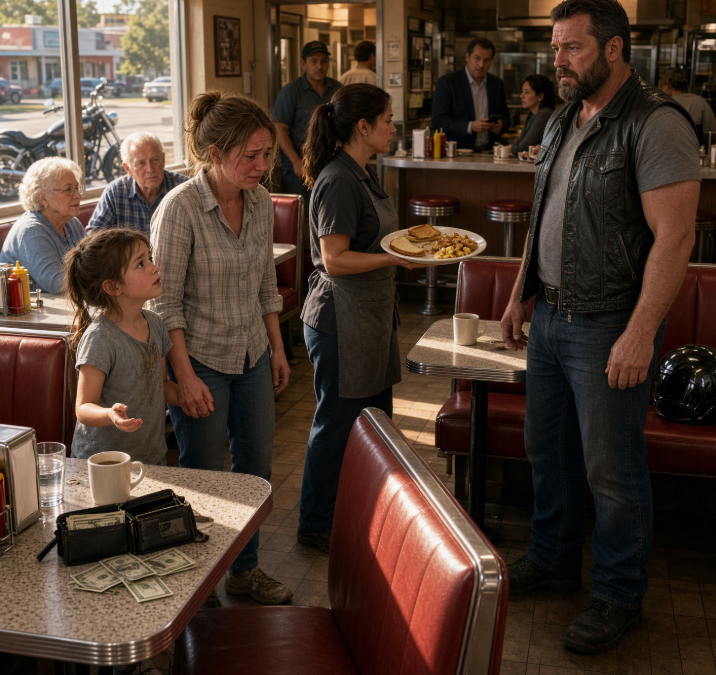
PART3:
Mara noticed and gently moved the menu between her daughter and the window.
Dorian saw that too.
He had seen that expression before.
Not simple curiosity.
Hunger.
The kind that carried embarrassment with it.
Mara had been struggling for months.
She had lost her job at a small clothing store after the owner cut staff and called it restructuring, as if a prettier word could pay rent. Since then, she had taken whatever work came close enough to reach and temporary enough to leave her nowhere steady. Some weeks she cleaned offices before sunrise. Some weeks she helped an elderly neighbor with groceries, laundry, and errands. Once, she spent two days folding inventory tags in a warehouse so cold her fingers ached through the night.
Nothing lasted.
Everything helped.
Not enough.
Their refrigerator had become frighteningly empty. Mustard. Half a jar of pickles. One egg. A carton of milk with two inches left. The previous evening, Laya had pretended she was not hungry so Mara could have the last piece of bread.
Mara had pretended to believe her.
That morning, while checking jacket pockets before doing laundry she could not afford at the laundromat until Monday, Mara found a few coins and one folded five-dollar bill in an old coat pocket.
It was not much.
It was foolish, maybe, to spend it at a diner.
But Laya deserved one normal afternoon.
One table.
One glass of cold water with ice.
One waitress calling her sweetheart.
One meal not eaten standing in the kitchen while her mother calculated what could stretch until morning.
So Mara brought her.
Now the check lay on the table.
Celeste placed it facedown with the practiced gentleness of someone who understood that paper could humiliate just as sharply as words.
“No rush,” Celeste said.
Mara opened her purse under the table.
Counted once.
Her stomach dropped.
She counted again.
Somehow she had miscalculated.
Tax.
She had forgotten tax.
The difference was small.
Small enough to be ridiculous.
Large enough to matter.
Her face warmed.
She leaned toward Celeste when the waitress passed again.
“I’m so sorry,” Mara whispered. “I think I counted wrong. I have most of it. I can leave what I have and come back with the rest. I swear I will. I just—”
Celeste glanced at the check.
Then at Mara’s face.
Then at Laya, who was pretending not to listen.
“Don’t worry,” Celeste said quietly. “I’ll take off the side. Kitchen rang it strange anyway.”
“You don’t have to—”
“It’s fine.”
Mara knew it was not fine.
A diner had rules. Celeste had a manager. Someone would notice if she adjusted checks too often. Kindness cost people something, even when they tried to make it look free.
“Thank you,” Mara said.
She said it too many times.
Celeste smiled like she had not noticed.
Then, as she cleared the nearby table, she picked up the plate Laya had watched earlier: toast, potatoes, half a pancake. Restaurant policy required discarded food to be thrown away. Health rules. Liability. Clean procedure. Mara knew there were reasons. Good reasons, probably. Sensible reasons.
Hunger did not care how sensible a rule was.
Laya watched the plate again.
Her eyes followed it toward the kitchen.
Her shoulders sank.
Mara leaned close.
“We’ll have something later at home.”
Laya looked down.
“There isn’t much at home.”
The words were soft.
Not accusing.
That made them worse.
Mara opened her mouth, but before she could answer, Laya gathered enough courage to look at Celeste.
“Excuse me,” she said.
Celeste paused.
“Yes, sweetheart?”
Laya’s hands twisted in her lap.
“Can I take the leftovers for my daughter?”
She froze, realizing she had repeated the words the way she had heard her mother talk about herself in grown-up places, mixing the sentence all wrong.
Her cheeks turned pink.
“I mean,” she whispered, “can my mom take them? For me? If they’re getting thrown away?”
The diner became quiet.
Not silent all at once.
Quiet in waves.
A conversation near the counter faded.
A fork stopped against a plate.
Someone at the next table looked over, then looked down too late.
Mara’s face burned.
“Laya,” she whispered. “No. Don’t ask that.”
“I’m sorry,” Laya said quickly.
Mara reached for her daughter’s hand.
“She didn’t mean—”
But Laya’s eyes had filled.
The kind of tears children fight because they already know their parents cannot fix the thing hurting them.
“I just thought if nobody wanted it,” she whispered.
Dorian Cain slowly looked up from his coffee.
He had heard the question.
He had heard the apology.
He had seen the shame move across Mara’s face like a door slamming.
He knew that shame.
He had carried it himself.
When Dorian was twenty-three, long before the motorcycle, long before the repair shop, long before he learned how to stand like a man nobody could move, he had slept for six weeks in the back room of an abandoned auto garage after losing his apartment.
He remembered hunger with humiliating clarity.
Not only the ache.
The calculations.
The pretending.
The way pride turned even kindness into something painful.
He remembered telling friends he had already eaten because admitting hunger felt like showing them a wound.
He remembered standing outside a gas station once, counting coins in his palm, trying to decide between a cup of coffee and a packaged sandwich, and choosing coffee because it lasted longer if he sipped slowly.
He remembered a stranger in a work shirt stepping beside him at the counter and saying, “Add whatever he’s having to mine,” without looking at him too long.
That mattered.
Not because one meal solved anything.
It did not.
Dorian was still broke the next day.
Still sleeping under a roof with holes in it.
Still ashamed.
But for twenty minutes, sitting in a plastic booth with a hot sandwich between his hands, he remembered he was human.
People misunderstood charity.
They thought it was about the giver feeling generous.
The best kind was not.
The best kind handed a person back their dignity quietly enough that they could still hold it.
Dorian stood.
Several customers stiffened.
The businessman at the counter lowered his phone.
The elderly couple by the pie case stopped eating.
Celeste turned from the kitchen door with the plate still in her hand.
Everyone expected the big man in the motorcycle vest to complain.
About the discomfort.
About the child.
About the silence.
About how nobody wanted to hear sad stories over lunch.
Dorian walked to Mara’s table.
He stopped a respectful distance away.
That mattered too.
A frightened person did not need a stranger looming over her.
He looked at Laya first.
“What’s your name, kiddo?”
Laya wiped her face quickly.
“Laya.”
“That’s a good name.”
She did not answer, but she did not look away.
Then Dorian looked at Mara.
“Nobody should have to feel ashamed for asking for food.”
Mara’s lips parted.
“I’m sorry. She shouldn’t have asked. We’re not trying to bother anyone.”
“You didn’t.”
“I don’t want charity.”
“I know.”
“You don’t know me.”
“No,” Dorian said. “But I know what it looks like when a mother pretends she isn’t hungry.”
Mara went still.
He turned slightly toward Celeste.
“Can you put in pancakes with strawberries for her?”
Celeste blinked.
Then nodded.
“And whatever her mom ordered, bring a full plate. Not one to split.”
Mara shook her head immediately.
“No. Please. I can’t—”
Dorian lifted one hand.
Not to stop her harshly.
Just enough to slow the panic.
“I’m not offering pity.”
Mara swallowed.
“Then what is it?”
“A meal.”
The answer was so plain that no one knew what to do with it.
Dorian looked at Laya again.
“You like strawberries?”
She nodded carefully.
“Whipped cream?”
Another nod.
“Then get the whipped cream.”
Celeste’s eyes were bright now.
“Coming right up.”
Dorian was not finished.
He looked toward the manager near the register, a nervous man named Paul who had been watching from behind a stack of receipts.
“You got safe extras from today? Food you can pack by the rules? Nothing off plates. Nothing you’re supposed to throw away. I’m not asking anyone to break health code.”
Paul blinked at him.
“Well, we sometimes have soup at closing, biscuits if they don’t sell, prep overflow—”
“Pack what you can safely sell or donate. I’ll pay.”
The diner remained silent.
Dorian looked around the room.
He did not raise his voice much.
He did not need to.
“I was the person at a table once pretending everything was fine because I was terrified somebody would discover how bad I was doing.”
The businessman lowered his phone completely.
Dorian continued, “The worst part wasn’t being hungry. Hunger is bad, but you can name it. The worst part was thinking needing help made me worthless.”
Nobody moved.
Even the cook appeared in the kitchen doorway, wiping his hands on a towel.
Dorian nodded once toward Mara and Laya.
“That little girl asked a practical question. Food was going in the trash, and she was hungry. Shame on the world if that’s the thing that embarrasses us.”
He returned to his table.
Sat down.
Picked up his coffee.
The room stayed silent for one more breath.
Then something shifted.
Not dramatically.
No applause.
No music.
No grand speech.
Just one chair scraping back near the window.
A woman in a blue cardigan stood and walked to the register.
“Add their meals to my bill too,” she told Paul. “Or another one for later. However you do it.”
The elderly man by the pie case reached into his wallet.
“My wife and I were headed to the market after this. We can pick up some groceries.”
His wife nodded.
“Do you have freezer space, honey?” she asked Mara gently.
Mara could not answer.
The businessman at the counter stared at his phone as if ashamed of having hidden behind it. Then he placed cash beside the register.
“Use this for anyone who needs a meal this week,” he said. “No names.”
A college student near the door raised a hand awkwardly.
“My aunt works with the community food pantry on Riverside Avenue. They’re open Tuesday and Thursday, but they can do emergency boxes. I have the number.”
Celeste wiped her cheek with the heel of her hand and pretended she had not.
Paul, still behind the register, cleared his throat.
“We can start a house meal fund,” he said, sounding surprised by his own words. “Quietly. People can add to it if they want. No questions at the counter.”
Rosalie—no, not Rosalie; Mara corrected herself later, because this was Riverside and the owner’s wife was named Denise—came out from the back office and looked at Paul as if she had been waiting years for him to become decent in public.
“We can do that,” Denise said. “We should have done it already.”
Within minutes, the diner transformed.
Not into a miracle.
Miracles were too clean a word for what happened.
It became human.
One person bought a meal.
Another wrote down a pantry address.
Someone else knew of a cleaning office hiring part-time evening help.
An older woman pressed a grocery store gift card into Mara’s hand and closed her fingers around it before Mara could refuse.
Mara sat frozen while tears ran silently down her face.
For months, she had worked so hard not to be seen.
Not by the landlord.
Not by former coworkers.
Not by other mothers at school pickup.
Not by Laya.
Especially not by Laya.
She had believed asking for help would make her look weak. She had believed accepting kindness would confirm every fear she had about herself: that she had failed, that she was not enough, that her daughter deserved someone better.
But sitting in that diner, surrounded by strangers who did not look disgusted, Mara understood something she had been too exhausted to believe.
Sometimes accepting kindness was not weakness.
Sometimes it was the first step toward standing again.
The pancakes came out fresh.
A full stack.
Strawberries shining red on top.
Whipped cream melting slowly down the side.
Laya looked at the plate for several seconds before touching her fork.
“Is it really for me?”
Celeste smiled.
“All yours.”
Laya looked at Mara.
Mara nodded, crying too hard to pretend now.
“Eat, baby.”
Laya took one bite.
Her face changed.
Not just happiness.
Relief.
For the first time that day, Mara saw her daughter smile without forcing it.
Dorian watched from his table.
He did not make a show of it.
Did not wink at the crowd.
Did not sit back like a man expecting praise.
He simply finished his coffee.
When he stood to leave, he walked over to Mara’s table and placed a card beside her hand.
“Friend of mine owns a small motorcycle repair shop two miles from here,” he said. “He needs someone for phones, invoices, scheduling, front-office work. I called him.”
Mara stared at the card.
Cain & Mercer Motorcycle Repair.
A phone number.
An address.
“He said he’ll talk to you Monday,” Dorian added. “Not a promise. Just a door.”
Mara looked up at him.
“Why are you doing this?”
Dorian glanced at Laya, who had whipped cream on the corner of her mouth and was trying to eat slowly enough to make the pancakes last forever.
“Because somebody once opened a door for me when I was too ashamed to knock.”
Mara held the card carefully, as if it might vanish if gripped too tightly.
“I don’t know how to thank you.”
“Don’t make it too complicated.”
He reached for his helmet.
“When you can, help somebody else. That’ll do.”
Then he left.
The bell above the door jingled softly behind him.
Through the window, Laya watched him cross the parking lot to a black motorcycle with chrome pipes and a worn leather saddlebag. The bike rumbled to life. For a moment, everyone in the diner seemed to watch him.
Then he rode away.
The next Monday, Mara almost did not go to the repair shop.
Fear tried to dress itself as practicality.
What if Dorian had exaggerated?
What if the owner only agreed out of politeness?
What if she showed up and they looked at her the same way some people had looked in the diner before he stood?
What if she was not qualified?
What if hope, once again, made a fool of her?
She stood in front of the bathroom mirror wearing her best blouse, the blue one with a tiny pull near the cuff. Laya sat on the toilet lid, swinging her feet.
“You look pretty,” Laya said.
Mara laughed softly.
“I look nervous.”
“You can be both.”
That sounded so much like something an old soul would say that Mara had to turn away for a second.
At Cain & Mercer Motorcycle Repair, the air smelled of oil, rubber, coffee, and metal. The front office was cluttered but not dirty. Invoices sat in piles. A phone rang twice before someone in the back shouted, “Ignore it unless it’s angry!”
A woman with silver hair and a grease pencil behind one ear came out from behind a parts shelf.
“You Mara?”
“Yes.”
“I’m Jo Mercer. Dorian said you can answer phones without sounding like you hate humanity.”
Mara blinked.
“I can try.”
Jo grinned.
“Good enough. You know invoices?”
“A little.”
“Scheduling?”
“Yes.”
“Computers?”
“Enough to learn.”
“That’s the best answer anyone gives.”
The job was not glamorous.
Mara answered phones.
Filed invoices.
Cleaned the front office.
Learned new software.
Made coffee strong enough that mechanics stopped complaining after the third day.
She wrote down parts orders, confirmed appointments, and discovered that men who could rebuild engines often became helpless when asked to spell their own last names clearly over the phone.
The pay was steady.
Not huge.
Steady.
That word became beautiful.
Slowly, the refrigerator at home began filling again.
Milk.
Eggs.
Apples.
Chicken.
Yogurt cups Laya liked.
A bag of strawberries Mara bought one Friday just because she could.
Overdue bills did not disappear.
But they stopped multiplying faster than she could face them.
Laya returned to school with a lighter heart. Her teacher sent a note home saying she was talking more in class again. Mara read it twice and cried in the parked car before going inside.
Three weeks after the diner, Laya asked if they could make pancakes at home.
Mara nearly said they should save the strawberries.
Then she stopped.
“Yes,” she said. “We can.”
They made them on a Saturday morning.
The first pancake burned.
The second tore in half.
The third was perfect enough for Laya to declare it restaurant quality.
Mara topped it with strawberries and a little whipped cream from a can she had bought as a surprise.
Laya took one bite and smiled.
Not with relief this time.
Just joy.
There was a difference.
Mara began to learn the difference.
Weeks later, Mara returned to Riverside Diner.
This time, she did not sit down afraid.
She walked in wearing the blue blouse from her interview, freshly washed, with Laya beside her carrying a small envelope in both hands.
Celeste saw them first.
Her face lit.
“Well, look at you two.”
Laya grinned.
“We came to bring something.”
Mara approached the counter and handed Celeste the envelope.
Inside was money for the meal Dorian had purchased.
And extra.
Not much.
But enough.
Celeste opened it, then looked up.
“Honey, you don’t have to repay him.”
“I know.”
“Then what’s this?”
Mara took a breath.
“I’m not here to repay him. I’m here to continue what he started.”
Celeste’s eyes softened.
Mara looked toward the register, where Paul had taped a small handwritten note near the counter:
Quiet Meal Fund Available. No Questions. No Judgment.
Mara nodded toward it.
“Use it for that.”
Celeste came around the counter and hugged her.
Laya hugged both of them because seven-year-olds understood group hugs better than adults understood policy.
Over the next months, the fund grew.
Not in a flashy way.
Riverside did not become famous. Nobody filmed inspirational videos in the corner. No newspaper came to photograph pancakes. That would have embarrassed everyone who needed the fund most.
Instead, kindness became part of the diner’s routine.
A trucker added five dollars and said nothing.
A retired teacher paid for three breakfasts every first Monday.
A teenage busboy put in two dollars from his tips and threatened to quit if anyone made a big deal out of it.
Paul created a button in the register system labeled “community meal” and acted like it was a business decision, though Denise saw him cover two meals from his own wallet when the fund ran low.
Celeste learned how to offer help without making anyone feel displayed.
“We’ve got a meal credit available today,” she would say quietly. “Kitchen made extra. You’d be doing us a favor.”
Sometimes people accepted.
Sometimes pride made them refuse.
Celeste never pushed.
Dorian did not return for several months.
Mara thought of him often, though not in a dramatic way. More like a landmark. A person whose kindness had divided her life into before and after.
Before the diner.
After the diner.
Before the card.
After the job.
Before Laya learned to ask for food through shame.
After Laya learned that needing help did not make her less worthy of being fed.
Then one cool afternoon, Dorian’s motorcycle rolled into the Riverside parking lot.
Laya spotted it first.
They had stopped by the diner after school because Laya wanted to show Celeste a certificate she had earned for helping organize a school food drive. Mara was parking when Laya gasped.
“Mom.”
“What?”
“It’s him.”
Dorian had just stepped off the bike and removed his helmet.
Laya was out of the car before Mara could remind her about parking lots, traffic, manners, or breathing.
“Mr. Dorian!”
He turned.
The serious face cracked into a smile.
“Well, hey there, Pancake.”
Laya skidded to a stop in front of him and held up her certificate.
“I helped with the food drive at school. We collected forty-three cans and twelve boxes of cereal and one boy brought sardines but nobody knows why.”
Dorian studied the certificate with complete seriousness.
“Forty-three cans is strong work. Sardines are controversial but useful.”
Laya nodded solemnly.
“That’s what I said.”
Mara walked up, smiling.
“Hi.”
Dorian looked at her work blouse, the repair shop logo stitched over one pocket.
“Jo still treating you like she treats everyone?”
“Terribly but fairly.”
“Then she likes you.”
“She said I alphabetized better than her last three hires combined.”
“That’s practically affection.”
Inside the diner, Dorian noticed the sign near the counter.
Quiet Meal Fund Available. No Questions. No Judgment.
He stood in front of it for a long moment.
Celeste came over with coffee.
“Your doing,” she said.
Dorian shook his head.
“No.”
“No?”
“I bought pancakes.”
“You embarrassed everybody into remembering they had hearts.”
“That sounds aggressive.”
“You’re a large man. Most things you do look a little aggressive.”
He smiled faintly.
Behind him, Laya was telling the cook about the sardines.
Mara stood beside Dorian, looking at the sign.
“She wanted to help with the food drive because of that day,” Mara said.
Dorian’s expression softened.
“Kids remember.”
“So do mothers.”
He glanced at her.
Mara took a breath.
“I was ashamed before you stood up. Not just embarrassed. Ashamed. Like everyone could see I had failed her.”
“You hadn’t.”
“I know that now.”
He nodded.
That seemed to be enough for him.
But Mara was not done.
“The job changed things. The meal changed that day. But what you said changed more.”
“What did I say?”
“That needing help doesn’t make a person worthless.”
Dorian looked away toward the window.
For a moment, he seemed not intimidating at all.
Just tired.
And human.
“Somebody had to tell me once,” he said.
“Who?”
“A man named Luis. Worked nights at a gas station. Bought me a sandwich and acted like it was nothing.”
“Was it?”
“No.”
“Did you ever repay him?”
Dorian smiled sadly.
“Tried. Went back months later. He’d moved to Texas. No address.”
“So you repaid him forward.”
“Guess so.”
Mara looked toward Laya, who was now showing her certificate to Paul, who pretended not to understand what a food drive was so she could explain every detail.
“It keeps going,” Mara said.
Dorian followed her gaze.
“Yeah,” he said quietly. “Sometimes it does.”
That afternoon, Dorian stayed for breakfast even though it was nearly four.
He ordered pancakes with strawberries.
Laya approved.
The businessman who had once lowered his phone during the silent moment came in while Dorian was there. He recognized Mara and looked awkward for half a second, then tapped the meal fund sign.
“Put two on there,” he told Celeste.
Mara saw.
So did Dorian.
Neither said anything.
Some changes deserved privacy.
At the repair shop, Mara became more than temporary help.
By spring, Jo Mercer trusted her with accounts, vendor calls, scheduling, and the delicate art of telling customers their bikes would not be ready Friday without making them threaten lawsuits or cry. Mara learned parts names, repair timelines, and how to translate mechanic language into customer language.
No, “your clutch is trash” became “the clutch assembly needs replacement.”
“Some idiot overtightened this” became “the previous repair caused some additional wear.”
Jo said Mara had a gift.
Mara said desperation had trained her to make bad news sound survivable.
On Laya’s eighth birthday, they went to Riverside Diner.
Not because they had nowhere else to go.
Because Laya chose it.
She wore a purple dress, brought two friends from school, and ordered pancakes with strawberries and whipped cream without checking Mara’s face first.
Mara noticed that.
It almost undid her.
Dorian sent a birthday card through Jo because he was out on a long ride.
Inside was a twenty-dollar bill and a note:
For pancakes, books, or emergency sardines.
Laya laughed for a full minute.
Mara kept the note.
Not the money.
The note.
One year after the afternoon in the diner, Riverside held its first quiet community meal day.
No banners.
No speeches.
Just a chalkboard sign that said:
Today’s special has already been paid forward.
Order what you need.
Mara helped Celeste serve that afternoon after her shift at the shop ended. Laya refilled napkin holders and took the job too seriously. Paul pretended to be annoyed by the extra crowd and then disappeared into the back because his eyes were wet.
A young father came in with two boys and the same careful face Mara remembered from herself.
He ordered one burger and three waters.
Celeste leaned down and said softly, “We’ve got credits today. The special’s covered.”
The man froze.
Mara saw the refusal rising.
Pride.
Fear.
Shame.
She stepped closer, not too close.
“My daughter and I used the fund once,” she said.
The man looked at her.
“Did it help?”
Mara looked across the diner at Laya, who was showing a smaller child how to fold napkins into crowns.
“Yes,” she said. “It helped.”
The man swallowed.
“Then two more burgers.”
Celeste wrote it down like any other order.
No applause.
No announcement.
Just food.
Just dignity.
That was the part Mara protected most fiercely.
Dignity.
Not everyone who needed help needed a lecture about gratitude.
Not every hungry person needed to be turned into a lesson.
Sometimes the holiest thing a diner could do was put a plate down and let someone eat while the food was hot.
Dorian came near closing.
He stood in the doorway, taking in the full tables, the chalkboard, the children eating, Celeste moving with tired grace, Mara carrying plates like she had worked there all her life, and Laya laughing near the pie case.
“You’re late,” Celeste told him.
“Story of my life.”
“There’s coffee.”
“Always?”
“Today, yes.”
He sat at the counter.
Mara brought him a cup.
For a moment, they said nothing.
Then Dorian looked around and shook his head.
“All this from leftovers.”
“No,” Mara said.
He looked at her.
“All this from a little girl brave enough to ask, and one man decent enough not to let shame answer first.”
Dorian looked into his coffee.
“You give me too much credit.”
“Maybe,” Mara said. “But I know what happened.”
He accepted that in silence.
Laya came running over.
“Mr. Dorian, we raised enough for thirty-two meals today.”
“That’s a lot of pancakes.”
“Not all pancakes.”
“Missed opportunity.”
She laughed.
Then she grew serious.
“Do you think the man who bought you a sandwich knows?”
Dorian looked at her.
“What?”
“My mom told me somebody helped you once. Do you think he knows you helped us?”
Dorian’s face shifted.
Mara wished, for half a second, she had not told Laya that part.
But Dorian answered.
“I don’t know.”
Laya thought about this.
“Maybe kindness works even if people don’t know where it went.”
Dorian stared at her.
Then smiled.
“Yeah, Pancake. Maybe it does.”
Years later, Laya would remember the diner window.
Not with shame, though Mara feared she would.
She would remember the sunlight.
The pancakes.
Her mother’s trembling hand.
The silence after she asked for leftovers.
And the sound of one chair scraping back.
She would remember Dorian Cain standing up, not like a hero in a movie, but like a man who had once been hungry enough to recognize the look in someone else’s eyes.
She would remember that nobody should feel ashamed for asking for food.
That became part of who she was.
At twelve, Laya volunteered at the food pantry on Riverside Avenue and organized cans by expiration date with a seriousness that frightened adults.
At fourteen, she corrected a teacher who described poverty as “bad choices” and used Mara’s permission to explain how quickly life could collapse when one job disappeared and no safety net caught the fall.
At sixteen, she worked weekends at the diner and always watched the window tables closely.
Not suspiciously.
Kindly.
She learned the faces people made when counting money under tables.
She learned how to ask, “Would you like me to check if there’s a meal credit available?” quietly enough that no one nearby heard.
Mara watched her daughter become someone who did not look away.
That was the real repayment.
Dorian grew older too.
His beard went grayer.
His rides got shorter.
His knees began making weather predictions more accurate than the local news.
He still stopped at Riverside when passing through, still ordered breakfast at unreasonable hours, still acted uncomfortable whenever anyone connected him to the meal fund.
The handwritten sign eventually became a small wooden one near the counter.
Quiet Meal Fund.
No Questions. No Judgment.
Underneath, in smaller letters Denise added one winter:
Everyone eats with dignity here.
Dorian pretended not to notice.
Celeste noticed him noticing.
One rainy afternoon, Mara found him outside the diner beneath the awning, looking through the window at a little boy eating soup while his mother sat across from him with both hands wrapped around a mug.
“Thinking?” Mara asked.
“Dangerous habit.”
“She used the fund?”
“Celeste said.”
Mara stood beside him.
Rain tapped the awning.
The neon sign buzzed softly.
Dorian’s motorcycle sat wet and shining near the curb.
“I used to think the man who bought me that sandwich saved my life,” he said.
Mara waited.
“He didn’t. Not exactly. I still had to crawl out of the mess I was in. Still had to work. Still had to fail a few more times. Still had to become somebody who could look himself in the mirror.”
Mara nodded.
“But he saved the part of me that believed I was worth feeding.”
She looked through the window at the boy lifting his spoon carefully.
“That part matters.”
“Yeah,” Dorian said. “It does.”
Inside, Laya waved them in.
The rain kept falling.
The diner stayed warm.
And the world, which could be so careless with people on the edge, held for a little while.
The day Mara first walked into Riverside Diner with barely enough money for one shared meal, she thought she was giving Laya one normal afternoon.
She did not know her daughter would ask the question Mara was too ashamed to ask.
She did not know the whole diner would go silent.
She did not know the biggest, most intimidating man in the room would stand because he recognized hunger’s quiet face.
She did not know one meal would become a job opportunity, then a community fund, then a habit of dignity that spread farther than anyone could measure.
Kindness rarely announces what it will become.
A plate can become hope.
A few words can become courage.
A business card can become a paycheck.
A meal fund can become a town’s conscience.
And a child who once asked for leftovers can grow into someone who makes sure other children do not have to ask.
On the anniversary of that first lunch, Mara and Laya sat by the window at Riverside.
Same table.
Same sunlight.
Different life.
Mara ordered two full meals.
Laya ordered pancakes with strawberries, not because she was starving, not because it was a dream she had to hold carefully, but because she liked them.
That alone felt like grace.
Dorian came in halfway through the meal, helmet under one arm.
Laya waved him over.
“We saved you a seat.”
He looked at the chair.
Then at Mara.
Then at the plate.
“You save me pancakes too?”
Laya slid the plate toward him.
“One bite.”
“Generous.”
“Don’t push it.”
Dorian sat.
Celeste topped off coffee without asking.
Near the counter, the meal fund sign waited quietly.
A woman with tired eyes read it twice before approaching Celeste.
Mara saw.
Laya saw.
Dorian saw.
None of them stared.
Celeste leaned forward and spoke softly. The woman’s shoulders loosened, just a little. She nodded once and guided a small boy toward a booth.
Food would come.
No announcement.
No shame.
Mara looked at Dorian.
He looked at Laya.
Laya looked out the window, where sunlight touched the glass in almost the same place her hand had pressed years before.
Then she picked up her fork and took another bite of pancakes.
The world had not become easy.
But it had become kinder in one small corner.
And sometimes one small corner was where a life began again.








