She Adopted a Cat Used as Bait in Dog Fighting and Spent $14,000 Saving Her—But What the Scarred Cat Did Every Night Made Every Dollar Worth It
PART3:
He sat up.
“First?”
“That’s what the shelter said.”
“Rhonda.”
“I know.”
“We don’t have four thousand lying around.”
“I know.”
“And if they’re saying first surgery, that means more.”
“I know.”
“And you’re thinking about going there.”
I looked down at my hands.
“I’m thinking she’s lying on a metal table tonight because somebody put her in a cage and nobody stopped it in time.”
Wayne rubbed his face.
He was a good man. Not a dramatic one. Not the kind who spoke in grand declarations. He fixed things, paid bills, cut grass, complained about politicians, and loved in practical ways. He had married me knowing my heart was often bigger than our budget and had spent years trying to help both survive.
“I’m not saying no,” he said quietly.
That made me look at him.
“I’m saying go see her before you decide we’re refinancing the house or selling my kidney.”
A laugh broke out of me and turned into a sob before it finished.
He reached for my hand in the dark.
“Go see her,” he said. “Then we’ll talk.”
But I already knew.
The next morning, I drove straight to Baton Rouge.
The sky was heavy and gray, the kind of Louisiana morning that felt damp before the rain even fell. Traffic dragged along the interstate. My hands gripped the steering wheel so tightly my knuckles ached. I kept telling myself I was only going to ask questions. Only going to see. Only going to understand the situation.
Practical women gather information.
That was what I told myself.
At the shelter, the front lobby smelled like disinfectant, wet fur, and coffee someone had forgotten on a warmer. A volunteer behind the desk looked up with tired eyes and a kind smile.
“Can I help you?”
“I’m here about the gray tabby from the raid.”
Her expression changed immediately.
Not surprise.
Concern.
“You saw the post?”
“Yes.”
“Are you with a rescue?”
“No.”
“A foster?”
“No.”
The word sat there between us.
I swallowed.
“I think I might be her person.”
The volunteer studied me, not unkindly.
Then she picked up the phone.
A few minutes later, the intake coordinator came out. Her name was Melissa. She was in her thirties, with her hair in a messy bun, dark circles beneath her eyes, and scrubs dotted with bleach stains. She carried a folder against her chest like a shield.
“Mrs. Landry?”
“Rhonda.”
She nodded.
“Rhonda. Before you see her, I need to be very honest.”
“I want you to be.”
“She is in critical condition. She survived the night, which is good, but she has severe trauma. Puncture wounds. Torn tissue. Broken tail. Possible infection risk. Shock. She is not stable enough for adoption in the normal sense. We are looking for a medical foster or adopter who understands the commitment.”
“I understand.”
Melissa opened the folder.
“No. I mean financially too.”
She showed me the first estimate.
Emergency stabilization.
Wound cleaning.
Imaging.
Surgery.
Medication.
Hospitalization.
The numbers blurred.
The first major procedure alone was expected to cost around four thousand dollars.
“And that’s if nothing gets complicated,” Melissa said gently. “There will likely be more.”
I nodded because my throat had closed.
“She may lose the tail. She may lose part of the ear. She may have nerve damage. She may not walk normally. She may not trust people. She may survive the surgeries and still decline later.”
Her voice softened.
“I’m not trying to scare you away.”
“Yes, you are.”
Melissa looked guilty.
“I’m trying to make sure you know what you’re saying yes to.”
I appreciated that.
More than she knew.
“Can I see her?”
Melissa hesitated only a second.
Then she led me back.
The medical room was quieter than the lobby. Machines hummed softly. A technician moved between kennels. Somewhere, a dog barked once and was quickly soothed. The gray tabby lay inside a warmed enclosure on layers of clean towels.
She was smaller than she had looked in the photo.
That was the first thing that broke me.
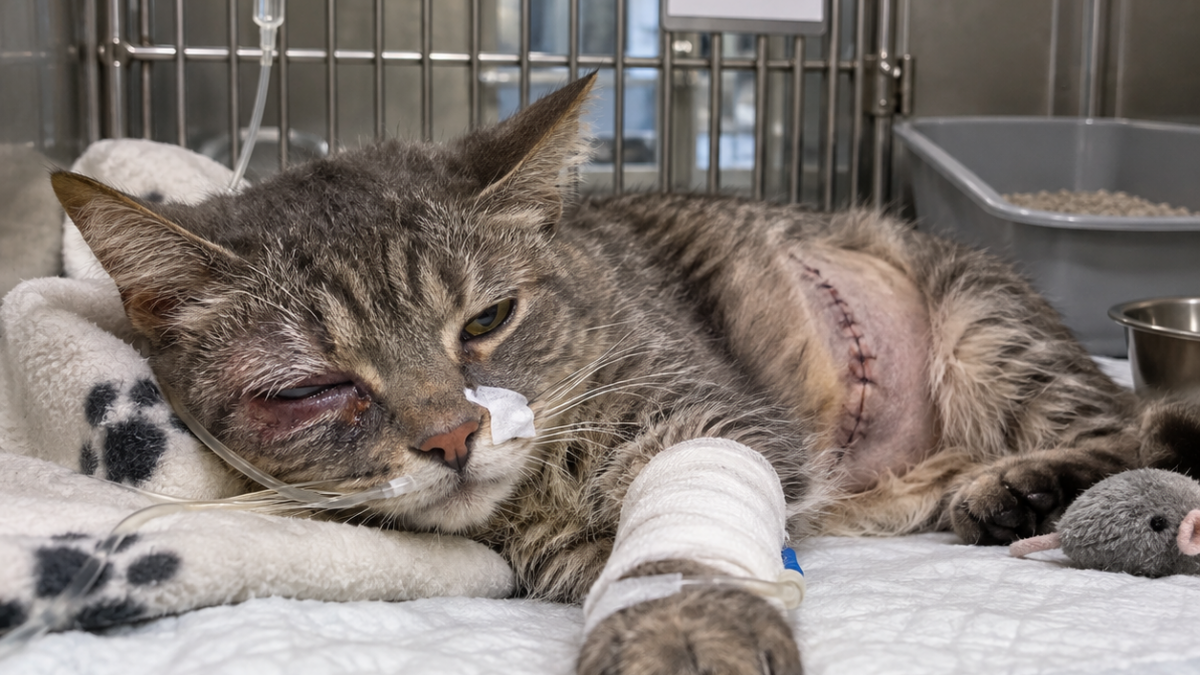
Pain had made her seem large online, but in person she was tiny. Maybe six pounds before the injuries. Less now. Her shaved body looked fragile beneath the bandages. One ear was torn nearly beyond recognition. Her tail was wrapped from base to tip. There were drains and stitches, bruises and swelling, places where fur had been clipped away to reveal the map of what had been done to her.
But she was breathing.
Shallow.
Fast.
Alive.
I stepped closer.
“Hey, baby,” I whispered.
Her eye opened slightly.
Not fully.
Just enough.
I do not know whether she saw me clearly. I do not know whether she understood I was there to help. I do not believe animals think in the neat, sentimental sentences people like to put in their mouths.
But I know this.
She looked at me.
And something in me chose.
Not emotionally.
Not dramatically.
Simply.
Like a door opening.
I turned to Melissa.
“What’s her name?”
“We haven’t named her yet. Just a case number.”
“A case number.”
Melissa looked ashamed, though it was not her fault.
“She came in with four cats. One deceased. Two transferred to another rescue for medical care. She was the worst.”
I looked back at the tiny tabby.
A case number.
Evidence.
Bait.
No.
“What happens if no one takes her?”
Melissa was quiet.
“We keep treating as long as we can. We apply for emergency funds. We ask partner rescues. We do what we can.”
“What you can afford.”
She did not answer.
She did not have to.
Shelters are full of good people forced to make impossible decisions because cruelty is expensive and compassion is underfunded.
I put my hand lightly against the enclosure door.
The tabby’s whiskers twitched.
“I want to adopt her.”
Melissa’s eyes filled.
“Rhonda—”
“I know.”
“You have not had time to think.”
“I thought all night.”
“Your husband—”
“He knows I’m here.”
“Does he know you’re signing?”
I almost smiled.
“He suspects.”
Melissa let out a breath that was half laugh, half sob.
“She may not survive.”
“Then she won’t die as a case number.”
The adoption paperwork felt absurdly ordinary.
Name.
Address.
Phone number.
Employment.
Veterinarian.
Signature.
Initial here.
Initial there.
By signing below, adopter assumes responsibility for future medical care.
Future medical care.
As if the future were guaranteed.
As if the little gray cat in the medical enclosure had not arrived from a place designed to erase her.
“What are you naming her?” Melissa asked.
I had not planned that.
But the name was already waiting.
“Jury.”
Melissa looked up.
“Jury?”
“Because someone should have been held accountable for what happened to her.”
My voice shook.
“But nobody was.”
Melissa wrote it down.
Jury Landry.
There it was.
A name.
A beginning.
The first surgery lasted hours.
I sat in the waiting area with vending machine coffee going cold in my hands, texting Wayne updates I barely understood.
They’re cleaning the wounds.
Tail is worse than they thought.
Ear tissue damaged.
She’s still under.
Wayne replied every time.
Still with you.
Tell her she’s ours.
Don’t forget to eat.
I did forget.
When the surgeon finally came out, I stood so fast the coffee spilled.
“She made it through,” he said.
My knees nearly gave out.
He warned me not to celebrate too soon. The puncture wounds had been deep. They had cleaned and closed what they could, placed drains, stabilized the broken tail, started strong antibiotics, and treated shock. Infection was the biggest concern.
“She is very fragile,” he said. “But she is fighting.”
I nodded.
Fighting.
People love that word for injured animals. Fighting. Brave. Strong. Survivor. Sometimes it helps us. Sometimes it asks too much of them. Jury had not chosen a battle. She had only endured one forced upon her.
Still, when I saw her after surgery, small and groggy and stitched together under warm lights, I whispered, “You fought enough. Let us carry some now.”
The bills began immediately.
Deposit.
Surgery.
Medication.
Hospitalization.
Follow-up.
Special bandages.
Pain control.
Recheck.
Another recheck.
Wayne and I sat at the kitchen table with papers spread between us. He wore his reading glasses low on his nose and tapped a calculator like it had personally insulted him.
“This is already more than the emergency fund.”
“I know.”
“We can put some on the credit card.”
“I know.”
“We should not put all of it on the credit card.”
“I know.”
He looked at me.
“Stop saying you know like that fixes math.”
“I’m scared if I stop saying it, I’ll cry again.”
His face softened.
“Then cry.”
I did.
Not because I regretted adopting her.
Because love does not cancel fear.
Because I knew the numbers were real.
Because I knew people would call me foolish.
Because some quiet part of me worried they were right.
Four thousand dollars became more when the tail failed to heal.
The tissue near the fractures began to die despite everything the surgeon had done. Jury stopped tolerating the bandage changes. Her fever rose. The vet called me at work, and I stood in the break room while he explained that the tail needed to be removed.
“I’m sorry,” he said.
“Will it save her?”
“It should remove a major source of infection and pain.”
“Then do it.”
That was surgery number two.
When I visited afterward, Jury was still groggy, her back end shaved clean, her tail gone. The sight punched me harder than I expected.
It was not vanity.
Cats use tails for balance, expression, dignity in motion. Seeing that little absence made me hate people I had never met with an intensity that frightened me.
The vet tech opened the kennel so I could touch her gently.
Jury lifted her head half an inch.
Then rested it against my fingers.
That was the first time she touched me by choice.
I cried in the parking lot for ten minutes.
Not long after, her right ear required reconstructive surgery. What remained of it could not heal cleanly without intervention. The surgeon warned me it would never look normal.
I almost laughed.
Normal had left long before Jury came to me.
“We’re not trying to make her look perfect,” I said. “We’re trying to make her comfortable.”
That was surgery number three.
By then, people knew.
At first, just family and close friends. Then friends of friends. Then strangers, because someone at the shelter posted an update about Jury’s adoption and medical journey.
Most people were kind.
Some were not.
The internet has a way of showing you both humanity and its mold.
She’s just a cat.
That money could help people.
You’re crazy.
Fourteen thousand? For an animal?
Why not put her down and adopt a healthy one?
I read those comments at midnight when I should have known better.
Wayne found me at the kitchen table with my phone in one hand and my other hand pressed against my mouth.
“Put it down,” he said.
“I shouldn’t care what strangers think.”
“Correct.”
“I do anyway.”
“Also correct.”
He took the phone gently.
Then he sat across from me.
“You want my honest opinion?”
“Always.”
“That money could help people. It has. It’s keeping you human.”
I laughed through tears.
“That sounds like something from a greeting card.”
“I’m working with what I’ve got.”
He reached across the table.
“Rhonda, the people saying she’s just a cat are never going to understand. Stop asking them to.”
“I’m not asking.”
“You’re reading like you are.”
He was right.
The next morning, I called the bank.
Refinancing a car to pay for a cat’s medical care is not something financial advisers recommend.
I know that.
I understood interest rates. I understood loan terms. I understood that cars lose value and medical bills do not become investments in any ordinary sense. I understood all the practical reasons not to do it.
I did it anyway.
The woman at the bank, Denise, knew me from town. She looked over the papers, then at me.
“Can I ask what this is for?”
I hesitated.
Then told her.
She sat back.
“A cat?”
“A cat.”
“And you’re sure?”
“No.”
That made her blink.
“I’m not sure about the money,” I said. “I’m sure about her.”
Denise was quiet for a moment.
Then she turned the papers around.
“Sign here.”
A month later, when I thought we had finally turned a corner, Jury developed an internal infection.
She stopped eating.
Stopped lifting her head.
Stopped making progress.
I had learned by then that hope is not a straight line. It rises, falls, stalls, frightens you, and sometimes waits until you are exhausted before asking whether you still mean what you said.
That infection nearly took her.
The emergency vet laid out options.
More imaging.
More labs.
Another major procedure.
More money.
Less certainty.
Wayne had driven with me that time. He stood beside me in the consultation room, one hand on my back.
The vet spoke gently.
“We need to discuss quality of life.”
I nodded.
That phrase is important.
It is also devastating.
I looked through the glass at Jury. She lay curled in the oxygen-supported kennel, small body rising and falling beneath blankets. One ear stood mostly intact. The other was a partial, uneven little shape. No tail. Shaved patches. Scars. A body redesigned by pain and medicine.
But when she heard my voice, her eyes opened.
Both of them.
She tried to lift her head.
That was my answer.
“She’s still in there,” I said.
The vet did not argue.
Surgery number four.
By then, the total was climbing toward numbers I could not say aloud without feeling lightheaded.
Eight months.
Appointments.
Medication schedules.
Wound checks.
Late-night scares.
Antibiotics hidden in treats.
Pain medicine drawn carefully into syringes.
Cones.
Soft blankets.
Heating pads.
Special litter so it would not stick to healing skin.
A notebook where I wrote every dose, every symptom, every question.
Jury came home between procedures, then went back, then came home again. Each return taught her something.
The carrier did not always mean she would be abandoned.
Hands could lift without hurting.
Doors could open.
Food would come.
Pain could be answered.
And I would bring her home again.
At first, she hid.
Under the guest bed.
Behind the laundry basket.
Inside a cardboard box Wayne cut low enough so she could step in without hurting her hind leg.
I let her.
Trust cannot be dragged into the light.
I placed food near her hiding spot, then farther away, then near the doorway. I sat on the floor and read out loud from grocery ads, vet instructions, old church bulletins, anything, just so she could learn my voice did not mean danger.
Sometimes Wayne found me lying on the hallway floor with one arm stretched toward a box.
“She come out yet?” he whispered.
“No.”
“You comfortable?”
“My hip is dead.”
He would nod solemnly.
“A noble sacrifice.”
“Bring coffee.”
“Yes, ma’am.”
The first time Jury stepped fully into the living room, we froze like fools.
Wayne was in his recliner watching a football game with the sound low. I was folding towels. Jury appeared at the hallway entrance, thin and uneven, her right hind leg slightly stiff, her altered ear giving her silhouette a crooked bravery.
No tail to balance with.
No full trust yet.
She took one step.
Then another.
Wayne did not move.
I did not breathe.
She crossed the rug, sniffed the coffee table, startled at the sound of the refrigerator, then retreated back into the hall.
But she came out.
That night, I wrote in the notebook:
Living room. 7:42 p.m. Brave girl.
A week later, she climbed onto the couch.
Not onto me.
Just the couch.
Still a miracle.
Two weeks after that, she let Wayne scratch the top of her head while pretending not to enjoy it.
“She likes me,” he whispered.
“Don’t get proud.”
“She likes me more.”
“She likes your chair.”
“Same thing.”
Then came the night she chose me.
I was lying on the couch because I had fallen asleep during a movie. The house was dim. Wayne had gone to bed. Rain tapped softly against the windows. For a moment, half awake, I felt a small weight near my hip.
I stayed still.
Jury stepped onto my stomach.
Then my chest.
Her paws were careful. Her body was warm. I could feel the slight unevenness in the way she balanced without a tail, the tiny adjustments, the caution. She stood over my heart, looking down at me.
I whispered, “Hi, baby.”
She lowered herself slowly.
Then pressed her face against my neck.
And started purring.
Not softly.
Not tentatively.
Loudly.
A deep, rumbling, impossible purr that vibrated through my collarbone and into the place where eight months of fear had been living.
I cried without moving.
Wayne appeared in the doorway half a minute later.
“Rhonda?”
I could not answer.
He turned on the hall light.
Jury kept purring against my neck.
Wayne’s face changed.
He leaned against the doorway, arms folded, eyes shining.
“Well,” he said quietly. “There she is.”
After that, it became our ritual.
Every night, Jury climbed onto my chest and pressed her face into my neck. Sometimes she kneaded the blanket. Sometimes she tucked her head beneath my chin. Sometimes she purred so loudly Wayne could hear from across the room and would say, “That cat sounds like a lawn mower with emotional damage.”
“She heard that,” I would tell him.
“She knows I respect her.”
Jury did not know about the money.
She did not know I had refinanced my car.
She did not know I had opened envelopes with shaking hands or cried in parking lots or argued with insurance representatives who had nothing to do with pet care but somehow still became targets for my stress. She did not know strangers online had debated whether her life was worth saving.
She knew warmth.
Food.
Hands that warned before touching.
A lap.
A home.
A person who took her to the vet when something hurt and always came back.
Maybe that was enough.
Eleven months after I signed the adoption papers, the shelter asked whether I would be willing to share an update.
I said yes.
I chose two photos.
The first was from the day I got her.
Jury on the exam table, shaved and bandaged, one eye swollen, feeding tube in place, body stitched in more places than I could count. I hated that photo. I loved it too. It was proof she had existed before healing. Proof of what she survived. Proof of why softness later mattered.
The second photo I took that morning.
Jury lay on a couch cushion in a patch of sunlight, one paw stretched forward, eyes half-closed. Her scars had healed into thin pale lines beneath her fur. One ear stood proudly upright. The other was mostly gone, a small uneven curve that made her look permanently windblown. No tail. Slight limp. Complete peace.
I posted them side by side.
My caption was simple.
Left photo: the day I got her. Right photo: today. $14,000. Four surgeries. One car refinance. I’d do it again tomorrow.
The post spread farther than I expected.
Messages came in from everywhere.
People shared stories of animals they had saved, animals they could not save, animals that had saved them. Some sent heart emojis. Some sent prayers. Some asked for updates. Some called me foolish. Some asked the question I knew would come.
Why would you spend that much money on a cat?
I stared at that comment for a long time.
Then I typed the truth.
Because the people who hurt her spent nothing. And I wanted the money to mean more than what they did.
That was the simplest way to say it.
Not the complete way.
The complete answer was longer.
Because she was alive.
Because pain should not get the final word just because healing is expensive.
Because cruelty had already made one decision for her, and I wanted love to make the next one.
Because shelters cannot carry every impossible case alone.
Because I had a car I could refinance and she had only one life.
Because when I looked at her, I did not see “just a cat.”
I saw a small creature who had been trapped, harmed, discarded, and still somehow reached the couch, the sunlight, my chest, my neck, the loud impossible purr of a life that refused to end where cruelty left it.
Because saving her did not fix the world.
But it fixed her world.
And sometimes that is the piece placed in your hands.
There was an investigation into the property where Jury was found.
There were arrests connected to the dog-fighting operation, though not enough, never enough. The people most responsible had a way of hiding behind ownership, ignorance, missing paperwork, and silence. The cats were treated like evidence until the case no longer needed them. Nobody stood in court and answered specifically for Jury’s torn ears, broken tail, or punctured body.
That is why I named her Jury.
Because some crimes leave victims who cannot speak the language courts require.
Because sometimes accountability comes incomplete.
Because I wanted her name to remember what the system forgot.
People ask whether I am angry.
Yes.
I am.
But anger alone cannot hold a cat at night.
Anger cannot schedule surgeries, measure antibiotics, clean wounds, refill food bowls, or sit patiently outside a cardboard box for three hours while a frightened animal decides whether the world is safe enough to step into.
Anger started the fire.
Love did the work.
Jury is different now.
Not normal.
I do not like that word for her.
She walks with a slight limp in her right hind leg from an old fracture. In summer, when her coat grows short, the scars across her back and neck become visible. Her missing tail sometimes makes her balance awkward when she jumps. Her partial ear gives her face a permanently surprised little angle. Loud barking on television sends her under the bed. Metal cage sounds still make her freeze.
Healing is not forgetting.
A body remembers.
But she also chases dust motes in afternoon light.
She steals Wayne’s chair.
She yells at birds through the window with deep moral outrage.
She has decided the blue blanket belongs to her and will bite the edge of it if anyone tries to fold it.
She follows me into the bathroom because apparently privacy is not part of our agreement.
She sleeps with her face pressed against my neck almost every night.
And she purrs.
Lord, that cat purrs.
Sometimes I wake at two in the morning to that sound and think of the wire cage behind the house in Baton Rouge. I think of the cat who died before help came. I think of the two injured cats who went to another rescue. I think of the police officer who made the call, the shelter team who went behind that house, the vet techs who cleaned wounds that must have broken their hearts, the surgeon who refused to give up, Melissa writing Jury’s name on the paperwork, Wayne sitting with a calculator and fear and choosing us anyway.
Saving one life is never one person’s work.
Even when one person signs the bill.
One afternoon, almost a year and a half after the adoption, the shelter invited me to speak at a small fundraiser. I nearly said no. I am not a speaker. I am a woman who cries too easily and loses her place when people watch her. But Melissa asked gently, and Jury’s story had helped raise medical funds for other injured animals, so I agreed.
I stood in front of a room full of folding chairs, volunteers, donors, foster families, and people who had seen too much animal suffering and still chosen to show up.
I held a photo of Jury.
Not the worst one.
The sunny couch one.
My hands shook.
“I’m not here to tell you everyone should spend fourteen thousand dollars on a cat,” I began.
A few people laughed softly.
“I know what that sounds like. I know what that costs. I know not everyone can. I barely could.”
I looked down at the photo.
“I’m here because when Jury came in, she had already been assigned a value by the people who hurt her. To them, she was disposable. A tool. A lure. Something small enough to sacrifice.”
The room went still.
“When the shelter called for help, they were asking someone to assign a different value. Not in dollars. In commitment. In time. In pain medicine and laundry and late-night fear. In choosing to look at something awful and say, ‘This is not where the story ends.’”
My voice cracked.
“She survived because a lot of people decided her life mattered before it was easy to believe she would make it.”
I looked at the volunteers.
“That is what rescue is. It is not always cute. It is not always grateful eyes and happy endings. Sometimes it is drains and stitches and debt and a cat under the bed who may not let you touch her for weeks. Sometimes it is loving something that still flinches.”
I paused.
“And sometimes, months later, that same animal climbs onto your chest, presses her face into your neck, and purrs so loudly your husband can hear it from across the room.”
People laughed then.
Some cried.
I did too.
Afterward, a woman came up to me. She held a tissue twisted in both hands.
“I saw a medical foster post this morning,” she said. “A dog with a broken pelvis. I was afraid to say yes.”
I waited.
She looked at Jury’s photo.
“I think I’m going to call.”
That was when I understood something.
The money I spent on Jury did not end with Jury.
Love does not work like subtraction.
You do not spend it and have less.
Sometimes you pour everything you have into one wounded life, and instead of emptying you, it creates a path for someone else to follow.
Jury will never know that.
She will never understand fundraising or court cases or comments or bank papers. She will never understand why strangers say her name with tears in their eyes.
She only knows morning sun.
Fresh water.
The sound of the treat bag.
The safety of a hand approaching slowly.
The certainty that when I carry her out the door in a carrier, I also carry her back in.
That is enough for her.
It has become enough for me.
People still ask if I would do it again.
Sometimes they ask with admiration.
Sometimes with disbelief.
Sometimes with judgment hiding behind curiosity.
My answer has not changed.
Yes.
Tomorrow.
Even knowing the cost.
Even knowing the fear.
Even knowing how many nights I would lie awake wondering if I had made an emotional decision that would bury us financially.
Even knowing her tail would be lost, one ear would never be whole, and some scars would remain no matter how much love came afterward.
Yes.
Because the point was never buying perfection.
The point was refusing to let cruelty be the last investment made in her body.
The point was taking a life that had been used for pain and spending something better on it.
Money.
Time.
Care.
Sleep.
Tears.
Hope.
A car refinance.
Four surgeries.
A thousand tiny acts of gentleness.
And yes, it was worth it.
Not because Jury became beautiful, though she is.
Not because she became easy, though she is easier now.
Not because the world praised me, because the world did not always.
It was worth it because tonight, when the house grows quiet and Wayne falls asleep in his chair with the television still mumbling, Jury will climb onto my chest.
She will turn once, maybe twice.
She will press the side of her face against my neck.
Her missing ear will brush my jaw.
Her small body will settle over my heart.
Then she will purr.
Loud.
Certain.
Alive.
And in that sound, I will hear the only verdict that ever mattered.
Not guilty of being too broken.
Not guilty of costing too much.
Not guilty of needing more than was convenient.
Worthy.
Worthy.
Worthy.
That is what her purr says to me.
Every night.
And every night, I believe it.








