Seven Years After My Cat Vanished, a Woman Called About His Microchip—Then I Said Our Old Phrase and He Put the Same White-Toed Paw on My Shoulder
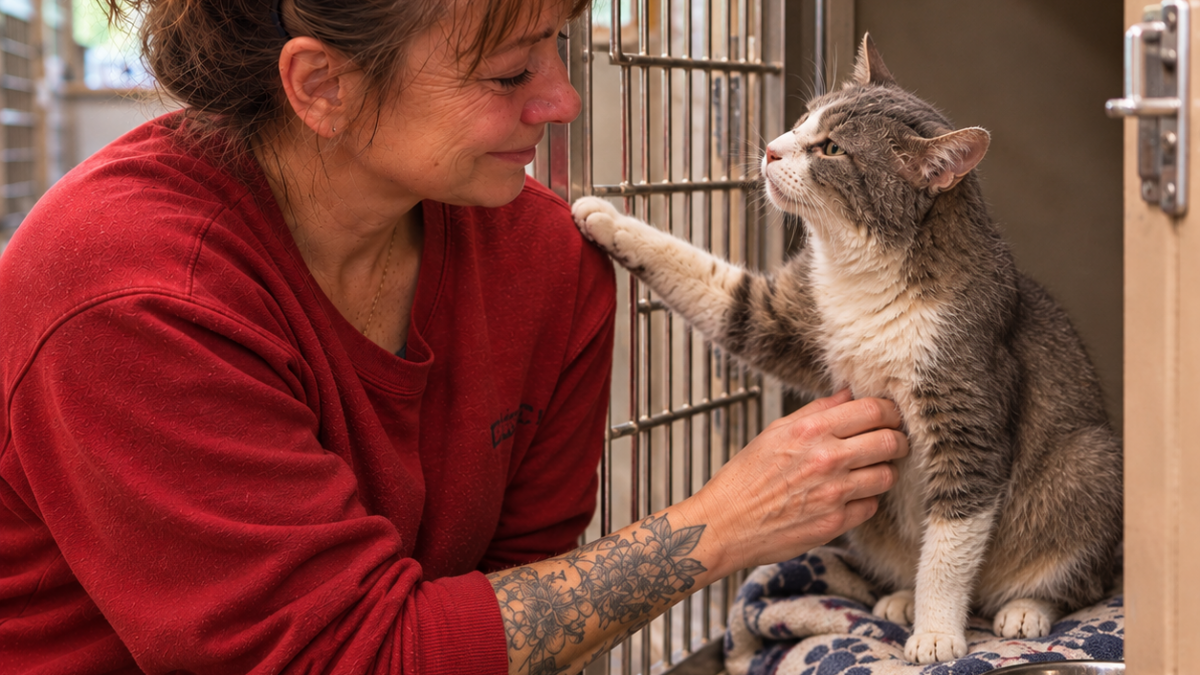
Seven Years After My Cat Vanished, a Woman Called About His Microchip—Then I Said Our Old Phrase and He Put the Same White-Toed Paw on My Shoulder
For seven years, I blamed myself for losing Orson, never knowing that he had spent most of that time less than two miles from the house where I kept waiting for him to come home.
When a rescue worker finally scanned the microchip beneath his skin, the phone call brought me the miracle I had stopped believing in—but it also uncovered a trail of strangers, an abandoned house, and one painful secret about why he had never made it back to me.
And when the old gray cat finally stood in front of me, thinner and scarred by years I could never give back, I asked him the same silly question I had asked when he was young—and his answer broke me completely.
The phone rang on a Wednesday afternoon in October.
I almost didn’t answer.
That’s the part I remember most clearly.
Not the woman’s voice.
Not the drive across Kansas City.
Not even the moment I finally saw him.
I remember looking at my phone while it buzzed on the kitchen table and thinking I didn’t recognize the number.
I had become one of those people who let unknown calls go to voicemail.
Too many scams.
Too many insurance offers.
Too many recordings insisting my car warranty was about to expire even though my car was eleven years old and had never possessed anything anyone could reasonably call a warranty.
So I let it ring three times.
Four.
Then, for some reason I still can’t explain, I answered.
“Hello?”
A woman said, “Is this Darlene Jones?”
Her voice was careful.
Professional, but warm.
“Yes.”
“My name is Megan. I’m calling from Heartland Street Cat Rescue.”
I leaned against the counter.
I knew the name.
They worked with outdoor colonies around Kansas City, trapping cats, getting them vaccinated and fixed, finding homes when they could.
I had donated twenty dollars to them once after seeing a fundraiser online.
“I think maybe you’ve got the wrong Darlene.”
“Did you ever have a gray-and-white cat named Orson?”
I almost hung up.
Not because I thought she was lying.
Because the question hurt.
Seven years had passed, but grief is strange.
Some wounds stop bleeding without ever becoming places you want anyone to touch.
“My cat disappeared seven years ago,” I told her.
There was silence on the other end.
Not long.
A second, maybe two.
Then Megan said, “We scanned his microchip.”
I stopped breathing.
“Your name came up.”
I pulled out the kitchen chair.
I didn’t sit.
I missed it the first time because my hand was shaking.
“What?”
PART2:
“The chip registration says Orson. Gray and white domestic shorthair. Male. Your address is listed on Benton Avenue.”
The chair scraped against the floor as I finally sat down.
“That’s my old address.”
“Your phone number was still current.”
I could hear people talking faintly behind her.
A metal door closing.
A dog barking somewhere farther away.
My hand tightened around the phone.
“No.”
“I’m sorry?”
“No, that’s not possible.”
Megan was quiet.
I heard myself laugh.
It wasn’t a happy sound.
“He disappeared in 2019.”
“I know.”
“No, you don’t understand.”
“I think I do.”
“I looked for him.”
My throat closed.
“I looked for months.”
“I believe you.”
“Where did you get this number?”
PART3:
“The microchip company.”
“No.”
I stood up again.
I couldn’t stay still.
“Orson would be…”
I tried to calculate.
He had been almost three when he vanished.
“…nearly ten.”
“We estimate this cat is around that age.”
“What does he look like?”
“Gray.”
“That’s not enough.”
“Gray across his back and head. White chest. White muzzle.”
My heart began pounding.
“His front paw.”
“What about it?”
“Which one has white toes?”
There was a pause.
I heard Megan say something to someone nearby.
Then she came back.
“His right front paw has four white toes and a little gray patch over the outside toe.”
I closed my eyes.
A crooked sock.
That’s what I used to call it.
His crooked little sock.
I sat back down.
“Where is he?”
“He’s safe.”
“Where?”
“At our partner clinic near Independence Avenue.”
“How did you find him?”
“One of our volunteers trapped him behind a row of commercial buildings yesterday.”
“Trapped?”
“Humane trap.”
“Was he feral?”
“No.”
She answered too quickly.
“What does that mean?”
“It means we’re pretty sure he belonged to somebody.”
“He belonged to me.”
The sentence came out sharper than I intended.
Megan didn’t react.
“I understand.”
“Is he hurt?”
“He’s very thin.”
My stomach tightened.
“How thin?”
“Too thin.”
“What else?”
“Some dental issues. Old scars. Mild dehydration. His coat is rough. The vet thinks he may have been outdoors for a while.”
“For a while?”
“We don’t know how long.”
I pressed my fingertips against my forehead.
“Is he dying?”
“No.”
That answer came immediately.
I exhaled.
“He’s older and he needs care, but no, Darlene. He’s not dying.”
I stared at the floor.
The kitchen was suddenly too quiet.
Seven years.
Seven years of assuming the worst.
Seven years of imagining roads.
Coyotes.
Winter.
Cars.
Cruel people.
Kind people.
Another family.
Nothing at all.
And now a stranger was telling me he was alive.
“Can I see him?”
“Of course.”
“When?”
“Whenever you can get here.”
“I can leave now.”
“I’ll be here.”
I hung up.
Then I sat at the table for nearly a full minute without moving.
My coffee had gone cold beside me.
The dishwasher hummed.
Outside, a truck passed.
Everything in the world continued normally.
That offended me.
I wanted something to happen.
Church bells.
Sirens.
The sky opening.
Some announcement that the seven years I had carried quietly were suddenly being handed back to me.
Instead, my refrigerator clicked.
I looked across the kitchen.
At the cabinet above the sink.
His bowl was still inside.
I hadn’t touched it in years.
I don’t mean I had forgotten it was there.
I knew.
Every time I rearranged that cabinet, I worked around it.
A small blue ceramic bowl with a white fish painted inside.
Orson’s bowl.
I had bought it at a thrift store for $2.99 when he was still a kitten.
I couldn’t bring myself to throw it away after he disappeared.
For months, I’d left it beside the back door with food.
Rain got into it twice.
Ants found it once.
Eventually, after almost a year, my sister told me gently that maybe it was time.
She didn’t mean stop loving him.
She meant stop waking up every morning to evidence that he wasn’t there.
I had picked up the bowl and cried so hard I had to sit on the kitchen floor.
Then I washed it.
Dried it.
Put it in the back of the cabinet.
And left it there.
Now Orson was alive.
Maybe.
I still couldn’t fully believe it.
I grabbed my keys.
Then stopped.
I looked in the hallway mirror.
My hair was a mess.
I had no makeup on.
My sweatshirt had a coffee stain near the pocket.
And the ridiculous thought came into my head that I should change.
For him.
As if a cat who had been missing seven years might care what I was wearing.
I laughed.
Then I cried.
Then I got into the car.
Kansas City traffic has never been kind to people in emotional emergencies.
Every red light felt personal.
I drove east with both hands locked around the steering wheel.
At one intersection, a gray cat crossed a lawn.
My heart jumped automatically.
Seven years later.
Still.
That’s what losing an animal does.
Or maybe what loving one does.
You keep looking.
Even after you swear you’ve stopped.
I found Orson behind my garage in the spring of 2016.
He was so small I initially thought the sound was coming from a bird.
A loud bird.
An outraged bird.
I was carrying two bags of groceries from my car when I heard this tiny, furious scream from behind the trash cans.
I set the groceries down.
“Hello?”
Another scream.
I moved one can.
There he was.
Gray head.
Huge ears.
White chest.
Dirty nose.
He couldn’t have weighed two pounds.
He looked at me and screamed again.
“Well, you’re subtle.”
I crouched.
He hissed.
Then screamed.
I brought out a saucer of tuna.
He stopped hissing.
That was the beginning of our negotiations.
For three days, he lived behind the garage.
I left food.
He ate it.
I sat nearby.
He watched me.
On the fourth evening, rain started.
I found him crouched beneath a broken garden chair.
He was soaked.
“Come on.”
I held out a towel.
He hissed.
“I know. I’m terrifying.”
He screamed.
“I’ve heard.”
Then he walked straight toward me.
I wrapped him in the towel.
He climbed inside my coat.
That was it.
No paperwork.
No grand decision.
No carefully researched adoption plan.
One minute I lived alone.
The next minute I belonged to a wet gray kitten with opinions.
I named him Orson because my father had loved old movies and because the kitten had the deep voice of a much larger creature.
My sister hated the name.
“He looks like a Smokey.”
“Every gray cat is named Smokey.”
“Then Ash.”
“No.”
“Storm.”
“No.”
“Mr. Gray.”
“Absolutely not.”
“So Orson?”
“Orson.”
Within a week, he acted as though the house had been waiting specifically for him.
He slept in the laundry basket.
Knocked bottle caps under the refrigerator.
Learned how to open one kitchen cabinet.
Stole a piece of turkey directly from my sandwich while maintaining eye contact.
He followed me everywhere.
Bathroom.
Bedroom.
Laundry room.
Basement.
If I worked at the dining table, Orson sat on the chair beside mine.
If I cooked, he supervised from the doorway.
If I took a shower, he waited on the bath mat as though I had entered a dangerous aquatic situation from which I might require rescue.
But his strangest habit started when he was about six months old.
Every evening, I sat on the same end of the couch.
Orson began climbing onto the back cushion behind me.
He would turn in a circle.
Settle down.
Then place one paw on my shoulder.
Always the right paw.
The one with the crooked white sock.
At first I assumed it was accidental.
Then he did it the next night.
And the next.
Eventually it became our thing.
“You checking on me again?”
I’d ask.
Orson would press his paw down.
Sometimes I imagined he understood.
Of course I knew he didn’t understand the words.
At least that’s what I told myself.
But that paw always landed on my shoulder.
Like a tiny weight saying:
I’m here.
Are you?
When he disappeared, it happened so quickly I spent years replaying it as if I could find another ending hidden inside the memory.
It was a Sunday afternoon.
My neighbor two houses down was having people over.
One of their relatives brought a dog.
Big shepherd mix.
Friendly, apparently.
But loud.
I was in the backyard watering tomatoes.
Orson had slipped through the screen door.
He was allowed in the fenced yard when I was outside.
He usually rolled in the sun or chewed grass.
The dog barked.
Orson froze.
Another bark.
He bolted.
“Orson!”
I dropped the hose.
The dog wasn’t even in my yard.
It was behind another fence.
But Orson didn’t know that.
He hit the narrow gap beside my gate, squeezed through, and vanished into the alley.
I ran after him.
Barefoot.
“Orson!”
I saw gray fur beneath a parked truck.
Then he shot across the alley.
Behind a garage.
Gone.
I spent six hours searching that first day.
At midnight, I sat on my back steps.
His food was beside me.
I kept telling myself he would come home once the neighborhood was quiet.
Cats do that.
Everyone said so.
He didn’t.
The next morning I printed fifty flyers at the library.
MISSING GRAY AND WHITE CAT.
ORSON.
MICROCHIPPED.
REWARD.
I taped them to telephone poles.
Posted them at the grocery store.
Handed them to mail carriers.
Knocked on doors.
One man told me he had seen a gray cat near the drainage ditch.
I spent two hours crawling through weeds.
Wrong cat.
A woman three blocks away called at two in the morning.
“I think he’s on my porch.”
I drove over in pajamas.
Wrong cat.
Someone found a dead gray cat beside Truman Road.
I went to identify it.
Not Orson.
I threw up behind my car afterward.
Weeks became months.
I placed his litter box outside because people online said the smell might guide him home.
I left shirts I’d worn near the porch.
I borrowed a humane trap.
I walked alleys at four in the morning with a flashlight.
I learned every outdoor cat within a mile.
There was a black tom missing half an ear behind the laundromat.
A calico near St. Matthew’s Church.
Two orange brothers under a retired teacher’s porch.
A gray cat named Smokey, proving my sister’s point, who lived five blocks away and caused me three separate heart attacks.
None were Orson.
Then winter came.
That first cold night nearly destroyed me.
The temperature dropped below twenty.
I lay awake imagining him outside.
I got up at 1:30 a.m.
Put on boots.
Walked for two hours.
Nothing.
People tried to comfort me.
“Maybe someone took him in.”
“He was friendly.”
“Maybe he’s living with another family.”
“Maybe he’ll still come back.”
Eventually the sentences changed.
“You did everything you could.”
“You can’t blame yourself.”
“You need to move forward.”
Then nobody mentioned him.
I didn’t stop looking all at once.
That’s not how giving up works.
You lose hope in tiny pieces.
First, you stop checking every lost-pet website daily.
Then weekly.
Then monthly.
You take down the last faded flyer.
You stop carrying his photograph in your purse.
You stop slowing down for every gray shape near the road.
Almost.
You put away the food bowl.
You tell yourself that keeping it out is foolish.
You never throw it away.
By the third year, if anyone asked whether I had pets, I said, “I used to have a cat.”
Used to.
Two words I hated.
In 2022, I moved.
Only six blocks away.
It felt like betrayal.
On the last night in the old house, I sat on the kitchen floor.
The rooms were empty.
Every sound echoed.
I looked at the back door and thought:
What if he comes back tomorrow?
That question nearly stopped me from moving.
My sister had to remind me that three years had passed.
I wrote my new phone number and address on a laminated card.
I put it beneath the old porch.
ORSON — IF FOUND, PLEASE CALL DARLENE.
I knew it was ridiculous.
I did it anyway.
Then life kept moving.
My sister became a grandmother.
I changed jobs.
My knees began hurting in winter.
The grocery store remodeled twice.
The elm tree in my old yard came down in a storm.
And somewhere inside me, Orson became a memory instead of an expectation.
Until Megan called.
The clinic was located in a low brick building between an auto-parts store and a bakery.
I pulled into the parking lot too fast.
Sat in the car.
Couldn’t get out.
My hands were shaking.
I had spent the entire drive afraid Megan was wrong.
Now I was afraid she wasn’t.
That probably sounds strange.
But if the cat wasn’t Orson, I could go back to the grief I knew.
If it was him, seven years of questions would become real.
Where had he been?
Had he suffered?
Had someone kept him?
Had he tried to return?
Had he been close enough to hear me calling?
Had I stopped too soon?
That was the worst one.
Had I stopped too soon?
I opened the car door.
Inside, the clinic smelled like disinfectant and dog shampoo.
A woman in blue scrubs came around the desk.
“Darlene?”
I nodded.
“Megan.”
She hugged me.
I hadn’t expected that.
“I’m glad you came.”
“Is it him?”
“I think you should see for yourself.”
My legs felt weak.
She led me down a short hallway.
“He was trapped yesterday morning.”
“Where?”
“Behind the old Whitmore Printing buildings.”
I knew the area.
Everybody did.
Old warehouses.
A tire shop.
A row of apartments.
“That’s less than two miles from Benton.”
“About 1.7.”
I stopped walking.
“You’re sure?”
“Yes.”
I laughed once.
It hurt.
“Seven years.”
Megan looked at me.
“I know.”
“Less than two miles.”
“I know.”
She opened a door.
There was one stainless-steel kennel inside.
A gray cat sat toward the back.
My heart broke before I knew whether he recognized me.
He looked old.
That was the first shock.
I don’t know why.
Of course he looked old.
Seven years had passed for him too.
But in my mind, Orson had been frozen at three.
Bright-eyed.
Round-faced.
Strong.
The cat in front of me was narrow.
His hips showed beneath his fur.
His coat had lost the silver shine I remembered.
One ear had a small tear.
His white muzzle made the gray around his face look darker.
There was a scar across his nose.
I stepped closer.
He watched me.
No meow.
No movement.
I put one hand over my mouth.
“Oh, baby.”
Megan stood behind me.
I whispered, “Orson?”
His ears moved.
That was all.
I knelt.
“It’s me.”
Nothing.
My vision blurred.
Of course.
What had I expected?
Seven years is longer than many pets ever live.
Maybe I was the one remembering.
Maybe to him I was just another woman.
I laughed nervously.
“I guess I’m older too.”
Orson blinked.
Megan unlocked the kennel.
“Want me to give you some space?”
“No.”
Then I changed my mind.
“Yes.”
She stepped back but stayed near the door.
Orson walked out slowly.
His gait was stiff.
He sniffed the floor.
My shoes.
The hem of my jeans.
He circled behind me.
I didn’t reach for him.
I was afraid.
Not of being bitten.
Of being rejected.
That’s embarrassing to admit.
I was sixty-one years old, kneeling on a clinic floor terrified that a cat might confirm I no longer belonged to him.
He sniffed my hand.
Walked away.
My chest tightened.
“It’s okay.”
I wiped my face.
“You don’t have to remember.”
Orson looked toward the door.
I thought that was it.
Then I said it.
I don’t know why.
Maybe because there was nothing left to lose.
“You checking on me again?”
Orson stopped.
Completely.
His head turned.
He looked at me.
Not past me.
Not through me.
At me.
My breathing caught.
He took one step.
Then another.
He came close enough that I could see the tiny brown fleck in his left iris.
I had forgotten that.
Or thought I’d forgotten.
He lifted his right paw.
Slowly.
He placed it against my shoulder.
The crooked white sock.
I broke.
There is no dignified way to describe what happened.
I made a sound somewhere between a laugh and a sob and folded around him.
“Oh my God.”
Orson pressed his paw harder.
“I’m sorry.”
I buried my face against his neck.
“I’m so sorry.”
Megan was crying too.
I know because later she apologized for it.
At the time, I barely saw her.
All I knew was that beneath the clinic smell, beneath the dirt and age and unfamiliar years, Orson smelled like himself.
Warm fur.
Dust.
Something I had carried in memory without realizing it.
“Where were you?”
I whispered.
“Where have you been?”
Orson purred.
Weakly at first.
Then louder.
The veterinarian came in twenty minutes later.
Dr. Ames.
She showed me his X-rays.
Bloodwork.
Dental disease.
Early kidney changes.
Arthritis.
No catastrophic injuries.
No terminal diagnosis.
“He has clearly had a rough stretch,” she said.
“How long?”
“Impossible to know.”
“Was he starving?”
“Recently, yes.”
“Recently?”
She nodded.
“His muscle loss suggests a longer period of poor nutrition, but not necessarily seven years.”
That confused me.
“So someone might have been feeding him?”
“Very likely.”
“Could someone have owned him?”
“Possible.”
“Wouldn’t they have scanned him?”
“Not if they never took him to a vet.”
I looked at Orson.
He was sitting beside my chair.
Touching my ankle.
“Can I take him home?”
Dr. Ames smiled.
“That’s what we’re hoping.”
The rescue waived everything.
I argued.
Megan refused.
“Save it for his follow-up care.”
I bought a carrier anyway.
Soft-sided.
Blue.
Orson walked into it without resistance.
Before we left, Megan handed me a photocopy.
“What’s this?”
“Where he was found.”
A map.
She had marked the trap location.
Behind Whitmore Printing.
1.7 miles from my old house.
I stared.
“Did you see him there before?”
“Our feeder did.”
“How long?”
“About six weeks.”
My head snapped up.
“Six weeks?”
“That’s when he started appearing regularly.”
“So he wasn’t there before?”
“We don’t know.”
“Are there other cats?”
“Eleven.”
“Could they tell you anything?”
She gave me a sad smile.
“Unfortunately they’re bad witnesses.”
I laughed.
But the question stayed.
Where had he been before six weeks ago?
I took him home.
The drive lasted twenty-three minutes.
Orson did not cry.
He sat inside the carrier looking through the mesh.
When we reached my house, I carried him inside.
I had moved since he’d disappeared.
That worried me.
The old house was six blocks away.
Would this smell wrong?
Would he panic?
Would he think I had brought him somewhere else only to lose him again?
I opened the carrier in the living room.
Orson stepped out.
Slowly.
He sniffed the rug.
Table.
Wall.
My shoes.
Then he looked at me.
“Not the same place.”
I sat on the floor.
“But I’m the same person.”
He came over.
Pressed his forehead against my knee.
I cried again.
I cried a lot that first week.
I had a spare bedroom.
I made it his room.
Litter box.
Water.
Food.
Blankets.
A heated bed.
He ignored the heated bed and slept against my feet.
The first night, I woke at 2:12 a.m.
Orson was standing beside my pillow.
Staring.
“Hi.”
He touched my shoulder.
I reached for him.
He curled against my chest.
I didn’t sleep much after that.
I just listened to him breathe.
The next morning, I opened the kitchen cabinet.
There was his bowl.
Blue.
White fish.
Dust around the rim.
I lifted it carefully.
My hands shook again.
I washed it.
Dried it.
Placed it beside the refrigerator.
Orson watched.
“Remember this?”
He sniffed the bowl.
Looked at me.
Then drank.
That nearly finished me for the day.
For the first week, I told myself that finding him was enough.
I didn’t need answers.
Answers wouldn’t restore seven years.
They couldn’t make his body young again.
They couldn’t give me back the nights I searched.
They couldn’t tell me what he felt.
So I focused on now.
Medication.
Small meals.
Kidney-friendly food.
A dental appointment.
A step stool beside the couch because his hips bothered him.
But Orson started doing things that made me curious.
On the third day, I opened the back door.
He froze.
Not scared.
Alert.
He stared outside.
The yard was different from the one he remembered.
Smaller.
Wooden fence.
Maple tree.
Orson stepped onto the porch.
Sniffed the air.
Then turned around and came inside.
He never asked to go out again.
At night, he slept behind me on the couch.
Always the same place.
Always the paw.
And every time I asked, “You checking on me again?” he pressed down.
Three weeks after he came home, Megan called.
“I have something strange.”
My stomach tightened.
“What?”
“Do you remember asking where Orson might have been?”
“Yes.”
“One of our colony feeders thinks someone knows him.”
I sat up.
“Who?”
“An older man named Calvin Price.”
“Do I know him?”
“I don’t think so.”
“He lives behind the Whitmore buildings.”
“Does he have Orson?”
“Not now.”
“Megan.”
“He says he used to see a gray cat that matches Orson near a house on Monroe Street.”
“How long ago?”
“Years.”
I stopped breathing.
“How many?”
“He isn’t sure.”
“Can I talk to him?”
Calvin Price was seventy-four and lived in a basement apartment behind a pawn shop.
He met Megan and me outside the next afternoon.
He wore a Royals cap and held a Styrofoam cup of coffee.
“You the cat lady?”
“I guess.”
Megan showed him a recent photograph.
Calvin squinted.
“Yeah.”
My heart jumped.
“You’ve seen him?”
“Pretty sure.”
“When?”
He scratched his jaw.
“Been a while.”
“How long?”
“Five years? Six?”
I grabbed the back of a chair.
“Where?”
“Monroe Street.”
“Where on Monroe?”
“Old yellow house. Used to belong to Miss Eleanor.”
“Who is Eleanor?”
“Eleanor Briggs.”
Calvin smiled.
“Sweet lady. Fed everything with four legs.”
“What happened to her?”
“She died.”
Something inside me tightened.
“When?”
“Couple months ago.”
Megan and I looked at each other.
“Did she own a gray cat?”
Calvin shrugged.
“Had three or four inside. More outside.”
“Did one have white feet?”
“Maybe.”
I showed him Orson’s old photograph.
Calvin stared.
“That looks like Chester.”
I blinked.
“Chester?”
“That’s what Eleanor called him.”
My throat went dry.
“She had him?”
“Pretty sure.”
“For how long?”
Calvin thought.
“I first saw him maybe 2020.”
One year after Orson disappeared.
“What happened after Eleanor died?”
Calvin’s expression changed.
“That’s ugly.”
“Tell me.”
“Her niece came down from Omaha.”
“And?”
“Cleaned the house out.”
“What happened to the cats?”
“Some rescue took two.”
“And the others?”
He looked away.
“Calvin.”
“Niece put them outside.”
My stomach dropped.
“Including Orson?”
“If Chester is your cat.”
“Why?”
“Said they weren’t hers.”
My hands curled into fists.
“Did anyone stop her?”
“People tried.”
“Who?”
“Me.”
He looked embarrassed.
“I told her Eleanor fed those cats for years.”
“What did she say?”
“Not her problem.”
I thought about Orson.
Thin.
Behind commercial buildings.
Six weeks before rescue found him.
Exactly around the time Eleanor died.
“Do you know the niece’s name?”
“Patricia Hall.”
The anger came faster than I expected.
For seven years, I had imagined Orson homeless.
Alone.
But maybe he hadn’t been.
Maybe someone had found him.
Loved him.
Given him another name.
Then died.
And Orson had been thrown outside again.
I asked Calvin for the address.
The yellow house on Monroe Street sat 1.3 miles from my old house.
Closer than the place where Orson had been trapped.
I drove past it that evening.
Empty.
For sale sign.
Overgrown yard.
A small wooden shelter remained behind the porch.
Someone had written CATS in faded marker.
I parked.
Walked to the fence.
Orson had lived here.
Maybe.
I didn’t know whether that thought comforted me or destroyed me.
Someone had fed him.
Someone had perhaps loved him.
But he had been one mile away.
One mile.
Had I ever driven past that house?
Had I walked nearby?
Had Orson heard my voice somewhere?
I called Megan.
“What if I could have found him?”
“Darlene.”
“I stopped looking.”
“You searched for years.”
“Not seven.”
“No one can search every street forever.”
“He was one mile away.”
“You didn’t know.”
“I should have.”
“How?”
I had no answer.
Guilt doesn’t need logic.
It only needs love and hindsight.
Two days later, Megan found Eleanor Briggs’s obituary.
She had been eighty-two.
Widowed.
Retired elementary school librarian.
No children.
The photograph showed a tiny woman with white hair and enormous glasses.
The obituary said she was known for “her love of books, neighborhood children, and every stray cat that crossed her porch.”
I cried.
Orson had found exactly the kind of person I would have prayed he found.
Then Megan found something else.
A Facebook account belonging to Eleanor.
Public.
Mostly gardening.
Church.
Cats.
The account hadn’t been updated in years, but we scrolled backward.
Nothing.
A photograph.
Gray cat sitting in a kitchen window.
Caption:
This fellow has been coming for supper for three weeks. Still won’t let me touch him.
My hands shook.
Orson.
No question.
The crooked sock was visible.
Three weeks later, another photo.
Same cat.
Closer.
Caption:
He finally came inside. He is very polite except when chicken is involved. I have named him Chester, although he refuses to answer to it.
I covered my mouth.
Megan whispered, “Oh, Darlene.”
More photographs.
Orson sleeping in a chair.
Orson beside a Christmas tree.
Orson curled beside an elderly black cat.
Orson on Eleanor’s lap.
One caption read:
Chester still sits at the back door some nights and cries. I think he misses someone.
I couldn’t continue.
I stood up.
Walked to the window.
Outside, people moved along the sidewalk.
My chest hurt.
He had remembered me.
That should have made me happy.
Instead, it broke something open.
For seven years I had asked whether Orson tried to come home.
The answer, apparently, was yes.
At least for a while.
Megan read another caption.
“Darlene.”
“I can’t.”
“You need to see this one.”
She turned the screen.
A photo from 2021.
Eleanor was sitting on her couch.
Orson was behind her.
His paw rested on her shoulder.
My breath stopped.
The caption said:
Chester has started doing this every evening. I think he’s checking whether I’m still here.
I sat down.
I couldn’t speak.
Megan cried before I did.
He had given her our little ritual.
At first that hurt.
Then I understood.
Orson hadn’t replaced me.
He had survived.
He had found another lonely person and offered her the same thing he had once offered me.
I’m here.
Are you?
I looked through every photograph.
There weren’t many after 2022.
Eleanor apparently stopped using social media regularly.
But enough existed to fill pieces of the missing years.
Orson had arrived at her house nearly ten months after disappearing.
That still left ten months unexplained.
But from 2020 until the summer of 2026, he had lived with Eleanor.
Six years.
She had taken him in.
Fed him.
Loved him.
Apparently never taken him to a veterinarian.
That frustrated me.
If she had, the chip might have brought him home.
But then I looked at her age.
Her limited income.
Her posts about getting rides to appointments.
Maybe veterinary care had simply been beyond her.
Life isn’t always built from villains and heroes.
Sometimes people do the best they understand.
Sometimes their best leaves holes.
Eleanor had saved Orson.
That mattered.
Then she died.
And the ugly part began.
We found Patricia Hall through probate records.
I did not contact her.
Megan did.
Patricia was defensive.
“Eleanor’s cats weren’t my responsibility.”
Megan explained that one had a microchip and a legal owner.
Patricia replied, “Then the owner should have kept track of it.”
When Megan told me that sentence, I felt something cold move through me.
I wanted to call Patricia.
I wanted to explain exactly what seven years felt like.
I wanted to tell her about flyers disintegrating in rain.
About freezing nights.
About identifying a dead cat on a highway.
About the bowl in my cabinet.
Megan stopped me.
“What do you want from her?”
“I want her to understand.”
“She may never.”
“Then I want her to feel ashamed.”
“That may never happen either.”
“She dumped an old cat outside.”
“I know.”
“After the woman who cared for him died.”
“I know.”
“There were other cats.”
“I know.”
“What happened to them?”
That became the important question.
Not Patricia.
The cats.
Calvin remembered four.
The rescue had taken two.
Orson was one.
That left at least one.
Megan’s group began searching.
We put traps near Eleanor’s house.
Trail cameras.
Food.
Three nights later, a small tortoiseshell appeared.
Old.
Thin.
She had been living under the detached garage.
Megan trapped her.
No microchip.
But Eleanor’s Facebook had photographs.
Her name had been Poppy.
Poppy went into foster care.
That should have been enough.
Then a volunteer found another cat.
Black.
Long-haired.
Dead beneath a shed.
Likely weeks earlier.
His name had been Bishop.
I cried for a cat I had never met.
Patricia had put them outside during the hottest part of a Missouri summer and driven back to Omaha.
Animal services opened a case.
I learned quickly that justice for animals rarely looks dramatic.
The law required evidence.
Dates.
Ownership.
Intent.
Patricia claimed the cats were “community cats.”
Photographs suggested otherwise.
Neighbors said Eleanor had kept them indoors.
The rescue documented conditions.
The case moved slowly.
A local reporter eventually contacted Megan because she had heard about multiple senior cats allegedly abandoned after an estate cleanout.
Megan asked whether I would speak.
I almost said no.
Then I looked at Orson.
He was asleep behind me on the couch.
Paw on my shoulder.
“Yes.”
The reporter came to my house.
Her name was Rebecca.
She listened more than she talked.
That made me trust her.
She asked about the microchip.
The search.
Eleanor.
Patricia.
“What do you want people to learn from this?”
I expected myself to say microchip your pets.
And I did.
But then I said something else.
“Check the chip again.”
Rebecca frowned.
“What do you mean?”
“If you find an animal, don’t assume they’re abandoned just because they look abandoned.”
I touched Orson’s back.
“Someone may have been missing them for years.”
The story aired on local television.
They showed Orson’s old photographs.
Eleanor’s photographs.
The white paw.
The reunion video Megan had recorded after asking permission.
I had forgotten she recorded it.
There I was on the clinic floor.
Older than I liked.
Crying harder than I remembered.
“You checking on me again?”
Then Orson lifting his paw.
People shared it thousands of times.
Strangers messaged me.
Some told me about cats found after two years.
Four years.
Nine years.
A dog reunited after six.
A parrot found across the state.
Others told me about animals they never found.
Those messages were harder.
One woman wrote:
My cat Lucy has been missing three years. I stopped posting because people think I’m crazy. Seeing Orson made me update her chip registration tonight.
I replied:
You’re not crazy.
The story also reached Patricia.
She posted publicly.
I wish it hadn’t become a spectacle, but there are two sides to every story. I inherited an unsafe property full of stray animals. I contacted local resources and did what I could. I will not accept harassment over decisions made under difficult circumstances.
That made people furious.
I didn’t respond.
Then Calvin did.
He posted a photograph.
It showed Patricia’s SUV outside Eleanor’s house.
The back door open.
A plastic carrier on the lawn.
Three cats standing nearby.
Date-stamped.
He wrote:
I took this the morning I asked her not to put Eleanor’s indoor cats outside. She told me, “If they’re hungry, they’ll hunt.”
That changed things.
Another neighbor came forward.
Then another.
One had text messages.
Patricia asking:
Do you know anyone who wants these cats? Otherwise they’re going out Monday.
The neighbor had replied:
Please give us time. We are contacting rescues.
Patricia:
House closes Tuesday. Not waiting.
Animal services added the messages to the case.
Eventually Patricia accepted a plea arrangement involving animal abandonment violations.
Fines.
Restitution to the rescue.
A prohibition against possessing animals for a period of time.
It wasn’t prison.
It wasn’t the dramatic justice people online demanded.
But her decisions were no longer invisible.
More importantly, Poppy survived.
She was adopted by a retired nurse named Janice.
Megan sent me the photograph.
Poppy sat in a sunbeam on a floral blanket.
Safe.
That mattered more than Patricia’s embarrassment.
Orson’s recovery took months.
He gained almost four pounds.
His coat softened.
The dental surgery removed six bad teeth.
His kidney numbers stabilized.
Arthritis medication helped him climb.
But there were things seven years had changed permanently.
He startled at barking dogs.
He hated open exterior doors.
If I stepped onto the porch without him, he cried.
The first time I left for groceries, I returned to find him sitting beside the front door.
Waiting.
I crouched.
“I’m coming back.”
He pressed his head into my chest.
For a while, I barely left the house.
Then Dr. Ames warned me gently.
“He needs to learn that you leaving doesn’t mean losing you.”
The sentence hit harder than she intended.
Maybe we both needed to learn it.
So I practiced.
Five minutes.
Ten.
Twenty.
I always came back.
Every time, Orson greeted me.
Eventually he stopped waiting directly beside the door.
He would sleep on the couch instead.
But when the lock turned, he appeared.
Always.
One afternoon, I drove him past the old Benton Avenue house.
I don’t know why.
Maybe I wanted closure.
The new owners had painted it blue.
My garden was gone.
The garage where I’d first found Orson had been rebuilt.
I parked across the street.
Orson sat in his carrier.
I opened the top.
He lifted his head.
Sniffed.
His ears turned.
For a moment, his whole body became alert.
“Remember?”
He stared toward the house.
Then he looked at me.
He climbed partially out of the carrier.
Placed his paw on my arm.
I cried.
Again.
I became very good at crying after Orson came home.
We stayed there five minutes.
Then I drove away.
I never returned.
I did visit Eleanor’s grave.
That surprised even me.
It took time to find.
A small cemetery in Independence.
Her stone was simple.
ELEANOR MAE BRIGGS.
BELOVED SISTER, AUNT, TEACHER, FRIEND.
I brought flowers.
And a photograph of Orson.
I felt silly standing there.
Then I remembered the bowl.
The flyers.
All the ridiculous things grief makes sacred.
“Thank you.”
My voice sounded too loud.
“His name was Orson.”
I smiled.
“But Chester was okay.”
I placed the photograph beneath the flowers.
“You kept him alive.”
The wind moved through the trees.
“I wish you’d scanned him.”
I laughed through tears.
“But I know you loved him.”
I looked down at the stone.
“I saw the picture with his paw.”
That almost undid me.
“Thank you for understanding what that meant.”
I stayed twenty minutes.
Before leaving, I said something I hadn’t expected.
“I hope he helped you too.”
Because looking at Eleanor’s photographs, I had realized something.
She lived alone.
Her husband had died years earlier.
Her relatives lived far away.
Her posts became lonelier after COVID began.
Then Orson appeared.
Chester, to her.
He slept beside her.
Sat in her window.
Put one paw on her shoulder.
Maybe he hadn’t just been rescued during those years.
Maybe he had rescued someone.
That thought changed the missing time.
I still hated losing him.
I still wished he’d spent every year with me.
But I could no longer call those years empty.
They belonged to Eleanor too.
Love doesn’t always return to us in a straight line.
Sometimes it goes somewhere else because it is needed.
Then somehow it finds its way back.
On the first anniversary of Orson’s return, Megan came over for dinner.
So did Calvin.
He brought Poppy’s new owner, Janice.
My sister came.
Dr. Ames stopped by after work.
I made too much food.
Orson hated crowds when he was young.
At ten, he had apparently decided humans existed primarily to admire him.
He moved from person to person.
Calvin scratched his ears.
“Chester.”
“Orson.”
“He was Chester six years.”
“He was Orson first.”
Calvin grinned.
“He’s ignoring both of us.”
Orson walked to Janice because she had chicken.
Traitor.
After dinner, we watched the local news clip.
I hated seeing myself cry.
Everyone else loved it.
When video-Orson lifted his paw, the room became quiet.
Calvin wiped his eyes.
“That old lady sure loved that cat.”
I nodded.
“She did.”
Janice showed us a new picture of Poppy asleep beneath her blanket.
“She still searches closets sometimes.”
“For what?”
“Maybe the other cats.”
Bishop.
The one who didn’t make it.
No one said his name for a moment.
Then Megan lifted her glass.
“To Bishop too.”
We all did.
Because happy endings aren’t made happier by pretending nobody was lost along the way.
Later, after everyone left, I sat on the couch.
Orson climbed behind me.
Slowly now.
His arthritis made jumping difficult, so I’d bought little steps.
He reached the top.
Circled.
Settled.
Paw on my shoulder.
“You checking on me again?”
Press.
I smiled.
“I’m still here.”
That became our new answer.
Not just the question.
The answer.
I’m still here.
Two years passed.
Orson turned twelve.
At least we think he did.
He became one of those dignified old cats who still occasionally did undignified things.
He stole butter.
Yelled at closed bathroom doors.
Once became trapped inside a paper grocery bag and blamed me personally.
His kidneys worsened.
Slowly.
Dr. Ames taught me how to give fluids under his skin.
I hated it.
Orson hated it more.
Afterward, he always demanded a treat and twenty minutes of lap time as compensation for emotional damages.
He slept more.
His gray fur faded.
White spread around his eyes.
Sometimes I caught myself grieving him while he was still alive.
People don’t talk about that enough.
When you get back someone you thought you had lost forever, every ordinary day becomes both gift and countdown.
I watched him breathe.
Counted meals.
Celebrated good bloodwork.
Panicked over bad mornings.
Dr. Ames finally said, “Darlene, don’t spend your second chance fearing the end of it.”
I knew she was right.
So I tried.
We sat in the sun.
I bought ridiculous salmon treats.
I let him sleep on freshly folded laundry.
I took too many photographs.
I talked to him constantly.
And every evening, the ritual remained.
Couch.
Orson.
Paw.
“You checking on me again?”
Press.
“I’m still here.”
On his thirteenth birthday—or the day I chose as his birthday—I invited Megan.
She brought a tiny plate of tuna.
Orson ate half.
Then fell asleep with his face in my hand.
Megan said, “You know, I almost didn’t scan him that day.”
My eyes opened.
“What?”
She smiled.
“Not because we don’t scan. We scan everybody.”
“What do you mean?”
“The scanner battery died.”
I stared.
“Don’t tell me this.”
“I had another one in my car.”
“You went to get it?”
“Yeah.”
“Why?”
“Because he was too friendly.”
She looked at Orson.
“He kept touching my arm through the kennel.”
My throat tightened.
“With which paw?”
Megan smiled.
“You know which one.”
I looked down.
The crooked white sock.
Seven years had depended on such tiny things.
A volunteer noticing friendliness.
A spare scanner in a car.
A phone number I had never changed.
A microchip the size of a grain of rice.
Me answering an unknown call.
Life turns on things too small to respect until afterward.
People sometimes asked whether I regretted microchipping Orson since it took seven years to work.
I always said the opposite.
That chip waited longer than I did.
It did its job when I couldn’t.
It carried one fact beneath Orson’s skin through every winter, every strange yard, every name anyone gave him.
He belongs to Darlene Jones.
Or maybe that isn’t exactly right.
Animals don’t belong to us the way furniture does.
The chip really meant:
Someone once loved this cat enough to leave a trail home.
And seven years later, somebody finally followed it.
Orson lived almost four more years after that phone call.
I got more time than I deserved.
More time than I had ever dared ask for.
His last winter was gentle.
He slept beside the radiator.
His appetite became unpredictable.
His back legs weakened.
But he still found the couch every evening.
I moved the steps closer.
Eventually I lifted him myself.
He would settle behind me.
Paw.
Shoulder.
Even when the paw became light.
Even when he no longer had much strength to press.
One March morning, he didn’t get out of bed.
I knew.
Not because he cried.
He didn’t.
Orson had never been dramatic about pain.
He simply looked tired in a way sleep could not fix.
I called Dr. Ames.
She came to the house.
Megan came too after I texted her.
My sister sat in the kitchen crying quietly.
Orson lay on my chest beneath his favorite blanket.
The blue ceramic bowl sat beside the bed.
I had put water in it.
He hadn’t touched it.
Dr. Ames listened to his heart.
Then looked at me.
I understood.
“Can we stay here?”
“Absolutely.”
I stroked his face.
Orson opened his eyes.
“Hey.”
His paw moved.
Barely.
I lowered my shoulder toward him.
He rested the crooked white toes against it.
Everyone in the room started crying.
I laughed.
Of course he would do that.
Of course.
“You checking on me again?”
His paw stayed there.
I bent down and kissed his head.
“I’m still here.”
His breathing slowed.
“I’m right here.”
Megan put her hand over her mouth.
Dr. Ames waited.
I kept talking.
“You found me.”
That sentence came out before I planned it.
Maybe because by then I understood the truth.
I had spent years saying I found Orson behind my garage.
Then I found him again through a phone call.
But maybe cats like Orson are never simply found.
They arrive.
They leave marks.
They teach you where your emptiness is.
Then they fill parts of it you hadn’t known were hollow.
“You found me twice,” I whispered.
Orson exhaled.
His paw remained on my shoulder.
Then his body became still.
There is no perfect way to lose something you love.
Even when you know it’s time.
Even when the ending is peaceful.
Even when you’ve already been given a miracle.
I held him for a long time.
No one rushed me.
Eventually Dr. Ames took care of everything.
I had Orson cremated.
His ashes sit beside the blue bowl.
Above them are two photographs.
One shows Orson as a kitten behind my garage.
Huge ears.
Dirty nose.
Defiant expression.
The other is Eleanor’s photograph.
Orson—Chester—behind her on the couch.
His paw on her shoulder.
People sometimes ask why I keep that one.
Because it proves something important.
The seven years I lost were not seven years without love.
They were seven years in which love took another route.
Orson spent almost a year surviving somehow.
Then he found Eleanor.
She gave him shelter.
He gave her company.
She called him Chester.
He let her.
He sat behind her.
Checked on her.
Stayed through the loneliness of old age.
Then she died.
He lost another home.
Another person.
He was thrown outside by someone who saw only an inconvenience where Eleanor had seen family.
He became thin.
Sick.
Old.
He joined a colony behind commercial buildings.
And somehow, after all that, when strangers trapped him and placed a scanner over his shoulders, there it was.
My name.
Waiting.
Some people thought the reunion was impossible.
It wasn’t.
It was improbable.
There’s a difference.
Impossible means there is no path home.
Orson had a path.
Tiny.
Hidden beneath his skin.
For seven years, neither of us could see it.
But it existed.
I still live in the same house.
The couch is in the same place.
Sometimes, usually in the evening, I feel something on my shoulder.
Not literally.
I don’t believe Orson’s ghost is walking around my living room.
At least I don’t think so.
It’s memory.
Muscle memory, maybe.
My body remembering the weight before my mind does.
For a second, I’ll almost say it.
You checking on me again?
Then I look over my shoulder.
Nothing.
And somehow that doesn’t hurt the way it once would have.
Because I know the answer now.
He remembered me.
After seven years.
After another name.
Another house.
Another person.
He remembered.
Not in some vague way I needed to imagine.
He showed me.
Paw.
Shoulder.
A little crooked white sock pressing down exactly where it always had.
That one gesture gave back something seven years of uncertainty had taken from me.
It told me I had mattered to him too.
That is all most of us want, isn’t it?
To know the love wasn’t one-sided.
To know the creature, person, parent, partner, friend, or animal we carried inside ourselves carried some piece of us too.
I used to think home was the yellow house on Benton Avenue.
Then I moved.
Orson couldn’t find that house anyway.
I used to think home was a bowl by the door.
A couch.
A backyard.
A familiar street.
Eleanor taught me otherwise without ever meeting me.
She gave Orson another home when mine was lost to him.
And Orson taught both of us something simpler.
Home can be a hand.
A voice.
A smell.
A lap.
A shoulder beneath one white paw.
It can be the place where you are recognized after the world has changed everything else.
Seven years after Orson disappeared, a stranger called me and asked if I had ever owned a gray cat.
I almost said no.
Not because I had forgotten him.
Because I had spent so long learning to live with the belief that he was gone.
Then a microchip remembered for both of us.
And when I finally knelt in front of that thin old cat, I didn’t know whether time had erased me from him.
So I asked the only question that belonged to us.
“You checking on me again?”
Orson lifted his paw.
Placed it on my shoulder.
And told me, without a single word, that after seven years, after another home, after another name, after hunger, loss, winter, age, and everything life had put between us…
he still knew exactly who I was.








