Seven Military K9s Broke Formation at the Memorial—Then They Surrounded the Mud-Covered Farmer Everyone Had Tried to Remove
PART3:
His eyes shifted for less than a second.
That alone made me look again.
“Watch me,” I whispered.
Rex immediately returned attention to me.
Good.
Then his nose lifted.
One slow breath.
I felt a faint vibration travel through the leash.
“Easy.”
Rex obeyed.
Mostly.
Twenty yards away, an event coordinator named Caroline Gable approached the old man.
I knew Caroline because she had spent three weeks emailing us instructions about everything from parking locations to acceptable leash lengths during photographs.
She was competent.
Organized.
Terrifyingly committed to schedules.
She was also having the worst morning of her professional life.
A senator was running late.
One camera riser had been installed incorrectly.
A catering truck had parked in a restricted zone.
The governor’s advance team had changed the security perimeter thirty minutes before the ceremony.
So when Caroline reached the farmer, patience was not among the tools she had left.
“Sir,” she said, “I’m going to need you behind the public barricade.”
The old man turned slowly.
“I’m just watching.”
“I understand, but this section is for participants and invited guests.”
He glanced toward the memorial.
“I won’t be in anybody’s way.”
Caroline forced a smile.
“The governor’s security detail will be sweeping this area. You can see perfectly well from the public section.”
She pointed with her clipboard.
The farmer didn’t look.
His eyes had moved toward the memorial wall.
Toward one particular name.
I couldn’t read it from where I stood.
His thumb slowly rubbed the back of his opposite hand.
Caroline mistook silence for stubbornness.
“Sir.”
He looked back at her.
“I heard you.”
“Then please move.”
No anger.
No embarrassment.
No argument.
The old man took two measured steps backward until he stood just outside the VIP seating area.
Still not where Caroline had told him.
Just beside the oak tree.
Technically clear.
Spiritually defiant.
Caroline decided that was good enough.
She walked away.
I watched her go.
Then looked at him.
Rex whined.
Barely audible.
A tiny sound.
For most dogs, meaningless.
For Rex, extraordinary.
I placed my hand on his neck.
“What?”
His eyes remained on the farmer.
“You know him?”
Ridiculous question.
Rex had never been anywhere near this place before.
The old man never looked toward us.
At least not directly.
But I had the strange feeling he knew Rex was watching.
The ceremony began at ten.
The high school band played the national anthem.
A chaplain offered a prayer.
The governor spoke about loyalty.
The senator spoke about sacrifice.
A major general spoke about service.
I listened respectfully.
Mostly.
But anyone who has attended enough ceremonies knows the difference between words that have been lived and words that have been approved by staff.
The speeches were good.
Polished.
Safe.
Courage.
Duty.
Partnership.
Honor.
Legacy.
All correct.
None complete.
I stood with six other handlers near the stage.
Staff Sergeant Riggs had Valor, a large German Shepherd with a chest like a barrel.
Sergeant Morales handled Jinx, a Dutch Shepherd who seemed assembled entirely from springs.
Specialist Boone had Pepper, a black Labrador detection dog.
Lieutenant Harris had Odin, another Malinois.
The other two were Scout and Ranger.
Seven dogs.
Seven handlers.
Seven perfect rehearsals.
Rex sat at heel.
But he kept noticing the farmer.
Every few minutes his nose turned.
Not enough for the audience to see.
Enough for me.
During the general’s speech, I looked toward the oak tree again.
The old man had not moved.
He wasn’t watching the politicians.
He was watching the memorial wall.
The general began telling the story of a K9 named Storm who had died during an overseas deployment.
Storm had located an explosive device seconds before a patrol would have crossed it.
The blast killed the dog.
His warning saved six soldiers.
The old farmer’s face changed.
Barely.
His jaw tightened.
His eyes closed.
One breath.
Then open again.
Not random emotion.
Grief.
I knew then.
Whatever else he was, he belonged there.
Not on the guest list.
Not on a seating chart.
But there.
I began wondering whether one of the names on that wall belonged to a dog he’d known.
Maybe he’d served.
Maybe he’d been a handler.
Vietnam, judging by his age.
There had been war dog programs back then.
Sentry dogs.
Scout dogs.
Tracking dogs.
Most of those animals never received public memorials.
Some never came home.
My instructor had once told us that hundreds of military dogs used in Vietnam were left overseas, transferred, euthanized, or otherwise lost to history.
The handlers came home carrying memories no ceremony could clean up.
Maybe that was it.
Then Caroline announced our procession.
“And now, ladies and gentlemen, we are honored to welcome seven active-duty military working dog teams of the 14th Military Police Brigade, representing the living continuation of the service and sacrifice commemorated here today.”
That was our cue.
We stepped forward.
Seven handlers.
Seven dogs.
Slow pace.
The crowd went silent.
Rex moved beside me.
Perfect heel.
I could feel the rhythm of him through the leash.
Step.
Step.
Step.
Valor to our left.
Jinx just ahead.
Dog tags made soft metallic clicks.
We reached thirty feet from the memorial.
Then Valor stopped.
Not slowed.
Stopped.
Riggs nearly stepped ahead of him.
“Valor.”
The German Shepherd lowered his head.
Sniffed.
His nose worked fast.
Then his head came up.
He looked past the memorial.
Past the chairs.
Past the stage.
Straight toward the oak tree.
Toward the farmer.
“Valor, heel.”
Nothing.
That dog had ignored Riggs exactly zero times in the previous four years.
Jinx reacted next.
Her head snapped sideways.
Tail started moving.
Not happy wagging.
Fast, tight, almost frantic.
She pulled.
Morales corrected lightly.
“Jinx. Heel.”
She pulled harder.
Then Rex trembled.
The leash in my hand came alive.
Every muscle in his body tightened.
He made a sound deep in his throat.
Not aggression.
Something closer to a sob.
“Rex?”
He stared at the old man.
So did Odin.
Pepper.
Scout.
Ranger.
All seven dogs.
Same target.
Same instant.
The procession disintegrated.
Commands started coming.
“Heel!”
“Sit!”
“Watch!”
“Ranger!”
“Jinx!”
“Valor, here!”
Nothing worked.
Not completely.
The dogs weren’t berserk.
That would have made sense.
They weren’t barking.
They weren’t lunging aggressively.
They were trying to go somewhere.
Trying desperately.
All toward the farmer.
The audience began murmuring.
Camera operators turned.
Phones lifted.
The general stopped talking to someone on stage.
Caroline’s face went white.
Then red.
She looked at the dogs.
At us.
At the old man.
I saw the conclusion form.
He had caused it.
Maybe a whistle.
Food.
Scent.
Some deliberate interference.
She started toward him.
“You!”
I moved before thinking.
Caught her arm.
“Ma’am, don’t.”
She stared at me.
“Corporal, control your dog.”
“I’m trying.”
“Then what is happening?”
“I don’t know.”
She pointed toward Gideon—though I didn’t know his name yet.
“He’s interfering with the ceremony.”
“No.”
“You don’t know that.”
I looked at the dogs.
They were whining.
Rex’s front feet shifted repeatedly as if every instinct told him to move.
I had seen him want a decoy.
Want a toy.
Want a search.
Never like this.
“They’re not angry.”
“I can see that.”
“They’re not distracted either.”
“Then what?”
I heard myself say the only phrase that made sense.
“They’re trying to report.”
Caroline frowned.
“What?”
“Report for duty.”
She looked at me like I’d lost my mind.
Maybe I had.
Then someone moved in the front row.
Colonel Arthur Hayes.
I knew the name.
Everyone in working-dog circles did.
Special operations.
Old school.
The kind of officer younger handlers whispered about because half his assignments weren’t available to discuss.
Hayes had silver hair, a weathered face, and the physical stillness of a man who never wasted motion.
He stood.
Looked at the dogs.
Then the farmer.
Something happened to his expression.
Confusion.
Disbelief.
Then recognition.
He walked across the lawn.
No rush.
No hesitation.
Caroline started to speak.
Hayes ignored her.
He stopped two feet from the farmer.
For several seconds, neither man said anything.
I will remember that silence longer than most speeches I have ever heard.
The farmer looked at the colonel.
The colonel looked at him.
Then Hayes whispered:
“God Almighty.”
The old man’s mouth moved slightly.
“Morning, Arthur.”
Hayes’s face changed.
Not military anymore.
Personal.
“You’re alive.”
The farmer smiled faintly.
“Been practicing.”
“I thought you died years ago.”
“So did the VA twice.”
Hayes laughed once.
Then his eyes filled.
He looked away as if embarrassed.
“Gideon.”
The name meant nothing to me.
Not yet.
Hayes turned toward us.
“Handlers.”
We straightened automatically.
“Stand easy.”
Riggs looked confused.
“Sir?”
Hayes looked at the dogs pulling toward the farmer.
“Let them go.”
Nobody moved.
He repeated:
“Drop the leashes.”
Seven handlers looked at one another.
This was insane.
The governor was twenty yards away.
A senator.
Families.
Children.
Television cameras.
Seven military dogs loose at once in a ceremonial crowd violated approximately every risk assessment ever written.
Riggs asked carefully, “Sir, confirm release?”
Hayes’s expression hardened.
“You heard me, Sergeant.”
Riggs unclipped Valor.
I released Rex.
The others followed.
For half a second, every handler braced.
The dogs did not explode.
They moved.
Together.
Not running wildly.
Trotting with purpose.
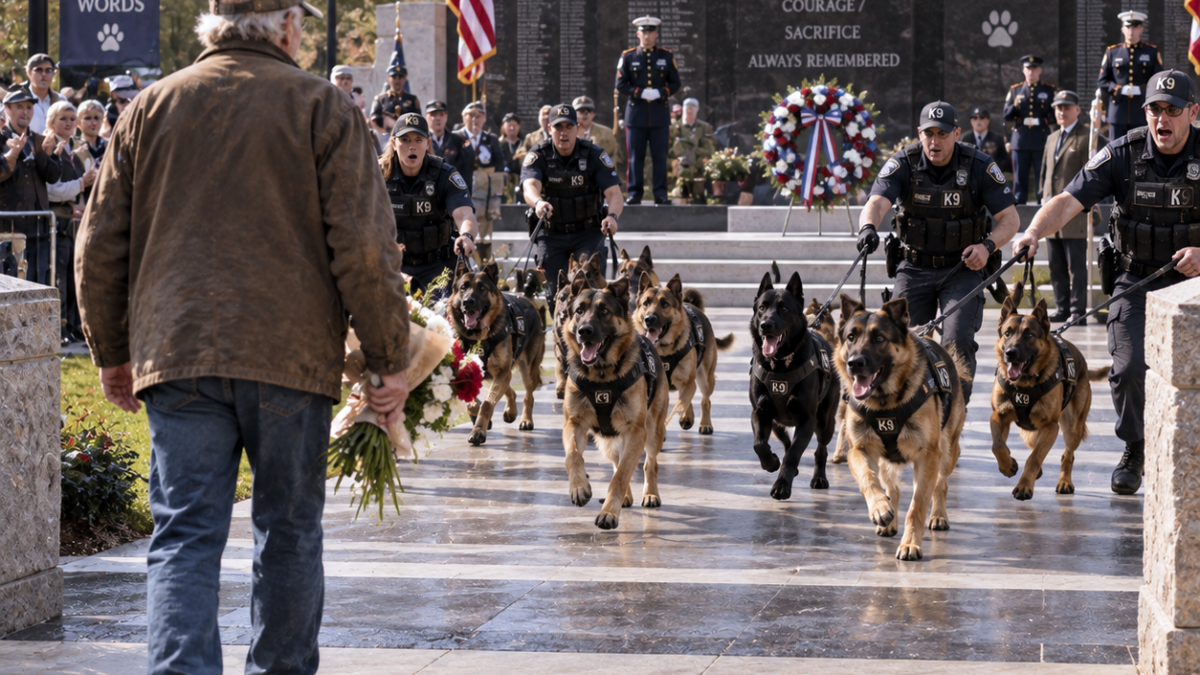
Seven dogs crossed the grass.
Around the wreath stands.
Past the edge of the memorial.
Toward the oak.
The farmer stayed still.
Valor reached him first.
The massive German Shepherd stopped.
Sniffed the man’s boots.
Then lowered himself.
Chest to grass.
Head on muddy leather.
Jinx pressed against the farmer’s left leg.
Rex arrived seconds later.
My confident, sharp, relentlessly intense dog became something I barely recognized.
He lowered his head.
Tail moving.
Then sat directly in front of the stranger.
Looked up.
Waiting.
One by one, all seven settled around him.
Pepper lay across his boots.
Odin leaned his shoulder into his knee.
Scout rolled slightly sideways, exposing his neck.
The farmer’s face collapsed.
Not dramatically.
Quietly.
One tear left his left eye.
He lowered himself slowly.
Painfully.
His knees clearly hated the decision.
The dogs crowded closer.
His hands moved.
Not random petting.
Purposeful.
Two fingers beneath Valor’s jaw.
Palm along Jinx’s shoulder.
Thumb behind Rex’s ear.
Rex closed his eyes.
The farmer whispered:
“Easy, son.”
My stomach dropped.
Not because of the words.
Because of the tone.
Rex responded to it.
Instantly.
His entire body relaxed.
Like he’d heard that voice his whole life.
The farmer looked around at the dogs.
“Hello, boys.”
Then toward Jinx and Pepper.
“And girls.”
A broken smile.
“Look at you.”
He touched Valor’s face.
“Same eyes.”
Riggs moved closer.
“Same as what?”
The old man looked up.
Hayes answered.
“Chaos.”
Riggs stopped.
Everyone in our program knew that name.
Not the dog exactly.
The line.
Chaos bloodline appeared buried in older breeding and behavioral documentation.
Dogs selected for nerve stability, search persistence, strong handler attachment.
Rex’s paperwork included references to the M-series lineage traced back through Chaos-derived stock.
The farmer looked at Rex.
“M designation?”
My mouth went dry.
“M-four-seven-seven.”
He smiled.
“Chaos.”
I stared.
“How could you know that?”
His eyes moved over Rex’s structure.
“Head.”
He touched his chest.
“Shoulders.”
Then his eyes.
“Mostly those.”
Hayes turned toward the crowd.
By then nobody spoke.
Not Caroline.
Not the governor.
Not the general.
Not us.
Hayes raised his voice.
“Ladies and gentlemen, you were invited here today to honor the history of the American military working dog.”
He looked toward the farmer surrounded by seven dogs.
“Most of you were never told the whole history.”
The old man closed his eyes briefly.
“Arthur.”
Hayes ignored the warning.
“For those asking who this man is—his name is Master Sergeant Gideon Black, United States Army, retired.”
A few older officers reacted.
Not many.
Hayes continued.
“In the late 1960s and early 1970s, Sergeant Black worked inside experimental military K9 programs that most official histories reduced to unit names, research groups, and classified field reports.”
Gideon stared at the grass.
“He developed field methods that changed how working dogs were selected, bonded, conditioned, and deployed.”
Caroline slowly lowered her clipboard.
Hayes pointed toward us.
“Every handler standing here has studied pieces of his work.”
I thought about academy manuals.
Old photocopied documents our instructors called Black Papers.
No author.
Just technical group attribution.
Trust conditioning.
Handler-transfer stress.
Odor association.
Threshold behavior.
Environmental recovery.
Reading microchanges in posture before obedience failure.
I looked at Gideon’s hands.
Oh God.
Hayes continued.
“You know those old training papers with no author’s name?”
Riggs whispered, “Sir…”
“Yes.”
Hayes looked at Gideon.
“Him.”
The crowd shifted.
I couldn’t speak.
The concepts I’d built my entire partnership with Rex around.
The reason I knew not to punish a hesitation before understanding it.
The reason we trained confidence before control.
The doctrine that said a working dog should trust the handler enough to think instead of merely fear consequences.
Gideon Black.
Old farmer.
Muddy boots.
Standing outside the VIP ropes.
Caroline whispered, “Why isn’t his name anywhere?”
Hayes heard.
His expression changed.
“That is a very good question.”
Gideon finally spoke.
“Because it doesn’t need to be.”
Hayes looked at him sharply.
“Don’t start.”
“Arthur.”
“No.”
Something old lived between those two men.
Argument repeated over decades.
Gideon stroked Rex’s neck.
“The dogs matter.”
“You matter too.”
“Debatable.”
“Not today.”
Hayes faced the audience again.
“Sergeant Black created and tested methods under conditions most of us would not survive. But much of his work went into classified programs. Other officers signed reports. Research teams received credit. Programs changed names. Wars ended.”
His jaw tightened.
“And Gideon did what good soldiers often do.”
He looked directly at the old man.
“He went home and kept his mouth shut.”
Gideon sighed.
“You make that sound stupid.”
“It was.”
A faint ripple of surprised laughter moved through the crowd.
Even Gideon smiled.
Then Hayes’s voice softened.
“He went back to Kansas.”
That surprised me.
“Raised cattle. Buried his wife. Stayed out of ceremonies.”
Hayes looked toward the memorial.
“And when committees eventually began writing official histories of the program, they found documents.”
He paused.
“But not the man behind them.”
Gideon slowly stood.
Rex rose with him.
So did every dog.
No commands.
“That’s enough,” Gideon said.
Hayes’s voice hardened.
“No. It isn’t.”
The ceremony never recovered its schedule after that.
Thank God.
The governor’s speech was shortened.
The senator abandoned half his remarks.
Nobody cared.
Our seven K9s remained near Gideon.
Eventually he told them:
“Back.”
Not loudly.
No formal command.
Just one word.
Every dog looked toward its handler.
Rex came to me.
I crouched.
He leaned against my chest.
“What was that?”
Rex licked once at my chin.
I clipped the leash.
When I looked up, Gideon stood watching me.
I straightened automatically.
He approached.
“You’re Carter?”
I blinked.
“How did you know?”
“Your name tape, son.”
Heat climbed my face.
“Right.”
His mouth moved.
Almost a smile.
He looked at Rex.
“You rush your left turns.”
“What?”
“He compensates.”
I stared.
Gideon took my leash hand gently.
Moved it half an inch.
“Stop steering him.”
“I don’t steer him.”
He looked at me.
I immediately knew I did.
Not much.
Tiny leash pressure.
Something instructors had corrected years before.
Something I’d slowly reintroduced without noticing.
“He trusts the path,” Gideon said. “Let him carry his half.”
I swallowed.
“Yes, Master Sergeant.”
“Gideon.”
“Yes, Master Sergeant.”
He sighed.
“You army boys never listen.”
“I’m military police.”
“That’s worse.”
Rex wagged.
Gideon scratched his chest.
Then he looked at me again.
“Good hands.”
I stopped breathing.
Those words mattered more than they should have.
Handlers understand.
Your hands are everything.
What the dog feels through the leash.
Pressure.
Uncertainty.
Anger.
Patience.
Timing.
Trust.
“You don’t fight him much,” Gideon said.
“No, sir.”
“Good.”
He took my hand.
His grip was shockingly strong.
“Keep it that way.”
I heard myself ask, “Why did they react to you?”
Gideon looked toward the dogs.
“Don’t know.”
“You don’t believe in blood memory, do you?”
“No.”
“Colonel Hayes said—”
“Arthur likes stories.”
Hayes, standing three feet away, said, “Arthur can hear you.”
Gideon ignored him.
“Dogs smell more than we know. They read posture. Breath. Chemicals. Movement. Maybe they smelled my farm dogs.”
“Military dogs?”
“Retired ones.”
I stared.
“You still work dogs?”
“Not officially.”
Hayes laughed.
“That’s like saying the ocean is occasionally damp.”
Gideon shrugged.
“I take hard cases.”
“What kind?”
“Dogs other people have stopped believing.”
That sentence stayed with me.
Caroline approached then.
Slowly.
No clipboard in front of her like a shield now.
Her eyes were red.
“Master Sergeant Black?”
Gideon turned.
“I owe you an apology.”
“No.”
“Yes.”
“You were doing your job.”
“I treated you like you didn’t belong here.”
He glanced toward the memorial.
“I didn’t.”
Caroline looked stricken.
“Of course you did.”
“No.”
He shook his head.
“They do.”
He pointed toward the engraved names.
“This belongs to them.”
Caroline’s voice became small.
“I looked at your clothes and decided who you were.”
Gideon studied her.
“That happens.”
“I’m sorry.”
He nodded.
Not dismissive.
Accepting.
“Then learn from it.”
No humiliation.
No revenge.
That somehow made Caroline cry harder.
The ceremony ended without anyone being sure exactly when.
People clustered around Gideon.
Senior officers.
Handlers.
Reporters.
Families.
He visibly hated the attention.
Within ten minutes he disappeared.
Literally.
I turned after speaking to Riggs.
Gone.
I searched near the oak tree.
Nothing.
Parking lot.
Nothing.
Hayes stood with both hands in his pockets.
“He does that.”
“Where did he go?”
“Home, probably.”
“Where?”
“Kansas.”
“That’s specific.”
Hayes smiled.
“He won’t like what happens next.”
“What happens next?”
The colonel looked toward the television cameras.
“You think nobody recorded seven military dogs breaking formation to salute a farmer?”
Within six hours, the video was everywhere.
Nobody Knew the Farmer.
Seven K9s Recognize Forgotten War Dog Legend.
Military Dogs Break Formation for Mysterious Veteran.
Some headlines were ridiculous.
One claimed the dogs recognized Gideon’s DNA.
Another said he had raised all seven personally.
Impossible.
One television host called him “the original dog whisperer of the United States military.”
Gideon reportedly turned off his phone.
I didn’t blame him.
But something useful happened too.
People started asking questions.
Who was Gideon Black?
Why wasn’t he in the memorial program?
Why were training documents we still used attributed only to research units?
Colonel Hayes started making calls.
So did I.
Not officially.
Curiously.
I went into our training archive.
Searched Gideon Black.
One result.
A personnel file summary with most operational sections redacted.
Vietnam-era assignments.
K9 evaluation.
Behavioral research.
Special operations support.
Then nothing.
I searched the old Black Papers.
No named author.
But buried in metadata of one scanned copy was:
G.B. FIELD NOTES TRANSCRIPTION.
I stared.
Another.
SGT BLACK REVISION.
Another.
GIDEON METHOD — HANDLER TRUST SEQUENCE.
My pulse jumped.
The evidence was there.
Not hidden perfectly.
Just buried beneath time and bureaucracy.
I showed Riggs.
He sat beside me.
“That’s him.”
“Looks like it.”
“Why no credit?”
“Maybe classified work.”
“Forty years later?”
I shrugged.
Then we found something worse.
A 1974 recommendation for a Distinguished Service Medal.
Recipient name:
Master Sergeant Gideon A. Black.
Status:
WITHDRAWN.
No explanation.
Riggs leaned toward the screen.
“What happened?”
“I don’t know.”
Colonel Hayes knew.
He told us three days later.
Not in an office.
At the kennel.
He came because he wanted to see Rex.
I think mostly he came because he knew we’d keep digging.
“Stop pretending you two are investigators.”
“We are military police,” I said.
“Exactly my concern.”
Riggs held up the copied recommendation.
“Why was this withdrawn?”
Hayes stared at it.
“Where’d you find that?”
“Archive.”
He sighed.
“Sit down.”
The story went back to Vietnam.
Gideon had entered the dog program when training philosophy was harsher.
Obedience through compulsion.
Dogs treated as equipment first.
Individual emotional differences often ignored.
Gideon disagreed.
Loudly.
Repeatedly.
He believed fear produced compliance, not reliability.
Under battlefield stress, a terrified dog could become unpredictable.
A bonded dog would fight to remain connected to the handler.
“He said trust was operational equipment,” Hayes told us.
I smiled.
That sounded like Gideon.
He began documenting methods.
Selection criteria.
Recovery after explosions.
Handler scent conditioning.
How to identify stress before behavioral collapse.
How to transfer a dog after the loss of a handler.
That last subject came from personal experience.
Gideon’s first military dog was Chaos.
German Shepherd.
Dark face.
Missing piece of left ear.
Together eighteen months.
During a patrol, Chaos detected movement before an ambush.
The dog alerted.
Gideon changed direction.
Three soldiers survived because of it.
Chaos was wounded.
Gideon carried him nearly two miles.
The dog survived.
Returned to work months later.
Eventually became foundation stock in a breeding-selection project.
“That’s why he recognized Rex’s line,” I said.
Hayes nodded.
“Chaos influenced several later lines.”
“What happened to the medal?”
Hayes’s face darkened.
Gideon had clashed with a colonel overseeing the program.
A senior officer wanted faster throughput.
More dogs.
Less individualized conditioning.
Gideon objected.
He documented increased stress failures.
The officer accused him of insubordination.
Gideon refused to sign an evaluation claiming a group of dogs was deployment-ready.
One later washed out during reassessment.
Gideon was proven correct.
But military institutions do not always enjoy being publicly proven wrong by sergeants.
His medal recommendation disappeared.
His reports were reissued under program authorship.
Not exactly stolen.
Not exactly credited.
Bureaucratically absorbed.
He retired soon afterward.
“Did he fight it?”
Riggs asked.
Hayes laughed without humor.
“Gideon?”
“Yes.”
“No.”
“Why?”
“He said the methods survived.”
I thought about the farmer under the oak tree.
A name isn’t important. The work is.
I understood.
I also hated it.
A week later, Congresswoman Elaine Foster, a former Army veterinarian, publicly requested a review of the historical working-dog program records.
That changed things.
Military archives were reopened.
Old personnel located.
Retired handlers interviewed.
Colonel Hayes testified.
So did three men in their eighties who had trained under Gideon.
Their stories aligned.
Gideon Black had not single-handedly invented the entire modern K9 program.
The viral internet version exaggerated that.
Real history is rarely one genius building everything alone.
But Gideon had done something substantial.
Foundational.
He had designed or refined several training principles later absorbed into official doctrine.
More importantly, his work shifted attitudes.
Dog as disposable equipment.
Toward dog as partner.
Not sentimentally.
Operationally.
Trust improved performance.
Stability.
Recovery.
Reliability under pressure.
The review found that his contributions had never been properly attributed.
When the report became public, I drove to Kansas.
I wasn’t invited.
Rex and I went anyway.
Gideon’s farm sat two hours west of Kansas City.
Forty acres.
Old red barn.
Weathered white farmhouse.
Fences that had been repaired so many times no two sections matched.
A sign near the driveway said:
BLACK FARM
Underneath:
IF GATE IS CLOSED, KEEP IT CLOSED.
IF DOG IS LOOSE, HE PROBABLY KNOWS MORE THAN YOU.
I laughed.
Rex started whining before I parked.
Not frantic like at the memorial.
Excited.
Gideon came out of the barn.
Same canvas jacket.
Same boots.
He looked at my government vehicle.
Then me.
“Thought I told Arthur not to send anyone.”
“He didn’t.”
“That sounds worse.”
I got out.
Rex waited.
“Permission?”
Gideon looked at him.
“Open the door.”
Rex jumped down.
Walked directly to Gideon.
No hesitation.
Gideon scratched his neck.
“Still steering left?”
“No.”
He looked at Rex.
“Liar.”
“I’ve improved.”
“Dog will tell me.”
We walked toward the barn.
Inside were four dogs.
All retired or rescued.
A one-eyed German Shepherd named Dolly.
A Malinois with a scarred muzzle named Chief.
A Labrador called June.
And a large Dutch Shepherd named Briggs who apparently hated everyone except Gideon.
Rex met them carefully.
No drama.
Gideon read every interaction without speaking.
I watched his eyes.
He did exactly what we’d been taught.
Only faster.
Weight shift.
Ears.
Mouth.
Tail.
Breathing.
One tiny pause before tension.
He saw everything.
“You came about the report,” he said.
“Yes.”
“Don’t want a ceremony.”
“I figured.”
“Don’t want another memorial.”
“You’re not dead.”
“Exactly.”
“They’re discussing restoring your medal recommendation.”
“No.”
I stared.
“Why?”
“Because medals are for actions. Not correcting paperwork half a century later because the internet embarrassed somebody.”
“You earned it then.”
“Maybe.”
“Colonel Hayes thinks you did.”
“Arthur thinks wearing matching socks counts as discipline.”
I laughed.
Then stopped.
“You really don’t care?”
Gideon looked toward the dogs.
“No.”
I believed him.
That was frustrating.
“What about history?”
“What about it?”
“Your name should be attached.”
“Why?”
“Because people should know.”
“Know what?”
“That you did this.”
He turned fully toward me.
“Ben, do you know who developed every technique you use?”
“No.”
“Every breeder who made Rex possible?”
“No.”
“Every veterinarian who corrected something people misunderstood?”
“No.”
“Every handler who learned a lesson the hard way and passed it down?”
“No.”
He nodded.
“Exactly.”
“That doesn’t mean nobody should get credit.”
“No.”
He softened.
“But credit is dangerous if you start confusing it with purpose.”
I looked at him.
“You sound like a training manual.”
“That’s because I wrote half of one.”
I laughed.
So did he.
Then he invited me inside for coffee.
His farmhouse looked like him.
Plain.
Old.
Functional.
Photographs covered one wall.
Dogs.
Dozens.
Some black and white.
Some faded color.
Handlers.
Kennels.
Vietnam.
Training fields.
One photograph showed a young Gideon kneeling beside a dark German Shepherd.
Chaos.
Same eyes as Rex.
Not literally.
But I understood what Gideon meant.
There was intensity there.
Directness.
I stepped closer.
“Chaos?”
“Yes.”
“He saved your life?”
“Several times.”
“What happened to him?”
Gideon’s expression changed.
“He stayed overseas.”
I immediately regretted asking.
“You mean—”
“Yes.”
I knew the history.
Many Vietnam war dogs never returned to the United States.
Quarantine regulations.
Policy.
Cost.
They were transferred or euthanized.
Handlers often had no say.
Gideon sat at the kitchen table.
“When my tour ended, I was told Chaos wouldn’t be coming.”
“What did you do?”
“Everything.”
His voice remained calm.
Too calm.
“Letters. Orders. Requests. Offered to pay transport.”
“And?”
“No.”
I looked at Chaos’s photograph.
“Did you say goodbye?”
“Yes.”
That one word contained fifty years.
“He knew?”
“Dogs usually do.”
Gideon stared into his coffee.
“I told him I’d come back.”
He swallowed.
“I didn’t.”
There it was.
The real reason Gideon stayed away from ceremonies.
Not modesty.
Not only that.
Guilt.
“I spent years teaching people that dogs remember trust,” he said.
A faint bitter smile.
“Then broke the biggest promise I ever made to one.”
“It wasn’t your choice.”
“You think dogs care about policy?”
I said nothing.
“No.”
He nodded.
“Neither did Chaos.”
The seven dogs at the memorial.
Their reaction.
Gideon’s tear.
I understood now.
He had not been seeing Rex.
Valor.
Jinx.
He had been seeing ghosts.
I asked why he came.
Gideon looked toward the window.
“Chaos’s name is on the wall.”
That stopped me.
“Which one?”
“Second section. Thirty-fourth line.”
“Why is he listed? I thought—”
“Hayes pushed for Vietnam dogs to be included.”
Gideon smiled.
“Persistent bastard.”
“Did he invite you?”
“For six months.”
“You ignored him.”
“Correct.”
“What changed?”
Gideon looked down.
“I turned eighty.”
“That’s your reason?”
“No.”
He breathed.
“I realized if I didn’t go then, I never would.”
The memorial wasn’t a ceremony to him.
It was a grave.
The closest thing Chaos ever got to one.
Caroline had nearly pushed him behind a barricade while he stood twenty yards from the only marker his partner ever received.
I felt anger.
Gideon saw it.
“Don’t.”
“She treated you—”
“She didn’t know.”
“She assumed.”
“So do we all.”
“She should have apologized.”
“She did.”
“You forgave her?”
“Nothing to forgive.”
I shook my head.
“You make it very hard to be angry on your behalf.”
“That’s intentional.”
Two weeks later, Caroline Gable arrived at Gideon’s farm.
I wasn’t there.
I learned afterward.
She brought no media.
No officials.
Just herself.
And an envelope.
Inside was her resignation from the memorial foundation.
Gideon refused to let her submit it.
“Why?” she asked.
“Because embarrassment isn’t a qualification for unemployment.”
“I failed.”
“You made a mistake.”
“In public.”
“Most mistakes happen somewhere.”
She told him she couldn’t stop thinking about the way she had looked at him.
Mud.
Old coat.
Wrong place.
She had spent months planning a ceremony about honor while unconsciously measuring worth by credentials and seating assignments.
“I don’t trust myself to do this work anymore.”
Gideon apparently asked:
“Did you learn?”
“Yes.”
“Then you’re more qualified today than you were that morning.”
She stayed.
And changed things.
The memorial foundation began gathering oral histories from forgotten handlers.
Kennel technicians.
Veterinarians.
Breeders.
Support staff.
People whose names never made plaques.
Not to create more heroes.
To make history less clean.
More true.
I volunteered.
So did Riggs.
Colonel Hayes pretended he wasn’t involved while calling everybody twice a day.
Six months after the ceremony, the historical review was completed.
The Army offered Gideon a formal recognition event.
He declined.
They offered again.
He declined more aggressively.
Then someone smarter changed the approach.
They didn’t call it an award ceremony.
They called it a handler symposium.
They invited young K9 teams.
Asked Gideon to teach.
He accepted in four minutes.
Of course he did.
The symposium took place in an old training facility, not a ballroom.
No politicians.
No stage lighting.
Folding chairs.
Kennel runs.
Training fields.
Twenty handlers.
Twenty dogs.
Gideon arrived in the same boots.
For three days, he dismantled half the habits we thought were excellent.
“Stop talking.”
That was his first lesson.
We stared.
“Dogs listen to your body before your mouth.”
He pointed at one handler.
“You’re nervous.”
The sergeant denied it.
His dog yawned repeatedly.
Gideon smiled.
“Dog disagrees.”
He taught us to observe without rushing to command.
A dog refusing a doorway.
Why?
Fear?
Odor?
Pain?
Floor texture?
Handler tension?
A good handler, Gideon said, did not treat every hesitation as defiance.
“Behavior is information.”
That line went into my notebook.
Then:
“Control without understanding is laziness.”
Another.
And:
“If the dog only works because he fears being wrong, he’ll fail when fear gets bigger than you.”
I wrote that twice.
On the final afternoon, Rex struggled during an exercise.
A metal grate.
He didn’t want to cross.
Old me would have corrected.
Encouraged firmly.
Moved him through.
Gideon raised one hand.
“Wait.”
We waited.
Rex sniffed.
Shifted left.
Sniffed again.
Gideon crouched.
Pointed.
One metal panel had shifted.
Tiny gap.
Rex’s nail could catch.
The dog had noticed danger.
I hadn’t.
Gideon looked at me.
“Trust goes both ways.”
That hurt.
In the useful way.
Afterward, the Army representative arrived quietly.
She carried a small case.
Gideon saw it.
“No.”
“Sergeant Black.”
“No.”
“Please.”
“No speeches.”
“No speeches.”
“Twenty seconds.”
He glared.
“Ten.”
She opened the case.
Inside was the Distinguished Service Medal that had been recommended in 1974.
Reissued.
Citation corrected.
Gideon stared.
The handlers stood silently.
No cameras except one official photographer positioned in the back.
The representative read only the final line:
“For foundational contributions to military working-dog training, handler safety, operational effectiveness, and humane partnership doctrine whose influence endured for generations.”
Gideon’s eyes moved toward the dogs.
Not the medal.
The representative held it out.
He did not take it.
For one terrible second, I thought he would refuse.
Then Rex walked forward.
I hadn’t commanded him.
He sat beside Gideon.
Gideon looked down.
“Traitor.”
Rex wagged.
Gideon took the medal.
No applause at first.
Then Riggs began.
Slow.
Everyone joined.
Gideon closed his eyes.
When he opened them, tears were there.
“That’s enough.”
Naturally, we ignored him.
That evening, Gideon gave the medal to the memorial foundation.
Caroline asked why.
“Put it near Chaos.”
She cried.
Again.
He pretended not to notice.
The next year, the memorial added a small exhibit.
Not a statue of Gideon.
He forbade that.
A simple display.
A photograph of Chaos.
One of Gideon’s original field notebooks.
The restored medal.
And a paragraph about the unnamed teams whose accumulated work shaped modern K9 doctrine.
At Gideon’s insistence, his name appeared only once.
The biggest line belonged to Chaos.
I visited the memorial with Rex.
We stood in front of that display.
Rex sniffed the glass.
“That’s your grandfather’s grandfather’s grandfather or something.”
A woman nearby laughed.
I turned.
Caroline.
She wore a foundation badge.
“You’re still bad at genealogy.”
“So are you.”
She looked at Rex.
“Does he still react to Gideon?”
“Every time.”
Gideon had become part of Rex’s world.
We visited the farm whenever we could.
Rex loved it.
Probably because Gideon violated all my feeding rules.
“That’s too much bacon.”
“He’s underfed.”
“He eats four cups a day.”
“Tragic.”
“You’re ruining him.”
“Improving morale.”
Rex agreed with Gideon.
Years passed.
Not many.
Enough.
Colonel Hayes died first.
Cancer.
Gideon attended the funeral.
Stood in the back.
Almost escaped afterward.
I caught him.
“You can’t keep leaving before people talk to you.”
“Watch me.”
Hayes’s death changed him.
The old guard was disappearing.
One by one.
People who remembered Chaos as a dog instead of a line in a database.
People who remembered jungle mud.
Old kennels.
Bad training practices.
Good discoveries.
Mistakes no report preserved.
Gideon began recording his stories for the foundation.
Caroline interviewed him.
He hated microphones.
Eventually forgot them.
He talked about dogs more easily than people.
Chaos.
Maggie.
Red.
Duke.
Samson.
A Labrador named Betty who found explosives better than any shepherd he’d worked.
Handlers too.
Men who came home.
Men who didn’t.
Dogs who saved lives.
Dogs humans failed.
He never romanticized war.
That mattered.
“Don’t call them heroes because it makes you comfortable,” he said during one interview.
Caroline asked what he meant.
“Hero is a word people use after asking someone else to pay a terrible price.”
Silence.
Gideon continued.
“Honor what they did. But don’t fall in love with the cost.”
That line became one of the most replayed pieces of the archive.
Rex retired at nine.
Hip problems.
Nothing catastrophic.
I adopted him.
There was never another option.
On our final duty day, I drove him to Gideon’s farm.
The old man sat on his porch.
Ninety, by then.
Thinner.
Walking with a cane.
Rex jumped from my truck.
Forgetting his hips for about five seconds.
Ran.
Gideon laughed.
“Idiot.”
Rex pressed against him.
I sat.
“You look terrible.”
“So do you.”
“I’m forty-one.”
“Exactly.”
We watched Rex wander the yard.
Gideon asked, “Hard?”
“What?”
“Retirement.”
“Yes.”
“For you or him?”
“Yes.”
He nodded.
“Give him another job.”
“Like what?”
“Keep you alive.”
I laughed.
“He’s overqualified.”
Gideon looked toward Rex.
“Dogs don’t retire from belonging.”
I wrote that one down mentally.
We talked until sunset.
Then Gideon asked me something unexpected.
“When I go, bring him.”
“Rex?”
“Yes.”
“Where?”
“To the memorial.”
I looked at him.
“You planning something?”
“Dying eventually.”
“Not funny.”
“Factually strong.”
“What do you want me to do?”
He looked toward the horizon.
“Let him visit Chaos.”
My throat tightened.
“Okay.”
“Don’t make a circus.”
“I won’t.”
“No seven-dog nonsense.”
“That wasn’t my fault.”
“It became everybody’s fault.”
I smiled.
Then asked, “Why Rex?”
Gideon’s face softened.
“Because he’s the one who found me.”
I almost corrected him.
Seven dogs had.
But I understood.
Rex was the first one Gideon let into what remained of his old life.
Gideon Black died eleven months later.
At home.
In bed.
A hospice nurse present.
One farm dog asleep beside him.
Ninety-one years old.
Caroline called me.
I knew before answering.
“Ben.”
I closed my eyes.
“When?”
“Last night.”
Rex lay near my feet.
His head lifted at the change in my breathing.
Caroline continued.
“He left instructions.”
“Of course he did.”
She laughed through tears.
“No giant funeral.”
“Of course.”
“No politicians.”
“Naturally.”
“Handlers welcome.”
I looked at Rex.
“Where?”
“The memorial.”
One week later, we returned to the same lawn.
Different season.
Different crowd.
Smaller.
No governor.
No senator.
No band.
Handlers.
Veterans.
Family from Gideon’s late wife’s side.
Caroline.
Riggs.
Me.
Dogs.
Lots of dogs.
Rex walked slowly now.
Gray muzzle.
Retirement weight.
Same amber eyes.
I brought him toward the oak tree.
The place Gideon had stood the first morning.
Rex stopped.
Sniffed.
Then looked toward the memorial.
We walked.
Chaos’s name was there.
Second section.
Thirty-fourth line.
Exactly where Gideon had said.
I knelt.
“That’s him.”
Rex sniffed the stone.
Then sat.
Caroline stood behind me.
“He knew this was where he wanted to end.”
“What do you mean?”
She handed me an envelope.
Gideon’s handwriting.
My name.
I opened it.
One sheet.
Ben,
If you’re reading this, apparently age finally succeeded where bad decisions, war, cattle, and Army bureaucracy failed.
Take care of Rex.
Don’t turn me into something I wasn’t.
I didn’t build the program.
Nobody builds anything worth having alone.
I learned from dogs, handlers, enemies, mistakes, men smarter than me, and men dumber than me who made useful errors.
Tell the truth messy.
Chaos taught me the most important thing I ever knew:
Trust is not obedience.
Trust is knowing someone will not spend you cheaply.
Remember that when you work with dogs.
Remember it when you lead people.
And if anybody puts up a statue of me, I will find a way back solely to knock it over.
—Gideon
P.S. Your left turns still need work.
I laughed so hard I started crying.
Rex looked at me.
“What?”
He leaned against my leg.
Caroline was crying too.
“What’s funny?”
I handed her the letter.
She reached the postscript.
Laughed.
Then covered her mouth.
We placed Gideon’s ashes beneath the oak.
No grand marker.
A small bronze plate:
GIDEON A. BLACK
MASTER SERGEANT, U.S. ARMY
HANDLER. TEACHER. PARTNER.
Underneath, at Caroline’s suggestion and Gideon’s prior approval:
TRUST GOES BOTH WAYS.
Rex lay beside the tree.
Other dogs settled around the lawn.
Not seven.
More than thirty.
No commands were needed.
Something about the quiet made handlers stop talking.
For several minutes, all we heard was wind.
Tags.
Breathing.
A bird somewhere above us.
I looked toward the polished memorial wall.
Years earlier, we had come there to honor dogs.
Instead, seven dogs had forced us to notice a man.
That bothered Gideon.
He never wanted to become the center.
Eventually I understood why.
He knew something ceremonies often forget.
Service is not a spotlight.
It’s a chain.
One person teaches another.
One dog changes one handler.
One mistake becomes a lesson.
One lesson becomes doctrine.
Names disappear.
The work travels.
Rex learned from me.
I learned from instructors.
They learned from men and women before them.
Somewhere far back in that line stood Gideon Black with Chaos beside him, arguing that a frightened dog shouldn’t be punished before someone asked why he was afraid.
That idea reached me decades later.
Reached Rex.
Probably saved both of us from mistakes I never knew we avoided.
After Gideon’s memorial, a young handler approached.
Private first class.
Maybe twenty-one.
Malinois beside him.
“Corporal Carter?”
“Retired from being corporal.”
“Sorry, sir.”
“Don’t sir me. Makes me nervous.”
He smiled.
“Can I ask something?”
“Sure.”
“Was he really that good?”
I looked toward Gideon’s plaque.
“No.”
The young handler seemed startled.
I continued.
“He was better and worse than the legend.”
“What does that mean?”
“He was stubborn. Arrogant sometimes. Terrible with recognition. Held guilt too long. Thought asking for help was a character defect.”
The handler smiled.
“And the better?”
“He paid attention.”
“That’s it?”
“That’s almost everything with a dog.”
I pointed at his Malinois.
“What’s his name?”
“Dagger.”
“What’s Dagger telling you right now?”
The young man looked down.
The dog kept shifting his weight.
He answered, “He’s restless.”
“Why?”
“Crowd?”
“Maybe.”
The handler watched again.
Then noticed.
Dagger kept glancing toward shade.
Panting.
“Hot.”
I nodded.
He immediately moved the dog beneath the tree.
Gave water.
Gideon would have approved.
Behavior is information.
Pay attention.
Rex lived three more years.
Good years.
Slow walks.
Too much bacon whenever Caroline visited because apparently she had inherited Gideon’s complete disregard for feeding rules.
His hips worsened.
His hearing faded.
But his nose remained unfairly good.
On his final morning, he couldn’t stand.
I carried him outside.
He was lighter than I expected.
That destroyed me.
Dogs take up so much space in your life that you forget how little their bodies actually weigh.
I laid him beneath the maple tree in my backyard.
He breathed slowly.
I sat beside him.
The veterinarian was coming.
I had Gideon’s letter folded in my desk.
I’d read it so many times the creases were soft.
Trust is not obedience.
Trust is knowing someone will not spend you cheaply.
Rex looked at me.
I touched his face.
“You did your part.”
His tail moved once.
“You don’t owe me anything.”
Another breath.
“You never did.”
The veterinarian arrived.
I stayed with him.
No uniform.
No command.
No working harness.
Just Ben and Rex.
When he died, my hand was on his chest.
The silence afterward was enormous.
A month later, Caroline and I returned to the memorial.
I carried a small urn.
Rex had earned burial options through the military program.
I chose the oak.
Near Gideon.
Near Chaos’s name.
We placed a small marker.
M477 — REX
HE TRUSTED WELL.
Caroline stood beside me.
“Remember the first day?”
“Every detail.”
“You grabbed my arm.”
“You were about to throw Gideon out.”
“I know.”
“You were terrifying.”
“I still am.”
“True.”
She looked toward the grass.
“I spent years being ashamed of that morning.”
“You shouldn’t.”
“Gideon said that too.”
“He was annoyingly forgiving.”
She smiled.
“He told me learning was the price of mistakes.”
“Sounds like him.”
We stood there.
Two humans.
Three names.
Hundreds more carved into stone.
Visitors walked past.
Most had no idea who Gideon had been.
That was okay.
Really.
Because his work was everywhere.
In the handlers correcting less and observing more.
In dogs taught through trust.
In policies recognizing working animals as partners rather than disposable tools.
In younger trainers who had never heard his voice but repeated ideas he fought for fifty years earlier.
Sometimes legacy does not look like fame.
Sometimes it’s a behavior someone no longer realizes they had to learn.
A gentler hand.
A patient pause.
A question asked before punishment.
A dog trusted enough to communicate.
Years later, when I began teaching young handlers, I started every class the same way.
No slideshow.
No rank.
No dramatic K9 footage.
I wrote one sentence on the board:
TRUST IS NOT OBEDIENCE.
Then I waited.
Eventually someone asked what it meant.
I told them about an old farmer at a memorial.
Not all at once.
I made them work for it.
I told them about seven military dogs with years of conditioning.
Seven handlers.
A perfect ceremony.
An event planner convinced the farmer didn’t belong.
A colonel who recognized a ghost.
Then I told them the leashes dropped.
And every dog went to Gideon.
Students always asked the same question.
“How did they know him?”
For years I tried answering.
Scent.
Body language.
Genetic tendencies.
Familiar odors.
Handler reactions.
Environmental association.
Maybe coincidence amplified by one dog’s response spreading through the group.
All reasonable.
All possible.
Eventually I stopped trying to solve it.
I would tell them:
“I don’t know.”
Because that was true.
The dogs had never met him.
Not directly.
Maybe Valor triggered Jinx.
Maybe Jinx triggered Rex.
Maybe Gideon carried the scent of working dogs on his clothes.
Maybe his posture, breathing, and complete lack of uncertainty made them perceive safety.
Maybe the old bloodlines mattered less than the stories made it seem.
Science should remain science.
But the part that mattered did not require magic.
Seven highly trained animals looked past clothes.
Past credentials.
Past seating assignments.
Past age.
Past status.
They responded to something the people around them had failed to recognize.
That was enough.
Human beings love uniforms because uniforms make identity easy.
Badges.
Stars.
Titles.
VIP passes.
Name cards.
Reserved chairs.
We organize the world until we begin believing the organization tells us who matters.
Gideon Black walked into the memorial looking like a man who had just repaired a fence.
Caroline saw mud.
I saw scars.
Colonel Hayes saw history.
The dogs saw Gideon.
Maybe that is why the moment stayed with so many people.
Not because seven K9s broke formation.
Because everyone watching suddenly had to confront the possibility that value can stand three feet away from us without wearing any of the signs we have been trained to respect.
Gideon never blamed Caroline.
That became one of the lessons I carried longest.
He could have humiliated her.
The crowd would have loved it.
A viral reversal.
Woman looks down on poor old farmer, discovers he’s a legend.
Easy story.
Satisfying villain.
But Gideon refused.
She made a mistake.
Then she learned.
That mattered more than punishing her for the version of herself who existed five minutes earlier.
He gave dogs the same grace.
Behavior is information.
Ask why.
Maybe we owe people some of that too.
Not endless excuses.
Not freedom from consequences.
Just enough patience to separate ignorance from cruelty.
Fear from aggression.
Mistake from character.
Gideon spent his life teaching dogs and humans to trust one another.
In the end, I think he taught us something harder.
Recognition matters.
Not celebrity.
Recognition.
Seeing what stands in front of you before somebody with more authority tells you what you’re supposed to see.
Rex taught me that too.
The first day at the memorial, I had a leash in my hand and a dog telling me something impossible.
Every rule said control him.
Correct him.
Restore formation.
Colonel Hayes gave us permission to do the opposite.
Release.
Observe.
Learn.
Seven leashes hit the grass.
And history walked out from under an oak tree.
I still visit sometimes.
The memorial has expanded.
More names.
That is the part nobody wants.
A living program creates new losses.
The oak tree is larger.
Gideon’s plaque is weathered.
Rex’s marker sits nearby.
Chaos remains on the black wall.
Second section.
Thirty-fourth line.
I always touch that name first.
Then Gideon.
Then Rex.
Three lives connected across nearly sixty years.
A dog that never came home.
A man who spent decades believing he failed him.
A dog born generations later who somehow helped lead that man back to the place he had avoided.
People ask whether I believe Rex recognized Gideon’s legacy.
No.
Not literally.
Dogs don’t read military history.
They don’t care who wrote doctrine.
They don’t understand medals.
Maybe that’s why their judgment can be so uncomfortable.
They respond to what is there.
Fear.
Calm.
Threat.
Trust.
Presence.
Gideon carried something those dogs wanted to be near.
Whatever the scientific explanation, I watched it happen.
Seven dogs pulled.
Seven handlers struggled.
Then we let go.
The dogs crossed the lawn.
One by one, they lowered themselves at an old farmer’s muddy boots.
And for the first time that morning, every important person at that ceremony stopped looking at the stage.
Maybe that was Gideon’s final lesson before any of us knew his name.
Sometimes the monument isn’t the polished stone in front of you.
Sometimes it’s the quiet person standing in the wrong clothes at the edge of the crowd, carrying an entire history no one bothered to ask about.
And sometimes it takes a dog to notice first.








