Rookie Cop Laughed at My Navy Admiral Uniform and Handcuffed Me in the Rain—Then the Base Commander Walked Into His Precinct
Rookie Cop Laughed at My Navy Admiral Uniform and Handcuffed Me in the Rain—Then the Base Commander Walked Into His Precinct
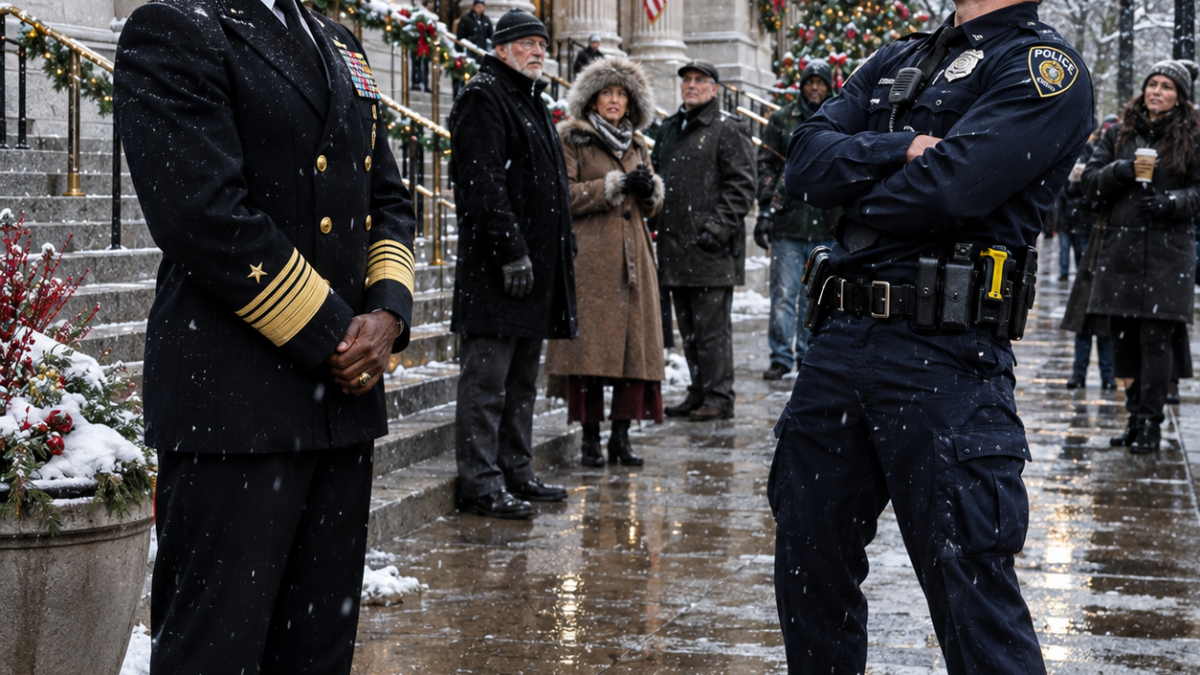
A twenty-six-year-old rookie officer pulled me from my car in freezing Virginia rain, mocked the Navy Cross on my chest, and tightened the cuffs after deciding an older Black man in an admiral’s uniform had to be impersonating someone important.
I gave him my military identification, my driver’s license, and the direct number for Naval Station Norfolk security, but instead of making one verification call he booked me for obstruction and impersonation while my soaked dress uniform hung from my shoulders like evidence in a crime I had never committed.
Then the precinct doors opened and the commander of the largest naval installation in the region walked inside with two Navy security officers, looked at the young cop standing beside me, and asked one quiet question that made every conversation in the building stop.
“Nice costume, old man.”
Officer Thomas Cole laughed as freezing rain ran down the back of my neck.
My hands were already cuffed behind me.
The steel was tight enough to press against bone.
He stood beside my gray sedan with one hand resting on his duty belt and the other pointing toward the gold stripes on my sleeves as though he had just uncovered the most ridiculous fraud in Virginia.
Then he reached forward.
And flicked the ribbon on my chest with one finger.
“Where’d you buy all this?”
I looked down at his hand.
Then back into his face.
“That ribbon represents the Navy Cross.”
He laughed again.
“You expect me to believe you earned the Navy Cross?”
I said nothing.
He shook his head.
“You people really commit to the bit, don’t you?”
You people.
There it was.
Not shouted.
Not emphasized.
Barely even intentional.
Just loose enough to fall out naturally.
Men often reveal more in careless language than they do under questioning.
Cole was twenty-six years old.
I was sixty-one.
He had worn a municipal police badge for a little over two years.
I had worn the uniform of the United States Navy for nearly four decades.
He believed I was pretending.
And the dangerous part was not simply that he was wrong.
It was how certain he was that he could not possibly be wrong.
My name is Rear Admiral Marcus Everett.
At the time, I was finishing my final year on active duty.
Thirty-nine years and seven months.
PART2:
I had entered the Navy as a nineteen-year-old midshipman who thought leadership meant being the loudest man in the room.
The Navy cured me of that quickly.
I learned leadership in engine rooms.
On dark bridges.
During fire drills that stopped being drills.
In the faces of sailors who needed an answer before I had one.
I had commanded a destroyer.
Later a squadron.
Eventually a carrier strike group.
I had served at Fleet Forces Command and spent years moving between Norfolk, Washington, Bahrain, and places most Americans could not find on a map without help.
I had sat inside rooms where everyone surrendered their phones before entering.
I had signed casualty letters.
I had knocked on doors.
I had carried folded flags.
And during one deployment in the Persian Gulf, I had pulled two sailors through smoke after a missile strike set part of our ship on fire.
One lived.
One did not.
The Navy Cross came from that night.
I never discussed it unless required.
Not because I was humble in some dramatic way.
PART3:
Because every decoration attached to that incident reminded me that someone else’s mother received a flag instead.
That evening I was wearing full service dress because I had attended a retirement ceremony for Vice Admiral Joseph Mercer, a man I had served with for twenty-three years.
The ceremony ran late.
Dinner afterward ran later.
By the time I left the naval facility, cold rain had moved across Hampton Roads.
I could have used a driver.
I did not.
My wife, Elaine, had spent years telling me my stubborn refusal to let junior officers drive me everywhere was going to become a problem eventually.
I had always replied:
“I still know how to operate a sedan.”
Technically, I was right.
My car was an eight-year-old gray Toyota Avalon.
No government plates.
No driver.
No flags.
Nothing announcing who sat inside.
I liked it that way.
I had been driving less than fifteen minutes when blue lights appeared behind me.
I checked my speed.
Forty-one in a forty-five.
Turn signal working.
Headlights on.
I assumed maybe a taillight had gone out.
I pulled onto the shoulder.
Turned off the engine.
Lowered the window.
Rain blew inside.
The officer approached from behind with a flashlight.
Bright beam first.
Face second.
“License and registration.”
I reached slowly toward my inside jacket.
“Officer, my wallet is in my left breast pocket.”
“Keep your hands where I can see them.”
I stopped.
“Understood.”
He leaned closer.
His flashlight moved across my uniform.
Collar devices.
Ribbons.
Sleeve stripes.
Nameplate.
His expression changed.
Not recognition.
Suspicion.
“What is this?”
I thought he meant the uniform.
“United States Navy service dress.”
He stared.
“You military?”
“Yes.”
“What rank?”
“Rear admiral.”
He actually smiled.
Not politely.
Amused.
“Sure.”
That was the first moment I understood the stop was no longer about traffic.
I kept my voice even.
“My identification is in my breast pocket.”
He looked at my face.
Then the uniform.
Then my car.
“What are you doing dressed like this?”
“I attended a retirement ceremony.”
“Where?”
“Naval Station Norfolk.”
He laughed softly.
“Of course.”
I said nothing.
He asked:
“You got a driver’s license?”
“Yes.”
“Then get it.”
I moved slowly.
He immediately said:
“Slow.”
“I am moving slowly.”
“Don’t get smart.”
I took out the wallet.
Opened it.
Virginia driver’s license.
Military identification.
Retired? No, active-duty CAC and perhaps general officer ID. Better to keep general “military identification card”. I handed both over.
Cole looked at the driver’s license first.
Then the military ID.
He stared for two seconds.
“You make this yourself?”
I thought I misheard him.
“Excuse me?”
He held up the card.
“This military ID.”
“No.”
“It looks fake.”
“It is not.”
He turned it under his flashlight.
“Rear Admiral Marcus Everett.”
“Yes.”
“Department of Defense.”
“Yes.”
He smiled again.
“You know impersonating military personnel can get you in trouble?”
I looked at him.
“So can accusing somebody without verifying identification.”
His smile disappeared.
“Step out of the vehicle.”
“Officer—”
“Step out.”
I had spent nearly forty years learning when an argument was useful and when it only provided someone with a reason to escalate.
I opened the door.
Rain hit immediately.
I stepped onto the shoulder.
“Hands on the roof.”
I complied.
Cars hissed past on wet pavement.
The freezing rain soaked through my shoulders.
Cole patted me down.
Found nothing.
He removed my wallet.
Phone.
Car keys.
Placed them on the hood.
“Any weapons?”
“No.”
“You sure?”
“Yes.”
“You military guys love carrying.”
“I am not carrying a firearm.”
“Turn around.”
I turned.
He examined my uniform from close range.
His eyes settled on the ribbons.
Then the stars.
Then the gold stripes.
His expression told me what he was thinking before he said it.
“You really went all out.”
I stared at him.
“What exactly do you believe is happening here?”
He shrugged.
“I’ve seen stolen valor people.”
“You think I pulled onto a public highway dressed as a rear admiral for entertainment?”
“People do weird things.”
“Call Naval Station Norfolk security.”
He laughed.
“Why?”
“They can verify my identity.”
“I don’t need you telling me how to do my job.”
“I am giving you the fastest way to resolve this.”
“You got orders on you?”
“No.”
“Official vehicle?”
“No.”
“Escort?”
“No.”
“Then I’ve got an old guy in a costume with a suspicious ID telling me he’s an admiral.”
I kept my voice controlled.
“You have a Virginia driver’s license matching my face and name.”
“People use fake licenses.”
“You have a military identification card.”
“Could be fake.”
“You can verify it.”
He stepped closer.
“What part of ‘stop telling me how to do my job’ are you struggling with?”
That was when another patrol car arrived.
Officer Melissa Grant stepped out.
Maybe early thirties.
Five or six years older than Cole.
She approached.
“What’ve you got?”
Cole answered before I could.
“Possible impersonation.”
Grant looked at me.
Then my uniform.
Her eyebrows moved.
“Military impersonation?”
“Yeah.”
“He’s claiming rear admiral.”
Grant looked at my military ID sitting on the hood.
“Did you run it?”
Cole said:
“I’m checking.”
That was not an answer.
Grant picked up the card.
She studied it longer than he had.
Then looked directly at me.
“Sir, what command?”
I gave her my current assignment.
Her expression changed slightly.
She looked at Cole.
“Maybe call the base.”
Cole snapped:
“I’ve got it.”
Grant lowered her voice.
“Tom.”
“I said I’ve got it.”
I watched her hesitate.
That hesitation mattered later.
She knew enough to question him.
Not enough to stop him.
Cole turned back to me.
“Put your hands behind your back.”
Grant’s head lifted.
“Tom.”
I said:
“Officer, I am not resisting you.”
“I said hands behind your back.”
“On what basis am I being detained?”
“Obstruction.”
“For asking you to verify my identification?”
“For refusing lawful instructions.”
“I have followed every instruction.”
“Hands.”
I complied.
Cuffs closed.
Too tight.
I said:
“The right cuff is too tight.”
Cole checked with one finger.
“It’s fine.”
“It is pressing directly on the wrist bone.”
“You’ll survive.”
Rain ran from my hair into my collar.
Grant looked uncomfortable.
“Want me to double-lock those?”
Cole did.
He tightened one first.
Then locked it.
Pain shot up my wrist.
I looked at him.
“Officer Cole.”
“What?”
“You just tightened that.”
“You moved.”
“I did not.”
“Quit arguing.”
Then he walked around to the front of me.
Looked at the ribbons.
And said:
“Nice costume, old man.”
That was when he flicked the Navy Cross.
I told him what it represented.
He laughed.
Then came:
“You people really commit to the bit.”
Grant heard it.
Her face changed.
“Tom.”
“What?”
“Enough.”
He looked at her.
“Relax.”
I said nothing.
I was angry.
Not the hot kind.
The colder kind.
The kind that becomes more precise as it grows.
Because at that point, I understood exactly what Cole had decided.
He had not investigated and reached the wrong conclusion.
He had reached the conclusion first.
Everything afterward existed only to defend it.
My age did not fit his idea.
My car did not fit his idea.
And, whether he wanted to admit it or not, my race did not fit his idea either.
Older Black man.
Ordinary Toyota.
Admiral uniform.
To him the combination looked impossible.
That impossibility became his evidence.
He put me in the back of his cruiser.
Grant stood near the door.
Before Cole closed it, I said:
“Officer Grant.”
“Yes, sir?”
“My phone has the base duty officer listed under ‘NOB Security.’”
Cole interrupted.
“No calls until booking.”
Grant looked at him.
“Tom, we can clear this in five minutes.”
“I said I’ve got it.”
She stared at him.
Then stepped back.
The door closed.
From the rear seat, I watched Cole search my car.
I had not consented.
He opened the trunk.
Found:
A garment bag.
A ceremonial cover.
One leather briefcase.
A retirement gift for Admiral Mercer I had forgotten to give him.
And a Navy folder containing unclassified event material.
He held it up.
Then looked toward Grant.
“See?”
I almost laughed.
See what?
That the man dressed as an admiral had Navy paperwork in his trunk?
The logic was collapsing under its own weight.
But Cole had become invested.
There is a point where certain people stop trying to determine what happened and start trying to avoid admitting they were wrong.
That point is dangerous.
Grant walked back to my door.
She opened it slightly.
“Sir.”
“Yes?”
“Is there somebody you want notified?”
“My wife.”
“Number?”
“Phone is locked.”
“Can you give it to me?”
I did.
She wrote it down.
Cole saw.
“What are you doing?”
“Notification.”
“He’ll get a call at the precinct.”
Grant closed the door.
I do not know whether she called Elaine then.
Later she told investigators she tried, but the call went to voicemail.
My wife was at home with her phone upstairs while she watched television downstairs.
That detail would make her furious for weeks.
The drive to the precinct took twenty-two minutes.
I spent most of it staring at the cage partition.
My wrists hurt.
My left hand had begun tingling.
Cole drove.
He talked over the radio.
Possible false military identification.
Possible stolen valor.
Possible obstruction.
Every “possible” sounded increasingly like “confirmed” in his voice.
At the precinct, he opened the rear door.
“Out.”
I stepped onto wet pavement.
Still cuffed.
Uniform soaked.
Shoes full of water.
We entered through the secure rear entrance.
A desk sergeant looked up.
Sergeant Raymond Ellis.
Late fifties.
Thick glasses.
He saw me.
Saw the uniform.
Then looked at Cole.
“What is this?”
Cole answered:
“Impersonating an officer.”
I almost corrected him.
Military rank is not the same as impersonating a civilian police officer.
Then decided to wait.
Ellis stood.
“Impersonating what?”
“Rear admiral.”
The sergeant stared at me.
Then at Cole.
“You sure?”
Cole put my ID on the desk.
“Fake.”
Ellis picked it up.
His expression changed.
“Who said it’s fake?”
Cole replied:
“Look at it.”
“I am.”
“It says rear admiral.”
“Yes.”
Cole laughed once.
“Come on, Sarge.”
Ellis looked at him.
“What does that mean?”
Cole gestured toward me.
“This guy?”
The room went still.
Not completely.
A printer still hummed.
Someone typed.
A phone rang.
But socially?
Still.
Sergeant Ellis looked at me again.
Then back at Cole.
“Take the cuffs off.”
Cole stared.
“What?”
“I said take the cuffs off.”
“He’s being booked.”
“For what?”
“Obstruction and false identification.”
Ellis held up my military ID.
“Did you verify this?”
“I inspected it.”
“That is not what I asked.”
Cole’s face tightened.
“He’s obviously not an admiral.”
Sergeant Ellis became very calm.
“Why?”
Nobody answered.
He repeated:
“Why is that obvious?”
Cole glanced at me.
“You’re kidding.”
“I am not.”
“He’s driving an old Toyota.”
I almost smiled.
Ellis did not.
“And?”
“He’s alone.”
“And?”
“He’s sixty.”
I said:
“Sixty-one.”
Cole ignored me.
Ellis waited.
Cole finally said:
“Look at him.”
Sergeant Ellis’s face hardened.
“Yes.”
“I am.”
Then he pointed at the cuffs.
“Remove them.”
Cole protested:
“Sarge—”
“Now.”
The cuffs opened.
Blood returned painfully to my hands.
I rubbed my left wrist.
A red groove circled it.
Ellis saw.
“How long were those on?”
“Approximately thirty-five minutes.”
“Any numbness?”
“Left hand.”
He looked at Cole.
“Get EMS.”
“I’m fine.”
Ellis turned to me.
“With respect, sir, I would like it documented.”
That was smart.
“Very well.”
Cole stood beside the desk.
Frustrated.
Not apologetic.
He still believed the room had lost perspective.
Ellis asked:
“Sir, can you give me your full name?”
“Marcus Daniel Everett.”
“Date of birth?”
I gave it.
“Current Navy status?”
“Active duty.”
“Current assignment?”
I told him.
Ellis sat.
Then looked at Cole.
“Watch.”
He picked up the phone.
Called dispatch.
Requested verification through the appropriate law-enforcement/military liaison process.
Then he called the number on my phone after getting permission for me to unlock it.
Naval Station Norfolk security desk.
He did not identify me as an admiral at first.
He simply asked whether they could verify an active-duty flag officer by name.
Less than two minutes later, the sergeant’s posture changed.
“Yes.”
Pause.
“Yes, he is physically here.”
Another pause.
Ellis looked at me.
“Yes, sir.”
That “sir” was not for me.
Someone on the other end outranked his normal conversation.
“No, sir.”
He swallowed.
“I understand.”
Then:
“Yes, Admiral Everett appears unharmed.”
Cole’s face finally changed.
Not fully.
A crack.
Ellis ended the call.
Silence.
I asked:
“Verified?”
Sergeant Ellis slowly placed the receiver down.
“Yes, Admiral.”
Cole looked between us.
“Wait.”
Ellis turned.
“Do not say another word.”
Cole said one anyway.
“But—”
“Not.”
“One.”
“Word.”
He pointed toward a chair.
“Sit down.”
Cole sat.
The precinct captain was called.
Lieutenant notified.
Internal affairs notified.
Not because I demanded it.
Because Sergeant Ellis understood a situation involving an unlawfully detained active-duty rear admiral, disputed identification, possible biased conduct, and a physical injury from handcuffs was going to become larger than his shift.
He was right.
EMS looked at my wrist.
No fracture.
Compression injury.
Numbness already easing.
Photos taken.
I requested no transport.
Then I called Elaine.
She answered immediately.
“Marcus?”
“Yes.”
“Where are you?”
“Police precinct.”
Silence.
“What?”
“I’m fine.”
“What happened?”
I looked at Cole.
He was sitting twenty feet away.
“Traffic stop.”
“Why are you at a precinct?”
“I’ll explain when I get home.”
“Are you arrested?”
“No.”
“Were you arrested?”
Pause.
“Temporarily.”
Elaine’s voice changed.
My wife had spent thirty-six years beside a military officer.
She understood the difference between panic and operational anger.
“Marcus.”
“I am fine.”
“Did they hurt you?”
“Minor issue with cuffs.”
“Minor?”
“I’m okay.”
She was silent.
Then:
“Do you want me there?”
“No.”
That was a mistake.
She arrived anyway.
But not before someone else did.
Approximately forty minutes after Sergeant Ellis verified me, the front doors opened.
Captain Laura Bennett, the precinct commander, had arrived first.
No umbrella.
Rain on her coat.
She walked directly to me.
“Admiral Everett.”
“Captain.”
“I’m Captain Bennett.”
“Yes.”
“I want to apologize for the circumstances that brought you here.”
“I appreciate you speaking with me.”
“We’re reviewing everything.”
“You should.”
Cole sat in a side office.
Door partly open.
I could see him.
He no longer looked amused.
Bennett asked me to describe the stop.
I did.
No speeches.
No embellishment.
Speed.
Window.
Identification.
Statements.
Cuffs.
Navy Cross.
“You people.”
Her pen stopped.
“He said that?”
“Officer Grant was present.”
Bennett looked toward the hallway.
Grant had already been separated for a statement.
“Anything else?”
“He repeatedly refused requests to verify my military identification.”
“Did you threaten him?”
“No.”
“Raise your voice?”
“No.”
“Physically resist?”
“No.”
“Did you comply with the order to exit?”
“Yes.”
“Hands behind back?”
“Yes.”
“Any instruction you refused?”
“No.”
She nodded.
“Body camera will establish that.”
“Good.”
Then the precinct doors opened again.
This time Sergeant Ellis stood.
So did Captain Bennett.
Three men entered.
The first was Rear Admiral Daniel Price, commander of Naval Station Norfolk.
Technically, we had known one another fifteen years.
He was younger than me by seven.
Tall.
Broad shoulders.
Still in uniform from his own evening engagement.
Two Navy security officers came behind him.
Price saw me.
Then my wet uniform.
Then the red marks on my wrists.
His face changed.
Not dramatically.
Daniel Price was not a dramatic man.
That made his anger worse.
He walked toward me.
“Marcus.”
“Dan.”
“You all right?”
“Yes.”
He looked at my wrists again.
“You sure?”
“Yes.”
Then he turned toward Captain Bennett.
“Who arrested him?”
Nobody answered immediately.
Cole could hear from the side office.
Price repeated:
“Who arrested Admiral Everett?”
Bennett said:
“Officer Thomas Cole.”
Price looked through the glass.
“Bring him out.”
Captain Bennett hesitated.
Not because she intended to protect Cole.
Because a naval base commander had no authority to order municipal police personnel around inside their own precinct.
Price understood immediately.
He corrected himself.
“Captain, I would like to speak to the officer who detained an active-duty flag officer after being given valid identification and a direct method of verification.”
Bennett nodded.
“Of course.”
Cole came out.
He had lost the swagger.
But he still seemed to believe there was some explanation that could put things back where they had been.
Price looked at him.
“You’re Officer Cole?”
“Yes, sir.”
Price pointed toward me.
“Do you know who that is?”
Cole swallowed.
“Rear Admiral Everett.”
“Now you do.”
“Yes.”
Price’s voice stayed quiet.
“What did you think he was when he told you the first time?”
Cole looked toward Bennett.
“Sir, I believed the identification could be fraudulent.”
Price nodded.
“Reasonable possibility.”
Cole looked relieved.
Price continued.
“So you called the base?”
Relief vanished.
“No.”
“You contacted military law enforcement?”
“No.”
“Department of Defense verification?”
“No.”
“You ran the identity through dispatch?”
“I was going to.”
“How long did you have him in custody before anyone verified it?”
Cole did not answer.
Sergeant Ellis did.
“Thirty-seven minutes before arrival, approximately another four here.”
Price nodded.
“Forty-one minutes.”
Then:
“What evidence did you have that the identification was fraudulent?”
Cole said:
“It didn’t make sense.”
Price waited.
“What didn’t?”
Cole looked at me.
The room became still again.
He finally said:
“The circumstances.”
Price’s eyes narrowed.
“Explain.”
“Sir—”
“What circumstances made a rear admiral impossible?”
Cole said nothing.
Price did not rescue him.
Nobody did.
That silence was more effective than shouting.
Finally Cole said:
“The car.”
Price looked toward me.
“Marcus.”
“Yes?”
“You still driving that Avalon?”
“Unfortunately.”
Price almost smiled.
Then returned to Cole.
“What else?”
Cole’s face reddened.
“He didn’t have security.”
Price replied:
“Most admirals do not travel with personal security to retirement dinners.”
Cole nodded.
Price continued.
“What else?”
No answer.
Price waited.
Captain Bennett said:
“Officer Cole, answer.”
He looked at me.
Then down.
“I thought he was impersonating.”
“That is the conclusion.”
Price said.
“I asked for the evidence.”
Nothing.
Price stepped back.
“There wasn’t any.”
Cole finally snapped.
“I was doing my job.”
Sergeant Ellis looked away.
Captain Bennett’s jaw tightened.
Price replied:
“Your job included verification.”
“I had a suspicious person—”
I spoke for the first time.
“What made me suspicious?”
Cole stopped.
I stood.
My wrist hurt.
Uniform still damp.
“What was suspicious, Officer?”
He said:
“The ID.”
“You never checked it.”
“It looked wrong.”
“How?”
No answer.
“My uniform?”
No answer.
“My car?”
He looked away.
“My age?”
Silence.
Then I asked the question everyone in the room understood.
“My race?”
Cole’s head came up.
“I never said that.”
“No.”
I nodded.
“You didn’t.”
He seemed relieved again.
Then I continued.
“You did say ‘you people.’”
His face changed.
“I didn’t mean—”
“I know.”
That was the point.
“You did not have to mean it carefully.”
No one spoke.
I looked around the precinct.
“I am not interested in a performance.”
Captain Bennett listened.
“I do not need Officer Cole to kneel.”
“I do not want a press conference where everyone tells me how much this department respects veterans.”
Price folded his arms.
I continued.
“What I want to know is whether this department is willing to examine how an officer had two valid forms of identification, a cooperative subject, a direct verification path, another officer advising him to verify, and still decided humiliation was easier than checking.”
Bennett nodded once.
“Yes.”
“Then do that.”
Cole said:
“I made a mistake.”
I looked at him.
“No.”
He stared.
“A mistake is misreading a plate.”
“Entering the wrong date.”
“Calling the wrong number.”
“You made a series of decisions.”
I counted them.
“You decided the uniform was fake.”
“You decided the ID was fake.”
“You decided verification was unnecessary.”
“You decided I was obstructing when I asked you to verify.”
“You decided to tighten cuffs after I told you they hurt.”
“You decided to mock a decoration you did not recognize.”
“And when another officer suggested a phone call that would have solved the entire matter, you refused.”
I lowered my hand.
“That is not one mistake.”
Cole said nothing.
Then Elaine arrived.
The front doors opened.
My wife walked in wearing a raincoat over pajamas.
She saw me.
Then my wrist.
Then Cole.
I had seen Elaine angry many times.
At contractors.
Doctors.
Airlines.
Our children.
Me.
Never like that.
She walked to me.
Touched my face.
“You’re okay?”
“Yes.”
She took my left hand.
Saw the cuff mark.
“What happened?”
“Too tight.”
Her eyes moved to Cole.
Price wisely stepped away.
Elaine said:
“Which one?”
I whispered:
“Please don’t.”
“Which one?”
Cole stood.
“I’m Officer Cole.”
Elaine stared at him.
Then:
“How old are you?”
He looked confused.
“Twenty-six.”
“My husband was nineteen when he joined the Navy.”
No one interrupted her.
“You have been alive seven years longer than he had been serving when you decided his entire career was a costume.”
Cole looked down.
Elaine continued:
“You know what I was doing when he earned that ribbon you laughed at?”
I closed my eyes.
“Elaine.”
“No.”
She looked at Cole.
“I was sitting in a kitchen with two children waiting for the Navy to tell me whether my husband was alive.”
Cole went pale.
“The ribbon you touched?”
“Someone died the night he earned it.”
Silence.
“Do not ever put your finger on a thing you do not understand and laugh because your imagination is too small to believe the person wearing it.”
I touched her arm.
“That’s enough.”
She looked at me.
“It isn’t.”
“For tonight.”
She breathed.
Then nodded.
Captain Bennett arranged a ride for us because my car remained on the roadside pending completion of the stop documentation.
Price offered his vehicle.
I refused.
Elaine said:
“Take the damn car.”
We took the damn car.
Before leaving, Captain Bennett gave me her card.
“Internal affairs will contact you tomorrow.”
“Fine.”
“We are preserving all body-camera footage.”
“Good.”
“Officer Cole is being removed from patrol pending review.”
I nodded.
Then looked toward Officer Grant.
She stood near the hallway.
I asked:
“Can I speak with her?”
Bennett allowed it.
Grant approached.
“Admiral.”
I said:
“You knew.”
Her eyes filled slightly.
“Yes.”
“You knew something was wrong.”
“Yes.”
“Why didn’t you stop it?”
She looked down.
“He was primary.”
“That is procedure.”
“Yes.”
“That is not an answer.”
She swallowed.
“I didn’t push hard enough.”
“No.”
“I’m sorry.”
I believed her.
But I was not ready to make her feel better.
“You should think about that.”
“I will.”
“Next time the person in cuffs may not have a base commander who can walk into your precinct.”
She looked at me.
That sentence landed.
“Yes, sir.”
We left.
At home, Elaine made tea neither of us drank.
I changed out of the uniform.
The jacket was still damp.
I hung it carefully.
Then stood looking at the ribbon rack.
The Navy Cross caught the bedroom light.
Elaine sat behind me.
“You okay?”
“I told you.”
“No.”
“You told the police you were okay.”
“That is different.”
I sat.
My wrist throbbed.
“I’m angry.”
“Good.”
“I hate being angry.”
“I know.”
“I’ve dealt with racism before.”
Elaine nodded.
“I know.”
“More than this.”
“I know.”
“Why does this bother me so much?”
She answered immediately.
“Because he laughed.”
That was exactly it.
I had been stopped before.
Questioned.
Underestimated.
In rooms where someone assumed I was an aide instead of the admiral.
At a defense conference once, a contractor handed me his empty glass because he assumed I worked hotel service.
I had experienced racism that was subtler.
And worse.
But Cole had laughed.
At the uniform.
At the ribbon.
At the possibility.
Not just disbelief.
Ridicule.
That laughter carried a message.
A man like you could not have done what this uniform says you did.
I slept badly.
The next morning, internal affairs called.
Then city leadership.
Then a Navy legal officer.
Then two reporters, though I had no idea how they got my number.
I declined interviews.
The police chief called personally.
Chief Harold Monroe.
He asked to meet.
I agreed.
Not at my home.
Not on base.
Precinct conference room.
Three days later.
Body-camera footage had already answered most factual questions.
Cole stopped me because he claimed my rear license plate light appeared dim.
Reasonable traffic stop.
Then everything changed after he saw the uniform.
The video showed:
I complied.
I identified the location of my wallet before reaching.
I gave valid identification.
I requested verification four times.
Officer Grant suggested verification twice.
Cole refused.
I never raised my voice.
Never threatened.
Never attempted to leave.
The video also captured:
“Nice costume, old man.”
“Army surplus store?”
“You people really commit to the bit.”
And the moment he flicked the Navy Cross.
It also showed him tighten the cuff after I complained about pain.
Internal affairs did not need my memory for that.
The camera remembered perfectly.
At the meeting, Chief Monroe sat across from me.
Black man.
Mid-fifties.
Twenty-eight years in policing.
Captain Bennett sat beside him.
City attorney.
Internal affairs commander.
Daniel Price joined as an observer at my request.
I wanted military representation present, not because I thought the Navy should dictate discipline, but because the stop had become entangled with my service identity.
Chief Monroe began:
“Admiral Everett, I watched the entire recording twice.”
I waited.
“What happened was unacceptable.”
I nodded.
“He had grounds for the initial traffic stop.”
“I agree.”
That seemed to surprise the city attorney.
I continued.
“My complaint is not that he stopped me.”
Monroe nodded.
“It’s what happened afterward.”
“Yes.”
“He failed to follow identification verification procedures.”
“Yes.”
“He escalated without evidence.”
“Yes.”
“He used language inconsistent with department standards.”
“Yes.”
“And he applied restraints improperly.”
“Yes.”
Monroe folded his hands.
“What outcome are you looking for?”
I thought about that question.
“I’m not the police chief.”
“No.”
“So I won’t tell you what discipline to impose.”
He nodded.
“But I want three things.”
“Name them.”
“First, preserve the truth.”
“No statement saying this was a misunderstanding.”
Monroe nodded.
“It wasn’t.”
“Good.”
“Second, review not only Cole but Grant.”
Captain Bennett shifted.
I continued.
“She knew verification should happen.”
“She said so.”
“But once he rejected her suggestion, she stepped back.”
“That matters.”
Monroe nodded slowly.
“And third?”
“Training built around uncertainty.”
He frowned slightly.
“Explain.”
“Your officer’s failure began with certainty.”
“He saw something outside his expectation.”
“Instead of asking ‘Could I be wrong?’ he asked only ‘How do I prove I’m right?’”
I leaned forward.
“That is dangerous in policing.”
“Race was part of it.”
“Age may have been part.”
“Class signals were part.”
“The car.”
“No escort.”
“Whatever.”
“But underneath all of it was an officer who had no method for challenging his own assumption.”
Price nodded.
Chief Monroe looked thoughtful.
I continued.
“You can teach military IDs.”
“Rank insignia.”
“Veteran interaction.”
“All useful.”
“But tomorrow it will be something else.”
“A doctor driving an old truck.”
“A judge wearing sweatpants.”
“A homeless veteran with a valid story.”
“A deaf person who doesn’t respond fast enough.”
“If the officer’s first assumption becomes sacred, training cards won’t save you.”
Nobody spoke for a moment.
Monroe said:
“That’s fair.”
The investigation lasted six weeks.
I did not interfere.
Did not call anyone.
Did not use rank.
Did not ask the Navy to pressure the city.
That restraint frustrated some people around me.
One captain on my staff said:
“Sir, if somebody did this to a junior sailor we’d burn the world down.”
I answered:
“No.”
“We’d use the process.”
“If the process fails, then we address that.”
Officer Grant received formal discipline for failing to intervene appropriately once she recognized the identification required verification.
She also requested remedial training voluntarily.
Three months later, she wrote me a letter.
Not an excuse.
She described the moment Cole refused her second suggestion.
She said she knew he was wrong but worried challenging him publicly would create conflict between officers at a roadside stop.
Then she wrote:
I protected the working relationship between two officers instead of protecting the citizen standing in handcuffs.
That sentence told me she had learned something.
I wrote back.
Thank you for recognizing the distinction.
That was all.
Cole’s outcome was more serious.
The investigation found policy violations involving:
Improper detention.
Failure to verify identity.
Unprofessional conduct.
Biased language.
Improper restraint application.
Inaccurate articulation in the initial arrest narrative.
That last one mattered.
His report claimed I had become “increasingly confrontational.”
Body camera showed otherwise.
It said I “repeatedly refused instructions.”
I had not.
Once video contradicted his written report, the matter stopped being only about judgment.
It became credibility.
The department terminated him.
He appealed.
The termination was upheld.
I learned the result from Chief Monroe, not from the news.
Cole’s police association representative later released a statement saying a young officer had been punished for making a good-faith mistake under difficult roadside conditions.
I understood why they said it.
I disagreed.
Again:
One mistake?
Maybe forgivable.
A chain of choices?
Different.
Months later, Cole requested to meet me.
Through his attorney.
I almost declined.
Elaine said:
“Why would you meet him?”
“I don’t know.”
“That’s not a reason.”
“No.”
She looked at me.
“You don’t owe him closure.”
“I know.”
That was exactly why I agreed.
Because I wanted to know whether he wanted forgiveness or understanding.
We met in a conference room at a mediator’s office.
No uniforms.
No cameras.
Cole looked younger without the badge.
That surprised me.
Twenty-six is young.
Too young for the certainty he had worn that night.
He sat across from me.
“I’m sorry.”
I waited.
He continued.
“I was wrong.”
“Yes.”
“I should’ve checked the ID.”
“Yes.”
“I shouldn’t have cuffed you.”
“Yes.”
“I shouldn’t have said what I said.”
“No.”
He looked at his hands.
“I’m not racist.”
There it was.
I leaned back.
“Why did you need to tell me that?”
He looked up.
“Because everyone thinks I am.”
“I didn’t ask what everyone thinks.”
“I want you to know.”
I considered.
“Do you want my opinion?”
“Yes.”
“I don’t know what is inside you.”
He blinked.
“I know what you did.”
“That is all I can evaluate.”
He shifted.
“I grew up around military people.”
“My uncle was Army.”
“I respect service.”
“Then why did you laugh?”
He looked down.
“I thought you were lying.”
“That does not answer the question.”
He breathed.
“Because it seemed ridiculous.”
“Why?”
Silence.
I waited.
Finally:
“I’d never seen…”
He stopped.
“What?”
“I’d never seen a Black admiral.”
There it was.
Quiet.
Ugly.
Honest.
I nodded.
“Neither had I until I became a junior officer.”
He looked at me.
“I’m serious.”
“When I entered the Navy, there were very few Black flag officers.”
“I had to learn that my imagination was not the boundary of reality.”
Cole looked ashamed.
I continued.
“Not knowing Black admirals exist is ignorance.”
“You could fix that with thirty seconds on a phone.”
“The problem was that your ignorance became authority.”
He swallowed.
“I know.”
“No.”
“You know now.”
I pointed toward the table.
“That night, you believed your lack of experience was evidence.”
That was the lesson.
He nodded slowly.
“I lost my career.”
“Yes.”
“I wanted to be a cop since I was a kid.”
“I believe you.”
He seemed surprised.
“You do?”
“Yes.”
“People can want honorable jobs and still behave badly inside them.”
I paused.
“Sometimes wanting the badge too badly makes losing face harder.”
He stared at me.
“I kept going because I didn’t want Grant to think I was wrong.”
That was new.
He continued.
“She questioned me.”
“I felt like she was undermining me.”
“So you doubled down.”
“Yes.”
“And I paid for your pride.”
His eyes filled.
“Yes.”
I did not enjoy that.
Contrary to what revenge stories promise, watching another person finally understand the damage they caused is not always satisfying.
Sometimes it is only sad.
I said:
“I accept that you are sorry.”
He looked up.
“That does not mean what happened disappears.”
“I understand.”
“And I am not going to call your department and ask them to rehire you.”
“I didn’t expect that.”
“Good.”
He nodded.
Before leaving, he said:
“For what it’s worth, I looked up the Navy Cross.”
I almost smiled.
“It was worth looking up before you touched it.”
He nodded.
“I know.”
That was the last time I saw Thomas Cole.
My retirement ceremony took place seven months later.
Norfolk.
Clear morning.
No rain.
Elaine sat in the front row.
Our children beside her.
Daniel Price spoke.
So did Admiral Mercer.
There were too many speeches.
Too many stories.
Some true.
Some improved by repetition.
Near the end, a young sailor approached carrying the shadow box that would hold my decorations after retirement.
The Navy Cross was inside.
For a moment I thought about the roadside.
Then decided I would not allow Thomas Cole to become part of what that medal meant.
He had touched it for three seconds.
My shipmates owned the rest.
When it was my turn to speak, I looked at the sailors in front of me.
Officers.
Enlisted.
Young.
Old.
Every race.
Every accent.
Every background.
I had prepared remarks.
I ignored half of them.
Instead I said:
“Rank gives you authority.”
“Experience gives you confidence.”
“But neither gives you certainty.”
The room became quiet.
“The most dangerous sentence a leader can think is, ‘I already know what this is.’”
I saw Daniel Price smile.
He knew exactly where that came from.
I continued.
“When something does not fit your expectation, do not punish the world for being larger than your imagination.”
Elaine lowered her head.
“That lesson applies on a ship.”
“In a command center.”
“In a police car.”
“In a family.”
“Everywhere.”
I looked toward the younger officers.
“Verify.”
“Ask.”
“Listen.”
“And leave yourself enough humility to be corrected before your mistake becomes someone else’s injury.”
That was the closest I ever came to discussing the arrest publicly.
The story did eventually reach newspapers.
Not because I released it.
Police records became public after the disciplinary process.
Headlines focused on the obvious.
ROOKIE COP ARRESTS NAVY ADMIRAL.
OFFICER MOCKED NAVY CROSS.
BASE COMMANDER CONFRONTS PRECINCT.
Those were true.
They were also incomplete.
The part I cared about most happened afterward.
The department changed its field-verification procedure.
When military status was relevant to a detention near the Hampton Roads installations, officers received a simplified contact protocol for military law-enforcement confirmation.
Supervisors added scenario training on identity assumptions and escalation.
Body-camera review became part of bias and professionalism training.
Officer Grant later became a field-training officer.
Three years after the incident, she emailed me.
Short message.
Admiral Everett,
I had a recruit stop an elderly man last night who said he was a retired federal judge. The recruit whispered to me that he thought the man was lying because of the car he was driving. I told him to verify first and form conclusions second. The judge was exactly who he said he was.
I thought you’d want to know.
—Melissa Grant
I read it twice.
Then forwarded it to Elaine.
She replied:
That was worth more than the apology.
She was right.
I had never wanted one bad traffic stop to become the most important event of my career.
It wasn’t.
It was one wet night among thousands of days.
But I carried the lesson.
Because Cole was not dangerous simply because he was inexperienced.
Inexperience is normal.
Every admiral begins as an officer who does not know enough.
Every captain once stood a watch for the first time.
Every surgeon performs a first procedure.
Every judge hears a first case.
Every police officer makes a first stop.
The problem comes when inexperience becomes invisible to the person carrying it.
When confidence arrives before competence.
When authority fills the gap.
Thomas Cole did not know what a Navy admiral looked like.
That was fine.
Then he decided an admiral could not look like me.
That was not.
He did not recognize the Navy Cross.
Fine.
Then he laughed at it instead of asking.
Not fine.
He doubted my identification.
Fine.
Then he refused to verify it.
Not fine.
He believed I might be lying.
Fine.
Police officers are allowed to be suspicious.
They are not supposed to turn suspicion into fact simply because fact checking might embarrass them.
That distinction was everything.
People later asked whether I wished I had told him immediately about the Pentagon.
The carrier strike group.
The Navy Cross.
The senior people who knew me.
No.
I had already told him everything he needed.
My name.
My identification.
My rank.
A verification number.
The rest should not have mattered.
That was another thing I refused to lose.
A citizen should not need impressive friends to be treated correctly.
I should not have needed Rear Admiral Price to walk into that precinct.
I should not have needed a decorated career.
I should not have needed rank.
If I had been Marcus Everett, sixty-one-year-old retired mechanic, the handcuffs still should not have been tightened for asking a question.
If I had been unemployed, the identification still should have been checked.
If I had been rude, the officer still should have written an accurate report.
If I had never served one day in uniform, “you people” still should have mattered.
That became the part of the story people often missed.
They loved the reversal.
Young cop mocks old man.
Old man turns out to be admiral.
Base commander arrives.
Everyone panics.
Justice.
But dignity cannot depend on surprise status.
The point was not that Officer Cole accidentally arrested an important man.
The point was that he decided what kind of man stood in front of him before doing the work required to know.
I retired after forty years.
Elaine and I moved closer to our daughter.
I kept the Avalon another four years just to irritate everyone.
Daniel Price once sent me a photograph of a newer one with the message:
ADMIRAL-APPROVED TRANSPORT.
I replied:
Too flashy.
He wrote:
It is gray.
Exactly.
Eventually the transmission gave out.
The mechanic said repairs would cost more than the car.
Elaine stood beside me in the shop.
“Let it go.”
“I can fix it.”
“You are emotionally attached to a Toyota because a police officer once thought admirals shouldn’t drive one.”
“That is not true.”
She stared.
I sighed.
“Partly true.”
We bought a Subaru.
Used.
Gray.
Some habits survive retirement.
The uniform hangs in a garment bag now.
I wear it rarely.
The decorations live in the shadow box.
Every once in a while, one of my grandchildren asks about them.
The youngest pointed at the Navy Cross once.
“What’s that one?”
I looked at it.
“Something from a bad night.”
“Were you scared?”
“Yes.”
“What did you do?”
“My job.”
He considered.
“Did you get a prize?”
I smiled.
“Sort of.”
Then:
“Did everybody come home?”
That stopped me.
Children accidentally ask the right question.
“No.”
He nodded.
Then moved on to asking whether ships had Wi-Fi.
Life does that.
It moves.
Even around things adults freeze into symbols.
The ribbon Thomas Cole flicked in the rain was never the important part.
The sailors were.
The duty was.
The years were.
The lessons were.
And strangely enough, that rookie officer eventually became part of one of them.
The last lesson the Navy gave me before retirement came not from a ship, an admiral, or a war.
It came from a twenty-six-year-old police officer standing beside a gray Toyota in freezing rain, laughing because reality had presented him with something his assumptions had not prepared him to see.
He thought his certainty made him strong.
It did the opposite.
It made him careless.
Forty years in uniform had taught me something he had not yet learned:
When you hold authority over other people, the ability to say “I may be wrong” is not weakness.
It is one of the safeguards that keeps your authority from becoming dangerous.
That night, Officer Cole never said those words.
Not beside the road.
Not when Officer Grant warned him.
Not when Sergeant Ellis held my military ID.
Not even when the base commander walked through the precinct doors.
By then, being wrong had become too expensive for him to admit.
So the truth had to arrive without his permission.
It came through a verification call.
A body camera.
A sergeant willing to ask one more question.
A fellow officer willing, eventually, to tell the truth.
And a commander who walked into a precinct not to rescue an admiral, but to ask why nobody had bothered to check whether the old man in the wet uniform was exactly who he said he was.
He was.
And that should never have been the surprising part.








