Retired Police Dog Tried to Walk Away—But Until the Little Dog Clung to His Leg and Refused to Let Him Leave Again
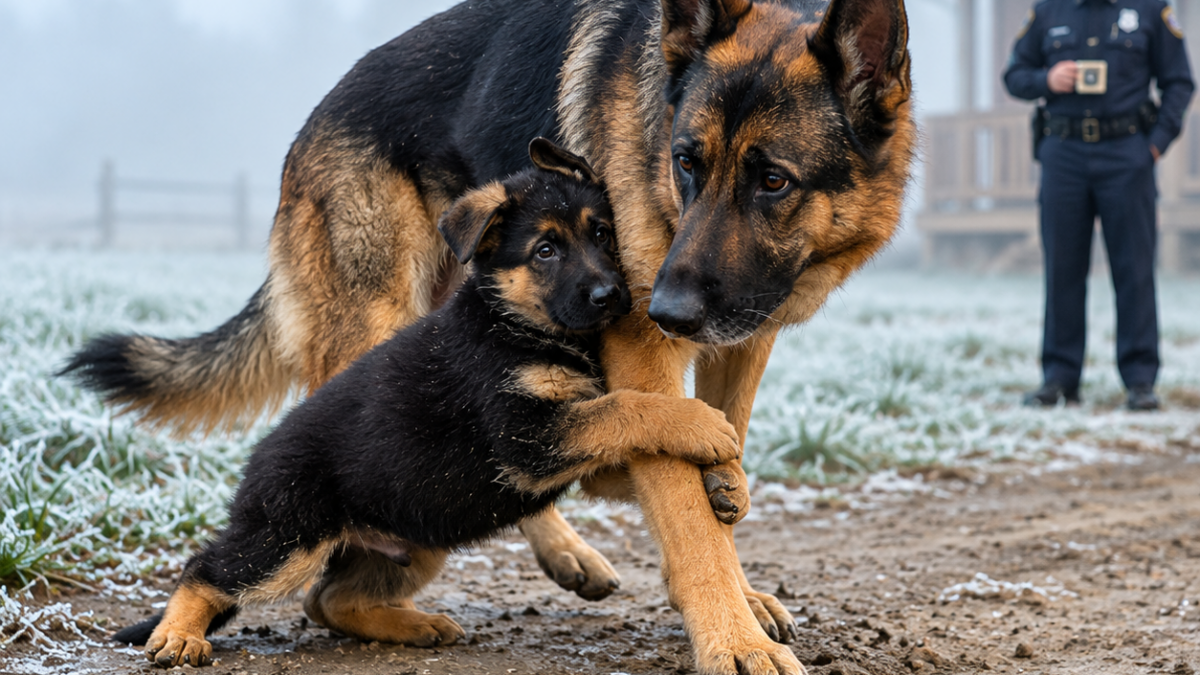
PART3:
Gunner stopped completely.
The puppy looked up.
He was maybe nine weeks old.
Too thin.
Dirty.
Black-and-tan coat tangled with dead grass.
One ear stood halfway while the other folded over like it had not yet decided what kind of dog it wanted to be.
His paws looked too big for his body.
There was mud dried beneath his belly and a small scratch across his nose.
But what made Clark stop smiling was the puppy’s eyes.
Fear.
Not ordinary puppy nervousness.
Panic.
The kind Clark had seen in people standing outside burning homes.
The kind that said there was only one safe thing left in the world and it was currently trying to walk away.
Gunner lowered his head toward the puppy.
A soft growl rolled from his chest.
Enough.
The puppy released him instantly.
He sat in the dirt.
His ears went back.
Gunner turned away.
The puppy stayed there.
For one second.
Two.
Three.
Gunner continued toward the house.
The puppy looked behind himself at the empty road.
Then at Gunner.
His entire body seemed to tighten.
He jumped up and ran after him.
This time he did not grab the old dog. He simply followed as close as possible, tiny legs working desperately to match Gunner’s longer stride.
Then he slipped near a muddy rut.
Without hesitation, both paws went around Gunner’s leg again.
Gunner froze.
Clark laughed despite himself.
The old dog raised his head and stared at him.
“You want me to arrest him?”
Gunner’s expression suggested Clark was no longer useful.
By the time they reached the porch steps, Gunner freed himself, climbed up, walked past Clark without acknowledgment, pushed through the open door, crossed the living room, and lowered himself dramatically onto his bed beside the fireplace.
He turned his back toward the door.
Case closed.
The puppy stopped on the porch.
Clark crouched.
“Hey, little guy.”
The puppy backed away.
Clark immediately stopped moving.
No growl.
No teeth.
Only fear.
That mattered.
A truly unsocialized puppy might avoid him, but this little dog’s reaction was different. His eyes went from Clark to the doorway, then back toward the road.
Clark remained crouched.
“Okay. Nobody’s grabbing anybody.”
He stood, went inside, filled a bowl with water, and placed it just beyond the threshold.
Then he stepped away.
The puppy stared at the bowl.
He did not approach.
Clark looked toward Gunner.
“Apparently this is your circus.”
One ear moved.
“Go show him.”
Gunner ignored him.
Clark folded his arms.
After thirty years in law enforcement, he had learned patience from murder suspects, city council meetings, and drunk people trying to explain why traffic laws did not apply to them.
He could outwait one retired German Shepherd.
Finally, Gunner sighed.
He stood, walked to the water, drank several times, turned around, and returned to his bed.
Only then did the puppy come inside.
He moved cautiously toward the bowl.
Sniffed.
Looked at Gunner.
Then drank.
Not politely.
Desperately.
Clark watched his sides move.
The little dog was thirsty enough to empty nearly half the bowl.
“That’s enough for a minute.”
Clark slid it back slightly so the puppy would not make himself sick.
The puppy startled but did not run.
Next came food.
Clark softened some kibble with warm water.
The puppy sniffed it.
Again, he would not eat.
Clark looked at Gunner.
Gunner looked away.
“Don’t make me hand-feed you to demonstrate.”
That got an ear twitch.
Clark took one piece of kibble from Gunner’s bowl and offered it to the old dog.
Gunner swallowed.
The puppy immediately lowered his head and began eating.
Clark’s smile disappeared.
That told him something.
The puppy did not trust the house.
He did not trust Clark.
He trusted Gunner.
If Gunner drank, water was safe.
If Gunner ate, food was safe.
If Gunner stayed, maybe this place was safe.
Clark sat on the edge of his chair.
“No collar.”
The puppy glanced up.
“No tag.”
Nothing.
“You smell terrible.”
A tiny tail moved once.
Clark almost smiled.
He had not intended to name him.
That would have been stupid.
Naming things was how temporary situations became permanent responsibilities.
Still, the word appeared in Clark’s head.
“Olly.”
The puppy lifted his head.
Clark frowned.
“Don’t do that.”
Olly stared.
“That wasn’t your name. That was a test.”
Tail wag.
Clark pointed toward him.
“Temporary.”
From his bed, Gunner groaned.
“I agree.”
For the first half hour, Olly remained careful.
Then warmth began reaching his bones.
Food settled in his stomach.
Fear loosened its grip.
And the quiet house Clark had spent two years constructing was destroyed by one puppy in approximately seventeen minutes.
The first casualty was a sock.
Clark found Olly dragging it backward across the kitchen floor.
“No.”
Olly pulled harder.
“Absolutely not.”
Clark reached.
Olly ran.
He tore through the living room with the sock flapping from his mouth, made an overly ambitious turn near the couch, lost traction, spun halfway around, regained balance, and continued as if everything had gone exactly according to plan.
Clark stood with one hand on his hip.
Gunner watched from his bed with open contempt.
“You’re responsible.”
Gunner closed his eyes.
Then Olly discovered Gunner’s tail.
The old dog was stretched beside the fireplace when his tail moved once across the floor.
Olly froze.
Clark recognized the posture immediately.
Front end lowering.
Rear end rising.
Tiny tail twitching.
“Don’t.”
Olly pounced.
His baby teeth closed around the end of Gunner’s tail.
Gunner came upright so fast Olly fell backward.
The puppy sat.
Gunner stared.
Olly stared back.
Gunner’s ears lifted.
Olly’s tail began to wag.
Slowly at first.
Then faster.
“No,” Clark whispered.
Olly attacked again.
Gunner growled and moved to the opposite side of the room.
Olly followed.
Gunner walked into the hallway.
Olly followed.
Gunner turned into the kitchen.
Olly followed.
Gunner doubled back.
Olly doubled back.
Five minutes later, the house became suspiciously quiet.
Clark found Gunner lying on the laundry room floor wedged between two baskets.
His expression was dark.
Clark leaned against the doorway.
“You’re hiding from a nine-week-old puppy.”
Gunner looked away.
A tiny head appeared around the corner.
Gunner’s eyes closed.
Olly squeezed into the laundry room.
Clark laughed.
And something about the sound startled him.
Not Olly.
Clark.
The house had not heard much laughter in two years.
Not real laughter.
There had been television laughter. Radio hosts. Joanne making jokes at the pantry. Clark chuckling politely in the grocery store when someone said retirement must be nice.
But laughter that arrived before he had time to stop it?
He could not remember the last time.
That realization made him uncomfortable enough that he left the laundry room and pretended he needed more coffee.
By evening, Olly could barely keep his eyes open.
Clark placed an old cushion near the fireplace and covered it with a folded blanket.
“That’s yours.”
Olly sniffed it.
Walked around it twice.
Sat.
“Good.”
Clark went to the kitchen.
When he returned, the cushion was empty.
Olly was asleep on Gunner’s bed.
His entire small body was pressed into the older dog’s side.
His head rested across Gunner’s foreleg.
Gunner was awake.
He looked directly at Clark.
Clark raised both hands.
“Not my problem.”
Gunner stood.
Olly woke instantly.
Gunner crossed the room.
Olly followed.
Gunner returned.
Olly followed.
Gunner stood beside the bed for several seconds.
Olly climbed onto it first.
The old dog released a long breath through his nose.
Then he lay down.
Olly curled against him and fell asleep almost immediately.
At 2:07 that morning, Clark woke for water.
The fire had burned down to an orange glow.
He stopped in the living room.
Olly was still asleep beside Gunner.
One tiny paw rested over the old dog’s leg.
Gunner could have moved.
There was plenty of room.
Instead, one of his front legs rested just behind Olly’s back, keeping the puppy away from the edge of the bed.
Clark watched.
“You’re getting soft,” he whispered.
Gunner’s eyes opened.
Clark continued toward the kitchen.
The next morning changed everything.
Gunner went into the yard shortly after sunrise.
Olly followed automatically.
Clark stood on the porch with coffee.
Olly started toward Gunner’s leg, received one warning look, and reconsidered.
“Learning,” Clark said.
The puppy walked beside him instead.
Then, without warning, Olly stopped.
His tail dropped.
The playful softness vanished from his body.
His ears flattened.
He stared toward the end of the road.
Clark followed his gaze.
An old house stood beyond a sagging fence about half a mile away.
Empty.
It had been empty for months.
The place had belonged to a family Clark barely knew. He remembered an older pickup truck, children once riding bicycles near the road, a barking dog behind the fence.
Then one day the truck disappeared.
Curtains came down.
Property notices went up.
That was about as much as Clark knew.
Olly whined.
Gunner turned.
The puppy looked at the old dog.
Then toward the abandoned house.
For the first time since arriving, he voluntarily moved away from Gunner.
He ran.
“Olly!”
The puppy crossed the yard, squeezed through the lower fence gap, and headed straight toward the empty property.
Clark set his coffee down so fast some spilled over the railing.
“Damn it.”
Gunner was already moving.
The old dog reached the fence and stopped because his larger body could not fit through the puppy-sized opening.
“Come on.”
Clark opened the gate.
By the time they reached the old property, Olly had disappeared behind the house.
Clark’s stomach tightened.
“Olly!”
No answer.
Then came a crash.
Metal against wood.
Gunner changed instantly.
The relaxed house dog vanished.
His head came up.
His shoulders tightened.
His pace increased.
Clark felt something old wake in himself too.
The awareness.
The scanning.
The automatic calculation of doors, windows, obstacles, sounds.
Retirement had removed the badge.
It had not removed thirty years of reflex.
They rounded the house.
Another sound.
Behind a storage shed.
Gunner reached it first.
Olly was trapped between weathered boards and a fallen sheet of thin metal. He was not injured, but he was terrified, scratching uselessly as the metal shifted around him.
“Easy.”
Olly heard Clark but kept struggling.
Then Gunner moved closer.
He stopped where the puppy could see him.
Olly went still.
Almost instantly.
Gunner stood there.
No bark.
No touch.
Just presence.
Clark removed the metal carefully, shifted one board, and reached in.
Olly scrambled into his arms.
His heart hammered against Clark’s hand.
“You trying to kill me before breakfast?”
Olly twisted toward Gunner.
Clark set him down.
The puppy immediately pressed himself against the old dog’s front leg.
Gunner smelled him from nose to tail, checking.
Satisfied, he remained beside him.
Clark exhaled.
Then he noticed the bowl.
A metal dog dish, half buried beneath leaves near the back step.
Old.
Scratched.
He picked it up.
A few feet farther away, under a board, something faded red showed through the weeds.
Clark bent.
A puppy collar.
The fabric was weathered, but the size was right.
A corroded metal tag hung from it.
Clark rubbed dirt away with his thumb.
Most of the lettering was unreadable.
Two letters remained.
O.
L.
Clark stared.
Olly had gone very still.
The puppy was looking at the back door.
Not exploring.
Remembering.
Clark felt the first cold suspicion settle into him.
“You’ve been here.”
The house answered with silence.
Over the next two days, Clark asked questions.
He told himself he was not investigating.
That lasted about twenty minutes.
Retired officers are not great at casually wondering.
He spoke with a neighbor named Mrs. Hargrove, who had lived across the road for twenty-three years and treated privacy as an unfortunate obstacle to community knowledge.
“Yes, they had dogs,” she said immediately. “A shepherd, I think. Big female. Pretty thing.”
“Puppies?”
“Maybe. I heard crying one night.”
“People crying?”
She frowned. “Dogs.”
“What happened to the family?”
“Money trouble. Husband lost work. Then there were arguments. Sheriff’s deputy came once.”
Clark knew better than to accept neighborhood memory as evidence, but pieces were forming.
He called the county shelter.
No surrender record.
No missing puppy report.
He called a veterinary clinic in town.
They remembered treating an adult German Shepherd registered to the address nearly a year earlier.
Female.
Name: Shadow.
No record of puppies.
Clark went home with more questions than answers.
Olly slept beside Gunner.
That night, thunder rolled across the valley.
The sound was distant.
Olly froze anyway.
The second rumble sent him under the dining table.
Clark crouched several feet away.
“Hey. It’s okay.”
Olly pressed himself deeper into the shadows.
Another rumble.
Gunner lifted his head from the fireplace.
He stood.
Walked to the table.
And lay down beside it.
That was all.
No command.
No rescue.
No attempt to drag Olly out.
He simply stayed.
Minutes passed.
Olly’s nose appeared.
Then his head.
He crawled from under the table and lay against Gunner.
One little paw settled over the older dog’s foreleg.
Gunner did not move away.
Clark stood in the kitchen doorway watching.
Suddenly the abandoned house bothered him more than before.
A puppy that young should not know abandonment panic.
Should not stare at empty doorways like they had betrayed him.
Should not need another living creature to prove food was safe.
Should not react to thunder like the sky itself was coming to take something away.
Clark sat in his chair.
He did not sleep much that night.
Two days later, Joanne Rusk stopped by.
Joanne was sixty-seven, widowed, opinionated, and incapable of entering Clark’s house without immediately identifying something he should be doing differently.
She managed the small community food pantry several streets over.
She stepped inside, saw Olly hiding partly behind Gunner, and smiled.
“So this is the temporary dog.”
“Correct.”
“How many days qualifies as permanent?”
“Don’t start.”
Olly sniffed her boot.
Joanne looked at Gunner.
The old dog looked exhausted.
“You look like a single father.”
Gunner walked away.
Olly followed.
Joanne laughed.
Then her expression turned serious.
“I need help at the pantry.”
Clark’s shoulders tightened before she finished.
“No.”
“You don’t know what I’m asking.”
“You need boxes moved.”
“I do.”
“No.”
“You retired, Clark.”
“Exactly.”
“You didn’t die.”
“Close enough.”
Joanne studied him.
Clark looked away.
She knew the truth because she had known him before retirement.
For three decades, Clark’s identity had been built around usefulness.
Someone called.
Clark went.
Someone was missing.
Clark searched.
Someone was in danger.
Clark stood between them and it.
Then retirement arrived and everyone congratulated him for finally getting his life back.
The problem was Clark had no idea what “his life” was without somebody needing something.
So he had made his world small.
Coffee.
Gunner.
Property.
Grocery store on Tuesdays.
Joanne on rare occasions when she refused to accept no.
No emergencies.
No responsibility.
No chance of failing anyone.
Joanne sighed.
“Fine.”
She headed toward the door.
Olly followed her briefly.
Then stopped and ran back to Gunner.
Joanne looked over her shoulder.
“You know, sometimes being needed isn’t the same as being trapped.”
Clark frowned.
She left.
That evening, Clark discovered Olly had stolen his glove and carried it onto Gunner’s bed.
He told himself this had nothing to do with Joanne.
Several days passed.
Olly grew bolder.
He learned that the refrigerator opening sometimes meant cheese.
He learned that Clark’s boots were not chew toys.
Then forgot.
He watched Gunner constantly.
When Clark said, “Sit,” Gunner sat.
Olly tried.
His rear end hit the floor.
His front half leaned too far sideways.
He tipped over.
Clark laughed.
Olly scrambled upright, stared at Gunner as if the older dog had somehow sabotaged him, and tried again.
Gunner looked straight ahead.
“Patience,” Clark told him.
Gunner’s eyes shifted toward Clark.
“Yeah, yeah.”
Something else changed.
Gunner stopped running from him.
Not entirely.
Olly still attacked his tail often enough that Gunner occasionally sought refuge behind furniture.
But when Olly was frightened, Gunner stayed.
When the puppy woke from a nightmare whining, Gunner did not leave the bed.
When Olly lost sight of him and panicked, Gunner waited in the doorway until he calmed down.
And one morning, Gunner went outside without Olly.
Clark noticed only because the expected sound never came.
One.
Two.
Three seconds.
No puppy.
Gunner reached the middle of the yard.
Stopped.
Turned around.
Looked toward the house.
Clark leaned against the doorframe.
Gunner waited.
Olly finally appeared from the hallway, one ear flattened strangely from sleep.
His tail exploded into motion.
He ran toward the door.
Gunner turned away the moment he saw him and continued toward the fence.
Clark smiled.
“So now you wait for him.”
Gunner ignored him.
The investigation into Olly’s past might have ended there if Clark had been better at leaving unanswered things alone.
He wasn’t.
A week later, the owner of a feed store mentioned something.
“You asking about the old Pierce property?”
“That’s the one.”
The man frowned.
“There was some ugly stuff there before they left.”
“What kind?”
“Dogs.”
Clark went still.
The feed store owner lowered his voice.
“Guy bred shepherds on the side. No license that I know of. Sold puppies online. Wife hated it.”
Clark felt anger rise.
“How many?”
“No idea.”
“Who bought them?”
“No idea.”
“What happened when they moved?”
“Thought they took everything.”
Clark returned to the abandoned house with the sheriff’s permission to walk the exterior property after explaining he was trying to identify the puppy.
Behind the shed, he found more than the collar.
Old plastic feeding pans.
A chain.
A broken crate.
A pile of moldy puppy pads inside a trash bag.
And beneath a section of collapsed porch, a cheap plastic transport kennel.
Too small for an adult German Shepherd.
Inside were claw marks.
Clark stared at them for a long time.
The marks were low.
Puppy height.
His jaw tightened.
He called the county animal welfare officer.
That turned the quiet question into a real investigation.
Records showed the former occupant, Travis Pierce, had advertised German Shepherd puppies on social media and classified sites under different names. At least three buyers later complained of sick or underage puppies. Nothing had resulted in charges because nobody connected the cases.
Until now.
One former buyer remembered being told the mother dog was named Shadow.
Another had screenshots showing a litter photographed on the back porch of the abandoned house.
Six puppies.
Clark zoomed in.
One puppy had a black patch shaped like a hook near his left shoulder.
Olly had the same marking.
Clark sat at his kitchen table staring at the image.
Six puppies.
One mother.
Five sold.
One apparently left behind.
Why?
The answer came from a message provided by one former buyer.
Travis Pierce had complained that the “last male” was too timid and too attached to the mother.
Bad temperament.
Won’t sell.
Clark had to put the phone down.
He looked across the room.
Olly was asleep with his nose pressed into Gunner’s fur.
Too attached.
As if attachment were a defect.
As if fear in a newborn animal said something ugly about the animal rather than the life surrounding it.
The animal welfare officer eventually located Travis in Idaho.
He denied abandoning Olly.
Claimed the puppy must have escaped before the family left.
Claimed he thought someone else had taken him.
Claimed he had “a lot going on.”
The excuses changed.
The evidence did not.
Neighbors had seen vehicles leaving the property.
No one saw anyone return.
Temperatures had dropped below freezing several nights afterward.
Olly had somehow survived.
Clark drove home from the sheriff’s office furious enough that he passed his own road and had to turn around.
He found Gunner and Olly near the fireplace.
Olly jumped up.
Ran toward him.
Stopped several feet away because he still sometimes remembered fear before affection.
Clark crouched.
The puppy approached slowly.
Then placed both front paws against Clark’s knee.
Clark looked down.
“You weren’t lost.”
Olly wagged.
“You were left.”
The words nearly broke something in him.
He sat on the floor.
Olly climbed awkwardly against his legs.
Gunner lifted his head from the bed.
Clark looked at him.
“You found him there, didn’t you?”
Gunner’s ears moved.
Clark imagined that morning before sunrise.
Gunner wandering farther than usual.
Finding the abandoned property.
Finding one thin puppy somewhere near that yard.
Maybe Olly approached him because Gunner looked like the mother he had lost.
Another German Shepherd.
Adult.
Steady.
Familiar.
Maybe Gunner tried to leave.
Maybe Olly followed.
And when Gunner realized the puppy would not survive alone, the old police dog had done what he had been trained to do for six years.
He brought the vulnerable one home.
“You son of a gun,” Clark whispered.
Gunner lowered his head again.
Olly climbed into Clark’s lap.
That night Clark called the shelter.
The legal holding period still needed to finish.
No owner had come forward.
Clark told them he would continue fostering Olly.
“Fostering,” he repeated afterward.
Gunner looked skeptical.
“Temporary.”
Gunner closed his eyes.
The next week, Olly woke Clark after midnight.
Sharp bark.
Pause.
Another bark.
Clark sat upright.
Olly stood at the back door.
“What?”
Olly ran to Gunner.
Nudged his shoulder.
Ran back.
Barked.
Gunner rose.
That got Clark moving.
He pulled on jeans, boots, and a coat.
The moment the door opened, Olly ran.
Not toward the abandoned house.
Toward the community pantry.
Gunner followed.
Clark went after both of them.
Cold air burned his lungs.
When they reached the pantry, a figure stood beside the small wooden structure.
An older man.
Lloyd Tatum.
Seventy-four.
Retired mechanic.
Clark knew him by sight.
Lloyd had one paper bag in his hand.
Several cans sat inside.
He froze when Clark approached.
“I was putting it back.”
Clark looked at the bag.
“You don’t have to.”
Lloyd’s face tightened.
“I can manage.”
Joanne emerged from the storage room.
One look told her everything.
“Lloyd.”
“I said I can manage.”
“I heard you.”
He placed a can back on the shelf.
Joanne stepped closer.
“The pantry exists for nights like this.”
“I’m not taking charity.”
“Then don’t call it charity.”
“What do you want me to call it?”
“Dinner.”
Lloyd’s jaw worked.
Clark recognized the shame.
He had seen it hundreds of times.
People would sleep in cars before admitting eviction.
Go hungry before saying broke.
Bleed before asking for help.
Dignity was strange that way.
Sometimes it saved people.
Sometimes it nearly killed them.
Then Olly ran forward.
Before anyone could stop him, he grabbed one of Lloyd’s work gloves from the shelf.
“Olly.”
The puppy ran.
Four steps.
His back legs tangled.
He rolled onto his side.
Still holding the glove.
Silence.
Then Lloyd laughed.
A startled, rusty laugh that seemed to surprise him more than anyone.
Olly scrambled upright and shook the glove.
Joanne smiled.
Clark did too.
Lloyd walked toward the puppy.
“Give me that.”
Olly dropped it.
When Lloyd returned to the pantry, he did not put the food back.
Clark did not say anything.
Neither did Joanne.
Some forms of mercy work better without witnesses.
On the walk home, Olly stayed beside Gunner.
Clark followed.
And for the first time in months, he caught himself wishing Joanne would ask again about helping at the pantry.
She did.
Clark said yes.
He made it sound reluctant.
Nobody believed him.
The house continued changing.
Lloyd occasionally came for coffee.
Joanne began leaving supply lists on Clark’s counter without permission.
Olly stole fewer socks and more gloves.
Gunner developed a habit of waiting for the puppy before entering the yard.
Clark’s quiet retirement began filling with inconvenient people.
He discovered he did not hate it.
Then the shelter called.
Olly’s holding period was nearly over.
A family in Billings had seen his profile.
Experienced with German Shepherds.
Fenced property.
Good references.
No young children.
One adult worked from home.
Excellent veterinary history.
They wanted to meet him.
Clark stood in the kitchen listening.
Everything about them sounded right.
“That’s good,” he said.
The shelter employee agreed.
Clark hung up.
Across the room, Olly slept stretched across Gunner’s paw.
Gunner’s eyes were closed.
Clark looked at them for a long time.
“This is good.”
Neither dog responded.
The family would come in two days.
Clark found a small travel bag.
Blanket.
Food bowl.
Chew toy.
Tennis ball.
The stolen glove he had finally surrendered.
Gunner entered while Clark was packing.
The old dog sniffed the bag.
Then looked toward Olly.
Clark noticed.
“Don’t start.”
Gunner stared at him.
“He needs a real family.”
Gunner looked around the house.
Clark frowned.
“I know what you’re implying.”
Gunner walked away.
That night Olly climbed onto Gunner’s bed.
Usually Gunner pushed him toward one side before settling.
This time he did not.
He lay down close.
Olly curled beneath his chest.
Clark turned off the lamp.
In the darkness, he stood longer than necessary.
He remembered his wife, Ellen.
He had not thought about her this sharply in months.
Ellen had died eleven years earlier from ovarian cancer after twenty-eight years of marriage. Clark had spent the first year after her death working every extra shift offered because an empty house felt easier if he returned too exhausted to notice it.
Gunner came into his life two years later.
Different kind of grief.
Different kind of companionship.
But the same lesson.
Love rarely asks whether the timing is convenient.
It simply moves into the empty place.
Clark went to bed angry at himself.
The next day, he helped Joanne carry boxes at the pantry.
Lloyd stopped by.
Mentioned a heater in his backyard shed was acting strangely.
“I’ll check it later,” Clark offered.
Lloyd waved him off.
“I can do it.”
Clark almost argued.
Then let him go.
By the time Clark returned home, the afternoon light was fading.
Gunner met him at the porch.
Clark stepped out of the truck.
Automatically looked behind him.
No Olly.
He waited.
Nothing.
“Where’s the kid?”
Gunner turned toward the house.
Clark went inside.
Living room empty.
Kitchen.
Hallway.
Bedroom.
“Olly!”
Nothing.
Back outside.
Gunner was already near the fence.
One lower board had come loose.
Puppy-sized opening.
Clark’s stomach dropped.
“Track.”
The command came automatically.
Gunner transformed.
Nose down.
Focused.
He smelled near the broken board.
Moved along the grass.
Returned.
Then took off.
Clark followed.
They crossed the road.
Not toward the abandoned house.
That surprised him.
Gunner kept moving past two properties.
Then three.
“Olly!”
Nothing.
The temperature was dropping fast.
Clark pictured ditches.
Roads.
Coyotes.
A puppy trapped beneath something.
Gunner suddenly accelerated.
They were approaching Lloyd’s property.
Then Clark heard it.
A bark.
High.
Sharp.
Again.
“Olly!”
Gunner ran.
Behind Lloyd’s house, the shed door stood partly open.
Olly appeared in the gap.
Barked.
Spun around.
Ran back inside.
Clark reached the doorway.
“Lloyd?”
A weak voice.
“Back here.”
Lloyd lay on the wooden floor beside a stool.
One hand pressed against his hip.
Olly circled him frantically.
“What happened?”
“Checking the heater. Foot slipped.”
“Hit your head?”
“No.”
“Can you stand?”
“Tried.”
“Don’t try again.”
Clark knelt, checked him, pulled out his phone.
Olly paced.
Door.
Lloyd.
Clark.
Door.
Bark.
Back to Lloyd.
The puppy had no training.
No procedure.
No understanding of emergency response.
He simply knew someone was down.
And he refused to leave him there.
“How long?” Clark asked.
“Maybe thirty minutes.”
Lloyd looked at Olly.
“He crawled under the shed door.”
Clark looked toward the gap beneath it.
Small.
Barely enough.
“He started barking the second he saw me.”
Lloyd gave a tired smile.
“Annoying little thing.”
Olly barked at him.
Lloyd laughed weakly.
Help arrived soon after.
Lloyd had fractured his hip.
Not minor.
Not catastrophic.
But serious enough that he would never have been able to get himself up.
The shed temperature was already falling.
The heater had shut off completely.
If Olly had not escaped the yard…
If he had not gone to Lloyd’s…
If he had not barked until Clark followed…
The paramedic said what everyone was thinking.
“He could’ve been out here all night.”
Clark looked at the puppy.
Olly had returned to Gunner.
And wrapped both paws around the old dog’s front leg.
Exactly like the first morning.
Gunner looked down.
Clark waited for the growl.
The impatient step.
The old “enough” expression.
It never came.
Olly tightened his grip.
Gunner lowered his head.
One slow lick across the puppy’s head.
Then he stood still.
He let him hold on.
Clark’s throat tightened.
The first morning, he had thought it was funny.
Now he understood.
Olly was not trying to stop Gunner from walking.
He was asking a question.
Are you still here?
Every time the old dog moved away, Olly needed the answer again.
Gunner stayed.
That was his answer.
Clark rested one hand on the retired K9’s shoulder.
“You brought him home, buddy.”
The next morning, the family from Billings arrived at ten.
Clark had barely slept.
Russell and Elaine Dorr were kind.
That made everything worse.
If they had been careless, loud, arrogant, inexperienced—anything—Clark could have refused them without questioning himself.
Instead, Russell crouched when Olly approached.
Let the puppy smell his hand.
Did not reach over his head.
Elaine asked about feeding, vaccinations, fear triggers, sleep habits.
They had owned two German Shepherds.
Their last dog had died at fourteen.
Their fence was six feet high.
Their veterinarian had written an excellent reference.
They had already bought a crate and a bed.
They liked Olly.
Olly liked them.
Clark hated that.
Not them.
The fact that they were good.
Russell rolled a tennis ball.
Olly chased it.
Brought it halfway back.
Abandoned it for a leaf.
Elaine laughed.
Clark smiled despite himself.
This could work.
That was the problem.
Gunner watched from near the doorway.
After nearly an hour, Russell stood.
“We should probably head out before the weather changes.”
Clark nodded.
The travel bag waited beside the door.
He picked it up.
Olly saw movement and followed everyone to the porch.
Gunner stayed in the living room.
At the threshold, Olly stopped.
Looked back.
Gunner stood several feet away.
The puppy stared.
Elaine waited.
Russell crouched.
“Come on, buddy.”
Olly looked toward them.
Took one step onto the porch.
Then another.
Clark’s chest tightened.
This was right.
This was what fostering meant.
You helped.
Then you let go.
Olly reached the second porch step.
Stopped.
Turned.
Ran.
“Olly.”
He flew back into the house.
Straight across the living room.
Onto Gunner’s bed.
He curled tightly in the middle.
The room went silent.
Gunner approached.
Clark remembered the first night.
Olly stealing the bed.
Gunner standing up.
Walking away.
Olly following.
Again.
Again.
Again.
Until Gunner finally surrendered.
This time, Gunner did not leave.
He climbed onto the bed.
Lowered himself beside Olly.
Then placed one front leg across the puppy’s back.
Olly stopped trembling.
His eyes closed.
Clark stared at them.
The travel bag suddenly felt absurd in his hand.
Olly had not run back because he preferred that bed.
He had run back to the place where food became safe only after Gunner ate.
The place where thunder passed because Gunner stayed beside the table.
The place where Clark’s slippers became a pillow.
The place where people left rooms and came back.
The place where he had learned that disappearance was not always abandonment.
Home.
Olly had already chosen it.
Clark had simply been the last one to understand.
He set the bag down.
“I think I need to call the shelter.”
Elaine smiled.
“I think you probably do.”
Russell looked at the two dogs.
“No hard feelings.”
Clark swallowed.
“You drove all this way.”
Russell shrugged.
“We drove here to make sure a puppy got a home.”
He pointed toward Gunner’s bed.
“Looks like the job’s done.”
Elaine crouched beside Olly one last time.
The puppy lifted his head.
She scratched behind his ear.
“You already picked your people, didn’t you?”
Olly tried to steal Russell’s glove.
Everyone laughed.
By that afternoon, the paperwork was complete.
Permanent adoption.
Clark Fenner.
Owner.
The word felt strange.
He looked at Gunner.
“No comments.”
Gunner slept.
Clark unpacked the travel bag.
Blanket back beside the fireplace.
Bowl back in the kitchen.
Toys everywhere.
The glove never returned to its original purpose.
Nothing in the house looked dramatically different.
Yet everything had changed.
Olly was no longer waiting for someone to decide whether he belonged.
He belonged.
The investigation into his abandonment continued quietly.
Animal welfare officials eventually confirmed that Travis Pierce had left the property without ensuring the last puppy was transferred or surrendered. He received charges related to animal abandonment and unlicensed breeding violations. The penalties were not as dramatic as Clark thought they should be.
Fines.
Probation.
Restrictions on animal ownership.
People always imagined justice as something that balanced pain perfectly.
Clark knew better.
A courtroom could not return the nights a nine-week-old puppy spent alone.
Could not explain to an animal why doors closed.
Could not undo hunger.
Justice was sometimes simply making sure the same person could not easily do it again.
For Clark, that had to be enough.
Winter came hard that year.
Snow buried the road edges.
Gunner moved more slowly in the cold.
Olly grew.
Too quickly, according to Clark.
His ears finally stood at the same time, though one tilted whenever he was confused.
He learned “sit.”
“Stay” remained more theoretical.
He learned not to attack Gunner’s tail.
Mostly.
He learned that Joanne always carried treats.
He learned Lloyd’s house was worth visiting because recovery from hip surgery meant Lloyd spent more time sitting and therefore became an excellent target for puppy affection.
And Lloyd changed too.
After leaving rehabilitation, he started coming to Clark’s twice a week.
At first, Clark told himself he was checking on him.
Then Lloyd began bringing coffee.
Then Joanne started joining.
Soon Clark’s kitchen table, which had once held newspapers and one mug, regularly held three mugs, pantry lists, dog hair, and arguments about football.
One snowy morning Clark opened the cabinet.
Reached for one mug.
Paused.
Took down two.
Lloyd sat in the chair opposite his.
Outside, snow drifted against the fence.
Near the fireplace, Gunner stood.
Olly lifted his head.
Months earlier, the puppy would have jumped up before Gunner took three steps.
This time, he watched.
Gunner left the room.
Olly stayed.
Clark noticed.
The puppy looked toward the doorway.
Waited.
Then lowered his head onto Clark’s foot.
Clark placed one hand along his back.
A few minutes later, Gunner returned.
Olly jumped up happily.
But there had been no panic.
No whining.
No frantic search.
Gunner had left.
Gunner had come back.
There was a difference now.
Olly was learning it.
Slowly.
Clark looked at Lloyd.
“You know what that means?”
Lloyd sipped coffee.
“That your dog finally stopped being neurotic?”
Clark glared.
“No.”
“Shame. That was my guess.”
“It means he trusts we come back.”
Lloyd’s expression softened.
He looked at Olly.
“Good lesson.”
Clark nodded.
“For people too.”
Lloyd said nothing.
He did not need to.
Spring came.
Olly doubled in size.
Then doubled again.
He began looking less like a puppy and more like a young German Shepherd, though he still attempted to climb into places built for his former body.
Including Gunner’s bed.
Clark bought Olly a brand-new orthopedic bed.
Thicker.
Larger.
Warmer.
Expensive enough that Clark complained about it for a week.
Olly ignored it.
Every night he squeezed onto Gunner’s.
Eventually Gunner stopped objecting.
Sometimes Clark woke before sunrise and found them lying side by side.
Old dog.
Young dog.
One scarred by years of service.
One scarred by being left too early.
Gunner began teaching him things without anyone asking him to.
How to wait at a doorway.
How to watch Clark’s hand signals.
How to stop at the road.
How to listen before charging into an unfamiliar space.
Clark never trained Olly as a police dog.
He had no interest in turning the puppy into Gunner’s replacement.
Nobody could replace Gunner.
But he allowed the young dog to learn discipline because discipline, when given with patience instead of fear, could become another form of safety.
Olly loved it.
More than Clark expected.
When Gunner sat, Olly sat.
When Gunner stopped, Olly stopped.
When Gunner looked toward Clark for permission, Olly began doing the same.
“Little copycat,” Joanne said one afternoon.
“Wrong species,” Clark replied.
Months later, the sheriff’s department invited Clark and Gunner to a retirement recognition event.
Clark almost refused.
He had spent enough years attending ceremonies where men congratulated each other for surviving work none of them knew how to stop doing.
But the chief asked personally.
And Gunner was getting older.
So Clark went.
Olly stayed with Joanne.
The event took place in the department garage.
Old photographs had been enlarged.
Gunner’s service record was displayed beside his retired badge.
Searches.
Apprehensions.
A missing seven-year-old he had located after thirteen hours in freezing weather.
An armed suspect found hiding beneath a crawl space.
A narcotics seizure Clark had forgotten about.
People gathered around Gunner.
Former officers scratched his neck.
Young handlers asked Clark questions.
Gunner tolerated the attention.
Then someone played a video from one of his first training years.
Young Gunner appeared on a screen.
Fast.
Powerful.
Black mask dark and sharp.
Clark watched the dog beside him.
Silver muzzle.
Stiff hips.
Slower breathing.
The contrast hurt.
Afterward, in the parking lot, Clark crouched beside him.
“We got old.”
Gunner looked away.
“Speak for yourself.”
One ear moved.
When they returned home, Olly ran out.
Straight past Clark.
Directly to Gunner.
But he did not grab his leg.
He stopped.
Touched his nose to Gunner’s chest.
Then walked beside him into the house.
Clark stood in the driveway.
That small restraint made him unexpectedly emotional.
Olly did not need to hold on every time anymore.
He had learned something stronger than clinging.
Trust.
That summer, Gunner began failing.
At first, only little things.
He stumbled getting up.
Slept longer.
Stopped finishing breakfast.
Clark told himself it was heat.
Then age.
Then arthritis.
The veterinarian found a mass near Gunner’s spleen.
Clark sat in the exam room with one hand on the old dog’s neck.
The vet explained options.
Surgery was possible.
Risky.
Tests first.
No promises.
Clark had spent his career delivering terrible news to families.
He had always believed there was a professional way to hear it.
There wasn’t.
He drove home without radio.
Olly sensed something immediately.
The moment Gunner entered, Olly pressed close.
Gunner went to his bed.
Olly climbed beside him.
Clark sat in his chair and stared at both dogs until the room blurred.
“No,” he said aloud.
Nobody had asked a question.
Treatment bought time.
Months.
Good months mostly.
Gunner still walked.
Still ate.
Still corrected Olly when necessary.
But Clark began noticing how often the old dog stopped simply to breathe.
Olly changed too.
The young energy remained, but around Gunner he became careful.
He stopped climbing over him.
Stopped attacking his tail entirely.
When Gunner struggled to rise, Olly stood nearby.
When he walked slowly, Olly matched him.
The puppy who once forced Gunner to drag him down a road learned to shorten his own stride for the old dog.
Clark watched them one evening crossing the yard together.
Olly could easily have run ahead.
He didn’t.
He stayed beside Gunner.
Exactly beside him.
Clark remembered something his old training sergeant used to say.
Loyalty isn’t who follows you when you’re strong.
It’s who slows down when you can’t keep up anymore.
That autumn, almost one year after Olly arrived, Gunner collapsed near the fence.
Olly barked first.
Clark ran.
Gunner was conscious.
Breathing hard.
They reached the veterinary clinic within twenty minutes.
Internal bleeding.
The tumor had ruptured.
Surgery could maybe give days.
Maybe weeks.
Or Gunner might die under anesthesia.
Clark stood beside the table.
His hands shook.
Olly was in the waiting room with Joanne, crying loudly enough that Clark could hear him through the wall.
The vet spoke gently.
“What would Gunner choose if he could?”
Clark closed his eyes.
That question hurt because he knew.
Gunner had spent his entire life doing hard things because Clark asked.
Running toward danger.
Holding position while injured.
Going back to work after stitches.
Crossing buildings where men waited with weapons.
Staying beside Clark after Ellen died.
Finding Olly.
Teaching him how not to be afraid.
Gunner had given enough.
Clark leaned down.
Pressed his forehead against the old dog’s head.
“You don’t have to work anymore.”
Gunner’s eyes stayed on him.
“You hear me?”
Clark’s voice broke.
“You’re off duty.”
Gunner breathed.
Clark cried openly.
He did not care who saw.
“You were the best partner I ever had.”
The vet asked whether Clark wanted Olly brought in.
Clark hesitated.
Then nodded.
Olly entered slowly.
For once, no rushing.
No chaos.
He saw Gunner lying on the blanket.
Stopped.
Walked forward.
He smelled the old dog’s face.
Gunner lifted his head weakly.
Olly placed one paw over Gunner’s leg.
The same gesture.
The first gesture.
The one that had started everything.
Gunner did not move.
Clark knelt beside them.
“You can stay.”
Olly lowered himself.
Pressed against Gunner’s side.
Gunner’s breathing gradually slowed.
Clark kept one hand on him.
Olly kept one paw on him.
When the veterinarian gave the final medication, Gunner exhaled softly.
His body relaxed.
And the retired police dog who had spent a lifetime refusing to leave anyone in danger finally left while two beings who loved him refused to leave him alone.
Olly stayed beside the body for several minutes.
Then stood.
Smelled Gunner once more.
Looked at Clark.
And walked to him.
Not frantically.
Not panicked.
He pressed his head against Clark’s chest.
Clark wrapped both arms around him.
They stayed on the floor together.
The house was unbearable afterward.
Gunner’s bed remained by the fireplace.
For three nights Olly slept beside it.
Not on it.
Beside it.
Clark did not move the bed.
Joanne came over but did not tell him what to do.
Lloyd brought coffee and sat quietly.
People from the department sent flowers.
One card simply said:
PARTNER FOREVER.
Clark placed Gunner’s retired badge beside the framed photograph from his service ceremony.
On the fourth night, Olly wandered through the house.
Clark sat in his chair.
The young dog stopped near Gunner’s bed.
Looked at it.
Then looked at Clark.
For a moment Clark thought he would lie down there again.
Instead, Olly crossed the room.
Placed both front paws on Clark’s knees.
Then slowly climbed his oversized body partly into Clark’s lap.
“You are not nine weeks old anymore.”
Olly ignored him.
Clark’s hand settled on his back.
The dog sighed.
Clark stared into the fire.
“I miss him too.”
Olly lowered his head.
Clark understood then that Gunner’s last gift was not only that he had rescued Olly.
He had taught Olly how to survive losing someone without believing the whole world had ended.
People leave.
Some because they choose to.
Some because life chooses for them.
But love that was safe can remain inside you after the body is gone.
Olly grieved.
But he ate.
He slept.
He followed Clark.
He waited by doors without panicking.
When Clark left for the pantry, Olly watched through the window.
When Clark came back, the dog greeted him joyfully.
He had learned the difference.
Someone leaving a room was not abandonment.
Someone dying after staying until the end was not abandonment.
And perhaps most importantly, loving again was not betrayal.
Winter returned.
Exactly one year and three months after Gunner had first come home dragging a puppy attached to his leg, Clark stood on the porch with his morning coffee.
Olly, now almost fully grown, walked the property.
Clark smiled at the similarity.
“Don’t bring anybody home.”
Olly disappeared down the road.
Clark’s smile faded.
“Olly.”
No answer.
He groaned.
Ten minutes later, the young German Shepherd returned.
Alone.
Mostly.
Joanne’s glove was in his mouth.
Clark stared.
“You crossed two streets to steal that?”
Olly wagged.
Clark laughed.
It came easily now.
The house behind him no longer felt like somewhere life had stopped.
Lloyd came by twice a week.
Joanne treated Clark as unpaid staff at the pantry.
Children from the neighborhood knew Olly’s name.
Clark had begun helping the sheriff’s department occasionally with community dog-safety demonstrations, where Olly served as an enthusiastic example of what happened when training met questionable impulse control.
And beside the fireplace, Gunner’s old bed remained.
Olly slept there sometimes.
Other nights he slept beside Clark’s chair.
He had his own expensive bed.
It remained almost completely unused.
One morning, Lloyd watched Olly squeeze himself into Gunner’s old bed and said, “You ever going to get rid of that?”
Clark looked at the bed.
The worn fabric.
The flattened side where Gunner had always rested.
The young dog curled inside the shape left behind.
“No.”
Lloyd nodded.
“Didn’t think so.”
Years later, people in Pinedale would remember Gunner as a police dog.
Clark remembered that too.
The courage.
The discipline.
The work.
But when someone asked him what Gunner’s greatest rescue had been, Clark never mentioned a suspect or a missing child or any commendation listed in department records.
He told them about a freezing October morning.
An old K9 coming home through the mist.
A tiny puppy wrapped around his leg.
A dog clearly annoyed by the entire situation.
And the simple fact that Gunner could have kept walking.
Could have shaken Olly loose.
Could have returned home alone.
He did not.
Somewhere on that road, the old dog recognized something Clark had not yet learned.
The puppy did not need somebody impressive.
He did not need a hero.
He needed somebody who stayed.
At first, that somebody was Gunner.
Then it became Clark.
Then Joanne.
Lloyd.
A whole small circle of people who had once believed needing others made them weak.
Olly changed all of them simply by being too young to pretend he did not need anyone.
And maybe that was why the puppy clung so hard that first morning.
He had already learned, at only nine weeks old, that doors could close.
Cars could leave.
Bowls could become empty.
People could disappear.
So when he found one old dog walking through the cold who did not hurt him, did not chase him away, and did not leave him beside the abandoned house, Olly held on with everything he had.
Gunner growled.
Gunner tried to walk away.
Gunner hid in a laundry room.
But when fear came, Gunner stayed.
And eventually, something beautiful happened.
Olly stopped needing to hold the leg.
He learned he could simply walk beside it.
That was Gunner’s real gift.
Not teaching a frightened puppy never to lose anyone again.
No creature can promise that.
He taught him that being loved once can make you brave enough to survive the day someone has to go.
He taught Clark something similar.
Retirement had convinced Clark his useful years were behind him.
Grief had convinced him a quiet house was safer than another loss.
Olly arrived and ruined both theories.
The puppy needed a home.
Lloyd needed someone to hear him.
Joanne needed help carrying boxes.
Gunner needed someone beside him at the end.
And Clark, though he had been too proud to say it, needed all of them.
Maybe family is rarely the thing we plan.
Maybe sometimes it arrives exhausted and muddy at seven in the morning, hanging from the leg of an irritated old dog.
Maybe it steals your gloves.
Interrupts your routines.
Takes over the bed you bought for someone else.
Makes your house noisy.
Makes your heart vulnerable.
And then one day, long after you stop calling it temporary, you realize the inconvenience was actually the rescue.
Not only for the one who came looking for a home.
For the ones who had forgotten they still had one to give.
Every winter, on the first truly cold morning, Clark still carried his coffee to the porch before sunrise.
Olly would stand beside him.
Older now.
Calmer.
His muzzle beginning to show the faintest gray.
Clark would sometimes look down the dirt road where Gunner had appeared through the mist all those years ago.
He could still see it if he let himself.
The old shepherd walking slowly.
The puppy attached to his leg.
Gunner looking toward the porch as though asking Clark to solve a problem he had accidentally brought home.
Clark would smile.
“You knew before I did, didn’t you?”
Olly would look up.
Clark would rest one hand on his head.
And somewhere in the silence between the mountains, the frost, the old house, and the bed still sitting beside the fireplace, Clark would remember the lesson Gunner had left behind.
When someone frightened finally trusts you enough to hold on, sometimes the most loving thing you can do is stop trying to walk away.








