Rescuers Heard Puppies Crying Beneath Metal at a Garbage Dump—But After Finding Nine of Them, They Realized the Most Heartbreaking Part of the Rescue Was Still Hidden
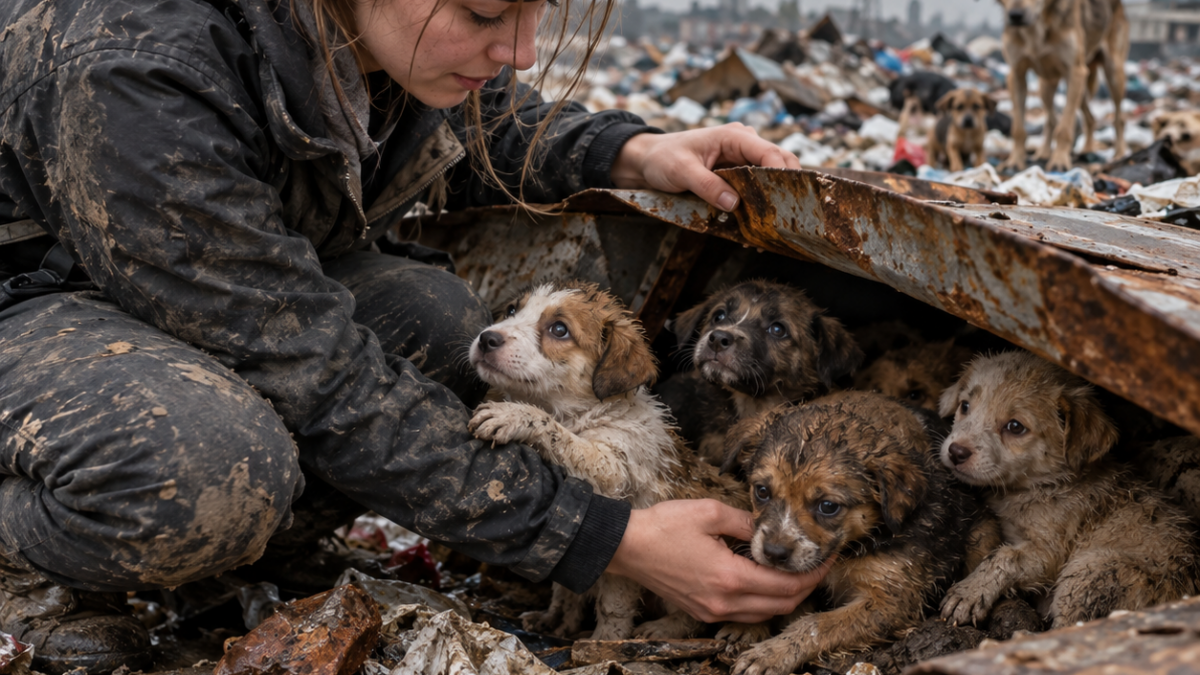
Rescuers Heard Puppies Crying Beneath Metal at a Garbage Dump—But After Finding Nine of Them, They Realized the Most Heartbreaking Part of the Rescue Was Still Hidden,
At first, we thought we were rescuing three abandoned puppies from a garbage dump.
Then we found six more hiding in the rain, two starving mothers watching from the shadows, and four tiny babies we had almost missed completely.
By the time it was over, thirteen puppies and two broken mother dogs had taught us that survival is sometimes hidden under rusted metal, plastic bags, and the kind of silence most people walk past.
The message came from a student just after noon.
She had been walking near the edge of a dump site when she saw puppies moving between piles of trash. At first, she thought they belonged to someone nearby, but when she waited and watched, no person came for them. No mother dog appeared. No food bowl sat beside them. No blanket. No shelter. Nothing but garbage, old plastic, broken glass, metal sheets, and the sour smell of waste heating under the sun.
She sent us a location pin and one blurry photo.
In the picture, I could barely see anything at first. Just a dirty patch of ground, torn bags, a bent piece of metal, and what looked like movement near the shadows.
Then I zoomed in.
A small face.
A puppy.
Its eyes were wide, dark, and scared.
That was all I needed.
We drove there immediately.
The dump was worse than I expected.
There are places that look dirty from far away, and then there are places that feel dangerous the moment you step into them. This was the second kind. The ground shifted beneath our shoes. Flies rose from ripped bags. Stray pieces of metal stuck out from the mud. Plastic fluttered in the wind like torn flags. The smell was heavy enough to sit in the back of my throat.
The student was waiting for us near the road, twisting her hands nervously.
“They were right here,” she said. “I swear. I saw them.”
“We believe you,” I told her.
But when we searched the spot she showed us, there were no puppies.
We checked behind broken boards.
Nothing.
We looked inside an old tire.
Nothing.
We moved carefully around the trash piles, calling softly, listening for movement.
Still nothing.
For nearly an hour, we searched the area.
Every few minutes, the student would point somewhere new.
“I think they went that way.”
“I saw one near that pile.”
“Maybe they crawled under there.”
We followed every guess.
Nothing.
The sun started to drop lower. The shadows grew longer. The dump became colder, uglier, quieter.
And I began to feel that terrible weight every rescuer knows.
The fear that you came too late.
The fear that something small and helpless was there, somewhere close, and you still could not reach it.
One of the volunteers sighed and wiped sweat from her forehead.
“Maybe the mother moved them.”
“Maybe,” I said.
But I did not believe it.
Something felt wrong.
The student had said the puppies lived there. Not passed through. Not wandered by. Lived there.
Puppies that young do not disappear cleanly from a place like that.
They hide.
We were about to widen the search toward the road when I heard it.
A cry.
So faint I almost thought it was a bird.
I raised my hand.
“Stop.”
Everyone froze.
The wind moved a loose piece of plastic.
Then we heard it again.
A tiny, broken whimper.
The student covered her mouth.
“There.”
PART2:
The sound was coming from beneath a large, rusted sheet of metal half-buried under trash. From the outside, it looked like nothing. Just scrap. The kind of thing people walk past without thinking.
We moved toward it carefully.
“Don’t lift it fast,” I said. “There may be sharp edges.”
One volunteer held the flashlight low.
Another slowly pulled away a torn bag caught on the side.
Then I saw eyes.
Three sets.
Three puppies were pressed together beneath the metal, their little bodies squeezed into the narrow gap between the rusted sheet and the dirt. They were covered in dust. Their paws were filthy. Their bellies looked swollen in that sick, unnatural way puppies’ bellies look when they are full of parasites or garbage instead of food.
They did not bark.
They did not run.
They just stared at us like they had already learned that the world was not safe.
“Oh, babies,” I whispered.
One was mostly brown with a white chest.
One was black with tan markings above the eyes.
The smallest one had pale fur and ears too big for her face.
When I reached in slowly, they backed away as far as the space allowed. The smallest puppy cried again, a thin sound that made the student start crying too.
“It’s okay,” I said softly. “We’ve got you.”
But they did not know us.
They did not know hands could help.
To them, hands were just another danger entering the dark.
We used towels.
Slowly. Gently. One puppy at a time.
PART3:
The brown one came first, trembling so badly the towel shook in my arms. The black one tried to hide his face against the metal. The little pale one pressed herself flat against the dirt until I had to slide my hand beneath her belly and lift her like something breakable.
She weighed almost nothing.
Once they were out, they clung to us with desperate little paws.
Not because they trusted us.
Because fear will make any warm body feel like shelter.
We placed them in a carrier lined with clean towels. They huddled together immediately, noses tucked against each other, still shaking.
The student kept whispering, “I’m sorry. I’m so sorry.”
I touched her shoulder.
“You found them,” I said. “That matters.”
We searched again before leaving.
Under metal.
Behind tires.
Near the broken fence.
Around the trash piles.
We found no mother.
No other puppies.
No fresh food.
No clean water.
Just scraps.
So we made the decision every rescuer hates making.
We took the three puppies to safety first, and we promised ourselves we would come back for their mother.
At the hospital, the smell of the dump still clung to them.
The veterinary staff moved quickly. Warm towels. Gentle hands. Clean blankets. Tiny exams. We named them temporarily so the staff could track them: Hope, Finn, and Lila.
Hope was the brown one.
Finn was the black one.
Lila was the tiny pale girl who had cried beneath the metal.
They were hungry, but we had to be careful. Puppies who have survived on trash cannot simply be given a big meal and left alone. Their bodies were fragile. Their stomachs were upset. Their intestines were irritated.
When the X-rays came back, the room went quiet.
Their bellies were filled with things puppies should never have eaten.
Tiny bone fragments.
Pieces of plastic.
Bits of garbage.
The vet stared at the images and shook his head.
“They were eating whatever they could find.”
I looked through the glass at the puppies curled together in the incubator.
Of course they were.
They had been trying to survive in a place where nothing soft or safe existed.
The doctor told us they needed time. Their bodies had to pass the debris safely. We had to monitor them closely, treat dehydration, manage parasites, and make sure nothing sharp caused internal damage.
For the next five days, that was our world.
Tiny meals.
Medicine.
Cleaning.
Warmth.
More cleaning.
Parasite treatment.
Soft blankets.
Careful monitoring.
Hope cried whenever she woke and could not see the others.
Finn tried to act brave but shook when anyone touched his paws.
Lila wanted to be held constantly. She would press herself into my chest and tuck her nose beneath my chin as if she were searching for a heartbeat that had gone missing.
They missed their mother.
That was obvious.
Even with food, warmth, and medicine, there was a kind of anxiety in them we could not fully soothe. They slept better when touching each other. They cried when separated for exams. They searched the room with their noses as if one familiar scent might bring everything back.
I kept thinking about the dump.
About the missing mother.
About the student’s words.
They live there.
On the fifth night, heavy rain started.
It came down hard, drumming against the hospital windows and flooding the parking lot. I remember standing near the puppies’ kennel, watching them sleep, when my phone rang.
It was one of our volunteers who had returned to the dump with another team.
Her voice was breathless.
“You need to come back.”
My stomach dropped.
“What happened?”
“We found more.”
“How many?”
A pause.
“Six.”
For a second, I could not speak.
Six more puppies.
In the rain.
At the same dump.
We rushed back with carriers, towels, flashlights, and food.
The dump looked completely different in the storm. Water ran between piles of trash. Metal sheets clanged in the wind. Mud swallowed our shoes. Every shadow moved.
We found the six puppies under a covered board we had missed the first time. They had been tucked farther back, hidden behind trash and soaked cardboard. They were older than the first three, maybe around two months old, but still thin and dirty. Their eyes reflected our flashlights. Their bodies stiffened when we approached.
They were searching for food.
That was what broke me.
Not playing.
Not exploring.
Not following their mother.
Searching for food in the rain under garbage.
We placed food down and stepped back.
They stared at us.
Then hunger won.
One puppy came forward.
Then another.
Then all six rushed to the food with tiny desperate sounds that were not quite growls and not quite cries.
We let them eat enough to calm them, then slowly gathered them.
They were scared, but too exhausted to fight much.
The strange part was this: they did not look like the same litter.
They were older.
Larger.
Different body shapes.
Different coats.
The first three were about six weeks old. These six were closer to two months.
That meant one thing.
They likely did not all come from the same mother.
We searched for the mother dog again that night.
Nothing.
Only paw prints in the mud.
Some small.
Some larger.
Some leading toward the back of the dump and disappearing where the ground became too messy to read.
“Maybe she ran when she saw us,” one volunteer said.
“Maybe,” I answered.
But I was no longer thinking about one mother.
I was thinking about two.
We brought the six puppies to the hospital.
Now we had nine.
Nine puppies from the same dump.
Nine little bodies carrying the same story of hunger, parasites, garbage, rain, and fear.
The hospital team stared at us when we walked in with the carriers.
One nurse said, “Please tell me that’s all of them.”
I wanted to say yes.
I really did.
Instead, I said, “We don’t know.”
The next days blurred together.
The first three needed careful monitoring because of the plastic and bone fragments in their stomachs.
The six new puppies needed parasite treatment, skin care, food, fluids, and time.
We set up a separate area for them with blankets and puppy pads. They were quiet at first, too quiet, the kind of quiet that comes from animals who have learned that making noise does not always bring help.
Then they began to change.
One found a toy and carried it like treasure.
Another discovered that blankets could be pulled into piles.
A tiny brindle girl barked at her own reflection in the metal water bowl and scared herself so badly she ran backward into her brother.
For the first time, the room began to sound like puppies should sound.
Messy.
Noisy.
Alive.
One of the first three, little Lila, was adopted by a nurse from the hospital.
The nurse had held her during one of the first difficult nights when Lila cried and refused to settle. After that, Lila searched for her every time she entered the room.
“I’m not adopting,” the nurse said for three days.
On the fourth day, she bought a pink blanket.
On the fifth, she filled out the paperwork.
Lila went home tucked inside that blanket, staring from the nurse’s arms with wide eyes.
She would never sleep under metal again.
She would never eat plastic again.
She would never cry in a dump and wonder if anyone heard.
That should have felt like enough.
But it did not.
Because somewhere out there, at least one mother was still missing.
We kept returning to the dump.
Morning.
Evening.
After rain.
Before sunrise.
We left food in safe places and watched from a distance. We checked for tracks. We spoke to workers nearby. We followed every report of a thin dog seen near the trash road.
For days, nothing.
Then came the call I had been waiting for and dreading.
“We found her.”
“Which one?”
The volunteer hesitated.
“Both.”
When we reached the dump, we saw them near the far edge of the property.
Two female dogs.
Both painfully thin.
Both wary.
Both standing near a broken concrete wall as if deciding whether to run.
One was tan with tired, gentle eyes and a face that looked older than her body should have been. The other was darker, with a rough coat, tense shoulders, and fear so sharp in her expression that I knew immediately she would not let us touch her easily.
And then we heard tiny cries.
Not from the mothers.
From behind them.
Four more puppies.
Four.
I remember actually sitting down on a broken piece of concrete because my legs stopped wanting to hold me.
Thirteen puppies.
Not nine.
Thirteen.
Two mothers.
Two litters.
A whole hidden family surviving in garbage while the world moved around them.
The four smallest puppies were tucked near a shallow space under concrete and boards. Three females and one male. They were younger than the second group but not as weak as the first three. Their little faces were confused when we brought them out. They blinked at us, unsure whether to hide or sniff.
The darker mother growled when we came too close.
Not viciously.
Desperately.
She was exhausted and terrified, but she still placed herself between us and the babies.
The tan mother stood beside her, trembling, but did not run.
I held out food.
Neither approached at first.
We stepped back.
The puppies cried.
The tan mother looked at them, then at us, then lowered her head and took one step toward the food.
That was the beginning.
We named the tan mother Gemma.
We named the darker one Bari.
Gemma was weak but willing to trust faster. Her eyes had warmth buried beneath fear, like a light still burning inside a house everyone thought was abandoned.
Bari was different.
Bari had survived by not trusting anyone.
She watched every movement. Every hand. Every carrier. Every sound. When I came too close, she snapped—not to hurt me, but to make the boundary clear.
I respected it.
“You don’t have to love us today,” I told her. “You just have to come with us.”
It took patience, food, barriers, and help from people who knew how to move scared animals without turning rescue into another trauma. Eventually, both mothers and the four remaining puppies were safely contained.
When we loaded them into the van, Gemma lowered her head against the carrier door.
Bari stayed standing the entire ride.
She did not take her eyes off me once.
At the hospital, the truth became heavier.
The puppies were scared but treatable.
The mothers were critical.
Gemma and Bari were both severely weakened. Their bodies had been feeding babies while they themselves were starving. Their bloodwork showed serious illness. Both needed treatment for babesiosis, a dangerous tick-borne disease that can cause anemia, weakness, fever, and even death if untreated.
The vet looked at me quietly after examining Bari.
“She is much worse than she wants us to know.”
That sentence stayed with me.
Because Bari had made herself look dangerous when really she was barely holding herself together.
Gemma allowed gentle handling sooner. She watched us with those warm, exhausted eyes as if she wanted to believe every kind thing but needed proof.
Bari did not.
For weeks, I wore gloves when feeding her.
Not because I was angry.
Because fear deserves safety too.
If gloves helped her eat without feeling trapped, I wore gloves.
If distance helped her breathe, I gave distance.
If she needed me to place the bowl down and walk away, I did.
Trust is not something you demand from a dog who has survived the worst of people and hunger and weather.
Trust is something you earn slowly enough that the dog can still choose no.
While the mothers stayed in the hospital, the healthier puppies came home with me.
All those little bodies.
All those paws.
All those eyes.
I turned one room of my house into a puppy disaster zone.
Blankets.
Pads.
Bowls.
Toys.
Tiny beds.
Medicine schedules taped to the wall.
At first, they moved carefully, as if the floor itself might betray them. They smelled every corner. They startled at normal household sounds. The washing machine. A closing cabinet. My phone ringing.
Even my cats stared at them from high shelves with complete judgment.
The puppies stared back with equal curiosity.
Within days, fear began turning into chaos.
They learned that toys squeaked.
They learned that water bowls could be stepped in.
They learned that blankets could be dragged.
They learned that slippers were apparently the most valuable objects in the world.
One morning I found three puppies asleep in a pile of stolen slippers.
Not chewing them.
Guarding them.
As if they had discovered treasure.
“I cannot keep buying slippers,” I told them.
One puppy yawned and put his paw on my slipper.
I bought more slippers.
That is how puppies win.
One by one, the adoptions began.
Each adoption should have been simple joy, but it never was. There was happiness, yes. Relief. Gratitude. But also a small ache each time one left.
I remembered where they came from.
I remembered metal.
Rain.
Trash.
Plastic in bellies.
Eyes full of fear.
Then I watched them leave in clean blankets, held by people who had already bought toys, beds, collars, bowls, and tiny promises they could not stop making.
One family adopted a playful female from the second group.
They sent a video two days later.
She was racing in circles around a living room rug, then suddenly flopped onto her back as if life had overwhelmed her with comfort.
Another puppy went to a retired couple who had lost their old dog the year before. They told me they were only fostering.
They adopted him in nine days.
“Technically,” the husband said, “he adopted my wife first.”
A little black puppy became inseparable from a boy who had been afraid of dogs until he met him.
A spotted female learned to sleep in a laundry basket even though her family bought three expensive beds.
Every update felt like a tiny reward for every hard moment.
But Gemma and Bari were still fighting.
Gemma improved first.
Her appetite returned slowly. Her gums gained color. Her steps became steadier. When I visited, she began wagging her tail before I reached her kennel.
One day, she pressed her forehead into my palm and closed her eyes.
I almost cried right there in the hospital.
“You’re coming back,” I whispered. “I know you are.”
Bari took longer.
Much longer.
Even after her body began healing, her fear stayed.
If I moved too fast, she stiffened.
If I reached toward her bowl, she backed away.
If someone unfamiliar entered the room, she retreated as far as the leash allowed.
I still wore gloves.
Then one morning, almost three months after we found her, I entered with her food and braced myself for the usual careful routine.
Bowl down.
Step back.
Wait.
Instead, Bari looked at me.
Not at the bowl.
At me.
Her tail moved once.
So small I almost missed it.
I froze.
“Bari?”
She took one step forward.
Then another.
She sniffed my glove.
And for the first time, she did not pull away.
I did not touch her.
That mattered.
I let her make the entire decision.
She sniffed my hand again, then lowered her head to eat.
I walked out of the room and cried in the hallway.
People sometimes imagine rescue as the moment the animal is lifted out of danger.
That is only the first rescue.
The second rescue is slower.
It is the day a dog eats without flinching.
The day a puppy sleeps belly-up.
The day a mother dog lets a hand come near her face and does not expect pain.
The day fear loses one inch.
The day trust chooses to try.
By winter, Gemma and Bari were strong enough to come to the sanctuary.
Snow fell the first morning they walked together outside.
Gemma stepped into it carefully, sniffed, then sneezed.
Bari stood at the doorway, suspicious.
I waited beside her.
The same dog who had once guarded her babies at a garbage dump now stared at white snow as if it were another trick the world had invented.
“It’s okay,” I said. “You can decide.”
Gemma turned back, tail wagging.
Bari watched her.
Then took one step.
The snow crunched beneath her paw.
She jumped backward.
Gemma bounced forward like a puppy.
Bari stared.
Then, suddenly, something shifted.
She stepped out again.
One paw.
Then two.
Then all four.
The cold air touched her face.
Snowflakes landed on her rough dark coat.
She looked at me once.
And then she ran.
Not far.
Not fast.
But free.
Gemma ran beside her, and for one beautiful moment, the two mother dogs who had once fought to keep thirteen puppies alive in a dump were simply dogs in the snow.
No garbage.
No hunger.
No hiding.
No fear strong enough to stop them.
Just snow.
Breath.
Movement.
Life.
I stood there with frozen hands and tears on my face, watching Bari discover that the world could be cold without being cruel.
Gemma and Bari stayed at our sanctuary together.
Some dogs are adopted quickly.
Some need time.
Some find home not in one family’s living room, but in a place built around their needs.
For them, the sanctuary became peace.
They had warm beds, daily meals, medical care, familiar faces, and space to move without pressure. Gemma became affectionate with nearly everyone. She had a way of leaning into people that made them feel chosen.
Bari remained selective.
I loved that about her.
When she trusted someone, it meant something.
She would sit near me in the evenings, not always touching, just near enough to say she no longer needed distance to feel safe.
The puppies kept growing.
Videos arrived constantly.
A puppy who once ate garbage now stealing a sock from a laundry basket.
A puppy running across a green yard with children.
A puppy sleeping upside down on a couch.
A puppy getting birthday treats.
A puppy wearing a ridiculous sweater and looking offended.
A puppy being kissed on the head by the nurse who adopted her from the hospital.
Every video reminded us how different their lives were now.
Their tails wagged.
Their coats shined.
Their eyes were bright.
They had names that belonged to families.
They had beds, toys, routines, favorite people, and habits that made their adopters laugh.
That was the reward.
Not praise.
Not attention.
Not the dramatic before-and-after pictures people love to share.
The reward was ordinary life.
The kind of ordinary life every animal should have had from the beginning.
A full bowl.
A safe floor.
A soft bed.
A person saying, “Good morning.”
A door that opens to a yard, not abandonment.
A hand that reaches down gently.
A night without hunger.
Sometimes I still think about the student who sent the first message.
If she had walked past, those first three puppies might have stayed under the metal until they were too weak to cry.
If we had stopped searching too soon, we might have missed the six in the rain.
If we had assumed there was only one mother, we might never have found Gemma and Bari.
If Bari had trusted people less, she might have run too far.
If Gemma had been too weak to come forward, the four tiny puppies might have remained hidden.
Rescue is often described as one big heroic act.
It rarely feels that way when you are inside it.
Inside it, rescue feels like mud on your shoes, fear in your stomach, phone calls at midnight, medicine schedules, cleaning towels, driving back one more time because something still feels unfinished.
It feels like doubt.
It feels like exhaustion.
It feels like wondering whether you are doing enough.
Then, months later, a video arrives.
A puppy once found beneath rusted metal is sleeping on a child’s pillow.
A mother dog once too weak to stand proudly walks through snow.
A frightened dog who made you wear gloves now rests beside your chair.
And suddenly you understand.
Yes.
It was enough to go back.
It was enough to listen.
It was enough to move the metal.
It was enough to not walk past.
Thirteen puppies survived.
Gemma survived.
Bari survived.
And not only survived.
They lived.
They grew.
They learned.
They trusted.
They became loud, silly, spoiled, loved dogs.
The dump still exists somewhere in my memory.
The smell.
The flies.
The rusted metal.
The crying beneath the scrap.
But it is no longer the strongest image.
The strongest image is Bari in the snow.
Her paws uncertain at first.
Her body thin but healing.
Gemma running beside her.
The air white around them.
And then Bari, the mother who once hid from the world to keep her babies alive, lifting her head and running forward as if she had finally understood that survival was not the ending.
Freedom was.
Love was.
A safe life was.
And every wagging tail that came after was proof that even in a place full of garbage, something precious had been waiting for someone to care enough to hear it cry.








