“Ready to Fail, Nurse?” the Chief Surgeon Mocked Before 300 Doctors—Then a Real Emergency Hit, and the Admiral Opened a Folder That Silenced the Entire Room.
PART3:
Then security redirected me because the west entrance was closed for construction.
By the time I ran across the medical center campus, the yellow backpack thumping against my shoulder, the exam had already started.
Bayou Crest was one of those military hospitals designed to make ordinary people feel temporary.
Glass.
Steel.
White stone.
Flags.
Portraits of surgeons whose eyes seemed disappointed in everyone walking beneath them.
I reached the lecture hall at 8:21.
The doors were closing.
I slipped through.
Three hundred people turned.
Doctors.
Residents.
Military physicians.
Senior nurses.
Candidates from naval hospitals across the country.
Above the stage, a blue banner read:
SURGICAL EXCELLENCE EXAMINATION.
The exam was famous.
Some said feared.
A multidisciplinary credentialing test for advanced emergency and surgical leadership.
People spent months preparing.
Promotions had followed high scores.
Careers had stalled after low ones.
I wanted one thing from it.
A teaching credential.
Nothing more.
I had no interest in surgical leadership.
No ambition to command departments.
I wanted permission to teach emergency response to civilians.
Coaches.
Bus drivers.
School staff.
People likely to be standing nearby during the first five minutes of a medical catastrophe.
Those minutes matter.
Sometimes more than the next five hours.
I had learned that the hard way.
I hoped to sit quietly.
Take the test.
Leave.
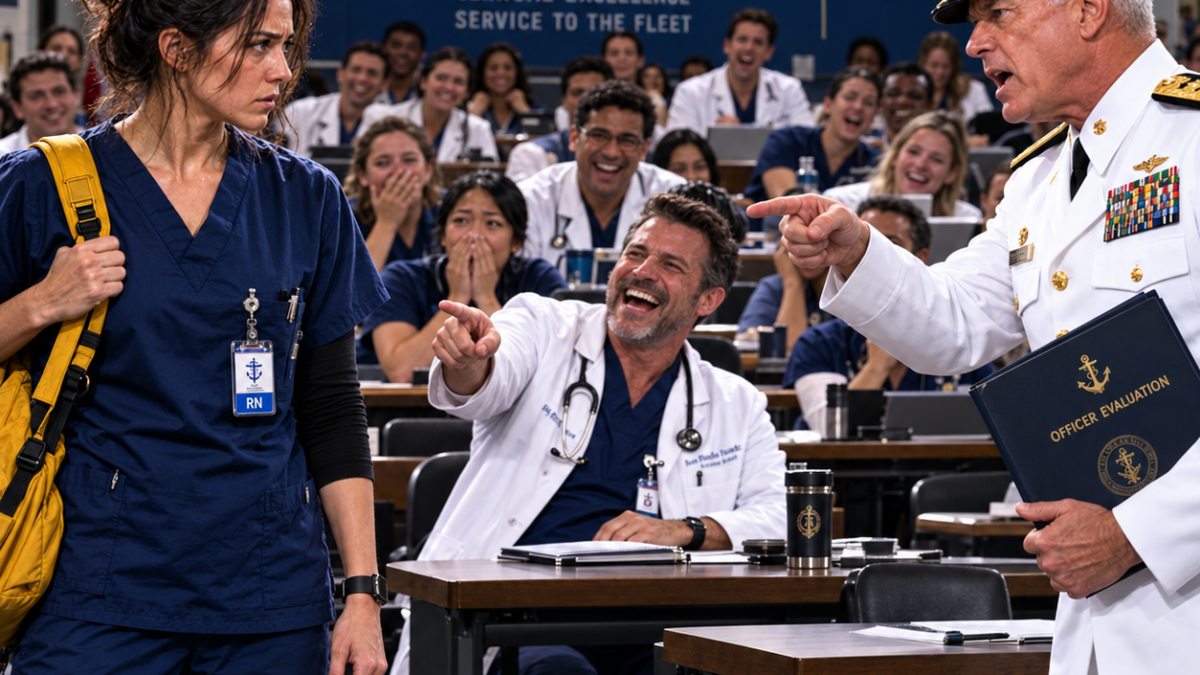
Then Dr. Wesley Granger noticed me.
“Well.”
His voice carried without effort.
Chief of Surgery.
Fifty-eight.
Silver beard.
White coat.
Reputation large enough that residents lowered their voices when he entered a room.
He leaned back in his chair.
“Look who decided to join us.”
A few heads turned more fully.
My stomach tightened.
He pointed.
“The nurse.”
I stopped in the aisle.
“Ready to fail, Nurse?”
Laughter.
Not everyone.
Enough.
I had learned years earlier that humiliation has a physical temperature.
Hot first.
Then cold.
My fingers tightened around the backpack strap.
“Sir, I apologize. My shift ran long.”
“Your shift?”
Granger looked around theatrically.
“She works shifts and wants to sit for Surgical Excellence.”
More laughter.
I looked toward the floor.
That mistake made him bolder.
“Do you know what exam you’re taking?”
“Yes, sir.”
“And what’s in the yellow backpack?”
He smiled.
“Lunch?”
A resident laughed loudly.
Another covered his mouth.
My hands began to tremble.
I hated them for it.
Commander Brenda Lusk, the exam coordinator, finally looked up.
“Back row. Seat fourteen.”
I started climbing.
“The clock began twenty minutes ago,” she added. “That’s your problem.”
“Yes, ma’am.”
Granger leaned toward his microphone.
“Some people pass exams.”
Pause.
“Others just pass time.”
More laughter.
I sat in the back.
Seat fourteen.
Opened the booklet.
Closed my eyes.
One breath.
Two.
Then began.
In the front row sat Rear Admiral Walter Keene.
He had not laughed.
I knew who he was.
Everybody did.
Deputy Surgeon General for Naval Medicine.
Silver hair.
White dress uniform.
A sealed blue folder resting on his knees.
I had met him once.
Seven years earlier.
He had been Captain Keene then.
A medical command officer who visited Walter Reed while I recovered.
I wasn’t sure he remembered me.
I hoped he didn’t.
Then I looked up.
He was watching.
Not smiling.
Not surprised.
Simply watching my pen.
I returned to the exam.
The first questions were straightforward.
Hemorrhagic shock.
Airway management.
Mass casualty triage.
Crush injury.
Spinal trauma.
Burns.
Damage-control surgery.
Emergency transport.
Resource allocation.
Then came scenario-based questions.
Those were easier.
Not because I was brilliant.
Because someone had once bled inside my hands while I made similar decisions for real.
There is a difference between knowing a protocol and remembering the face attached to why the protocol exists.
Question 47 described a casualty with unstable pelvic trauma in a resource-limited environment.
I remembered Kandahar.
Question 62 concerned prolonged field stabilization during delayed evacuation.
I remembered the canyon.
Question 79 concerned suspected cervical fracture after high-energy blunt trauma.
I stopped.
Read it twice.
My left hand shook.
Not from uncertainty.
From memory.
Mud.
Darkness.
Tex Dawson.
His head between my palms.
Bullets striking stone.
Four hours.
Do not move.
Stay with me.
I swallowed.
Answered.
Kept going.
Forty minutes after I sat down, I finished.
I checked every page once.
Then stood.
Granger noticed.
“Giving up already?”
A few people laughed.
“I’m finished, sir.”
He looked at the clock.
“Forty minutes?”
“Approximately.”
“Remarkable confidence.”
I carried the booklet down.
Commander Lusk dropped it onto the stack without looking.
“Wait for practical.”
“Yes, ma’am.”
The practical was held in the training atrium next door.
Massive space.
Glass roof.
Concrete floor.
Simulation rooms.
Twelve-foot rappel platform used for casualty extraction drills.
Candidates lined the perimeter.
SEAL instructors had been invited to demonstrate a vertical recovery scenario.
I stayed near the back wall.
Yellow backpack over my shoulder.
Dr. Granger stood near the front narrating loudly to several residents.
“Efficiency.”
“Decisive movement.”
“Do not hesitate.”
Words surgeons love.
Master Chief Tex Dawson climbed the platform.
I recognized the name on the roster.
Not the man.
Seven years changes a face.
He had been younger then.
Blood covered most of him the last time I saw him.
Now:
Broad.
Weathered.
Gray at the temples.
Training shirt.
Harness.
Lieutenant Commander Aaron Knox stood below overseeing the exercise.
I knew that name too.
Another ghost.
Knox had been with the team in Afghanistan.
Different mission.
Same deployment cycle.
He had not seen me yet.
Good.
I watched the platform.
Something bothered me.
Anchor.
Top left.
One bolt sat slightly proud of the mounting plate.
Maybe nothing.
Tex clipped in.
Knox called:
“Ready.”
Tex stepped backward over the edge.
Rope loaded.
Metal snapped.
The entire anchor tore loose.
Tex fell.
Twelve feet.
His back hit concrete.
Then his head.
The sound silenced three hundred people.
For one second nobody moved.
Then everyone did.
Granger ran first.
“Get him up!”
Two residents grabbed Tex’s shoulders.
Another reached for his legs.
I heard myself say:
“Stop.”
Too soft.
Nobody heard.
The residents started lifting.
Something inside me opened.
Not anger.
A door.
“DO NOT MOVE HIM.”
The words cracked through the atrium.
Everyone froze.
My backpack hit the floor.
I ran.
My hands stopped shaking.
Completely.
I slid onto my knees behind Tex’s head.
“Master Chief, don’t move.”
His eyes opened.
Unfocused.
“What…”
“Do not nod.”
I stabilized him manually.
“Tell me your name.”
“Tex.”
“Good.”
“Can you feel your hands?”
Pause.
“No.”
Granger reached for his shoulder.
“Move aside.”
I did not.
“Doctor, take your hand off him.”
His face changed.
“Excuse me?”
“He has a possible cervical injury.”
“I’m aware of spinal trauma.”
“Then do not lift him.”
“I am Chief of Surgery.”
“And right now you are about to make the patient worse.”
Silence.
Every face turned toward us.
His cheeks reddened.
“You don’t give me orders.”
“I’m giving everyone the same instruction.”
My voice stayed low.
“Don’t move him.”
Tex whispered:
“My fingers.”
“I know.”
“Can’t feel them.”
“I know.”
“Am I paralyzed?”
“No predictions.”
I looked directly into his eyes.
“You stay still. I’ll stay here.”
Something changed in Tex’s face.
A flicker.
Recognition not yet formed.
Knox crouched opposite.
He watched my hands.
My posture.
The way I stabilized Tex.
His expression sharpened.
“Where did you learn that?”
“Training.”
“What training?”
“Later.”
He kept staring.
“Those aren’t classroom hands.”
Granger snapped:
“This is absurd.”
Knox ignored him.
I said:
“Rigid collar.”
“Backboard.”
“Controlled transfer.”
Knox stood.
“You heard her.”
Granger glared.
“You are taking orders from a nurse?”
Knox looked at him.
“I’m taking good orders.”
That shut the room down.
Commander Lusk hovered nearby.
“Should we call security?”
Granger pointed.
“Yes.”
I did not look up.
“Call emergency response first.”
She stared.
I said:
“Commander, the patient.”
That snapped her back.
She called.
Collar arrived.
We stabilized Tex.
Prepared for controlled movement.
Then I heard metal overhead.
A groan.
Everyone else was looking at the casualty.
I looked up.
The rappel tower leaned.
The failed anchor had loaded the adjacent frame.
Another bolt shifted.
A cable snapped.
Sparked against lighting hardware.
One examiner screamed.
The entire crowd surged toward the main doors.
Three hundred people.
One exit.
Panic.
This is how secondary casualties happen.
Not from the first accident.
From everyone reacting without a plan.
Granger stood.
Frozen.
The tower leaned toward the doors.
I looked at Knox.
“Take my position.”
“What?”
“Head stabilization.”
He moved immediately.
I placed his hands.
“Do not release.”
“Got him.”
I stood.
Then shouted:
“STOP MOVING!”
Some heard.
Not enough.
I climbed onto the lowest platform step.
“STOP!”
Command voice.
The voice I had buried seven years.
The atrium changed.
People stopped.
Not all.
Enough that pressure at the doorway loosened.
“The tower is leaning toward the main exit.”
Faces looked up.
Fear.
“Do not run under it.”
I pointed.
“Left side: service corridor behind the stage.”
“Right side: follow them.”
“Single file.”
“No pushing.”
“Move.”
Commander Lusk said:
“Who authorized—”
“The evacuation diagram on that wall.”
I pointed.
“Service corridor goes to ambulance bay.”
She turned.
Saw it.
Then began directing people.
Knox almost smiled despite the situation.
Granger remained still.
I looked at two SEAL instructors.
“Kill power to the overhead rig.”
One hesitated.
Knox shouted:
“Do it!”
Lights went out.
Emergency lighting remained.
Sparks stopped.
We lifted Tex as a coordinated team and moved.
The crowd flowed through the service corridor.
Slow.
Controlled.
Someone stumbled.
Another person caught him.
No stampede.
At the rear, Granger still stood in the atrium.
Staring up.
I went back.
Grabbed his sleeve.
“Doctor.”
Nothing.
“Wesley.”
His eyes found mine.
“Walk.”
He walked.
Twenty yards into the corridor, the tower failed.
Steel crashed behind us.
Glass exploded across the atrium.
The sound was enormous.
People screamed.
Then silence.
Dust filled the doorway.
Where three hundred people had been standing less than two minutes earlier, twisted metal covered the floor.
Knox looked at me.
Hands still holding Tex’s head.
“Who are you?”
“Keep moving.”
We reached Trauma Bay One.
The emergency team took over.
Or tried to.
Tex’s blood pressure had dropped.
Pulse slow.
Skin warm.
Neurologic deficits.
The pattern worried me.
Granger arrived after regaining himself.
White coat crooked.
Face pale.
But command instinct returned.
“Thank you, Nurse.”
He pulled on gloves.
“I’ll take it from here.”
I remained near Tex.
His eyes found mine.
“Don’t leave.”
I did not.
Granger noticed.
“Step aside.”
“His pressure is dropping.”
“I can read a monitor.”
“This may be neurogenic shock.”
Granger looked toward a resident.
“Prepare airway control.”
“His airway is patent.”
“We don’t wait for deterioration.”
He reached toward the collar.
I caught his wrist.
The entire trauma bay froze.
“Do not remove that.”
He looked at my hand as though no nurse had touched him in thirty years.
“Release me.”
“After imaging.”
“I need extension.”
“No.”
“Security.”
Two guards entered.
I removed my hand from his wrist but stayed beside Tex.
Granger said:
“Remove her.”
Neither guard moved.
Because someone stood behind them.
Rear Admiral Keene.
“Doctor Granger.”
His voice was quiet.
“Stand down.”
Granger turned.
“Admiral, this nurse is interfering with trauma care.”
Keene looked toward me.
Then Tex.
Then the monitor.
“Is she?”
“Yes.”
Keene looked toward the guards.
“Leave.”
They left.
Granger stiffened.
“With respect, sir—”
“Stand down.”
This time there was steel beneath it.
Granger did.
Neurosurgery arrived.
Dr. Maya Lindqvist.
Scandinavian name.
Texas accent.
Fast eyes.
She asked what happened.
I gave her the sequence.
Fall.
Head strike.
Immediate paresthesia.
Upper-extremity sensory loss.
Bradycardia.
Hypotension.
No uncontrolled airway issue.
She examined Tex.
Ordered CT.
Imaging came back twelve minutes later.
Everyone gathered.
C2 fracture.
Unstable.
Bone displacement perilously close to cord compromise.
Dr. Lindqvist stared at the images.
Then looked around.
“Who maintained manual stabilization?”
No one spoke.
Knox pointed at me.
“She did.”
“Immediately?”
“Yes.”
Lindqvist looked at the scan.
“If he had been lifted by the shoulders and legs…”
She stopped.
Then finished plainly.
“There is a high probability this would have displaced further.”
Granger sat down.
She continued:
“He could have lost motor function from the shoulders down.”
The room was silent.
Tex was taken for surgery.
Granger did not look at me.
Keene did.
“Ms. Hollister.”
I looked at him.
“Sir.”
“You remember me.”
“Yes.”
“Good.”
That was all.
I tried to leave.
Knox stopped me in the hallway.
“Gwen.”
Hearing my first name from him hit harder than expected.
He was looking at my scars.
“You served with us.”
“Briefly.”
“Not briefly.”
“I need to go.”
“Mercy?”
I stopped.
There are names that unlock rooms inside the body.
That one did.
Knox’s face drained.
“Oh my God.”
I looked toward him.
“Don’t.”
“You’re Mercy.”
“Not anymore.”
He stepped closer.
“We thought you died.”
“No.”
“You vanished.”
“I left.”
“Why?”
I laughed once.
Not kindly.
“Because I was allowed to.”
That ended the conversation.
For ten minutes.
Then surgery began.
I sat in the waiting area with my yellow backpack between my feet.
The emergency was over.
My hands began shaking again.
Harder now.
Adrenaline release.
Keene saw.
He sat beside me.
Not too close.
“Still happens?”
“Yes.”
“How long?”
“Seven years.”
“Treatment?”
“Enough.”
“Helping?”
“Sometimes.”
He nodded.
“Why this exam?”
“I need the credential.”
“For what?”
“Teaching.”
“Surgery?”
“No.”
“Then why Surgical Excellence?”
“Because the Navy decided civilian emergency education instructors who teach advanced trauma modules need an approved high-level clinical credential.”
Keene frowned.
“That sounds bureaucratic.”
“It is.”
“What do you want to teach?”
“First response.”
“To whom?”
“People who don’t think they are medical.”
He waited.
I continued.
“Coaches.”
“Teachers.”
“Bus drivers.”
“Factory supervisors.”
“Parents.”
“Anyone likely to be the only person standing there before an ambulance arrives.”
Keene looked toward the operating room.
“Like the atrium.”
“Yes.”
He studied me.
“Why hide your service record?”
“I didn’t hide it.”
“You omitted most of it.”
“Application asked for current credentials.”
“You listed RN.”
“I am an RN.”
“You have a Silver Star.”
“That is not a clinical credential.”
For the first time he smiled.
“You haven’t changed.”
“I have.”
The smile disappeared.
“I know.”
Tex’s surgery lasted three hours.
Stabilization succeeded.
No cord transection.
Neurologic function began returning.
When he woke, he could move fingers.
By evening, I stood at the doorway.
Ready to leave.
Tex saw me.
“Wait.”
I stopped.
His neck was immobilized.
Voice rough.
“You said it.”
“Said what?”
“Stay still.”
I looked at him.
He continued:
“Let me do the talking.”
Something cold moved through me.
“Master Chief—”
“Mountain canyon.”
No.
“Seven years ago.”
Knox stood beside his bed.
Tex’s eyes filled.
“Four hours.”
I could not speak.
“You held my head.”
Memory arrived whole.
Night.
Rocks.
Gunfire.
Tex younger.
Blood on his face.
Spinal injury suspected after blast.
Evacuation impossible until air corridor reopened.
Four hours maintaining stabilization with shrapnel embedded in my own forearm.
My fingers cramping.
Tex fading.
Every twenty minutes:
Stay with me.
You are not leaving.
Finally helicopter.
Then surgery.
I never saw him afterward.
Until that day.
Tex whispered:
“Mercy.”
Knox closed his eyes.
I looked down.
“My name is Gwen.”
“Yes, ma’am.”
That broke me more than Mercy.
I sat.
Tex said:
“I looked for you.”
“So did several people.”
“Why did you disappear?”
“I didn’t disappear.”
I looked at both men.
“I separated.”
“Three months later.”
“Yes.”
“After the medal.”
“Yes.”
“Why?”
I could have lied.
Medical reasons.
Family.
Career change.
Instead:
“Because every room I walked into, someone needed me to be the version of myself who could kneel in blood and stay calm forever.”
Neither spoke.
“I couldn’t.”
Tex whispered:
“You saved people.”
“I know.”
“You saved me.”
“I know.”
“Then why—”
“Because knowing how to save someone doesn’t mean you can keep living like every room is a casualty collection point.”
The monitor beeped.
Steady.
“I couldn’t sleep.”
“I couldn’t hear helicopters.”
“I couldn’t stand behind doors.”
“I couldn’t let people touch my wrists.”
“My hands shook unless somebody was dying.”
I showed them.
Small tremor.
Tex stared.
“This?”
“Yes.”
“I thought—”
“Everybody thought fear.”
“What was it?”
“Everything after fear.”
Knox looked away.
I continued.
“I took a quiet clinic job.”
“Smaller scrubs?”
Tex almost smiled.
“Larger.”
I tugged the sleeve.
“People ask fewer questions when you look like you don’t belong anywhere important.”
That sentence landed hard.
Knox said:
“You deserved—”
“No.”
I cut him off.
“Do not tell me what I deserved.”
He stopped.
“I got to leave.”
“That mattered.”
They accepted it.
That was why I stayed another twenty minutes.
The next morning, Bayou Crest’s main conference hall filled before eight.
Word had spread.
Tower collapse.
Dawson survived.
Unknown nurse.
Emergency evacuation.
Rumors multiplied.
Some called me former special operations.
Some said trauma surgeon.
One story had me as a classified operative.
People become imaginative when the truth embarrasses them.
I stood near the back wall.
Same place I always chose.
Dr. Granger sat front row.
No jokes.
Commander Lusk beside him.
Keene walked to the podium carrying the same blue folder.
The hall quieted.
“Yesterday,” he began, “three hundred candidates completed the Surgical Excellence Examination.”
My stomach tightened.
I had forgotten about the exam.
He continued.
“This examination has been administered in its current form for nineteen years.”
“Maximum theoretical score: one hundred.”
“Highest previous score: ninety-seven.”
Granger looked up.
Keene opened the folder.
“Yesterday, one candidate completed the written section in thirty-eight minutes after beginning twenty minutes late.”
Whispers.
“One candidate answered every scored item correctly.”
Silence.
“One hundred.”
Someone turned toward the back.
Then another.
Keene said:
“Gwendolyn Hollister.”
I wanted the floor to open.
“She was also the candidate publicly asked whether she was ready to fail.”
No one looked at Granger.
Which meant everyone was thinking about him.
Keene continued:
“Her current title is Registered Nurse.”
“Her previous title was Hospital Corpsman First Class Gwendolyn Hollister, United States Navy.”
Knox stood near the side wall.
Tex sat in a wheelchair with a cervical brace.
I had not known they were coming.
“Call sign Mercy.”
My hands started shaking.
“Attached to Naval Special Warfare for four years.”
“Recipient of the Silver Star.”
“Multiple commendations.”
“Advanced prolonged-field-care instructor.”
“Highest documented casualty survival rate in her assigned medical element during her final deployment cycle.”
I hated the last one.
Numbers hide dead people.
Keene turned a page.
“And there is something else.”
He looked toward Granger.
“Question seventy-nine.”
My breath stopped.
“Suspected unstable cervical trauma after high-energy blunt injury during delayed evacuation.”
People remembered.
“That question was written from a Naval Medicine protocol revision.”
Keene held up a paper.
“The revision incorporated findings from an after-action report authored seven years ago.”
He looked at me.
“By Corpsman Hollister.”
Murmurs.
“Yesterday, several of you attempted to move Master Chief Dawson before cervical stabilization.”
The room became very still.
“The person who stopped you was not merely familiar with the protocol.”
“She helped create the lessons behind it.”
No one laughed.
Then Keene said:
“Ms. Hollister.”
I wanted to stay at the wall.
Didn’t.
Walked down.
Same aisle.
Different silence.
Three hundred faces.
I reached the front.
Keene turned toward me.
“The examination result qualifies you for the teaching credential you requested.”
“Thank you, sir.”
“But I would also like to offer you—”
“No.”
The word left before diplomacy.
A few people gasped.
Keene’s eyebrow rose.
I lowered my voice.
“Sir, whatever leadership job is coming, no.”
A small smile.
“You haven’t heard it.”
“I know what rooms like this do when they discover someone has a dramatic résumé.”
That earned a few uncomfortable expressions.
Keene closed the folder.
“Fair.”
Then Dr. Granger stood.
Slowly.
He walked toward me.
Yesterday, he had filled every room with volume.
Now his voice barely crossed the aisle.
“Ms. Hollister.”
“Yes, Doctor?”
“I owe you an apology.”
I waited.
“I called you nurse as if it were beneath surgeon.”
The room seemed to contract.
“I used your lateness to make entertainment.”
“I assumed your place in that hall before knowing why you were there.”
“And when Master Chief Dawson fell…”
His throat moved.
“I was wrong.”
I said nothing.
He continued:
“Worse, I was certain.”
That mattered.
Wrong can be corrected.
Certainty resists correction.
“If you had not stopped us…”
He looked toward Tex.
“I could have destroyed that man’s life.”
Tex watched.
Granger faced me again.
“I’m sorry.”
People expect forgiveness scenes to be beautiful.
Mine wasn’t.
I was still angry.
Still tired.
Still remembering laughter.
“Thank you.”
Granger looked almost disappointed.
Maybe he expected more.
I gave him more.
“Doctor?”
“Yes?”
“Do not apologize because I turned out to have a résumé you respect.”
He froze.
“Apologize because you humiliated a nurse before you knew anything about her.”
His face changed.
“Yes.”
“If I had never served.”
“Yes.”
“If I had scored sixty.”
“Yes.”
“If I had been exactly what you thought I was.”
He lowered his head.
“You still would have deserved respect.”
“Correct.”
That sentence mattered more than the medal.
More than the perfect score.
More than three hundred people eventually standing.
Keene stepped forward.
“Doctor Granger will undergo leadership review.”
Granger nodded.
“He has also volunteered to attend the first emergency-response class Ms. Hollister teaches.”
Granger looked up.
“I did.”
I stared at him.
“Front row?”
“If you’ll have me.”
I almost smiled.
“Bring a notebook.”
A few people laughed.
Not at me.
Different sound.
Keene asked:
“Will you teach?”
I looked around.
Surgeons.
Nurses.
Residents.
Sailors.
People who had laughed.
People who had not.
People who had stayed silent.
“Yes.”
Then added:
“On one condition.”
Keene sighed theatrically.
“Of course.”
“Open enrollment.”
“Explain.”
“Surgeons don’t own emergency care.”
That got attention.
“If someone collapses in a school gym, there may be no doctor.”
“If a bus rolls over, the first person may be a driver.”
“If someone falls from scaffolding, the first person may be another worker.”
“I want coaches.”
“Teachers.”
“Parents.”
“Sailors.”
“Security.”
“Custodians.”
“Anyone.”
Keene nodded.
“Granted.”
Three months later, forty people sat on the floor of the rebuilt training atrium.
New tower.
Independent structural inspection.
Redundant anchors.
Lessons learned.
Dr. Granger sat in front.
No white coat.
Notebook.
Commander Lusk sat two chairs away.
Tex entered walking slowly.
Neck healed enough for rehabilitation.
Knox beside him.
The class applauded.
Tex raised one hand.
“Don’t encourage me.”
He looked toward me.
“I hear the instructor barely passed the exam.”
Granger actually laughed.
I pointed to the floor.
“Sit down.”
“Yes, ma’am.”
The yellow backpack sat open beside me.
Inside was the old field medical kit I had carried overseas.
For years I had hidden it beneath notebooks.
Lunch.
Ordinary things.
That morning, I placed it in plain view.
Not because I wanted Mercy back.
Because hiding and healing are not the same.
I began the class.
“Before we talk about technique, we’re going to talk about the first mistake people make during emergencies.”
Granger raised his hand.
I stared.
“You don’t need permission.”
“Habit.”
“What’s the mistake?”
He answered:
“Acting before understanding.”
I nodded.
“Good.”
Tex whispered loudly:
“He studied.”
The room laughed.
We spent six hours learning how to recognize danger.
How to call for help.
How to avoid unnecessary movement in suspected spinal injuries.
How to control bleeding.
How to communicate.
How to make space for professionals when they arrive.
No heroics.
No improvising beyond training.
That last lesson was important.
People loved my story because I had known what to do.
The dangerous interpretation was that confidence alone saves lives.
It does not.
Competence does.
Preparation does.
Knowing when not to move someone does.
Knowing when to wait.
Knowing your limits.
At lunch, Granger sat beside me.
We ate sandwiches.
His looked expensive.
Mine was peanut butter.
He asked:
“Why did you finish the exam so quickly?”
“I knew the answers.”
“That is irritating.”
“Yes.”
He smiled.
Then:
“Were you nervous?”
“Very.”
“You didn’t look it.”
“My hands were shaking.”
“I noticed.”
He looked ashamed.
“I thought that meant you were intimidated.”
“It did.”
He blinked.
I continued.
“I was intimidated.”
“But you still—”
“Being afraid and being capable are not opposites.”
He absorbed that.
“I spent thirty years thinking confidence was visible.”
“It often is.”
“And competence?”
“Sometimes quieter.”
That became one of the first things he repeated later to residents.
Granger did change.
Not instantly.
People do not become gentle because of one humiliating revelation.
He remained demanding.
Occasionally arrogant.
Still loud.
But he stopped using humiliation as instruction.
Residents noticed.
Nurses noticed more.
He started asking their names.
When a young nurse corrected him during a trauma simulation six months later, everyone held their breath.
Granger checked the monitor.
Then said:
“You’re right.”
Two words.
Apparently unprecedented.
Someone texted me immediately.
MIRACLE AT BAYOU CREST.
I replied:
DOCUMENT IT.
Commander Lusk changed too.
She revised late-entry policy for examinations involving healthcare workers coming from active shifts.
Not because lateness became irrelevant.
Because context mattered.
Candidates still lost time.
They were no longer publicly shamed.
Structural changes are less cinematic than apologies.
Usually more valuable.
Tex recovered.
Not perfectly.
Residual numbness in two fingers.
Occasional neck pain.
But he walked.
Returned to instruction.
Stopped rappelling from questionable platforms.
At least, that was what he claimed.
Knox remained in contact.
He sent me terrible memes about nurses outranking SEALs.
I ignored most.
Eventually, my emergency-response course became permanent.
Not mine alone.
A team formed.
Paramedics.
Nurses.
Physicians.
Athletic trainers.
Teachers.
People from different professions.
That mattered.
I refused to build another system around one “hero.”
Hero systems break when the hero leaves.
Good systems distribute knowledge.
We taught thousands.
School districts.
Coaches.
Transit workers.
Community centers.
Military families.
One year after the exam, a high-school football coach who had taken our course recognized signs of spinal trauma after a player landed badly during practice.
He did not move the boy.
Called EMS.
Kept him still.
The athlete recovered.
The coach emailed me:
I almost pulled him up because that’s what I would have done before your class.
I printed the email.
Not because I needed praise.
Because that was the entire reason I had taken the exam.
Not the admiral.
Not the score.
That.
One person standing in the right place knowing one thing that prevents a worse injury.
That was enough.
My hands continued trembling.
For years.
Some days less.
Therapy helped.
So did sleep.
So did finally admitting I was not obligated to hide every sign of what war had done.
People still asked.
“Are you nervous?”
Sometimes I said:
“Yes.”
Sometimes:
“No, my hands shake.”
Both answers were acceptable.
I stopped stuffing my hands into sleeves.
That felt bigger than wearing medals ever had.
Three years after the exam, Rear Admiral Keene retired.
At his ceremony, I sat in the back.
Of course.
He spotted me.
Of course.
Afterward he approached.
“You still choose the last row.”
“Best exit access.”
“You know that’s trauma talking.”
“And fire code awareness.”
He laughed.
Then handed me the sealed blue folder from the exam day.
Empty now except one page.
My score sheet.
I looked at it.
“You kept this?”
“Yes.”
“Why?”
“Because you would never ask.”
“That is accurate.”
I handed it back.
“No.”
“Why?”
“I don’t need it.”
Keene studied me.
“Keep it anyway.”
I eventually did.
It lives in a drawer.
Not framed.
Next to grocery receipts.
Appropriate.
Tex retired two years later.
His speech lasted seven minutes.
Five involved complaining about Knox.
At the end, he called me forward.
I refused.
He threatened to tell everyone about Afghanistan.
I went.
He hugged me.
Asked first.
That mattered.
Into my hand he placed an old fabric strip.
Faded.
Medical tape wrapped around part of it.
“What is this?”
“Your sling.”
I stared.
Seven years earlier.
My own forearm had been bleeding while I stabilized him.
Someone cut cloth from my equipment pouch to make a temporary support after evacuation.
“You kept this?”
“Apparently.”
“Why?”
Tex looked uncomfortable.
“You told me not to move for four hours.”
“Yes.”
“I needed something to hate.”
I laughed harder than I had in months.
“That is fair.”
Then he became serious.
“I spent years thinking you were dead.”
“I know.”
“When I found out you weren’t, I was angry.”
“That also seems fair.”
“Then I realized you didn’t owe us your life after saving ours.”
That sentence stayed.
For years I had believed leaving made me weak.
Then selfish.
Then disloyal.
I had intellectually rejected those ideas.
Emotionally, they remained.
Tex gave me a better one.
You did not owe us your life after saving ours.
That helped.
I began using it with veterans I met through teaching.
Different wording.
You are allowed to become someone after service.
You are allowed to be ordinary.
You are allowed not to turn pain into inspiration.
You are allowed to leave the uniform behind without betraying who wore it.
Some people needed that more than tactical instruction.
Granger retired at sixty-five.
Before leaving, he invited me to his final grand rounds.
I expected medicine.
Instead the title slide read:
THE DANGER OF BEING THE MOST CERTAIN PERSON IN THE ROOM.
I laughed from the back.
He pointed at me.
“She is why.”
Then corrected himself.
“No.”
He shook his head.
“My mistake is why.”
That distinction impressed me.
He told the entire story.
Not my medals.
His behavior.
How confidence, status, and experience had made him dismiss information coming from someone he had categorized as beneath him.
He showed no video of me.
No heroic music.
No dramatic photograph.
He ended with:
“The day Master Chief Dawson fell, I knew more surgery than Nurse Hollister.”
“Probably by a great deal.”
People laughed.
“But she knew the thing that mattered first.”
He looked across the auditorium.
“Expertise is contextual.”
“If your identity depends on always being the smartest person in the room, eventually you will become dangerous.”
That was Granger’s best lesson.
Not mine.
His.
Afterward we drank terrible hospital coffee.
He asked:
“Do you forgive me?”
I considered.
“For humiliating me?”
“Yes.”
“I stopped thinking about it years ago.”
“That sounds evasive.”
“It is accurate.”
“Not the same as forgiveness.”
“No.”
He waited.
I said:
“I trust you now.”
That affected him more.
“Thank you.”
Trust was better than symbolic absolution.
Earned slowly.
Demonstrated through behavior.
Not granted because somebody said sorry once.
At forty-two, I finally stopped working clinic nights.
The tremor worsened when exhausted.
I taught full time.
That frightened me at first.
Teaching placed me in front.
No back row.
No oversized scrubs to disappear inside.
Students looked at me expecting answers.
I learned something uncomfortable.
Leadership does not have to feel like command.
Sometimes it means making a room safe enough for someone else to say you are wrong.
I began every course with a rule:
“Correct me.”
Students looked confused.
“If I say something that conflicts with evidence, current protocol, or the scenario, speak.”
One paramedic student asked:
“Even in front of everyone?”
“Especially then.”
“Won’t that undermine authority?”
“No.”
“Why?”
“Authority that cannot survive correction is insecurity.”
Granger stole that line for a lecture.
I charged him a sandwich.
Years later, one student named Rachel challenged me during a simulation.
I had interpreted a scenario one way.
She noticed a medication interaction I missed.
My first internal reaction was irritation.
Important admission.
Ego does not disappear because you teach against it.
Then I checked.
She was right.
I said so.
Class moved on.
Afterward I sat alone.
Thought about Granger.
About how easy it is to become the thing you once criticized when enough people start trusting you.
That became another lesson.
Humility is not a trait you achieve.
It is maintenance.
Like sterile technique.
Skip it long enough and contamination spreads.
The Naval Medical Education Command eventually incorporated parts of our civilian-first-response curriculum into broader community programs.
Not because I demanded it.
Because outcomes supported it.
I preferred data to mythology.
By fifty, the story of the “nurse who aced the surgeon exam” still surfaced online every few years.
Usually exaggerated.
Some versions had five hundred doctors.
Some said I performed emergency neck surgery on the floor.
False.
One claimed I was secretly an admiral.
Very false.
People love hidden-rank stories because they make disrespect feel safe in retrospect.
The mocked person deserved respect because she was secretly extraordinary.
I hated that lesson.
The correct lesson was harder.
I deserved dignity before anyone knew anything about me.
So did every nurse in that hall.
Every resident.
Every janitor.
Every late candidate.
Competence can earn authority.
Accomplishment can earn admiration.
Human dignity requires neither.
I began correcting storytellers when possible.
“Was Dr. Granger wrong because you were a decorated corpsman?”
“No.”
“He was wrong because humiliating someone publicly for status is bad leadership.”
“Would the story matter if you failed the exam?”
“Yes.”
That answer disappointed people.
I did not care.
Stories are supposed to teach us something.
Sometimes the popular lesson is the wrong one.
At fifty-three, my hands still tremble.
Less.
Not gone.
I no longer hide them.
A young nurse once watched me before a lecture and asked:
“Are you scared?”
“Yes.”
“Still?”
“Always.”
She seemed surprised.
“But you speak in front of hundreds of people.”
“Yes.”
“You saved people under fire.”
“Yes.”
“You stopped a crowd during a collapsing structure.”
“Yes.”
“And you’re nervous about a lecture?”
“Very.”
She laughed.
Then realized I was serious.
“Courage isn’t the absence of that?”
“No.”
“What is it?”
I thought about giving her something wise.
Instead:
“Doing the useful thing anyway.”
That was enough.
Master Chief Tex Dawson died at sixty-two.
Cancer.
Nothing cinematic.
Knox called.
We attended the funeral.
Tex had requested no military theatrics beyond what his family wanted.
They wanted honors.
Good.
His daughter found me afterward.
She was thirty.
I had never met her.
“You’re Gwen?”
“Yes.”
She hugged me.
“He talked about you.”
“That sounds dangerous.”
She laughed.
“He said you were the reason he got thirty extra years.”
“No.”
I shook my head.
“Surgeons gave him those.”
“You kept the surgeons from losing them first.”
Fair.
She handed me an envelope.
Inside:
a photograph of Tex during rehabilitation after the Bayou Crest fall.
Neck brace.
Middle finger raised toward camera.
Back:
TELL MERCY I STILL HATE LYING STILL.
I laughed until I cried.
Knox stood beside me.
“He would be pleased.”
“He was obnoxious.”
“Yes.”
“Good man.”
“Yes.”
Grief was easier when it could contain both.
At sixty, I visited Bayou Crest for what I planned to be my final large lecture.
The training atrium looked different.
New simulation technology.
Different walls.
Same rebuilt rappel tower.
I stood beneath it.
Young residents moved around me.
None knew the original incident unless they had read the plaque.
Yes.
There was a plaque.
I had objected.
Keene had ignored me.
It did not have my name.
My condition.
It read:
PAUSE BEFORE YOU MOVE.
Good.
I approved eventually.
The chief surgeon at the time was a woman named Dr. Lena Alvarez.
She met me near the platform.
“Dr. Granger trained me.”
I raised an eyebrow.
“Before or after personality rehabilitation?”
She laughed.
“After.”
“Good.”
“He talked about you constantly.”
“Unfortunate.”
“He said you taught him the most important surgical skill of his career.”
“What?”
“Stopping.”
I looked at the plaque.
That was fair.
We think expertise means action.
Cut.
Intubate.
Move.
Intervene.
Sometimes the lifesaving act is restraint.
Don’t lift.
Don’t twist.
Don’t rush.
Don’t let panic decide.
That principle extended beyond trauma medicine.
I just took longer to see it.
Don’t decide who someone is from clothing.
Don’t interpret shaking as weakness.
Don’t interpret silence as ignorance.
Don’t confuse title with truth.
Don’t keep pushing when the situation is asking you to stop and reassess.
Maybe the exam had always been testing more than surgical knowledge.
That final lecture was called:
THE FIRST TEN SECONDS.
I told no war story at the beginning.
No medals.
No humiliation.
I put an image of an empty hallway on the screen.
Then asked:
“What happens when something goes wrong and you are the only person there?”
People gave medical answers.
Call code.
Assess airway.
Get help.
Good.
Then I asked:
“What happens when the person with the lowest status in the room sees the danger first?”
Silence.
That was the real lecture.
Not cervical stabilization.
Listening.
Authority.
Cognitive bias.
Team dynamics.
When do people speak?
When do they remain silent?
What kind of leader receives correction?
What kind punishes it?
How many disasters begin because someone noticed something and decided the social cost of speaking was too high?
That question matters in operating rooms.
Cockpits.
Ships.
Factories.
Families.
Everywhere.
I told them about the anchor bolt.
I had noticed it.
Did not speak.
Why?
I was the late nurse who had just been laughed at.
Maybe it was nothing.
Maybe I would look foolish.
Those few seconds haunted me.
The bolt failed.
Tex fell.
I could not know if warning would have changed it.
But I knew why I had remained silent.
Status.
That became the biggest change in my teaching.
I no longer only taught people how to respond after emergencies.
I taught teams how to make warning possible before them.
Speak-up culture.
Check-backs.
Closed-loop communication.
Permission to challenge.
Structural inspection.
Redundant safety.
Less dramatic than rescue.
Far better.
After the lecture, a resident approached.
Twenty-seven.
Nervous.
She said:
“Dr. Alvarez told me Granger used to make residents cry.”
“Yes.”
“He became different?”
“Yes.”
“How?”
“Slowly.”
“People really change?”
“Sometimes.”
“What makes the difference?”
I thought about Granger.
Apology.
Leadership review.
Training.
Years of behavior.
“Being ashamed is not the same as changing.”
She waited.
“Change is what you do after shame stops being interesting.”
She wrote that down.
I laughed.
“Don’t quote me.”
She absolutely did.
At sixty-two, I officially stopped formal teaching.
Mostly.
People still call.
Keene died the year before.
Granger sent flowers to his funeral.
Commander Lusk became a hospital administrator known for reading evacuation maps obsessively.
Knox retired.
Dr. Alvarez continued teaching.
Life scattered everyone.
My yellow backpack remains in my closet.
The zipper broke twice.
I repaired it.
Inside:
old field kit.
Tex’s piece of cloth.
Keene’s perfect score sheet.
A peanut-butter cracker packet probably expired during the Obama administration.
Memory and trash coexist well.
Sometimes I open it.
Not often.
Mercy feels like another person now.
Not stranger.
Not exactly me.
A version.
Twenty-eight years old.
Bloody hands.
Command voice.
Certain because uncertainty would kill someone.
Gwen is quieter.
Older.
Still steady when needed.
But allowed to leave afterward.
That difference took decades.
If you ask what happened the day Chief Surgeon Wesley Granger mocked a late nurse in front of three hundred people, most retellings will say he learned not to judge a book by its cover.
Too easy.
The real lesson is less satisfying.
You may never discover the hidden extraordinary thing about the person you humiliate.
They may not be a decorated corpsman.
They may not ace your exam.
They may never save a Master Chief.
You still owe them dignity.
Granger’s apology mattered only after he understood that.
And my perfect score?
I barely remember the questions.
Except seventy-nine.
I remember that one.
Because behind the words was Tex.
The canyon.
Four hours.
My shaking hands before and after, but never during.
Years later, another fall.
Another concrete floor.
Another moment when everyone wanted to move too fast.
I did not ace that question because I memorized the protocol.
I aced it because once, a human being’s future had depended on me learning why the protocol existed.
That is the difference experience makes.
But experience also creates danger.
It can make you humble.
Or Granger.
You choose repeatedly.
Every room.
Every patient.
Every student.
Every correction.
The last time I saw Wesley Granger, he was seventy-two.
We sat in a hospital cafeteria.
He had retired.
Gray hair.
No white coat.
Nobody knew who he was.
A young nurse bumped our table.
Coffee spilled across his sleeve.
She panicked.
“Oh my God, Doctor—”
He looked at her badge.
“Emily.”
She froze.
“It’s coffee.”
He smiled.
“I’m washable.”
She laughed nervously.
He helped her wipe the table.
After she left, I stared at him.
“What?”
“That was very mature.”
“I’ve changed.”
“Apparently.”
He took a sip from the surviving coffee.
Then said:
“You know what I hate about that day?”
“Which part?”
“That I remember the laughter more than the fracture.”
I understood.
“Me too.”
He looked down.
“I created it.”
“Yes.”
“You don’t soften anything.”
“You would distrust me if I did.”
“True.”
He smiled.
Then:
“I spent years wishing I could erase those thirty seconds.”
“Why?”
“Because I became better.”
I looked at him.
“Then don’t erase them.”
He frowned.
“They’re evidence.”
“Of what?”
“That becoming better was necessary.”
He thought for a long time.
Then nodded.
We finished lunch.
No dramatic forgiveness.
No admiral.
No applause.
Just two old medical professionals sitting across from each other.
One had once mocked the other.
One had once grabbed the other’s wrist in a trauma bay.
Both changed.
That felt like a better ending.
People tell stories about quiet heroes because we like discovering strength where we were told not to expect it.
I understand.
But the older I get, the less interested I am in hidden greatness.
I am more interested in rooms where people do not need secret medals to be heard.
Where the nurse can say stop.
Where the resident can challenge the chief.
Where the late candidate can explain why without becoming entertainment.
Where the person closest to the problem has enough psychological safety to speak before metal breaks.
That is what I wanted to build after Bayou Crest.
Not admiration.
A better room.
And if some young nurse walks late into that room someday wearing oversized scrubs, carrying a cheap yellow backpack, hands shaking for reasons nobody understands, I hope nobody laughs.
I hope someone moves a chair.
Hands her the exam.
Lets her speak.
Because maybe she is extraordinary.
Maybe she isn’t.
Either way, she deserves the chance to show you who she is before you decide for her.
I was called Mercy once.
For years I believed I had to bury that woman to survive.
I was wrong.
I did not need to bury her.
I needed to stop letting everyone else own her.
She was mine.
The courage.
The fear.
The shaking.
The knowledge.
The scars.
The silence.
All mine.
The morning Admiral Keene announced that I was the only person who had ever aced the exam, three hundred people stood.
Tex saluted from his wheelchair.
Knox stood at attention.
Granger apologized.
People later described that as the moment I finally received the respect I deserved.
They were wrong about one thing.
I had deserved it the day before.
Before the perfect score.
Before the fall.
Before anyone knew what the scars meant.
Before anybody said Mercy.
I deserved it when I was simply Gwen Hollister, RN, twenty minutes late, exhausted from staying with a sick child, standing in the aisle while a powerful man decided a nurse would make an easy joke.
That is the part worth remembering.
Not because quiet people are always secretly heroes.
Because they should never need to be.








