Police Ordered Their K9 to Tear Into a 72-Year-Old Veteran—But the Dog Turned and Exposed Everything
PART3:
Trevor exhaled.
“Mr. Bennett, most of your neighbors have accepted.”
“Most of my neighbors don’t live here anymore.”
“That’s precisely the point. The area is changing.”
“So I should leave because everyone else did?”
“The project will happen.”
Sebastian looked past him toward the maple tree Martha planted the year their daughter was born.
“No.”
Trevor’s expression cooled.
“You may want to consider whether refusing is in your best interest.”
Sebastian’s eyes returned to him.
He had heard threats delivered with rifles.
He had heard them whispered in jungles.
He had heard them spoken across tables by men wearing uniforms.
Threats did not become more impressive because they wore ties.
“You may want to consider whether threatening an old man on his porch is in yours.”
Trevor left.
The letters changed after that.
Inspection notices.
Zoning violations.
Vegetation citations.
Claims that the retaining wall near Sebastian’s driveway encroached eleven inches onto municipal easement.
A notice alleging improper rainwater drainage.
Another claiming the detached shed did not comply with updated setback requirements despite having stood in the same spot since 1986.
Sebastian took the notices to city hall.
A clerk told him to file appeals.
He filed.
The appeals vanished.
He filed again.
Hearings were postponed.
One violation became four.
Then eight.
Mayor Thomas Higgins appeared on local television two months later standing beside a rendering of the future Sycamore Heights Luxury Residences.
Glass balconies.
Fitness center.
Rooftop pool.
Ground-floor restaurants.
“Pine Ridge must embrace progress,” Higgins said.
Sebastian stared at the television.
On the rendering, his home did not exist.
Neither did the maple tree.
Neither did the porch.
Neither did Martha.
He turned the television off.
The following morning, he found another notice nailed to his door.
STRUCTURE SUBJECT TO CONDEMNATION REVIEW.
He tore it down.
Used it to start the fireplace that evening.
Martha would have approved.
Officer Jenna Hastings first saw Sebastian’s name three weeks later.
She had been with Pine Ridge Police Department for only seven months.
Twenty-six years old.
Academy honors.
Still young enough to believe department policies meant something because someone had written them down.
The call appeared on her terminal at 1:37 p.m.
WELFARE / MUNICIPAL ASSIST.
ADDRESS: 14 SYCAMORE DRIVE.
SUBJECT: SEBASTIAN BENNETT.
AGE: 72.
POSSIBLE NONCOMPLIANCE WITH EMERGENCY CONDEMNATION ORDER.
She reread the final line.
K9 RESPONSE REQUESTED.
Jenna frowned.
“For a condemnation?”
Officer Brody Carmichael sat in the driver’s seat beside her.
Forty-one.
Sixteen years on the job.
Thick neck.
Buzz cut.
A permanent expression suggesting everyone around him had already disappointed him.
“K9’s there for officer safety.”
“Against a seventy-two-year-old?”
Carmichael looked at her.
“Age doesn’t make somebody harmless.”
“I know.”
“Do you?”
His tone made the question an insult.
Jenna looked out the windshield.
She had learned quickly that challenging Carmichael directly turned every conversation into a test of loyalty.
They were parked behind the precinct.
Titan sat behind the steel partition.
The German Shepherd was almost eighty pounds.
Dark saddle coat.
Large head.
Sharp amber eyes.
Three years partnered with Carmichael.
Titan had a reputation inside the department.
Fast.
Controlled.
Reliable.
Jenna liked him more than his handler.
Titan never humiliated rookies for asking questions.
“What’s the actual concern?” she asked.
“City says Bennett refuses to vacate a condemned property.”
“Does he have somewhere to go?”
“Not our problem.”
“Did the court issue an eviction?”
Carmichael’s jaw moved.
“Mayor’s office issued an emergency removal order.”
“That isn’t what I asked.”
He turned toward her.
“You planning to be a lawyer today?”
“No.”
“Good. Then be a cop.”
The words stayed with Jenna.
Be a cop.
She had joined after watching her father spend thirty-two years as a public defender.
He used to say the most dangerous sentence a government employee could speak was:
I’m just doing my job.
Because that sentence was where personal responsibility went to hide.
Jenna checked the call notes again.
No reported violence.
No weapon history.
No criminal record listed.
One annotation mentioned military veteran.
“Vietnam?” she asked.
Carmichael shrugged.
“Probably.”
“You know what branch?”
“Why does that matter?”
“It might matter when dealing with stress.”
Carmichael laughed.
“You want to hug him?”
“No.”
“Then stop overthinking.”
A black SUV pulled into the lot.
Chief Robert Evans stepped out.
He came straight toward Carmichael’s cruiser.
Jenna found that unusual.
Chiefs did not usually walk outside to brief patrol officers on municipal code calls.
Carmichael lowered the window.
Evans leaned in.
“Mayor wants this resolved today.”
Jenna looked at him.
“Resolved how?”
Evans ignored her.
Carmichael nodded.
“He’ll be out.”
“No scenes,” Evans said.
That sentence made Jenna uneasy.
“If he resists?”
Chief Evans looked toward Titan in the back.
“Then follow procedure.”
He walked away.
Jenna watched him cross the lot.
“What was that?”
Carmichael started the engine.
“That was the chief telling us to do our jobs.”
“No. That was the chief telling you to get one old man out of one specific house.”
“Same thing.”
Jenna looked back at Titan.
The dog met her eyes.
She had no idea that within forty minutes, he would make a better decision than every senior officer involved.
At 2:16 p.m., three police cruisers turned onto Sycamore Drive.
Sebastian heard them before he saw them.
Tires against pavement.
Engines.
Then the sudden chirp of sirens.
He was sitting in Martha’s old armchair near the front window, polishing the wooden cane his father had carried for years before passing it down.
The sound made Sebastian’s pulse jump.
Not because he feared police.
Because some sounds bypass memory and go straight to the body.
Engines approaching fast.
Doors slamming.
Men shouting outside.
His right hand trembled.
He stared at it until the tremor slowed.
“You’re home,” he whispered to himself.
Martha had taught him that.
During the bad years after Vietnam, she learned how to pull him back.
Name the room.
Name the year.
Touch something solid.
“You’re home, Seb.”
Sometimes he could still hear her voice.
He stood.
His left knee protested.
He took the cane.
At the window, he saw three cruisers.
A police dog.
Four officers.
And beyond them, at the far end of Sycamore Drive, two yellow bulldozers.
Sebastian’s stomach dropped.
The bulldozers bothered him more than the police.
They had come prepared for his house to disappear.
He walked toward the screen door.
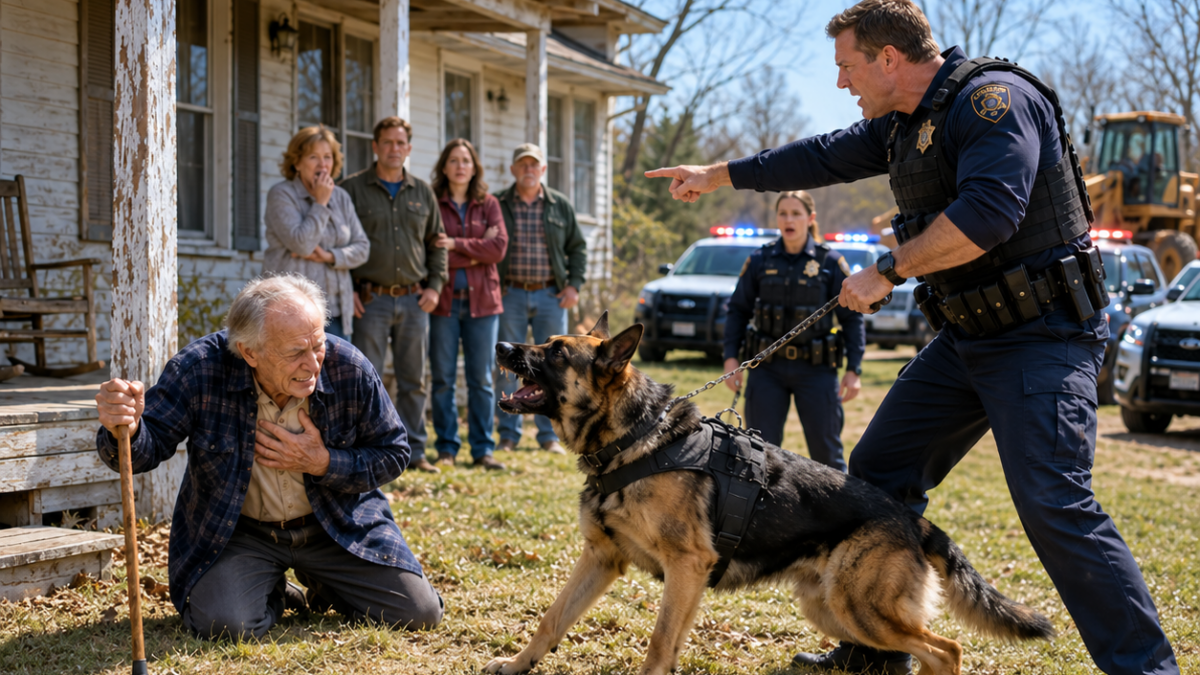
Officer Brody Carmichael came up the cracked concrete path.
He wore enough tactical equipment for a hostage situation.
Jenna followed several feet behind.
Titan moved at Carmichael’s side.
The dog’s mouth was open slightly.
Panting in the heat.
Sebastian opened the screen.
“Sebastian Bennett!” Carmichael shouted.
“You don’t need to yell. I’m twelve feet away.”
One of the officers behind Carmichael smirked.
Carmichael did not.
“By emergency order of the City of Pine Ridge, this structure has been condemned. You are required to vacate immediately.”
Sebastian looked toward the bulldozers.
“Funny how fast they arrived.”
“Step off the porch.”
“I’m not leaving.”
“Sir,” Jenna said gently, “do you have documentation showing you’ve appealed the order?”
Sebastian looked at her.
“Yes.”
“Where?”
“Inside.”
Carmichael raised a hand.
“Nobody is going back inside.”
Jenna turned.
“If he has appeal paperwork—”
“The order is active.”
Sebastian looked at Carmichael.
“I have a court date next Thursday.”
“Doesn’t matter.”
“It matters to the judge.”
“The building is classified as an immediate health hazard.”
Sebastian looked at his own house.
Then back at Carmichael.
“The building has survived forty-seven years.”
“Your opinion isn’t relevant.”
“My ownership is.”
Carmichael stepped forward.
“Last warning. Walk down those steps with your hands visible.”
Sebastian tightened his grip on the cane.
“This is my property.”
Carmichael’s eyes moved to the cane.
“Drop the weapon.”
Sebastian almost laughed.
“What?”
“The object in your right hand.”
“My cane?”
“Drop it.”
“I need it to walk.”
“Drop the weapon.”
Jenna stepped closer.
“Brody, it’s clearly a mobility aid.”
Carmichael ignored her.
Sebastian’s breathing changed.
The heat suddenly felt thicker.
The porch narrowed around him.
His heartbeat became loud.
Too loud.
He recognized the sensation.
The beginnings of panic.
He forced his shoulders down.
Home.
Porch.
Tuesday.
Pine Ridge.
He looked at the maple tree.
Home.
Carmichael shouted again.
“Drop it!”
The sound hit somewhere old.
Sebastian’s chest tightened.
He stepped backward.
Then forward.
Pain shot beneath his sternum.
He stopped.
His left arm tingled.
No.
Not panic.
Something else.
He took a breath.
Couldn’t fill his lungs.
Jenna saw his face change.
“Mr. Bennett?”
Sebastian tried answering.
Nothing came.
Carmichael reached for his radio.
“He’s refusing commands.”
“Brody, wait.”
Sebastian’s knee buckled.
He grabbed the porch rail.
The cane struck the wood.
Carmichael’s hand moved toward his weapon.
“Drop it now!”
Sebastian came down the two porch steps awkwardly.
Not advancing.
Falling.
His knee hit the grass.
Then his other.
The pain in his chest exploded.
He clutched himself with his left hand.
His right still held the cane because releasing it felt impossible.
“He’s moving toward us!” Carmichael shouted.
Jenna’s head snapped around.
“He’s collapsing!”
“Drop the weapon!”
“It’s a cane!”
Sebastian tried to speak.
“Chest.”
The word barely escaped.
Jenna stepped forward.
“I think he’s having a cardiac event.”
Carmichael shoved her arm away.
“Stay back.”
“What are you doing?”
Titan had become still.
The dog watched Sebastian.
Not his cane.
Not his hands.
His body.
Sebastian bent forward.
His vision narrowed.
The grass blurred.
Carmichael unclipped Titan’s lead.
Jenna saw it.
Her blood went cold.
“No.”
Carmichael shouted, “Last chance!”
Sebastian didn’t even seem to hear him.
“Brody, do not deploy the dog!”
Carmichael’s face had changed.
Jenna would remember that later.
Not angry exactly.
Humiliated.
He had issued commands.
Sebastian had not obeyed.
For Carmichael, that became the only fact in the world.
“Apprehend!”
Jenna lunged.
Too late.
Carmichael dropped the leash.
“Titan! Get him!”
The German Shepherd exploded forward.
Twenty feet.
Maybe less.
Sebastian looked up.
For one terrible second, he understood.
The dog.
Teeth.
Speed.
He could not move.
Could not protect himself.
He thought of Martha.
Not dramatically.
Just her face in the kitchen one Sunday morning.
Flour on her cheek.
Laughing.
That was the image his mind chose.
Then Sebastian closed his eyes.
Titan reached him.
And stopped.
Paws tore through the dry grass.
Dirt sprayed.
The dog’s chest nearly struck Sebastian’s shoulder.
But there was no bite.
No impact.
Instead, Titan lowered his head.
His nose moved over Sebastian’s chest.
The old man gasped.
Titan whined.
High.
Urgent.
The dog shifted around him.
Then pressed his body beneath Sebastian’s shaking arm.
Sebastian instinctively leaned.
Titan held.
Jenna stared.
“Oh my God.”
Carmichael shouted, “Titan!”
The dog ignored him.
“Apprehend!”
Titan remained beside Sebastian.
“Bite!”
The word echoed across Sycamore Drive.
Curtains moved in neighboring windows.
A woman stepped onto her porch.
A landscaper across the street stopped his mower.
Behind a parked truck, seventeen-year-old Leo Bennett raised his phone.
Leo was not related to Sebastian despite sharing the last name.
He lived three houses down with his mother.
He had started filming when the cruisers arrived because teenagers filmed everything adults wished later had stayed unseen.
His hands shook now.
On the screen, Titan turned.
Not toward Sebastian.
Toward Carmichael.
The German Shepherd stepped between them.
His posture transformed.
Shoulders squared.
Head lowered.
Fur rose along his spine.
Carmichael stared.
“Titan.”
The dog’s upper lip lifted.
A low growl rolled from his chest.
Nobody moved.
Carmichael’s face reddened.
“What the hell are you doing?”
Titan growled louder.
Jenna stepped forward.
“Back away.”
Carmichael looked at her.
“What?”
“The dog is telling you to back away.”
“He’s malfunctioning.”
“No. He’s protecting a man who’s clearly sick.”
Carmichael grabbed his Taser.
Jenna’s stomach dropped.
“Don’t.”
The laser appeared on Titan’s chest.
The dog did not flinch.
Sebastian’s fingers tightened weakly into his fur.
Carmichael raised the weapon.
“Move!”
Titan barked.
One explosive sound.
Carmichael jerked backward.
Jenna stepped between them.
“Put the Taser down!”
“Get out of my way!”
“Put it down!”
“He’s turned aggressive.”
“Because you’re pointing a weapon at him and a medical patient.”
“He disobeyed a bite command.”
“Thank God!”
Carmichael stared at her.
The sentence hung there.
Thank God.
Jenna realized her body camera was recording.
So was his.
So were the other officers’.
She did not care.
Sebastian groaned.
Jenna reached for her radio.
“Dispatch, send EMS immediately. Seventy-two-year-old male, severe chest pain, possible myocardial infarction. K9 is currently guarding patient. Advise paramedics to stage until we secure scene.”
Carmichael shouted, “Cancel that!”
Jenna stared at him.
“No.”
“I’m the senior officer.”
“You’re not canceling medical.”
“I said—”
“You just ordered a dog to bite a man having a heart attack.”
Silence.
Even Carmichael understood how that sounded.
Sirens approached.
Titan remained between him and Sebastian.
When paramedics arrived, they stopped near the sidewalk.
One raised both hands.
“Who’s got control of the dog?”
Carmichael barked a command.
“Titan! Heel!”
Nothing.
“Titan!”
The dog did not look at him.
The paramedic shook his head.
“We can’t approach until he’s secured.”
Sebastian heard that.
Barely.
He lifted one trembling hand.
Touched Titan’s muzzle.
The dog looked down.
Sebastian whispered, “It’s okay.”
Titan’s ears shifted.
“Let them help.”
The dog looked toward the paramedics.
Then back to Sebastian.
Slowly, Titan stepped aside.
Sat.
Jenna stared.
Carmichael stared harder.
The paramedics rushed forward.
Oxygen.
Monitor.
Blood pressure.
One medic looked at the screen.
“ST elevation. We need to move now.”
They lifted Sebastian onto a stretcher.
Titan stood.
Tried to follow.
A backup K9 handler arrived and secured him with a heavy lead.
Titan pulled toward the ambulance.
Sebastian reached one hand toward him.
“You’re all right, boy.”
The ambulance doors closed.
Titan barked once.
Then disappeared into the rear cage of a police SUV.
Carmichael immediately began speaking.
“He advanced with a weapon.”
Jenna turned.
“What?”
“The subject ignored lawful commands and advanced holding a blunt object.”
“He collapsed.”
“He moved toward officers.”
“He was having a heart attack.”
“We didn’t know that.”
“You knew enough not to send a dog.”
Carmichael stepped closer.
“You need to think very carefully about what goes in your report.”
Jenna’s skin went cold.
“My report is going to say what happened.”
“Your perception of what happened.”
“No.”
She looked at his body camera.
“What happened.”
Across the street, Leo Bennett tapped UPLOAD.
Four minutes and thirty-seven seconds of video began traveling through the internet.
By the time Sebastian reached Pine Ridge General Hospital, twenty thousand people had watched it.
By sunset, two million.
By midnight, more than twelve million.
The title Leo typed without much thought became the headline repeated around the country.
COP ORDERS K9 TO ATTACK SICK VETERAN — DOG REFUSES.
The video was brutal because it was simple.
No commentary.
No editing.
Sebastian falling.
Jenna shouting that he was sick.
Carmichael releasing Titan anyway.
The command.
Bite.
Titan stopping.
The growl.
The Taser.
The dog shielding Sebastian.
People argued online about police use of force, property rights, K9 deployment, veterans, corruption.
But one part was difficult to argue with.
The old man was on his knees clutching his chest when Carmichael released the dog.
At 5:40 that evening, Mayor Thomas Higgins stood in his office watching the video on mute.
Apex Real Estate CEO Richard Gallagher sat across from him.
Neither spoke until it ended.
Gallagher stood.
“This is catastrophic.”
Higgins wiped his forehead.
“The department will investigate.”
“My investors don’t care about an internal investigation.”
“We can manage the narrative.”
“The narrative is a German Shepherd protecting a war hero from your police officer.”
“He’s not a war hero.”
Gallagher looked at him.
“Silver Star recipient. Vietnam veteran. Seventy-two-year-old widower. That’s what every network is running.”
Higgins cursed.
Chief Robert Evans entered.
“Carmichael’s on administrative leave.”
“Good.”
“Temporary.”
Higgins turned.
“What about the dog?”
Evans hesitated.
“Titan exhibited handler-directed aggression.”
Gallagher stared.
“So?”
“Department policy permits designation as dangerous if an apprehension K9 turns on the handler.”
Higgins stopped pacing.
A thought appeared.
Cold.
Useful.
“Then the dog was unstable.”
Evans looked at him.
“What?”
“The K9 malfunctioned.”
Gallagher slowly understood.
Higgins continued.
“Carmichael attempts lawful detention. Dog becomes unpredictable. Situation deteriorates.”
“There’s video of Carmichael ordering the bite.”
“Which becomes a training failure. Maybe the dog misread commands.”
“He clearly didn’t.”
Higgins turned toward Evans.
“You want the department destroyed over this?”
Evans said nothing.
“Because if the public believes Carmichael intentionally sicced a stable police dog on a cardiac patient, every decision around that eviction gets examined.”
Gallagher leaned forward.
“And we do not want the eviction examined.”
Higgins nodded.
Evans understood.
The condemnation order.
The expedited municipal findings.
The city inspectors pressured to produce violations.
The development agreement.
Campaign donations routed through consulting firms.
Everything depended on keeping the story narrow.
One bad officer.
One unpredictable dog.
Not one coordinated effort to remove the last property owner standing between Apex and fifty million dollars.
Evans looked toward the window.
“What happens to Titan?”
Higgins’s answer came without hesitation.
“Put him down.”
Even Gallagher looked uncomfortable.
“You can do that?”
“If he’s classified as dangerous.”
Evans nodded slowly.
“Tomorrow morning.”
Higgins turned back to the television.
Titan’s image filled the screen.
The dog standing over Sebastian.
“Then do it before this becomes harder.”
Officer Jenna Hastings learned about the euthanasia order at 9:12 p.m.
She was sitting alone at her kitchen table.
Still in uniform pants.
White T-shirt.
Hair damp from a shower she barely remembered taking.
Her department laptop was open.
She had already written her incident report three times.
Each version sounded worse for Carmichael than the last because the facts themselves were bad.
At 8:47, another officer texted her.
They’re moving Titan to county animal control.
Jenna called.
“What happened?”
The officer lowered his voice.
“Chief classified him handler-aggressive.”
“For protecting Bennett?”
“Officially, for turning on Brody.”
“He didn’t attack Brody.”
“I know.”
“When’s the hearing?”
“What hearing?”
Jenna went still.
“What do you mean?”
“They signed emergency euthanasia authorization.”
“When?”
“Tomorrow. Seven a.m.”
Jenna stood.
“They can’t.”
“They can under the dangerous-service-animal policy.”
“This is insane.”
“Jenna, stay out of it.”
“No.”
“I’m serious. Word is the chief wants everyone quiet until press briefing.”
She looked at the laptop.
Her body camera footage was stored on the secure server.
So was Carmichael’s.
High-definition.
Clean audio.
The public video showed what happened from across the street.
The body camera showed something worse.
Carmichael shoving Jenna.
Sebastian saying “chest.”
Jenna identifying possible cardiac distress before deployment.
Carmichael releasing Titan anyway.
And after Sebastian left, Carmichael turning toward officers and saying:
“He came at us. That’s what we’re writing.”
Jenna replayed that part.
Once.
Twice.
Her hands shook.
She knew copying departmental evidence without authorization could end her career.
She knew leaking active investigative material could expose her to criminal charges.
She knew exactly what Chief Evans would call her.
Disloyal.
Untrustworthy.
Unfit.
Her father’s old sentence returned.
I’m just doing my job.
Jenna plugged in a flash drive.
Then stopped.
She stared at the screen.
There was a difference between courage and impulsiveness.
Evidence needed somewhere it could survive.
Somewhere outside Pine Ridge.
She called David Caldwell.
Independent investigative reporter.
Forty-nine.
Known locally for spending eighteen months exposing kickbacks in the county road department.
He answered at 9:34.
“Caldwell.”
“My name is Jenna Hastings.”
Pause.
“Officer Hastings?”
“You know who I am?”
“Your name is already online.”
She closed her eyes.
“I have the body camera footage.”
Silence.
“The original?”
“Yes.”
“Why are you calling me?”
“Because they’re going to kill Titan at seven tomorrow morning.”
David’s voice changed.
“What?”
“They’re labeling him dangerous.”
“Because he protected Bennett?”
“Yes.”
“You have proof?”
“Yes.”
“Officer, do you understand what you’re telling me?”
“Yes.”
“No. Do you understand what happens to you if you leak that footage?”
“Yes.”
“I don’t think you do.”
Jenna looked at the copy bar moving across her screen.
“Maybe not.”
“Why me?”
“Because if I send this to the department, the department buries it.”
“What about state investigators?”
“I’ll send it there too.”
“Federal?”
“If you’ll help me get it where it needs to go.”
David was quiet.
Then:
“Don’t email anything from your personal account.”
Jenna breathed.
He continued.
“And don’t alter the file.”
“I won’t.”
“You preserve metadata. You make two copies. One goes to counsel before publication.”
“I don’t have counsel.”
“You do now.”
“You’re helping me?”
“No.”
His voice was hard.
“I’m protecting the evidence.”
That was enough.
At 11:18 p.m., Sebastian Bennett opened his eyes.
The first thing he heard was a monitor.
The second was Martha.
Not really.
Memory.
You stubborn old man.
He almost smiled.
Pain sat deep in his chest.
Not the crushing pressure from the lawn.
A bruised, exhausted ache.
He looked down.
Hospital gown.
IV.
Oxygen tubing.
His right wrist wore an identification band.
A cardiologist stood near the window.
“You gave us trouble.”
Sebastian tried speaking.
His throat was dry.
“How bad?”
“Myocardial infarction.”
Sebastian looked at him.
“Heart attack.”
“I know what it means.”
“Of course you do.”
The doctor came closer.
“You were lucky.”
Sebastian almost laughed.
“Didn’t feel lucky.”
“You had rapid EMS response. More importantly, whoever kept you from collapsing completely probably helped.”
Sebastian remembered fur.
Heat.
A dog’s body beneath his arm.
“Titan.”
The doctor looked confused.
“The police dog.”
“Oh.”
Sebastian closed his eyes.
“He didn’t bite me.”
“So I’ve seen.”
“You saw the video?”
“Everyone has.”
Sebastian opened his eyes again.
“Where is he?”
“I don’t know.”
The question bothered him.
Where is he?
Not the police officer.
Not the mayor.
Not his house.
Titan.
The door opened fifteen minutes later.
Jenna Hastings stepped in wearing jeans and a gray sweatshirt.
Sebastian recognized her.
“You.”
“Me.”
“You tried to stop him.”
“I didn’t stop enough.”
“You tried.”
She sat.
“You had a major heart attack.”
“So they keep telling me.”
“They placed a stent.”
“Also told me.”
“You should be resting.”
Sebastian looked at her face.
“You didn’t come here to discuss cardiology.”
Jenna swallowed.
“No.”
“What happened to the dog?”
She stared.
Sebastian’s voice sharpened.
“Officer.”
“Jenna.”
“What happened to Titan?”
“They took him to county animal control.”
“Why?”
“Because he growled at Carmichael.”
Sebastian’s expression hardened.
“He saved my life.”
“I know.”
“Where is he?”
“Sebastian—”
“Where?”
Jenna’s eyes filled.
“They’ve scheduled euthanasia for seven.”
The monitor beside him changed rhythm.
Jenna looked toward it.
“Stay calm.”
“You came into a cardiac unit and told me they’re killing the dog who kept me alive.”
“I know.”
“Why?”
“Because they’re afraid.”
“Of a dog?”
“Of what he proves.”
Sebastian stared.
Jenna told him.
The condemnation order.
The pressure from the mayor’s office.
The body camera.
Carmichael’s attempted false narrative.
The dangerous-dog classification.
She had sent the footage to a journalist and external investigators.
Sebastian listened without interrupting.
When she finished, he swung his legs toward the edge of the bed.
Jenna stood.
“No.”
“Where are my clothes?”
“No.”
“Jenna.”
“You are not leaving.”
“I am.”
“You had a heart attack less than twelve hours ago.”
“They’re killing him in seven.”
“The story is already out.”
“Stories don’t unlock cages.”
“Thousands of people are contacting the facility.”
“People call. Bureaucrats wait.”
He reached for the IV line.
Jenna grabbed his hand.
“If you pull that out yourself, I swear to God—”
Sebastian looked at her.
For one second, the frightened rookie disappeared.
She looked exactly like a police officer.
Good.
He smiled faintly.
“You’ve got backbone.”
“This isn’t funny.”
“No.”
He released the IV.
“Then help me do it properly.”
“Do what?”
“Leave.”
“You need physician approval.”
“Get me a doctor.”
“No doctor is approving this.”
“Then get me my pants.”
At 5:55 a.m., David Caldwell published the body camera footage.
The headline was simple.
PINE RIDGE K9 FACES EUTHANASIA AFTER REFUSING COMMAND TO BITE VETERAN IN MEDICAL DISTRESS.
Below it were documents.
The emergency condemnation order.
Apex development plans.
Campaign finance records.
City inspection dates.
A leaked internal email from Mayor Higgins’s office marked:
Need Bennett parcel cleared before financing deadline.
The article did not accuse anyone beyond what evidence showed.
It did not need to.
By 6:10, satellite trucks were outside county animal control.
By 6:20, hundreds of people had arrived.
By 6:30, cars blocked both sides of the road.
Veterans.
Dog handlers.
Residents.
Reporters.
Animal advocates.
People who had seen four minutes of video and decided one German Shepherd had behaved with more restraint than the humans around him.
Inside the facility, Titan sat in kennel B-7.
He had not eaten.
A veterinary technician named Clara Reyes had been assigned to prepare him.
She read the euthanasia order three times.
The stated reason:
Handler-directed aggression following operational command failure.
Clara had watched the footage.
She entered the kennel.
Titan stood.
No growl.
No bark.
He looked past her.
Toward the door.
“I’m not doing it.”
Her supervisor looked at her.
“What?”
“I’m not euthanizing him.”
“We have an order.”
“Then find someone else.”
“Clara.”
“No.”
Another veterinarian entered.
He had also seen the video.
“I won’t either.”
The facility director rubbed his forehead.
“This is a lawful departmental order.”
The veterinarian folded his arms.
“Then the police department can explain in writing why a dog that exercised bite inhibition against a medically compromised subject is being classified as dangerously unstable.”
“It’s already in writing.”
“Not medically.”
That word mattered.
Medical authorization was required.
The director looked toward the growing crowd outside.
No veterinarian on shift would sign.
At 6:42, Mayor Higgins called Chief Evans.
“Why isn’t it done?”
“The vets are refusing.”
“Replace them.”
“With who?”
“I don’t care.”
“There’s media everywhere.”
“Then move the dog.”
“Can’t.”
“Why?”
“Crowd blocked transport.”
Higgins cursed.
Gallagher called two minutes later.
“My board is freezing the Sycamore project.”
“What?”
“They want distance.”
“This will pass.”
“No, Thomas. Body cam shows Carmichael lying. Caldwell published emails.”
Higgins went silent.
“What emails?”
“The Bennett parcel messages.”
Cold spread through his stomach.
“Those were internal.”
“Not anymore.”
At 6:57, Sebastian Bennett left Pine Ridge General Hospital against medical advice.
He wore the same brown slacks he had been wearing the previous afternoon.
A clean flannel shirt Jenna bought at an all-night store.
Hospital wristband.
Wooden cane.
His face looked gray.
Every step hurt.
The cardiologist followed him to the elevator.
“Mr. Bennett, I’m asking you not to do this.”
Sebastian stopped.
“Doctor, have you ever owed your life to someone?”
The doctor looked at him.
“Yes.”
“Then you understand.”
“I understand emotion. I’m worried about your heart.”
“So am I.”
“Then stay.”
Sebastian shook his head.
“My heart already decided.”
Jenna drove.
She kept glancing at him.
“If you die in my car, I’m going to be extremely angry.”
Sebastian looked out the window.
“Noted.”
“This isn’t heroic.”
“No.”
“It’s reckless.”
“Probably.”
“Good. As long as we’re clear.”
They turned onto County Road 8.
Traffic had stopped.
People filled the shoulder.
Signs.
Cameras.
Police barriers.
Sebastian stared.
“All this for Titan?”
“For you too.”
He shook his head.
“Shouldn’t be.”
“What?”
“I’m not the remarkable part.”
Jenna looked at him.
“You survived war, came home, built a life, lost your wife, stood up to a developer, almost got attacked by a police dog, had a heart attack, and walked out of the hospital twelve hours later.”
Sebastian considered.
“Still think the dog is more interesting.”
She laughed despite herself.
When people recognized him walking toward the facility, the crowd changed.
Noise faded.
One person stopped chanting.
Then another.
A path opened.
Sebastian leaned on his cane.
Jenna walked beside him.
He hated the cameras.
Hated the attention.
But he kept moving.
Near the entrance, a reporter shouted, “Mr. Bennett! What do you want to see happen?”
Sebastian stopped.
He looked toward the glass doors.
“Bring me Titan.”
“Do you want charges against Officer Carmichael?”
“Bring me the dog.”
“Do you think the mayor targeted you?”
“Bring me the dog.”
That became the only quote broadcast for the next hour.
Inside, the facility director met him.
“Mr. Bennett, Titan remains police property.”
Sebastian looked at him.
“Then tell the police I’m here.”
“The department has suspended the euthanasia pending review.”
“Suspended?”
“Yes.”
“Not canceled.”
“No.”
Sebastian’s jaw tightened.
“Then I’m not leaving.”
The director looked toward Jenna.
“Officer, he needs to return to the hospital.”
Jenna folded her arms.
“I tried.”
“You brought him here.”
“He’s remarkably persuasive.”
Sebastian pointed his cane toward the kennel corridor.
“I want to see him.”
“We can’t authorize—”
A voice behind them interrupted.
“Yes, you can.”
Everyone turned.
Three people entered.
Two wore dark suits.
The third displayed credentials.
Special Agent Daniel Cross, Federal Bureau of Investigation.
Behind him stood investigators from the state attorney general’s public integrity division.
The facility director went pale.
Cross looked at Jenna.
“Officer Hastings?”
“Yes.”
“We received the evidentiary package.”
Her stomach tightened.
“Am I under investigation?”
“Eventually everyone involved will be interviewed.”
That did not comfort her.
Cross continued.
“But right now we need the original K9 handling records and emergency euthanasia order preserved.”
He looked toward the director.
“No documents leave this building.”
The director nodded.
Outside, camera crews surged toward the windows.
Inside, Sebastian barely cared.
“Can I see the dog now?”
Cross looked at him.
For the first time, his expression softened.
“I think you’ve waited long enough.”
The kennel door opened.
Titan appeared at the far end of the hallway.
A handler held the leash.
The German Shepherd walked cautiously.
His ears moved.
He saw Jenna first.
Then Sebastian.
Everything changed.
Titan surged forward.
The handler nearly lost his grip.
“Easy!”
Sebastian dropped his cane.
It struck the floor.
Jenna reached for him.
But Sebastian lowered himself carefully to his knees.
Titan reached him.
The dog shoved his head against Sebastian’s chest.
Same place.
Exactly where his nose had pressed the previous afternoon.
Sebastian wrapped both arms around him.
The old veteran’s face disappeared into thick fur.
“You good boy.”
Titan whined.
“You good, good boy.”
Sebastian cried.
Not loudly.
His shoulders simply shook.
For five years after Martha died, he had believed the deepest grief left in him had already found its place.
He had been wrong.
Something about being protected by an animal who owed him nothing cracked through a wall Sebastian had not known remained standing.
Titan licked his cheek.
Sebastian laughed through tears.
“They said you were dangerous.”
Titan pushed closer.
Sebastian rubbed both sides of his neck.
“You knew better than all of us, didn’t you?”
Jenna turned away and wiped her eyes.
Outside the glass doors, hundreds of people watched.
Nobody cheered at first.
The moment was too quiet.
Then Sebastian looked up.
Titan remained pressed against him.
Someone outside began clapping.
Then another.
Within seconds, the sound became thunder.
Titan startled.
Sebastian held him.
“Easy.”
The dog looked at him.
And settled.
Special Agent Cross watched.
He had spent twenty-two years investigating corruption.
He trusted documents.
Bank records.
Metadata.
Witness statements.
Not symbolism.
But even he understood what the crowd saw.
A police dog who had been ordered to hurt a helpless man was now choosing the same man as his safe place.
That image made the official story impossible to maintain.
The criminal investigation moved quickly after that.
Not because corruption suddenly became easy to prove.
Because the people involved began panicking.
Panic creates records.
Phone calls.
Deleted messages.
Transfers.
Attempts to coordinate stories.
Richard Gallagher, CEO of Apex Real Estate, called Mayor Higgins four times after learning federal agents had arrived.
The fourth call was intercepted under emergency authorization after investigators established probable cause from financial records.
Gallagher said:
“You told me Carmichael could handle Bennett.”
Higgins answered:
“He was supposed to remove him, not start a national scandal.”
That one sentence destroyed several defenses.
Search warrants followed.
Mayor’s office.
Police administration.
Apex headquarters.
Carmichael’s home.
Investigators found more than they expected.
Inspection reports on Sycamore properties had been altered.
Photographs were mislabeled.
Several “unsafe structure” findings had been copied nearly word for word from unrelated properties.
A city building inspector named Mark Ellis admitted Mayor Higgins’s office pressured staff to accelerate condemnations.
“Did you believe Sebastian Bennett’s house was an immediate danger?” investigators asked.
“No.”
“Then why did you sign?”
Ellis looked down.
“My supervisor said my job depended on it.”
“Did that make the finding true?”
“No.”
Sebastian heard that statement weeks later.
His reaction surprised Jenna.
He did not celebrate.
He simply said, “Fear makes cowards of ordinary people before it makes villains.”
Jenna looked at him.
“You feel sorry for him?”
“No.”
“Then what?”
“I understand him.”
“That’s not the same thing.”
“No.”
Sebastian looked toward Titan sleeping beside the porch.
“Understanding isn’t forgiveness.”
Officer Carmichael’s body camera proved devastating.
Not only the attack command.
The aftermath.
His instruction that officers describe Sebastian as advancing.
His claim that the cane was raised aggressively when footage showed otherwise.
His attempt to cancel EMS.
His Taser aimed at Titan.
When investigators searched departmental records, they found previous complaints.
Too many.
A man with a broken wrist after a traffic stop.
A teenager bitten by another K9 during an arrest despite lying prone.
A woman who alleged Carmichael threatened arrest when she recorded him during a domestic call.
Complaints had been closed.
Reduced.
Reclassified.
One supervisor note read:
Officer Carmichael demonstrates aggressive command presence but remains within departmental expectations.
Jenna stared at that sentence when investigators showed her.
“Departmental expectations.”
Her father’s voice returned again.
I’m just doing my job.
She understood now how systems taught people to confuse repeated behavior with acceptable behavior.
Carmichael was charged with aggravated assault, falsification of an official report, civil rights violations, and misconduct in office.
Chief Evans resigned two days before federal charges were announced.
It did not save him.
Investigators found he had received undeclared consulting payments routed through a company connected to Apex.
Mayor Higgins was arrested at 6:12 one Thursday morning.
News helicopters circled his house.
He came outside in a golf shirt.
Handcuffs.
No suit.
No podium.
No city seal behind him.
Just a frightened man being placed into a government vehicle.
Sebastian watched for thirty seconds.
Then turned off the television.
Martha’s photograph sat beside it.
“You’d have enjoyed that,” he told her.
Titan lifted his head.
Sebastian looked at him.
“Don’t judge me.”
Titan rested his head again.
Apex Real Estate announced it had terminated Richard Gallagher.
Then insisted the company had no knowledge of his misconduct.
Investigators disagreed.
Financial records tied development payments to consultants associated with city officials.
The Sycamore Heights project collapsed.
Investors withdrew.
Contracts were suspended.
Properties acquired through disputed condemnations entered legal review.
Some former residents received settlements.
Others were offered the opportunity to challenge the sales.
For Sebastian, the question remained simple.
His house.
Could he keep it?
Six weeks after the lawn incident, Sebastian sat in a federal courtroom beside an attorney supplied by a veterans’ legal advocacy group.
Jenna sat behind him.
Titan was not allowed inside.
He waited with a retired K9 handler outside the courthouse.
The city’s attorney stood.
“Pine Ridge concedes the emergency condemnation order was procedurally defective.”
Sebastian whispered to his lawyer, “Procedurally defective?”
His lawyer whispered back, “Legal language for they got caught.”
Sebastian nodded.
The judge continued.
The condemnation was vacated.
All liens and fines associated with the fraudulent enforcement actions were suspended pending review.
Sebastian retained full title and possession.
The city was prohibited from initiating new adverse property action without independent judicial oversight.
The judge looked directly at him.
“Mr. Bennett, your home is yours.”
Sebastian sat still.
His lawyer touched his arm.
“You won.”
Sebastian’s eyes filled.
Not because of the legal victory.
Because for months he had imagined bulldozers flattening Martha’s kitchen.
Her garden.
Their daughter’s bedroom.
The doorway where he once measured her height in pencil marks.
He thought of the maple tree.
Still standing.
“Mr. Bennett?” the judge asked.
Sebastian cleared his throat.
“Thank you, Your Honor.”
Outside, reporters waited.
He ignored most questions.
One woman called, “Mr. Bennett, what are you going to do now?”
Sebastian looked toward the courthouse steps.
Titan stood there.
Waiting.
He smiled.
“Go home.”
The legal problem of Titan was harder.
The Pine Ridge Police Department no longer wanted him.
That much was obvious.
But K9 ownership involved contracts, liability, retirement rules, handler rights, and city property procedures.
Carmichael’s attorney initially argued Titan should remain impounded as evidence.
Sebastian hated that.
“Evidence sleeps in boxes,” he said. “That dog needs sunlight.”
Jenna petitioned for temporary foster release.
So did the county veterinarian.
A judge approved Titan’s placement at a certified retired-working-dog facility while ownership was resolved.
Sebastian visited every day he could.
At first, staff limited him to thirty minutes because of his heart.
Titan apparently disagreed with the schedule.
Whenever Sebastian stood to leave, the dog positioned himself beside the exit.
“I have to go.”
Titan stayed.
“You don’t understand cardiology.”
The dog stared.
“Neither do I, really.”
Eventually Sebastian sat again.
The staff stopped pretending thirty minutes meant anything.
One afternoon Jenna joined him.
Titan lay with his head across Sebastian’s shoe.
“You know what everyone keeps asking me?” Jenna said.
“What?”
“Why he stopped.”
Sebastian scratched Titan’s ear.
“What do you tell them?”
“That I don’t know.”
Sebastian looked at her.
“Good answer.”
“They want some scientific explanation.”
“Maybe there is one.”
“Maybe.”
“He smelled my heart attack.”
“Possibly.”
“He recognized I was weak.”
“Likely.”
“He knew I wasn’t attacking.”
“Probably.”
Sebastian looked down.
“Or maybe somebody spent years teaching him the difference between a command and a threat.”
Jenna frowned.
“Aren’t police dogs supposed to follow commands?”
“Soldiers too.”
She understood the comparison.
Sebastian had never spoken much about Vietnam.
Not to reporters.
Not to Jenna.
But now he said:
“When I was nineteen, I thought discipline meant doing what the man above you said before thinking about it.”
He looked toward the field.
“I learned better.”
“What happened?”
Sebastian smiled faintly.
“Nothing I’m telling a twenty-six-year-old over bad coffee.”
“I’m a police officer.”
“That makes you more curious, not more entitled.”
She laughed.
Then grew serious.
“Would you adopt him?”
Sebastian’s hand stopped.
“If they’d let me.”
“He’s a lot of dog.”
“So was Martha.”
Jenna stared.
Sebastian grinned.
“She would’ve laughed.”
“You compared your dead wife to an eighty-pound German Shepherd.”
“My wife had a stronger bite.”
Jenna laughed so loudly Titan raised his head.
Sebastian became serious again.
“I don’t know if I’m the right home.”
“Why not?”
“I’m seventy-two.”
“So?”
“He could outlive me.”
Jenna had no answer.
“That scares me,” Sebastian said.
Not death itself.
Leaving something that depended on him.
He knew what it meant to be left.
Titan lifted his head and pressed it against Sebastian’s knee.
Jenna watched.
“Maybe he already chose.”
Sebastian looked at the dog.
“Animals shouldn’t get to make legal decisions.”
“Tell him that.”
Three months after Sycamore Drive exploded into national headlines, Titan was officially retired.
The ceremony was small.
No mayor.
No chief.
No speeches about departmental excellence.
The interim police commissioner stood outside headquarters with Jenna, several K9 handlers, and Sebastian.
Titan’s badge was removed from his harness.
His service designation ended.
The commissioner looked uncomfortable.
“We owe this animal better than what happened.”
Sebastian appreciated that she said it plainly.
No heroic exaggeration.
No pretending institutions became good because bad people were removed.
“We are revising K9 deployment policy,” she continued. “No apprehension deployment may be ordered against a visibly incapacitated subject without an articulable violent threat. K9 medical and behavioral review will be independent of the handler when a deployment is disputed.”
Jenna whispered, “Amazing that had to be written.”
Sebastian whispered back, “Most rules are somebody’s bad decision turned into paperwork.”
Then the commissioner turned toward Sebastian.
“There remains the question of retirement placement.”
Sebastian’s heart beat faster.
“Mr. Bennett, Titan’s prior handler is legally disqualified from ownership while his criminal matter is pending. Departmental review recommends civilian placement.”
She smiled.
“Titan has repeatedly demonstrated a preference.”
Sebastian looked down.
Titan sat beside him.
“So, subject to final home inspection and veterinary approval, we’d like to place him with you.”
Sebastian did not answer.
Jenna nudged him.
“Say something.”
He cleared his throat.
“I have a fenced yard.”
The commissioner laughed.
“We know.”
“I walk slow.”
“Probably good for a retired dog.”
“My porch boards need work.”
“Titan hasn’t complained.”
Sebastian looked at the German Shepherd.
“You want to come home with me?”
Titan leaned his body against Sebastian’s leg.
That settled it.
The first night was strange.
Sebastian drove Titan to 14 Sycamore Drive.
The dog jumped from Jenna’s SUV.
Stood in the front yard.
The same yard.
The same dry patch where Sebastian had collapsed.
Titan sniffed the ground.
Sebastian watched him.
He wondered what dogs remembered.
Scent?
Fear?
Events?
Did Titan know this was where his old life ended?
Where another began?
The dog walked toward the porch.
Stopped at the bottom step.
Looked back.
Sebastian laughed.
“Bossy already.”
Titan waited.
Sebastian climbed slowly.
One step.
Then another.
The dog followed.
Inside, Titan explored carefully.
Kitchen.
Living room.
Hallway.
Martha’s bedroom.
Guest room.
Back door.
He stopped beside Martha’s gardening gloves.
Sniffed them.
Sebastian’s chest tightened.
“Those were hers.”
Titan looked at him.
“You would’ve liked her.”
The dog returned to the living room.
Sebastian had bought an expensive orthopedic dog bed.
Titan sniffed it.
Then lay on the floor beside Sebastian’s chair.
“That’s ninety dollars over there.”
Nothing.
“You understand money?”
Titan closed his eyes.
“Clearly not.”
Sebastian fell asleep in Martha’s armchair.
At 2:13 a.m., he woke.
Titan was sitting beside him.
Watching.
“What?”
The dog’s ears moved.
Sebastian listened.
Nothing.
Then he realized.
Titan was checking him.
His breathing.
His chest.
Sebastian rested a hand on the dog’s head.
“I’m okay.”
Titan remained.
“Doctor says I’m okay.”
Still nothing.
Sebastian smiled sadly.
“You don’t trust doctors either?”
Eventually Titan lay down.
Sebastian did not return to sleep.
He sat there feeling something he had not felt in years.
Not simply less lonely.
Responsible.
There was a difference.
Loneliness made the days blend.
Responsibility gave morning a reason to arrive.
At 6:00, Titan wanted outside.
At 6:17, breakfast.
At 6:23, apparently more breakfast.
At 7:00, walk.
Sebastian had not taken a morning walk around Sycamore Drive since Martha died.
Now he had no choice.
They moved slowly.
Old veteran.
Retired K9.
Sebastian with his cane.
Titan adjusting his pace.
Neighbors came outside.
Some waved.
Some cried.
Leo Bennett stood by his mailbox.
The teenager who recorded everything suddenly looked embarrassed.
Sebastian stopped.
“You’re Leo.”
“Yes, sir.”
“You filmed it.”
Leo looked down.
“I didn’t know if I should.”
“You uploaded it.”
“Yes.”
“Why?”
Leo shrugged.
“Because they were lying.”
Sebastian studied him.
Seventeen.
Skinny.
Nervous.
Probably had no idea one tap changed dozens of lives.
“You did good.”
Leo looked up.
“Really?”
“Don’t get addicted to filming people’s worst moments.”
Leo smiled.
“But that one?”
Sebastian nodded.
“That one mattered.”
Titan sniffed Leo’s hand.
Leo froze.
“He likes you.”
“How can you tell?”
“He hasn’t eaten you.”
Leo laughed.
The criminal cases took almost two years.
Justice moved slower than outrage.
Mayor Higgins eventually pleaded guilty to bribery, conspiracy, and deprivation-related federal offenses tied to the property scheme.
Richard Gallagher entered a cooperation agreement.
Chief Evans was convicted on corruption and obstruction charges.
Carmichael refused every plea offer.
He insisted Sebastian had posed a threat.
The trial lasted eleven days.
Sebastian testified.
So did Jenna.
So did medical experts.
Video played repeatedly.
Carmichael’s attorney tried to describe the cane as a potential weapon.
Sebastian was asked whether he had ever used it defensively.
“No.”
“Could it hurt someone?”
“So could this microphone.”
The judge told the jury to disregard the comment.
Several jurors hid smiles.
Carmichael’s attorney asked why Sebastian did not simply comply.
That question changed the room.
Sebastian leaned forward.
“Because it was my house.”
“You could have contested the matter afterward.”
“I had been contesting it.”
“You could have gone peacefully.”
“To where?”
The attorney paused.
Sebastian continued.
“You keep asking why I didn’t leave like I had somewhere else waiting.”
His voice remained calm.
“My wife died in that house. My daughter took her first steps there. My father helped me build the porch. I had legal appeals pending. I had broken no criminal law. And your client came onto my lawn and told a dog to tear into me while I was having a heart attack.”
The courtroom went silent.
“I’ve spent most of my life being told old men should understand when the world is ready to move past them.”
Sebastian looked at Carmichael.
“I understood perfectly.”
The jury convicted him.
Jenna cried in the courthouse restroom afterward.
Not because of the verdict alone.
Because she had spent two years wondering whether speaking up had destroyed her career.
The department had placed her on paid administrative leave for six weeks after the leak.
Then an independent review concluded her disclosure was protected under state whistleblower statutes because she had simultaneously preserved evidence and reported suspected criminal misconduct.
She returned to duty.
Some officers treated her differently.
A few called her traitor behind her back.
One refused to partner with her.
Another quietly thanked her.
“You said what a lot of us were scared to say.”
Jenna remembered Sebastian’s words.
Fear makes cowards of ordinary people before it makes villains.
She was promoted to detective three years later.
Not because of Titan.
Not because of fame.
Because she was good.
Sebastian liked that.
He distrusted symbolic promotions.
“Earn it,” he told her.
“I did.”
“Good.”
“That’s all?”
“You want balloons?”
“I saved your life.”
“Titan saved my life.”
“I saved Titan.”
“Fair.”
“You’re terrible at gratitude.”
“Martha said the same thing.”
Jenna became family without either of them noticing when it happened.
Sunday coffee.
Grocery runs.
Veterinary appointments when Sebastian’s knee hurt.
Christmas dinner.
One year, she brought a boyfriend.
Titan stared at him for twenty-three straight minutes.
The relationship ended three weeks later.
Jenna blamed the dog.
Sebastian called it quality control.
Life on Sycamore Drive changed again.
But not the way Apex planned.
After the corruption case, the city designated the older section as a protected residential conservation district.
Sebastian initially opposed the idea because he distrusted anything involving city hall.
A new council member came to his porch.
“No one can force you.”
Sebastian stared.
“You people finally learned that sentence?”
The council member laughed nervously.
The district passed.
Developers could still buy properties.
Residents could still sell.
But coordinated condemnation abuse became harder.
More transparent.
Independent review was required.
The city also created a relocation legal-assistance fund after former residents sued.
Not every wrong was repaired.
Several families never returned.
Some took settlements because starting over had already happened.
One elderly couple moved back.
Sebastian helped them carry boxes.
At seventy-four.
Jenna yelled at him.
“You had a heart attack.”
“Two years ago.”
“You’re carrying a dresser.”
“It’s small.”
“Put it down.”
Titan barked.
Sebastian stared at him.
“Don’t take her side.”
Titan barked again.
“Traitor.”
By then, Titan’s muzzle had begun turning gray.
Retirement softened him.
He learned squirrels.
Mail trucks.
Sunlight on the porch.
He stopped waking at every vehicle after midnight.
Stopped pacing when fireworks sounded far away.
The first Fourth of July was difficult.
At the first explosion, Titan stood.
Body rigid.
Sebastian recognized the posture.
He turned off the television.
Sat on the floor.
“Come here.”
Titan paced.
Another explosion.
The dog’s breathing accelerated.
Sebastian held out one hand.
“Home.”
Titan looked at him.
“Porch. Living room. Pine Ridge.”
The dog came closer.
Sebastian remembered Martha doing the same thing for him.
Name the room.
Name the year.
Touch something solid.
He rested one hand against Titan’s neck.
“You’re home.”
Titan lowered himself beside him.
Another explosion cracked outside.
Sebastian flinched.
Titan lifted his head.
For a second they looked at each other.
Two old soldiers startled by the same sound for different reasons.
Sebastian laughed.
“Pair of heroes.”
Titan rested his head across Sebastian’s thigh.
Neither moved until the fireworks ended.
At seventy-six, Sebastian suffered another cardiac scare.
Not a heart attack.
Arrhythmia.
He woke one morning to Titan pawing his bed.
Hard.
Persistent.
“Stop.”
Titan barked.
Sebastian tried sitting.
The room tilted.
Titan barked again.
Sebastian reached for his phone.
Jenna arrived before the ambulance because she happened to be nearby.
She found Titan standing beside the bed.
“You knew.”
The dog looked at her.
“You knew before he did.”
Sebastian, pale beneath the blankets, muttered, “Don’t encourage him. He’s insufferable already.”
At the hospital, tests showed an abnormal rhythm requiring treatment.
The cardiologist told Sebastian that seeking help when he did likely prevented something worse.
Jenna sat beside him.
“You understand Titan has now saved you twice.”
Sebastian closed his eyes.
“I’m beginning to feel inadequate.”
“You should.”
“He can’t cook.”
“You can’t either.”
“Leave.”
She smiled.
Titan was not allowed inside cardiac care.
He waited with a hospital security officer downstairs.
When Sebastian was discharged, Titan nearly pulled the handler over.
The German Shepherd pressed his head against Sebastian’s chest.
Again.
Always the chest.
Sebastian held him.
“All right. I get it.”
Titan whined.
“I know.”
By Titan’s eleventh year, age arrived quickly.
Hips.
Arthritis.
Slower mornings.
Less interest in long walks.
Sebastian understood.
Their route shortened.
Five blocks became three.
Three became one.
Some mornings they walked only to the maple tree and back.
Neither complained.
One afternoon, Leo Bennett returned from college.
He found Sebastian and Titan on the porch.
“Mr. Bennett?”
Sebastian squinted.
“Leo?”
The teenager was twenty-one now.
Taller.
Beard attempting to exist.
“You look terrible.”
Leo laughed.
“Nice to see you too.”
He sat.
“I’m studying journalism.”
Sebastian groaned.
“What did I do wrong?”
“You told me filming mattered.”
“One time.”
“Changed my life.”
“That’s a lot of responsibility to put on an old man.”
Leo looked at Titan.
“Changed his too.”
Titan slept.
Leo became quiet.
“Do you ever wish I hadn’t posted it?”
Sebastian thought.
“Yes.”
Leo looked surprised.
“Sometimes.”
“Why?”
“Because everybody knew my worst day.”
Sebastian looked toward the street.
“People saw me scared. Sick. On my knees.”
“I’m sorry.”
“Don’t be.”
He sighed.
“Because if you hadn’t, Carmichael would’ve written the story himself.”
Leo nodded.
Sebastian continued.
“Truth can cost dignity.”
“Was it worth it?”
Sebastian looked at Titan.
“Yes.”
“But don’t forget the cost.”
Leo never did.
Years later, his first major investigative story exposed neglect inside a private veterans’ care facility.
He mailed Sebastian the newspaper.
Across the top he wrote:
I remembered. Truth with dignity.
Sebastian framed it.
Titan never cared.
By twelve, the dog needed help getting into the truck.
Sebastian needed help too.
Jenna watched them one Saturday.
“This is absurd.”
“What?”
“You both need ramps.”
“Speak for yourself.”
“You’re seventy-nine.”
“Numbers.”
“Titan is twelve.”
“Also numbers.”
“You two are exhausting.”
Sebastian ordered the ramp.
Pretended it was only for Titan.
Everyone allowed the lie.
The final winter came quietly.
Titan stopped finishing breakfast.
Then walks became difficult.
The veterinarian found a mass.
Splenic.
Likely cancer.
Sebastian sat in the examination room holding the leash.
“How long?”
The veterinarian hesitated.
“Could be weeks. Maybe a few months.”
Sebastian looked at Titan.
Weeks.
After everything.
Sycamore Drive.
The lawn.
The shelter.
The porch.
Fireworks.
Hospital trips.
Years suddenly became weeks.
“What can we do?”
“Keep him comfortable.”
“Can you fix it?”
“At his age, surgery would be very high risk.”
“Can you fix it?”
The veterinarian met his eyes.
“No.”
Sebastian nodded.
Old soldiers know when an answer is no even when everyone wishes otherwise.
He took Titan home.
For three weeks, the dog seemed almost himself.
Good days.
Bad days.
Jenna visited more.
Leo came back.
Neighbors brought food Sebastian did not want.
Titan ate hamburger.
Refused prescription diet.
Sebastian supported the rebellion.
One cold March morning, Titan did not stand.
Sebastian found him beside the fireplace.
The dog lifted his head.
Tried.
Could not.
Sebastian lowered himself to the floor.
His own knees screamed.
“Don’t.”
Titan looked at him.
“You’ve done enough standing.”
He called Jenna.
Then the veterinarian.
They came to the house.
Titan lay on the old orthopedic bed Sebastian had bought his first night.
The same bed the dog ignored for two years.
Jenna sat nearby crying openly.
Sebastian had not cried yet.
He stroked Titan’s gray muzzle.
The veterinarian asked softly, “Are you ready?”
Sebastian looked at the dog.
“No.”
The veterinarian waited.
Sebastian breathed.
“But he is.”
Jenna covered her mouth.
Sebastian leaned closer.
“Remember that lawn?”
Titan’s eyes moved toward him.
“You were supposed to bite me.”
His voice cracked.
“Worst police dog in Pine Ridge.”
Jenna laughed through tears.
Titan’s tail moved once.
“You were a terrible employee.”
Another faint movement.
Sebastian pressed his forehead against Titan’s head.
“But you were a good boy.”
There.
The tears came.
“You were such a good boy.”
The veterinarian administered the first medication.
Titan relaxed.
Sebastian kept one hand against his chest.
Exactly where Titan’s nose had pressed years earlier.
“You can stop checking now.”
Titan’s breathing softened.
“My heart’s okay.”
Jenna cried harder.
“Mostly.”
Sebastian smiled through tears.
“You go rest.”
Titan exhaled.
Once.
Then again.
And then the dog who refused one terrible command made his final choice.
He let go.
The house became quiet.
The wrong kind again.
For weeks, Sebastian heard Titan everywhere.
Tags against the floor.
Paws in the hallway.
The thump when he lay beside the chair.
At 6:17 every morning Sebastian still woke expecting breakfast duty.
He walked to the kitchen.
Stopped.
Remembered.
Grief is cruelest in routines.
Jenna visited almost daily.
Sebastian pretended it annoyed him.
One afternoon she found him holding Titan’s old collar.
“You want to talk?”
“No.”
“Okay.”
She sat anyway.
After a while Sebastian said, “Martha would’ve loved him.”
“I know.”
“You never met Martha.”
“I’ve heard approximately six hundred stories.”
“Most exaggerated.”
“I’m sure.”
He smiled.
Then stared at the collar.
“I thought after she died I was finished collecting things I couldn’t keep.”
Jenna said nothing.
“I didn’t want another thing to lose.”
“That would have been easier.”
Sebastian looked at her.
One is easier.
The idea had followed him his whole life.
Easier to sell.
Easier to leave.
Easier to comply.
Easier to stay quiet.
Easier not to love a dog whose life would probably end before his.
“Yeah,” he whispered.
“Would it have been better?”
Sebastian shook his head.
“No.”
Six months later, the city unveiled a small plaque at the entrance to Sycamore Drive.
Sebastian had fought against it.
He lost.
It read:
TITAN — K9 47
WHO PROVED THAT DUTY WITHOUT JUDGMENT IS NOT LOYALTY.
Below that:
IN HONOR OF THOSE WHO CHOOSE TO PROTECT WHEN POWER CHOOSES TO HARM.
Sebastian hated ceremonies.
He attended anyway.
Jenna stood beside him in detective dress uniform.
Leo attended with a press credential.
The interim chief spoke.
A state official spoke.
Sebastian was asked to speak.
He stepped toward the microphone.
Looked at hundreds of people.
Then at the plaque.
“I don’t know much about heroic dogs.”
People laughed softly.
“I knew one dog.”
He paused.
“He didn’t expose corruption because he understood politics.”
The crowd became quiet.
“He didn’t know what a developer was. He didn’t know what the mayor wanted. He didn’t know what body cameras were.”
Sebastian’s hand tightened around his cane.
“He knew one thing.”
He looked toward the patch of grass where Titan had once stood over him.
“He knew I was not a threat.”
Jenna lowered her eyes.
“And when a man with authority told him otherwise, Titan trusted what was right in front of him more than the command.”
Sebastian breathed slowly.
“I spent part of my youth in a war. Officer Hastings spent hers learning how to police. Titan spent his learning how to obey.”
He looked toward Jenna.
“Every one of us eventually had to learn the same harder lesson.”
The crowd waited.
“Authority and right are not always the same thing.”
No applause yet.
Sebastian preferred that.
He continued.
“Courage isn’t disobedience for its own sake. It isn’t shouting. It isn’t refusing every command because you believe yourself smarter.”
His voice softened.
“Courage is knowing that when a command asks you to abandon what you know is human, lawful, or decent, your conscience still belongs to you.”
Now the silence felt different.
Warm.
Alive.
Sebastian looked at Titan’s name.
“A dog reminded us of that.”
He stepped away.
The applause began slowly.
Then grew.
Sebastian returned to his porch before the ceremony ended.
Too many people.
Too much noise.
He sat in his old chair.
Martha’s yellow gardening gloves still hung beside the kitchen door.
Titan’s collar rested on the table.
Outside, the maple tree moved in the breeze.
Sycamore Drive remained.
Children rode bicycles.
Mrs. Ramirez watered flowers.
Leo’s mother complained about somebody parking across her driveway.
Ordinary life.
The kind Sebastian had almost lost.
Years later, when people asked about the day a police dog refused an attack command, the story often became cleaner than it really had been.
People liked simple heroes.
Bad cop.
Good dog.
Brave veteran.
Honest rookie.
Corrupt mayor.
Justice.
Real life had been messier.
Jenna had been afraid.
Sebastian had been stubborn.
Some city employees had followed bad orders because they feared losing jobs.
Some officers had known Carmichael’s reputation and said nothing.
Some officials convinced themselves development justified pressure.
Some people only found courage after someone else went first.
Even Titan had not magically solved anything.
A teenager had to record.
Jenna had to preserve evidence.
Journalists had to verify it.
Investigators had to follow money.
Witnesses had to testify.
Jurors had to listen.
Judges had to act.
Veterinarians had to refuse.
Ordinary people had to decide that convenience was not the same as right.
That was why Sebastian never liked the phrase:
Titan changed everything.
The dog did not change everything alone.
What Titan did was stop.
At the one moment when everyone expected blind momentum, he stopped.
He looked.
He recognized reality.
Then he stood between a vulnerable person and the man trying to hurt him.
That pause gave everyone else a choice.
Some failed it.
Some passed.
And everything that followed came from that.
Sebastian lived at 14 Sycamore Drive until he was eighty-four.
He never sold.
Never moved.
The maple tree grew broad enough to shade most of the front yard.
Jenna visited on Sundays.
Detective Hastings eventually became Lieutenant Hastings.
Sebastian continued calling her Rookie.
She continued hating it.
Leo became an investigative journalist.
He brought his wife to meet Sebastian years later.
Then his daughter.
The little girl climbed onto Sebastian’s porch and pointed at the framed photograph near the door.
It showed Titan sitting beside Sebastian beneath the maple tree.
“Who’s the dog?”
Sebastian looked at the photograph.
“Friend of mine.”
“Was he a police dog?”
“Once.”
“Was he brave?”
Sebastian smiled.
“Sometimes.”
The child frowned.
“Only sometimes?”
“That’s all anybody has to be.”
She thought about that.
Then looked again.
“What did he do?”
Sebastian leaned back.
He could have told the dramatic version.
The command.
The charge.
The growl.
The corruption.
The arrests.
Instead, he gave her the version that mattered.
“He knew when not to hurt somebody.”
The girl nodded solemnly.
As if that answer made perfect sense.
Maybe to children it does.
Adults complicate things.
We build ranks.
Systems.
Titles.
Policies.
Uniforms.
Contracts.
Then sometimes we become so impressed by the structures we created that we forget why they were supposed to exist.
To protect people.
Not crush them.
Sebastian looked toward the patch of lawn.
He could still picture Titan there.
Standing over him.
Refusing.
Sometimes Sebastian wondered what would have happened if the dog obeyed.
He did not dwell on it.
That road led nowhere good.
He preferred what actually happened.
A German Shepherd ran twenty feet across a dying veteran’s lawn.
He had every physical ability to injure the man.
Every expectation.
Every command.
And he chose restraint.
Maybe it was scent.
Maybe training.
Maybe instinct.
Maybe Titan simply read the truth better than his handler did.
Sebastian never needed to know.
He knew what came afterward.
A dog was supposed to become a weapon.
Instead, he became a shield.
A rookie who had been told to remain loyal chose truth.
A teenager who could have lowered his phone kept recording.
Veterinarians refused to kill an animal to protect a narrative.
Investigators followed documents powerful men assumed no one would ever connect.
A neighborhood survived.
A corrupt administration fell.
And one lonely old veteran who had spent five years believing the warmest part of his life was behind him ended up sharing his final strong years with a dog who once came charging across a lawn to attack him.
Sebastian had thought Martha’s death was the last time love would make his house feel full.
Titan proved him wrong.
That was the part of the story Sebastian treasured most.
Not the arrests.
Not the headlines.
Not the plaque.
A water bowl in the kitchen.
Dog hair on the couch.
Slow walks.
Fireworks endured together.
A heavy head resting against his knee.
The quiet knowledge that something alive was waiting for him each morning.
Power had come to Sycamore Drive intending to remove an old man because he stood in the way.
Instead, the people behind it lost their offices, their project, their reputation, and eventually their freedom.
Sebastian kept the house.
Jenna kept her badge.
Leo kept the truth.
And Titan?
Titan lost his badge.
Lost his handler.
Lost the only career he had ever known.
Then he gained something better.
A porch.
A home.
An old man who needed him.
And the right to spend the rest of his life protecting someone who would never again order him to hurt an innocent person.
Years after Titan was gone, Sebastian still kept one photograph beside Martha’s.
Martha in the garden.
Titan on the porch.
Two different chapters of the same life.
Two reminders that love could arrive in forms you never planned for.
When Sebastian’s daughter once suggested moving the photograph of Titan into the hallway, he refused.
“Why?”
“Because he belongs there.”
“Beside Mom?”
Sebastian nodded.
His daughter smiled.
“She really would have loved him.”
“I know.”
“How?”
Sebastian looked at Titan’s photograph.
“Because he was stubborn.”
His daughter laughed.
“Like her?”
“Like both of us.”
Outside, the maple leaves moved.
Sebastian closed his eyes.
For just a moment, the porch felt full again.
Martha somewhere in memory.
Titan somewhere beyond it.
And Sebastian exactly where he had always fought to remain.
Home.
The world had once ordered Titan to attack a helpless man.
Titan looked at that man, looked at the command, and refused.
That refusal did not make him less loyal.
It revealed what loyalty was supposed to mean.
Not obedience to cruelty.
Not protection of authority at any cost.
Not silence when someone powerful decides a weaker person is disposable.
Loyalty is standing where you are needed when standing there costs something.
Jenna learned it.
Leo learned it.
Sebastian already knew it.
And Titan, without ever understanding a single law, taught it to an entire city.
The officer gave the command.
The dog made the choice.
And in the space between those two things, everything changed.








