“Please… We Can’t Walk Anymore,” the Elderly Couple Pleaded — The Marine & K9 Left All Speechless
PART3:
He had been curled beside the door, nose tucked near his paws, eyes half closed in that way dogs have when they are sleeping but somehow still more alert than most people awake.
Now he was standing.
Perfectly still.
Ears forward.
Nose lifted.
Every muscle in his body had tightened.
I turned.
“What is it, buddy?”
Ranger did not look at me.
He sniffed the air once.
Then again.
Then harder.
A low growl vibrated from his chest.
The sound raised the hair on the back of my neck.
I had learned years earlier never to dismiss Ranger when he sounded like that.
Not once.
He walked to the station door and scratched hard at the wood.
“Outside?”
He barked once.
Sharp.
Urgent.
I grabbed my flashlight first.
Then the emergency medical pack.
Thermal blankets.
Radio.
Flares.
Sidearm.
Not because I expected trouble, but because old training does not ask permission before showing up.
I pulled on my parka and opened the door.
The storm exploded into the room.
Wind hit my face like a wall of needles.
Snow rushed over the threshold.
The stove flame snapped sideways.
Ranger bolted into the darkness.
“Ranger!”
He did not run recklessly.
He never did.
He moved with purpose, disappearing between curtains of snow, then stopping just long enough to make sure I was behind him.
That was how he worked.
Lead, check, lead again.
I stepped into the storm and pulled the door shut behind me.
The cold took my breath immediately.
Snow was already near my knees in places where the wind had piled it against the station. Each step was work. My flashlight beam dissolved after twenty feet. Sometimes I could see Ranger’s shape ahead. Sometimes I could see only the flash of his tail, the dark outline of his head, then nothing until his bark guided me forward.
Half a mile from the station, he stopped beside a shallow ditch.
His bark changed.
Frantic now.
Not searching.
Found.
I raised the flashlight.
The beam swept across snow.
Brush.
A broken roadside marker.
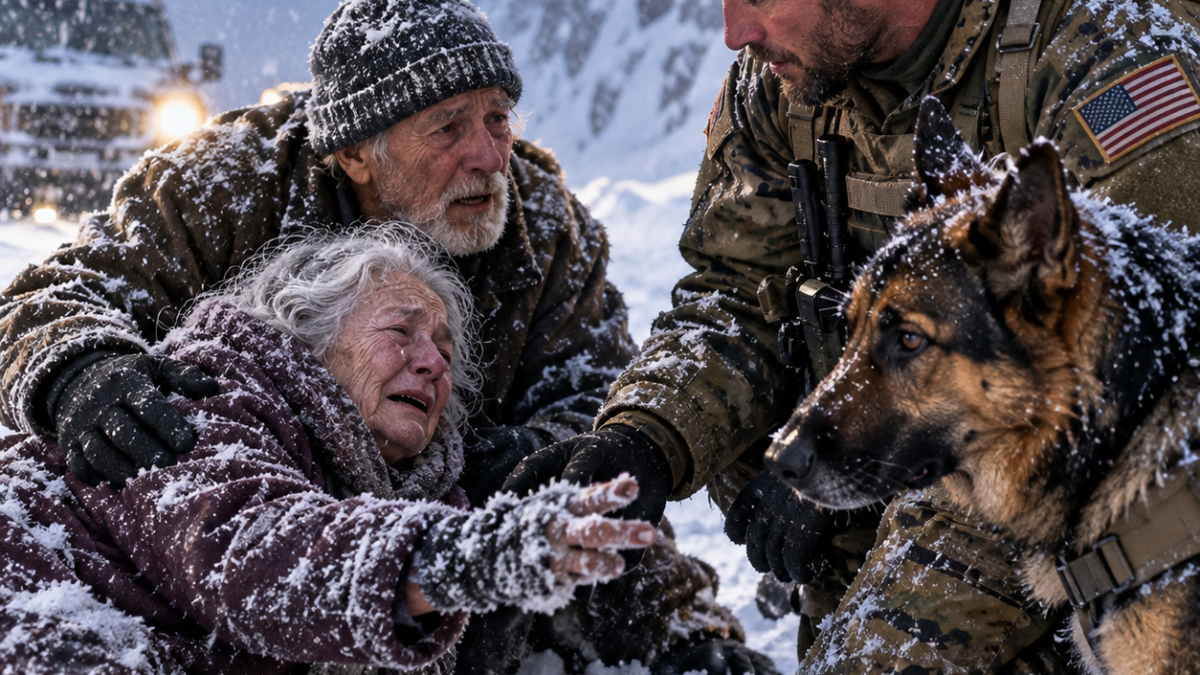
Then an old man collapsed beside a woman lying motionless in the snow.
For a second, even my training went quiet.
The old man had both arms hooked under the woman’s shoulders, trying to pull her forward inch by inch. His body shook with exhaustion. His knees kept sliding. Snow clung to his coat, his eyebrows, his beard, his gloves.
He looked nearly eighty.
Tall once, maybe.
Strong once.
The kind of old strength that came from ranch work, long winters, and never asking for help until help was the only thing left.
A weathered veteran’s cap clung crookedly to his silver hair.
His face was pale, but his eyes were steel blue and still fighting.
The moment he saw my light, relief almost knocked him over.
“Please,” he gasped.
He tried to rise and failed.
“We… we can’t walk anymore.”
His voice cracked.
“My wife.”
He looked down at the woman in his arms.
“Please save her.”
I dropped beside them.
The woman was several years younger than him, though illness had stolen whatever softness age had tried to leave. Silver hair framed a gentle face drained nearly colorless. Frost clung to her eyelashes. Her lips had turned blue. One gloved hand was pressed weakly against her chest as if protecting a pain too deep for words.
I checked her pulse.
Weak.
Dangerously slow.
Her breathing was shallow, uneven.
“Hypothermia,” I said quietly.
The old man stared at me as if the word itself could kill her.
“What’s your name, sir?”
“Arthur,” he said. “Arthur Sullivan.”
“I’m Staff Sergeant Caleb Ward. This is Ranger.”
Ranger had lowered himself beside the woman, pressing his body close without lying on her.
Arthur looked at the dog, then back at me.
“My wife. Evelyn.”
“How long have you been out here?”
“I don’t know. Our truck died. Ten miles back. Maybe twelve. No phone service. No cars.”
He swallowed, and the movement looked painful.
“We were trying to reach our daughter.”
That sentence struck me.
Not shelter.
Not a hotel.
Not help.
Their daughter.
“We’ll talk about that later,” I said. “Right now, we get both of you warm.”
Arthur caught my sleeve.
His fingers barely had strength.
“Please. She’s dying.”
I met his eyes.
“Not while I’m here.”
I do not know why I said it.
It was not a promise any man had the right to make.
But sometimes, in the worst moments, people need certainty before reality is ready to provide it.
Arthur nodded once.
He wanted to believe me so badly it hurt to see.
I wrapped Evelyn in a thermal blanket, then another. I checked her airway, lifted her carefully, and signaled Arthur to lean against me as we started back toward the station.
Those half miles felt longer returning than they had leaving.
Ranger led us through the storm, doubling back every few yards when Arthur stumbled. Twice, Arthur nearly went down. Once, I had to stop and brace him against a pine trunk while I adjusted Evelyn’s weight in my arms.
She was light.
Too light.
That scared me more than carrying her would have.
People in real danger sometimes feel weightless.
Like the body is already deciding how much of itself to keep.
By the time the ranger station appeared through the snow, Arthur was crying.
Silently.
No drama.
Just tears freezing along the lines of his face.
Inside, the warmth hit us like mercy.
I laid Evelyn on the cot near the stove and began working.
Wet outer layers off.
Dry blankets on.
Warm air.
Pulse check.
Breathing.
Pupils.
Arthur sat beside her and refused to let go of her hand.
His own hands were shaking so badly I had to wrap them before he caused more damage.
Ranger stood over Evelyn as though he had been assigned to guard her by God himself.
“Is she going to live?” Arthur asked.
“I’m working on yes.”
He nodded.
Then lowered his head.
The emergency radio crackled behind me.
“Winter Patrol Seven, be advised. Storm has intensified. All rescue operations suspended until sunrise.”
I looked toward the window.
Snow struck the glass in white bursts.
The dispatcher continued through static.
“Repeat, all rescue operations suspended until sunrise. No ground teams beyond checkpoint. No air support. Hold position.”
Hold position.
I looked back at Evelyn.
Her breathing had slowed even more.
Arthur whispered her name.
I keyed the radio.
“Copy.”
The dispatcher asked if I needed anything else.
I almost laughed.
A road.
An ambulance.
A helicopter.
A second set of hands.
A miracle.
Instead, I said, “I’ll update when I can.”
The radio faded.
For the next hour, the station became its own small world.
There was only the storm, the fire, the old couple, Ranger, and the constant sound of my own training in my head.
Check pulse.
Monitor breathing.
Warm gradually.
Do not overheat.
Keep them awake if possible.
Watch for cardiac distress.
Evelyn’s eyelids fluttered.
Arthur leaned forward.
“Evie?”
Her eyes opened.
Pale blue.
Clouded with pain, but still gentle.
She looked at Arthur first.
Then at me.
Then at Ranger, whose head rested near her arm.
“He’s beautiful,” she whispered.
I glanced at Ranger.
“He knows when people are hurting. Sometimes before they do.”
Evelyn lifted trembling fingers and brushed them through the fur between his ears.
Ranger did not move.
A faint smile touched her mouth.
Then it disappeared.
“I don’t have much time left,” she said.
Arthur lowered his head immediately.
“Evie, don’t.”
“Yes,” she whispered. “He deserves to know.”
I stayed quiet.
Years in uniform taught me that not every emergency could be fixed with pressure, gauze, or evacuation.
Sometimes people needed a witness.
Someone to hold the silence while truth climbed out.
“The cancer spread to my lungs six months ago,” Evelyn said. “Then it reached my heart. The doctors stopped talking about treatment.”
She swallowed carefully.
“They started talking about making memories.”
Arthur’s grip tightened around her hand.
“We wasted six years,” he said.
Evelyn turned her head slightly.
“It was not only your fault.”
“It was.”
“Ours,” she corrected softly.
Arthur closed his eyes.
“Our daughter, Emily,” he said. “She went through a terrible divorce. She told us her husband had been unfaithful.”
His voice cracked with shame old enough to have roots.
“We didn’t believe her.”
Evelyn’s eyes filled.
“We had known him for years,” she said. “He was charming. Helpful. Always respectful to us. Emily came home crying, and we thought she was overwhelmed. Angry. Looking for someone to blame.”
Arthur stared into the fire.
“She begged us to trust her. We asked for proof.”
He said those words like each one cut him.
“A week later, she brought proof. Photographs. Bank statements. Hotel receipts. Everything she had told us was true.”
Evelyn covered her mouth with one trembling hand.
“But by then,” she whispered, “our daughter was not trying to prove anything anymore.”
Arthur nodded.
“She looked at us and said, ‘You trusted a stranger more than your own daughter.’”
The fire snapped.
Wind battered the walls.
No one spoke.
I had heard men confess things before.
Fear.
Guilt.
Regret.
Combat strips people down to what they carry.
But family regret has a different weight.
It sits deeper.
It waits longer.
“No parent should ever hear those words,” Evelyn said.
Then she closed her eyes.
“And no child should ever have to say them.”
Arthur’s jaw trembled.
“She left. Took her boy and moved to Riverton. We wrote letters. Called. Sent birthday cards for Noah. Nothing.”
“Noah?” I asked gently.
“Our grandson,” Evelyn said. “Five years old now.”
Arthur wiped at his face with the back of one hand.
“We’ve never held him.”
The sentence landed heavily.
Evelyn turned her face toward the fire.
“When the doctors told me there was no more treatment, I told Arthur I did not want a cruise. I did not want a hospital room. I did not want to sit in our house waiting for death to choose the hour.”
Her voice was weak, but steady.
“I wanted to see my daughter. I wanted to tell her I should have believed her the first day she came home. I wanted to hold my grandson once.”
Arthur bent over her hand.
“That’s why we were on the mountain road,” he said. “I thought if we drove through before the worst of the storm…”
He could not finish.
He did not need to.
Before I could answer, he suddenly stiffened.
“Her medicine.”
He lurched up from the chair.
“Her heart medicine. I packed it. I know I did.”
He hurried toward the worn canvas backpack lying near the door and began emptying it onto the floor.
Sweaters.
Canned food.
Family photographs.
A small Bible.
A folded scarf.
His movements became frantic.
“No. No, it has to be here.”
I knelt beside him.
“Arthur, slow down.”
“I packed it,” he whispered. “When the truck died, I threw everything into the bag. I must have lost it.”
Evelyn reached weakly toward him.
“Arthur, don’t blame yourself.”
He did not hear her.
Panic had closed around him.
I checked every pocket.
Every zipper.
Every fold.
Nothing.
Arthur covered his face.
“Dear God.”
Then Ranger stood.
He lowered his nose toward the backpack.
Not wildly.
Carefully.
He sniffed along the side seam, circled once, then stopped.
His ears lifted.
He nudged the bag with his muzzle.
Then scratched insistently at the inner lining.
I froze.
“What did you find, buddy?”
Ranger scratched again.
I picked up the bag and felt along the inside.
The lining had torn near the bottom corner.
Something hard shifted between the fabric and outer canvas.
Using my pocket knife, I carefully opened the seam.
My fingers touched plastic.
I pulled out a small prescription bottle.
Arthur stared.
“There it is.”
He made a sound that was half sob, half prayer.
“I never would have found that.”
I checked the label, expiration date, and dosage instructions, then handed it to Evelyn with water.
She placed one tablet beneath her tongue and closed her eyes.
Several long minutes passed.
Then the tension in her shoulders eased.
A little color returned to her cheeks.
“I can breathe again,” she whispered.
Arthur kissed her forehead without saying a word.
Ranger sat down beside her cot, calm as stone.
The radio crackled again.
I picked it up.
“Winter Patrol Seven.”
A voice came through, older and rough from too many winter rescues.
“Caleb, this is Sheriff Brooks.”
I knew Daniel Brooks well enough to trust him.
He was fifty-six, gray-haired, and honest in a way that had probably cost him promotions.
“I’m here, Sheriff.”
“Highway is officially closed. State rescue suspended every vehicle. Helicopters grounded. Winds too strong. Earliest deployment sunrise, maybe later.”
I glanced at Evelyn.
“What about an ambulance?”
“No chance.”
The words fell heavily inside the station.
Brooks hesitated.
“Caleb, if you stay where you are, you’re covered under emergency protocol.”
I said nothing.
“But if you drive that patrol SUV after this call, you’re making that decision on your own. No backup. No rescue. If something goes wrong, nobody can reach you until morning.”
Arthur stared at the floor.
Evelyn looked toward the fire, strangely peaceful.
Ranger walked over and sat beside me.
He looked up with complete trust.
That was the thing about Ranger.
He never understood politics.
Liability.
Procedure.
Paperwork.
He understood need.
He understood someone had to move.
I pressed the transmit button.
“Roger that.”
I clipped the radio to my vest.
Then I picked up the keys to the Forest Service four-wheel-drive SUV.
Arthur looked at me.
“You can’t risk your life for us.”
“I’m not risking it for you,” I said. “I’m using it for you.”
His eyes filled.
I looked at Ranger.
“You ready?”
Ranger stood.
Of course he was.
I turned back to Arthur and Evelyn.
“There isn’t another option.”
Outside, the blizzard continued to rage.
Inside, the decision had already been made.
There was no turning back.
The Forest Service SUV rolled into the storm just after midnight, headlights carving two pale tunnels through the endless white.
Every mile away from the ranger station meant fewer chances of turning back.
I kept both hands steady on the wheel.
Fear was there.
I would be lying if I said it wasn’t.
Fear is not the enemy.
Panic is.
Fear sharpens judgment if you do not let it take the wheel.
Arthur sat in the front passenger seat, wrapped in blankets, shoulders hunched, eyes fixed on the invisible road.
Every few seconds, he glanced over his shoulder to make sure Evelyn was still breathing.
In the back, Evelyn rested beneath two thermal blankets.
Ranger lay beside her with his body pressed lightly against her legs, sharing warmth without disturbing her. Every so often, he lifted his head and studied her breathing.
He had done that overseas.
Watched wounded Marines until evacuation arrived.
He was doing it again now.
Snow hammered the windshield.
The wipers fought and lost and fought again.
“No tire tracks,” I murmured.
Arthur looked ahead.
“What does that mean?”
“We’re probably the only people crazy enough to be out here tonight.”
He managed the faintest smile.
Then it disappeared.
“I’m sorry you got dragged into our mess.”
“You didn’t drag me anywhere.”
For several miles, only the engine, wind, and windshield wipers spoke.
Then Evelyn opened her eyes.
“Mr. Ward?”
“Caleb,” I said.
She smiled weakly.
“Caleb.”
Her voice was soft enough that Arthur leaned back to hear.
“I don’t want you thinking Arthur and I were bad parents.”
I kept my eyes on the road.
“We loved Emily more than anything,” Evelyn said. “But love without trust isn’t enough.”
Arthur lowered his head.
“When Emily’s marriage collapsed, she came home crying. She told us her husband had another woman.”
His hands tightened around his knees.
“I had known that young man nearly fifteen years.”
“So had I,” Evelyn whispered. “We thought she was overwhelmed. Looking for someone to blame.”
“She begged us to believe her,” Arthur said.
His voice cracked.
“We asked for proof instead.”
I felt the weight behind those words.
In combat, hesitation can cost lives.
In families, it can cost years.
“A week later,” Arthur continued, “she came back with photographs. Bank statements. Hotel receipts.”
He swallowed hard.
“Everything she’d said was true.”
“But by then,” Evelyn said, “our daughter wasn’t trying to prove anything anymore.”
Arthur closed his eyes.
“She told us, ‘You trusted a stranger more than your own daughter.’”
The words lingered inside the vehicle longer than the storm outside.
Nobody spoke.
Even Ranger lifted his head, watching the old couple as though he understood grief in a language beyond ours.
Nearly an hour into the journey, the dashboard chimed.
A red warning light flashed.
At the exact same moment, Ranger stood abruptly.
His ears locked forward.
Instead of barking, he pressed his nose firmly against Evelyn’s arm.
My hands tightened around the wheel.
I had seen that warning before.
Something was about to go wrong.
Arthur turned in his seat.
Evelyn’s breathing had become shallow and uneven.
I eased the SUV onto a narrow turnout carved into the mountainside, keeping the engine running and the heater high.
“Evelyn,” Arthur called.
She tried to answer.
Only a faint gasp came out.
Her right hand pressed against the center of her chest.
“My chest.”
I was already moving.
I climbed into the back seat with practiced efficiency, unzipping the emergency medical kit.
Training took over.
Check pulse.
Check breathing.
Pulse oximeter.
Blood pressure.
Medication.
Sequence, not panic.
Ranger stayed perfectly still beside Evelyn, watching every move I made.
Arthur’s hands shook uncontrollably.
“Is she having a heart attack?”
“I don’t know yet,” I said honestly. “But I need you calm for her.”
He nodded, fighting for breath.
I looked directly at Evelyn.
“Evelyn, can you hear me?”
She managed a weak nod.
“Good. Keep looking at me. Slow breaths.”
I placed one tablet of her prescribed heart medication beneath her tongue and continued monitoring her pulse.
Long seconds passed.
Then another minute.
Gradually, the tightness in her face eased.
Her breathing slowed.
“I think it’s passing,” she whispered.
Arthur closed his eyes and pressed his forehead gently against hers.
“You scared me.”
“I’m sorry,” she murmured.
I let myself take one slow breath.
Then climbed back behind the wheel.
“We’re losing time.”
The storm had become worse.
Visibility was nearly gone.
I inched the SUV forward until the headlights caught something stretched across the entire road.
A massive pine tree.
The trunk was thicker than a pickup truck, crashed directly across the mountain highway, dragging snow-covered branches with it.
I stopped.
Arthur stared through the windshield.
“Can we drive around it?”
I got out with a chainsaw and recovery winch.
Wind slammed snow into my face as I worked.
“For a tree this size? Not safely.”
I cut away smaller branches first, then attached the steel cable to the thickest section of trunk.
The SUV strained against the weight.
Tires spun on ice.
The tree shifted only inches.
Not enough.
Then I saw something worse.
Beyond the fallen tree, drifting snow had completely erased the roadway.
The GPS blinked once.
Then died.
SIGNAL LOST.
Arthur had climbed out despite the cold.
“What now?”
I opened the glove compartment and pulled out a waterproof topographic map.
Then a military compass.
“I stopped trusting electronics a long time ago.”
I studied the map beneath my flashlight.
Most nearby forest roads had been abandoned decades earlier.
None appeared reliable.
Then Ranger sniffed the wind.
He trotted several yards into the trees and stopped beside a narrow opening almost hidden beneath snow-covered brush.
He barked once.
Not urgently.
Confidently.
I walked over and brushed snow away with my boot.
Beneath the drift lay an old gravel road.
Nearly invisible.
I checked its direction against the compass, then traced the faded route across the map.
A slow smile crossed my face.
“It’s an old Forest Service access road.”
Arthur looked uncertain.
“Will it hold?”
“It was built before GPS existed,” I said. “Sometimes the oldest roads are the ones people forget.”
I looked at Ranger.
“You found it.”
Ranger wagged his tail once.
That was enough celebration for him.
I folded the map, climbed back into the SUV, and carefully steered toward the forgotten trail.
As we disappeared into the darkness between towering pines, I saw a warning sign half-buried under snow.
ROAD NOT MAINTAINED.
TRAVEL AT YOUR OWN RISK.
Arthur saw it too.
He looked at me.
I looked at him.
Neither of us said what both of us knew.
We had been traveling at our own risk since the moment Ranger scratched at the station door.
The abandoned Forest Service road became a narrow ribbon of white.
The SUV crawled forward with four-wheel drive engaged, tires biting cautiously into frozen earth and hidden rock.
According to the paper map, Riverton was less than five miles away.
Under normal conditions, it would have been a short drive.
Tonight, those final miles felt longer than the entire journey.
I moved to the back seat beside Evelyn and had Arthur drive exactly as I instructed.
Slow.
No sudden turns.
No braking hard.
Keep the wheel steady.
If I said stop, stop.
The old veteran obeyed with the focus of a man who had spent his life learning that pride was useless if it got someone killed.
I kept two fingers on Evelyn’s wrist.
Every few minutes, I checked her pulse, watched the color of her lips, counted breaths.
Ranger remained pressed close to her legs, eyes open.
The radio crackled.
“Winter Patrol Seven, this is Sheriff Brooks.”
I picked up the mic.
“I’m here.”
Static ripped through the cabin.
“Another avalanche came down fifteen minutes ago. Every route behind you is blocked. You’re completely isolated until the storm breaks.”
Arthur tightened his grip on the wheel.
“So nobody’s coming.”
Brooks heard him.
“I’m afraid not.”
A pause.
“Caleb, you’re the only help they’ve got.”
I looked through the windshield where snow erased everything beyond twenty yards.
“We’ll keep moving.”
“Be careful, son.”
The transmission faded.
Silence returned.
Several minutes passed before Evelyn opened her eyes.
“Arthur.”
“I’m right here.”
“If we reach Emily, promise me something.”
“Anything.”
“Don’t let me spend our first moments asking for forgiveness.”
Arthur glanced into the rearview mirror.
“What?”
A faint smile touched her lips.
“I want to hug her first.”
Arthur’s eyes glistened.
“You’ll have plenty of time.”
Evelyn shook her head gently.
“I hope you’re right.”
At that exact moment, Ranger lifted his head.
His ears snapped forward.
A deep growl rumbled in his chest.
Then he barked sharply.
Once.
Twice.
I reached for Evelyn’s wrist.
Her pulse was racing far beyond normal.
“Evelyn?”
She clutched her chest, face twisting with pain.
The portable monitor burst into a rapid warning tone.
Then, without another word, she collapsed sideways into my arms.
“Arthur, stop.”
The SUV skidded to a halt, tires grinding against packed snow before coming to rest beside a line of frost-covered pines.
Arthur threw open the driver’s door and rushed to the rear, nearly losing his balance in the wind.
When he saw Evelyn motionless in my arms, every ounce of color left his face.
I checked for a pulse.
Once.
Again.
Nothing.
“She has no heartbeat.”
Arthur dropped to his knees beside the open door.
His hands shook so violently he could barely hold the edge of the seat.
“Evie.”
I lowered the rear seats, creating enough room for treatment.
Then I positioned Evelyn flat and started CPR.
Hands locked.
Center of chest.
Controlled compressions.
Steady rhythm.
Do not think about the storm.
Do not think about Arthur.
Do not think about Emily’s house five miles away.
Do not think about Noah.
Do the work.
Ranger barked repeatedly, pacing beside the SUV before returning to Evelyn’s side.
Then he nudged Arthur’s arm hard with his nose.
Not gently.
Commanding.
As if demanding that the old man stay present instead of falling into despair.
Arthur clasped Evelyn’s hand between compression cycles.
“I’m sorry,” he whispered through tears. “I’m sorry we didn’t believe our little girl. Please don’t leave before you tell her yourself.”
I did not slow.
One cycle.
Then another.
Time disappeared beneath wind, snow, and the rhythm of my hands.
Nearly two minutes passed.
Then Evelyn gasped.
A deep, sudden breath tore through the frozen air.
A weak heartbeat returned beneath my fingertips.
Arthur broke down completely, resting his forehead against her hand.
“You came back.”
I helped Evelyn regulate her breathing, then checked her pulse again.
Unstable.
Too unstable.
I looked at Arthur.
“The nearest hospital is east of here. If we turn now, we might reach it.”
Evelyn opened her eyes.
“No.”
“Evelyn, you may not survive another cardiac arrest.”
“I understand.”
Her voice was barely above a whisper.
Yet every word carried quiet certainty.
“I have already accepted dying. What I cannot accept is leaving this world without holding Noah or telling Emily that her mother was wrong.”
Silence settled over the vehicle.
The kind of silence no protocol covers.
I looked at Arthur.
Then at Ranger.
He had rested his head across Evelyn’s trembling hand, offering the last comfort he could.
I lowered my eyes for several seconds.
Then made the decision.
“Arthur, you drive.”
The old veteran nodded.
I climbed fully into the back beside Evelyn, secured the monitor, and kept two fingers on her wrist.
“I’ll watch her every second.”
Arthur restarted the engine.
The SUV rolled slowly back onto the snow-covered road.
No one spoke again.
Only five miles remained.
I understood that from that moment forward, whatever happened would rest entirely on my shoulders.
Riverton appeared like a dream.
After hours of blinding wind, frozen roads, fallen trees, and impossible choices, the quiet neighborhood looked almost unreal.
Warm porch lights glowed through evening darkness.
Thin smoke rose from chimneys.
Christmas decorations blinked softly in windows.
Ordinary life had continued here while four souls had been racing against time through the mountains.
Arthur brought the SUV to a slow stop in front of a modest white farmhouse with blue shutters.
His hands stayed on the steering wheel long after the engine fell silent.
He had dreamed of this moment for six years.
Now that he had reached it, fear replaced hope.
“What if she won’t open the door?” he whispered.
Behind him, Evelyn leaned weakly against the seat.
Her face had grown paler during the final miles.
Every breath cost her.
Still, when she looked through the frosted window toward the house, her eyes brightened for the first time since I had found her in the snow.
She squeezed Arthur’s hand.
“We made it.”
Arthur nodded, unable to speak.
I stepped out first and scanned the icy walkway.
Then I opened the rear door and offered Evelyn my arm.
Ranger jumped down beside us, staying close enough that his shoulder brushed lightly against her leg whenever she wavered. He matched every slow step she took.
Patient.
Gentle.
Unshakable.
The front door opened only a few inches.
A woman in her early forties stood inside, frozen in disbelief.
Emily Sullivan was tall and slender, with chestnut-brown hair pulled into a loose ponytail and hazel eyes that looked like they had learned caution the hard way.
She stared first at Arthur.
Then at Evelyn.
No one spoke.
Six years of silence suddenly felt heavier than all the snow covering the porch.
Emily’s hand tightened on the door.
“What are you doing here?”
Arthur tried to answer.
Nothing came out.
Evelyn opened her mouth, but weakness stole the words before they could leave.
I stepped forward.
“Ma’am,” I said quietly, “your mother doesn’t have much time.”
Emily’s expression changed instantly.
She looked beyond me and finally saw how fragile Evelyn had become.
The color drained from her face.
She rushed onto the porch just in time to catch her mother before she lost balance.
“Mom.”
One word.
The first time she had said it aloud in six years.
Emily wrapped both arms around Evelyn.
For several long seconds, neither woman spoke.
Six years of hurt, unanswered letters, pride, grief, divorce, betrayal, and sleepless nights disappeared beneath one embrace.
Arthur stood motionless on the porch, tears filling his tired blue eyes.
The proud rancher who had once believed he could solve every problem with stubborn determination now understood that the hardest battles are won only by humility.
“I’m sorry,” Evelyn whispered.
Her voice shook, but she forced the words out.
“I should have believed you the very first day you came home. I failed you as your mother.”
Emily shook her head as tears streamed down her cheeks.
“I stopped hoping you’d ever say that.”
Arthur stepped forward next.
He removed his worn veteran’s cap.
“I failed you too, sweetheart. I was too proud to admit I was wrong. I’ve wanted to tell you that every day for six years.”
Emily looked at both of them.
Then she pulled her father into the embrace.
None of them noticed the front door opening wider until a small voice interrupted the silence.
“Mom? Who’s that dog?”
A five-year-old boy stepped cautiously onto the porch wearing oversized winter boots and a bright red jacket zipped nearly to his chin.
Dark hair stuck out beneath his knitted hat.
His curious green eyes moved from the unfamiliar adults to Ranger, who sat quietly at the bottom of the porch steps without making a sound.
Instead of walking forward, Ranger wagged his tail once and lowered himself into a relaxed sitting position.
Noah smiled.
“Can I pet him?”
I nodded.
“If you walk slowly, he’ll meet you halfway.”
The little boy took careful steps across the porch.
Ranger remained perfectly still until Noah’s small hand touched the thick fur behind his ears.
Then the German Shepherd leaned forward just enough to accept the touch.
Noah laughed.
“He’s so soft.”
That laugh broke the last wall.
Evelyn lowered herself carefully with my support and opened her trembling arms.
“Noah.”
The little boy looked toward his mother.
Emily gave a quiet nod.
Noah walked straight into Evelyn’s embrace.
The elderly woman closed her eyes as she held her grandson for the very first time.
Tears rolled silently down her face.
But they were no longer tears of regret.
Arthur wrapped one arm around both of them while Emily rested her head against her father’s shoulder.
I stepped back without saying a word.
Some moments belong only to families.
Ranger stepped back with me.
He leaned against my leg.
For the first time all night, I let my shoulders drop.
Several days later, Evelyn Sullivan passed away peacefully in Emily’s home.
Not in the snow.
Not in a stranded truck.
Not alone.
She died in a warm bed with Arthur holding one hand and Emily holding the other. Noah sat nearby with Ranger’s head in his lap, quietly telling his grandmother that the dog was being very good and should maybe have pancakes.
Before she passed, Evelyn heard the words she had crossed a mountain to hear.
“We love you, Mom.”
She smiled after that.
Arthur told me later it was the most peaceful smile he had seen on her face in years.
I attended the funeral a week later.
I stood near the back in dress blues, Ranger sitting at my side.
I had not planned to bring him inside.
Noah insisted.
“He saved Grandma,” the boy said.
No one argued.
During the service, Emily spoke.
Her voice shook at first.
Then steadied.
“My mother and father made a mistake years ago,” she said. “So did I. My mistake was believing pain had to stay exactly where someone left it.”
Arthur bowed his head.
Emily looked toward him.
“My parents came through a blizzard to say what should have been said six years earlier. I wish we had more time. But I am grateful we had enough.”
Enough.
That word stayed with me.
After the service, Arthur came to where I stood outside near the church steps.
He looked smaller than he had in the snow.
Grief does that.
It folds people inward.
He held out his hand.
I shook it.
Then he pulled me into a hug.
Old soldiers do not always hug gracefully.
That one did.
“I would have lost her on that road,” he whispered. “Without you.”
I glanced down at Ranger.
“Without him.”
Arthur knelt slowly, joints protesting, and placed both hands on either side of Ranger’s face.
“You found us,” he said.
Ranger licked his chin once.
Arthur laughed through tears.
“Good dog.”
Ranger wagged his tail.
He already knew.
In the months that followed, Emily and Arthur began rebuilding what six years had broken.
Not quickly.
Not perfectly.
People like stories where forgiveness happens in one embrace and all the pain disappears.
Real forgiveness is less dramatic and more demanding.
There were awkward dinners.
Hard conversations.
Old accusations.
New tears.
Missed years no one could return.
Arthur learned Noah’s favorite cereal, favorite dinosaur, favorite bedtime story, and that the boy believed all dogs understood English but pretended not to so they could avoid chores.
Emily learned that her father had kept every birthday card returned unopened.
Arthur learned that love without listening can become another kind of pride.
Noah learned that his grandfather could fix nearly anything mechanical but could not build a Lego spaceship without making “structural suggestions” nobody requested.
Ranger learned that Noah always dropped crackers.
They became friends immediately.
A year later, another winter storm swept across the Wyoming mountains.
I was once again volunteering for seasonal patrol duty.
Some people told me I should take a quieter assignment.
A desk.
Training.
Coordination.
I understood why.
The mountains had nearly killed us that night.
But every time I thought about stepping back, I remembered Arthur’s voice in the snow.
Please.
We can’t walk anymore.
So I returned.
Ranger trotted beside me through fresh powder on a quiet forest trail.
He was seven now.
A little slower.
Still sharper than any human I knew.
Halfway along the trail, he stopped.
Lifted his head.
Caught an unfamiliar scent drifting through the wind.
I smiled and tightened my grip on the leash.
“What is it, partner?”
Ranger looked toward the endless white forest.
Then he took one confident step forward.
I followed without hesitation.
Some patrols have an ending.
The ones that matter never truly do.
I have spent most of my life around uniforms, ranks, orders, and protocols.
I believe in them.
Discipline saves lives.
Procedure matters.
Training matters.
But some nights teach you that rules and courage are not always the same thing.
That night, dispatch said hold position.
The storm said stay inside.
Common sense said wait until morning.
But a dying woman wanted to hold her grandson.
An old man needed one more chance to say he was sorry.
A daughter deserved to hear the truth before grief made it permanent.
And a German Shepherd with a missing notch in his ear knew there were people in the snow before any human did.
Caleb Ward did not stop the blizzard.
Ranger did not cure Evelyn’s cancer.
None of us erased six years of silence.
But sometimes a miracle is not the storm disappearing.
Sometimes a miracle is someone walking into it.
Sometimes it is a dog barking at the door.
A Marine trusting him.
An old man refusing to let go of his wife.
A mother using her last strength to tell her daughter, “I should have believed you.”
Sometimes God does not move the mountain.
Sometimes He sends the right footsteps through the snow.
I still patrol Wind River Pass.
I still read weather charts.
I still listen to the radio crackle in the dark.
And whenever Ranger lifts his head toward the storm, I remember that night.
The blue lips.
The shaking hands.
The old veteran pleading in the snow.
The forgotten road beneath the drift.
Evelyn’s heartbeat returning under my fingers.
Emily’s door opening.
Noah’s small voice asking about the dog.
And the way forgiveness, after six years of silence, began with one word.
Mom.
That is why I keep going back.
Because somewhere out there, somebody is always closer to safety than they know.
Somebody is always one call, one bark, one act of courage away from making it home.
And if Ranger hears them first, then I follow.
Every time.








