Phoenix Couldn’t See, Smell, or Lift His Head—But He Kept Giving Them One More Reason Not to Give Up
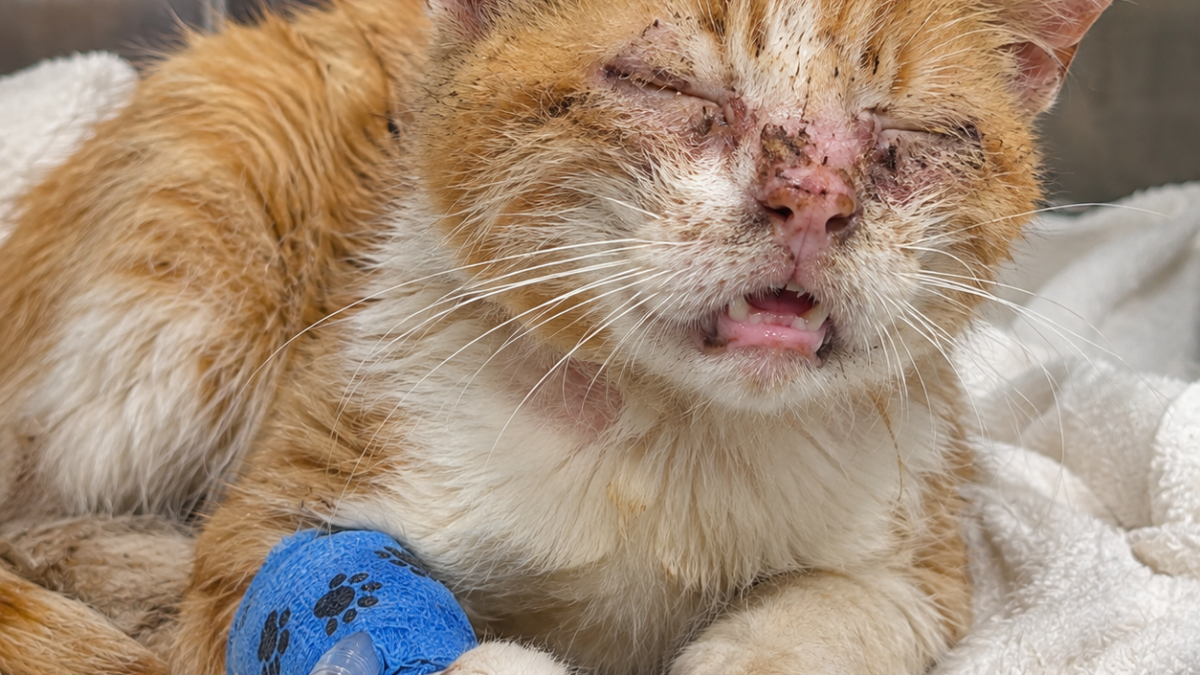
Phoenix Couldn’t See, Smell, or Lift His Head—But He Kept Giving Them One More Reason Not to Give Up.
Phoenix could barely lift his head when a taxi driver found him after a devastating accident.
He could not see, could not smell, and injuries to his face had left him struggling even to breathe normally.
Then the tests revealed that the damage went far deeper than anyone first realized.
The taxi driver almost missed him.
There was nothing dramatic about the moment at first.
No crowd.
No frantic animal running through traffic.
No loud cries calling attention to what had happened.
Just a cat lying where a cat should not have been lying.
Still.
Too still.
The driver slowed.
For a second, he may have thought the animal was already dead.
Then something moved.
Barely.
A small shift.
Enough.
The taxi stopped.
The driver stepped out and approached carefully.
The cat did not run.
He could not.
Up close, the situation became frightening.
His face had taken the worst of whatever had happened.
His breathing sounded wrong.
He could barely hold his head upright.
His body looked exhausted, but it was the face that made the driver understand this was not a cat who could simply be moved out of danger and left to recover on his own.
Something was terribly wrong.
The driver crouched.
“Hey.”
No response at first.
Then the cat moved slightly.
Alive.
That was all the driver needed.
He found something to wrap around the injured animal and lifted him as carefully as possible.
The cat did not fight.
He did not have the strength.
The trip to the shelter became a race no one had planned that morning.
The driver kept glancing over.
Still breathing.
Still there.
PART2:
He could not know what injuries were hidden beneath the fur.
Could not know whether the cat would survive the next hour.
Could not know that the animal he had just lifted from the aftermath of an accident would soon be given a name meant to describe rebirth.
At that moment, he only knew one thing.
Leaving the cat behind was not an option.
The shelter staff understood immediately that this was beyond routine intake.
The cat arrived weak.
His head drooped.
His breathing was obstructed.
His face looked injured in ways that demanded immediate veterinary attention.
He was transferred into medical care.
The first examinations did not bring good news.
There was severe pus accumulation.
The cat could not breathe properly through his nose.
His head was so weak he struggled to keep it elevated.
The veterinary team began evaluating what they could stabilize first.
Breathing.
Pain.
Hydration.
Infection.
Nutrition.
A severely injured animal cannot be treated like a list of independent problems.
Everything affects everything else.
A cat struggling to breathe may not eat well.
A cat unable to smell often loses interest in food because scent is such an important part of feline appetite.
A painful jaw can make eating harder still.
Weakness reduces movement.
Poor nutrition slows healing.
Infection consumes energy the body desperately needs elsewhere.
Phoenix—though he had not yet fully earned that name in anyone’s mind—was trapped inside a chain of problems.
The team started breaking that chain one link at a time.
The first images and tests revealed significant trauma.
Then came the CT scan.
Everyone hoped it would provide clarity.
It did.
Just not the kind they wanted.
Phoenix’s jaw could not close properly.
Dental trauma had altered the way the structures of his mouth came together.
That alone would complicate eating and comfort.
But the deeper concern involved his facial nerves.
The accident had caused severe neurological damage.
Phoenix had lost sensation across his face.
The numbness changed everything.
He could not experience his face normally.
He could not rely on sensory information most animals use automatically.
His caretakers watched him and began understanding why some of his behavior looked so strange.
He was not simply weak.
He was trying to exist inside a world that no longer arrived through his senses in the familiar way.
Then came the examination of his eyes.
The ophthalmologist assessed what remained.
Responses were tested.
Structures examined.
The hope was cautious.
Perhaps swelling was interfering.
Perhaps neurological recovery might return something.
Perhaps there was still a path toward vision.
The specialist eventually had to say what no one wanted to hear.
Phoenix’s eyesight could not be restored.
The words changed the room.
He was blind.
The accident had already taken his ability to see.
Facial nerve damage had taken sensation.
His ability to smell was gone.
His nose was obstructed.
His jaw was injured.
His body was weak.
He struggled to hold his head.
There are moments in rescue when the number of problems begins to feel larger than the animal.
Phoenix seemed impossibly small beneath the list.
One person quietly asked the question everyone had been avoiding.
“What kind of life can he have?”
No one answered immediately.
Because the honest answer was:
They did not know.
Not yet.
It is easy to look at a severely injured animal and imagine the future only through what has been lost.
Sight.
Smell.
Normal facial sensation.
Easy breathing.
Normal jaw movement.
Strength.
But animals do not live inside medical summaries.
They live inside moments.
Warmth.
Food.
Pain.
Relief.
A familiar voice.
The location of a bed.
The texture of a floor.
The smell of something—if smell remains.
A human hand.
A sound.
A routine.
Phoenix’s future would depend less on how many normal abilities he had lost and more on whether the abilities that remained could support comfort, interest and connection.
The people around him were not ready to decide before he had a chance to answer that himself.
So they continued.
The name came naturally.
Phoenix.
A creature associated with destruction and return.
The staff knew the symbolism was almost too obvious.
But when they looked at him, it felt right.
Not because anyone knew he would recover.
They did not.
A name is not a prophecy.
It was hope.
Nothing more.
And sometimes hope is enough reason to start another day.
The next problem appeared almost immediately.
Phoenix’s immune system was struggling.
A severe allergy had pushed his body into an immunosuppressive state.
That meant an animal already fighting injury, infection and inflammation had less biological strength available for the fight.
His skin and tissues reacted.
His body remained under constant stress.
Medication had to be chosen carefully.
The caretakers could not simply attack every symptom aggressively without considering what that approach might do to the rest of him.
They needed balance.
That word would become central to Phoenix’s recovery.
Treat.
But do not overwhelm.
Control infection.
But avoid unnecessary medication when possible.
Support inflammation carefully.
Protect damaged tissues.
Restore breathing.
Help him eat.
Give his body enough time to respond.
His caretaker became the person who saw the small details.
The crusting around Phoenix’s eyes.
The way dried material formed and had to be softened before it could be removed safely.
The way his face remained numb while the tissue itself still required protection.
The way medications had to be applied gently, day after day.
There was nothing glamorous about the work.
A soft cloth.
Medication.
Patience.
A frightened or exhausted cat.
Sometimes resistance.
Sometimes complete passivity.
Then repeat.
Morning.
Evening.
Again tomorrow.
Recovery is often presented through dramatic before-and-after pictures.
Phoenix’s real recovery existed in the invisible space between them.
A caretaker holding his head gently because he could not keep it in the right position.
A few minutes spent loosening crusting without damaging the skin beneath.
Medication placed carefully around injured eyes that would never see again.
A bowl adjusted because his jaw and breathing made eating difficult.
A floor cleared because blindness changed how he moved.
Someone sitting beside him when he had no idea where the room ended.
These acts would never appear in a single photograph.
Together, they built the life Phoenix still had.
At first, holding his head higher was a major event.
Someone noticed it one afternoon.
Phoenix had been resting.
Usually his chin dropped quickly.
This time he lifted.
Not much.
But the head remained up.
One second.
Then another.
The caretaker watched without touching him.
Phoenix lowered it.
Rested.
Later he did it again.
“Look at you.”
No celebration.
No loud voices.
He did not need pressure.
The next day, he held it slightly longer.
Strength was returning somewhere beneath everything else.
That changed the emotional atmosphere.
Phoenix’s body had not surrendered.
His progress was tiny enough that a stranger might have missed it.
The people caring for him saw every millimeter.
As his head control improved, Phoenix became more active in the space around him.
Blindness meant movement would always require adaptation.
His damaged facial sensation complicated that further.
He could not rely on the same signals another cat would receive while exploring.
He bumped.
Stopped.
Reoriented.
His caretaker began keeping the environment predictable.
Food in the same place.
Water in the same place.
Bedding unchanged whenever possible.
No unnecessary furniture movement.
Safe pathways.
A cat who cannot see can memorize a world.
But the world must stay reliable long enough to be memorized.
Phoenix learned slowly.
At first, every new surface seemed to create hesitation.
His nose could not guide him in the usual way either.
Cats use smell constantly.
Food.
Territory.
Other animals.
People.
A home.
All of it is partly olfactory information.
Phoenix’s loss of smell removed another map.
He had to build different ones.
Sound became important.
The caretaker spoke before touching him.
“Phoenix.”
Pause.
Then the hand.
The pattern prevented surprise.
The same voice before meals.
The same voice during eye care.
The same voice when entering the room.
At first, Phoenix did not respond obviously.
Then his ears began turning toward it.
Later, his head.
Recognition without sight.
The caretaker noticed.
“You know me.”
Perhaps he knew the voice.
Perhaps the rhythm.
Perhaps the vibration of footsteps.
Whatever it was, Phoenix was constructing familiarity.
That was one of the first signs that his world was no longer only pain.
He was learning.
Learning requires enough safety to pay attention.
Another improvement appeared in movement.
Phoenix had once kept his head low, navigating almost entirely close to the floor.
As strength returned, his posture changed.
He stopped relying on that constant low position as heavily.
He began orienting more confidently.
The caretaker watched him cross a small safe area.
One careful step.
Pause.
Another.
He contacted a soft obstacle.
Stopped.
Shifted direction.
Continued.
A healthy sighted cat could cross the same space without thought.
Phoenix’s journey required concentration.
But the point was not how slowly he did it.
The point was that he did it.
His confidence followed physical improvement.
Not quickly.
Confidence is built by successful repetition.
Walk three feet without injury.
Find the bowl.
Locate the blanket.
Hear the caretaker.
Rest.
Repeat.
Every day that ended safely taught Phoenix something.
The world may be difficult.
It is not always dangerous.
That distinction changed him.
Then came the rehabilitation specialist.
By then, everyone understood that basic supportive care had helped Phoenix stabilize, but several deeper problems remained.
His breathing through the nose was still compromised.
The facial trauma had altered structures.
Inflammation persisted around the area above his eye.
The rehabilitation consultation became the next major step.
More evaluation.
More discussion.
More uncertainty.
A surgical plan emerged.
Rhinoscopy.
Nasal dilation.
The goal was not cosmetic.
Phoenix needed a clearer airway.
A broken bone had contributed to collapse within the nasal sinus structure.
The obstruction made normal breathing difficult.
For a cat who had already lost smell and vision, restoring every possible part of comfortable breathing mattered enormously.
The procedure would allow the team to examine the nasal passages more directly.
Clear blockages.
Dilate narrowed areas.
Address inflammation where possible.
Nothing about it was simple.
Phoenix had already endured so much.
Every new procedure carried risk.
The caretaker struggled with the decision.
“How much is too much?”
That question has no universal answer.
Treatment can preserve life.
Treatment can also become its own burden.
The team looked at Phoenix’s current behavior.
He was eating more.
Holding his head better.
Engaging.
Learning the space.
Responding to familiar presence.
Those signs mattered.
They suggested that Phoenix was not merely surviving because humans refused to stop.
He was participating.
The intervention had a clear goal:
help him breathe.
They moved forward.
The rhinoscopy and dilation were performed.
The first day afterward, everyone watched closely.
Then came another treatment day.
And another.
Four consecutive days.
The routine was exhausting.
For Phoenix.
For the caretaker.
For the medical team.
But changes began appearing.
Breathing eased.
The obstructed nasal passages improved.
Inflammation began responding.
Phoenix seemed less consumed by the effort of simply drawing air through damaged structures.
People who have never struggled to breathe rarely think about how much energy breathing can require when something blocks it.
For Phoenix, easier airflow meant energy could move elsewhere.
Food.
Movement.
Healing.
Attention.
Rest.
The improvement did not erase blindness.
It did not restore smell.
It did not repair nerve sensation.
But it gave him something fundamental.
Breath with less struggle.
That was enough to shift another part of the battle.
Then, one day, Phoenix started coughing.
The sound frightened everyone.
A fragile animal recovering from nasal procedures and serious trauma suddenly coughing can signal many problems.
The caretaker watched closely.
Again.
Phoenix coughed harder.
Then something came out.
At first, she did not understand what she was seeing.
Then she did.
A parasitic worm.
The discovery added yet another problem to a medical history that already felt impossible.
Phoenix had been carrying parasites on top of everything else.
He was treated quickly with antiparasitic medication.
The caretaker later described the moment with a strange combination of horror and relief.
Horror because the parasite had been inside him.
Relief because now they knew.
A known problem can be treated.
An unknown one simply continues.
Phoenix received the medication.
The treatment helped remove another source of stress from a body that had been carrying far too many.
At this point, it would have been easy to load him with medication for everything.
His caretaker and medical team consciously tried not to do that.
Antibiotics had their place.
His infection history was serious.
But they did not want to use them excessively without purpose.
They worked with a therapist.
Adjusted care.
Tried to support Phoenix in a way that could be maintained rather than relying on constant escalation.
This required more observation.
Not less.
If a medication was reduced or avoided, they needed to know immediately if symptoms changed.
The caretaker became highly attuned to Phoenix.
How he breathed.
How he ate.
How he held his head.
Whether crusting increased.
Whether discharge changed.
How much energy he had.
How he moved.
What his stool looked like.
How he rested.
Special-needs care often means knowing details about an animal most people never need to notice.
Phoenix’s survival depended on those details.
Yet something else was happening beneath the medical work.
He was becoming a cat again.
Not merely a patient.
The distinction appeared first around food.
Eating had been complicated from the beginning.
Jaw trauma.
Allergy.
Breathing difficulty.
Loss of smell.
Weakness.
All of them interfered.
The caretaker had spent long periods worrying over meals.
Would he eat?
Would the food trigger a reaction?
Could he chew comfortably?
Was the amount enough?
Was he losing weight?
Would another change be necessary?
Food became medicine without being medication.
Phoenix needed a carefully tailored diet.
What worked for another cat might not work for him.
His allergic condition required attention.
Ingredients mattered.
Reactions mattered.
Consistency mattered.
The first time Phoenix ate a full meal comfortably, the caretaker almost did not trust it.
She watched.
He continued.
No obvious struggle.
No stopping every few bites.
No immediate distress.
When the bowl was finished, Phoenix sat quietly.
The caretaker stared.
“Was that it?”
Phoenix had no idea this was supposed to be historic.
He had eaten.
Humans were emotional about it.
Not his problem.
The next meal went well too.
Then another.
The battle around food slowly changed from emergency to routine.
That was enormous.
Nutrition strengthens almost everything.
Immune function.
Muscle.
Skin.
Healing.
Energy.
A cat who can eat consistently has access to resources the body cannot manufacture from hope.
Phoenix began gaining physical strength.
His coat improved.
His posture looked less collapsed.
His head remained higher.
Movement became less tentative.
The people who saw photographs from the beginning and then met him later often needed a moment.
Same face.
Yet not the same presence.
In the early images, Phoenix seemed swallowed by his injuries.
Later, Phoenix occupied his body again.
Blind.
Still neurologically impaired.
Still medically complicated.
But present.
His caretaker stopped interpreting every sound as an emergency.
That was another kind of progress.
At first, silence frightened her.
Coughing frightened her.
A missed bite frightened her.
Sleeping too deeply frightened her.
Every unusual movement could mean decline.
Eventually she learned Phoenix’s patterns.
This sound is normal.
This breathing is comfortable.
This sleeping position is his favorite.
This pause at the doorway means he is orienting.
This head turn means he heard something.
This reluctance around food deserves attention.
This one does not.
Knowledge replaced some of the fear.
Phoenix seemed to gain confidence at the same time.
The room expanded.
Then the hallway.
Then other safe areas.
He memorized.
People unfamiliar with blind cats sometimes imagine constant collision.
Phoenix did bump into things.
Especially early.
But animals learn.
He counted distance through repetition without literally counting.
Recognized floor changes.
Understood where walls were.
Learned the location of doors.
Sound reflected differently in spaces.
Air moved differently.
A blind animal does not simply wander through darkness.
He builds another version of the room.
Phoenix’s version was made of memory.
Sound.
Touch.
Texture.
Routine.
His caretaker helped by not rearranging everything.
A chair left where he knew it belonged became information.
A rug became a landmark.
A bowl became a fixed destination.
The world became predictable enough that Phoenix could become independent inside it.
One afternoon, the caretaker watched him move from his bed to his food area without guidance.
He paused only once.
Turned correctly.
Reached the bowl.
She smiled.
Phoenix began eating.
No celebration.
She had learned.
Some victories are best allowed to become normal.
That was what she wanted most.
Normality.
Not a normal cat.
Phoenix would never fit that description medically.
A normal life.
Or at least a life that felt ordinary to him.
Wake.
Stretch.
Orient.
Eat.
Rest.
Move.
Listen.
Recognize a voice.
Receive medication.
Complain.
Sleep.
The more of the day that became routine, the less his injuries controlled every moment.
Phoenix also began showing preferences.
That delighted everyone.
Patients are often passive because sickness removes the energy required for opinion.
Phoenix recovered enough to dislike things.
Some medications.
Certain handling.
Unwanted interruptions.
He might turn away.
Shift.
Resist slightly.
The caretaker welcomed these signs.
“You have complaints now.”
Phoenix did not need to answer.
His face could not express everything the way it once might have, but his behavior communicated plenty.
He wanted control.
Control is a good sign.
A cat who cares where he lies, what he eats and who touches him has a stake in his own life.
The facial numbness never disappeared simply because people wished it away.
That required continued caution.
Phoenix could not always feel irritation or injury normally.
The caretaker sometimes had to be his sensory system.
Check the face.
Check the eyes.
Check for crusting.
Check skin.
Check mouth.
Notice things before they became larger.
His blindness required similar vigilance.
Sharp objects.
Unexpected heights.
Open hazards.
Everything mattered.
But the home did not feel like a padded cage.
That was deliberate.
Phoenix needed safety.
He also needed experience.
A life protected from every possible difficulty can become no life at all.
So his caretaker created controlled freedom.
Safe floor.
Predictable furniture.
Accessible resting spots.
Then Phoenix chose.
Move or rest.
Approach or stay.
Listen.
Explore.
He became increasingly interested in sound.
A door opening.
Footsteps.
The shake of a food container.
A voice from another room.
Birds outside.
Traffic in the distance.
Phoenix could not see the source.
He could not smell many of the things another cat would investigate.
But sound gave his world depth.
His ears turned quickly.
Sometimes his entire body followed.
A bird outside the window could hold his attention.
The caretaker wondered what he imagined.
Perhaps nothing visual.
Perhaps a map built entirely from location.
Near.
Far.
Left.
Right.
Moving.
Gone.
Phoenix still had a world.
Different did not mean empty.
That distinction became more important as months passed.
When people heard his medical history, they tended to react the same way.
“He’s blind?”
“Yes.”
“He can’t smell?”
“No.”
“His face is numb?”
“Yes.”
“And his jaw?”
“Injured.”
“How does he live?”
The caretaker would look toward Phoenix.
Usually he was doing something ordinary.
Eating.
Sleeping.
Listening.
Walking slowly through a familiar room.
The answer became:
“Like Phoenix.”
No one else needed to live exactly that way.
He did.
His life had reorganized itself around what remained.
And what remained was more than outsiders assumed.
Hearing.
Movement.
Appetite.
Memory.
Preference.
Comfort.
Attachment.
Curiosity.
Routine.
Trust.
Those were not small things.
At ten months after rescue, the transformation became undeniable.
Phoenix was still receiving medical support.
His journey was not over.
But eating was no longer the crisis it once had been.
His carefully selected diet helped manage the severe food allergy.
He could receive nourishment without constant distress.
The caretaker had spent months thinking about every meal.
Now meals began to feel like meals again.
That may have been one of the most emotional milestones.
Not a dramatic surgery.
Not an impossible recovery.
Just a bowl placed down.
Phoenix eating.
The caretaker walking away without watching every bite.
That is what success can look like.
The absence of panic.
The disappearance of emergency from an ordinary act.
Phoenix’s medical care continued.
Regular assessment.
Diet management.
Eye care.
Monitoring breathing.
Watching the nasal condition.
Supporting his immune health.
No one declared him “fixed.”
That word did not fit.
Phoenix was living with permanent consequences.
Blindness remained.
Loss of smell remained.
Facial numbness remained.
His history of allergy and immune suppression remained relevant.
The jaw trauma remained part of how his body worked.
But he was stronger.
The name Phoenix started feeling less symbolic and more accurate.
Not because he had risen untouched.
A phoenix in mythology burns and returns whole.
Phoenix the cat returned changed.
Perhaps that made his story more honest.
Real recovery rarely returns an animal to the exact body that existed before.
Sometimes scars stay.
Vision does not return.
Nerves do not repair completely.
A jaw remains altered.
Medication becomes routine.
Special food becomes permanent.
Recovery is not erasure.
It is learning whether life can grow around the damage.
Phoenix’s did.
His caretaker saw it every morning.
Phoenix heard footsteps.
His ears turned.
He knew who was coming.
A hand touched the familiar area of his body.
He relaxed.
That recognition had once seemed uncertain.
Now it was routine.
The person he could not see had become part of his map.
Humans often think connection requires eye contact.
Phoenix proved otherwise.
He knew people without seeing faces.
Recognized voices.
Footsteps.
Touch.
Timing.
Perhaps scent had once helped before the accident.
Now the bond had changed channels.
Still a bond.
The caretaker noticed that Phoenix behaved differently with familiar and unfamiliar people.
New footsteps made him more cautious.
Familiar ones did not.
A stranger’s voice caused stillness.
The caretaker’s voice allowed relaxation.
That difference meant something.
Trust had survived sensory loss.
Or perhaps it had rebuilt itself afterward.
Either way, it was real.
The taxi driver who found Phoenix eventually received updates.
He had carried a barely responsive cat into safety and then returned to his normal life, not knowing whether the animal would survive.
Months later he saw a video.
Phoenix holding his head up.
Moving.
Eating.
The driver watched twice.
“That’s him?”
Yes.
Same cat.
He shook his head.
The memory he carried was of a body that seemed close to death.
The cat in front of him now still looked different.
One glance revealed the lasting injuries.
But Phoenix moved with intention.
That difference was everything.
The driver visited.
Phoenix could not see him.
Could not recognize his smell in the normal feline way.
Perhaps he had no memory of that first car ride.
The driver crouched.
“Hey, buddy.”
Phoenix’s ears turned.
The man reached slowly.
The caretaker guided him on where to touch safely.
Phoenix accepted the hand.
The driver swallowed hard.
“I really thought he was gone.”
The caretaker looked at Phoenix.
“So did we.”
Phoenix moved his head slightly toward the voice.
Nothing dramatic.
Yet the driver’s eyes filled.
He had never needed Phoenix to remember him.
He only needed to know that stopping had mattered.
One decision.
Pull over.
Pick him up.
Take him somewhere.
Everything came after.
The shelter.
Veterinarians.
CT scan.
Ophthalmologist.
Medication.
Daily eye care.
Rehabilitation.
Rhinoscopy.
Nasal dilation.
Parasite treatment.
Diet.
Therapy.
Ten months.
All of it began because a driver looked at an animal lying near the road and chose not to keep going.
Phoenix’s story became larger than the accident.
People heard it and focused naturally on the most dramatic pieces.
Blind.
No smell.
Nerve damage.
Severe allergy.
Collapsed nasal structures.
Worm.
Surgery.
But the caretaker saw another story underneath.
Consistency.
The same person applying eye medication again.
Cleaning again.
Preparing the right food again.
Watching again.
Making the room safe again.
Taking Phoenix to another appointment.
Returning home.
Doing it tomorrow.
Compassion is often described as feeling.
Phoenix needed compassion to become a schedule.
That is how he lived.
The caretaker sometimes became tired.
That mattered too.
Rescue stories can accidentally make human caregivers sound endless.
They are not.
Special-needs care is work.
Appointments cost time.
Medication schedules interrupt days.
Diet restrictions complicate routines.
Worry affects sleep.
Cleaning never feels heroic at midnight.
There were moments when the caretaker wondered whether she was doing enough.
Moments when improvement seemed too slow.
Moments when a symptom returned and erased weeks of confidence in seconds.
She did not always feel strong.
She did the work anyway.
That may be a more useful definition of dedication.
Not never being tired.
Continuing while tired.
Phoenix, for his part, had no interest in becoming inspirational enough to justify the effort.
He simply became more himself.
He developed favorite spots.
A particular bed.
A familiar section of floor.
A location where sound from outside was interesting.
He learned meal times.
Learned voices.
Learned how to move around obstacles.
When something was moved unexpectedly, confusion showed.
The caretaker learned the cost of casual rearranging.
“Sorry.”
Phoenix stood still.
She returned the object.
Phoenix reoriented.
Lesson learned.
His home belonged partly to his memory now.
Every object had a responsibility to remain where expected.
Visitors were told.
Do not leave bags in walkways.
Close doors consistently.
Do not move his bowls.
Speak before touching.
Small rules.
Huge difference.
This was not pity.
It was accessibility.
Phoenix did not need people constantly rescuing him from blindness.
He needed an environment where blindness did not create unnecessary danger.
Once he had that, he could do far more independently than first imagined.
The same principle applied to smell.
Food needed other signals.
Temperature.
Texture.
Routine.
Sometimes stronger encouragement.
But once Phoenix understood the bowl and diet, he could eat.
The loss remained real.
Adaptation stood beside it.
His facial numbness posed subtler challenges.
A cat that cannot fully feel the face may not respond normally when something irritating happens.
The caretaker monitored proactively.
She became careful with temperature.
Pressure.
Medication.
Cleaning.
The eye area especially.
Phoenix could not protect himself exactly as another cat might.
So care filled the gap.
Not every missing function needs to be replaced completely.
Sometimes it needs a person paying attention.
By ten months, the tiny acts that once felt extraordinary had become almost boring.
Phoenix held his head up.
Normal.
Phoenix ate.
Normal.
Phoenix moved across the room.
Normal.
Phoenix responded to his caretaker.
Normal.
That was the victory.
People want dramatic endings.
Phoenix’s best ending was boredom.
A morning where nothing went wrong.
Breakfast consumed.
Medication accepted.
Breathing comfortable.
A nap.
Another meal.
No emergency.
No new diagnosis.
No desperate drive to the clinic.
Just a cat getting through a day.
Then another.
That is what the first people who saw him barely alive had been fighting for.
Not applause.
Tuesday.
Wednesday.
Thursday.
Ordinary time.
Phoenix still required support.
He was not medically simple.
The path ahead remained uncertain.
His caretaker knew future complications were possible.
Severe trauma can leave consequences that appear later.
Allergic conditions require continued management.
Blindness changes risk.
Nerve damage complicates communication from the body.
But uncertainty no longer felt like a death sentence.
It felt like life.
Every animal’s future is uncertain.
Phoenix’s simply required people to admit it more often.
His caretaker stopped asking whether he would ever be the cat he was before.
Nobody even knew what that cat had been like.
The accident had erased that history before anyone in his new life met him.
The only Phoenix they knew was this one.
The cat who could not see.
The cat who listened intensely.
The cat whose face carried damage.
The cat who needed a special diet.
The cat who survived a parasitic infection in the middle of everything else.
The cat who learned familiar spaces.
The cat who could eat again.
That was enough.
The name Phoenix no longer meant returning to a former self.
It meant continuing after the former self became unreachable.
There is a kind of grief in permanent injury.
Humans feel it on behalf of animals.
We imagine what they lost.
The view from a window.
The smell of food.
The feeling of a hand across the face.
Perhaps that grief is appropriate.
Those losses matter.
But Phoenix also taught the people around him to avoid mourning so loudly that they missed the life still happening.
He could hear the window.
Hear birds.
Feel warmth.
Recognize touch elsewhere.
Eat.
Rest.
Know a person.
Navigate.
The sensory world was smaller in some ways.
It was not gone.
One day, the caretaker sat beside him while rain tapped against the glass.
Phoenix’s ears followed the sound.
The storm moved.
Drops struck faster.
Then slower.
Phoenix remained still.
Listening.
The caretaker wondered whether he liked rain.
No way to know.
She put a hand near him.
Phoenix shifted slightly closer.
That answer was enough.
The room was safe.
The sound interesting.
A familiar person nearby.
Life did not need to offer everything at once.
Sometimes it offered rain.
Phoenix’s story spread gradually.
People reacted with shock.
How could a cat endure so much?
How could someone care for him?
How could he be happy without sight or smell?
The caretaker disliked that last question.
Not because it was cruel.
Because happiness is not a checklist of senses.
Phoenix’s life had limits.
His happiness, if that was the right human word, appeared in behavior.
Relaxing.
Eating willingly.
Moving toward familiar sounds.
Resting deeply.
Accepting affection.
Showing interest in the environment.
Those signs mattered more than assumptions.
A cat cannot tell us:
I am happy.
He tells us through living.
Phoenix was living.
Not perfectly.
Not easily.
But actively.
That was why nobody regretted refusing to give up during the worst weeks.
They had not known what would happen.
They simply gave Phoenix enough time to show them.
His strength had never been loud.
Even at the beginning, he did not fight in some dramatic way.
He could barely lift his head.
Strength looked like continuing to breathe.
Then swallowing.
Then eating.
Then holding the head.
Then learning the floor.
Then tolerating another treatment.
Then another.
People often notice resilience only after enough small acts accumulate into something visible.
Phoenix’s resilience existed before anyone named it.
The taxi driver saw it first without understanding.
The body was still alive.
The shelter saw it next.
The cat kept responding.
The medical team saw it in the way he stabilized.
The caretaker saw it every day.
Progress does not need awareness to be progress.
Phoenix did not know people were impressed.
Good.
That meant he could focus on being a cat.
There were playful moments eventually.
Small ones.
A sound caught attention.
A soft object moved.
Phoenix investigated with the tools available.
His play did not look identical to another cat’s.
It did not need to.
Interest was the point.
A cat wanting to interact with something for no reason except curiosity is a cat with energy to spare beyond survival.
The first time Phoenix did something clearly playful, his caretaker laughed.
Not because it was extraordinary behavior.
Because it was ordinary.
Again, ordinary became precious.
He also became more vocal.
Not constantly.
But enough that people began recognizing differences.
A sound near feeding time.
A complaint during treatment.
A softer response to his caretaker.
Phoenix had ways of participating in the household.
Blindness did not make him invisible.
His presence shaped routines.
Furniture placement.
Meal preparation.
Medical schedules.
The home bent around him in small ways.
He also bent around the home.
That is what adaptation really is.
Mutual adjustment.
Not the animal doing all the work.
Not humans doing everything for him.
Both.
The caretaker changed the environment.
Phoenix learned it.
The medical team improved his airway.
Phoenix used the energy to eat and move.
The diet was tailored.
Phoenix rebuilt strength from it.
Medication treated parasites.
Phoenix’s body recovered from the burden.
Every improvement required both intervention and response.
That partnership made the story possible.
At around ten months, someone who had not seen Phoenix for a long time visited.
She remembered the early updates.
The images of a cat unable to hold his head.
The descriptions of pus buildup and nasal blockage.
The ophthalmologist’s conclusion.
The severe allergy.
The repeated procedures.
She entered expecting to see a fragile patient.
Phoenix was resting.
His head upright.
Body healthier.
The visitor spoke.
His ears turned.
He shifted toward the sound.
“That’s Phoenix?”
The caretaker smiled.
“Yes.”
“He looks…”
She stopped.
There was no good word.
Better felt too small.
Normal felt inaccurate.
Different was obvious.
“Alive,” the caretaker offered.
The visitor nodded.
“Very alive.”
Phoenix heard the conversation and then ignored them.
That made everyone laugh.
There is dignity in being uninterested in your own legend.
Phoenix did not know anyone considered him extraordinary.
He knew dinner mattered.
The caretaker often thought about that.
The title others might give the story would focus on what happened to him.
Phoenix himself lived mostly in what happened next.
That is the privilege of surviving long enough.
The accident becomes history.
Not irrelevant.
But behind you.
Ten months is enough time for countless ordinary moments to accumulate over the worst single one.
The caretaker could remember the beginning without living inside it.
That is healing too.
Not just for the animal.
For the people who almost lost him.
The first time Phoenix had a bad day after months of improvement, panic returned instantly.
He ate less.
Moved less.
The caretaker’s mind went back to the beginning.
Something is wrong.
Everything is coming back.
The veterinarian checked him.
No catastrophic new problem.
A temporary setback.
Support.
Observation.
Phoenix improved again.
The episode taught the caretaker how deeply the early fear remained inside her.
Phoenix recovered faster than she did.
By evening, he was eating.
She was still watching.
“You’re fine.”
Phoenix continued.
“I’m the problem.”
He did not disagree.
Living with a medically complicated animal means learning not to turn vigilance into constant alarm.
That balance takes time.
Phoenix and his caretaker learned together.
His ongoing support became sustainable because routines were refined.
Medication placed where it could not be forgotten.
Food prepared predictably.
Appointments scheduled.
Emergency numbers saved.
Eye-care supplies organized.
The extraordinary became logistical.
That is how long-term care works.
Love becomes infrastructure.
A shelf.
A schedule.
A bowl.
A clean cloth.
A therapist’s number.
A transport plan.
A diet order.
People call these things boring.
Phoenix needed boring.
Boring kept him well.
The possibility of adoption was complicated.
People who heard his story could become emotionally overwhelmed.
They wanted to save him.
But Phoenix did not need someone moved only by tragedy.
He needed knowledge.
Commitment.
A willingness to continue specialized care.
A predictable environment.
A person who would understand that blindness and nerve damage did not make him helpless but did create responsibilities.
If his permanent home eventually came, it would need to be built around reality.
No one wanted Phoenix chosen because someone cried over his past and then discovered the present required too much work.
The right kind of love would ask practical questions.
What does he eat?
How do you manage the eye care?
How often are his medical checks?
What environmental changes help him navigate?
How does he react to unfamiliar spaces?
What signs suggest discomfort when his facial sensation is limited?
How do you introduce him safely to another animal?
What happens if his nasal symptoms return?
Those questions are less emotional.
They matter more.
Phoenix’s caretaker had learned that love is not measured by how sad someone feels when hearing the story.
It is measured by what they are willing to do on day 217.
And day 311.
And when the medication runs out.
And when the cat refuses the new food.
And when a symptom changes on Sunday night.
Compassion has endurance.
Phoenix’s name represented that too.
Not only his endurance.
The endurance around him.
He could not have rebuilt alone.
No animal does.
Even the strongest body needs an environment where recovery is possible.
Phoenix had received that.
A taxi driver stopped.
Shelter staff responded.
Veterinarians investigated.
A specialist examined his eyes.
CT imaging showed what could not be seen.
Rehabilitation brought another plan.
Surgery improved the airway.
Parasite treatment removed another threat.
Diet supported his allergy.
Therapy helped guide medical choices.
A caretaker repeated the daily tasks long after the dramatic rescue was over.
No single hero.
A chain.
Phoenix survived inside that chain.
He became the common responsibility connecting people who might never otherwise have known each other.
The taxi driver.
Veterinary team.
Shelter.
Specialists.
Caretaker.
Each carried one part.
Phoenix carried the rest.
There is a tendency to call animals like him “fighters.”
The word fits in some ways.
But Phoenix’s fight was often passive.
He endured.
His body responded.
He ate when he could.
He rested.
He accepted care.
He adapted.
That can be fighting too.
Not every survivor needs to look fierce.
Sometimes survival is allowing someone to clean the wounds again.
Sometimes it is swallowing another bite.
Sometimes holding your head up five seconds longer.
Sometimes breathing more easily after surgery.
Sometimes learning a hallway by memory.
Phoenix did all of those.
No applause necessary.
By the time ten months had passed, the staff who remembered his first arrival could finally speak about the past without lowering their voices.
“He couldn’t lift his head.”
Now he could.
“He couldn’t breathe through his nose.”
Now it was significantly improved.
“He couldn’t eat properly.”
Now his diet was working.
“He was covered in crusting.”
Now daily care had changed the condition of his face.
“We didn’t know if he’d make it.”
Now Phoenix was standing in the room while they talked about him.
That is the kind of contradiction rescue workers never get tired of.
The patient who once existed mostly in worried sentences becomes someone interrupting the conversation.
Phoenix sometimes did exactly that.
A sound.
A movement.
A reminder.
Enough talking about the dying cat.
The living one is here.
The caretaker began taking photographs that had nothing to do with medical documentation.
Phoenix sleeping.
Phoenix listening.
Phoenix beside his bowl.
Phoenix resting comfortably.
No clinical purpose.
That represented another shift.
At first, every photograph answered:
Is he improving?
Later photographs answered nothing.
They were memories.
A life worth recording for itself.
The difference is enormous.
One day, someone looked through the early pictures and said,
“I can’t believe that’s the same cat.”
The caretaker could.
She saw continuity where others saw transformation.
The shape of his head.
The way he positioned his body.
Certain sounds.
Habits.
Phoenix had always been there.
Illness had covered him.
Recovery revealed more of him.
That idea mattered.
Care did not create Phoenix’s value.
It allowed more of his existing life to be experienced.
He deserved help before anyone knew whether he would become inspiring.
Before improvement.
Before the surgeries worked.
Before he could eat.
Before anyone had a success story to share.
That is the real moral underneath every rescue.
Help cannot depend on whether the ending will make people feel good.
The taxi driver did not know the ending.
He stopped anyway.
The veterinarians did not know whether treatment would succeed.
They tried based on medical judgment.
The caretaker did not know whether Phoenix would ever navigate confidently.
She changed the room anyway.
The outcome was built after the decision to care.
Not before.
Phoenix continued receiving support.
His story was not finished.
No one pretended the difficult medical history had vanished.
But his days became richer.
More predictable.
The caretaker could finally imagine seasons instead of hours.
That is one of the most meaningful changes in serious rescue.
At the beginning, the future is:
Will he make it through tonight?
Later:
What will he need next month?
Eventually:
How do we keep him comfortable for years?
The time horizon expands.
Phoenix earned that expansion.
Ten months after the accident, people were discussing long-term strength and stability.
That conversation would have been unimaginable during the first emergency examination.
The accident changed him.
The care changed what happened afterward.
Both truths existed.
If someone saw Phoenix now without knowing his history, they would immediately notice some differences.
Blind eyes.
Altered facial movement.
The posture of an animal who uses sound and memory differently.
Perhaps the jaw.
Perhaps the signs of old trauma.
But if they stayed longer, they would notice other things.
He knows where food is.
He recognizes familiar voices.
He has preferences.
He can relax.
He can eat.
He can rest without constant distress.
He understands the rhythm of his space.
He has people.
Those details matter more the longer you look.
Phoenix’s life asks observers to stay longer.
First glance:
injury.
Second:
disability.
Third:
cat.
That progression happened to almost everyone.
The caretaker had arrived at the third stage long ago.
She no longer woke every morning thinking:
I care for a blind cat with facial nerve damage.
She thought:
Phoenix needs breakfast.
That is belonging.
The diagnosis remains.
The individual becomes larger.
One evening, after food and treatment, Phoenix settled into his bed.
The caretaker sat nearby.
His breathing was quiet.
Easy enough that she did not consciously count it anymore.
That realization stopped her.
For months, she had counted.
Watched the chest.
Listened for obstruction.
Measured comfort through every breath.
Now she had forgotten to be afraid for several minutes.
She smiled.
That was recovery too.
Phoenix fell asleep.
Head resting naturally.
The same head he once could not lift.
The caretaker looked at him and remembered the name they had chosen.
Phoenix.
At first, it had been aspirational.
Almost a challenge to fate.
Rise.
Survive.
Come back.
Now she understood the name differently.
A phoenix does not return by reversing the fire.
It returns because something continues after it.
Phoenix the cat had not undone the accident.
He had built a life after it.
Blind.
Unable to smell.
Facial sensation lost.
Jaw changed.
Allergy managed.
Nasal structures treated.
Parasites gone.
Diet adjusted.
Care ongoing.
Alive.
There was no need to turn that into perfection.
It was enough.
More than enough.
The people who once wondered whether his condition was simply too complicated eventually learned that complexity does not automatically mean misery.
Some complicated lives are very good lives.
They simply require more deliberate support.
Phoenix’s did.
His future would always depend on people noticing details.
But all domestic animals depend on people.
Phoenix’s dependence was only more visible.
Food.
Safety.
Medical care.
Consistency.
Those are not weaknesses.
They are the agreement humans make when they accept responsibility for another living creature.
Phoenix required that agreement to be taken seriously.
The caretaker did.
So did the people who stayed involved.
When someone called him unlucky, the caretaker understood.
The accident had been devastating.
His injuries permanent.
But she also thought about the taxi driver.
The medical team.
The specialist.
The surgeries.
The person applying medication every day.
The carefully prepared food.
The home arranged around blindness.
How do you measure luck after all that?
Phoenix had suffered terribly.
He had also been noticed.
Both truths again.
No need to choose one.
His story was never about pretending suffering was a gift.
It was about what people did once suffering existed.
They responded.
Again.
Again.
Again.
Until response became life.
Phoenix’s eyes would never see the faces of the people who saved him.
His nose might never tell him the familiar story of home the way another cat’s could.
His face might never regain normal sensation.
But he knew them.
Not in the expected ways.
He knew enough.
A voice entered.
His ears turned.
A hand approached after warning.
His body relaxed.
The bowl arrived.
He ate.
A bed remained where memory said it should.
He slept.
For Phoenix, perhaps home was not what could be seen or smelled.
Perhaps home was repetition.
The same safe events happening often enough that the body stopped expecting disaster.
That idea explains much of recovery.
Safety repeated becomes trust.
Food repeated becomes expectation.
Gentleness repeated becomes attachment.
Medical care repeated becomes stability.
Phoenix lived inside those repetitions.
The accident had happened once.
Care happened hundreds of times.
Eventually, hundreds began to outweigh one.
Not erase it.
Outnumber it.
That is how life grew.
The caretaker still had difficult days.
Phoenix did too.
But the story no longer depended on every day being better than the last.
Real recovery is not a straight line.
Some days simply maintain.
Some slide backward.
Some move forward unexpectedly.
The direction matters across time.
Phoenix’s direction was unmistakable.
From barely lifting his head—
to holding it.
From obstructed breathing—
to improved airflow after treatment.
From struggling with food—
to eating reliably on a tailored diet.
From helplessness in unfamiliar space—
to navigation through memory and sound.
From constant crisis—
to ongoing care.
That was enough reason to keep going.
People sometimes asked when Phoenix would be “fully recovered.”
The caretaker eventually stopped liking the phrase.
Fully according to what?
Eyesight would not return.
Smell had not returned.
Nerve damage remained.
He would always carry medical history.
If “fully recovered” meant becoming indistinguishable from a cat who never had an accident, then never.
If it meant living comfortably within the body he had now—
perhaps recovery was already happening every day.
Words matter because they shape expectations.
Phoenix was not unfinished until normal returned.
Normal was being rewritten around him.
A new normal included blindness.
Special food.
Care.
Medication.
Familiar routes.
Sound-based navigation.
That did not make it lesser.
Simply specific.
Phoenix became an expert in his specific life.
That may be the most respectful way to describe adaptation.
Not heroic.
Expert.
He knew how to move through the room.
The caretaker did not.
If blindfolded, she would fail immediately.
Phoenix knew exactly where the bed ended.
Where the bowl began.
Where the rug changed texture.
Where a voice usually came from.
He had information invisible to sighted people.
His competence grew inside the world available.
That is what animals do when given enough time.
The caretaker often wondered what would have happened if people had judged him too early.
If the first CT scan had become the entire future.
If blindness had been interpreted as no quality of life.
If inability to smell had been considered too much.
If facial nerve damage had made care seem pointless.
If allergy had been the final complication everyone refused to manage.
If the parasite had been one problem too many.
Each stage contained a possible ending.
Someone kept choosing continuation.
Not automatically.
Not recklessly.
Based on Phoenix’s condition.
His response.
His comfort.
His participation.
The choices were reassessed again and again.
That is responsible hope.
Not ignoring reality.
Looking at reality and asking whether another reasonable step exists.
For Phoenix, another step kept existing.
So they took it.
Eventually those steps became ten months.
And ten months became a life measured less by rescue and more by routine.
The taxi driver returned to work.
The clinic treated other emergencies.
The specialist saw other patients.
The shelter received new animals.
Phoenix stopped being the only crisis in anyone’s world.
That is a good thing.
A rescue succeeds when the rescued animal no longer has to remain the emergency.
Phoenix became part of ordinary time.
The caretaker still looked at him occasionally and felt the old disbelief.
He almost died.
That thought would probably never disappear entirely.
But immediately another thought followed.
He didn’t.
Phoenix shifted in his bed.
Listened.
Ate.
Continued.
The simplest ending would be to say Phoenix proved that love can heal anything.
That would not be true.
Love did not restore his sight.
It did not repair every damaged nerve.
It did not return smell.
It did not erase the broken structures in his face.
Medicine could not do all of that either.
Phoenix’s story is more powerful without pretending otherwise.
Love did not make him uninjured.
It made sure he did not face the injuries alone.
Love drove him to the shelter.
Love paid attention to results.
Love cleaned crusted eyes.
Love learned the diet.
Love accepted blindness.
Love arranged furniture.
Love went to rehabilitation.
Love sat through procedures.
Love treated the worm.
Love avoided careless medication choices.
Love watched.
Love adapted.
Love stayed.
That is enough magic for one story.
Phoenix did the rest with the body he still had.
When his caretaker calls him now, he cannot turn toward a face he sees.
He turns toward sound.
When food arrives, he cannot appreciate its smell the way most cats do.
He eats through routine, texture, familiarity and the body’s knowledge of hunger.
When someone touches his face, sensation may never be what it once was.
So they touch carefully.
Nothing about him is simple.
And still—
Phoenix lives.
Not in the abstract.
Today.
This meal.
This bed.
This voice.
This breath.
That is what survival eventually becomes.
Specific.
Present tense.
The name Phoenix once described what people hoped he might do.
Rise.
Now it describes what has already happened in a quieter way than anyone expected.
He did not rise untouched from tragedy.
He rose blind.
He rose altered.
He rose with medical needs.
He rose slowly enough that some days nobody could see it happening.
But one morning, the cat who once could not hold his head was simply holding it.
One month, the cat who struggled to eat was simply finishing meals.
One day, the room that had once confused him was simply home.
The dramatic transformation hid inside ordinary repetition until it was already there.
That is Phoenix.
Not a cat who defeated every injury.
A cat who learned to build a life around the ones that stayed.
And the people who refused to give up were never rewarded with the perfect animal they might have wished for.
They received something better.
Phoenix exactly as he became.
Alive.
Stable.
Known.
Loved.
Still healing.
Still teaching everyone around him that a second chance does not mean getting the first life back.
Sometimes it means discovering that another life is possible.








