Our White Cat Brought Home a Terrified Stray Kitten—Then a Stranger Claimed Him Without a Single Photo to Prove He Was Theirs
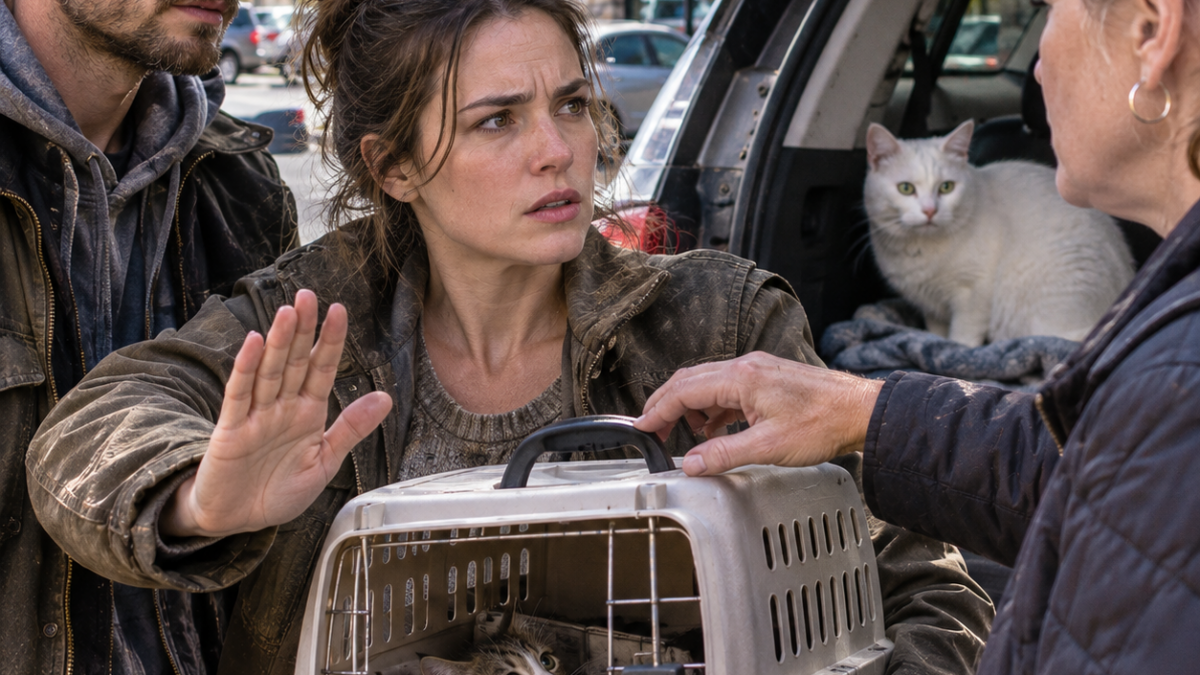
Our White Cat Brought Home a Terrified Stray Kitten—Then a Stranger Claimed Him Without a Single Photo to Prove He Was Theirs.
Our white cat walked a starving kitten straight to our back door, but two days later a stranger appeared online claiming he belonged to them—and they became furious the moment I asked for one photograph proving it.
When I checked our security camera, I found a car stopping beside the vacant lot thirty minutes before the kitten arrived, and suddenly returning him no longer felt like the honest thing to do.
But the truth about who had dumped him, why strangers were hunting “free kittens” across Fort Collins, and what our quiet white cat had actually led home would turn one frightened animal into evidence nobody expected.
The first thing the kitten trusted was not me.
It was Mora.
That mattered later.
At the time, I only thought it was strange.
My name is Carmen Reyes. I was thirty-one years old that fall, living with my boyfriend, Evan, in a small house on the northwest side of Fort Collins, Colorado.
I worked remotely for a medical billing company.
Evan worked maintenance for Colorado State University.
We had no children.
One cat.
One mortgage.
One half-dead vegetable garden we kept promising to take more seriously next summer.
Our cat, Mora, was seven years old, almost completely white except for a small gray mark near her left ear.
She had yellow eyes and the emotional range of a disappointed librarian.
Mora did not like strangers.
She did not particularly like other cats.
She tolerated dogs only when they remained across the street.
She had once spent three hours refusing to enter our bedroom because Evan had placed a new laundry basket beside the door.
She believed routine was a moral virtue.
Every morning at 6:12, she waited beside her food bowl.
At noon, she slept in the back window.
At four, she followed sunlight across the living-room floor.
At sunset, if the weather was good, she went into our enclosed backyard through a microchip-controlled cat door and sat beneath the lilac bush like a tiny white security guard.
That was Mora.
Predictable.
Suspicious.
Completely uninterested in rescue work.
Then one October evening, she brought home a kitten.
PART2:
I was at my kitchen table staring at a spreadsheet when I heard the soft mechanical click of the cat door.
I didn’t look up.
Mora came and went often enough that the sound had become part of the house.
Then I heard another noise.
A tiny scrape.
Pause.
Scrape.
I turned.
Mora stood just inside the mudroom.
Behind her, still outside on the deck, was something small and brown.
At first I thought she had brought home prey.
“Please don’t be a mouse.”
Mora stared at me.
The brown shape moved.
A face appeared.
Kitten.
Tiny.
A brown tabby, maybe eight weeks old, maybe younger.
White chin.
White socks.
Huge ears.
His ribs showed slightly beneath his coat.
He stayed pressed against Mora’s flank so tightly that his head nearly disappeared into her fur.
I stood slowly.
“Evan?”
No answer.
He was in the living room.
I crouched.
“Hey, baby.”
The kitten ignored me.
Completely.
His eyes never left Mora.
PART3:
She walked one step forward.
He followed.
She stopped.
He stopped.
The coordination was so exact it looked rehearsed.
That made me uneasy.
Mora glanced at him once.
Then at me.
Then sat directly on the threshold.
Half inside.
Half outside.
Blocking the door open.
“You know we don’t do this,” I whispered.
Her tail flicked.
Our rule about new animals was simple.
No direct introductions.
Quarantine first.
Vet check.
Parasite prevention.
Vaccines.
We had learned that from a friend who fostered cats.
But rules sound different when the animal in question is shivering five feet from your kitchen.
Outside, the evening temperature was dropping fast.
October in Fort Collins can look gentle during the day and become cold enough after sunset to remind you winter is already somewhere nearby.
The kitten shifted.
His body tightened suddenly.
He stared past me toward the yard.
Not at anything I could see.
His ears flattened.
He began trembling.
Not delicate shivering.
Whole-body shaking.
I lowered myself onto the tile.
Didn’t reach.
Didn’t call.
Just made myself smaller.
Mora remained where she was.
The kitten pressed against her.
Then, after maybe thirty seconds, darted inside.
One fast movement.
He stopped the instant all four paws touched the kitchen tile.
Mora stood.
Walked toward the mudroom.
He followed.
Evan appeared from the living room.
“What’s going on?”
He saw the kitten.
Then Mora.
Then me.
“No.”
“I didn’t do anything.”
“Carmen.”
“She brought him.”
Evan looked at Mora.
Mora looked back with no visible remorse.
“She hates cats.”
“I know.”
“Why is there a cat?”
“I don’t know.”
The kitten tucked himself beneath Mora’s chest.
Evan’s expression changed.
Just slightly.
“Oh.”
“Yeah.”
He crouched several feet away.
The kitten flattened.
Evan immediately backed up.
“Okay.”
That was one reason I loved him.
He could be stubborn.
Overly practical.
Obsessed with lists.
But if an animal said no, he listened.
“We quarantine,” he said.
“Obviously.”
“Vet tomorrow.”
“Yes.”
“Found-animal report.”
“Yes.”
“Post locally.”
“I know.”
“We do not—”
“Name him.”
He pointed at me.
“Correct.”
Mora escorted the kitten to the mudroom herself.
I mean that literally.
We opened the door.
Placed food, water, litter, towels inside.
The kitten would not enter until Mora did.
She stepped inside.
He followed.
Then we eased Mora back out.
The instant the door closed, the kitten made a sound.
Thin.
High.
Barely a meow.
Mora dropped onto the floor outside the door.
She pressed her nose to the crack.
From inside came another tiny cry.
Mora answered.
“Mrrp.”
One sound.
Firm.
The kitten went quiet.
Evan and I looked at each other.
He said:
“That’s weird.”
Mora ignored dinner.
That was when I became worried.
Mora had never ignored dinner for anything.
We gave the kitten privacy.
At eleven, I checked quietly.
Food missing.
Water lower.
Litter used.
He was wedged behind a storage bin.
Eyes open.
Watching.
Good enough.
Mora slept outside the mudroom door.
Around three in the morning, I woke and found Evan’s side of the bed empty.
He was sitting in the hallway.
“What are you doing?”
He pointed.
Mora was still there.
“She hasn’t moved.”
From behind the door came a tiny scratch.
Mora’s tail tapped once against the floor.
Evan whispered:
“She’s babysitting.”
“Don’t say that.”
“Why?”
“Because then I’ll get attached.”
“You’re already sitting on the floor at three in the morning.”
“Fair.”
The next morning, I opened the door only a few inches.
The kitten sat behind it.
Mora stood.
They touched noses through the gap.
The kitten’s entire body softened.
Not dramatically.
But enough.
That was when I knew he had not simply followed Mora because she happened to be nearby.
He had chosen her.
Or she had chosen him.
Maybe both.
Then I looked through the mudroom window.
Along the damp dirt beside our back fence were tracks.
Small.
Five toes.
Raccoon, probably.
Fort Collins had plenty.
I told myself that explained the kitten’s fear the previous night.
Predator nearby.
Cold.
Hungry.
Lost.
Simple.
I wanted simple.
Instead, I got my phone.
Took photographs.
Front.
Sides.
White chin.
Paws.
Tail.
No collar.
No visible injuries.
Then we went to the veterinary clinic.
He weighed 1.8 pounds.
Male.
Approximately seven weeks old.
Fleas.
Mild dehydration.
No microchip.
No serious illness.
The vet, Dr. Hannah Lee, listened to his lungs and said:
“He’s lucky.”
I looked at Mora’s carrier beside us.
We had brought her too because the kitten became frantic when separated.
Mora sat inside glaring at civilization.
“Apparently she thinks so.”
Dr. Lee smiled.
“She brought him home?”
“Yep.”
“That’s unusual.”
“Very.”
“Is she maternal?”
“No.”
“Ever had kittens?”
“She was spayed before we adopted her.”
Dr. Lee looked at the kitten.
He was pressed against the side of Mora’s carrier.
“She may simply have recognized distress.”
Evan said, “Can cats do that?”
Dr. Lee shrugged.
“They do plenty we don’t understand.”
We took him home.
Then I did the responsible thing.
I posted him everywhere.
Fort Collins lost pets group.
Nextdoor.
PawBoost.
Local shelter board.
Larimer County found-animal report.
Neighborhood Facebook pages.
I made flyers.
FOUND KITTEN.
BROWN TABBY.
WHITE CHIN/PAWS.
PROOF OF OWNERSHIP REQUIRED.
I deliberately left out certain details.
A tiny dark spot inside his left hind paw.
One broken whisker.
The unusual way the white fur climbed higher on one front leg than the other.
Details a real owner might know.
By afternoon, comments arrived.
Beautiful baby!
Thank you for helping him!
If nobody claims him I want him!!!
My daughter would LOVE him.
Free kitten?
That last comment bothered me.
I deleted nothing.
Just watched.
Nobody legitimate claimed him.
That evening, he came out of the mudroom.
Supervised.
Mora walked first.
He followed.
Three inches behind.
She sat beneath the kitchen table.
He sat beneath the kitchen table.
She drank.
He drank.
She looked out the window.
He copied her.
Then a truck door slammed outside.
The kitten ran so hard he hit the cabinet.
Mora walked straight to him.
No rush.
No alarm.
She touched his nose.
He stopped shaking sooner.
Evan leaned against the counter.
“We’re in trouble.”
“Why?”
“You know why.”
“We’re not naming him.”
“Right.”
“No names.”
“Absolutely.”
The kitten climbed onto Mora’s back.
She tolerated it.
Evan whispered:
“Jesus.”
“Don’t.”
“He’s staying.”
“We don’t know that.”
“He climbed her.”
“I can see.”
“He thinks she’s his mother.”
“She is white and he is brown.”
“I don’t think he has access to genetics.”
I laughed.
That was the first evening we nearly named him.
We resisted.
At 8:42 p.m., my phone buzzed.
Private message.
THAT’S OURS.
WE CAN PICK HIM UP TOMORROW.
My stomach tightened immediately.
Not because the message was suspicious.
Because it might be true.
Someone might love him.
Someone might have spent two nights crying and searching.
Our attachment did not make their loss less legitimate.
I replied:
Hi. I’m glad you saw the post. Can you send me a photo of him from before he went missing and tell me approximately when/where he disappeared?
Three dots appeared.
Then disappeared.
Then:
WE DIDN’T TAKE MANY PICS.
He’s just a kitten.
I stared.
I replied:
No problem. Can you describe any identifying markings not obvious in the post?
Answer:
Brown striped cat white feet.
Everything in the photographs.
I asked:
Male or female?
Long pause.
Male.
Could be guessed.
Name?
Tiger.
The kitten did not react when I said Tiger.
Not proof of anything.
Cats ignore names professionally.
Still.
I asked where Tiger lived.
Answer:
Near Shields.
That covered an enormous area.
I asked for a cross street.
No answer for twenty minutes.
Then:
Can pick up tomorrow.
Evan read over my shoulder.
“Maybe they’re bad at texting.”
“Maybe.”
“We can’t assume.”
“I know.”
“What do you want to do?”
“Vet clinic.”
He nodded.
Neutral.
Public.
Microchip scanner.
Staff nearby.
A place where I could ask questions without somebody knowing our address.
I sent the location.
The claimant agreed.
The next morning, the kitten flattened inside the carrier.
Mora yowled when we carried him toward the front door.
We had planned to leave her home.
We lasted forty seconds.
The kitten threw himself against the carrier door.
Not trying to escape toward freedom.
Trying to get back to Mora.
Evan swore.
“Bring her.”
So we did.
At the veterinary clinic, Mora’s carrier sat beside his.
He pressed himself against the wall nearest her.
Then the claimant walked in.
A man.
Maybe mid-thirties.
Baseball cap.
Black hoodie.
No carrier.
That was the first thing I noticed.
No leash.
No box.
No blanket.
Nothing for transporting a kitten.
He looked at the carrier.
“That’s him.”
No emotion.
Maybe some people are simply reserved.
I reminded myself.
I said:
“Great. I just need to verify.”
His face changed slightly.
“Verify what?”
“Ownership.”
“I told you.”
“Do you have a picture?”
“No.”
“Vet record?”
“He hasn’t been to a vet.”
“Adoption paperwork?”
“No.”
“How long did you have him?”
“Couple weeks.”
“What food?”
“Cat food.”
“What kind?”
“I don’t know. Whatever.”
“What litter?”
He stared.
“Seriously?”
“I need to be sure.”
“He’s mine.”
“Okay. What’s his name?”
“Tiger.”
I crouched by the carrier.
“Tiger.”
Nothing.
Again, meaningless.
I asked:
“What scares him?”
The man shrugged.
“He’s a cat.”
“How did he get out?”
“Door.”
“Which door?”
“My house.”
“Where?”
“Shields.”
“Cross street?”
His jaw tightened.
“Why are you making this difficult?”
I stood.
“Because I found a kitten and I’m not handing him to someone without proof.”
His eyes moved toward Evan.
Then back.
“You posted him.”
“Yes.”
“So give him back.”
The clinic receptionist had begun listening.
I could feel it.
The man reached for the carrier handle.
I placed my hand over it.
“Stop.”
His face changed completely.
Anger.
Fast.
Too fast.
“Lady, that’s my property.”
Property.
Not kitten.
Not cat.
Not Tiger.
Property.
My heart started pounding.
Evan stepped closer.
“Back up.”
The man looked at him.
“This doesn’t involve you.”
“It does now.”
The receptionist stood.
“Sir, if ownership is disputed, we recommend animal control.”
The man swore.
Then looked at me.
“You people steal pets and think you’re heroes.”
That hurt because it was exactly the fear I already had.
What if he was right?
What if I had allowed attachment to become justification?
I forced myself to say:
“Bring proof and I’ll cooperate.”
“I’m not wasting my time.”
He walked out.
No goodbye to the kitten.
No glance back.
Nothing.
I stayed beside the carrier with my hands shaking.
The receptionist said:
“You did the right thing.”
I wanted to believe her.
I wasn’t sure.
At home, the moment we opened the kitten’s carrier, he ran directly to Mora.
She stepped over him.
Pinned him gently against the floor between her front legs.
Then started grooming his head.
Slow.
Deliberate.
He went limp beneath her.
Safe.
That night I barely slept.
At 1:14 a.m., I pulled up the back security camera.
I wanted to see how Mora had found him.
Our backyard camera covered part of the alley and the vacant lot two houses down.
I scrolled backward.
5:12 p.m.
Nothing.
5:18.
Mora enters the yard alone.
Then leaves again through the fence opening we had been meaning to repair.
That surprised me.
Mora rarely left the yard.
5:31.
A dark blue sedan rolled slowly along the alley-side street.
Stopped beside the vacant lot.
Headlights off.
Driver’s door did not open.
Passenger door did.
Someone leaned out.
I couldn’t see their face.
Something small was placed—or thrown—near the curb.
The car pulled away.
I stopped breathing.
I replayed it.
Zoomed.
Pixelated.
Small shape.
Brown.
The shape did not move for almost two minutes.
Then it crawled beneath a bush.
5:47.
Mora appeared.
Walked toward the bush.
Stopped.
Sat.
Waited.
5:58.
The kitten emerged.
6:03.
Mora walked toward our yard.
The kitten followed.
My chest tightened.
I woke Evan.
“Look.”
He watched.
Once.
Then again.
“Jesus.”
“They dumped him.”
“Maybe.”
“Evan.”
“I know what it looks like. We need to be careful.”
I saved the clip.
Then remembered the claimant.
Had he dumped the kitten?
Why dump an animal and then demand him back?
That made no sense.
Unless he wasn’t the person in the car.
Or unless something else was happening.
The next morning, someone shared our original found-kitten post.
Caption:
FREE KITTEN?
Underneath were three comments.
Interested.
Where?
Still available?
My skin prickled.
I clicked the account that shared it.
Mostly buy/sell listings.
Phones.
Tools.
Furniture.
Puppies.
Kittens.
Lots of kittens.
Some posts had been deleted.
Others showed animals advertised for “rehoming fees.”
$80.
$120.
$150.
I scrolled.
A black kitten.
Orange.
Gray.
Several looked too young.
One caption:
RESCUED BABIES NEED HOMES.
Another:
LAST ONE LEFT.
No vaccination records mentioned.
No shelter.
No rescue affiliation.
Then I saw the profile picture.
The man from the clinic.
My stomach dropped.
“Evan.”
He came over.
I showed him.
His face hardened.
“He’s flipping kittens.”
“Maybe.”
“Carmen.”
“I know.”
We called Larimer Humane Society.
They took the report seriously but cautiously.
A person reselling animals was not automatically committing a crime.
If the animals were theirs legally, rehoming fees could be legitimate.
But falsely claiming found animals?
Possible theft or fraud depending on circumstances.
Dumping?
Animal abandonment.
They asked for screenshots.
Security video.
Messages.
Description of the man.
We sent everything.
Then the officer asked:
“Have you had any other claimants?”
“No.”
“Keep the post active.”
“Why?”
“Because if this person is monitoring found-animal listings, we’d like to know whether others report the same behavior.”
That sentence opened a door I hadn’t known existed.
I searched older local posts.
FOUND KITTEN.
FOUND PUPPY.
STRAY CAT.
Free kitten.
Anybody missing this baby?
Then I looked through comments.
The same account appeared again.
And again.
Sometimes different names.
Same profile photograph in one.
Same wording in others.
That ours.
Can get today.
Where meet?
Need address.
My hands went cold.
I messaged three posters privately.
One answered.
Her name was Tasha.
She had found two orange kittens near a drainage ditch six months earlier.
A man claimed them.
No photographs.
Said they belonged to his sister.
Tasha handed them over.
“Why?” she asked after I explained.
I sent a screenshot.
She went silent.
Then:
Oh my God.
“What?”
She sent me another screenshot.
Three days after the kittens were collected, both appeared in an online marketplace listing.
$100 each.
RESCUED ORANGE BABIES.
She had never known.
Tasha had saved the claimant’s phone number.
It matched the number attached to the account that messaged me.
Now we had something.
We sent it to animal control.
Then another woman contacted us.
Then another.
A college student had surrendered a found kitten to the same man after he claimed it belonged to his girlfriend.
A retired couple gave him a small terrier because he said it was his mother’s lost dog.
That dog appeared for sale later too.
Now the problem was not just Rook—
No.
He still didn’t have a name.
Evan caught me thinking it.
“Did you almost name him?”
“No.”
“You paused.”
“I was breathing.”
“You name when you breathe now?”
“Shut up.”
The kitten sat beside Mora at the window.
Same posture.
Same tail placement.
Mora looked ancient beside him despite being only seven.
He looked at her every few seconds.
Checking.
Learning.
“You know we’re keeping him if nobody legitimate comes forward,” Evan said.
“We have to wait.”
“How long?”
“Legal stray hold.”
“We filed the report.”
“I know.”
He sat beside me.
“You’re scared.”
“Yes.”
“Of what?”
“That wanting him will make me dishonest.”
Evan thought about that.
Then said:
“Wanting him and stealing him are different things.”
“I know.”
“Do you?”
I looked at the kitten.
“No.”
That was the hardest part.
The false claimant made me suspicious.
Suspicion made me protective.
Protection could become possession if I wasn’t careful.
I had to leave room for the possibility that a real owner still existed.
So we kept searching.
Flyers stayed up.
We contacted veterinary clinics.
Neighborhood pages.
Rescues.
No matching lost report.
No photograph.
No family asking desperately.
Nothing.
Then, four days after the kitten arrived, a woman named Renee Martinez messaged me.
Not claiming him.
She wrote:
I think I know where he came from.
My heart jumped.
I called.
Renee lived six blocks away.
She had been feeding a mother cat behind an old rental property.
The mother gave birth to five kittens.
Renee had contacted the property manager asking permission to trap them safely.
The manager said no.
Then the cats disappeared.
“When?”
“Two nights before your post.”
“All of them?”
“Mom showed up later. Kittens didn’t.”
“Do you have photos?”
“Yes.”
She sent one.
Five kittens beneath a wooden deck.
Three tabbies.
One black.
One tortoiseshell.
I zoomed.
One tabby had white socks.
White chin.
The same white fur climbing higher on the front left leg.
Then Renee sent another picture.
The kitten was closer.
Inside left hind paw—
dark spot.
I sat down.
“That’s him.”
Evan looked.
“Yeah.”
I called Renee back.
“Who owns the property?”
“Landlord in Loveland. But his tenant was the one complaining.”
“What tenant?”
“A guy named Corey.”
My heart started pounding.
“Last name?”
“Baines, I think.”
The false claimant’s profile name:
Corey Baines.
Everything aligned too quickly.
I told Renee about the clinic.
The resale posts.
The security video.
She went silent.
Then said:
“I saw his car.”
“What color?”
“Dark blue.”
My stomach dropped.
Renee had confronted Corey weeks earlier because he wanted the cats gone.
He told her:
“I don’t care what you do with them. Just get them off the property.”
She arranged with a rescue volunteer to trap the family that weekend.
Before the volunteer arrived, the kittens disappeared.
The mother remained.
Corey told Renee he had “handled it.”
She assumed he had taken them to a shelter.
He hadn’t.
Animal control now had enough for a formal investigation.
They located Corey.
He denied dumping kittens.
Denied claiming ours.
Until shown the messages.
Then said he had mistaken the kitten for one he had “rehomed.”
Rehomed.
The word made me furious.
Investigators searched public sales records and interviewed witnesses.
The pattern became clear.
Corey did maintenance work for several rental properties.
He encountered unwanted litters and stray animals.
Sometimes tenants surrendered them willingly.
Sometimes he removed animals from properties.
Then he watched online lost-and-found pages for young, desirable animals he could claim.
He resold them with small “rehoming fees.”
Not thousands.
Not enough to attract attention.
Fifty dollars.
One hundred.
One hundred fifty.
Cash.
Fast.
Animals moved before anyone asked questions.
The cruelty was ordinary.
That was what stayed with me.
No dramatic criminal empire.
No warehouse full of cages.
Just a man who discovered people gave away vulnerable animals when he sounded confident enough.
Then came the worse part.
Renee’s litter.
Corey admitted he had collected the five kittens.
He sold two.
One escaped from his garage.
Two became sick.
He did not want veterinary bills.
So he drove them away and left them in different areas.
Our kitten was one of those.
The other abandoned kitten had not yet been found.
I cried when the officer told me.
Not quietly.
I went into the bathroom, locked the door, and cried until my chest hurt.
Evan sat outside.
Didn’t knock.
After a while, I opened the door.
“What about the others?”
“One sold kitten was located.”
“And?”
“Family bought her three days ago. They’re cooperating.”
“The other?”
“Still looking.”
“The escaped one?”
“Unknown.”
I pressed my hands against my face.
“We should’ve found them sooner.”
Evan crouched in front of me.
“We didn’t know they existed.”
“Mora did.”
“What?”
“She found one.”
“That doesn’t mean she knew there were five.”
“I know.”
But the thought stayed.
Why had Mora left our yard that evening?
Had she heard him?
Smelled him?
Seen him dropped?
Had she followed the car?
We would never know.
The missing kitten was found two days later.
Alive.
A black female.
Dehydrated.
Hiding inside a drainage culvert less than half a mile from where our kitten had been dumped.
A volunteer trapped her.
The other sold kitten was located with a family in Windsor.
They had paid Corey $125.
They thought they were paying a rescue fee.
He had told them the kittens’ mother died.
That lie made me angrier than almost anything else.
Because people had tried to do something kind.
He had used kindness as a business model.
The fifth kitten—the one who escaped—remained missing for eleven days.
Then a CSU student posted a picture.
Tortoiseshell kitten under a parked car.
Renee recognized her.
All five kittens were alive.
The mother cat was trapped too.
Spayed.
Vaccinated.
Then adopted by Renee.
She named her Juniper.
The investigation expanded beyond our case.
Seven families identified animals Corey had sold.
Four found-animal posters said he had falsely claimed animals from them.
One dog was returned to his original owner after nearly eight months.
That reunion became local news.
Corey was cited for animal abandonment.
Later he faced additional charges related to false claims, improper sales, and treatment of animals in his custody.
The penalties were not as dramatic as people online wanted.
No movie-style courtroom collapse.
No twenty-year sentence.
But he lost his job with the property company.
Was prohibited from handling animals through that employer.
Paid fines.
Faced restitution.
And, most importantly to me, the animals stopped moving through his hands.
Then came the public humiliation he created himself.
A local reporter contacted him.
He agreed to an interview.
Apparently he believed he could explain everything.
He said:
“I was finding homes for animals nobody wanted.”
That clip went everywhere.
Renee watched it at our kitchen table.
Her jaw tightened.
“Nobody wanted?”
She pointed toward Mora and the kitten sleeping together on the rug.
“That mother cat screamed for those babies every night.”
I looked at the screen.
Corey continued.
“People are acting like I was hurting them. I was solving a problem.”
There it was.
The same word people use when empathy becomes inconvenient.
Problem.
The kittens were a problem.
Their mother was a problem.
Found animals were opportunities disguised as problems.
He had never needed to hate them.
Indifference was enough.
The reporter then showed our security footage.
The dark sedan.
The tiny shape near the vacant lot.
Corey stopped talking.
The interview ended shortly afterward.
Public opinion did the rest.
I did not celebrate.
Not really.
I was relieved.
But by then my attention had moved back to the kitten.
Because while adults argued about evidence and ownership, he was changing.
At first, every car door sent him under furniture.
Then every third car door.
Then only the loud ones.
He learned the dishwasher.
Hated the vacuum.
Loved paper balls.
Failed repeatedly at jumping onto the couch.
Mora demonstrated.
He watched.
Tried.
Missed.
Tried again.
The first successful jump startled him so much he immediately jumped back down.
Mora looked disgusted.
He worshipped her anyway.
At night, they slept together.
Not near.
Together.
His head beneath her chin.
One paw over her leg.
Sometimes Mora groomed him until his fur stood in ridiculous spikes.
He tolerated everything.
She became different too.
That surprised us.
Mora had always been independent.
After he arrived, she started calling for him.
If he disappeared into another room, she checked.
If he cried at the veterinarian, she answered.
She even shared her window spot.
Evan said:
“She needed him.”
I looked at him.
“Mora?”
“Yeah.”
“She had us.”
“Maybe that wasn’t the same.”
That sentence stayed with me.
We often assume animals want only what humans provide.
Food.
Warmth.
Safety.
But maybe Mora had been missing something too.
Not desperately.
Not tragically.
Just quietly.
A companion who understood her language.
The legal stray period expired.
No legitimate owner came forward.
Animal control cleared the kitten for adoption through the proper process.
We had one final decision.
It should have been easy.
It wasn’t.
Because once keeping him became legal, the fear changed.
Before, I was afraid someone would take him.
Now I was afraid I would fail him.
What if Mora changed her mind?
What if he developed expensive medical problems?
What if two cats complicated travel?
What if our house became too small?
What if attachment made future loss harder?
All the ordinary cowardly questions love creates.
I recognized them because I had felt them once before.
When I was eleven, a kitten followed me home.
Gray.
Tiny.
Friendly.
I begged my mother to let me keep him.
She told me we could if I took responsibility.
Food.
Litter.
Vet.
I became frightened.
Responsibility sounded permanent.
So I carried the kitten back to the porch where I found him.
Nothing terrible happened.
A family eventually took him.
But I remembered the moment I set him down.
He followed me halfway home.
I walked faster.
For years, that memory bothered me.
Not because eleven-year-old me was evil.
Because I had learned something uncomfortable.
Sometimes people abandon what they love because fear of responsibility feels easier to justify than fear of love.
I did not want to do that again.
One Sunday afternoon, Evan sat beside me on the living-room floor.
Mora slept on the couch.
The kitten was curled against her stomach.
Evan said:
“If he stays, we do it right.”
I nodded.
“Insurance.”
“Yes.”
“Vaccines.”
“Already.”
“Microchip.”
“Yes.”
“Emergency fund.”
“Yes.”
“Cat sitter when we travel.”
“Yes.”
He looked at me.
“Name.”
I smiled.
Finally.
We had avoided it for almost two weeks.
“What?”
He glanced toward the mudroom.
Then the back door.
The place where Mora had brought him.
“I keep thinking about the threshold.”
“Threshold is a terrible name.”
“I know.”
“Door?”
“Worse.”
“Hinge?”
“Absolutely not.”
We laughed.
Then I said:
“Latch.”
Evan stopped.
“Latch.”
“Because he showed up at the thing that decides whether a door stays closed or opens.”
“That is unbearably sentimental.”
“You like it.”
“I do.”
We looked at him.
“Latch,” I whispered.
His ears moved.
Mora opened one eye.
Evan smiled.
“Guess that’s it.”
Latch became ours legally three days later.
Microchip registered.
Records transferred.
Insurance activated.
Name official.
That should have been the ending.
It wasn’t.
Because Renee called.
“You need to see this.”
She sent me a photograph.
Juniper—the mother cat.
Beside her was the black kitten rescued from the culvert.
The kitten had been named Bean.
They were curled together in Renee’s spare bathroom.
Then another photograph.
The two sold siblings had been reunited temporarily for veterinary checks.
One orange tabby.
One brown female.
Then the tortoiseshell found near CSU.
Five kittens.
All alive.
Renee wrote:
I keep thinking they should see each other again.
So we arranged it.
Not a chaotic reunion.
Not all loose together immediately.
A rescue volunteer supervised.
Health checks first.
Then a large enclosed room.
Latch entered beside Mora.
The instant he saw the other kittens, he froze.
So did they.
For several seconds, nothing happened.
Then Bean—the black female—made a tiny trill.
Latch answered.
He ran.
Not cautiously.
Not fearfully.
Ran.
Five kittens collided in the middle of the room.
Tails.
Paws.
Sniffing.
Rolling.
Tiny cries.
Mora sat near the wall watching.
Juniper entered last.
The room changed.
Every kitten stopped.
Juniper made a low sound.
Latch dropped flat.
Then crawled toward her.
My throat closed.
Juniper sniffed his head.
Then began washing his face.
Exactly the way Mora did.
I cried instantly.
Evan put his arm around me.
Renee cried too.
Even the rescue volunteer turned away.
Mora watched.
No jealousy.
No aggression.
After several minutes, Latch returned to her.
Pressed against her side.
Juniper watched.
Mora looked back.
Two female cats.
One biological mother.
One who had led him home.
There was no way to know what either understood.
I know what I felt.
Family was suddenly larger than ownership.
That mattered.
The rescued siblings were all adopted carefully.
Bean stayed with Renee and Juniper.
The orange male went to a retired couple.
The brown female went to the Windsor family who had unknowingly purchased her; after the investigation, they legally adopted her through the rescue.
The tortoiseshell went to a veterinary technician.
We created a group chat.
THE FIVE.
Evan hated the name.
Then checked it constantly.
Every birthday, photos.
Every weight gain.
Every ridiculous sleeping position.
Latch grew fastest.
By six months, his ribs disappeared.
His coat became thick.
His white socks looked brighter.
His personality emerged.
He was chaos.
There is no kinder word.
He opened cabinets.
Stole bread ties.
Learned to turn on the bathroom faucet.
Dragged Evan’s clean socks into the hallway.
Once dropped a toy mouse into my coffee.
Mora remained dignified.
Mostly.
Then I caught her helping him open a closet.
They had become criminals together.
A year after Latch arrived, another found-kitten post appeared in our neighborhood group.
Tiny gray kitten.
The comments began.
So cute!
I want her!
Free?
My stomach tightened.
But something had changed.
The moderator added:
Proof of ownership required. Please do not surrender found animals directly to unverified claimants. Use shelter/found-animal procedures.
I stared at that message.
One small change.
Maybe because of Latch.
Maybe because of the investigation.
The local rescue started distributing flyers explaining how to verify ownership.
Keep identifying details private.
Ask for prior photographs.
Vet records.
Microchip.
Specific markings.
Meet in safe locations.
File found reports.
Do not publicly disclose every unique characteristic.
Do not hand animals to someone simply because they sound confident.
Renee helped organize it.
So did I.
I spoke once at a neighborhood association meeting.
I hated public speaking.
My hands shook.
I told them:
“Doing the right thing doesn’t always mean giving an animal to the first person who says ‘mine.’ Sometimes doing the right thing means slowing down long enough to verify.”
Someone asked:
“What if the real owner gets offended?”
I said:
“A real owner who loves an animal may be frustrated. But they should also understand why proof protects their pet.”
Afterward, an older man approached.
He told me his dog had disappeared two years earlier.
Someone found him.
Asked for a photo.
The man had hundreds.
They were reunited the same day.
“Proof isn’t the enemy,” he said.
“Exactly.”
Months later, Corey pleaded guilty to several charges connected to animal abandonment and false representations.
He paid restitution.
Received probation conditions.
Was barred from operating an animal-resale business.
Again, not dramatic enough for social media.
But there was one moment that mattered to me.
During the hearing, the judge asked him why he had abandoned the sick kittens instead of taking them to a shelter.
Corey said:
“They weren’t worth the vet bills.”
The courtroom became completely still.
Worth.
There it was.
The entire story compressed into one word.
Not worth it.
Latch had been cold.
Thin.
Frightened.
Sick.
Therefore not worth the expense.
Mora had looked at the same kitten and made a different calculation.
No money.
No language.
No moral speech.
She simply stayed beside him and walked home slowly enough that he could follow.
I thought about that for weeks.
We often congratulate ourselves for being more sophisticated than animals.
Then sometimes an animal makes the kinder decision without needing to explain it.
Two years passed.
Latch stopped flinching at ordinary car doors.
Mostly.
Certain sounds still froze him.
A slow-moving car in the alley once sent him racing toward Mora.
She was asleep.
He climbed directly on top of her.
She looked furious.
Then groomed him.
Some memories remain in the body after the danger is gone.
That does not mean healing failed.
It means healing has history.
Mora aged.
White fur hiding the gray that eventually appeared anyway.
She became slower.
Jumped less.
Latch adjusted automatically.
If she no longer climbed onto the top shelf, neither did he.
When she began using a small step beside the couch, he used it too despite being perfectly capable of jumping.
We laughed at first.
Then realized he was still copying her.
Always.
At seven weeks old, he had learned how to live by watching Mora.
Years later, he still checked her first.
Visitors?
Look at Mora.
Vacuum?
Mora.
New furniture?
Mora.
Thunder?
Mora.
Safe?
Mora.
Then came the winter when Mora became sick.
Kidney disease.
Early stage.
Manageable.
Then less manageable.
Medication.
Special food.
Fluids.
Frequent vet visits.
Latch hated the carrier more than she did because whenever we took Mora somewhere, he became frantic.
We started bringing him to certain appointments when possible.
He sat beside her.
Exactly as she had sat outside the mudroom door for him.
One evening, Dr. Lee—the same veterinarian who had examined Latch as a tiny stray—looked at both of them and said:
“He’s returning the favor.”
I had to look away.
Mora lived another nineteen months.
Good months.
Mostly.
Window sunlight.
Warm blankets.
Latch beside her.
Then the day arrived when good care could no longer create good days.
That decision nearly broke me.
Evan too.
We scheduled a home euthanasia.
No bright clinic.
No carrier.
No separation.
Mora lay on her favorite blanket near the back door.
The same door.
Latch sat against her.
The veterinarian explained everything.
I cried so hard I could barely breathe.
Evan held my hand.
When the medication made Mora sleepy, Latch began grooming her forehead.
Slow.
Steady.
The way she had groomed him after the false claimant tried to take him.
The way she had washed fear from his body over and over.
Mora’s breathing stopped peacefully.
Latch remained beside her.
He touched her nose.
Waited.
Then lay down.
I don’t know what cats understand about death.
I will not pretend.
But Latch knew something had changed.
For weeks afterward, he sat by the back door at sunset.
Waiting.
That was the worst part.
The first evening, I cried.
The second too.
Then eventually I began sitting with him.
We watched the yard together.
One night, he leaned against my leg.
Not searching.
Just staying.
It reminded me of the first night.
Mora on the threshold.
Half inside.
Half outside.
Holding the line until a frightened kitten made a choice.
I finally understood why we named him Latch.
I had thought the name described him.
It described Mora.
She had been the mechanism.
The small living thing that kept our home from being completely closed.
Years passed.
The white cat who led him home became a photograph above our kitchen table.
Latch grew older.
Still tabby.
Still white socks.
Still one dark spot beneath the hind paw.
He became calmer.
Not Mora-calm.
Nobody could achieve that level of judgment.
But calmer.
Then one October evening, almost seven years after his arrival, I heard the cat door move.
We no longer allowed Latch unsupervised outdoor time, but the enclosed patio still had an interior flap.
Tap.
Scrape.
I looked up from my laptop.
Latch stood near the door.
He was staring outside.
Not moving.
Something about his posture made my heart jump.
I opened the back door.
Cold fall air came in.
Dry leaves.
Wood smoke.
Exactly like that first evening.
Near the edge of the deck sat a tiny shape.
Black.
Kitten.
Maybe ten weeks old.
Thin.
Scared.
I laughed and cried at the same time.
“You have got to be kidding me.”
Latch walked outside.
Slowly.
The kitten backed away.
Latch stopped.
Sat.
Waited.
My chest tightened.
He did not approach.
Did not chase.
He simply stayed visible.
After a while, the kitten moved one step closer.
Then another.
I lowered myself onto the kitchen tile.
Same place.
Same posture.
Years collapsed.
Latch looked back at me.
Then at the kitten.
Evan came from the living room.
Saw the scene.
Stopped.
“No.”
I laughed.
“You said that last time.”
“I remember.”
“We have rules.”
“I know.”
“Quarantine.”
“Yes.”
“Vet.”
“Yes.”
“Found report.”
“Yes.”
He looked toward Mora’s photograph.
Then back at Latch.
The black kitten had reached him.
Pressed against his side.
Latch remained still.
Evan whispered:
“Oh, come on.”
I smiled through tears.
The kitten followed Latch toward the house.
Two inches.
Freeze.
Two inches.
Freeze.
Exactly the way Latch had once followed Mora.
At the threshold, Latch stopped.
Half inside.
Half outside.
My breath caught.
He sat.
He held the door.
I covered my mouth.
Evan saw it too.
Neither of us spoke.
The black kitten stared at the warm kitchen.
Then at Latch.
Then darted inside.
I closed the exterior door gently behind them.
Not trapping.
Protecting.
Latch led the kitten toward the mudroom.
I followed.
And in that moment I understood something I had spent years trying to put into words.
Rescue does not always begin with the person who opens the door.
Sometimes it begins with the one who shows another frightened creature where the door is.
Mora had done that for Latch.
Latch was doing it now.
We found that little black kitten’s family two days later.
A real family.
Photographs.
Vet records.
A ten-year-old girl who cried before she even touched him.
His name was Pepper.
He had slipped out when a screen tore during a storm.
When the girl arrived, she sat on our floor and waited rather than grabbing.
Pepper approached her.
Latch watched.
I watched too.
The girl whispered:
“I thought I lost you.”
She had brought a photograph.
Pepper asleep on her pillow.
Same tiny white patch beneath his neck.
Same face.
Proof.
Love with evidence.
We returned him.
It hurt.
Of course it did.
But it also felt clean.
Right.
That night, Latch sat by the back door.
I sat beside him.
“You did good.”
He looked at the yard.
Maybe waiting for Mora.
Maybe not.
I touched his back.
He leaned against me.
I used to think the lesson of his story was about caution.
Ask questions.
Demand proof.
Do not trust strangers simply because they speak confidently.
Those lessons matter.
They protected him.
They exposed someone who had used people’s kindness.
But they are not the deepest lesson.
The deepest lesson came before any investigation.
Before the false claimant.
Before the security footage.
Before animal control.
A frightened kitten stood outside a house.
A white cat could have gone inside alone.
Instead, Mora remained on the threshold.
She waited.
That was all.
She did not drag him.
Did not force him.
Did not decide for him.
She simply showed him:
Here.
Safe.
Follow if you want.
And he did.
That choice gave us Latch.
It gave Latch Mora.
It helped five siblings find homes.
It exposed a man treating vulnerable animals like merchandise.
It reunited other lost animals with people who had been searching for them.
And years later, it taught Latch to sit beside another frightened kitten and offer the same thing he once received.
Not ownership.
Not rescue in the heroic sense.
A way home.
People still ask me whether Mora somehow knew Latch needed help.
I don’t know.
I hope she did.
Maybe she heard him crying near the vacant lot.
Maybe she smelled another cat.
Maybe instinct took over.
Maybe there is no mystery at all.
But I know this.
Mora had hundreds of chances to walk away.
She didn’t.
And when someone later appeared demanding the kitten she had brought to us, my greatest fear was that protecting him would make me dishonest.
It didn’t.
Protecting him meant being willing to search for the truth even if the truth meant losing him.
That is the difference between love and possession.
Possession says:
I want you, therefore you are mine.
Love says:
I want you safe, even if safety eventually leads somewhere else.
Latch happened to stay.
Pepper didn’t.
Both outcomes were right.
Today, the glass jar on our kitchen shelf contains Mora’s old collar.
Beside it is Latch’s first veterinary tag.
Above them is the photograph of the two cats asleep together near the back door.
Mora white as snow.
Latch small and striped, face tucked against her chest.
Sometimes people see it and ask:
“Were they related?”
I always smile.
“No.”
Then I usually stop.
Because the longer answer is harder to explain.
Not by blood.
Not by ownership.
Not by anything a form would recognize.
But yes.
They were family.
One came from somewhere we never fully knew.
One walked out into the cold and found him.
And when the frightened kitten pressed against her as if she were the last safe thing left in the world, Mora did not ask whether he belonged to her.
She brought him home first.
We figured out the rest later.








