Our Black Cat Refused to Cuddle Anyone for 10 Years—Then My 6-Year-Old Son Needed Heart Surgery and He Never Left His Side
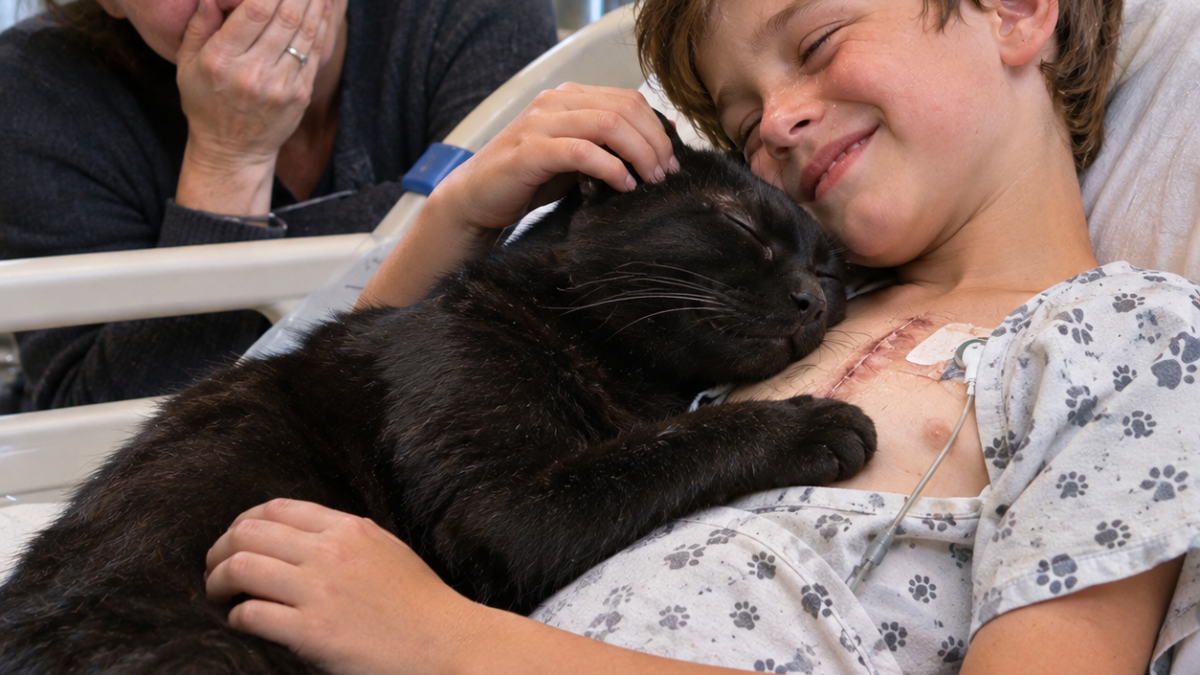
Our Black Cat Refused to Cuddle Anyone for 10 Years—Then My 6-Year-Old Son Needed Heart Surgery and He Never Left His Side
For ten years, our black cat Figaro had avoided laps, hated being carried, and walked away from anyone who tried to cuddle him—as if affection were a personal insult he had no intention of tolerating.
Then my six-year-old son, Alden, began getting sicker from the heart defect he had been born with, and one night I opened his bedroom door to find Figaro lying beside him with one black paw resting directly on his chest while Alden whispered, “Don’t worry, Fig. My heart’s still working.”
Two years later, after surgery had given my little boy enough strength to ride his bike again, Figaro became the one whose body was failing—and I watched my eight-year-old son kneel on the floor so the old cat would never have to struggle to reach his heart again.
My name is Maren.
We live in a small town in Pennsylvania in an old two-story house with creaky floors, crooked porch steps, and white paint that should have been redone at least three summers ago.
Every spring I say this is the year I will repaint the porch.
Every fall I say next year.
The porch remains unconvinced.
Alden was six when everything changed.
He was small for his age.
Not alarmingly small.
Just the sort of child strangers sometimes guessed was four or five until he started talking and corrected them with the confidence of a retired school principal.
He loved dinosaurs.
Not just the normal six-year-old version of loving dinosaurs.
He had opinions.
If you called a pteranodon a dinosaur, Alden would inform you—politely at first—that it was a flying reptile.
He owned seventeen plastic dinosaurs, one stuffed green tyrannosaurus named Walter, and a faded blanket covered in cartoon triceratops that he had slept under since he was three.
He liked peanut butter sandwiches with the crusts removed.
Apple slices without skin.
Chocolate milk only in the blue cup.
And he believed Figaro was his best friend.
That belief made very little sense.
Figaro had never encouraged it.
Figaro was ten years old, completely black except for six white hairs beneath his chin and one on his chest that Alden called “his secret star.”
He had lived with me since he was a kitten.
I found him beneath a stack of pallets behind the grocery store where I worked.
He was maybe eight weeks old, furious, thin, and entirely convinced that human contact was an unacceptable violation of international law.
I brought him home anyway.
For ten years, he remained remarkably consistent.
He did not cuddle.
He did not sit on laps.
He tolerated petting when he initiated it.
If you picked him up, his entire body went stiff with such profound disappointment that you usually put him down from shame.
Visitors rarely saw him.
PART2:
He disappeared before the doorbell finished ringing.
He slept at the foot of my bed occasionally but never touching me.
He accepted food.
He accepted housing.
He accepted that we occupied the same property.
I would not have described him as affectionate.
Alden disagreed.
“Fig loves me,” he would say.
“He loves the furnace vent.”
“He sleeps in my room.”
“He sleeps on the heat register in your room.”
“He follows me.”
“He follows anyone holding turkey.”
“You don’t understand cats, Mom.”
Apparently not.
Alden had been born with a serious congenital heart defect.
The medical name sounded enormous when he was a baby.
Too many syllables.
Too much meaning packed into words I barely understood.
I learned quickly.
PART3:
Parents of sick children become unwilling experts.
Oxygen saturation.
Echocardiogram.
Cardiology.
Pressure gradients.
Medication dosages.
What color around his lips meant call the doctor.
What kind of tired was ordinary.
What kind of tired meant stop.
What kind of breathing meant listen.
What kind meant act.
For years, we managed.
Appointments.
Monitoring.
Restrictions.
Questions.
Alden knew he had a “special heart.”
That was how we explained it when he was little.
As he got older, he understood more.
Not everything.
Enough.
He knew he could not always run as long as the other children.
He knew there were days his chest felt funny.
He knew adults watched him too carefully on playgrounds.
And he knew he hated hospitals.
There was one cardiology appointment that divided my life into before and after.
It was late October.
Cold rain.
Alden wore his dinosaur raincoat and carried Walter beneath one arm.
We expected another scan.
Another adjustment.
Another appointment in three months.
Instead, Dr. Warren spent longer than usual looking at the screen.
He measured something twice.
Then three times.
He asked the technician for another view.
That was when I knew.
You learn doctors’ faces.
They try not to show concern until they are ready to explain it.
But mothers become very good at reading the half-second before a professional expression returns.
Afterward, Dr. Warren asked a nurse to take Alden to choose a sticker.
Alden objected.
“I already got one.”
“You can get two.”
That was how I really knew.
Doctors do not bribe six-year-olds with a second sticker unless they want to speak to the mother alone.
When the door closed, Dr. Warren pulled his chair closer.
“We need to start talking seriously about surgery.”
For a moment, I heard every word except surgery.
The room became very still.
I looked at the plastic heart model on the counter.
Red.
Blue.
Little tubes.
Something meant to make a complicated thing easier to understand.
“When?”
“We have some time to plan.”
“How much?”
“Weeks, not months.”
I looked toward the door Alden had gone through.
“He’s six.”
“I know.”
“He’s been stable.”
“He has.”
“Then why now?”
Dr. Warren explained.
The changes.
The strain.
Why waiting longer carried its own risks.
He did not frighten me unnecessarily.
He also did not comfort me with things he could not promise.
I appreciated that later.
At the time, I wanted him to lie.
I wanted him to say:
Actually, never mind.
I want you to go home and forget this conversation.
Instead, I nodded.
Asked questions.
Wrote things down.
Then Alden returned carrying three stickers because apparently the nurse was an accomplice.
He looked at me.
“Why are you crying?”
I wiped my face immediately.
“I’m not.”
He stared.
Six-year-olds are terrible at pretending not to notice.
“Yes, you are.”
“Just tired.”
He handed me one sticker.
A stegosaurus.
“You can have this.”
That nearly finished me.
On the drive home, he talked about lunch.
Then school.
Then Figaro.
He had no idea that my mind was already in an operating room that had not happened yet.
That evening, I stood in the kitchen making peanut butter sandwiches.
My hands shook.
I cut off the crusts.
Then cut the sandwich diagonally because Alden insisted triangles tasted better than squares.
Figaro appeared beneath the table.
Alden came in.
“Fig, sit.”
Figaro ignored him.
“See? He listens.”
“He is literally walking away.”
“He’s thinking about it.”
That was Alden’s relationship with Figaro.
Absolute faith unsupported by evidence.
At least, that was what I believed.
Over the next few weeks, Alden became more tired.
He started coming home from school and lying on the couch.
He stopped racing upstairs.
Sometimes halfway up, he would sit on a step.
“Just resting.”
I tried not to look frightened.
Children notice fear even when we think we hide it.
One night, I woke around eleven-thirty.
I heard whispering.
At first, I thought Alden was talking in his sleep.
I walked down the hall.
His bedroom door was open a few inches.
I pushed it gently.
Then stopped.
Figaro was on the bed.
That alone was unusual.
He sometimes slept in Alden’s room, but always at the foot.
Never touching.
Now he lay beside Alden.
Close.
His body curved against my son’s side.
One front paw rested lightly on Alden’s chest.
Right over his pajama shirt.
Alden had one hand on Figaro’s back.
“Don’t worry, Fig.”
The cat’s ears turned.
“My heart’s still working.”
I covered my mouth.
Alden whispered:
“It just needs fixed.”
Figaro did not know that.
Of course he didn’t.
He could probably hear or feel breathing.
Warmth.
Movement.
Maybe Alden had been restless and Figaro found the bed comfortable.
Cats do things for reasons that belong to cats.
But that did not make the scene less powerful.
Because Figaro had never done that before.
I stood in the doorway until my legs hurt.
Eventually Alden saw me.
“Mom?”
I wiped my face.
“What?”
“You’re crying again.”
“Allergies.”
“In November?”
“Very aggressive allergies.”
He looked unconvinced.
Figaro lifted his head.
Then, instead of leaving like he normally would when another person entered, he lowered it again.
His paw remained on Alden’s chest.
From that night on, something changed.
Not magically.
Figaro did not become a cuddly cat with everyone.
He still hated visitors.
He still walked away from me when I tried to hold him.
He still treated the vacuum cleaner like a sworn enemy.
But with Alden, he stayed.
If Alden napped, Figaro slept near his pillow.
If Alden sat on the floor building dinosaurs, Figaro lay beside the pile.
When Alden returned from appointments upset, Figaro appeared in his room within minutes.
Sometimes he climbed onto the bed.
Sometimes not.
But he was there.
I began noticing something else.
On days when Alden was especially tired, Figaro followed him more closely.
That did not mean he was diagnosing anything.
I need to say that.
Animals notice routines.
Changes in movement.
Changes in smell.
Changes in activity.
They notice when a child who normally runs suddenly walks.
Figaro did not understand congenital cardiology.
He understood his boy was different.
That was enough.
I worked at a grocery store.
Thirty-two hours most weeks.
Sometimes more when somebody called out.
By the month before surgery, I had missed so many shifts I stopped counting.
My manager, Denise, was kinder than company policy required.
“Go.”
“I can work until three.”
“Go.”
“I need the hours.”
“You need your kid.”
“I need insurance too.”
She looked at me.
“Go, Maren.”
I cried in the stockroom once.
Not dramatically.
I was holding a case of canned green beans when suddenly my body decided that was where everything would happen.
The scheduling.
Bills.
Fear.
Forms.
Pre-op testing.
Hospital directions.
Alden asking whether surgery would hurt.
Me telling him doctors would keep him asleep.
Him asking what if he did not wake up.
That question.
I still hate remembering it.
He asked in the car.
Very casually.
“What if I don’t wake up?”
I gripped the steering wheel.
“You will.”
“How do you know?”
Because mothers are supposed to know.
That is the lie children believe until life teaches them otherwise.
I said:
“Because your doctors are very good.”
“Is that the same as knowing?”
I looked at him in the mirror.
No.
It was not.
So I pulled into a pharmacy parking lot.
Turned around.
“No.”
He looked frightened.
“I can’t promise exactly what will happen.”
His eyes filled.
I reached back.
“But I can promise you will not be alone.”
That mattered.
He nodded.
Then:
“Can Figaro come?”
I laughed softly.
“To surgery?”
“Not in surgery.”
“Good.”
“After.”
I hesitated.
“Cats aren’t usually allowed in hospitals.”
His face fell.
“But he stays when I’m sick.”
“I know.”
“What if I wake up and nobody knows?”
“I’ll be there.”
“He knows before you.”
That stung slightly.
“Excuse me?”
“Fig always knows when I wake up.”
I almost laughed.
Then saw he was serious.
The surgery stopped being an abstract medical event for him at that moment.
It became somewhere he would wake without his cat.
He cried.
“I don’t want to do it without him.”
I parked fully.
Unbuckled.
Climbed into the back seat.
Held him.
He was six but suddenly felt much smaller.
“I’m going to be there.”
“I know.”
“Emily—”
My sister Emily? Wait, no. In our family, Emily was my cousin? Actually, there was no Emily here.
I caught myself before saying a name that belonged to somebody else’s story.
I said:
“Grandma will be there too.”
My mother lived forty minutes away and had already planned to come.
“Aunt Jo is coming.”
He sniffed.
“Fig isn’t.”
“No.”
He cried harder.
At our next pre-op appointment, nurse Colleen heard him ask again.
Colleen was one of those nurses children trust immediately.
Probably because she never spoke in the high, false voice adults sometimes use when they are terrified of upsetting kids.
She crouched beside Alden.
“You really love that cat?”
“He’s my best friend.”
I looked away before my expression betrayed anything.
Colleen said:
“I can’t promise he can come.”
Alden nodded sadly.
“But I can ask.”
His eyes lifted.
“Really?”
“Really.”
“Before surgery?”
“Probably not.”
“After?”
“If your doctors say you’re stable enough, if hospital rules allow it, and if we can make arrangements.”
That was a lot of conditions for a six-year-old.
He heard only:
Maybe.
“Can you ask today?”
Colleen smiled.
“I will.”
Alden looked at me triumphantly.
I said:
“Do not emotionally blackmail the nurse.”
“I don’t know what that is.”
“Exactly.”
The weeks before surgery passed too quickly and too slowly.
We packed.
Walter the stuffed dinosaur.
Pajamas.
Books.
Tablet.
Chargers.
Slippers.
Photographs.
Alden chose one picture of Figaro.
It was objectively a terrible photograph.
Figaro was sitting on the windowsill looking furious because I had opened the curtains.
His eyes were half closed.
One ear slightly crooked.
Alden loved it.
“He looks tough.”
“He looks constipated.”
“Mom!”
“Sorry.”
The night before surgery, Figaro slept against Alden again.
I checked twice.
Maybe three times.
At four-thirty in the morning, I woke Alden.
He was groggy.
Figaro followed us downstairs.
While I packed the last things, the cat sat beside Alden’s shoes.
When we opened the front door, Figaro moved closer.
Then sat.
He did not try to escape.
He simply watched us leave.
Alden turned.
“Bye, Fig.”
Figaro blinked.
“Take care of the house.”
The cat began licking one paw.
“Great.”
I laughed.
That helped.
At the hospital, Alden became quieter.
Children understand when adults stop pretending something is routine.
There were wristbands.
Questions.
Vitals.
People introducing themselves.
An anesthesiologist.
A surgeon.
Consent forms.
I signed my name too many times.
I hated that every signature meant:
Yes, I understand.
I did not understand.
I understood words.
Risk.
Bleeding.
Infection.
Arrhythmia.
Complications.
That is different from understanding your six-year-old is about to disappear through a door and you cannot follow.
Just before they took him, Alden held Figaro’s photograph against his chest.
I sat beside him.
He looked at it.
Then handed it to me.
“Keep this safe.”
“I will.”
“He’ll need to know where I went.”
My throat closed.
“I’ll explain.”
“How?”
“I’ll tell him.”
“He doesn’t understand people words.”
“He understands some.”
“Like what?”
“Dinner.”
That made him smile.
Then the transport team came.
I kissed his forehead.
“I love you.”
“Love you too.”
“You’re going to do great.”
He looked scared.
So did I.
The bed rolled away.
I walked beside it until someone gently told me where to stop.
I stood there until Alden disappeared.
Then I went to the waiting room and cried so hard my mother had to take the photograph of Figaro from my hand because I was bending it.
The surgery lasted hours.
People called.
I ignored most of them.
My manager texted:
NO NEED TO RESPOND. WE’RE THINKING OF YOU.
That was perfect.
No obligation.
My mother bought coffee I did not drink.
I checked the clock every seven minutes.
Sometimes three.
Hospital waiting rooms have a special kind of cruelty.
Everyone is experiencing the most important day of their life in the same room.
And everyone else looks ordinary.
One family ate sandwiches.
A man slept.
A woman knitted.
A television played a cooking show.
I wanted the world to understand something enormous was happening.
It did not.
Eventually Dr. Warren appeared.
I stood before he reached me.
“It went well.”
Those three words.
I will never forget them.
Not perfect.
Not over.
Not guaranteed.
But well.
The repair had gone as planned.
They would monitor closely.
Recovery would be difficult.
But Alden had come through surgery.
I hugged a doctor who probably did not expect it.
He tolerated me.
When I finally saw Alden, he did not look like my Alden.
That is something nobody prepares you for.
Machines.
Tubes.
Lines.
Dressings.
Pale skin.
Swelling.
He was asleep.
I stood beside him.
Held his hand.
Talked.
Even when I did not know whether he heard.
“Figaro is probably destroying the furniture.”
He was not.
My neighbor Susan had agreed to feed him.
According to her, Figaro sat by the front door most of the first day.
Then disappeared upstairs.
The second day, he did the same.
Susan sent a picture.
Black cat.
Front door.
Waiting.
Again, I did not tell myself he understood surgery.
He understood Alden left.
He understood Alden had not come home.
That was enough.
When Alden woke more fully, he was miserable.
Pain.
Confusion.
Dry mouth.
Fear.
He did not talk much.
When he did, he asked:
“What day?”
“Tomorrow.”
“No.”
“What?”
“When Fig comes.”
I had forgotten Colleen’s promise.
Not forgotten exactly.
Buried.
I said:
“We don’t know yet.”
His face crumpled.
He looked at the empty chair beside the bed.
Then turned away.
Recovery became harder on the second day.
Not medically catastrophic.
Just hard.
He had to move.
Cough.
Breathe deeply.
Eat.
Do things that hurt.
He became angry.
Then quiet.
He refused pudding.
He refused television.
He stopped asking questions.
That frightened me more than crying.
On the third morning, Colleen came into the room smiling.
Not her normal smile.
A secret smile.
Alden noticed.
“What?”
“I have news.”
“What?”
“Your doctors say you’re stable enough.”
“For what?”
“We arranged something.”
I knew before he did.
My hand flew to my mouth.
Colleen pointed toward the doorway.
“We have a special visitor.”
Alden sat up too fast.
“FIG?”
“Slow down.”
His face changed.
I have never seen joy arrive so visibly on another human being.
Figaro came in an old hard-sided carrier.
Susan had brought him to the entrance.
Hospital staff had coordinated the visit carefully.
It was not casual.
He was not a service animal.
Not a therapy animal.
No magical rule allowed pets everywhere.
The care team approved a brief controlled visit under specific conditions after Alden was stable enough.
A clean blanket.
No contact with surgical sites.
Hand hygiene.
Staff oversight.
Short duration.
All of that mattered.
But to Alden, only one thing mattered.
Figaro was there.
The carrier door opened.
Figaro did not rush out.
Of course not.
He was still Figaro.
He remained inside for nearly a minute looking offended by the entire hospital.
Then he heard Alden.
“Fig.”
His ears turned.
“Come here, buddy.”
Figaro stepped out.
Slowly.
He sniffed the clean blanket.
Looked around.
Then climbed onto the separate blanket placed beside Alden.
Not on his chest.
Not near lines or dressings.
Just close enough.
Alden reached.
His fingers touched Figaro’s back.
“You found me.”
Colleen looked away and wiped beneath one eye.
I did the same.
Figaro turned.
Then did what he had begun doing at home.
One paw forward.
Resting on the blanket near Alden’s side.
Not literally checking his heart.
Just close.
Alden smiled.
“My heart’s fixed.”
I said:
“Repaired.”
He frowned.
“Mom.”
“Sorry.”
Figaro curled up.
And for the first time since surgery, Alden looked peaceful.
The visit was not long.
Maybe twenty minutes.
Perhaps less.
It felt enormous.
When Figaro had to leave, Alden cried.
But differently.
Not terrified.
Sad.
Normal sad.
He kissed the top of Figaro’s head.
Figaro tolerated it.
A major concession.
Then the carrier closed.
Alden watched it go.
“Mom?”
“What?”
“He knows I’m coming home.”
I looked at my son.
“Yes.”
That one I allowed myself to believe.
Recovery took time.
More than Alden expected.
More than I expected.
Walking hurt.
Sleeping was difficult.
The incision frightened him.
He asked if it would always look that way.
No.
He asked if kids would stare.
Maybe.
He asked if his heart could break open.
No.
He asked if Figaro would smell the hospital on him.
Probably.
We went home days later.
Figaro was waiting near the front door.
Susan had sent photos proving he spent an unreasonable amount of time there.
When Alden stepped inside, Figaro approached.
Sniffed his shoes.
His hospital bag.
His pajamas.
Then looked up.
Alden crouched carefully because his chest was sore.
Figaro rubbed against his leg.
That was it.
No dramatic leap.
No perfect movie reunion.
But Alden laughed.
His first real laugh since surgery.
That sound filled the house.
The weeks afterward were not easy.
A successful surgery does not mean a child walks out healed and normal instantly.
There were restrictions.
Medication.
Follow-ups.
Fear every time he said his chest hurt.
Fear every time he looked pale.
Fear every time he was tired.
I had to learn the difference between recovery and emergency.
Again.
Alden hated being protected.
“I can do it.”
“Doctor said no.”
“I feel fine.”
“Doctor still said no.”
“Fig thinks I can.”
“Fig eats dust.”
“That doesn’t mean anything.”
“It means he is not your cardiologist.”
Figaro stayed nearby.
Always Alden.
Only Alden.
He still would not cuddle me.
This became insulting.
I fed him for ten years.
Paid veterinary bills.
Cleaned litter.
He chose the small person who occasionally forgot to fill the water bowl.
“Traitor.”
Figaro stared.
Alden laughed.
That was worth it.
Gradually, Alden grew stronger.
Walks.
Then school half-days.
Then full days.
Then playground with restrictions.
Then more freedom.
At his first cardiology appointment after returning to school, Dr. Warren listened.
Checked.
Reviewed imaging.
Then smiled.
Everything looked as expected.
Alden asked:
“Can I ride my bike?”
“Not yet.”
He groaned.
At the next appointment:
“Now?”
“Short rides.”
Alden looked at me as if Christmas had arrived.
He was seven then.
By eight, he rode around the cul-de-sac.
Not recklessly.
Mostly.
I still watched too closely.
He would turn the corner and I would count.
One.
Two.
Three.
Then his helmet appeared again.
I learned to breathe.
That might have been my recovery.
Not his.
Figaro aged while Alden strengthened.
At first, slowly.
A little stiffness in the back legs.
Longer naps.
Less jumping.
Then noticeable.
He stopped climbing onto the kitchen windowsill.
He used the stairs carefully.
Sometimes he stood below the couch calculating the jump longer than he used to.
At twelve, he tried one evening.
Front legs reached.
Back legs failed.
He dropped back onto the rug.
Tried again.
Failed.
I started getting up.
Alden beat me.
He walked over.
“Hey, old man.”
Figaro looked up.
Alden placed one hand beneath his chest and another under his back end.
He had learned how to lift him gently from our veterinarian.
No dangling.
No grabbing.
He placed him on the couch.
“There.”
Figaro immediately curled up like the entire event had been arranged for his convenience.
Alden sat beside him.
“I’ve got you now.”
I turned toward the kitchen.
Not because I needed anything.
Because crying in front of children becomes exhausting after a while.
Alden called:
“Mom?”
“I’m making tea.”
“You don’t drink tea.”
“I might start.”
“You’re crying.”
“I’m chopping onions.”
“There aren’t any onions.”
“Mind your business.”
He laughed.
That became our life.
Alden stronger.
Figaro weaker.
The roles changed so gradually I did not notice until one morning.
Every school day, Figaro started walking to the front door before Alden left.
Slowly.
Stiffly.
But he went.
Alden put on his backpack.
Figaro waited.
Then he rose onto his back legs and placed both front paws against Alden’s chest.
The first time I nearly stopped it.
I worried about pressure near Alden’s surgical scar.
But two years had passed.
His cardiology team had cleared normal activity long before.
Figaro was barely ten pounds.
Alden held him gently.
“Morning check.”
Figaro purred.
Figaro did not often purr loudly.
With Alden, he did.
The ritual continued.
Every morning.
Paws against chest.
Alden steadying him.
Then:
“Okay, Fig. Still working.”
I asked once:
“What is he doing?”
Alden looked at me as if I were slow.
“Checking.”
“Checking what?”
“My heart.”
“You know he isn’t actually checking your heart.”
“I know.”
I raised an eyebrow.
He smiled.
“He thinks he is.”
Maybe.
Or maybe he had learned that standing that way earned touch and attention.
It did not matter.
Then Alden placed his own hand against Figaro’s chest.
“And I check his.”
I felt that old pressure behind my eyes.
“Is his still working?”
“Yes.”
“Good.”
For several months, I could predict the morning ritual by sound.
Backpack zipper.
Shoes.
Figaro’s nails on the floor.
Alden’s laugh.
Then goodbye.
It became ordinary.
The best things sometimes do.
Figaro’s veterinarian diagnosed arthritis.
Medication helped.
We added a little step beside the couch.
Then another beside Alden’s bed.
Figaro still slept there most nights.
Sometimes beside Alden.
Sometimes near his feet.
At thirteen, he stopped jumping entirely.
At first Alden lifted him every time.
Then we bought ramps.
Figaro distrusted them for a week.
Of course.
Then decided ramps had been his idea.
We put rugs over slippery floors.
Moved his food.
Added a lower-sided litter box.
Alden participated in everything.
“Why does his food go here?”
“Easier.”
“Why not upstairs anymore?”
“Stairs.”
“I can carry him.”
“You’re not always home.”
“I can come home.”
“You have school.”
“School is overrated.”
“That argument has been denied.”
Figaro’s world became smaller.
Not sad.
Smaller.
Living room.
Kitchen.
Alden’s room when carried.
Porch on warm days.
He slept in sun patches.
He demanded food.
He still hissed at delivery drivers.
His personality remained gloriously intact.
Then last Tuesday came.
I remember because Tuesdays are grocery-delivery days at work and I was already late.
Alden had his backpack on.
Shoes tied.
Figaro walked toward the door.
Slowly.
He stopped.
Looked at Alden.
Then tried to rise onto his back legs.
His front paws lifted maybe two inches.
His back legs trembled.
He dropped.
He tried again.
Nothing.
I saw Alden’s face.
For one second, he was six again.
Hospital bracelet.
Stuffed dinosaur.
Fear.
His eyes filled.
Figaro sat.
Confused.
Alden did not cry.
He took off his backpack.
Set it down.
Then knelt.
All the way to the floor.
“Here.”
He moved close enough that Figaro did not have to stand.
Figaro lifted one paw.
Then the other.
Placed them against Alden’s chest from where he sat.
Alden held him gently.
“There you go, buddy.”
His voice was very soft.
“You don’t have to stand anymore.”
I stood in the hallway.
Unable to move.
Alden lowered one hand to Figaro’s side.
Waited.
I knew what he was doing.
Feeling the little heartbeat beneath fur.
“Your heart’s still working too.”
Figaro closed his eyes.
Purred.
Alden stayed there until his school bus was almost at the corner.
Then he kissed Figaro’s head.
Picked up his backpack.
At the door, he turned.
“Mom?”
“Yes?”
“Don’t let him try the stairs.”
“I won’t.”
“Promise?”
“Promise.”
He left.
I sat on the floor beside Figaro and cried into both hands.
Figaro ignored me.
Some things never change.
Later that week, I took him to the veterinarian.
Nothing sudden.
Nothing catastrophic.
Age.
Arthritis.
Muscle loss.
We adjusted pain management.
Discussed quality of life.
That conversation frightened me.
I knew where it eventually led.
But we were not there yet.
Figaro still ate.
Still purred.
Still complained.
Still wanted Alden.
Still watched the front door.
Still enjoyed warm sunlight.
So we adapted.
That is what families do when bodies change.
Alden no longer waited for Figaro to stand in the mornings.
He kneels automatically now.
Backpack first.
Shoes.
Then floor.
Figaro puts his paws against him.
Alden puts a hand against Figaro.
Neither of them is diagnosing anything.
Neither is saving the other in some medical sense.
It is just their ritual.
A boy who once needed help getting out of bed.
A cat who now needs help getting onto the couch.
A child whose chest once carried fresh surgical dressings.
An old animal whose back legs no longer cooperate.
I used to think caregiving always moved in one direction.
Parent to child.
Human to animal.
Strong to weak.
Then Alden and Figaro taught me that care has a way of circling back.
Not evenly.
Not perfectly.
But back.
Figaro stayed beside Alden when the world became frightening.
Now Alden changes his water.
Carries him gently.
Puts rugs where his paws slip.
Sits on the floor because standing is hard for him.
Children notice more than we think.
Alden noticed every time Figaro stayed.
And now he stays too.
A few nights ago, I passed Alden’s bedroom.
Door partly open.
Exactly like that night two years earlier.
Figaro was on the bed because Alden had lifted him there.
The old cat lay against Alden’s side.
One paw near his chest.
Alden was reading a dinosaur book.
He stopped.
Placed two fingers against Figaro’s ribs.
Waited.
Then whispered:
“Still working.”
I stood in the hallway.
Again.
Apparently my role in this family is to stand in doorways and cry.
I did not interrupt.
Alden looked older than eight in that moment.
Then he turned the page and read:
“Pterosaurs were not technically dinosaurs.”
And suddenly he was eight again.
I smiled.
Figaro purred.
As I write this, Figaro is still here.
He is thirteen.
Old.
Black fur dusted gray around his mouth.
Stiff.
Opinionated.
No longer capable of climbing onto Alden’s bed without help.
Alden is eight.
His cardiology appointments continue.
His heart still requires monitoring.
He still has a scar down his chest.
He no longer hides it at the pool.
He tells other children:
“My heart had construction.”
That is apparently his preferred medical terminology.
He rides his bike.
Goes to school.
Argues about bedtime.
Forgets socks.
Leaves dinosaur books on the floor.
He is not magically cured.
Figaro did not heal him.
Doctors did surgery.
Nurses cared for him.
Medication helped him recover.
Time helped.
His own body did extraordinary work.
But Figaro gave him something medicine could not prescribe.
Familiarity.
Routine.
A warm black shape beside him during a terrifying season.
Someone he could talk to without worrying the listener might cry.
I learned about that only later.
Alden admitted he sometimes told Figaro things because he did not want to scare me.
That hurt.
Then taught me something.
Children protect parents too.
Even when they shouldn’t have to.
He remembered one afternoon before surgery.
The thing I had overheard.
“I’m scared, Fig. But don’t tell Mom. She already cries when she thinks I’m asleep.”
I thought I had hidden it.
Of course I had not.
Alden knew.
He just loved me enough to pretend.
Figaro became the place where he put the fear he did not want to hand to me.
Maybe that is what pets sometimes are.
Not healers.
Not mind readers.
Witnesses.
Safe places for feelings that do not fit anywhere else.
I used to think the greatest gift I received was hearing:
The surgery went well.
Nothing will ever surpass that morning.
But life after survival taught me there are quieter gifts too.
Watching your child return to school.
Hearing him complain about homework.
Seeing him ride too fast and having the luxury of yelling:
“Slow down!”
Being annoyed because he left peanut butter on the counter.
Those ordinary irritations become precious after you have spent hours wondering whether you will ever experience them again.
And then there is this old cat.
The cat who refused affection for ten years.
The cat who treated cuddling like an accusation.
The cat who somehow decided that when Alden’s body became tired and frightening, rules could be suspended.
He stayed.
Now the rules have changed again.
Figaro is the tired one.
And Alden has decided he will stay.
Last Tuesday, I thought watching Figaro fail to stand would break Alden’s heart.
Instead, my son simply lowered himself.
No panic.
No anger.
No embarrassment for the old cat.
He brought his body down to where Figaro could reach him.
That image has stayed with me more than anything.
Because so much of love is exactly that.
We spend years asking people to rise.
Get better.
Be stronger.
Come back.
Fight.
Try.
Stand.
And sometimes the kindest thing is to stop asking them to climb.
To get down beside them.
To meet them where their body can still go.
Figaro once climbed onto Alden’s bed because Alden was too weak to come find him.
Now Alden gets onto the floor because Figaro is too weak to stand.
Two years ago, my six-year-old whispered:
“My heart’s still working.”
Now my eight-year-old puts one small hand against the chest of an old black cat and says the same thing back.
“Yours is too.”
For now, it is.
And for now, that is enough.
Because I no longer think love is measured by how tightly someone can hold on.
Sometimes love is simply this:
When the one who once stayed beside you becomes too tired to stand, you get down on your knees so they never have to reach for you alone.








