Our 190-Pound Rescue Mastiff Stayed Completely Silent for 42 Days—Then at 3:14 A.M., He Made One Strange Sound Outside Our Daughter’s Bedroom Door
PART3:
Most frightened dogs still want something.
Distance.
Food.
Escape.
Comfort.
Control.
Gus seemed to want nothing.
He moved where the leash guided him. He stopped when the leash stopped. He tolerated the vet tech touching his ears, his paws, his ribs. He did not resist. He did not cooperate. He simply endured.
“Has he ever made noise here?” Nina asked.
Linda shook her head.
“No barking?”
“No.”
“Whining?”
“No.”
“Growling?”
“Never.”
“That sounds good,” I said, though I knew better.
Linda looked at me with tired eyes.
“Sometimes silence is good,” she said. “Sometimes it’s a locked door.”
We still took him.
I wish I could say we did it because we were selfless people who saw exactly what he needed and rose to the occasion with pure hearts. The truth is messier. We took him because I saw him standing there like a living absence and could not stop thinking about how many animals like him vanish inside systems because they do not know how to perform pain in ways people recognize.
We took him because Nina looked at his huge head hanging low and whispered, “He’s still in there somewhere.”
We took him because Linda said, “You don’t have to,” and somehow that made me want to.
We signed the paperwork in fifteen minutes.
A ridiculous amount of time for a decision that would reshape our house.
The ride home took almost two hours.
Gus sat upright in the back seat the entire way.
He did not lie down.
Did not look out the window.
Did not sniff the seat.
Did not shift when we turned.
Nina kept glancing at him in the rearview mirror. Every time she did, his eyes were fixed on the back of the front passenger seat, staring at the upholstery like it contained instructions only he could read.
Once, near the freeway exit, I said, “You okay back there, big guy?”
Nothing.
Not even an ear twitch.
Nina reached over and rested her hand on my knee.
“We knew it would be slow,” she said.
“I know.”
But I didn’t know.
Not really.
I thought slow meant days of coaxing. A little progress each week. Treats placed closer. A first tail wag after patience and kindness. I had seen enough rescue videos to distrust miracles, but some foolish part of me still expected a visible story arc.
Gus did not offer one.
When we got home, he stepped out of the car only because the leash suggested it. He walked up the front path, through the door, into the living room, looked around once, and went to the corner farthest from the entrance.
Then he turned toward the wall.
That was it.
That was where he was going to be.
I set food and water six feet from him because that was what the rescue protocol recommended. Not too close. Not too far. Accessible without forcing interaction. We kept the room quiet. We kept our voices low. We did not crowd him.
Four hours passed before he lay down.
Even then, it was not relaxation.
It was surrender to gravity.
At midnight, the food bowl was untouched.
By morning, it was empty.
“So he eats,” Nina said.
“Just not in front of us.”
“That’s something.”
“That’s something,” I repeated.
We built our first routines around not witnessing him.
Food at seven. Room cleared by seven-oh-five. Bowl checked at eight. Water refreshed when he was not looking. No sudden movements near the living room. No guests. No direct approaches. Back door cracked at night if weather allowed. Hallway light dimmed. Layla’s toys relocated upstairs.
Then Layla came home from kindergarten.
Our daughter was five years old, small for her age, with dark curls that never stayed in the hair ties Nina bought by the dozen, and the kind of seriousness some children carry not because they are unhappy, but because they are always studying the world for patterns. She loved picture books, peanut butter toast, frogs, and Murphy, though Murphy accepted her devotion with the strained dignity of royalty burdened by an affectionate subject.
We had told her about Gus before bringing him home.
“He is very scared,” Nina explained.
“Is he mean scared or sad scared?” Layla asked.
That question stayed with me.
“We don’t think he’s mean scared,” I said. “But we have to be careful because scared animals need space.”
“Can I pet him?”
“No.”
“Can I talk to him?”
“Not close up.”
“Can I look at him?”
“Gentle looking,” Nina said.
Layla accepted these rules with a solemn nod that made my chest ache.
When she walked into the house that first afternoon, she kicked off her sneakers by the door, dropped her backpack with the full-body relief of a child released from structure, and started toward the living room.
I stepped forward.
“Layla—”
She did not run.
Did not squeal.
Did not say, “Doggy!”
She walked past Nina, past me, stopped about three feet from Gus, and sat down on the floor with her hands folded in her lap.
Completely still.
I was on my feet before I realized I had moved.
Nina said my name once from the kitchen doorway.
“Marco.”
Quiet.
Not warning me away exactly.
Reminding me that any sudden movement now was worse than stillness.
So I stopped six feet behind Layla, heart pounding so hard I could feel it in my teeth, watching Gus’s shoulders, his mouth, his ears, the line of his back.
Murphy sat on the windowsill washing one paw.
Completely unbothered.
I clung to that.
Murphy, who once hissed at a Halloween decoration for three straight days, was washing his paw while my five-year-old daughter sat three feet from a silent 190-pound Mastiff.
Twenty-two minutes passed.
I know because I counted every one of them by the clock above the television.
Gus did not move.
Layla did not speak.
At minute twenty-two, Gus lowered his head onto his paws.
Then he looked at her.
Not past her.
Not through her.
At her.
Layla looked back.
The room held its breath.
Then she stood slowly and walked into the kitchen.
“Can I have crackers?” she asked.
Nina turned away, and I saw her wipe one eye with the heel of her hand before opening the pantry.
That night, after Layla was asleep and Gus was still in the corner, Nina said it straight.
“One warning sign and he’s gone.”
“I agree.”
“I mean it, Marco.”
“I know.”
“I can’t gamble with Layla.”
“We won’t.”
What she did not tell me then, what I would not learn until months later, was that after I fell asleep, she opened her laptop and drafted three emails to large-breed rescues within driving distance. She saved them in a folder titled Backup.
She did not send them.
She just wanted them ready.
That was Nina.
She loved with contingency plans.
I loved with receipts in my wallet.
Neither of us knew yet how similar fear had made us.
The first two weeks were the hardest.
Not because Gus did anything dramatic.
Because he did almost nothing.
Drama at least gives you direction. A bite means one thing. Destruction means another. Barking, growling, pacing, escape attempts—all hard, but readable.
Gus gave us silence.
He stayed in the corner for most of every day. He ate only when the room was empty. He drank only when the house was still. He would not look at me if I entered too directly. He would not take food from my hand. He would not step into the kitchen. He would not follow us. He did not respond to his name. If a delivery truck stopped outside, he did not lift his head. If Layla dropped a block upstairs, he did not flinch.
It was like living with a huge, breathing statue.
Except at night.
That took me three nights to figure out.
At first, I worried he was not relieving himself. The rescue had warned us that shut-down dogs sometimes held everything far too long in new homes. I let him into the yard several times during the day, but he would only stand near the door, body stiff, then turn back inside.
On the third night, I slept on the couch with one eye open and a clear view of the back door.
I almost missed it.
What I noticed first was Murphy.
At 3:45 a.m., the cat jumped onto the back of the couch and sat there facing the hallway, tail curled around his paws, ears forward.
Waiting.
Fifteen minutes later, Gus stood.
Slowly.
Carefully.
Stiff from holding the same position for hours.
He walked the long way around the room, hugging the wall, every step measured. He passed within ten feet of me and did not look over. He moved through the back door I had left cracked and into the yard.
Same patch of grass.
Same position.
Same path back.
Then he drank water, returned to the corner, and lay down.
Murphy jumped off the couch and went to the kitchen like the night’s business had concluded.
I lay there in the dark feeling strangely honored.
Not because Gus trusted us.
He didn’t.
Because he had shown me the first rule of his survival.
He would do what he needed only when no one watched.
After three nights, I stopped staying up.
The system worked.
He had a routine.
Our job was to leave it alone.
Around day eight, I asked the rescue if they had any history beyond intake notes.
Linda sent over a small envelope.
Inside were three Polaroids.
I spread them on the kitchen counter after dinner while Nina loaded the dishwasher.
The first showed Gus in a backyard, far from the people in the frame, standing near a fence line. The second showed him indoors, angled away from whoever held the camera, body low, head lowered. The third showed him next to a man’s leg, shoulders stiff, ears back.
Nina came to stand beside me.
“Where did those come from?”
“Previous records.”
She picked up the first photo, then the second.
“Why would someone take pictures like this?”
“To document behavior, maybe.”
“They look like evidence.”
That word settled between us.
Evidence.
On the back of the third photo was a faded date stamp.
I did the math once.
Then again.
Then sat down.
“What?” Nina asked.
“The rescue said he was four.”
“Yes.”
“This picture is from almost five years ago.”
She turned the photo over.
“Maybe the date is wrong.”
“Maybe.”
But I knew it wasn’t.
Gus was not four.
He was at least seven.
Maybe eight.
And judging by the way he looked in those pictures, he had been shut down for years.
Nina sat across from me.
“How long can a dog live like that?”
I looked toward the living room corner.
“I don’t know.”
But what I thought was worse.
How long can anyone?
On day fourteen, Linda called.
I answered in my garage office while spreadsheet columns glowed on my computer screen and a half-finished shelter budget sat open beside a cold cup of coffee.
She did not pressure me.
That made it harder.
“Marco,” she said, “I want to talk through an option.”
I leaned back in my chair.
“Okay.”
“There’s a sanctuary in northern California. They take long-term shut-down dogs. Lifetime placement. Quiet environment. Experienced staff. No expectation that he’ll ever become adoptable in the usual way.”
I said nothing.
“They have an opening at the end of the month.”
I looked through the open office door into the hallway. I could not see Gus from there, but I knew exactly where he was.
“That sounds like you’re telling me to give up.”
“No,” Linda said. “I’m telling you there is no shame if this is too much.”
I hated her for saying it kindly.
I hated that part of me felt relieved.
“How soon do you need to know?”
“A week would be best.”
I wrote the date on the back of a CVS receipt because it was the only paper near me. Then I folded it and placed it in my wallet.
I did not tell Nina.
So by the end of day fourteen, there were two exits quietly open inside our house.
Hers in a laptop folder.
Mine in a wallet.
Neither of us knew about the other.
That night, Layla sat three feet from Gus again.
She had started doing it most afternoons after kindergarten. She never touched him. Never called him. Never brought toys too close. She simply sat with her hands in her lap and sometimes whispered things too softly for us to hear.
On day fifteen, something shifted.
Layla entered the living room, and Gus lifted his head before she sat down.
First time.
It was small enough that if I had blinked, I would have missed it.
But I did not blink.
Two days later, he stood when she walked past on her way to the kitchen.
Didn’t follow.
Didn’t move toward her.
Just stood.
Then lay back down when she disappeared.
On day eighteen, Layla left a balled-up sock in the hallway near the spot where Gus had started lying in the evenings.
Nina moved to pick it up.
Layla said, “Leave it.”
Nina looked at me.
I shrugged because at that point I was willing to consider socks part of a therapeutic protocol if the cat approved.
In the morning, the sock was three feet farther down the hall, closer to Layla’s bedroom.
Gus had moved it.
None of us saw him do it.
The next night, Layla left another sock.
By morning, it was gone.
We found it tucked beside Gus in the corner.
Nina stood there with the laundry basket in her hands.
“He’s collecting her,” she whispered.
The sentence should have made me uneasy.
It did.
But not in the way I expected.
There was possessiveness that worried me in dogs. Guarding. Fixation. Obsession. We knew the difference mattered.
This did not feel like that.
It felt like a dog gathering evidence that she existed.
A scent.
A trace.
A reason.
On day nineteen, I was working in the garage office when I sensed something in the hallway.
I looked up from my laptop.
Gus stood outside the door.
His massive body filled the frame.
Not coming in.
Not leaving.
Just standing there.
I froze.
Then I remembered the rule.
Do not make a big thing out of progress.
Progress hates applause when fear is watching.
So I looked back at my spreadsheet.
“Hey, Gus,” I said softly.
Nothing.
I kept working.
He stayed for two hours.
At some point, my leg cramped because I did not want to stand and ruin it. My coffee went cold. A client called, and I whispered through half the conversation before remembering I was whispering for a dog who had not made a sound in nineteen days.
When he finally left, I stayed at my desk another ten minutes, staring at the hallway where he had been.
That night, I took the sanctuary receipt out of my wallet.
I unfolded it.
Looked at the date.
Folded it again.
Put it back.
I told myself I was keeping options open.
That was true.
It was also cowardly.
On day twenty, Linda sent a fourth photo.
She said it had been found misfiled in Gus’s old intake scans.
I opened it while standing in the kitchen.
Gus lay near a doorway in a house I did not recognize. His head was down, body stretched across the hall, almost exactly the way he would later lie near Layla’s room. Through the doorway, I could see a sliver of a small bed. A stuffed animal on the floor. A nightlight shaped like a moon.
A child’s bedroom.
I stared at the photo until my eyes burned.
I had been telling myself Gus chose Layla.
The photo said something different.
He had done this before.
For another child.
In another house.
And whatever that arrangement had been, it had ended.
That knowledge changed the shape of him.
Until then, Gus had been a mystery. A shut-down giant. A rescue case. A dog with no sound, no trust, no obvious story.
Now he was something else.
A dog who had once stationed himself outside a child’s door.
A dog who had lost that child, or that home, or both.
A dog who came into our house, saw Layla, and began waiting for something he recognized.
Nina walked in while I was still holding the photo.
“What’s that?”
I slid it under a stack of school papers faster than I meant to.
“Old record photo.”
Her eyes narrowed.
“Anything important?”
“No. Just… old.”
I lied.
Not because I wanted to keep it from her forever.
Because she was already measuring danger every minute, and I did not know how to say, The 190-pound silent dog sleeping in our living room may have a history of attaching himself to children, and we do not know whether that is beautiful or dangerous.
I put the photo in the kitchen drawer later.
The one with batteries, birthday candles, tape, spare keys, and all the things families keep because they do not know where else a life should store its small emergencies.
I did not look at it again for weeks.
Day twenty-two was the first time Gus ate in the kitchen.
Nina was at the table doing books for her small design business. I was upstairs helping Layla choose pajamas because the pink ones were “too pajama” and the yellow ones had “bad sleeve feelings,” which is apparently a valid category when you are five.
When I came down, I stopped at the bottom of the stairs.
Gus stood at his bowl ten feet from Nina.
Eating.
In front of her.
Nina did not look at him.
She kept her eyes on her papers, one hand resting near her calculator, the other turning a page.
Both of them ate dinner in their own way.
Neither acknowledged the miracle.
That night, after Layla fell asleep, Nina stood in our bathroom brushing her teeth and started crying.
She did it silently, one hand over her mouth, toothbrush still in the other.
I stepped closer.
“What?”
She shook her head, then laughed once through tears.
“He ate,” she whispered.
I pulled her into my arms.
“I know.”
“I was so sure we couldn’t do this.”
“Me too.”
She pulled back and looked at me.
“You were?”
“Of course.”
“You always act like you can out-patience anything.”
“That’s branding.”
She laughed again, and for the first time in twenty-two days, the house felt less like a test we were failing and more like a family trying.
By day twenty-four, Gus started lying in the central hallway in the afternoons.
The location was not random.
From there, he could see the kitchen, the living room, the staircase, and the hallway leading to Layla’s room.
A strategic position.
That thought made me uneasy until Murphy walked past him one day carrying a stolen twist tie in his mouth and did not even slow down.
Murphy’s verdict remained unchanged.
Not a problem.
By day twenty-six, Gus followed Layla from the kitchen to her bedroom.
I saw it happen.
Layla walked down the hall holding a coloring book and a purple marker. Gus lifted his head, stood slowly, and followed.
I almost spoke.
Nina touched my arm and shook her head.
We watched from the kitchen.
Layla went into her room and sat at her little desk.
Gus stopped at the doorway.
He did not enter.
He sat in the hallway and watched her color for fifteen minutes.
Then, when she left, he stood and walked away.
That was when I began to understand the doorways.
Gus did not belong to rooms.
He belonged to thresholds.
Between hallway and bedroom.
Between living room and kitchen.
Between inside and outside.
Between danger and child.
He placed himself where things changed.
As if he had learned that bad things enter through openings.
Day twenty-eight became the day Nina still talks about.
Murphy jumped onto the back of the couch, walked across it, and stepped down onto Gus’s back like he was a footbridge.
Casual.
Unbothered.
The way a cat treats furniture he has known his whole life.
Gus’s eyes opened.
He did not move.
Murphy stepped from Gus’s back to the windowsill and settled there in a loaf shape, staring outside like nothing worth discussing had occurred.
Nina, who was washing dishes, set a plate down in the sink and stared.
“He let the cat walk on him.”
“He did.”
“Murphy used him as infrastructure.”
“Murphy has always believed in efficient routes.”
Nina leaned against the counter.
“That cat would not do that if he was worried.”
“No.”
She wiped her hands slowly.
“Okay.”
It was not a full surrender.
But it was a shift.
Day thirty, the corner was empty.
That sounds simple.
It wasn’t.
For thirty days, that corner had been Gus’s address. His bunker. His refusal. His survival station. We had learned to move around it. Food went near it. Water started near it. We had stopped looking directly at it because staring felt rude somehow.
On day thirty, I walked into the living room and the corner was empty.
Gus was in the hallway.
Not hiding.
Not flattened.
Lying where life moved around him.
I stood there long enough for Nina to walk in behind me.
“What?”
I pointed.
She looked at the empty corner.
Then at Gus.
Then at me.
“Nope,” she said.
“Nope?”
“If we make a thing of it, I’ll cry, and if I cry, you’ll cry, and then the dog will think we’re unstable.”
“Fair.”
We went to the kitchen and silently ate leftover pasta standing up like cowards in our own house.
Day thirty-one, bedtime.
Nina was putting away dishes when she saw Gus walk down the hallway. He stopped outside Layla’s closed door, circled once, and lay down facing it.
He stayed there all night.
She checked at midnight.
Still there.
At three.
Still there.
At six, when Layla woke up and opened the door, she found him lying across the hall.
“Good morning, Gus,” she said like this was normal.
He lifted his head.
No sound.
But his tail moved once.
The next night, same thing.
And the next.
By day thirty-five, that was just where he slept.
We thought it was sweet.
We did not yet understand it was also a warning system.
By then, Gus still had not made a sound.
Not one.
We had gotten used to it.
That sounds strange now, but families adapt quickly to whatever becomes normal inside their walls. We stopped expecting a bark when the doorbell rang. We stopped expecting a whine at mealtime. We stopped expecting a growl when the neighbor’s dog barked. We stopped expecting sound from him at all.
Gus communicated in position.
Corner meant unavailable.
Hallway meant observing.
Kitchen meant progress.
Office doorway meant company.
Layla’s door meant watch.
Those were his words.
We learned to read them.
On day forty-two, at 3:14 in the morning, I woke to a sound I had never heard before.
At first, I thought it was the house.
An old pipe.
A truck somewhere far away.
A low vibration coming up through the floorboards.
Then it came again.
Steady.
Deep.
Not a bark.
Lower than that.
Not a growl exactly, but close enough that every parent instinct inside me went cold.
I sat up.
Nina stirred beside me.
“What is that?”
“I don’t know.”
The sound came again.
A low, sustained hum.
I was in the hallway before I remembered moving.
Gus was outside Layla’s door.
His usual spot.
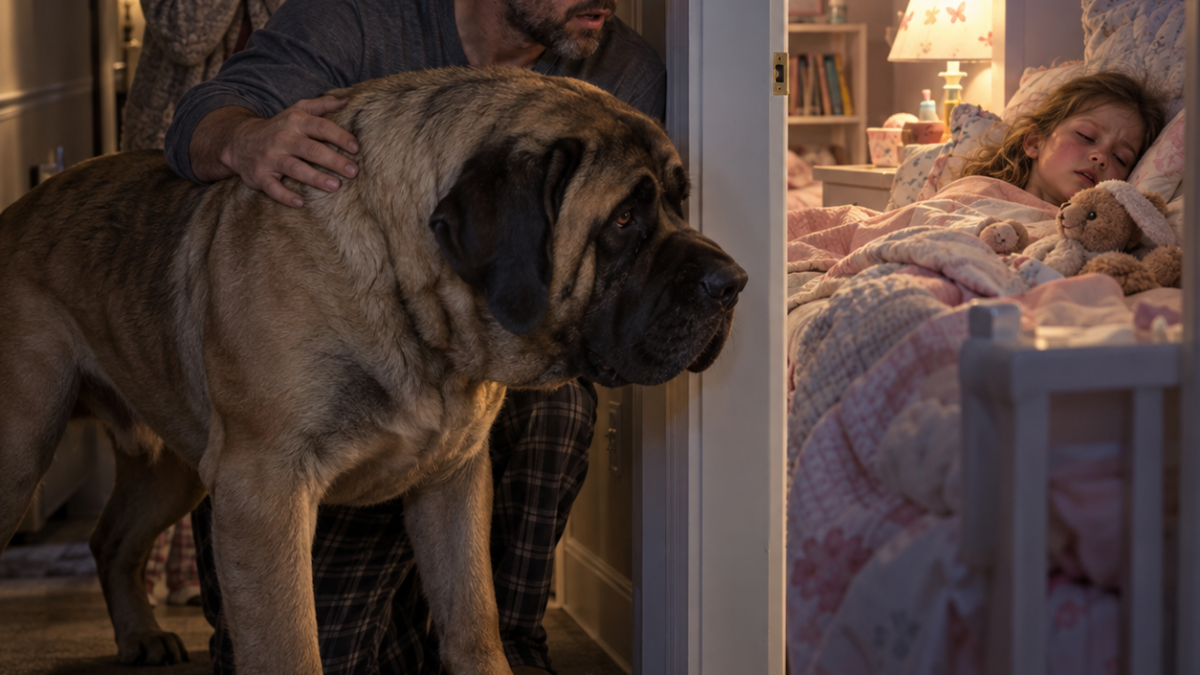
But he was standing now, weight forward, nose pressed into the gap beneath the door.
The sound was coming from him.
Forty-two days of silence, and now this.
Murphy sat at the end of the hallway, upright, tail wrapped around his paws, watching.
Not alarmed.
Focused.
That distinction mattered for exactly half a second.
Then Gus made the sound again, and I opened Layla’s door.
The room was too warm.
That was my first thought.
Layla was curled on her side, breathing fast and shallow. Her cheeks were flushed a deep, frightening red. Sweat dampened her hairline. One hand clutched her blanket, the other pressed against her stomach.
“Layla,” I said.
Her eyes opened.
Too slowly.
They did not find me at first.
Nina appeared behind me.
“Oh my God.”
The next minutes were motion.
Thermometer.
One hundred and four point two.
Water.
Layla barely sipped.
Shoes.
Keys.
Nina’s voice shaking while trying not to scare our daughter.
“Sweetheart, we’re going to get you checked out, okay?”
“My tummy hurts,” Layla whispered.
“I know, baby.”
Gus stood in the hallway while we moved around him.
He did not block us.
Did not follow into the room.
Did not make another sound.
But when I carried Layla out, her head on my shoulder, Gus stepped backward to clear the doorway and watched us with eyes that were no longer empty.
We were in the car by 3:47.
Urgent care was a twenty-minute drive that felt like crossing a continent.
Nina sat in the back with Layla, wiping her face with a damp cloth and coaxing tiny sips of water.
I drove too carefully and too fast at the same time.
At the clinic, the doctor checked her temperature, hydration, breathing, and responsiveness. Blood pressure. Heart rate. Capillary refill. Questions about vomiting, fluids, urination, stomach pain, how long she had been warm, what she had eaten.
I answered half.
Nina answered the rest.
The doctor listened, nodded, examined Layla again, and finally said the sentence that made my knees weak.
“You got her here at the right time.”
It was a virus.
Mild in the way doctors mean mild when they are comparing it to the terrible possibilities they are trained to rule out, not mild in the way parents feel while watching their child lie limp on an exam table at four in the morning. The fever had climbed fast. She was dehydrated. If we had waited until morning, it could have become dangerous.
We were given instructions, fluids, fever control guidance, and the kind of reassurance that only begins working once you are in your own house again.
We got home at seven.
Gus was still in the hallway.
He had not moved in over four hours.
Not to drink.
Not to lie down.
Not to return to the corner.
He stood outside Layla’s door, facing it, waiting for the child who had left through it in my arms.
When we brought Layla back, wrapped in a blanket and half asleep, Gus stepped aside.
Nina carried her into the bedroom and settled her in bed.
I sat down on the hallway floor beside Gus.
I did it without thinking.
My hand landed on his back.
The moment I realized I was touching him, I froze.
Forty-two days.
No one had touched him.
Not really.
Not since the first necessary handling at the rescue. Not in our house. We had honored distance like scripture.
His body stiffened beneath my hand.
I almost pulled away.
Then, slowly, Gus leaned into the touch.
Not much.
Just enough.
A shift of weight.
A decision.
Something opened in my chest so sharply I had to bow my head.
“Good boy,” I whispered.
My voice broke.
“You did good, big guy.”
He leaned harder.
Nina came out of Layla’s room and saw us there.
She covered her mouth.
Then she went into the kitchen to make coffee.
While the machine brewed, she opened her laptop. Months later she would tell me what happened next. She opened the folder labeled Backup. The three unsent emails to large-breed rescues were still there, waiting like exit doors. She selected all of them, deleted the folder, and closed the laptop.
She didn’t tell me then.
She only came back with two cups of coffee, sat on the floor beside me, and placed her hand next to mine on Gus’s back.
He did not move away.
We sat there together outside our daughter’s room while she slept.
“We’ll wait together,” I whispered.
I am not sure whether I was speaking to Gus, to Nina, or to myself.
Maybe all three.
After that night, Gus changed faster.
Not dramatically.
He did not become a different dog by breakfast. He did not suddenly play fetch, bark at squirrels, or roll over for belly rubs. Trauma does not dissolve because of one meaningful moment. Trust built under pressure still needs ordinary days to become safe.
But something had shifted.
He had spoken, and the world had not punished him.
He had let himself be touched, and the touch had not hurt.
He had done the job he had apparently been waiting to do, and when Layla came home, she came back.
Maybe that mattered most.
The first week after the fever, Gus began lying near my office during the workday. At first in the hall. Then just inside the door. Eventually, beside the filing cabinet, where he snored silently in a way that made his jowls puff but produced no sound.
He followed Nina into the kitchen when she did books.
He let Layla place a book beside his paw while she read aloud, though she still did not climb on him or grab him. We taught her carefully that trust was not permission to forget respect.
Murphy resumed using Gus as furniture.
Sometimes he walked across the giant dog’s back to reach the windowsill. Sometimes he lay a few feet away on the rug, tail flicking in Gus’s direction, the two of them sharing space the way animals do when they have decided the other is not a problem.
Gus never became noisy.
Even now, he rarely barks.
But he is not silent anymore.
He sighs.
That came first.
A heavy, dramatic sigh when he lies down in the kitchen, as if the weight of monitoring our household has become almost too much to bear.
He huffs when Murphy steals his bed.
He makes a soft rumble when Layla reads him books about bears, especially if she does the voices too loudly.
Once, when a delivery driver rang the bell and dropped a box with an impressive crash, Gus barked exactly one time. The sound was so deep and startling that the delivery driver jumped backward off our porch step and Murphy fell off the couch.
Layla applauded.
Gus looked embarrassed.
Months passed.
Layla turned six.
Gus learned the sound of the school bus brakes and began standing before we heard them. He did not greet her wildly. He simply walked to the front window, watched, and then waited near the door. When she came in, he sniffed her backpack, her hair, her hands.
Checking inventory.
Child returned.
All parts present.
At night, without anyone telling him, Gus still walks down the hallway and lies outside Layla’s door.
Same spot.
Facing the door.
Sometimes, if she is away overnight at her grandmother’s, he still lies there for a while, then eventually comes to our bedroom doorway as if reporting the irregularity.
“She’s at Grandma’s,” Nina tells him every time.
He accepts this after some thought.
A few weeks after Layla’s fever, I cleaned out my wallet at the kitchen table.
Old receipts. Expired insurance card. A coupon for a sandwich shop I never visited. A folded CVS receipt fell out.
I opened it.
The date was still there.
Sanctuary opening.
Northern California.
End of the month.
Weeks past now.
I sat there looking at the little paper that had once represented an exit I was too ashamed to admit I wanted.
Nina walked in and saw my face.
“What is it?”
I handed it to her.
She read it.
Then looked at me.
“I had a backup folder,” she said.
“What?”
“Three emails. To rescues. I wrote them on day one.”
I stared at her.
“You never told me.”
“You never told me about this.”
We sat in silence for a few seconds.
Then, unexpectedly, we both laughed.
Not because it was funny exactly.
Because fear had been living in both of us with separate filing systems.
“I deleted mine,” she said.
I dropped the receipt in the trash.
“Me too.”
That night, when I stepped over Gus on my way to bed, I did it without thinking.
That is the part I think about most now.
Not the night of the fever, though I think about that too.
Not the first time he leaned into my hand, though I will remember that until I die.
Not even the sound he made after forty-two days of silence.
I think about stepping over him in the hallway like I would step over a sleeping family member.
Because that is what he is now.
Part of how the house is built.
There is still one thing I have never told Nina in full detail.
The fourth photo remains in the kitchen drawer.
Gus by the doorway.
The small bed beyond it.
The stuffed animal on the floor.
A child’s room.
I have not looked at it in a long time.
I do not know whose child he watched before ours.
I do not know whether that child moved away, got sick, was taken from him, or simply belonged to a family who could not understand what kind of loyalty had lain across their threshold every night. I do not know whether Gus failed someone, or someone failed Gus, or life did what life does and broke what never deserved breaking.
I used to think I needed to know.
I don’t anymore.
What I know is this.
Before Gus came to us, he was alone for a long time.
Maybe surrounded by people.
Maybe inside homes.
Maybe with food and water and yards and names.
But alone in the way a creature is alone when nobody understands what he is trying to do.
Then he came into our house, walked to a corner, and waited.
Our daughter sat three feet from him.
He looked at her like he recognized the beginning of a sentence he had heard before.
And for forty-two days, he did not make a sound.
People sometimes ask why we kept him.
They mean it kindly, usually.
They say, “I don’t know if I could have handled that,” or “Weren’t you afraid?” or “How did you know he was safe?”
The honest answer is that we didn’t always know.
We watched.
We measured.
We respected the risk.
We kept boundaries.
We made backup plans.
We nearly gave up.
But sometimes a life enters your house so shut down that the only way to love it is to stop demanding proof that your love is working.
You feed it and leave the room.
You open the door and don’t watch.
You let the child sit three feet away while your heart tries to pound out of your chest.
You trust the cat when the cat says nothing is wrong.
You wait.
And wait.
And wait.
Then, one night, the silent dog finally speaks.
Not for himself.
For your child.
And you realize that all along, beneath the fear and the stillness and the corner-facing silence, he had been listening.
He had been learning the sounds of your home.
The rhythm of your daughter’s breathing.
The difference between sleep and distress.
The difference between ordinary fever warmth and something wrong enough to break forty-two days of silence.
Gus was never empty.
He was full of a language we had not yet earned the right to hear.
Now he lies outside Layla’s door every night.
Sometimes I pause before going to bed and look down at him.
His big head on his paws.
His eyes half closed.
His body across the threshold.
A wall made of fur and memory.
I step over him carefully.
He opens one eye, confirms it is only me, and closes it again.
“Good night, Gus,” I whisper.
Most nights, he says nothing back.
He doesn’t have to.
The whole house already knows what he means.
I’m here.
I’m watching.
You’re not alone.








