On Valentine’s Day, a Half-Frozen Tuxedo Cat Scratched at My Door—Weeks Later, I Realized He Hadn’t Come Inside Alone; He Had Found the One Cat He Refused to Leave
PART3:
I had no plans.
That was not unusual, and I had long since stopped pretending February 14 did not sting a little. It was not that I wanted roses or a restaurant reservation. I had never been especially sentimental about Valentine’s Day, even when I was married. Paul once gave me a heart-shaped box of chocolates on clearance on February 15 and said, “See? This is fiscal romance.” I laughed then. I still think it was funny.
But after divorce, Valentine’s Day becomes less about romance and more about public evidence.
Evidence that someone thought of you.
Evidence that you are chosen.
Evidence that your name belongs in someone’s plan.
That year, I bought myself a frozen lasagna at the grocery store because it was on sale and because cooking a full meal for one on Valentine’s Day seemed like an insult I did not need to design for myself. I also bought a small bouquet of carnations, not red, because red felt too theatrical. Pale yellow. Friendly flowers. Flowers that did not ask questions.
The cashier, a teenage boy with acne and no emotional stake in my evening, said, “Big plans?”
I looked at the frozen lasagna, the carnations, and the generic cat litter.
“Very.”
He did not know whether to laugh.
I let him off the hook by smiling.
Outside, the cold had that hard Midwest bite we get when winter is dragging its feet and everyone is sick of it. Snow had gathered in tired ridges along the curb. A few Valentine balloons drooped from mailboxes, shivering in the wind. Down the street from my house, someone had hung a heart-shaped wreath on their door, and the red ribbon snapped against the wood like it was trying to escape.
By seven, I was home.
By seven-thirty, the lasagna was in the oven, the carnations were in an old glass jar, and Cleo was sitting near the radiator with her paws tucked beneath her chest, pretending not to watch me.
“I know,” I told her. “It’s not glamorous.”
She blinked.
“You’re not exactly dressed for dinner either.”
She turned her head toward the window.
I was wearing sweatpants and my old grocery-store jacket, the one I kept near the back door because it was ugly but warm. I remember that detail clearly because I still had it on when I opened the door.
The first sound came at 8:12.
A faint scratch.
Not a knock.
Not a thump.
A scratch so soft I thought at first it was sleet hitting the glass.
Cleo’s head lifted.
That made me pause.
She stared toward the front door, ears forward, body still.
Then came the sound again.
Scratch.
Pause.
Scratch.
I turned off the oven timer because somehow that seemed necessary, then walked through the living room. The porch light was on. Through the frosted glass pane near the door, I could see nothing but darkness and the blur of snow along the steps.
Scratch.
This time, a sound came with it.
Small.
Worn out.
Not a full meow.
More like a throat trying to remember how to ask.
I opened the door.
And there he was.
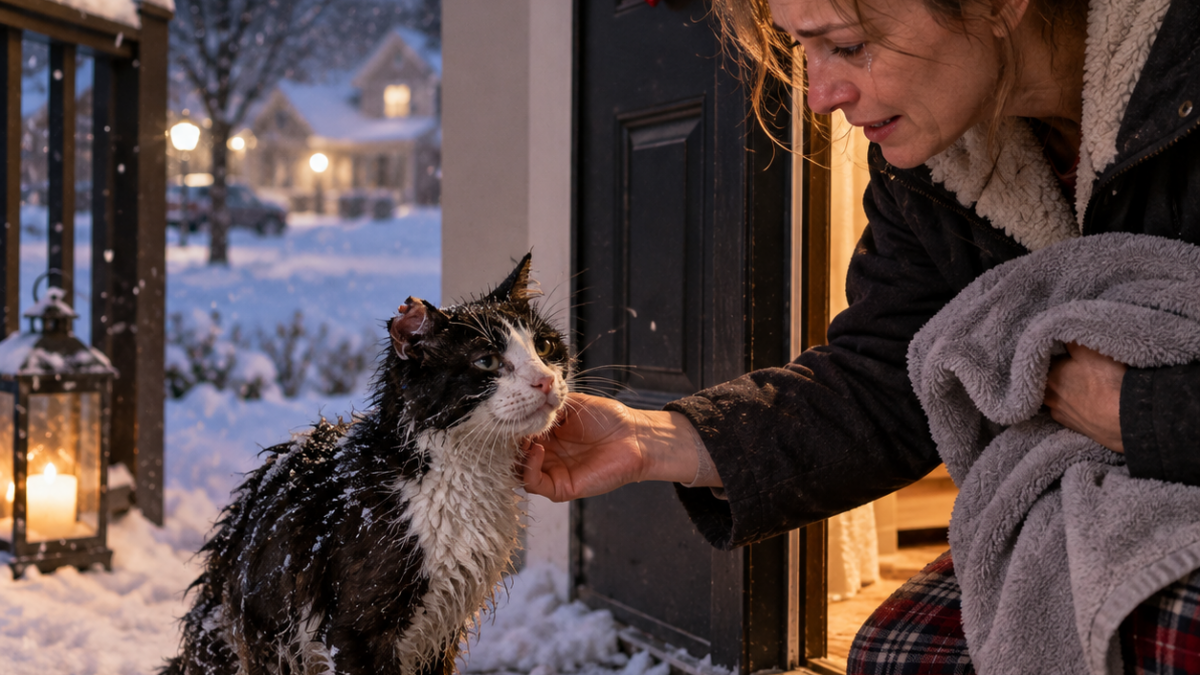
A black-and-white tuxedo tomcat, thin as a coat hanger, stood on my porch with one paw lifted and his body shaking so hard I could see the sharp outline of every rib beneath his ragged coat. His fur was matted in clumps. One ear was nicked and crusted. His whiskers were stiff with frost. There was dried blood along one shoulder and fresh blood near his back leg. His eyes were half closed, but when he looked up at me, I felt something inside my chest buckle.
Not break.
Buckle.
As if a beam I had trusted to hold weight suddenly sagged.
He looked like he had spent his last bit of strength choosing my house.
I had seen hurt animals before. I had taken in neighborhood strays long enough to find rescues for them. I had bottle-fed kittens one summer when a feral mother vanished. I had driven Mrs. Donnelly’s beagle to the emergency vet when she slipped on ice and broke her leg while Mrs. Donnelly was visiting her daughter in Ohio.
But this was different.
This cat did not cry loudly.
He did not push inside.
He did not rub my legs in charming desperation.
He simply stood there, trembling on my porch, and made that thin worn-out sound again.
Please.
I’m done.
For a second, I froze.
Then my body remembered before my mind did.
I grabbed an old towel from the basket near the door, stepped onto the porch in my socks, and wrapped him as gently as I could. He flinched once, but he did not fight. That scared me. Animals with strength left often fight help before they understand it. He just folded into the towel like something that had run out of objections.
He weighed almost nothing.
That scared me more than the blood.
I carried him inside and kicked the door shut behind me.
Cleo stood halfway down the hall, eyes huge.
“It’s okay,” I told her, though nothing was okay yet.
I set the cat in a laundry basket near the heater with the towel tucked around him. His head lifted weakly. I expected him to hiss, bite, panic, anything.
Instead, he pushed his face against my wrist.
Not hard.
Just enough.
Enough to let me know that even after whatever had happened to him, he still wanted touch.
That was when I started crying.
Not big movie tears.
Not the kind where you collapse beautifully and someone runs in to hold you. Just the tired kind that leaks out before you can organize yourself against it.
I sat on the kitchen floor in my socks, still wearing that ugly jacket, while the frozen lasagna thawed on the counter and a half-dead tuxedo cat leaned into my wrist like I was the safest place he had found in a long time.
I snapped a picture with my phone and sent it to a local rescue chat I had worked with before.
The replies came fast.
Bring him inside now.
He may not make it through the night.
Can you keep him warm?
Do you have a carrier?
Emergency clinic opens at 7 but call the after-hours number if he crashes.
I did not have a carrier ready. I had Cleo’s, in the basement, dusty from her last vet visit. I did not know how to check whether a cat was crashing. I did not know if he was someone’s lost pet, a dumped cat, a feral, a fighter, an old house cat who had been failed by the world so completely that he had learned to ask at the final door.
I knew he was cold.
I knew he was hurt.
I knew he was in my house now.
That was enough for the first hour.
I warmed towels in the dryer. I called the emergency clinic and described him badly because fear makes amateurs of us. I offered water. He did not drink. I offered wet food. He sniffed it once and turned away. His body kept shaking, though less violently as warmth returned. Cleo watched from the hallway with the grave expression of a small judge.
At some point, I remembered the lasagna and turned off the oven.
Dinner no longer mattered.
Around midnight, he finally slept.
Not peacefully.
Not deeply.
He startled every time the furnace clicked on. His paws twitched. Once he made a low sound in his sleep, and I found myself saying, “You’re inside, sweetheart. You’re inside.”
I do not know when I started calling him sweetheart.
Some words arrive before names.
The next morning, I drove him to the clinic as soon as the doors opened.
The vet’s name was Dr. Holloway. She had silver hair pulled into a low ponytail, tired eyes, and the quiet practicality of someone who had learned not to gasp in front of clients. She examined him while he lay on a warm blanket, too exhausted to object.
Her mouth tightened as she worked.
That told me enough before she said anything.
“He has multiple bite wounds,” she said. “Some older. Some fresh. Fleas. Ticks. Severe dental disease. Frost damage on the ears and paws. He is dehydrated and underweight.”
I nodded because I needed my body to do something.
“Is he old?”
“Older adult. Hard to be precise in this condition.”
She listened to his heart, checked his gums, palpated his thin belly. He barely reacted.
Then she said, “His blood glucose is very high.”
I looked at her.
“What does that mean?”
“We need to run more tests, but he may be diabetic.”
Diabetic.
The word sounded too large for the shaking little cat on the table.
“How long has he been like this?” I asked.
It is the question people ask when they do not know what else to do with pain.
Dr. Holloway gave me that look vets get when they are trying to stay practical and kind at the same time.
“Too long.”
I looked down.
The cat had lifted one paw through the kennel door of the exam cage they had placed him in while preparing fluids. He rested it on my sleeve.
Then he started purring.
Not loudly.
Not with the rumbling confidence of a well-fed house cat in a sunbeam.
It was uneven. Broken in places. But it was a purr.
A cat that beaten up, that cold, that sick, still chose to purr.
I had to turn away.
Dr. Holloway pretended to adjust something on the counter.
Mercy often looks like someone giving you three seconds to cry without making you explain yourself.
“He’ll need treatment,” she said. “And monitoring. Dental work eventually, if he stabilizes. Insulin if diabetes is confirmed. This is not a simple stray hold.”
“I understand.”
I did not understand.
Not really.
Understanding comes later, usually with bills.
“What do you want to call him?” the technician asked while filling out the intake sheet.
I had not thought about a name.
He looked small inside the towel. Small, broken, old before his time.
I wanted him to have something stronger than the shape he was in.
“Aslan,” I said.
The technician smiled.
“Like the lion?”
“Yes.”
The cat blinked slowly, unimpressed by literature.
“Aslan,” I repeated.
He lowered his head onto the blanket.
I told myself I was fostering him.
That sounded responsible.
Temporary.
Safe.
I had fostered before, briefly. Bottle kittens. A mother cat recovering from surgery. A senior dog for five days after his owner died until the nephew could drive in from Michigan. Fostering had rules. A beginning, a goal, an end. You helped, you loved carefully, and then you handed the animal into its next chapter.
That was what I told myself on the drive home after leaving Aslan at the clinic.
I am fostering him.
Just until he gets well.
Just until we know what he needs.
Just until the rescue finds the right home.
It is amazing how many lies begin with just until.
The rescue helped with the first round of bills. I paid what I could. I started a notebook for his care before he even came home.
Medication times.
Food amounts.
Glucose readings.
Water intake.
Litter box notes.
Weight.
Questions for the vet.
Love, I learned again, often becomes administration when someone fragile depends on you.
When I brought Aslan home three days later, Cleo watched the carrier from the staircase.
She did not run.
That felt promising.
He came out slowly, stiff from soreness, patches shaved where wounds had been cleaned. His fur looked worse before it could look better. His tuxedo markings were there, but buried under dullness, clumps, and the indignities of survival. His white chest was yellowed in places. One ear folded oddly. His eyes seemed too large for his face.
He walked three steps into the living room, saw Cleo, and stopped.
I held my breath.
Cleo came down two steps.
Then another.
She crossed the room in that cautious, floating way of hers and stopped in front of him.
Aslan did not move.
Cleo sniffed his face.
I prepared for hissing, swatting, retreat.
She simply stayed.
No drama.
No announcement.
No grand gesture.
Just stayed.
That night, they slept three inches apart.
Two nights later, they were curled together.
A week after that, Cleo was grooming the back of his neck like she had known him all her life.
It did something to me, seeing that.
Two animals with scars nobody could fully see, choosing each other without speeches, conditions, or background checks.
Cleo, who had taken months to trust my hand, made room for him almost immediately. She let him have the warmest part of the blanket near the radiator. She sat beside him during insulin shots, as if supervising. She licked dried food from his whiskers because he was too tired to clean himself properly.
Aslan accepted it with the exhausted entitlement of a cat who had survived too much to pretend he did not need help.
The first week, he slept like sleep itself might be a trick.
He would doze for ten minutes, then jerk awake, eyes wide, body tense, ready for whatever had hurt him before. I learned to move slowly around him. No sudden noises. No dropped pans. No vacuum cleaner unless he and Cleo were secured in the bedroom with blankets and soft music.
By the second week, he cleaned his whole bowl.
I stood in the kitchen doorway and watched as if he had performed surgery.
“Good boy,” I whispered.
He ignored me, then licked the plate again.
By the third week, he found the couch.
Not the cat bed.
Not the folded blanket I bought specially.
The couch.
He climbed onto the left corner with the determination of a retired old man claiming his recliner at the end of a long shift. Cleo joined him ten minutes later. He looked surprised. Then pleased. Then asleep.
Every evening after that, when I sat down with tea, he pressed himself against me.
Not near me.
Not politely nearby.
Against me.
One heavy, warm, recovering body leaning into my side like letting go was no longer an option.
Cleo took the other side.
My sofa, which had spent years holding only me and the occasional unfolded laundry basket, became crowded with the kind of life that makes sitting still feel necessary.
People started asking about adoption once Aslan improved.
That is how rescue works.
A suffering animal becomes stable, and suddenly everyone wants to know the plan. Not because they are cruel. Because there is always another animal waiting. Another intake call. Another frozen porch. Another senior cat with bad teeth. Another kitten under a shed. Another dog on a chain. Rescue is one long hallway of need, and no room can stay occupied forever without someone asking who comes next.
The first inquiry came through the rescue coordinator, Dina.
“Don’t panic,” she said, which is always how people begin sentences that make you panic. “But a family asked about Aslan.”
I was at the kitchen table, writing down his evening insulin dose.
Cleo and Aslan were in the window, shoulder to shoulder.
“What family?”
“Good application. Quiet home. Older child. No dogs. Big windows. They lost their cat last year. They love black-and-white cats.”
Black-and-white cats.
That phrase bothered me irrationally.
Aslan was not a decorative category.
He was not a color scheme.
But I said nothing.
“They understand diabetes?”
“They say they’re willing to learn.”
“Dental issues?”
“Yes.”
“Age?”
“Yes.”
Cleo bent her head and began washing Aslan’s ear. He closed his eyes.
Then Dina said, “They only want Aslan.”
I looked at the two cats in the window.
Pressed together so closely it was hard to tell where one ended and the other began.
I thought about the porch.
The frost on his whiskers.
The way he had leaned into my wrist when he had almost nothing left.
The way Cleo had walked up to him and simply stayed.
“No,” I said.
Dina was quiet.
“I know we need homes,” I added quickly. “I know. But not without Cleo.”
“They didn’t apply for two.”
“Then they don’t want him.”
The words sounded harsher than I intended.
Or maybe exactly as harsh as they needed to be.
A week later, I stopped pretending I was fostering.
I adopted Aslan.
Officially.
Signed the papers.
Paid the fee.
Updated the microchip.
Bought a second set of bowls even though he and Cleo preferred stealing from each other’s dishes.
I thought the decision would feel joyful.
It did.
For about three days.
Then came the voicemail.
The woman’s name was Mara.
I had not met her yet. At that point, she was only a voice on my phone, soft and polite, careful in the way people get when they believe they are being reasonable and you are the one making things hard.
She said she had heard through the rescue that I had changed my mind.
She said her family had really loved his picture.
She said her daughter had already started calling him “the Valentine cat.”
Then she paused and said, very evenly, “I just think it’s sad when someone keeps an animal because they got attached, even when another family might have given him a better home.”
A better home.
I listened to that voicemail six times.
Then I sat at my kitchen table staring at the cracked corner like it might explain something.
Because the ugly truth was, I knew why those words landed.
My house was small.
My couch was old.
The bathroom floor squeaked.
The kitchen cabinets were dated.
I was a divorced woman in her fifties with one grown son three states away and two rescue cats sleeping on a blanket thrown over furniture I had meant to replace years earlier.
On paper, I was not impressive.
On paper, a quiet family with bright windows and matching food bowls probably did look better.
Aslan was on the sofa while I played the message again.
He lay on his side, one paw hanging off the cushion, belly finally full enough to round slightly. Cleo was curled against his back like a comma.
At the sound of Mara’s voice, he opened one eye.
Then shut it again.
As if he had already made his decision and did not understand why humans insisted on paperwork after the truth was obvious.
But I am human.
Humans can turn one sentence into a courtroom.
For the rest of the day, every little thing in the house looked different.
The litter box by the laundry room.
The medication bottles lined near the sink.
The notebook where I tracked insulin, appetite, water intake, bathroom habits.
The old rug by the back door.
The scratch on the coffee table from when Ben was ten and tried to build a model airplane without reading instructions.
I started seeing my home through a stranger’s eyes.
Not mine.
Not Aslan’s.
Not Cleo’s.
Some imagined judge standing in the doorway deciding whether love counted if the couch was outdated.
Maybe that was the first mistake.
That night, I barely slept.
Aslan slept.
Cleo did too.
They were curled at the end of my bed, breathing in that small synchronized rhythm animals have when they trust the room they are in.
I lay awake hearing Mara’s words.
A better home.
The next morning, Ben called.
“Hey, Mom.”
“Hey, honey.”
“You sound tired.”
“I am tired.”
A pause.
“What happened?”
I did what mothers do.
I almost lied.
Then I was too tired.
So I told him.
Not all of it.
Enough.
The family.
The voicemail.
The phrase I could not stop chewing on.
He listened without interrupting, which meant something serious was coming because Ben interrupts when relaxed.
“Do you want me to be honest?” he asked.
“No.”
He laughed once.
Then he was honest anyway.
“I think you were right to keep him if he and Cleo are bonded.”
My shoulders dropped.
Then he kept talking.
“But I also think maybe you need to ask yourself whether you kept him for the cat or because you were lonely.”
There are questions that sound simple until they hit bone.
I looked out the kitchen window at the dirty snow along the curb.
“That’s kind of a mean thing to say.”
“No,” he said gently. “It’s kind of a real thing to say.”
I did not answer.
“Mom, I’m not attacking you. I’m saying don’t turn this into one of those situations where an animal becomes the whole center of your world because the rest of it hurts.”
I wanted to be angry.
Part of me was.
Another part of me knew what he meant.
Loneliness does not always look dramatic.
Sometimes it looks like buying one sweet potato and a can of soup. Sometimes it looks like eating dinner over the sink because sitting at the table feels too formal for one person. Sometimes it looks like saying you enjoy the quiet because that sounds healthier than admitting the silence has begun to feel organized against you.
And sometimes it looks like opening the door to a half-frozen cat and feeling, almost immediately, that something in your own chest has been found out.
“I’m managing,” I said.
“I know you are.”
“That’s different from being happy though, isn’t it?”
That one got me.
I looked over at the couch. Aslan had rolled onto his back, all four paws loose. Cleo was washing one ear with the fierce concentration of a tiny old librarian.
“You make it sound like keeping a cat is some moral failure.”
“No,” Ben said. “I’m saying don’t let people shame you for loving something. But don’t hide inside that love because it’s easier than dealing with everything else.”
I wish I could tell you I handled that call with maturity.
I did not.
I snapped at him.
I told him he lived far enough away to turn concern into philosophy. I told him it was easy to advise me from another state. I told him if he was so worried about the size of my life, he could try calling more than once every ten days.
That was unfair.
It was also true.
Families have a special talent for placing truth inside cruelty and cruelty inside truth until no one knows which part to apologize for first.
We hung up with that brittle politeness people use when nobody wants to be the first to say they have been hurt.
After that, I cleaned my kitchen like I was punishing it.
I wiped counters that were already clean. Swept corners nobody saw. Scrubbed food bowls while Cleo watched from the doorway and Aslan sat by the heater blinking like an old foreman letting a younger worker waste energy.
By noon, I was exhausted.
Nothing in the house had changed.
That was the problem.
Everything looked exactly the same, but my head had turned mean.
Two days later, Dina texted and asked if I would let the rescue share Aslan’s story online.
Before-and-after pictures.
A reminder not to overlook older cats.
A note about bonded pairs.
I almost said no.
The idea of strangers discussing my life like it was a cautionary tale made my stomach tighten. But then I looked at Aslan. He was loafed in a sunny patch by the back door, looking like a bakery item with opinions. Cleo sat beside him, tucked close.
I thought about all the people who say they want to rescue until rescue shows up ugly, expensive, inconvenient, and no longer decorative.
So I said yes.
I sent the porch picture.
In it, Aslan looked like a cat assembled from weather and bad luck. Frost-whiskered, hollow-eyed, matted, barely there.
Then I sent a new one.
Aslan in the kitchen window, fur grown back, chest full, face smug.
Cleo beside him, smaller but no less sure.
The rescue posted both with a gentle caption about second chances, senior cats, and love making room.
For the first hour, the comments were lovely.
Beautiful.
What a miracle.
Thank you for saving him.
He looks so happy.
Then came the others.
Not cartoon-villain comments.
Ordinary ones.
The kind that sound almost sensible until you realize they are built on a belief you cannot live with.
Older cats deserve peace.
Resources should go to younger animals with better odds.
Bonded pairs are exaggerated sometimes.
Fosters should not keep animals just because they get attached.
Prepared families should not be turned away because one person cannot let go.
Then, halfway down the thread, there was Mara.
She did not name me.
She did not insult me.
She wrote, “Sometimes families get passed over because someone mistakes their own loneliness for a cat’s best interest. That part never gets posted.”
I read that sentence standing at the stove with soup heating.
The spoon slipped from my hand.
Broth splashed onto the burner and hissed.
Cleo bolted.
Aslan did not.
He simply stared at me with those steady yellow-green eyes, as if he had survived frostbite, infection, diabetes, and Valentine’s Day only to discover humans could injure themselves with glowing rectangles.
I deleted the rescue app from my phone.
Then reinstalled it.
Then deleted it again.
A ridiculous modern ritual, as if removing an icon could quiet the inside of my head.
Ben texted around eight.
Still love you.
I stared at the screen for a long time.
Then wrote back:
Still annoyed with you.
He replied with a thumbs-up and a cat emoji.
That made me smile against my will.
Then I cried again.
Not because of the comment thread.
Not really.
Because middle age is humiliating in ordinary ways.
You think you have become sturdy. You think the big heartbreaks are behind you. Then some stranger on the internet questions whether your life is too small, and suddenly you are standing in your kitchen crying over soup while one rescued cat hides under a chair and the other blinks at you like a tired therapist.
A week after the post went up, Aslan had a dental procedure.
He still had rotten teeth that needed work, and because of the diabetes, everything had to be managed carefully. The clinic wanted to keep him overnight for monitoring.
I told myself it was fine.
One night.
One routine procedure.
People who believed animals “get over it” were probably right, and I was making theater out of normal care.
Then I put him in the carrier.
Cleo followed us to the door.
She did not do much.
That was what made it sad.
She simply sat very straight, tail wrapped around her feet, watching.
Aslan, who normally protested the carrier like it was a tax audit, made almost no sound at all.
At the clinic, he let the technician take him. But before she carried him back, he twisted his head around once.
Not toward me.
Toward the towel in the carrier.
The one Cleo had slept on that morning.
It was such a small thing.
Another person might not have noticed.
I noticed.
On the drive home, my house felt wrong before I opened the door.
You know how some places have a shape to their silence?
This one did.
It was missing something.
Cleo met me in the hallway and looked behind my legs for him. When she did not find him, she walked room to room.
Not running.
Just checking.
Closet.
Sofa.
Bathroom rug.
Window ledge.
Laundry basket by the heater.
Then she made one short sound.
Not loud.
Not dramatic.
A question.
I bent down and stroked her back.
“He’s at the doctor’s,” I told her, because grief makes fools and storytellers out of all of us.
She let me touch her.
That was unusual enough to scare me.
That night she ate half her dinner, then sat by the front window for an hour. Every few minutes, she turned and looked at me like I had misplaced something important.
I hardly slept.
Not because I was worried about the procedure, though I was.
Because the house had returned to the kind of quiet I used to call peaceful before I knew better.
I lay in bed and realized something I wish more people understood.
Silence feels different once love has lived in it.
Before, it is quiet.
After, it is absence.
The clinic called the next morning.
The procedure had gone well.
But the technician laughed softly near the end of the update.
“What?” I asked.
“Your boy has been acting like a tiny offended widower.”
I actually laughed.
Then she said, “He wouldn’t settle last night. We moved his carrier towel closer to the kennel door, and he calmed down when he could smell it. Is there another cat at home?”
“Yes.”
“I thought so. He perked up every time we came near him with the towel.”
When I picked him up, Aslan looked exhausted.
Older.
That happens sometimes after animals have been through too much already. One hard day puts years back on them.
He climbed into the carrier with careful stiffness, dignity held together by stubbornness.
The minute we got home, Cleo was waiting.
She went to the carrier before I even set it down.
No hissing.
No caution.
She pressed her face to the door.
Aslan made a sound I had never heard from him before.
Not a cry.
Not a purr.
Something between relief and recognition.
The door was barely open before he stepped out and leaned straight into her.
Cleo licked the side of his face once.
Then again.
He lowered his head and stood there like somebody finally putting down a suitcase.
I sat on the hallway floor and watched those two old souls reunite, and something inside me hardened into certainty.
Not anger.
Not defensiveness.
Certainty.
Because I had just seen the thing everybody wanted to argue about as if it were a theory.
It was not a theory.
It was two living creatures telling the truth with their bodies.
Some people will hear that and roll their eyes.
They will say I was projecting. Giving human language to animal behavior. Seeing what I wanted to see because my own life was lonely.
Maybe.
I do not care.
A lot of what gets dismissed as projection is really attention.
And some people cannot stand the idea that love might be easier to recognize when you stop insisting you own the definition of it.
A few days later, I called Ben.
This time, I was the one who said, “You can be honest.”
He was quiet.
Then he said, “Okay.”
I told him about the overnight stay. About Cleo checking every room. About the towel. About the hallway reunion.
When I finished, he let out a long breath.
“Yeah,” he said. “Okay. That sounds like a real bond.”
“You think?”
“I think maybe sometimes people act like attachment only counts when humans are the ones having it.”
That stayed with me.
Because it was bigger than cats.
Bigger than rescue.
Bigger than my small house and squeaky bathroom floor and the woman online who thought she understood my motives.
We live in a time when everybody wants proof before they offer mercy.
Proof the bond is real.
Proof the need is serious.
Proof the cost is justified.
Proof the hurting creature will give something charming back.
And if it cannot?
If it is old, expensive, sick, inconvenient, scarred, shy, slow to trust, or likely to die sooner than we would like?
A lot of people start doing math.
I understand math.
I live by math.
Mortgage.
Gas.
Groceries.
Co-pays.
Electric bill.
Insulin syringes.
Dental estimates.
I know what practical looks like.
I am not naïve.
But practical is not always the same as right.
That is something people forget whenever love stops being efficient.
Two weeks later, Dina asked if I would come speak at a small adoption event.
Not a speech, she promised.
Just sit at a table for an hour with photos of Aslan and talk to people about senior cats.
I almost refused.
I am not an event woman.
I am a cardigan, grocery list, get-home-before-dark woman.
But Dina sounded tired, and I knew why. Every shelter worker I have ever known carries that same haunted optimism, the look of someone trying to save what can be saved without drowning in what cannot.
So I said yes.
I brought three pictures.
The porch picture.
The clinic picture.
And one of Aslan and Cleo in the window looking like an elderly married couple judging the neighborhood.
People stopped.
They always do for a good before-and-after.
A teenage girl cried.
An older man told me he had lost his wife and then, six months later, the fifteen-year-old cat she loved most. He said the second loss almost took him down in a way he had not expected because no one sent casseroles when the cat died.
A young couple asked careful questions about adopting older pets.
A mother with two boys listened closely while I explained diabetes management, then admitted her family was not ready for that level of care. I thanked her for knowing that before taking a cat home.
Then a woman in a puffy cream coat walked up to my table and stared at the photos for a long second.
I knew her before she introduced herself.
Not from life.
From the voice.
The voicemail woman.
Mara.
She looked ordinary.
That is not an insult.
It is an observation.
She was not the villain I had built in my head during angry kitchen conversations with myself. She looked like someone who bought hand soap in bulk, remembered school spirit days, and got tired in honest ways.
“I’m Mara,” she said.
I nodded.
“I know.”
She winced.
“That’s fair.”
For a second, neither of us spoke.
Then she looked at the window photo.
“They really are attached.”
“Yes.”
She folded her arms.
“My daughter was upset.”
“I’m sorry.”
“I know that probably sounds ridiculous to you.”
“No,” I said. “It doesn’t.”
That surprised her.
Maybe it surprised me too.
Because the truth was, I did understand.
We had looked at the same cat and wanted the same thing for different reasons.
Comfort.
Hope.
A soft living creature to pour tenderness into.
That does not make one person evil and the other noble.
It just makes the collision hurt.
Mara looked down.
Then back up.
“I was angry,” she said. “Not just about the cat.”
I waited.
She gave a tired laugh.
“My daughter’s father moved out two weeks before Valentine’s Day. She got stuck on the idea of that cat. I think I did too. It felt like a good ending I could hand her.”
There it was.
The part people do not put in comment sections.
The real wound under the opinion.
“I’m sorry,” I said.
She nodded.
Then she said something I will never forget.
“I think I wanted him because he looked like survival that had already been cleaned up.”
The sentence hit me hard.
Yes.
That was exactly it.
People love rescue once the blood is washed off.
Once the coat grows back.
Once the hard part has been made photogenic.
Once the animal can sit in a sunny window and symbolize healing instead of requiring it.
Mara looked embarrassed.
“I shouldn’t have written what I wrote.”
“No,” I said. “You shouldn’t have.”
She gave a small, guilty smile.
“But I’m glad you said it to my face.”
She laughed once.
“That’s mean.”
“Maybe. But true.”
We stood there in the strange warmth of not being friends but no longer being enemies either.
Then her daughter came running up.
She was maybe nine, with pink cheeks, an untied boot lace, and the solemn seriousness children get around animals they have already loved from a picture.
She looked at Aslan’s photo.
“That’s him.”
Mara put a hand on her shoulder.
“That’s him.”
The girl leaned closer.
“Is he happy?”
I looked at the photo.
Aslan was squinting into the sun like it owed him money. Cleo was tucked against him.
“Yes,” I said. “He really is.”
The girl nodded.
Then said, “Good.”
Children are sometimes better than adults because they have not yet learned to dress disappointment up as principle.
They simply feel it.
Then move.
Before Mara left, she surprised me.
“We met a one-eyed tabby in the back room,” she said. “My daughter likes her.”
I smiled.
“Older?”
“Twelve.”
“Good.”
She gave me a look.
“You saying that on purpose?”
“Yes.”
She laughed.
And just like that, the whole story shifted a little inside me.
Not because I had been vindicated.
Because I had been reminded that most hurtful opinions are pain trying to sound authoritative.
That does not excuse them.
But it explains some things.
That night, I went home and watched Aslan and Cleo wrestle very slowly over the same blanket.
By wrestle, I mean Cleo swatted him once, and Aslan immediately rolled over like a corrupt politician caught on camera.
I laughed so hard I had to sit down.
Then I thought about the adoption event.
The faces.
The questions.
The way people’s eyes softened at the healthy photo and hardened slightly at the words insulin, dental work, bonded pair, senior.
And I got mad.
Not wild mad.
Clear mad.
The kind that leaves no smoke.
Because I realized how often we use the word deserving when we really mean convenient.
That cat deserves a chance.
That one is too far gone.
That old dog deserves peace.
That one is too expensive.
That woman deserves companionship.
That one should learn to be alone.
That child deserves stability.
That elderly parent should not be a burden.
Everyone talks about deserving when what they usually mean is whether the care required will fit neatly inside their existing life.
I understand limits.
Truly.
Not everyone can take in a diabetic senior cat.
Not everyone should.
This is not a sermon about martyrdom.
It is about honesty.
Because there is a difference between saying I cannot and saying it is not worth it.
One is a boundary.
The other is a verdict.
And old, hurting things in this world get too many verdicts.
A few nights later, I wrote a post on my own account.
Not the rescue page.
Mine.
I almost did not hit publish.
Then I remembered how many people had no problem placing their opinions on my life, my house, my loneliness, and my cats.
So I told the truth.
I wrote that love is not proven by how pretty the ending looks in a photo.
I wrote that a forever home is not the biggest house, the cleanest couch, the youngest family, or the most impressive life on paper.
I wrote that a forever home is the place where a creature stops bracing for abandonment.
I wrote that people were free to call me emotional if they wanted, but I had watched a traumatized old tomcat sleep for the first time in years because a shy gray rescue made room for him without a single speech about who deserved what.
Then I wrote the line that apparently made half the comments section lose its mind.
Stop calling it a forever home if forever only counts when the animal is easy.
I put the phone down and made tea.
By the time the kettle whistled, the post had already started moving.
At first, it was people I knew.
Then people I did not.
A cousin in Ohio shared it.
A former coworker wrote, “This is about more than cats.”
She was right.
That is why people reacted the way they did.
The comments filled quickly.
Some people agreed with the force of relief.
A man wrote about taking in his late father’s ancient beagle because no one else wanted an old dog with a cough and bad hips.
A woman wrote about her daughter’s autistic rescue cat who only slept if her senior companion was beside her.
Someone who worked in animal transport said the hardest part of the job was watching people split bonded pairs because they liked one coat pattern more than the other.
Then came the pushback.
Of course it did.
Some said I was shaming people with real financial limits.
I was not.
Some said animals are resilient and humans anthropomorphize too much.
Some probably do.
Some said I was being dramatic.
That was fair.
I am dramatic.
You do not sit on a kitchen floor in your socks crying over a half-frozen cat and remain fully moderate in all things.
But the comment repeated most was this:
Not everyone can build their whole life around an animal.
I read that one three times.
Then I thought about it.
Because that sentence reveals more than people realize.
No one says that about golf.
Or youth sports.
Or home renovation projects.
Or marathon training.
Or the thousand small ways people organize their lives around the things they value.
But let a middle-aged woman center care in her home, and suddenly everyone wants to make sure she is not losing perspective.
I have noticed this for years.
A divorced man in his fifties who pours himself into restoring an old truck is keeping busy.
A woman the same age who spends real money and time caring for old animals is making them her whole personality.
Interesting, isn’t it?
That struck a nerve too.
Good.
Some nerves need finding.
Ben called that night laughing.
“Mom.”
“What?”
“You’re trending among women with rescue pets and opinions.”
“I don’t know whether that’s good.”
“It is if you enjoy being called brave, unstable, and iconic in the same thread.”
I laughed.
Then he got quiet.
“I’m sorry, by the way.”
“For what?”
“For making you feel like I was judging you.”
I leaned against the counter.
“I know you were worried.”
“I was,” he said. “But I read what you wrote, and I think I was partly scared because you love them that much.”
“Yes,” I said. “I do.”
“And that means if anything happens to them…”
He trailed off.
There it was.
The fear beneath his concern.
Loss.
Not judgment.
Fear.
“I know,” I said.
He exhaled.
“I just don’t want life to break you again.”
That undid me.
Because love after heartbreak is always a kind of risk math.
You tell yourself you know better now.
You tell yourself not to get too attached.
You tell yourself to stay practical.
And then some living thing leans its full weight against you and says, without words, I’m here. Are you?
If you answer honestly, you are in it.
Breakable and all.
Spring came slowly.
It always does here.
Dirty snowbanks sagged into gray puddles. The porch steps reappeared. The neighborhood thawed into dog walkers, delivery vans, bicycles, and people airing out garages as if winter had personally offended them.
Aslan grew broader through the chest.
His fur came in thick.
His white bib looked almost formal again.
Cleo remained slight, elegant, and mildly judgmental.
Every morning, they sat in the kitchen window together like retired landlords monitoring the street.
Every morning, I looked at them and thought about how close easy endings come to not happening.
If I had waited ten more minutes to open the door.
If the rescue had been full.
If the clinic had shrugged.
If I had listened to the family with the good windows.
If I had treated bond as sentiment instead of fact.
If I had kept asking whether I was enough instead of asking whether this was home.
One Saturday in March, there was an envelope in my mailbox.
No return address.
Inside was a Valentine card from the discount aisle kind of pretty. A simple red heart on the front.
Inside, in careful handwriting, it said:
My daughter and I adopted the one-eyed tabby. Her name is June now. You were right about older cats.
Under that, in smaller writing:
I was wrong about some other things too.
No signature.
It did not need one.
I stood on my porch reading that card while wind moved through the bare trees and a dog barked somewhere down the block.
Then I laughed.
Then I cried.
Again.
I seem to do a lot of that these days.
But it is a better kind.
Less like collapse.
More like thaw.
That evening Ben video-called while I was measuring cat food.
He asked to see them.
So I turned the phone.
Aslan looked up, offended at being documented during dinner.
Cleo ignored us both.
Ben smiled that soft smile he gets when he is trying not to show how much he misses home.
“They look good,” he said.
“They are good.”
“You too?”
I looked around my kitchen.
At the magnets on the fridge.
At the tea towel hanging crooked.
At the orange sunset catching on the sink window.
At the two cats who had turned my once-silent house into a place with routines, interruptions, medicine times, fur on everything, and more tenderness than I had planned for.
Then I said the truest thing I could.
“Yeah,” I told him. “I think I am.”
And that is where I wish more stories became honest.
Not at the rescue.
Not at the dramatic photo.
Not at the viral post.
At the after.
At the ordinary maintenance of loving something fragile.
That is where devotion lives.
In the shots and checkups.
In the litter and laundry.
In canceled plans and opened curtains.
In the decision, over and over again, to keep making room.
People love the phrase who saved who because it sounds good on a mug.
But the real answer is messier than that.
Aslan did not arrive and magically heal my life.
Cleo did not become a fuzzy little therapist in gray fur.
My son did not suddenly move closer.
The marriage did not undo itself into something kinder.
The years I spent learning how to make myself smaller did not vanish because one tuxedo cat scratched at my door on Valentine’s Day.
That is not how rescue works.
What happened was simpler.
And maybe bigger.
A starving old cat showed up needing warmth.
A shy gray cat made room beside him.
And somewhere in the middle of taking care of them, I stopped treating my own heart like a temporary place to stay.
People can argue all day if they want.
Whether I should have let him go.
Whether I projected too much.
Whether bonded pairs are always real.
Whether older animals are worth the money.
Whether lonely people should be careful not to make pets their whole life.
Let them talk.
I know what I know.
I know what a half-frozen animal sounds like when he has run out of options.
I know what relief looks like when it finally lets itself sleep.
I know what it means for a shy cat to scoot over three inches and change the weather inside a house.
I know a lot of beings get left behind in this world for the same reason.
They are no longer shiny enough.
Young enough.
Easy enough.
Useful enough.
Profitable enough.
Convenient enough.
That applies to old cats.
It applies to sick dogs.
It applies to lonely neighbors.
It applies to divorced women in their fifties who have learned how invisible a person can become once she is no longer performing youth for the room.
And I am tired of pretending that kind of sorting is wisdom.
Sometimes it is only cowardice with better manners.
So yes.
Next February, when stores fill with candy hearts and roses and all the polished versions of devotion people can buy by the dozen, I will still know the truest Valentine I ever received came shivering to my front door with frost on his whiskers and almost nothing left.
I will still know the bravest thing in this story was not that I opened the door.
It was that after years of living like my heart needed to stay neat, quiet, and prepared for disappointment, I let something battered come in and rearrange the place.
Aslan is asleep on the arm of my couch right now.
Cleo is tucked against his side.
They are both snoring a little.
Outside, the porch steps are dry.
Winter has finally let go.
Inside, the house is full of soft animal breathing and the low hum of a life that no longer sounds abandoned.
That is not a better home on paper.
I know that.
It is better in the ways that matter.
And some of the best things I know now are things no chart, no stranger, and no comment thread could ever measure.
Sometimes the right love is not the most impressive offer.
Sometimes it is just the place where the shaking stops.
Sometimes rescue is not about finding the fanciest forever.
Sometimes it is about recognizing where something broken has finally stopped asking permission to stay.
Here, he did.
Here, she made room.
Here, I did too.
And that, controversial or not, is the whole truth.








