On Christmas Night, a Tiny Kitten Walked Into a Garage With Burns Covering Her Body—But It Was What She Did Next That No One Could Forget.
PART3:
“Come here.”
Something in Elena’s voice made him run.
He entered the garage and stopped.
“Jesus.”
“Get a towel.”
“Should we touch her?”
“I don’t know.”
The kitten made another tiny movement.
Her front paw slid.
Her body lowered toward the concrete.
Elena moved before thinking.
She grabbed a clean bath towel Daniel brought and folded it twice.
Then she slipped her hands beneath the kitten as carefully as she could.
The tiny body barely weighed anything.
The kitten flinched.
But she did not bite.
Did not scratch.
Did not fight.
She simply rested against Elena’s hands.
That trust frightened Elena almost as much as the burns.
Animals in severe pain usually defended themselves.
This kitten seemed past defending anything.
Daniel whispered, “Is she alive enough to make it?”
“I don’t know.”
Elena wrapped the towel loosely around her.
“Call emergency vet.”
The nearest twenty-four-hour clinic was twenty-seven minutes away.
They made it in nineteen.
Daniel drove.
Elena sat in the passenger seat holding the kitten inside a laundry basket lined with clean towels.
Every turn made the tiny body tense.
Elena kept one hand near her without pressing.
“You’re okay.”
She knew it was a lie.
So she corrected herself.
“You’re not okay yet.”
The kitten’s eyes opened slightly.
“But we’re going somewhere that can help.”
Christmas music played quietly from the truck radio.
Elena reached over and turned it off.
The cheerful sound suddenly felt unbearable.
At the emergency clinic, veterinary technician Rachel Kim took one look inside the basket and called for help.
The normal Christmas-night calm disappeared.
A veterinarian came immediately.
Dr. Amelia Hart.
Thirty-eight.
Hair tied back.
Blue scrubs.
Tired eyes that sharpened the instant she saw the kitten.
“What happened?”
“We found her in our garage.”
“When?”
“Twenty minutes ago.”
“Do you know how she was burned?”
“No.”
“Any chemicals around where you found her?”
“No. Nothing.”
Dr. Hart leaned closer.
The kitten tried to lift her head.
“Hi, sweetheart.”
Elena asked, “Can she survive?”
Dr. Hart did not answer immediately.
That silence stayed with Elena.
“She’s alive now.”
“What does that mean?”
“It means we treat what’s in front of us.”
The kitten was moved into treatment.
Elena and Daniel waited.
Forty minutes.
Then another thirty.
At 12:18 a.m., Dr. Hart returned.
Her expression was serious.
“She has significant burns.”
“How much?”
“Initial estimate is close to forty percent of her body surface.”
Elena closed her eyes.
Daniel asked, “Is that survivable?”
“It can be.”
Not will.
Can.
“There are areas along her back, shoulders, neck, and head. Both ears are significantly injured.”
“Her eye?”
“The right eye itself looks intact at the moment. The surrounding tissue is damaged and swollen.”
“Was this done to her?”
Dr. Hart paused.
“We don’t know.”
Elena hated that answer.
But guessing would not help the kitten.
“What happens now?”
“Pain control first.”
Dr. Hart continued carefully.
“Fluids. Wound management. Monitoring temperature. Infection risk is going to be important. Some burn injuries evolve over several days because tissue damage can be deeper than it first appears.”
“So she could get worse?”
“Yes.”
Elena looked through the treatment-room window.
The kitten lay beneath warming blankets.
Tiny.
Motionless.
A veterinary nurse was placing an IV catheter.
“Does she have a name?”
Dr. Hart asked.
Elena shook her head.
“No.”
Daniel looked at his wife.
“What about Cloe?”
Elena turned.
“Why Cloe?”
“My grandmother’s cat.”
“That cat hated you.”
“Exactly. She lived eighteen years out of spite.”
Elena almost laughed.
The sound came out broken.
Dr. Hart smiled.
“Cloe it is.”
That Christmas night became the first night of Cloe’s second life.
Nobody knew it yet.
The first forty-eight hours were worse than Elena expected.
Burn wounds are deceptive.
The outside is only part of the injury.
Damaged skin cannot protect the body normally.
Fluid loss.
Temperature instability.
Pain.
Infection.
Inflammation.
Every system feels the stress.
Cloe was small.
Perhaps three months old.
Maybe four.
Nobody knew exactly.
Her baby teeth placed her somewhere in that range.
A kitten that young should have been wasting energy on play.
Instead, her body was spending everything it had simply staying alive.
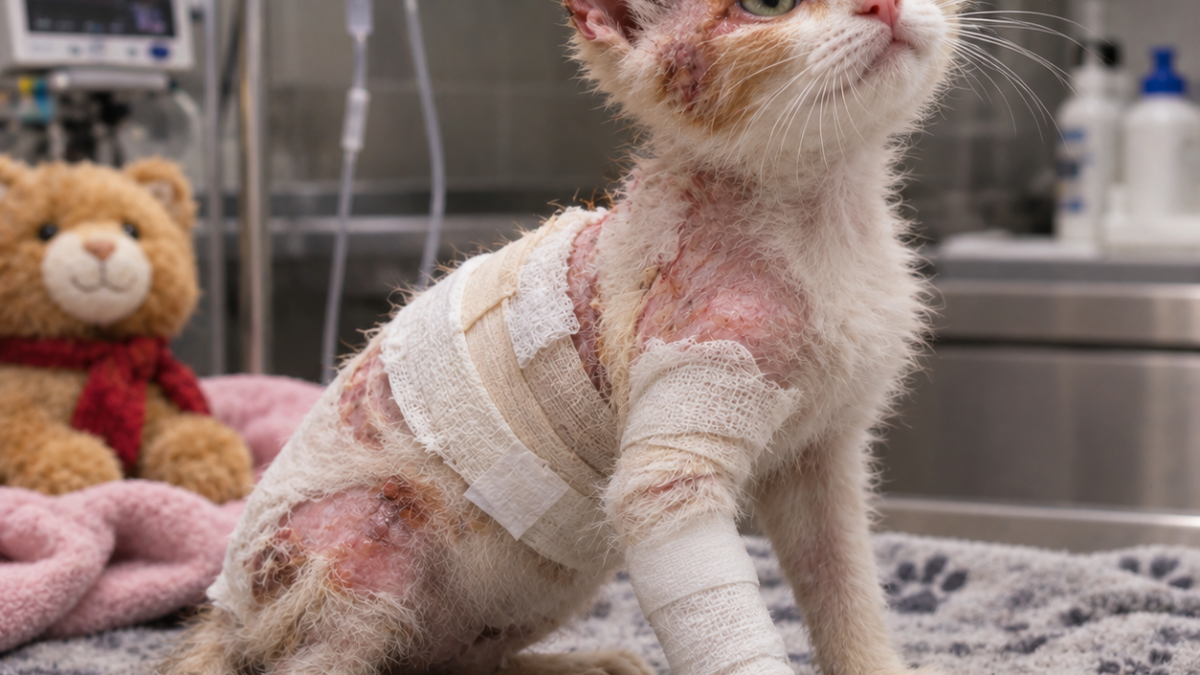
Bandages covered most of her torso.
Soft dressings protected damaged areas around her shoulders and neck.
Her ears could not be fully wrapped the same way.
They required careful cleaning and monitoring.
Cloe received pain medication.
Fluids.
Nutritional support.
Antibiotics when clinically indicated.
Her temperature dropped once during the first night.
Then stabilized.
Elena called at six in the morning.
Then ten.
Then two.
Finally Rachel said gently:
“Mrs. Morales, we will call you if anything changes.”
“I know.”
“You can sleep.”
“I know.”
“Have you?”
“No.”
Rachel smiled through the phone.
“Cloe is resting.”
“Is she suffering?”
“We’re controlling her pain.”
“Does she know where she is?”
“I can’t tell you what she understands.”
Pause.
“But she responds when we speak to her.”
Elena held the phone tighter.
“How?”
“She opens her eyes.”
That was enough to make Elena cry.
By the third day, Cloe still had not worsened dramatically.
That counted as good news.
Dr. Hart allowed Elena to visit.
The kitten looked smaller beneath bandages.
Her torso was almost completely wrapped.
One front leg remained free.
Her head rested on a folded towel.
Elena sat beside the kennel.
“Hi.”
Cloe opened one eye.
The right remained partially swollen.
Elena placed two fingers against the kennel floor.
She did not touch.
Just waited.
Cloe moved her nose toward them.
One inch.
Then another.
Her whiskers brushed Elena’s fingertip.
Elena felt something collapse inside her chest.
“You remember me?”
Probably not.
Maybe she associated the voice with the garage.
Maybe she associated hands with warmth.
Maybe it meant nothing more than curiosity.
Elena did not care.
She remained there for twenty minutes.
Cloe slept.
When Elena stood to leave, one tiny paw moved.
Not toward her.
Just shifted.
Still, Elena went home thinking about it.
Movement.
Life.
The burns required repeated dressing changes.
Those days were difficult.
Even with pain control and sedation when needed, wound care could not always be comfortable.
Damaged tissue needed cleaning.
Dressings needed replacement.
Healing skin needed protection.
Some areas looked better.
Others declared their true depth only later.
Part of each ear could not be saved.
Dr. Hart explained this quietly.
“The damaged margins are not viable.”
Elena understood the words before her heart accepted them.
“You have to remove part?”
“Yes.”
“Will it hurt her?”
“She’ll be anesthetized.”
“Will she still hear?”
“The outer ear shape will change, but the injury does not appear to have destroyed her hearing.”
Elena looked at Cloe.
The kitten’s ears were one of the first things people noticed about cats.
Beautiful triangles.
Alert.
Expressive.
Cloe’s would never look typical.
For one second, Elena grieved that.
Then felt guilty.
Dr. Hart must have noticed.
“She does not know what ears are supposed to look like.”
Elena turned.
“What?”
“Cloe.”
The veterinarian smiled faintly.
“She will know whether they hurt.”
That reframed everything.
The surgery removed damaged tissue.
Cloe recovered.
Her ears became smaller.
Uneven.
One folded slightly differently.
They healed.
Cloe did not care.
Weeks passed.
Elena visited almost every day.
Daniel came when he could.
They had not technically adopted Cloe.
They were simply the people who found her.
That distinction grew increasingly meaningless.
Elena brought soft blankets.
Rachel labeled one:
CLOE’S CHRISTMAS BLANKET
Dr. Hart objected.
“It needs to be washable.”
“It is.”
“Very washable?”
“Extremely washable.”
Cloe eventually started eating more independently.
That was celebrated as if she had won an Olympic medal.
The first time she finished half a bowl of recovery food, Rachel took a photograph and sent it to Elena.
SOMEONE WAS HUNGRY TODAY.
Elena showed Daniel.
He stared at the picture.
“That’s good?”
“That’s very good.”
“How much did she eat yesterday?”
“Two spoonfuls.”
He nodded.
“So yes.”
He paused.
“Do you think she knows she’s famous in this house?”
“Our children are jealous.”
Their daughter Sofia, twenty, was home from college.
Their son Mateo, seventeen, complained that Elena talked about Cloe more than both human children combined.
Elena denied it.
The family disagreed.
Cloe became stronger.
Not quickly.
Burn recovery did not respect anyone’s desire for a satisfying timeline.
There were setbacks.
One section became inflamed.
Another healed beautifully.
She developed irritation under one dressing.
Her appetite dipped.
Then returned.
She gained a little weight.
Lost some.
Gained again.
Some mornings she looked exhausted.
Other mornings she stood before the kennel door when staff arrived.
That was how everyone started noticing her personality.
At first, Cloe had been described as gentle.
Later, they discovered gentle did not mean passive.
Once pain eased, she had opinions.
Rachel attempted a dressing change one afternoon.
Cloe reached out and stole a gauze square.
Rachel took it back.
Cloe stole another.
“You are committing medical theft.”
The kitten bit the corner.
Rachel photographed her.
The picture reached Elena with the caption:
CRIMINAL ACTIVITY HAS BEGUN.
Elena cried again.
This time from happiness.
Because stealing gauze was kitten behavior.
Kitten behavior meant Cloe’s world was becoming bigger than pain.
The first real turning point happened during a quiet therapy session.
Cloe had spent most of the morning sleeping.
Her bandages were lighter now.
Several wound areas had closed enough to need less coverage.
Soft orange fur had begun appearing around healthy margins.
Not much.
A fine fuzz.
But there.
Rachel placed a small cloth mouse beside Cloe’s bed.
No expectation.
Just something normal.
For several minutes, Cloe ignored it.
Then the mouse rolled slightly when Rachel bumped the blanket.
Cloe’s eyes followed.
Her head lifted.
Rachel stopped what she was doing.
Cloe stared.
One front paw moved.
Slowly.
She reached.
Touched the toy.
Nothing dramatic happened.
No running.
No pouncing.
The mouse shifted perhaps two inches.
Cloe reached again.
Rachel covered her mouth.
Another technician looked over.
“What?”
Rachel whispered:
“She’s playing.”
Three people gathered at a respectful distance.
Cloe tapped the mouse.
Then grabbed it weakly with one paw.
For perhaps fifteen seconds, she was not a burn patient.
She was simply a kitten.
Rachel filmed five seconds.
Sent it to Elena.
Elena watched at the grocery store.
Once.
Twice.
Then leaned against a freezer door crying while strangers pushed carts around her.
She called Dr. Hart.
“She played.”
“I heard.”
“She played.”
“Yes.”
“Do you understand?”
“I think I do.”
“No, I mean—”
Dr. Hart laughed softly.
“Elena.”
“What?”
“We all cried.”
Cloe kept improving.
Wounds closed from the edges.
New tissue formed.
Scabs changed.
Bandages became smaller.
Soft fur returned in patches.
Some areas would remain scarred.
Some hair might never grow normally.
Her right eye area improved.
The swelling disappeared.
The eye itself remained functional.
The kitten who once could barely walk began moving around the recovery room.
At first slowly.
Then with more confidence.
Her gait looked stiff when healing skin pulled.
She adapted.
One afternoon she climbed onto a folded towel without help.
Another day she attempted to jump onto a low cushion.
Failed.
Tried again.
Made it.
Rachel applauded.
Cloe looked offended by the attention.
“Sorry.”
Rachel whispered.
“Very dignified.”
Laser therapy became part of her wound-recovery routine where appropriate.
At first Cloe watched everything.
Later, she relaxed.
Then something happened nobody expected.
She started falling asleep during sessions.
Not sedation.
Sleep.
Real sleep.
The first time, Rachel stared.
“Is she asleep?”
Dr. Hart looked over.
“Yes.”
“How?”
“Because she’s tired.”
“No.”
Rachel laughed.
“I mean, how does a kitten who went through all that sleep while we’re touching her?”
Dr. Hart looked at Cloe.
“Trust.”
That word stayed with the team.
Trust.
People often call animals resilient.
Sometimes too quickly.
As if surviving pain means pain does not matter.
Cloe’s gentleness was not proof she had forgotten what happened.
Nobody knew what happened.
Nobody knew whether the burns came from an accident, a fire, exposure to a hot surface, or something deliberate.
There was no reliable evidence.
The rescue did not invent an answer.
What they knew was what came afterward.
Cloe allowed people close.
She learned voices.
Rachel’s footsteps.
Dr. Hart’s voice.
Elena’s scent.
When Elena visited, Cloe began walking toward the front of the enclosure.
Later, she climbed into Elena’s lap.
The first time, Elena sat completely still.
Cloe circled once.
Her body still showed scars.
Her ears small and irregular.
Orange fur patchy along her back.
Then she lowered herself against Elena’s thigh.
Elena whispered:
“You’re choosing me?”
Cloe started purring.
Elena looked toward Rachel.
“Did you hear that?”
“Yes.”
“Is she—”
“Yes.”
“You could let me finish.”
“No need.”
That purr changed things.
Elena had been telling herself she was visiting because she found Cloe.
Because responsibility required follow-through.
Because abandoning the kitten emotionally after rescuing her felt wrong.
But sitting there with Cloe asleep in her lap, Elena finally admitted something.
She wanted the kitten home.
Daniel already knew.
“You’re adopting her.”
Elena looked across the dinner table.
“I didn’t say that.”
“You have a photo of her as your lock screen.”
“That means nothing.”
“You ordered cat stairs.”
“She may need them.”
“In our house.”
Elena paused.
Daniel smiled.
“You ordered cat stairs for a cat we supposedly do not own.”
“They were on sale.”
Sofia laughed.
Mateo said:
“I’m losing my room.”
“You’re not losing your room.”
“Yet.”
Elena pointed at him.
“Do not encourage your father.”
Daniel said:
“She’s coming home.”
Everybody knew.
There was still one problem.
Cloe was not medically ready.
Healing burns takes time.
Skin needed stability.
Follow-up care.
Monitoring.
Her treatment did not end because she was playful.
That became emotionally difficult.
The better she looked, the more everyone wanted to rush.
Dr. Hart refused.
“Home is not a prize we hand out early because we’re excited.”
Elena sighed.
“I know.”
“Say it.”
“Cloe goes home when Cloe is ready.”
“Good.”
“I dislike you.”
“Normal.”
Elena prepared anyway.
Quiet room.
Soft bedding.
No rough surfaces.
Low furniture.
Easy litter access.
Medication station.
Emergency clinic numbers.
She removed loose cords.
Moved cleaning chemicals.
Bought toys.
Too many toys.
Daniel returned half.
Elena bought them again online.
Weeks later, Cloe received clearance to leave inpatient-style care.
The morning Elena came to get her, she arrived forty minutes early.
Rachel laughed.
“You know we don’t open until nine.”
“I was nearby.”
“You live twenty-five minutes away.”
“Traffic was good.”
Rachel brought Cloe out.
No full-body bandages now.
Only a small protective dressing.
Orange fur growing.
Scars visible.
Ears changed forever.
Eyes bright.
Cloe saw Elena.
Walked toward her.
Not quickly.
She still moved carefully.
But deliberately.
Elena crouched.
Cloe reached her.
Pressed against her hand.
That was the moment Elena officially failed at being “just the finder.”
She signed adoption paperwork.
Daniel had predicted it.
Sofia took video.
Mateo pretended he was not emotional.
Nobody believed him.
The ride home was completely different from the first one.
On Christmas night, Cloe rode in pain inside a laundry basket.
Now she traveled in a padded carrier.
Elena sat beside her.
Daniel drove.
Sunlight came through the windows.
Cloe meowed once.
Elena laughed.
“You found your voice.”
At the house, she opened the carrier in a quiet room.
Cloe stayed inside.
Elena did not pull her out.
Five minutes.
Ten.
Then one orange paw appeared.
Cloe sniffed.
Stepped onto the rug.
Paused.
Another step.
She walked around the room.
Bed.
Water bowl.
Toy basket.
Window.
She reached the patch of sunlight beneath the window and stopped.
Then lowered herself.
Curled.
Closed her eyes.
Elena stood in the doorway.
Daniel whispered:
“What?”
“She’s sleeping.”
“Yes.”
“In the sun.”
He put an arm around Elena.
“Good.”
That became Cloe’s favorite place.
Every morning, sunlight reached the rug around ten.
Cloe learned the schedule better than anyone.
She would move from breakfast to the window.
Stretch.
Roll onto one side.
Sleep.
Scars visible.
Ears uneven.
Perfectly content.
The family eventually stopped seeing the injuries first.
That happened gradually.
Visitors noticed.
Children sometimes asked what happened to her ears.
Elena explained simply:
“She was badly burned when she was little.”
“Did it hurt?”
“Yes.”
“Is she okay now?”
Cloe usually answered by trying to steal something.
One child asked:
“Is she ugly?”
Elena froze.
Before she could answer, the child’s older sister said:
“No. She looks like Cloe.”
Elena never forgot that.
Exactly.
Cloe looked like Cloe.
Her ears were not failed versions of normal ears.
They were healed ears.
Her scars were not flaws.
They were tissue that closed.
Her patchy fur was not evidence she needed fixing.
It was part of the body that carried her forward.
Cloe’s personality became increasingly ridiculous.
She loved paper bags.
Despised closed bathroom doors.
Stole cotton swabs.
Slept beneath Daniel’s chin even though he claimed he did not want a cat in the bedroom.
Attacked shoelaces.
Learned the sound of the treat drawer.
Could identify Elena opening yogurt from two rooms away.
She developed a habit of bringing toys into the bathtub.
Nobody knew why.
One morning Daniel found four mice and a plastic ball inside the empty tub.
He called Elena.
“Your cat is building something.”
“Our cat.”
“No.”
Cloe appeared.
Meowed.
Daniel looked down.
“Fine.”
Our cat.
Cloe became deeply affectionate.
Maybe she always would have been.
Maybe surviving changed nothing about that.
People liked to tell themselves rescue animals understand gratitude.
Elena was not sure.
She did not need Cloe to be grateful.
Cloe did not owe anyone affection because people helped her.
Care was not a loan.
But the affection came anyway.
Cloe slept beside Elena.
Followed her into the kitchen.
Sat on papers when Elena tried to work.
When Elena cried after her mother became ill, Cloe climbed into her lap and remained there for almost an hour.
Elena stroked the scarred back.
Once, the body in her hands had been so injured she was afraid to touch it.
Now Cloe pressed against her as if touch were the safest thing in the world.
Follow-up appointments continued.
Dr. Hart examined the scars.
Eyes.
Ears.
Skin.
Movement.
At one appointment, she stepped back.
“Well.”
Elena became nervous.
“What?”
“Nothing.”
“You said well.”
“Cloe looks good.”
“That’s it?”
“That’s it.”
Elena stared.
“After months of everything, you’re giving me ‘looks good’?”
Dr. Hart smiled.
“I can create a longer sentence if you want.”
“I want medical drama.”
“You have had enough.”
Cloe attacked the end of the stethoscope.
Dr. Hart laughed.
“She agrees.”
The clinic staff loved when Cloe returned.
Not because of the injuries.
Because she had become Cloe.
Rachel would call from the back:
“Christmas girl’s here!”
Cloe responded to the voice.
Ran toward her as fast as her slightly stiff gait allowed.
Rachel always crouched.
“Look at you.”
Cloe climbed into her lap.
Years later, Rachel admitted she had not been sure Cloe would survive the first night.
Elena asked:
“Why didn’t you tell me?”
“You didn’t need that.”
“You told me it was serious.”
“Yes.”
“But not how scared you were.”
“I’m allowed to be scared quietly.”
Elena understood.
People often talk about veterinary teams as if they simply perform procedures.
They forget the emotional part.
The technicians changing dressings at midnight.
The veterinarian checking wounds during holidays.
The staff member who notices a patient ate three more bites than yesterday.
The person who celebrates a paw touching a toy.
Cloe’s recovery existed because many small actions accumulated.
No single miracle.
No dramatic medicine-movie scene.
People simply kept showing up.
That was the pattern.
Christmas night:
Elena showed up.
Emergency clinic showed up.
Dr. Hart.
Rachel.
Volunteers.
Then Cloe showed up too.
Again.
Again.
Again.
Healing required her body to do work nobody could do for it.
Months after the adoption, the rescue asked Elena whether she would allow Cloe’s story to be shared.
Elena agreed carefully.
“No graphic pictures.”
“We’ll be respectful.”
“No pretending we know how she was burned.”
“Agreed.”
“No saying she was grateful to humans.”
The rescue coordinator smiled.
“Why?”
“Because people didn’t save her so she would owe us something.”
The woman nodded.
“Fair.”
Cloe’s story spread.
People responded strongly to one photograph.
Not the worst injury.
Not the bandages.
A picture taken months later.
Cloe asleep during treatment.
Eyes closed.
Face relaxed.
Scarred ears visible.
That image affected Elena most too.
Because pain was not the story she wanted preserved.
Safety was.
The garage image mattered.
The clinic mattered.
But the sleeping kitten meant something else.
It meant a body that had once associated every movement with pain could relax.
That trust was not dramatic.
It was earned.
Minute by minute.
Touch by touch.
Eventually, Christmas returned.
One year.
Elena worried the date would make her sad.
Instead, it became strangely joyful.
They put up a small tree.
Cloe immediately climbed halfway into it.
“Absolutely not.”
Elena reached for her.
Cloe disappeared deeper.
Daniel laughed.
“This is the severely injured kitten you were afraid would never play?”
“Yes.”
“She’s eating the tree.”
“I see that.”
“Medical miracle.”
“Help me.”
Cloe knocked an ornament down.
Mateo filmed.
Sofia laughed.
Eventually the family removed the lowest ornaments.
Cloe declared victory.
That Christmas night, Elena stood in the garage.
Same concrete.
Same rear tire.
Same fluorescent light.
A year earlier, Cloe had appeared beside it.
Elena looked toward the side door.
Still occasionally stuck in damp weather.
Daniel found her.
“You okay?”
“Yes.”
“You’ve been standing here ten minutes.”
“I was thinking.”
“About her?”
“Yes.”
Inside the house, they heard a crash.
Then Sofia shouted:
“Cloe!”
Daniel sighed.
“She is alive.”
Elena laughed.
That was enough.
Not every year was easy.
Cloe developed chronic skin sensitivity around one scarred area.
Some fur never grew back fully.
Dry winter air sometimes irritated her skin.
Her ears required a little extra monitoring.
Sun exposure needed caution on vulnerable skin.
Nothing catastrophic.
Just lifelong reminders.
At three years old, Cloe had a minor procedure.
Elena panicked disproportionately.
Dr. Hart noticed.
“She’s not that Christmas kitten anymore.”
“I know.”
“You’re acting like she is.”
“I know.”
“She is healthy enough for anesthesia.”
“I know.”
“You can breathe.”
“I am breathing.”
“You’re not doing it convincingly.”
The procedure went fine.
Cloe woke furious.
A good sign.
At four, she became slightly overweight because Daniel fed treats whenever she looked at him.
Elena confronted him.
“You’re making her fat.”
“She survived burns.”
“That does not exempt her from calories.”
“She deserves treats.”
“She deserves functioning joints.”
Cloe sat between them.
Daniel gave her a treat.
Elena shouted:
“Daniel!”
He said:
“She asked.”
At five, Cloe became obsessed with a heated bed.
At six, she began waking Elena at 5:30 every morning.
At seven, she started sleeping more.
Normal aging.
At eight, a little gray appeared around her muzzle.
Elena noticed before anyone.
She touched it.
“No.”
Cloe blinked.
“You’re not allowed.”
Cloe yawned.
Time continued anyway.
People sometimes asked Elena whether she wished Cloe looked “normal.”
That question became stranger with every year.
Normal compared to what?
The ears were Cloe’s ears.
The scars were Cloe’s scars.
Elena stopped mentally comparing them to anything else.
One photographer offered to digitally reconstruct Cloe’s ears for a portrait.
Elena refused.
“Why?”
“Because those wouldn’t be her.”
The photographer apologized.
No harm intended.
But Elena kept thinking about it.
People love restoration.
Before.
After.
Broken.
Fixed.
But some lives do not return to an earlier version.
They move forward changed.
That does not make the future lesser.
Cloe never regained the ear tips she lost.
Some scars remained.
She still had a good life.
Those statements did not contradict each other.
At nine years old, Cloe experienced her first real health scare unrelated to the burns.
Kidney values slightly abnormal.
Nothing severe.
Monitor.
Diet adjustments.
More water.
Elena felt old fear return.
She sat beside Cloe’s bed that evening.
“Remember when I thought surviving Christmas meant everything would be easy afterward?”
Cloe purred.
“Very naive.”
Years of rescue had changed Elena too.
After Cloe’s story spread, people began contacting her about injured animals.
She was not a veterinarian.
She made that clear.
But she helped connect people with clinics and rescues.
One December, a neighbor called about a stray dog with an injured paw.
Another year, someone brought a sick kitten to her door.
Daniel looked at the carrier.
“No.”
Elena said:
“I haven’t said anything.”
“You have the face.”
“What face?”
“The Christmas garage face.”
They fostered the kitten.
Found it a home.
Then another.
Cloe tolerated fosters selectively.
Some she mothered.
Some she ignored.
One black kitten attempted to sleep on her heated bed.
Cloe slapped him.
Elena said:
“Compassion.”
Cloe stared.
“Remember when people saved you?”
Another slap.
“Apparently irrelevant.”
Cloe never became a symbol to herself.
That was important.
She did not wake each morning thinking:
I am a survivor.
She woke thinking:
Breakfast.
Sun.
Bird.
Lap.
Toy.
Nap.
Dinner.
Human.
Warmth.
That simplicity made Elena reconsider the way people narrated animal rescue.
Humans need meaning.
Animals often need safety.
Meaning comes afterward.
One day Elena found the original Christmas photographs.
She had avoided them for years.
Cloe in the garage.
Cloe at the clinic.
Bandages.
Injuries.
Small face.
Elena cried.
Then Cloe, now nine, climbed onto the couch beside her.
Elena looked from the photograph to the cat.
The difference was enormous.
Not only physically.
The kitten in the picture seemed to be enduring the world.
The cat beside her owned it.
She pushed Elena’s phone away with one paw.
Sat directly on the photograph.
Elena laughed.
“Okay.”
She moved the pictures.
Cloe curled down.
That became Elena’s favorite memory.
Not because Cloe understood.
Because she accidentally covered the past with herself.
Present over history.
Living cat over injured photograph.
Exactly right.
As Cloe aged, her sleeping became deeper.
Sunlight remained her favorite.
Elena moved a padded bed beside the largest window.
By eleven, Cloe spent most afternoons there.
Ears silhouetted against the light.
Uneven.
Small.
Beautiful.
Children who had grown up visiting the house did not find them unusual.
To them, that was simply what Cloe looked like.
One Christmas, Elena’s young granddaughter asked:
“Why does Cloe have little ears?”
Elena answered:
“She got hurt when she was a baby.”
“Did somebody fix her?”
Elena paused.
That word again.
Fix.
“She got help.”
“Is she fixed now?”
Cloe was asleep.
Gray around the face.
Scarred skin.
Healthy weight.
Loved beyond reason.
Elena smiled.
“She’s Cloe now.”
The little girl accepted that immediately.
Children sometimes do better with truth than adults.
At twelve, Cloe’s kidneys worsened.
Treatment began.
Fluids.
Medication.
Diet.
Regular checks.
She tolerated everything with the same bizarre patience she had shown as a kitten.
Rachel, now working at another clinic, visited.
She sat beside Cloe.
“You still let everyone do whatever they want.”
Cloe purred.
Rachel looked at Elena.
“Do you remember the mouse?”
Elena knew instantly.
“The first toy.”
“She barely touched it.”
“We thought it was everything.”
“It was.”
They sat quietly.
Cloe slept between them.
At thirteen, arthritis affected her back legs.
Elena bought steps.
Then another heated bed.
Daniel had stopped pretending not to spoil her years earlier.
Cloe had beds in four rooms.
At fourteen, she became fragile.
Still affectionate.
Still hungry some days.
Less on others.
Veterinary medicine kept her comfortable.
But no recovery story outruns time forever.
One afternoon, Dr. Hart—also grayer now—sat with Elena.
“She’s slowing down.”
“I know.”
“Not today.”
Elena looked up.
“What?”
“I’m not telling you today is the day.”
Relief hit so hard Elena felt weak.
Dr. Hart continued.
“But start thinking about what comfort looks like.”
Elena hated the conversation.
Then understood she owed Cloe the same honesty Dr. Hart had given them on Christmas night.
Not false hope.
Not premature despair.
The truth.
They watched.
Good days.
Bad days.
Appetite.
Movement.
Pain.
Interest.
Comfort.
Cloe still wanted sunlight.
Still wanted Elena.
Still complained when dinner was late.
So life continued.
Then one morning, Cloe did not get out of her bed for breakfast.
Elena carried food.
Cloe smelled it.
Turned away.
That frightened Elena more than any scar.
Dr. Hart examined her.
Kidney disease had advanced.
Treatment could perhaps buy time.
But the question became:
What kind of time?
Elena sat beside Cloe that evening.
Christmas was three weeks away.
She ran one finger over the little damaged ear.
Cloe leaned into the touch.
“You came to me on Christmas.”
Purr.
“Terrible gift.”
Purr.
“Very expensive.”
Cloe closed her eyes.
Elena cried.
“You were supposed to stay forever.”
Of course she wasn’t.
Nothing does.
Cloe remained home.
Comfort medication.
Warm bed.
Family visits.
Sofia came.
Mateo.
Grandchildren.
Rachel.
Daniel sat with her every morning.
One sunny afternoon, Cloe walked slowly toward the window.
Not carried.
Walked.
Each step stiff.
She reached the sun patch.
Lowered herself.
Elena sat beside her.
For hours.
That evening, Cloe became restless.
Unable to settle.
Breathing changed.
Elena called Dr. Hart.
They made the decision.
Home euthanasia.
Same house.
Same family.
No emergency clinic.
No fear if they could help it.
Dr. Hart arrived the next morning.
Cloe lay in Elena’s lap.
Christmas lights glowed faintly in the room even though it was daytime.
Daniel sat beside them.
Sofia and Mateo nearby.
Elena looked at Cloe.
The ears.
The scars.
The orange fur now threaded with gray.
All those years.
All that ordinary life.
She whispered:
“You walked into my garage.”
Cloe purred faintly.
“You could barely move.”
Her voice broke.
“And then you took over my whole house.”
Daniel laughed through tears.
Cloe’s paw rested against Elena’s wrist.
Dr. Hart gave the sedative.
Cloe relaxed.
Elena kept speaking.
Not because Cloe understood every word.
Because love needed somewhere to go.
“You don’t have to hurt.”
Breath.
“You don’t have to be brave.”
Breath.
“You don’t have to fight anything.”
Cloe’s eyes closed.
Elena touched her forehead.
“You made it home.”
The final medication was given.
Cloe died peacefully in Elena’s lap.
Sunlight touched one side of her body.
For several minutes nobody moved.
Then Daniel said quietly:
“Merry Christmas, little girl.”
Elena cried harder.
The first Christmas after Cloe died was unbearable.
The garage felt wrong.
The sunlight patch empty.
Daniel still reached for treats.
Elena woke expecting the sound of paws.
They put up the tree.
Nobody climbed it.
That hurt more than Elena expected.
Sofia brought a small orange ornament.
Not a perfect cat.
A handmade one.
Small uneven ears.
She hung it low.
Elena stared.
“Why low?”
Sofia smiled.
“That’s where Cloe would’ve stolen it.”
Elena laughed and cried simultaneously.
They kept the ornament there.
Years later, Elena volunteered at the same emergency clinic’s rescue fund.
Every Christmas, she donated toward treatment for animals whose families could not afford emergency care.
She never called it the Cloe Fund publicly.
Dr. Hart did.
Elena complained.
Dr. Hart ignored her.
One year, money from the fund helped treat a burned puppy.
Another year, a cat injured beneath a car.
Another, a stray kitten with a severe infection.
Elena sometimes wondered whether turning grief into helping others was selfish.
Then decided the animals did not care why the bill got paid.
One Christmas night, almost eight years after Cloe died, Elena went into the garage.
Same fluorescent lights.
Different truck.
New shelves.
She stood near the spot where she had first seen the orange kitten.
For a moment, she could picture everything.
Tiny body.
Damaged ears.
Slow steps.
The trust.
Then she remembered something people often got wrong when retelling Cloe’s story.
They called it a Christmas miracle.
Elena understood why.
But miracles sound sudden.
Cloe’s survival was not sudden.
It was thousands of small things.
One woman opening a garage door.
One emergency clinic staying staffed on Christmas.
One veterinarian choosing pain control.
One technician changing one dressing.
One bowl of food.
One clean blanket.
One treatment.
One paw reaching toward one toy.
One day followed by another.
Healing rarely arrived dramatically.
It accumulated.
So did trust.
So did love.
That was Cloe’s real story.
Not that a burned kitten became beautiful again.
She had never stopped being worthy of care.
Not that all her scars disappeared.
They didn’t.
Not that her ears returned to normal.
They never did.
Cloe’s story was that pain did not get the last word.
The garage was not the end.
The bandages were not the end.
The scars were not the end.
After all of that came toys.
Sunlight.
Christmas trees.
Stolen gauze.
Treats.
Children.
Heated beds.
Vet visits.
Arguments about her weight.
Fourteen ordinary years of being somebody’s cat.
That was the part Elena wished every person could understand.
Rescue is not only about saving an animal from the worst day of its life.
It is about staying long enough for that worst day to stop being the most important thing about them.
Cloe eventually became so much more than the kitten who had been burned.
She was demanding.
Affectionate.
Spoiled.
Curious.
Funny.
Stubborn.
Sleepy.
Loved.
The scars never vanished completely.
They simply stopped being the first thing anyone who knew her saw.
On the wall near Elena’s kitchen window, one photograph remained.
Cloe was lying in a patch of afternoon sunlight.
Adult.
Healthy.
Eyes half closed.
Her shortened ears visible.
One paw stretched forward.
No bandages.
No clinic.
No emergency.
No tragedy happening.
Just a cat taking a nap in her own home.
That was Elena’s favorite picture.
Because if you did not know the story, you would never guess what Cloe had survived.
And if you did know the story, you understood why such an ordinary photograph meant everything.
The kitten who walked into a garage hurting on Christmas night had once needed strangers to help her survive the next hour.
She ended up with a family who cared for her through thousands of ordinary days.
And somewhere between those two moments, Cloe stopped being the kitten everyone feared they might lose.
She simply became the cat nobody could imagine their home without.








