OFFICER, REMOVE HIM FROM OUR PROPERTY—HE’S REFUSING A LAWFUL HOA ORDER!
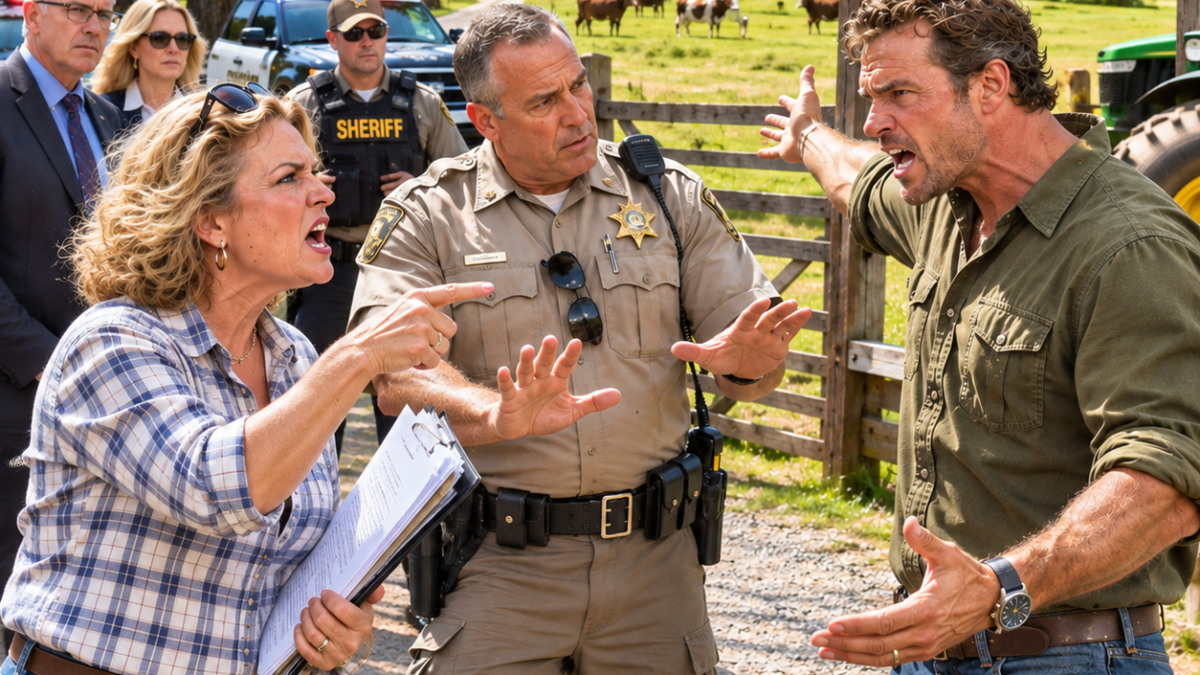
“OFFICER, REMOVE HIM FROM OUR PROPERTY—HE’S REFUSING A LAWFUL HOA ORDER!” Patricia Wallace shouted as the fourth police cruiser in two weeks rolled onto my dirt road.
I stood beside my tractor, covered in dust, and said, “Officer, I’m not an HOA member. I own every acre you’re standing on.”
Then Patricia handed the deputy a recorded property claim carrying my dead father’s signature—and another cruiser came racing up the road.
My name is Ryan Henderson, and Henderson Farm sits on seventy-four acres in eastern Tennessee.
My grandfather bought the first fifty acres in 1972.
Dad added another twenty-four later from a retired farmer next door.
By the time the land came to me, it included pasture, woods, a creek, two barns, a farmhouse, a machine shed, and an old gravel road connecting the farm to the county highway.
I was thirty-eight when Dad died.
I repaired diesel engines in town three days a week, but the farm was my real life.
Cattle.
Hay.
Fences.
Old machinery.
One field rented to a neighbor who grew pumpkins every fall.
Nothing glamorous.
I liked it that way.
Dad taught me two things that mattered more than farming.
Help people when you can.
And never confuse kindness with surrender.
He was generous.
If a storm blocked a road, he opened our gate.
If a neighbor needed a chainsaw, he showed up.
If someone lost livestock, Dad helped look.
But every favor remained a favor.
He never believed helping someone meant they suddenly owned part of the farm.
That lesson became important after Oak Valley Estates appeared north of us.
Oak Valley started with around sixty homes.
Then came a second phase.
Larger houses.
Sidewalks.
Clubhouse.
Pool.
Walking trails.
Eventually more than 140 families lived there.
Most were normal people.
Frank Miller lived near my north fence.
His wife Susan bought eggs from me every Saturday.
Their granddaughter Lily loved watching the calves.
I never hated the subdivision.
They had their property.
I had mine.
Simple.
Then Patricia Wallace became HOA president.
The first time Patricia came to Henderson Farm, she parked her silver SUV outside my gate.
Sunglasses.
Folder.
Confidence.
PART2:
She told me Oak Valley was improving community safety and appearance.
I asked why she was telling me.
“Your property borders almost half our southern edge.”
“So?”
“We’ve received concerns.”
“About what?”
“Your cattle fence. Old machinery. Your barn roof.”
I laughed.
Not because I wanted to insult her.
Because I genuinely thought she was joking.
She was not.
Patricia opened her folder.
VOLUNTARY COMMUNITY MEMBERSHIP.
Oak Valley wanted Henderson Farm to join the HOA.
All seventy-four acres.
I stared at her.
“You want a working cattle farm inside your subdivision HOA?”
“Membership would give you pool access, clubhouse access, trash service, road maintenance, community patrol and landscaping assistance.”
I looked across the pasture.
“I think I’m good.”
Her smile tightened.
“Membership would also prevent future conflicts.”
“What conflicts?”
“Your farm affects community appearance, drainage, traffic and safety.”
“The farm was here before Oak Valley.”
“Times change.”
“Deeds don’t.”
That ended the conversation.
She left the membership packet.
I put it in a kitchen drawer.
Never signed it.
Two weeks later another packet arrived by certified mail.
Then another.
Six months free dues.
I said no.
One year free.
Still no.
Then Patricia called.
She described Henderson Farm as an “unregulated property inside the Oak Valley growth area.”
I repeated it.
“Unregulated?”
She said the farm affected neighborhood standards despite not being formally inside the subdivision.
I told her county regulations already applied to me.
That should have been the end.
Instead, the violations began.
Cattle fence too tall.
Barn roof wrong color.
Tractor visible from walking trail.
Livestock odor.
Gravel-road dust.
Then a bill.
$3,600.
Unpaid HOA dues.
Late fees.
Fence penalties.
Barn penalties.
Administrative fees.
And something called an external property compliance assessment.
I called Oak Valley management.
Linda Brooks answered.
She searched my address.
Then went quiet.
“Mr. Henderson?”
“Yes?”
“Your parcel doesn’t appear to be part of Oak Valley.”
“Correct.”
She apologized.
Said the account must have been created accidentally.
The next day Patricia called.
She said Linda had no authority to cancel board penalties.
I asked the obvious question.
“How can your board penalize property outside your HOA?”
Patricia said their legal adviser believed neighboring land could become subject to limited community rules if it shared roads, drainage or emergency access.
That was new.
“What road do I share?”
“The gravel lane along your northern field.”
“That belongs to Henderson Farm.”
“The original developer used it.”
“For ninety days.”
Dad had allowed temporary construction access years earlier.
Written permission.
Start date.
End date.
No permanent easement.
No HOA rights.
I told Patricia that.
She said Oak Valley’s attorney was reviewing the matter.
That was when I hired Rachel Morgan.
Rachel specialized in farms, easements and boundary disputes.
She reviewed my deed.
County maps.
The temporary access agreement.
Oak Valley’s declarations.
Every violation notice.
Then looked at me.
“You’re not in Oak Valley.”
“I know.”
“No recorded declaration touches Henderson Farm.”
“I know.”
“No permanent road easement.”
“Correct.”
“No HOA jurisdiction.”
“Exactly.”
Rachel sent a letter.
Stop the fines.
Stop representing Henderson Farm as HOA property.
Stop entering my address into Oak Valley’s compliance system.
Stop claiming control over my road.
For almost a month, everything became quiet.
I repaired fence.
Frank helped clear a fallen tree.
Susan brought pie.
Lily helped feed a calf.
Those ordinary moments reminded me that Oak Valley residents were not my enemies.
Patricia was one person.
A few board members were another handful.
Most families knew nothing about the argument.
Then police started arriving.
The first deputy drove through my gate on a Tuesday morning while I operated my tractor near the north field.
“Mr. Henderson?”
“Yes.”
“We received a report of dangerous heavy-equipment operation near children.”
I looked at my tractor.
Then the empty field.
The closest sidewalk was more than two hundred feet away behind fencing.
The deputy looked embarrassed.
He left.
Two days later another cruiser.
Loose cattle reported inside Oak Valley.
Every cow was exactly where it belonged.
The deputy walked the fence with me.
No break.
No loose animal.
He left.
Then:
Noise complaint.
Illegal dumping.
Blocked emergency road.
Aggressive livestock.
Unauthorized construction.
Every complaint connected to something Patricia had already complained about in writing.
Rachel began keeping a log.
Date.
Time.
Deputy.
Complaint.
Outcome.
Nothing criminal ever found.
But the visits continued.
I started feeling watched.
Move hay?
Maybe cruiser.
Start tractor?
Maybe cruiser.
Cattle near north fence?
Maybe complaint.
Then Deputy Paul Jenkins arrived while I repaired a water trough.
He had already visited twice.
He stepped out shaking his head.
“Ryan.”
“What now?”
“Unauthorized commercial construction.”
I pointed toward the little three-sided cattle shelter I was repairing.
“That?”
He laughed.
“No. Caller says you’re building a commercial structure.”
“It’s fifteen years old.”
“I can see that.”
Then he lowered his voice.
“Someone keeps reporting you.”
“I noticed.”
“The sheriff’s office has noticed too.”
That made me feel slightly better.
Then he said something that did not.
“The latest caller said Henderson Farm is under Oak Valley HOA control and you’re refusing lawful compliance.”
I stared at him.
Two days later Patricia returned.
She stayed outside my gate.
At least she had learned something.
“The police calls would stop if you cooperated.”
That sentence changed everything.
“What does cooperate mean?”
“Join Oak Valley.”
I stared.
“Are you telling me those calls are connected to me refusing membership?”
She stepped backward verbally.
“I’m saying conflicts would naturally disappear if your property followed the same rules as everyone else.”
I took out my phone.
“Say that again.”
She stopped talking.
Rachel sent a stronger letter.
Stop using police complaints as leverage.
Stop misrepresenting ownership.
Stop claiming Henderson Farm belongs to Oak Valley.
The HOA attorney denied harassment.
Then Oak Valley produced something new.
Historical documents.
According to Patricia, Henderson Farm might already have been partially annexed into Oak Valley years ago.
Rachel requested copies.
The document was titled:
HENDERSON PROPERTY COMMUNITY ACCESS AGREEMENT.
Dad’s name appeared at the bottom.
His signature.
Dated twelve years earlier.
According to it, Dad had agreed to place the northern thirty acres under Oak Valley community standards in exchange for road maintenance and drainage support.
I had never seen it.
The signature looked real.
That scared me more than Patricia’s threats.
Dad had handled his own paperwork.
Could he have signed something and never mentioned it?
Possible.
People miss things.
Families lose records.
I spent that night opening every cabinet in the farmhouse.
Then Dad’s old metal file box.
Inside:
The original ninety-day construction-access agreement.
Temporary.
No permanent road.
No HOA membership.
Then a handwritten note.
OAK VALLEY ASKING AGAIN ABOUT PERMANENT ROAD. TOLD THEM NO.
Dated one year after the supposed permanent community agreement.
That made no sense.
If Dad had already handed thirty acres to Oak Valley control, why would they still be asking for permanent road access?
Rachel agreed.
Something was wrong.
She asked for the original document.
Oak Valley said the historical archive contained it.
They would locate it.
Meanwhile, the police calls continued.
By the seventh visit, even Paul Jenkins was frustrated.
The complaint claimed I had locked Oak Valley residents out of a shared emergency road.
Paul stood beside my gate.
My road.
My deed.
My lock.
“How many times have we been here?”
“Seven.”
He nodded.
Then came number eight.
I was moving hay near the barn when Patricia arrived with two board members.
Minutes later, Paul’s cruiser rolled up.
Patricia walked toward him carrying a thick folder.
“Officer, he’s trespassing on property controlled by Oak Valley.”
I laughed.
The claim was so absurd it sounded almost funny.
Then Patricia pointed at me.
“Remove him from our property.”
That was when I shouted:
“Officer, I’m no HOA member. I own this land.”
Paul looked at me.
Then Patricia.
Then the farmhouse.
The barn.
The cattle fence.
The large green sign behind me:
HENDERSON FARM — PRIVATE PROPERTY.
Patricia smiled.
“Not anymore.”
She opened the folder.
This time it was not merely an HOA letter.
A county filing.
Recorded property notice.
It claimed Oak Valley had rights over my northern thirty acres.
Dad’s signature appeared again.
There was a notarized statement.
Map.
Control language.
Temporary authority pending ownership review.
For one horrible moment, I wondered if Paul might actually tell me I could not use part of my own farm.
Then another cruiser came racing up the road.
Deputy James Wilson stepped out before it fully stopped.
“NOBODY TOUCHES THAT GATE.”
Everybody froze.
James walked toward Paul.
“We just got a call from the county recorder.”
Patricia’s smile disappeared.
“What call?”
James ignored her.
He looked at me.
“Mr. Henderson, did you transfer thirty acres to Oak Valley yesterday?”
“No.”
“Did your father sign anything recently?”
“My father died four years ago.”
James looked back at the document.
The notarized acknowledgment was dated six months earlier.
My dead father had supposedly appeared in front of a notary two and a half years after his funeral.
Nobody said anything.
One Oak Valley board member whispered:
“What?”
Rachel arrived less than ten minutes later.
She read the filing.
Saw the date.
Her expression hardened.
“Where did this come from?”
Patricia said Oak Valley’s property consultant had processed old records.
“Which consultant?”
She hesitated.
Oak Valley Community Services.
Rachel searched the company.
Owner:
Thomas Wallace.
Patricia’s husband.
Then another engine approached.
Not police.
Heavy equipment.
A small excavator came along the old gravel lane from Oak Valley.
Utility truck behind it.
Another truck.
Paul looked at Patricia.
“What is that?”
“Emergency road work.”
Rachel stared.
“You sent contractors onto disputed private property before the filing was even accepted?”
Patricia said Oak Valley needed to secure access before I blocked the road.
That was when I understood this had never been about annoying HOA letters.
The police calls were creating a record.
Dangerous machinery.
Loose cattle.
Blocked emergency access.
Noise.
Road obstruction.
Construction issues.
One complaint after another.
All building the same story.
Ryan Henderson is dangerous.
Henderson Farm creates safety problems.
Oak Valley needs control.
Paul stopped the excavator.
The supervisor climbed down carrying a work order.
HENDERSON NORTH ACCESS EMERGENCY CONTROL PROJECT.
Authorized by Oak Valley Community Services.
Purpose:
ESTABLISH CONTINUOUS HOA USE BEFORE ANTICIPATED OWNERSHIP CHALLENGE.
Rachel read it twice.
“Continuous use.”
They were not repairing a road.
They were trying to create history.
Use the lane.
Improve it.
Send equipment across it.
Then later claim Oak Valley had always exercised control.
Before we could process that, James’s radio crackled.
The county recorder had found three more questionable property documents notarized by the same person.
All involving landowners who had refused Oak Valley access.
Frank Miller’s older brother.
A retired couple.
A vacant parcel south of my farm.
Then Frank came running from the north fence.
Black plastic folder in his hands.
“Ryan, I found this under an HOA survey marker.”
Inside:
Photographs of my farm.
My gate.
My truck.
My cattle.
My work schedule.
Police call dates.
A future-road map.
Three roads cutting through Henderson Farm.
At the top:
PHASE ONE — CREATE ENFORCEMENT HISTORY.
PHASE TWO — ESTABLISH ACCESS.
PHASE THREE — FILE CONTROL CLAIM.
And in red:
IF OWNER REFUSES, ESCALATE CALLS UNTIL COUNTY INTERVENES.
Paul read it.
Then James.
Patricia said it was fake.
Rachel immediately stopped me from reacting.
“It could be planted. Let them verify it.”
She was right.
Evidence first.
Frank explained where he found it.
Deputies photographed and bagged the documents.
The construction crew left once Paul told them property authority was disputed.
The supervisor apologized.
He had been told the HOA legally controlled the lane.
That mattered.
A contractor acting on bad paperwork is not automatically part of the scheme that created the paperwork.
One Oak Valley board member, Robert Hayes, looked shaken.
He said the board had voted for an emergency-access review.
Not seizure.
Not construction.
Not land control.
He pulled up the meeting minutes.
The actual motion authorized investigation of emergency-access alternatives and consultation with counsel.
Nothing more.
Patricia had gone far beyond the vote.
The county recorder froze the new filing.
Then Rachel asked Oak Valley’s actual attorney, Laura Mitchell, whether she had ever advised the HOA that Henderson Farm belonged to Oak Valley.
Laura said no.
The next HOA meeting was packed.
Residents stood along the walls.
Robert opened the meeting.
Repeated police complaints.
Property filing.
Oak Valley Community Services.
Laura spoke first.
“Henderson Farm is not part of Oak Valley.”
Whispers moved through the room.
She confirmed the ninety-day construction agreement had been temporary.
No permanent road right.
No HOA authority.
Robert asked why residents had been told otherwise.
Patricia said Thomas’s company uncovered historical documents.
Rachel stood.
“Where is the original community-access agreement?”
Thomas Wallace was sitting beside Patricia.
First time I had seen him.
Mid-forties.
Neat suit.
Very calm.
He said the original remained in Oak Valley’s historical archive.
“Who controls that archive?”
“Oak Valley Community Services.”
His company.
Rachel asked about the notarized date.
Thomas said:
“Likely clerical.”
Nobody laughed.
A dead man appearing in front of a notary was not a clerical error.
Then Robert showed financial records.
Oak Valley had paid Thomas’s company more than $84,000.
Records modernization.
Access planning.
Emergency route consulting.
Property integration.
Residents started shouting questions.
“What property?”
Robert looked at me.
“Henderson Farm appears in several invoices.”
Patricia told everyone to remain calm.
Frank stood.
“Why didn’t you tell us Ryan wasn’t in the HOA?”
“The legal status was complicated.”
Frank pointed toward Laura.
“Your own lawyer just said it wasn’t.”
Then Thomas finally lost some composure.
He said residents were getting distracted by technicalities.
Oak Valley needed southern access.
Emergency vehicles needed options.
Future traffic would increase.
Rachel caught the phrase.
“Future traffic?”
Robert answered.
Thomas’s company had been working with a developer on a new subdivision south of Henderson Farm.
Eighty-two homes.
Willow Creek Preserve.
The easiest connection between Willow Creek and Oak Valley crossed my gravel lane and southern field.
My farm was the bridge.
Without it, the development needed a longer road around wetlands.
And a new bridge.
Estimated added cost:
$1.9 million.
Now everything made sense.
The emergency access.
The complaints.
The fake history.
The property filing.
Somebody needed control over Henderson Farm because my land could save a development project nearly two million dollars.
Then Robert showed another fact.
Thomas was also advising Willow Creek’s developer.
Laura asked if he had disclosed that conflict.
He had not.
The board suspended Patricia’s authority.
Five to one.
Patricia voted for herself.
Thomas’s company contract was frozen.
Every enforcement action against Henderson Farm stopped.
I should have felt relief.
Mostly, I felt tired.
That night Frank and Susan came over.
Susan brought coffee and pie.
Frank sat on my porch.
“Most of us thought the police calls meant something real.”
“I know.”
“We should have asked.”
“You trusted people running your HOA.”
He looked down.
I understood.
The next breakthrough came from the document examiner.
Dad’s signature on the so-called community-access agreement was not handwritten onto that page.
It was a digital copy.
More importantly, it matched the signature on Dad’s real ninety-day construction agreement almost perfectly.
Same small break.
Same upward stroke.
Same tiny irregularity.
Somebody had lifted Dad’s genuine signature from the old file and placed it on a new agreement.
That was worse than a forged handwriting imitation.
The signature itself was real.
It was simply in a place Dad never put it.
Sheriff investigators obtained access to Thomas’s company records through legal process.
The fake agreement had been created seven months earlier.
Before many of the police calls.
Before Patricia began publicly demanding emergency access.
That mattered.
The document had existed before the supposed crisis.
Then the crisis appeared.
File history showed versions.
Draft one:
Road access.
Draft two:
Northern thirty acres.
Draft three:
Emergency-control language.
Final:
Enforcement support based on repeated county response.
The account creating the file belonged to Thomas.
Rachel warned me that account ownership alone did not prove who physically created every edit.
Then investigators found emails.
Thomas to Patricia:
“Old signature works cleanly. We can establish historical agreement first. Then build usage record around it.”
Patricia:
“How many calls before county starts treating Ryan as repeat problem?”
Thomas:
“Enough that file looks established. Don’t overdo too fast.”
I read that three times.
There it was.
The police calls were not just random neighbors getting annoyed.
At least part of the campaign had been planned.
Build a file.
Create a pattern.
Make me look dangerous.
Then use the police visits as support for land control.
The sheriff’s office reviewed other Oak Valley disputes.
Frank’s brother, William Miller, had refused permission for a drainage pipe.
Later a recorded agreement appeared saying he approved it.
He said he never signed.
Jack and Diane Foster refused a walking trail across their wooded parcel.
Later, an access agreement appeared.
Again, questionable.
Same notary.
Sandra Price.
Then investigators discovered payments.
Oak Valley Community Services had paid Southern Access Solutions more than $62,000.
Owner:
Sandra Price.
The notary.
That did not prove everything.
But it connected money to paperwork.
Investigators compared the agreements.
William’s signature had been copied from an old legitimate document.
Jack Foster’s too.
My father’s too.
The pattern:
Find a genuine old signature.
Create a new agreement.
Insert the signature.
Add access language.
Add notary page.
Record the document.
Rachel summarized it perfectly.
“They didn’t need fake signatures. They needed real signatures in fake places.”
Then county crews found something beneath my gravel lane.
Fresh conduit.
Communication cable.
Electrical conduit.
And another empty run.
No permits.
No recorded utility rights.
The lines went north toward Oak Valley.
South toward future Willow Creek land.
They had already been preparing the future road underground.
While I argued over complaints and documents, infrastructure was being installed beneath my farm.
Near the conduit, workers found a metal tag.
OAK VALLEY SOUTH — PHASE TWO.
The project had been moving before anyone told me.
Then investigators located Sandra Price.
She was at Thomas’s property.
Loading boxes of Oak Valley land records into his truck.
One box:
HENDERSON ORIGINALS.
Inside:
Dad’s original ninety-day construction agreement.
The exact document investigators believed supplied the copied signature.
Sandra said she was returning files.
Thomas said they belonged to his company.
Deputies seized the material properly.
No dramatic roadside conclusions.
The investigation continued.
Sandra later admitted Thomas sent her assembled document packages.
She claimed he described them as historical records needing certification.
She denied personally seeing Dad sign anything.
That created the obvious problem.
A notary is supposed to witness or properly verify the signer.
Dad had been dead.
Sandra should have known.
But she also had saved emails.
Invoices included:
HENDERSON HISTORICAL ACCESS PACKAGE.
MILLER DRAINAGE CONTINUITY FILE.
FOSTER TRAIL RIGHT SUPPORT.
Three landowners.
Three people who had refused Oak Valley something.
Three “historical” agreements appearing afterward.
Then investigators found Thomas’s process file.
Six steps.
Identify old signed document.
Build new access agreement.
Create enforcement record through complaints.
Record access claim.
Establish physical use.
Defend as existing right if owner objects.
That was the entire strategy.
Written down.
The financial motive became even clearer.
Thomas held a twenty-percent interest in the Willow Creek Preserve development through another company.
Patricia had never disclosed it to the Oak Valley board.
Without access across Henderson Farm, the project faced roughly $1.9 million in extra road, bridge and wetland costs.
Thomas had built his development economics around a road he did not own.
When I refused?
He tried to create the road on paper.
Patricia used the HOA.
Police complaints created history.
History supported the claim.
Claim supported construction.
Construction could later be described as existing use.
The whole thing connected.
Then Rachel found a draft lawsuit.
Oak Valley had been preparing to sue me.
Public nuisance.
Interference with emergency access.
Damage to property values.
The proposed complaint asked a judge for temporary control of my north lane.
And what evidence did it cite?
Police responses.
Seven.
Then eight.
Exactly the calls Rachel had been tracking.
The complaint did not emphasize outcomes.
No loose cattle found.
No blocked public road.
No crime.
No illegal construction.
It emphasized volume.
Police came here repeatedly.
Therefore there must be a problem.
That was the danger.
A pile of events can look like truth if nobody reads what each event actually proved.
Rachel built a binder.
Every deputy report.
Every outcome.
She labeled it:
WHAT ACTUALLY HAPPENED.
Dad would have liked that.
The county formally rejected Oak Valley’s property-control filing.
Invalid notary date.
No valid transfer.
No permanent easement.
No evidence Henderson Farm had ever joined Oak Valley.
My land records remained unchanged.
Henderson Farm was mine.
That should have been the end.
It was not.
Investigators still wanted to know who made the false police complaints.
Phone records provided the answer.
Some calls came from normal residents.
People like Steven Parker, who genuinely believed my locked gate blocked an emergency route because the HOA told him so.
Those were honest mistakes.
I refused to treat them like fraud.
But six complaints came from prepaid phones.
Different numbers.
Same billing source.
Oak Valley Community Services.
One device connected to Thomas’s office.
Another to Southern Access Solutions.
Another repeatedly connected to Patricia’s home Wi-Fi.
Someone had purchased phones specifically to create complaints.
Paul Jenkins called me.
His voice sounded different.
“Ryan, some of the calls were planned.”
I sat down.
I had believed that for months.
Hearing it confirmed still hurt.
Then one prepaid device became active again.
Moving toward Henderson Farm.
Paul called immediately.
“Lock the gates. Stay at the house.”
I checked cameras.
Front gate.
Nothing.
North lane.
Nothing.
Then creek camera.
Dark pickup entering from the old southern service path.
Two men got out.
One carried a shovel.
The other a long metal case.
They walked toward the conduit route county crews had started removing.
Paul told me not to approach.
I stayed inside.
The men stopped near an old culvert.
One started digging.
The other opened the case.
Documents.
Stacks.
They began pushing folders into the culvert.
Then a second vehicle arrived.
Patricia’s silver SUV.
She stepped out.
Pointed farther down the field.
Opened her rear hatch.
Boxes.
OAK VALLEY POLICE RESPONSE FILES.
HENDERSON ENFORCEMENT.
WILLOW CREEK ACCESS.
Paul said deputies were two minutes away.
Then Patricia pulled out a red gasoline can.
One man spread papers across the ground.
Patricia poured gasoline over them.
Red and blue lights appeared beyond the trees.
She froze.
One man ran.
A cruiser entered from the opposite direction and blocked him.
Paul arrived with two more deputies.
Everybody was ordered away from the records.
Hands visible.
Nobody resisted.
Probably the smartest decision anyone made in that entire story.
The two men worked for Oak Valley Community Services.
They claimed they were protecting documents from rain.
Paul looked at the gas can.
Nobody bothered debating that explanation in the field.
Everything was photographed.
Boxes.
Papers.
Culvert.
Gasoline.
Vehicles.
Then seized properly.
Paul came to my farmhouse afterward.
I opened the door.
“So is this police call number nine?”
For the first time in weeks, he laughed.
“No.”
He looked back toward the field.
“This one’s ours.”
That sentence felt good.
For months, Patricia had brought law enforcement to Henderson Farm as if I were the problem.
Now deputies had come because other people were trespassing on my land.
The recovered boxes contained the final pieces.
Draft access agreements.
Copied signatures.
Complaint logs.
Maps.
Payment records.
One spreadsheet:
HENDERSON ESCALATION SCHEDULE.
First membership offer.
First violation notice.
First police complaint.
Emergency-route letter.
Historical-access claim.
County filing.
Construction start.
Planned lawsuit.
The dates matched almost perfectly.
This had been run like a project.
Another email from Thomas:
“Anything with enforcement sequencing or signature files cannot remain available if county expands review.”
Patricia replied:
“I’ll handle the physical records.”
She did.
Badly.
Once investigators put everything together, Thomas began cooperating more.
According to the case summary later shared with us, he said the whole thing started with Willow Creek access.
He believed Henderson Farm had once allowed temporary construction use.
Then convinced himself that restoring or extending the route was reasonable.
My refusal threatened nearly two million dollars in project costs.
So one bad decision became another.
Take Dad’s old signature.
Create a broader agreement.
Build complaint history.
Use police responses.
Record claim.
Begin physical work.
Patricia used her role as HOA president to make the process appear like community safety.
At some point, they stopped asking whether they had a right to my land.
They only asked how to make the result look legitimate.
Sandra also cooperated.
She faced consequences for notarizing documents she could not truthfully verify.
But she helped identify altered files and signature sources.
Other landowners got their records corrected.
William Miller’s drainage agreement was invalidated.
Jack and Diane Foster’s walking-trail claim was removed.
Another landowner discovered Oak Valley had been preparing a similar parking-access claim against him.
Henderson Farm was simply the case where the process got pushed far enough to expose the entire system.
Oak Valley responded faster than I expected once the evidence became undeniable.
Patricia was permanently removed.
Thomas’s company contract terminated.
Independent accountant.
Independent property attorney.
Every access file reviewed.
The new board sent me one letter.
One page.
No tricks.
No vague language.
“Henderson Farm is not and has never been a member of Oak Valley Estates Homeowners Association.”
I framed it.
After months of documents pretending otherwise, one honest sentence felt powerful.
The HOA withdrew every violation.
Every fake assessment.
Every road claim.
Every internal file describing me as a noncompliant member was corrected.
The county recorded its own notice.
No Oak Valley covenant covered Henderson Farm.
No valid HOA easement crossed my property.
Rachel made sure everything was filed.
Dad always said paper stayed.
This time paper told the truth.
Then something strange happened.
The police calls stopped.
Completely.
I cut hay.
Nothing.
Moved cattle.
Nothing.
Repaired fence.
Nothing.
Worked late in the machine shed.
Nothing.
For months I had expected a cruiser whenever an engine started.
Ordinary life suddenly felt luxurious.
Paul still visited sometimes.
But for coffee.
One morning he pulled up.
I walked outside.
“You sure nobody complained about my coffee?”
“Give Oak Valley time.”
We both laughed.
Civil claims took longer.
Trespass.
Property damage.
Legal expenses.
Lost farm time.
False filings.
I told Rachel I did not want ordinary residents destroyed financially for decisions they had never understood.
She separated claims.
Insurance covered some.
Thomas’s companies and development interests covered others.
Sandra’s professional coverage became involved.
The northern lane was restored.
Illegal conduit removed.
Survey markers for Willow Creek taken off my farm.
Oak Valley reimbursed certain public costs where legally appropriate for knowingly manufactured complaints.
That mattered to the sheriff’s office.
The lesson was never “don’t call police.”
If someone sees danger, call.
The lesson was:
Do not turn emergency services into leverage in a property dispute.
Oak Valley changed its rules.
No board-directed police complaint campaign.
No property outside HOA boundaries placed inside enforcement systems.
Family-connected vendors required disclosure.
Land-access projects required independent legal review.
Historical agreements required original-document verification.
Boring rules.
Excellent rules.
Willow Creek Preserve collapsed in its original form.
Without Henderson Farm as the cheap road, the financial plan no longer worked.
Investors backed away.
Months later another developer bought the land.
Smaller project.
New bridge.
Separate county-road entrance.
One manager came to my gate before construction.
He called first.
Waited.
Asked permission.
Then showed me a map.
No road through Henderson Farm.
No utilities.
No access claim.
He asked about drainage.
We talked twenty minutes.
Then he left.
That was what cooperation looked like.
Conversation.
Not compliance notices.
Not copied signatures.
Not eight police cruisers.
Frank remained one of my closest neighbors.
He felt guilty.
I told him to stop.
He had trusted people managing his association.
Once truth appeared, he helped.
That mattered more.
Susan still brought pie.
Lily still came to see the calves.
Robert served as HOA president long enough to stabilize things, then stepped aside.
“Too much paperwork.”
I laughed.
“I’ve had enough paperwork too.”
Patricia and Thomas faced separate legal consequences.
Different actions.
Different responsibility.
That mattered.
Patricia’s use of HOA authority, participation in complaints, false-access campaign and attempted destruction of physical records were part of her case.
Thomas faced broader issues involving document creation, signature reuse, development planning and business records.
Sandra faced her own consequences over notarization.
I attended only one hearing.
Patricia passed me in the hallway.
She stopped.
For once, no folder.
No sunglasses.
No HOA voice.
Just tired.
“I should have left you alone.”
I did not know what else to say.
So I said the truth.
“Yes.”
She nodded.
Walked away.
That was enough closure.
A year later, the farm looked normal again.
Grass covered the conduit trench.
The old gravel road remained because it belonged to me.
The gate stayed locked when I wanted it locked.
Open when I wanted it open.
Then one winter storm knocked trees across Oak Valley’s main entrance.
An ambulance needed another route to reach a resident.
Robert called.
“Ryan?”
“Yes?”
“Can they cross your lane?”
He asked.
That word mattered.
I drove to the gate.
Unlocked it.
The ambulance crossed Henderson Farm.
A fire vehicle followed.
Afterward, Robert thanked me.
I closed the gate.
Nobody filed an easement.
Nobody claimed permanent rights.
Nobody said one emergency had changed ownership.
Dad would have liked that.
Kindness with boundaries.
Always.
That was the lesson.
Oak Valley took Dad’s temporary favor and tried to transform it into permanent authority.
When I refused, Patricia and Thomas tried to build a history making me look unreasonable.
Loose cattle.
Dangerous equipment.
Noise.
Blocked access.
Illegal construction.
Again.
Again.
Again.
At one point, I knew half the deputies in the county by first name.
Every police call was supposed to make Henderson Farm look suspicious.
Instead, every actual report eventually helped prove the opposite.
No loose cattle.
No blocked public road.
No crime.
No illegal construction.
No emergency.
The calls became evidence against the story they were supposed to support.
That irony still makes me smile.
The sentence I yelled during the eighth visit became a joke between Paul and me.
“Officer, I’m no HOA member. I own this land.”
At the time, I said it because I was angry.
Later, I realized it contained the entire case.
I was not an HOA member.
I owned the land.
Everything complicated came from people refusing to accept those two simple facts.
The HOA letters did not change them.
Police calls did not change them.
Dad’s copied signature did not change them.
The fake notary page did not change them.
The work crew did not change them.
A development project saving nearly two million dollars definitely did not change them.
Today, a new sign stands beside my north gate.
Frank helped install it.
HENDERSON FARM — PRIVATE PROPERTY.
EMERGENCY ACCESS BY PERMISSION ONLY.
Frank stepped back after we finished.
“Think Patricia would have understood that?”
I smiled.
“Eventually.”
Then we went back to repairing fence.
That was where the story really ended.
Not in court.
Not with police lights.
Not with Patricia beside a fake document.
It ended with Henderson Farm still being Henderson Farm.
Cattle in the pasture.
Hay in the barn.
Tractor tracks in the dirt.
Neighbors who learned to ask.
And a gate that opened only when I chose to open it.
Oak Valley spent months trying to prove that enough police calls, enough paperwork and enough official-looking documents could create authority over land it did not own.
In the end, all those cruisers proved something much simpler.
You can call the police ten times.
You can send a hundred HOA letters.
You can create maps, agreements and claims that look official.
But eventually, somebody is going to read the deed, look at the land, look at the owner standing in front of them—
and ask the question Patricia Wallace hoped nobody ever would.
“Why are we here again?”








