Nobody Wanted the Injured German Shepherd I Bought for $10—Until His Military Chip Revealed Why He Had Been Missing for Three Years
PART2:
I saw something in those eyes I recognized before I wanted to.
Not fear.
Not defeat exactly.
The dull edge that comes after fear has burned too long to stay bright.
I had seen it in my own bathroom mirror after coming home from war. The first year back, before I learned how to make my face acceptable in public. Before I learned to answer, “Doing good,” fast enough that people would not ask a second question.
I reached into my jacket pocket.
The ten-dollar bill was crumpled, folded around the receipt from the wrench.
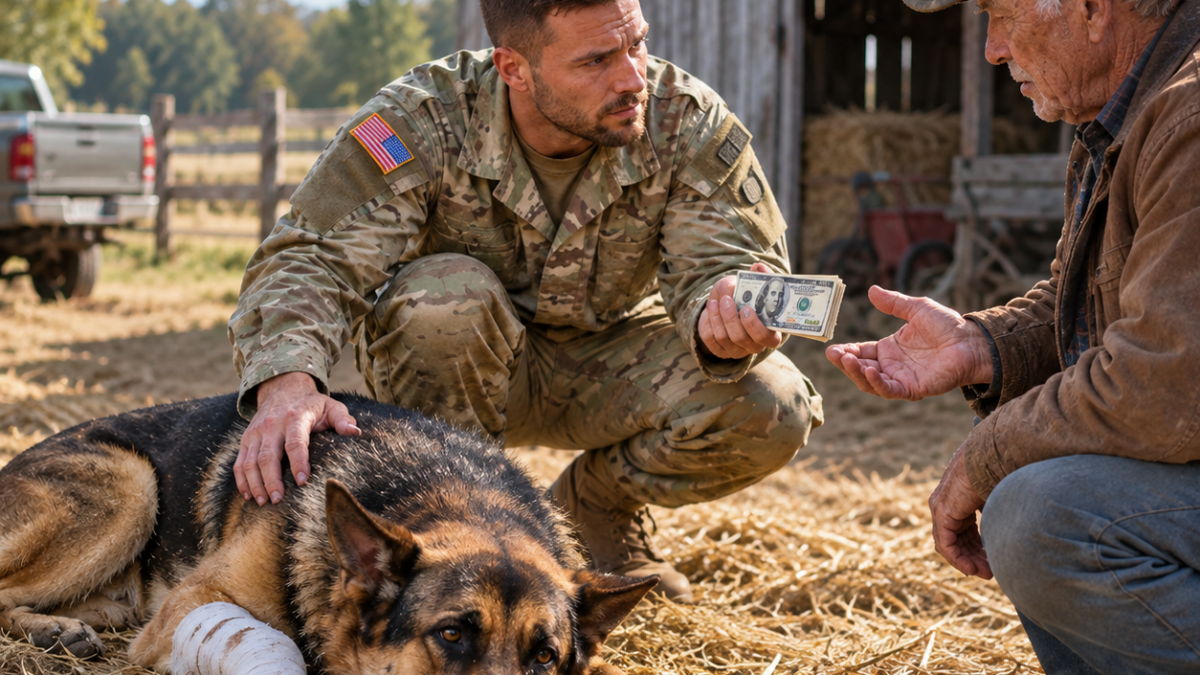
I held it out.
“I’ll take him.”
The man snatched it.
“Your problem now.”
No pause.
No goodbye.
No pat on the dog’s head.
He turned away and started telling another customer about a box of rusty fishing lures.
I crouched slowly.
The dog watched my movement without flinching.
That told me something.
Not everything.
Just something.
“Hey, buddy,” I said.
My voice sounded different. Lower. Gentler. A voice I rarely used anymore because gentleness felt too exposed in my own mouth.
I loosened the knot around the fence post and let the rope slip free.
The dog’s ears flicked forward.
He stood.
Unsteady at first.
Then squared himself.
Even with the limp, there was discipline in the movement. A quiet adjustment, weight balanced, attention forward. Not stray behavior. Not pet-store obedience. Something cleaner than that. Older.
I did not understand it yet.
“What do I call you?” I murmured.
The dog blinked.
Sun caught the amber in his eyes.
“Hunter,” I said.
The name arrived whole.
Like it had been waiting for both of us.
He stepped toward me, and for a moment we simply stood there amid the market noise, a scarred Marine and a limping shepherd nobody wanted, joined by a ten-dollar transaction so small the world nearly missed it.
On the way to my truck, I passed Sarah Johnson’s coffee stand.
Sarah was Pine Hollow’s unofficial mayor. Not elected. More powerful than elected. She was in her late fifties, tall and wiry, with sharp blue eyes, silver-threaded hair, and a voice that could bless you or skin you depending on what you had coming. Her husband had died in a logging accident twenty years earlier, and since then she had poured her grief into church suppers, town committees, hospital rides, and knowing everyone’s business with alarming accuracy.
“Morning, Mark,” she called.
Then her eyes dropped to Hunter.
Her smile faded.
“Oh,” she said softly.
That one syllable told me she saw more than most people had.
“Name’s Hunter,” I said.
“Looks like he’s had a rough go.”
“Yeah.”
PART3:
Sarah came around the stand slowly, wiping her hands on a towel.
“May I?”
I looked at Hunter.
He stood at my left side, not leaning away, not seeking her out. Alert but controlled.
“Slow,” I said.
She gave me a look that said she knew how to move around frightened things, including me.
She crouched just enough, held out the back of her hand, and waited.
Hunter sniffed once.
Did not move closer.
Sarah accepted that.
“Well,” she said, standing, “you’re in good hands now, handsome.”
I looked away.
That sentence made something in my chest feel too tight.
“Coffee for the road?” she asked.
“I’m good.”
“You never are, but I’ll let it go.”
That was Sarah.
Kindness with teeth.
I opened my truck door.
Hunter surprised me by hopping in with a smoothness his limp should not have allowed. He settled on the passenger seat facing forward, rope still loose around his neck, posture calm. Not excited. Not confused. Just ready.
As if he had ridden out of places worse than a flea market before.
The drive home was quiet.
The roads outside town curved past fields, barns, and maples shedding gold leaves into roadside ditches. Hunter watched the passing trees through the windshield. Once or twice, I glanced over expecting restlessness, but he sat still, his ears making tiny adjustments to each sound.
At a stop sign, I said, “I don’t know what I’m doing.”
Hunter did not look at me.
“Fair. Neither do you.”
He continued staring forward.
“I’ve got a barn. Food. Water. Not much else.”
His ear twitched.
“Not exactly a sales pitch.”
That was the first time I smiled that day.
When we reached the farmhouse, the afternoon light had softened. I parked beside the barn and led Hunter toward the back. He walked at my pace without being asked, slightly behind my left knee, close enough to stay with me but not crowding.
I noticed that too.
Inside the barn, the air smelled of hay, cold wood, old oil, and mice I pretended not to know about. I spread a thick wool blanket in the corner farthest from the door but with a clear view of the entrance. That mattered. I knew what it felt like to need sightlines.
I filled a stainless-steel bowl with water and a dented dish with kibble I kept around for strays.
Hunter sniffed the food.
Did not eat.
Instead, he lowered himself onto the blanket, careful with the bad leg. His eyes followed me as I moved through the barn. Calm. Watchful.
I knelt nearby.
Not too close.
“You’re safe now, Hunter.”
For a moment, nothing changed.
Then I felt it.
The smallest release in his shoulders.
Not trust.
Maybe not even belief.
Just the body hearing a sentence and deciding, for one second, not to argue.
Outside, wind moved through bare branches.
A crow called from the fence line.
Inside the barn, man and dog shared a quiet stillness, both of us pretending we were not relieved to have found something we were not looking for.
The first night, Hunter did not sleep much.
Neither did I.
The farmhouse carried sound strangely in cold weather. Every shift of the barn door. Every scrape of claws against wood. Every rustle of the wool blanket. I lay in my bedroom staring at the ceiling, listening as if he were a sentry and I had forgotten how to stand watch.
Around three, the wind slammed something loose against the barn wall.
I was out of bed before I knew I had moved.
By the time I reached the kitchen, my pulse had already gone back years. Not barn. Not wind. Dust. Fire. Metal. Someone yelling for Doc though Doc was already gone. My right hand gripped the edge of the counter hard enough to hurt.
Then, from the barn, I heard one low whine.
Hunter.
Not fear.
A sound like he had heard me.
I forced air into my lungs.
One breath.
Another.
“Not there,” I whispered.
The kitchen returned slowly.
Cold tile under my feet.
Moonlight on the sink.
My own reflection in the dark window.
I put on boots and crossed to the barn anyway.
Hunter lay on the blanket, head lifted, ears forward.
“You heard that too?” I asked.
He watched me.
I pulled a crate over and sat across from him.
Neither of us slept much after that.
But the barn felt less empty.
In the morning, frost dusted the grass and turned the fields pale gold. I brought him fresh water and sat again, drinking coffee from a dented mug while he pretended not to watch me.
He did not eat while I was standing.
So I turned my back.
A minute later, kibble shifted in the dish.
I smiled into my coffee.
Trust, I learned again, sometimes begins where nobody has to witness it.
Over the next few days, I moved an old armchair from the house into the barn. The chair had belonged to my uncle and smelled faintly of tobacco no amount of time had fully removed. I placed it far enough from Hunter that he would not feel crowded and spent long stretches there reading paperbacks, repairing tools, or saying nothing.
Some people think silence is empty.
It is not.
Silence is full of whatever you bring into it.
At first, mine was full of old noise. Engines. Radios. Warnings. Marian’s voice. My mother’s last breath. The flea market man saying your problem now.
Hunter’s silence was different.
His had weight. Discipline. Injury. Patience.
We sat inside both.
On the third day, Sarah showed up unannounced, as Sarah often did because knocking was more of a suggestion in her personal constitution.
She stood in the barn doorway wearing a dark blue raincoat and a knitted scarf the color of red wine.
“I brought him something,” she said.
“You brought the dog food?”
“I brought both of you soup, but I assume the dog has better manners.”
She held out a small paper bag.
Inside was roasted chicken wrapped in wax paper.
“Sarah.”
“What? He looks like he could use real food, and you look like you’ve been surviving on coffee and resentment.”
“That’s a balanced diet.”
“It is not.”
I tore off a small piece of chicken and placed it near Hunter’s bowl.
He looked at it.
Then at me.
Then at Sarah.
Sarah did not move.
Neither did I.
Finally, Hunter lowered his head and took the piece between his teeth. He chewed slowly, as if food this good might be a test.
Sarah’s face lit up.
“There’s a start.”
“It’s something,” I said.
She looked around the barn. At the chair. The blanket. The water bowl. The space I had made.
Then she looked at me with those sharp eyes.
“Maybe more than something.”
I busied myself folding the wax paper.
Sarah let me have that mercy.
For the first week, Hunter kept his distance most of the time. But his eyes changed. Suspicion became curiosity. Curiosity became something harder to name.
One evening just before dusk, I sat cross-legged on the barn floor cleaning an old lantern. Without realizing it, I began humming. It was a tune from deployment, something one of the guys used to play badly on a harmonica during long nights when nobody wanted to admit they were scared.
Hunter lifted his head.
I kept humming.
He rose slowly and stepped toward me.
One slow step.
Then another.
His front paws stopped inches from my knee.
I froze.
I looked down, not at his eyes but at the lantern in my hands.
Then I felt the brush of his nose against my knuckles.
Light.
Cautious.
Deliberate.
I swallowed hard.
“You’re getting there, buddy.”
His tail moved once.
Just once.
That was enough.
By the end of the week, November winds had sharpened. The barn doors rattled when gusts pushed through, and damp leaves gathered along the fence line. Hunter still limped, but he moved with more confidence. He followed me around the barn at a distance, watching as I mended a hinge, stacked wood, and sorted old bolts into jars because apparently being alone long enough turns a man into his grandfather.
Then the toolbox fell.
I had perched it on a crate while tightening the side-door hinge. The crate shifted. The toolbox hit the barn floor with a metallic crash so loud it punched straight through my chest.
Hunter moved before I did.
His ears snapped forward.
He sprang up, bad leg and all, and came in a fast arc to place himself between me and the source of the noise. Head lowered. Shoulders balanced. Eyes scanning the open door, corners, rafters, shadows.
Not panic.
Training.
Every hair on my arms rose.
I had seen dogs move like that before.
Not pets.
Working dogs.
Military dogs.
Dogs who knew the difference between sound and threat because someone had taught them with stakes attached.
I crouched slightly.
“Hunter.”
His ear flicked back toward me.
I tested a thought.
In a calm, firm voice, I said, “Down.”
His body dropped instantly.
Chin flat.
Legs tucked.
No hesitation.
No confusion.
Only compliance.
My mouth went dry.
“You’ve done this before.”
Later that afternoon, I tested again.
I picked up an old tennis ball from a box of junk and stood a few feet away.
“Stay.”
Hunter locked in place.
I tossed the ball across the barn.
His eyes tracked it.
His body did not move.
Only when I said, “Okay,” did he cross the distance, retrieve the ball, and return it gently to my feet.
I stared at him.
This was not backyard obedience.
This was not some farmer teaching a dog to sit before supper.
That night, after dinner, I scrolled through my contacts until I found a name I had not called in nearly a year.
Tom Reyes.
Tom had been a Marine with me years earlier. Shorter than me, built like a steel beam, and blessed with a dry humor that could cut through terror better than morphine. After leaving active duty, he had gone into military and law-enforcement K9 training, consulting, and rehabilitation. He understood dogs the way some priests understand confession.
He answered on the fourth ring.
“Mark Thompson,” he said. “I thought you fell off the map.”
“Something like that.”
“You alive?”
“Mostly.”
“That’s your brand.”
I almost smiled.
“I’ve got a dog here,” I said. “German Shepherd. Picked him up at the flea market. Injured. Thin. But he’s got skills.”
Tom’s voice changed.
“What kind of skills?”
I described the toolbox crash. The protective stance. The down. The stay. The retrieval. The left-side pacing. The way he watched exits. The way he responded to tone before command.
Tom was quiet for a moment.
“That’s muscle memory from serious training.”
“That’s what I thought.”
“How old?”
“Hard to say. Maybe seven. Maybe older.”
“Any tattoo? Chip?”
“Haven’t checked yet.”
“Get him scanned.”
“I was planning a vet visit for the leg.”
“Do it soon.”
I glanced toward the barn window, where Hunter lay on his blanket with his head on his paws, eyes fixed on the house.
“Tom.”
“Yeah?”
“What are the odds a dog like that ends up tied to a post for ten bucks?”
“Low if his story is clean.”
I did not like the answer.
“I’ll keep you posted.”
“Mark?”
“Yeah?”
“If he’s trained the way you say, don’t push him. A dog like that has a past. Sometimes the training is the only part of them still organized.”
After we hung up, I sat in the kitchen for a long time, listening to wind press against the windows.
A past.
We all had one.
The question was whether Hunter’s was coming for him.
The first real flashback happened two days later.
I had smaller ones all the time. Moments. Smells. A sudden noise. A muscle memory surge I could usually hide if nobody was looking. But this one came in hard.
I had taken Hunter on the trail behind my property near dusk. Frost hardened the leaves under our feet. The woods were mostly bare, maples and oaks stripped down to dark limbs against a bruising purple sky. Hunter moved beside me, steady despite the limp.
The air smelled faintly of smoke from someone’s fireplace.
Then a branch snapped somewhere deeper in the woods.
In the right life, that was nothing.
In the wrong memory, it was everything.
The smell of smoke became burning fuel.
The bare trees became a road bordered by walls.
The snap became a crack of small-arms fire.
My breath shortened.
My vision narrowed.
The trail tilted.
I reached for the nearest tree and gripped the bark like the present was something I could physically hold.
Not there.
Not there.
Not there.
My body disagreed.
My knees hit the ground.
The past surged up bright and full of teeth.
Then Hunter was against me.
Not jumping.
Not pawing.
He pressed the weight of his body against my right side, firm and steady. His shoulder leaned into my ribs. His head nudged under my hand. When my fingers clenched, they closed around fur instead of air.
His breathing was slow.
Even.
I heard it.
Felt it.
Inhale.
Exhale.
Inhale.
Exhale.
Without realizing it, I matched him.
The gunfire became branches.
The burning fuel became wood smoke.
The road became frost and mud beneath my knees.
Hunter stayed.
No fear in him.
No confusion.
Just focus.
Quiet resolve.
As if he knew exactly where I had gone and exactly how to bring me back without making me ashamed of needing rescue.
A crunch of footsteps approached.
My head snapped up.
Carl Benton emerged between the trees, wearing his battered leather hat and a green jacket that had likely survived three decades of abuse. Carl lived on the adjoining property and had been a volunteer firefighter before arthritis bent his shoulders and retirement stole the radio from his kitchen. He had the alert eyes of someone who knew what trouble looked like from far away.
“You all right there, Mark?”
I forced a breath.
“Yeah. Just needed a minute.”
Carl’s gaze shifted to Hunter, still pressed against my side.
“That’s a good dog.”
I looked down.
Hunter’s eyes stayed on mine.
“Yeah,” I said quietly. “He knows.”
Carl nodded once and continued down the trail, giving me the gift of not asking a second question.
Hunter stayed close all the way home.
Back in the barn, I crouched in front of him and rested one hand on his shoulder.
“You’re more than a fighter, aren’t you?”
His tail brushed once against the blanket.
“You’ve been trained for this.”
He did not move.
But something had changed.
Before that night, I thought I was helping an injured dog recover.
After that night, I understood he had already started saving me.
The next morning, I called Pine Hollow Veterinary Clinic.
Hunter’s limp had worsened after the trail. Not much, but enough. He favored the left hind leg more sharply, a hitch in his movement that spoke of an old injury never properly repaired.
The clinic sat between the feed store and a bakery that smelled like cinnamon rolls even when my life was falling apart. Inside, the waiting room was warm and bright, with a radio playing low country music and a bulletin board full of lost cats, vaccination reminders, and one flyer for goat yoga that I refused to investigate.
Marla at the desk recognized me.
“Morning, Mark. Who’s this handsome fellow?”
“Hunter. Old leg injury. Maybe more.”
Dr. Benjamin Simmons came out within minutes. He was in his late fifties, tall with a slight stoop from years bent over exam tables, salt-and-pepper beard trimmed close, eyes sharp behind wire-rimmed glasses. He had the calm of a man who had seen every kind of panic and preferred truth to drama.
“Good to see you, Mark.”
He crouched to greet Hunter, but did not crowd him.
Hunter sniffed once and allowed existence.
Simmons smiled faintly.
“Discerning.”
“You have no idea.”
In the exam room, Hunter stood with controlled patience. Simmons checked the leg, joints, hips, spine. His hands were gentle but thorough.
“Old trauma,” he murmured. “Could be blunt force. Could be shrapnel. Hard to say without X-rays.”
When his hands moved over Hunter’s neck and shoulders, he paused.
His brow furrowed.
“There’s something here.”
I straightened.
“What?”
“Small hard spot under the skin, behind the left shoulder.” He pressed lightly. “Could be a microchip, but it feels damaged or migrated.”
He took a scanner from the counter and passed it over the area.
Nothing.
He adjusted the angle.
Nothing again.
Hunter stood still.
Simmons tried from lower, then behind, rotating the scanner slowly.
A faint beep.
The display flickered.
Stabilized.
Simmons stared at it.
Then he looked at me.
“Well,” he said softly. “This is something.”
“What?”
He turned the screen.
The numbers made no sense to me.
The words below did.
ECHO-7.
US MILITARY K9 STATUS.
MISSING IN ACTION.
SYRIA.
THREE YEARS PRIOR.
For a moment, I could not hear the radio.
“What?”
Simmons read silently, then scrolled.
“Registered name Echo-7. German Shepherd. Convoy escort and detection work. Last status: missing after IED strike during humanitarian transport in northern Syria. Handler injured and evacuated. Dog unaccounted for, presumed dead.”
The exam room seemed to tilt.
I looked at Hunter.
He stood between us, ears forward, tail still, as if the words meant nothing to him.
Maybe they did not.
Maybe they meant everything in a language too old for records.
“How does a dog go from a war zone to a flea market in Pine Hollow?” I asked.
Simmons leaned back, arms folded.
“Best guess? After the explosion, he was found by locals or passed through unofficial hands. Injured dogs sometimes get moved, traded, sold. Rescue networks, private transport, military contractors, black-market channels. It can get muddy fast. If the chip was damaged and hard to read, anyone scanning quickly could miss it.”
“Three years.”
Simmons nodded.
“Three years.”
I rested my hand on Hunter’s back.
His breathing rose steady beneath my palm.
A decorated military working dog, presumed dead after an explosion, had crossed half the world somehow and ended up tied to a fence post in a small Ohio flea market for ten dollars.
No.
Not ended up.
Survived to reach.
There is a difference.
Simmons softened his voice.
“Whatever happened out there, he’s here now. And from the looks of it, he’s chosen you.”
I looked down.
Hunter met my eyes without blinking.
There was no need for words.
Both of us understood the same thing.
We had found each other after walking separate brutal roads.
And I was not letting go.
The news did not stay quiet.
I tried.
Simmons had to contact the registry. The registry contacted a military K9 recovery liaison. The liaison contacted someone else with a title that sounded too official to ignore. Tom Reyes called me twice that night, voice tight with awe and concern.
“Echo-7,” he said. “Mark, do you understand what you’ve got?”
“A dog.”
“You know what I mean.”
“Yeah.”
“His handler was Staff Sergeant Liam Hayes. Survived the blast. Lost part of his right leg. Medical retirement. He was told Echo died.”
I closed my eyes.
That hit harder than I expected.
“Is he asking for him?”
“I don’t know yet.”
Those five words followed me around the house all night.
I went out to the barn after midnight.
Hunter lifted his head as I entered.
I sat in the old armchair and looked at him across the dim yellow light.
“You had somebody,” I said.
His ears moved.
“Maybe somebody who loved you right.”
He blinked slowly.
I leaned forward, elbows on knees.
“If he comes for you…”
The sentence broke.
I had owned Hunter for less than two weeks.
Owned was not even the right word.
No one owns a creature like that. You share a life. You keep faith. You do not own.
Still, the thought of losing him opened a place in me so raw I had to look at the floor.
I had not realized how much room he had already taken.
Hunter rose, crossed the barn slowly, and lowered himself beside my boot.
Then he rested his head on my foot.
Not dramatic.
Not needy.
Just weight.
Presence.
A vow without language.
I put my hand on his neck and sat there until the first gray light touched the edges of the barn.
Two days later, a black government SUV came down my gravel drive.
I watched from the porch as it rolled past the maple tree and stopped near the barn. Hunter stood beside me, body alert but quiet. My heart hammered anyway.
A woman stepped out first.
Major Claire Doyle, though she introduced herself as “Claire” after giving her title because she said retired Marines got twitchy around unnecessary formality. She had dark hair tucked beneath a knit cap, a weatherproof jacket, and the kind of eyes that missed nothing.
The passenger door opened.
A man got out slowly.
He was about my age, maybe younger, with a prosthetic right leg and a cane in his left hand. His beard was trimmed short. His face was pale beneath the controlled expression. He stood there beside the SUV staring at Hunter like the world had just returned a ghost to his driveway.
Hunter froze.
Not fear.
Recognition.
His body lifted before he moved.
Ears forward.
Tail still.
Eyes locked on the man.
The man’s mouth trembled.
“Echo?”
The name came out broken.
Hunter took one step.
Then another.
Then he moved faster than I had ever seen him move, limp forgotten for those few seconds, crossing the yard with a sound that was half whine, half breath.
The man dropped the cane.
“Echo.”
Hunter reached him and pressed his whole body against the man’s legs.
Not jumped.
Not knocked him down.
Pressed.
Like he remembered exactly how much weight that man could take and where.
The man buried both hands in Hunter’s fur and folded over him.
I looked away.
Some moments are too sacred to stare at.
Major Doyle stood beside me on the porch.
“Staff Sergeant Liam Hayes,” she said quietly. “Echo’s handler.”
“I figured.”
“He thought he died.”
“I know.”
“He blamed himself.”
Of course he did.
Survivors are artists of blame. We paint ourselves into every empty space.
For several minutes, Liam and Hunter stayed like that in the yard. Man and dog breathing into a wound three years old. The cold wind moved around them. Leaves scraped along the gravel. Somewhere in the barn, a hinge tapped.
Finally, Liam looked toward me.
His eyes were red.
“You found him?”
“At a flea market.”
His face changed.
“What?”
“Tied to a post. Injured. A man sold him to me for ten dollars.”
Liam looked down at Hunter.
Something dark crossed his expression.
“I looked for him,” he said.
“I believe you.”
He swallowed hard.
“They told me there was no way he survived the blast. Then when no remains were found, I kept asking. For months. Longer. People were kind, but… kind in the way that means stop asking.”
Major Doyle looked at the ground.
Liam scratched behind Hunter’s torn ear.
“He always hated being called Echo by strangers,” he said. “But he answered to it for me.”
“I named him Hunter.”
Liam smiled through pain.
“That fits him too.”
Then came the question I feared.
Major Doyle explained the official situation in careful language. Echo-7 had been listed presumed dead, not active property. His status was being corrected now that the chip had been verified. There would be reports, veterinary evaluations, military records, questions about how he re-entered the country.
But as far as immediate custody, nobody was there to take him by force.
Not that day.
I should have felt relief.
Instead, I felt the heavier thing.
Choice.
Liam looked at me.
“Has he been good for you?”
I almost gave the standard answer.
Fine.
Great dog.
No trouble.
Then Hunter leaned against Liam’s good leg and looked back at me.
I told the truth.
“He pulled me out of a flashback in the woods.”
Liam’s face shifted.
“Compression?”
“Yeah.”
“Breathing anchor?”
“Yeah.”
“He always knew.”
The words were simple.
The grief inside them was not.
Liam looked down at Hunter.
“I have a service dog now,” he said quietly. “VA helped after… after everything. Her name’s Grace. She’s good. Different, but good.”
I nodded.
“I’ve got two kids. A split-level house. A wife who went through hell trying to keep me alive after I came home. When Echo disappeared, I told myself if he ever came back, I’d never let him out of my sight.”
He swallowed.
“Now I’m looking at him, and all I can think is he looks tired.”
Hunter sat between us.
The wind lifted the fur along his neck.
Liam continued.
“He’s older.”
“He’s hurt.”
“He’s home with you?”
I could not answer.
My throat had closed.
Liam looked toward the barn, the blanket visible through the open door, the water bowl, the old chair.
“He chose your place.”
“He remembered you.”
“He can do both.”
That sentence undid me more than anything else that day.
People like clean love stories. One person. One home. One rightful claim. But war teaches ugly lessons about belonging. Sometimes the living carry more than one truth. Sometimes the heart knows old loyalty and new safety at the same time.
Major Doyle gave us space.
Liam crouched carefully, hand braced on his prosthetic knee, and held Hunter’s face between his palms.
“You did good, partner,” he whispered. “You survived. That’s all I ever wanted.”
Hunter touched his nose to Liam’s chin.
Liam closed his eyes.
Then he stood.
The effort cost him.
I saw it because I knew what pain looked like when a man wanted to hide it.
He picked up his cane and looked at me.
“May I visit him?”
The question almost knocked the breath out of me.
He was asking.
Not taking.
Not claiming.
Asking.
“As often as you want,” I said.
His face broke open with gratitude.
Major Doyle cleared her throat softly.
“There is one more matter. The man who sold him to you.”
My jaw tightened.
“What about him?”
“If Echo came through unofficial channels, we need to know how. If he was neglected or traded illegally, that matters.”
“I know where he was.”
“Will you show us?”
I looked at Hunter.
Then at Liam.
“Yes.”
By the next Saturday, half of Pine Hollow knew something was happening.
That is how small towns work. You can whisper into a pillow and someone at the feed store will ask about it by noon.
The man who sold Hunter was named Delbert Haskins.
I learned that from Sarah, who knew his name, his ex-wife’s name, the amount he owed on back taxes, and the fact that he had once been banned from the church chili cook-off for trying to enter canned stew in a crockpot.
“He’s trouble,” she said while pouring coffee at her stand. “Not clever trouble. Lazy trouble. That can still hurt things.”
Delbert was at his usual stall when I returned with Major Doyle, Deputy Collins, and a plainclothes investigator from some federal office I never did fully understand. Liam stayed back at my farm with Hunter. We agreed it was better. If Delbert recognized the dog’s value or the handler’s emotion, he might perform stupidity with extra enthusiasm.
Delbert looked up as we approached.
His eyes landed on me.
Then on the others.
His mouth tightened.
“Can I help you?”
“You sold me a German Shepherd last week,” I said.
“No refunds.”
“I’m not asking for one.”
Major Doyle stepped forward.
“We need to ask where you got him.”
Delbert shrugged too fast.
“Man owed me money. Gave me the dog.”
“What man?”
“Don’t know his name.”
Deputy Collins, a woman in a yellow-brown sheriff’s jacket with a stare that could make raccoons confess, tilted her head.
“You took a dog instead of cash from a man whose name you don’t know?”
Delbert’s face reddened.
“Happens.”
The investigator began asking questions. Dates. Description. Vehicle. Any paperwork. Whether the dog had received veterinary care. Whether Delbert knew he was injured. Whether Delbert had attempted to scan for a chip.
Delbert’s answers got worse.
He had gotten Hunter from a hauler passing through two counties over. No paperwork. No vet. No attempt to find an owner. He had kept him tied behind a shed for three weeks because, in his words, “dog didn’t do nothing but stare.”
At that, something in me moved.
I stepped closer before I thought.
Deputy Collins shifted slightly, ready.
Major Doyle’s hand lifted just enough to warn me.
Delbert saw all of it and smiled.
“You got soft over a busted dog?”
I looked at him.
The market noise faded.
For one second, I was back beside that fence post seeing Hunter’s amber eyes for the first time. Steady. Unasking. Waiting for whatever came next because too many people had already taught him that wanting did no good.
“You had a military working dog tied behind a shed,” I said.
Delbert’s smile faltered.
“What?”
“Decorated K9. Missing for three years.”
He stared.
Then, like greed waking from a nap, his whole face changed.
“Hold on. That dog’s worth something?”
There it was.
Not concern.
Not shock.
Not shame.
Value.
Major Doyle’s voice went cold.
“Mr. Haskins, where did you get Echo-7?”
“Echo? You mean Hunter?”
“He was never yours.”
“I sold him.”
“For ten dollars,” Sarah called from her coffee stand, appearing at the exact worst and best moment with both hands on her hips. “In front of God and half the market.”
Delbert snapped, “Stay out of this.”
Sarah smiled.
“No.”
More people gathered.
The investigator kept his voice level.
“Mr. Haskins, you may want to think carefully before making any claim to an animal you acquired without paperwork and neglected while injured.”
Delbert’s mouth opened, then closed.
The crowd had changed.
A week earlier, people had walked past that dog.
Now they leaned in because the word military had entered, because value had appeared, because a creature nobody wanted had become important enough for officials.
That made me angry in a way I did not have language for then.
Hunter had been just as worthy tied to that post for ten dollars as he was with a military record and a missing status.
The chip had not made him valuable.
It had only made people ashamed of how easily they had failed to see it.
Delbert was eventually cited for neglect and questioned about the animal transport chain. I later heard investigators traced the hauler to a ring moving dogs through private sales with fake rescue paperwork. Some were stolen. Some abandoned. Some imported through gray channels that left records muddy and animals worse.
I do not know how much justice came from it.
Enough to shut down Delbert’s stall for a while.
Enough to get him banned from the flea market after Sarah and three vendors threatened to boycott if he returned.
Enough that no one in Pine Hollow could say, “I didn’t know,” without sounding like they knew exactly what they had ignored.
But justice did not heal Hunter’s leg.
It did not erase three missing years.
It did not give Liam back the nights he had spent grieving a dog still alive somewhere.
It did not give me back the years war had rearranged inside me.
Real justice rarely fixes the original wound.
At best, it stops someone from making the wound profitable.
Hunter’s first public miracle came in cold rain.
By then, the story of Echo-7 had begun spreading through town, though most people still called him Hunter because that was the name he wore in Pine Hollow. Sarah brought him chicken every few days and claimed it was “for morale.” Carl Benton stopped by with old military dog stories he swore were true and absolutely were not. Dr. Simmons X-rayed Hunter’s leg and found old bone damage, shrapnel fragments too risky to remove, and arthritis that would need care for the rest of his life.
“Rest,” Simmons told me.
Hunter looked offended.
“He is retired,” Simmons said.
“I’ve met Marines better at that.”
Simmons glanced at me over his glasses.
“Present company included?”
I did not answer.
Because he was right.
One late November afternoon, rain had been falling since dawn. Cold, steady, miserable rain that turned dirt roads into slick ribbons and made the fields look tired. I was in the barn cleaning an old rifle I never fired anymore but maintained because familiar rituals can be comforting when they are safe.
Hunter lay on his blanket, ears twitching at the rain.
Tires crunched over wet gravel.
Carl’s truck stopped outside the barn.
He climbed out fast, leather hat pulled low, worry cut deep into his weathered face.
“Mark!”
I stood.
“What’s wrong?”
“Have you seen Mrs. Wilkins?”
Evelyn Wilkins was seventy-eight, proud as a queen, and lived alone near Mill Road. Fine white hair. Neat coat. Tiny gloves. She had once brought me lemon bread after hearing I was back from the hospital years earlier, then pretended it was extra so I would not have to thank her too much.
“No. Not since last week.”
“Her nephew came by. House unlocked. Coat and boots gone. She’s not there. Deputies have been searching, but the weather’s turning ugly and visibility’s bad.”
My eyes went to Hunter.
He was already standing.
Tail low.
Ears forward.
Ready.
Carl followed my gaze.
“You think he can track?”
“I think we ask.”
Within minutes, we were at the back edge of Mrs. Wilkins’s property, where a narrow trail disappeared into the trees. Deputy Collins waited in a yellow rain slicker, flashlight beam cutting through gray drizzle.
“You’re Mark Thompson?”
I nodded.
“Carl says your dog has training.”
“Military level. He can track if he has scent.”
She handed me a knitted scarf sealed in a plastic bag.
“This was by her kitchen door. Recent.”
I crouched and held it near Hunter.
“Find.”
I do not know why I chose that word.
Maybe because part of me knew he already understood.
Hunter inhaled deeply.
Then he looked up at me once, amber eyes steady.
I’ve got it.
He lowered his head and moved.
Not down the main trail.
Right.
Into denser undergrowth.
Carl hesitated.
“You sure?”
“Trust him.”
The woods fought us.
Mud sucked at our boots. Wet branches slapped our faces. Rain ran under my collar and down my back. Hunter moved in a zigzag pattern, nose low, tail flicking as he worked. The limp was there, but duty rode above it.
Once, he stopped at broken branches.
Once, near a shallow gully, he lifted his head and tested the air.
Then he surged down a narrow animal path.
The ground leveled into a hollow ringed by leaning cedar trees.
And there, half-hidden against one trunk, sat Mrs. Wilkins.
She was soaked through, small and pale, legs pulled beneath her, lips tinged blue.
I reached her in seconds.
“Mrs. Wilkins, it’s Mark. You’re safe now.”
Her cloudy eyes blinked.
“I got turned around,” she whispered. “I didn’t know which way.”
I stripped off my jacket and wrapped it around her shoulders.
Hunter pressed close to her legs, lending heat. She reached a trembling hand toward him, and he lowered his head just enough for her fingers to thread into his fur.
Carl radioed Collins.
“We’ve got her. Send the stretcher. Ground’s bad. She’s not walking out.”
While we waited, Hunter never moved from Mrs. Wilkins’s side. His eyes scanned the trees as if guarding her from cold, rain, confusion, and every other thing that had nearly taken her.
The deputies arrived with a stretcher and thermal blanket. By the time we carried her out, the rain had softened to mist.
At the ambulance, Mrs. Wilkins lifted one shaking hand and brushed Hunter’s head.
No words.
None needed.
Deputy Collins turned to me.
“We were looking in the wrong place,” she said. “He went straight to her.”
I looked down at Hunter.
He shook rain from his coat, then leaned slightly against my bad leg.
“That’s what he does,” I said.
The story traveled through Pine Hollow faster than weather.
By Monday, the hardware store owner had treats “for your partner.” By Tuesday, three strangers had stopped me outside the post office. By Wednesday, Sarah said people who normally could not agree on road salt, school budgets, or pie crust were agreeing Hunter was “something special.”
Attention did not sit easily with me.
It rarely does when you have spent years arranging your life around not being seen too clearly.
But something about this attention was different.
People did not just look at Hunter. They looked at me with him. Not with pity. Not with the careful discomfort some folks have around veterans who came home changed. They looked like maybe the story made room for a version of me they understood better.
A man and his dog.
A rescue.
A search in the rain.
Small towns like symbols they can carry without getting cut by the edges.
Sarah saw me retreating before I admitted it.
She arrived at my barn with a basket of biscuits, apple butter, and the expression of a woman prepared to interfere.
“You got an invitation,” she said.
“I get mail.”
“You ignore mail.”
“I evaluate mail.”
“You hide from mail.”
She handed me an envelope.
Pine Hollow Veterans Association.
Inside was a handwritten note from Frank Meyers, the chairperson. Frank was a stocky man in his early sixties with a steel-gray crew cut, a Vietnam-veteran father, and a way of making younger men stand straighter without raising his voice.
Mark,
We’d be honored if you and Hunter joined us Saturday at the community hall. The guys would like to meet you both. I think it might be good to be around people who speak the same language.
I read it twice.
Then set it on the workbench.
“No.”
Sarah crossed her arms.
“You didn’t even pretend to consider it.”
“I considered it fast.”
“Crowds?”
“Yes.”
“Veterans?”
“Also yes.”
“Being thanked?”
“Especially yes.”
She looked toward Hunter, who sat beside the barn door watching us like a judge.
“You know,” she said, “sometimes healing asks you to walk into the room, not away from it.”
“That from a fortune cookie?”
“Church bulletin.”
“Figures.”
She smiled.
“You don’t have to stay long. You don’t have to talk about anything you don’t want to. But you might find people there who know the difference between silence and peace.”
I hated how good she was at finding the exact place to press.
Saturday came cold and clear.
I stood outside the community hall with Hunter at my side, listening to voices inside. Coffee. Laughter. Chairs scraping. A burst of applause from some story already underway.
My chest tightened.
Hunter leaned against my leg.
Not hard.
Enough.
“Yeah,” I muttered. “I know.”
Inside, the hall was warm and smelled of chili, coffee, pine wreaths, and old wool coats. Flags hung along the walls. Folding tables displayed photos, medals, faded unit patches, and newspaper clippings. Veterans of every age filled the room—men and women with white hair, missing limbs, ball caps, tattoos, quiet eyes, loud laughs.
Frank spotted us immediately.
“Mark Thompson,” he said, gripping my hand. “Good to finally meet you. And this must be Hunter.”
He looked at Hunter and gave a nod that was more like a salute than a greeting.
Hunter sat.
Perfectly.
Frank’s eyebrows lifted.
“Well. He outranks half the room already.”
I almost smiled.
Conversation came easier than I expected.
Not easy.
Easier.
A Vietnam veteran told me about a shepherd he served with in 1969 who could smell tripwires and hated canned peaches. A young Army woman with a prosthetic leg knelt beside Hunter and did not touch until I nodded. A Marine my age told me his bomb dog once stole an officer’s sandwich during inspection and caused more morale than any speech command had ever delivered.
Hunter stayed steady.
He accepted hands when invited. Ignored loud noises unless they mattered. Positioned himself beside me whenever the room tightened in my chest.
At one point, a boy about ten came with his grandfather and asked if he could hug Hunter.
I looked at Hunter first.
He stepped forward and rested his head gently against the boy’s shoulder.
The boy’s face lit up.
Something in me shifted.
The walls I had kept around myself did not fall. That would be too clean. But they thinned. Every handshake, every shared story, every joke spoken in the language of people who knew how to survive by not saying too much—it all made the world feel slightly less hostile.
Hunter was the reason I stayed.
By the time we left, the winter sky had turned pale steel, and the first stars blinked above the parking lot.
I looked down at him beside the truck.
“You did more than save Mrs. Wilkins,” I said quietly.
His ears moved.
“You’re saving me too.”
Hunter looked up, tail giving one slow wag as if he had known that longer than I had.
The fight over Hunter came after the town ceremony.
Maybe attention always brings out the hands that were not there when the work was dirty.
Frank Meyers called in early December. The Veterans Association wanted to honor Hunter and recognize the search rescue with Mrs. Wilkins. Nothing too big, he promised, which meant it would be bigger than I wanted and smaller than Sarah thought it should be.
I agreed because Frank had a way of making service sound like invitation instead of performance.
The ceremony took place on the first snowy Saturday of the season. The town hall was packed. Flags along the walls. Dark blue cloth over the front table. Coffee steaming in paper cups. Mrs. Wilkins sat in the second row wrapped in a thick coat, alive and annoyed that people kept asking if she needed help.
Carl sat beside her, hat in his lap, proud as if he had personally trained Hunter between arguing with squirrels.
Sarah sat near the aisle.
Liam Hayes came too.
That surprised me.
He arrived with his wife, Elise, and their two children, plus Grace, his current service dog. Hunter saw him and gave a low whine. Liam crouched as best he could and pressed his forehead to Hunter’s for a moment.
No one spoke.
Even Sarah had the good sense to look away.
When the ceremony began, Frank stepped to the microphone.
“Today we honor not only our veterans, but those who continue to serve in ways that go beyond the battlefield.”
I stood at the side of the room with Hunter in perfect heel position. My palms were sweating. My bad leg ached. Every exit in the room had already been counted twice.
Frank motioned me up.
Applause filled the hall.
I walked to the podium because Hunter walked with me, and sometimes courage is just borrowed steadiness.
I rested my hands on the wood and looked out at Pine Hollow.
“When I first saw Hunter,” I said, “he was tied to a post at the flea market. The man selling him said he wasn’t worth much anymore.”
The room went still.
“Ten dollars. That was it.”
I looked down at the dog beside me.
“I didn’t know who he was. I didn’t know what he had survived. I didn’t know he had a military name, or a handler who still grieved him, or a record buried in a damaged chip. I just knew he needed someone.”
My voice roughened.
“And maybe I did too.”
Hunter looked up at me.
I kept going.
“People have told me I saved him. That’s kind. But not entirely true. Hunter saved me first. He’s been there through the roughest nights, the quietest mornings, the moments when my body forgot I was home. He pulled me out of the woods when my mind went somewhere else. He led us to Mrs. Wilkins when the rest of us were looking in the wrong place.”
I saw Mrs. Wilkins wipe one eye and pretend she had not.
“He is not a symbol to me,” I said. “He’s not a headline. He’s not a war story with fur. He is a living soul who was hurt, lost, passed along, neglected, and still chose to trust again.”
My hands tightened on the podium.
“That matters. Not because he was a military K9. Not because he has a record. Not because he saved someone in the rain. It mattered when he was tied to that post too. It mattered before we knew his name.”
The room was silent.
That was when the door opened.
Cold air swept in.
So did Delbert Haskins.
He had two men with him and a folded paper in his hand. His face was red from cold or anger or both. He looked toward the stage, saw Hunter wearing a new collar tag from the Veterans Association, and his mouth twisted.
“That dog belongs to me!”
The room turned.
Frank stepped away from the microphone.
Deputy Collins, who had been near the back, moved immediately.
I felt Hunter shift.
Not forward.
Up.
His body came alert beside my leg.
I gave one quiet command.
“Stay.”
He stayed.
That mattered more to me than anything Delbert said.
Deputy Collins met him halfway down the aisle.
“Mr. Haskins, this is not the time.”
“It’s the time when I say it is,” he snapped. “That dog was mine. He bought him for ten dollars before I knew what he was. Sale wasn’t fair.”
Sarah stood.
“Oh, you have got to be kidding me.”
Delbert pointed at me.
“He took advantage.”
The whole hall reacted.
A low wave of anger moved through the veterans, sharp enough to raise the hairs on my neck. Men and women who had sat politely through ceremony shifted in their chairs. Frank stepped down from the stage, face dark.
Liam stood too, slowly, cane in hand.
The sight of him made Delbert hesitate.
Major Doyle had come in from a side row before I even saw her move.
She approached with the calm of someone who had handled much worse men in much worse places.
“Mr. Haskins,” she said, “you have already given a statement regarding your acquisition of Echo-7.”
“Hunter,” Delbert snapped, realizing too late that correcting the name did not help him.
Major Doyle’s eyes cooled.
“You acquired an injured dog without paperwork, provided no veterinary care, tied him at a market, and sold him for cash. You are currently under investigation for neglect and possible involvement in unlawful animal transport. This is not the venue for further claims.”
Delbert lifted the paper.
“I got rights.”
Deputy Collins took it from him.
She read for three seconds.
“This is a handwritten note.”
“It’s a bill of ownership.”
“It says, ‘Dog mine unless worth money.’”
The silence lasted one perfect beat.
Then Carl Benton laughed.
Laughed so hard he had to grab Mrs. Wilkins’s chair.
The room broke.
Even Frank covered his mouth.
Delbert lunged forward, humiliated.
Hunter stood.
One smooth motion.
Between me and the aisle.
No bark.
No growl.
Just position.
Every veteran in that hall recognized it.
So did Liam.
His face changed with pride and pain.
“Still got it,” he whispered.
I rested my hand lightly on Hunter’s back.
“No,” I said.
Hunter held.
Deputy Collins and another officer escorted Delbert out while he cursed about lawyers, value, theft, and men who thought medals made them better than regular folks.
When the doors closed behind him, the hall stayed silent.
I looked down at Hunter.
Then at Liam.
Then at everyone who had watched a dog once called worthless stand with more dignity than the man who sold him.
I stepped back to the microphone.
My hands were no longer shaking.
“That,” I said, “is what I mean.”
No one moved.
“Some people only see value after someone else names it. They walked past him when he was limping. They ignored him when he was thin. They sold him when he was inconvenient. Then the second a record called him important, they came back with open hands.”
I looked toward the doors where Delbert had disappeared.
“But Hunter did not become valuable when the chip beeped. He was valuable when nobody knew who he was. He was valuable when he was dirty, hungry, injured, and tied to a post. And if there’s anything I’ve learned from this dog, it’s that we better be careful with anything we call worthless just because we don’t know its history.”
This time, the applause did not erupt.
It rose.
Slowly.
Heavy.
Like people were not clapping for a performance but agreeing to carry something harder than sentiment.
Frank presented Hunter with a collar tag engraved with the Veterans Association emblem. Liam helped fasten it. His hands shook only once.
Afterward, people lined up.
Not to make a spectacle.
To honor him.
The young Army woman with the prosthetic leg spent several minutes sitting beside Hunter, one hand resting near his paw.
An older veteran leaned close to me and said, “Take care of each other.”
Sarah hugged me without asking, which I permitted because some battles are not worth fighting.
Mrs. Wilkins took Hunter’s face in both hands and said, “I looked in the wrong direction too, sweetheart. We’re all learning.”
Hunter licked her glove.
By the time the crowd thinned, snow had begun drifting outside.
Liam and I stood under the town hall awning while Hunter and Grace sat near each other like professionals after a long shift.
“I thought seeing him with you would kill me,” Liam said.
I looked at him.
“Does it?”
“A little.”
I nodded.
He smiled faintly.
“But mostly it heals something. Not all. Never all. But something.”
He watched Hunter.
“I used to dream he was still out there waiting for me. That was the worst part. Not knowing. Thinking maybe he needed me and I wasn’t coming.”
My throat tightened.
“He waited,” I said. “Then he survived. Then he found the right road.”
Liam looked at me.
“You were on that road too.”
I did not answer.
He did not need me to.
Officially registering Hunter as my service dog took time, evaluations, paperwork, training checks, and more patience than I naturally possessed. Tom Reyes helped. Dr. Simmons documented medical needs. Major Doyle cleared Hunter’s corrected status. Liam wrote a letter that I kept folded in my desk.
It said Hunter had served with honor, had earned rest, and had chosen a new mission.
I read that line more than once.
A new mission.
I used to think missions belonged to younger men.
Men with radios and rifles, men who could run without pain, men who still believed adrenaline was the same as purpose.
Hunter taught me otherwise.
Our mission became smaller.
Better.
We worked with the Pine Hollow Veterans Association, not in some dramatic program with glossy brochures and perfect slogans, but in the real ways wounded people actually meet each other.
Quietly.
Awkwardly.
Over coffee.
At the edge of a room.
Beside folding chairs.
Hunter had a way of finding the person who least wanted to be found.
At meetings, he would settle beside the veteran who stood near the exit pretending not to need anybody. He would rest his head on the knee of the woman whose hands shook when helicopters passed overhead. He would sit calmly with the young Marine who insisted he was “just tired” until tears ran down the man’s face and nobody made him explain them.
I learned to stand there too.
Not fixing.
Not preaching.
Staying.
That is a harder skill than people think.
War teaches action. Civilian life after war requires stillness. Nobody gives medals for sitting beside someone through the part where they do not know how to speak.
Hunter deserved one.
Months passed.
His coat grew thick again. His ribs disappeared under muscle and care. The limp remained, but Dr. Simmons managed the pain. On good days, Hunter moved like a memory of power. On bad days, he leaned more heavily against me, and I leaned back.
Fair trade.
My farmhouse changed.
There was a dog bed in the kitchen, though he preferred the rug by the stove. A ramp by the porch steps because pride is stupid and arthritis is real. A hook by the door for his harness. A basket of toys he mostly ignored except for the old tennis ball from the barn, which he carried like official property.
I slept better.
Not perfectly.
Perfectly is a word for people selling things.
But better.
When nightmares came, Hunter was there before I fully surfaced. Weight against my side. Head under my hand. Breathing steady enough to borrow.
Sometimes I woke and whispered, “I’m sorry.”
For waking him.
For needing him.
For whatever humans had done to get him from Syria to a flea market.
He never accepted the apology because dogs are wiser than we are about useless guilt.
He simply stayed.
One spring morning, I took him back to the flea market.
Not because I wanted drama.
Because I needed a wrench again.
Life has a sense of humor sharp enough to cut.
Main Street smelled of coffee, damp earth, and frying dough. Tables lined the road. People called greetings. Sarah waved from her stand. Delbert’s old spot was occupied by a woman selling handmade birdhouses and lavender soap.
Good.
Hunter walked beside me in his service harness, collar tag glinting. People noticed him, of course. Some smiled. Some nodded. Some stepped aside with respect.
Near the far fence post, I stopped.
The rope was gone.
Obviously.
Still, I saw it.
A thin, dirty line tied loosely to weathered wood.
A dog sitting at the end of it, patient enough to break your heart.
Hunter stopped beside me.
He looked up.
“You remember?” I asked.
He leaned against my leg.
Maybe he did.
Maybe he only knew I needed a minute.
Sarah appeared beside us with two coffees, because she had the supernatural timing of a woman who considered privacy negotiable.
“Big thoughts?” she asked.
“Some.”
She handed me a cup.
“This is where it started.”
I looked down at Hunter.
“No,” I said. “This is where I caught up.”
Sarah smiled.
“That’s better.”
A little boy nearby tugged his mother’s sleeve.
“Mom, look at the dog.”
The mother glanced at Hunter’s harness and said, “He’s working, honey. We don’t pet working dogs without asking.”
The boy nodded solemnly.
Then he looked at Hunter and whispered, “Good job.”
Hunter’s tail moved once.
I had to look away.
Because sometimes healing is not the dramatic moment people expect.
Sometimes healing is standing in the place where something was once called worthless and watching a child recognize dignity without needing the whole story.
That summer, Liam visited with his family.
His kids loved Hunter. Hunter tolerated them with the solemn patience of a retired general supervising civilians. Grace, Liam’s service dog, slept under the kitchen table while Liam and I sat on the porch watching fireflies blink over the field.
“Do you ever feel guilty?” he asked.
“For what?”
“For needing him.”
I looked at Hunter, who lay at the top of the porch ramp with his head on his paws.
“Every day at first.”
“And now?”
“Only when I forget he needs me too.”
Liam nodded.
“I had to learn that with Grace.”
We sat in the warm dark.
Crickets sang.
Far away, someone set off a firework early and stupidly.
My body jolted.
Hunter lifted his head and pressed back against my knee.
Grace did the same for Liam.
For a moment, neither of us spoke.
Then Liam laughed softly.
“Look at us.”
“Two grown Marines being managed by dogs.”
“Could be worse.”
“Has been.”
We both laughed then.
Quietly.
Honestly.
That was something too.
A year after I bought Hunter, Pine Hollow held the Veterans Association ceremony again. This time, I did not stand at the podium shaking. I stood there with Hunter beside me, Sarah in the front row, Liam and his family near the aisle, Mrs. Wilkins wrapped in a shawl she insisted was not because she was fragile but because the hall was “kept at morgue temperature.”
I spoke to a room full of people who no longer felt like a threat map.
“When I first brought Hunter home,” I said, “I thought rescue meant taking him away from the man who didn’t want him.”
Hunter sat calmly at my left side.
“I was wrong. That was just removal. Rescue came after. It came in every bowl of food, every vet visit, every night he woke me from a nightmare, every time I had to prove I would still be there in the morning.”
The room listened.
“People love rescue stories because they like the moment something is saved. But saving is not a moment. It is a commitment repeated until fear starts believing you.”
I looked toward Liam.
He nodded once.
“Hunter had been called useless, broken, too expensive, not worth keeping. Some of us have heard different versions of the same thing. Too damaged. Too angry. Too quiet. Too hard to love. Too changed to fit where we used to belong.”
My voice roughened.
“But worth does not disappear because someone stops recognizing it.”
I rested my hand on Hunter’s head.
“This dog was valuable before the military record. Before the rescue in the rain. Before the ceremony. Before the collar tag. Before anyone clapped. He was valuable tied to that fence post with mud on his legs and pain in his body.”
I looked out at the room.
“So are people. Before they recover. Before they explain themselves well. Before they become useful again. Before their pain turns into a story others can admire. They matter while they’re still in it.”
No one clapped right away.
That was how I knew they heard me.
Then Mrs. Wilkins started.
Of course she did.
Soon the whole hall followed.
Hunter leaned against my leg.
Steady as ever.
These days, Hunter is gray around the muzzle.
So am I, more than I prefer.
His limp is worse in winter. My shoulder is worse before storms. We have both become weather instruments with opinions. Dr. Simmons says Hunter is aging well for what he has been through, which is a sentence people also say about veterans when they do not know whether compliment or pity is safer.
We still walk the trail behind the property.
Not as far as before.
Enough.
Sometimes we stop in the hollow where he found Mrs. Wilkins. I think he remembers. He sniffs the cedar trees, then looks back at me as if asking whether I am coming.
I always am.
Sometimes smoke from a distant chimney still turns my chest tight. Sometimes a branch snap still becomes another sound for half a second. Sometimes the past grabs me by the collar before I can brace.
Hunter presses close.
I breathe with him.
Inhale.
Exhale.
Inhale.
Exhale.
Back to frost.
Back to trees.
Back to home.
People still tell me I saved him.
I usually let them.
It is easier than explaining that rescue is not a straight line. It loops. It doubles back. Some days I carry him. Some nights he carries me. Neither of us keeps score because love that keeps score is just business wearing perfume.
But if you want the truth, here it is.
Nobody wanted him when he looked like work.
Nobody wanted the limp, the mud, the torn ear, the history hidden under scars.
Nobody wanted the cost.
Nobody wanted the questions.
Then a chip beeped and suddenly everybody wanted the hero.
I am grateful the truth came out.
I am grateful Liam got his goodbye and hello.
I am grateful Delbert did not get to profit from cruelty.
I am grateful Pine Hollow learned to see Hunter clearly.
But I will always be proudest of the ten-dollar moment.
Before the record.
Before the applause.
Before anyone called him Echo-7.
Before the town knew it had walked past a miracle.
I saw a dog sitting at the end of a rope with amber eyes that did not beg.
And something in me recognized something in him.
Maybe that is how most second chances begin.
Not with certainty.
With recognition.
With one wounded thing looking at another and thinking, You too?
Hunter sleeps beside my bed now.
He has three expensive dog beds and uses none of them correctly. His favorite place is the old rug where morning sun lands. His collar tag from the Veterans Association hangs beside his military record on the wall, though he cares more about the tennis ball still kept under the kitchen chair like contraband.
The porch railing is fixed.
The wrench I bought that day hangs on a nail in the barn.
Sometimes I look at it and think how close I came to leaving after paying for it.
How close I came to walking past.
How close every one of us comes, every day, to missing the life we were meant to save because it does not look valuable yet.
The world is full of beings tied to their own fence posts.
Old dogs.
Quiet neighbors.
Veterans in grocery aisles.
Widows behind clean curtains.
Kids acting out because pain has nowhere else to go.
Men like me, standing in barns at midnight, pretending the shaking will pass if we just stay useful enough.
And maybe we cannot save all of them.
Maybe no one can.
But sometimes, one ordinary afternoon, you can stop.
You can ask the story.
You can refuse the verdict someone else put on a living thing.
You can hand over ten dollars and take the rope.
That choice will not fix the whole world.
But it might fix the direction of yours.
Hunter just lifted his head as I write this.
The barn light is on outside.
Wind is moving through the bare trees.
Somewhere beyond the field, Pine Hollow is settling into evening—porch lights, dinner dishes, pickup trucks ticking cool in driveways, people carrying private battles behind ordinary doors.
Hunter looks toward me, amber eyes steady as the first day.
Not pleading.
Not demanding.
Just present.
I stand slower now. So does he.
“Come on, partner,” I say.
His tail moves once.
We walk to the door together, our steps uneven but matched.
A man and his dog.
Both limping.
Both breathing.
Both still here.
And if that is not a miracle, I do not know what is.








