Nobody Wanted Me Until She Stopped at My Cage—Twelve Years Later, I Finally Understood Why She Chose Me
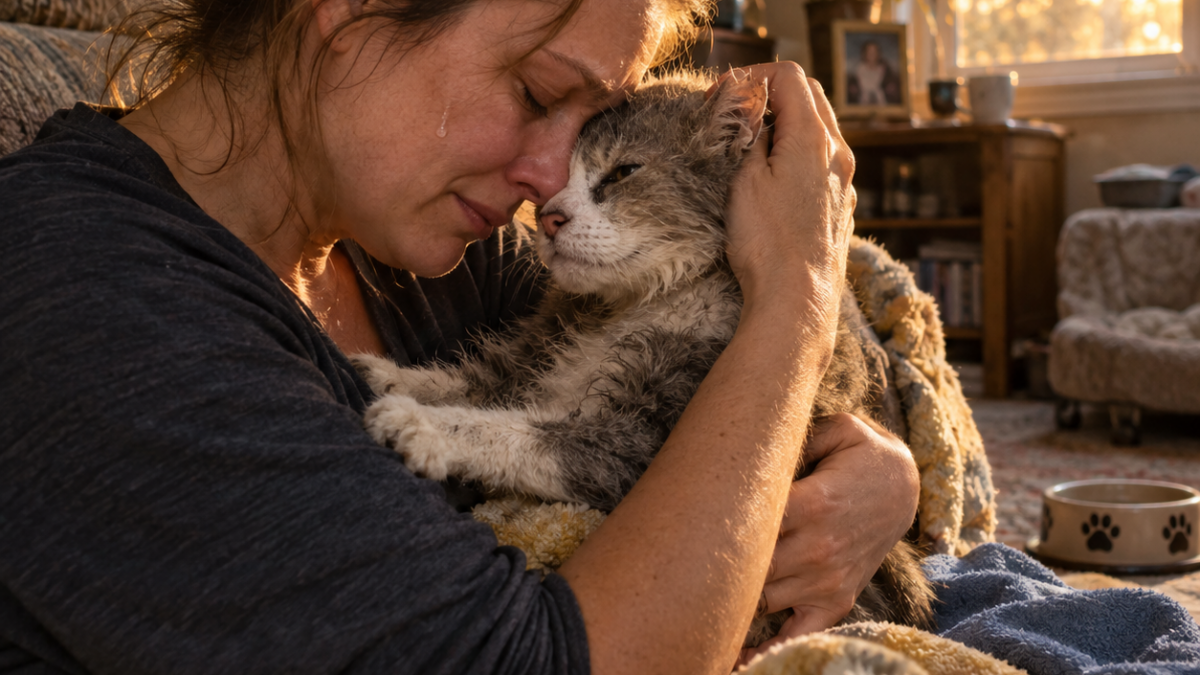
PART3:
My expression looked permanently irritated even when I was comfortable.
A volunteer had written “independent personality” on my card.
That is shelter language for difficult.
I watched people stop.
Read.
Move on.
Then she came in.
Her name was Claire.
She was twenty-six.
I learned that later because birthdays are apparently very important to humans, even though most of them complain about getting more of them.
Claire did not look like someone who had arrived to choose a pet.
She wore an oversized gray sweatshirt.
Cheap black sneakers.
Her hair was tied up badly.
She held a paper coffee cup in both hands.
There were dark circles beneath her eyes.
She looked tired in a way I recognized.
Not sleepy.
Used up.
She walked past two cages.
Then mine.
Then came back.
I sat near the rear wall.
She crouched.
We stared at each other.
Most humans make ridiculous noises at cats.
“Kiiiitty.”
“Pspspsps.”
“Who’s a handsome baby?”
Claire didn’t.
She looked at my ear.
My fur.
My narrowed eyes.
Then she said, “Well.”
I moved one paw forward.
“You look like you’ve had a week.”
Her voice cracked slightly.
I walked toward the bars.
She held out one finger.
I smelled coffee.
Laundry detergent.
Rain.
And loneliness.
Especially loneliness.
People have a smell when they have been crying regularly.
Salt.
Skin.
Stale rooms.
Stress.
I rubbed my face against the bar near her hand.
Claire laughed.
A real laugh.
Short.
Surprised.
Like her own body had made the sound without asking permission.
She looked behind her.
A shelter employee approached.
“You interested in Jasper?”
Jasper.
That was the name they had given me.
Claire looked back at my card.
“Jasper?”
“He came in as a stray.”
“How long?”
“About three weeks.”
The employee hesitated.
“He’s a little shy. Would probably do best in a quiet home.”
Quiet.
Another polite word.
Claire understood it too.
“You mean nobody wants him.”
The employee gave the careful smile of somebody trained not to insult inventory.
“He just hasn’t found the right person.”
Claire stared at me.
I stared back.
Then she whispered so softly that the employee did not hear:
“Yeah. Me neither.”
I pushed my nose through the bars as far as possible.
Claire’s eyes filled.
She laughed again.
“Oh, no.”
She wiped under one eye.
“Absolutely not. You do not get to manipulate me.”
I blinked.
She stood.
Walked away.
I sat down.
I was not surprised.
Everybody walked away.
Five minutes later, she returned with adoption papers.
That was Claire.
She spent years thinking every important decision required weeks of analysis.
But the decisions that changed her life were usually made in one emotional moment she later had to financially justify.
She had twenty-eight dollars in her checking account after the adoption fee.
She told me that years later.
Her first apartment was a studio above a laundromat.
It was technically a one-bedroom if you were generous and had never seen a bedroom.
The heater clanked every twenty minutes.
The windows leaked air.
The kitchen faucet dripped.
The refrigerator hummed loudly enough that I initially believed another animal lived behind it.
My first food bowl was an old cereal dish with blue flowers.
My first water bowl was a plastic container that once held takeout soup.
My first bed was a folded blue towel.
Claire apologized for everything.
“Sorry it’s small.”
I walked the perimeter.
“Sorry about the heater.”
I smelled under the couch.
“Sorry, I don’t have a real cat bed yet.”
I jumped onto the windowsill.
“Sorry about—”
I looked at her.
She stopped.
“Okay.”
That first night, she expected me to hide.
I did.
For approximately forty minutes.
Then the radiator exploded into banging sounds, and I came out from beneath the couch ready to fight the building.
Claire was asleep on the couch.
Not the bed.
She had left the bedroom door open for me, but apparently feared crowding me.
One arm hung toward the floor.
Her fingers rested a few inches above the carpet.
I sniffed them.
She did not move.
I sat beside the couch.
The apartment felt strange.
But not dangerous.
I lay down near her hand.
That became our first night.
In the beginning, Claire worked at a call center.
I hated that job and never set foot inside it.
She left at 7:20.
Returned around 6:00.
Some evenings her steps came lightly up the stairs.
Those were good days.
Other evenings I could hear her before the key entered the lock.
Slow.
Heavy.
Pause outside.
Deep breath.
Then the door.
I learned to wait.
The second she entered, I sat near the mat.
“Hey, buddy.”
She always said it the same way.
Even when crying.
Especially when crying.
She changed clothes.
Made noodles.
Fed me first.
Then she sat on the floor or couch and talked.
Customers called her stupid.
Managers tracked bathroom breaks.
A man named Derek stole credit for her work.
Her mother called and asked when she would “do something serious” with her life.
Her younger sister got engaged.
An old college friend bought a house.
Everybody seemed to be moving forward.
Claire felt stuck in a studio over a laundromat with twenty dollars until payday and a shelter cat who bit cardboard.
I thought we had a good arrangement.
Humans make comparisons too easily.
A cat never looks at another cat’s social media and wonders why he has not purchased property.
One evening Claire sat at the table with bills spread out.
I jumped onto them.
“Jasper.”
I sat.
“Move.”
I lay down.
She tried pulling a bill from beneath my chest.
I placed one paw on her wrist.
“You are deeply unhelpful.”
I purred.
She stopped fighting.
Then she cried.
I did not move.
“I don’t know what I’m doing,” she whispered.
Neither did I.
But doing nothing together seemed acceptable.
Months passed.
Claire bought me an actual cat bed.
I ignored it.
She bought a scratching post.
I scratched the couch.
She bought a toy mouse.
I preferred the receipt.
She learned not to take my ingratitude personally.
Then she met Michael.
I noticed his smell first.
Cologne.
Leather.
Coffee.
Confidence.
He came over wearing a dark coat and carrying flowers.
Claire had cleaned the apartment for two hours before he arrived.
She had also cleaned me, an insult I have not forgotten.
Michael crouched.
“Hey, Jasper.”
I looked at Claire.
“How does he know my name?” my expression asked.
Claire smiled nervously.
“I’ve told him about you.”
Michael extended his hand.
I sniffed.
He did not smell dangerous.
That should not be confused with trustworthy.
He was around constantly after that.
He made Claire laugh.
He cooked.
He replaced the broken cabinet hinge.
He complained about cat hair but said it with a smile.
For almost two years, Claire looked happier.
She moved out of the call center and into an administrative job at a medical office.
We moved to a larger apartment.
I gained a second window.
My quality of life improved dramatically.
Michael eventually brought boxes.
His jackets occupied the closet.
His shoes appeared beside Claire’s.
His toothbrush arrived.
Then his mail.
Humans treat possession migration as a relationship milestone.
At first, I liked having him there.
He fed me when Claire worked late.
He opened windows.
He let me smell his dinner.
But slowly, I noticed things Claire didn’t.
Her laughter became cautious.
She checked his face before disagreeing.
He corrected small things.
How she parked.
How she cut vegetables.
How loudly she laughed in restaurants.
What she spent.
Who she texted.
Sometimes they fought quietly after midnight.
I sat outside the bedroom.
One evening Michael came home angry.
Claire had been waiting.
Dinner cold.
Her hands folded.
“You said six.”
“I said around six.”
“It’s almost nine.”
“I got held up.”
“You could’ve texted.”
Michael tossed his keys onto the counter.
“Why do you always do this?”
“Do what?”
“Turn everything into a problem.”
Claire’s shoulders changed.
Smaller.
“I just worried.”
“You worry because you need control.”
He walked past her.
I followed.
Michael looked down.
“Not now, Jasper.”
He nudged me away with his foot.
Not hard.
But dismissive.
Claire saw.
“Don’t push him.”
Michael turned.
“I barely touched him.”
“I said don’t.”
That surprised both of them.
Claire rarely challenged him directly.
Michael laughed without humor.
“You care more about that cat than me.”
Claire stared.
I sat between them.
“No,” she said. “I trust him more.”
The room changed.
Three weeks later, Michael moved out.
The breakup was ugly.
Not physically.
Words can damage a room without breaking furniture.
He told Claire she was impossible to satisfy.
Too sensitive.
Too suspicious.
Unstable.
He said no one would put up with her long-term if she kept interpreting everything as an attack.
Claire cried.
He packed.
I watched.
At one point Michael pointed at me.
“That thing is going to die someday, you know.”
Claire went very still.
“What?”
“You built your whole emotional life around an animal.”
“Get out.”
“I’m serious.”
“Get out.”
“You think that cat—”
“Get out!”
That was the loudest I had ever heard Claire.
Michael stared.
Then smiled.
Cold.
“Fine.”
He left.
The door closed.
Claire locked it.
Then locked the deadbolt.
Then leaned her back against the door.
Her body slid downward.
She sat on the floor.
I approached.
She buried her face in both hands.
I rubbed against her knee.
At first she ignored me.
Then she grabbed me.
Too tightly.
I allowed it.
Her face pressed into my fur.
“Please don’t leave me too.”
I did not know what too meant in the human way.
But I understood the body holding me.
Fear.
Humiliation.
Grief.
Relief.
Humans often feel contradictory things and then punish themselves for it.
Cats do not.
I stayed.
That winter was bad.
Claire stopped opening the curtains.
She took sick days when she wasn’t sick.
She ate cereal for dinner.
Sometimes she came home and lay on the couch without taking off her coat.
I developed methods.
If she stayed in bed after nine, I walked on her chest.
If she locked the bedroom door, I scratched.
If she cried in the shower, I yelled outside until she emerged.
If she sat too long staring at nothing, I pushed objects from tables.
Once I broke a coffee mug.
That got a reaction.
“Jasper!”
Success.
Another time she spent an entire Sunday under a blanket.
I attacked her feet.
“Stop.”
I attacked again.
“Jasper.”
Again.
She kicked slightly.
I pounced.
Finally she laughed.
Tiny.
But there.
I sat beside her.
She uncovered her face.
“You’re a terrible emotional support animal.”
I purred.
She scratched my chin.
“Fine. Maybe not terrible.”
Slowly, Claire came back.
Not dramatically.
There was no morning when she woke cured.
Humans like transformation stories with music behind them.
Real recovery is less cinematic.
Claire started washing dishes the same night instead of leaving them overnight.
She answered calls from her sister.
She went outside on Saturdays.
She opened the curtains.
She replaced Michael’s chair.
She moved the couch.
She painted one wall yellow and hated it, then repainted it blue.
She got promoted.
She made a friend named Nina at work who laughed loudly and never apologized.
Nina came over often.
I approved after four visits.
Claire eventually dated again.
A teacher.
Then a dentist.
Then nobody for a long time.
That last period was when she changed most.
She stopped treating being alone like an emergency.
She bought flowers for herself.
Went to movies alone.
Took a pottery class.
Burned food while learning recipes.
She talked less about being chosen.
More about choosing.
I was proud, though I expressed this by sleeping on her clean laundry.
Years passed.
Claire’s hair became shorter.
Then longer.
Then shorter again.
She changed jobs.
Moved apartments twice.
Each time, I inspected every empty room before furniture arrived.
Each time, she put down the same blue towel from our first apartment before anything else.
“For continuity,” she said.
The towel became thin enough to see light through.
I loved it.
By year ten, my body began making decisions without consulting me.
The windowsill became difficult.
I would crouch.
Calculate.
Jump.
My back feet sometimes missed.
Claire pretended not to see the first time.
The second time, she bought a little set of pet stairs.
I stared at them.
“No.”
I stared harder.
“Do not make this about pride.”
I walked away.
Three days later, when she was not looking, I used them.
She looked.
I stopped halfway.
“Not a word,” her face said.
We understood each other.
Then food became harder.
My teeth hurt.
She switched brands.
Then textures.
Pâté.
Gravy.
Prescription.
Warm water mixed in.
She researched constantly.
Late at night I watched blue light illuminate her face as she read:
Senior cat kidney disease.
Cat losing weight but eating.
When is a cat too old for anesthesia.
Signs a cat is in pain.
Quality of life scale.
That last search changed her.
She closed the laptop.
Looked at me.
I looked away.
A few months later, the vet said words Claire had expected and still wasn’t ready to hear.
Kidneys.
Arthritis.
Weight loss.
Age.
Supportive care.
Comfort.
Monitor.
None of the words meant death individually.
Together, they gathered around it.
Claire became efficient.
Medication at seven.
Special food.
Fresh water in three rooms.
Litter box with a lower edge.
Rug runners so I would not slip.
Heating pad.
Steps.
She reorganized her life around me without calling it sacrifice.
That was her greatest kindness.
She did not perform love.
She made adjustments.
If I vomited, she cleaned it.
If I missed the litter box, she cleaned that too.
The first time it happened, I stood near the accident.
Embarrassed.
I had always been clean.
Cats care deeply about this.
Claire walked in.
Stopped.
Saw me.
Saw the floor.
Her expression changed.
I lowered my head.
She crouched.
“Hey.”
I wouldn’t look.
“Jasper.”
She touched my shoulder.
“It’s okay.”
She cleaned quietly.
Then kissed my head.
“No shame in this house, old man.”
I remembered that.
Humans do not realize how much dignity can be protected by tone.
By twelve years, my face had turned white around the nose.
My hips showed.
I slept more.
Played almost never.
Sometimes I woke and forgot where I was for several seconds.
I would cry.
Claire always answered.
“I’m here.”
From the bedroom.
“I’m here, Jasper.”
From the kitchen.
“I’m right here.”
Eventually, she moved my bed beside hers.
Then one night she moved herself to the floor beside me.
That was when I knew she knew.
The morning of the expensive litter came after three bad nights.
I had stopped finishing meals.
My breathing was different.
My legs trembled after crossing the room.
Claire watched everything.
Counted everything.
How much water.
How much food.
How many times I stood.
How long I slept.
Humans think counting gives them control.
Sometimes it only gives fear a schedule.
She called the clinic.
Spoke quietly.
“Yes.”
Pause.
“No, he’s still drinking.”
Pause.
“A little.”
Pause.
“No.”
Longer pause.
“I understand.”
She ended the call.
Sat beside me.
“You hate that place.”
I blinked.
“So we’re not going unless we have to.”
The next morning she went to the store.
She bought the expensive litter because it was softer under paws.
She bought baby food.
Tuna.
A heated blanket.
A new water dish raised on a stand.
She also bought herself coffee and forgot to drink it.
At checkout, the cashier scanned the litter.
“That’s the fancy stuff.”
Claire smiled.
“Yeah.”
“Your cat picky?”
Claire swallowed.
“Old.”
The cashier nodded.
“My dog’s fourteen.”
Claire looked relieved to speak with somebody who might understand.
“It’s hard.”
“Yeah.”
That was all.
Two strangers.
Four words.
Claire almost cried anyway.
At home, she put everything away.
Except the litter.
She left it near the hallway.
That bag became a symbol she resented.
Preparation.
Hope.
Waste.
She held me that evening in the recliner.
I had spent hundreds of nights in that chair.
On her lap while she read.
On the arm while she watched television.
Behind her head when she tried to work.
Now I lay against her chest.
My body felt heavier than it should have.
Her heart beat underneath me.
Slow.
Strong.
“You saved me,” she whispered.
No.
That was not right.
Not entirely.
She gave me a home.
I gave her somebody to come home to.
She fed me.
I interrupted despair.
She paid for medicine.
I sat through loneliness.
She carried me out of a shelter.
I carried her through years nobody else saw.
Rescue is a word humans like because it creates direction.
One saves.
One is saved.
That was never us.
We traded.
Home for witness.
Food for routine.
Warmth for presence.
Years for years.
That night she did not put me down.
She sat until her back hurt.
I knew because she shifted every few minutes.
Eventually she carried me to the bedroom.
She had built a nest beside the bed.
Two blankets.
Her old sweatshirt.
The blue towel.
My first towel.
I smelled it.
Under twelve years of detergent, moves, sunlight, dust, and life, I imagined I could still smell the first apartment.
Claire lay beside me.
Not on the mattress.
Floor.
Face level with mine.
“You remember this?”
Her fingers touched the towel.
“I stole it from my mother’s linen closet.”
I blinked.
“She thinks she lost it.”
Claire smiled.
Then cried.
“I kept everything from you.”
Not true.
She had thrown away hundreds of ruined toys.
But humans speak poetically near endings.
She touched the notch in my ear.
“I never found out what happened here.”
Good.
Some histories do not improve with explanation.
She closed her eyes.
“I’m scared I’m doing this wrong.”
There it was.
The fear beneath everything.
Humans want love to come with instructions.
Especially at the end.
They want a number.
A test.
A clear point where mercy becomes required.
They want somebody with authority to say:
Now.
Before now is selfish.
After now is cruel.
Now is correct.
Life rarely provides such precision.
Claire whispered, “What if you still have good days?”
I breathed.
“What if tomorrow is better?”
I shifted my paw.
“What if I make the call too soon?”
Her voice broke.
“What if I already waited too long?”
There are no words cats can speak to humans.
If there were, I would have told her:
You are asking the wrong question.
You are asking how to avoid guilt.
You cannot.
Love creates guilt at endings because every choice leaves another choice unlived.
If you wait, you will wonder if I suffered.
If you let me go, you will wonder if I had more time.
You are not choosing between grief and peace.
You are choosing which grief will protect me better.
But I could only look at her.
Claire put her forehead against mine.
“I’m sorry.”
She said it over and over.
Humans collect apologies at the end.
They remember every late dinner.
Every irritated voice.
Every trip they postponed.
Every moment they did not appreciate enough while it was ordinary.
They turn years of love into a courtroom and prosecute themselves using five bad minutes as evidence.
Claire remembered once pushing me off the bed because I woke her at four in the morning.
She remembered yelling when I scratched her new couch.
She remembered leaving me overnight with a friend for a work trip.
She remembered being late from the office.
She remembered every pill she forced down my throat.
None of those were the story.
The story was twelve years.
Twelve years of doors opening.
Bowls filled.
Windows shared.
Illness noticed.
Fear answered.
Presence.
I wanted to interrupt her guilt.
I could not lift my paw high enough.
So I moved my head into her palm.
She stopped talking.
Her fingers curved around my cheek.
“Okay,” she whispered.
We slept like that.
In the morning, pale light came through the curtains.
Claire woke before the alarm.
She watched me breathe.
Once.
Twice.
Three times.
Counting again.
I opened my eyes.
“Morning,” she said.
Her smile looked destroyed.
She stood.
Made coffee.
Did not drink it.
Opened her phone.
Closed it.
Walked to the window.
Came back.
Finally, she called.
“Yes,” she said.
Pause.
“Today.”
Her free hand covered her mouth.
“At home, if possible.”
She listened.
“Yes.”
Another pause.
“I don’t want him scared.”
That mattered.
I had started in a place full of fear.
Bleach.
Metal.
Strangers.
I did not want my last room to smell like that.
The person on the phone must have said something kind.
Claire nodded even though nobody could see.
“Thank you.”
After the call, she sat beside me.
“We have a few hours.”
She laughed once.
Awful sound.
“Like we’re waiting for a delivery.”
I watched her.
She started cleaning.
Humans do strange things when powerless.
Claire wiped the kitchen counters.
Already clean.
Folded laundry.
Rearranged books.
Emptied the dishwasher.
Refilled my water.
Opened drawers.
Closed them.
At one point she stood holding a spoon for almost a minute.
Then put it in the wrong drawer.
Grief had already begun dismantling her concentration.
Around ten, she brushed me.
Slow.
Careful near my spine.
“You still shed like you’re getting paid.”
I would have purred louder if I could.
She brushed my cheeks.
My neck.
The ragged ear.
“Handsome.”
Claire had always called me handsome.
I respected that she could love while lying.
She opened the window slightly.
Spring air entered.
Dirt.
Grass.
Car exhaust.
Warm pavement.
A dog somewhere.
Flowers.
Rain far away.
I lifted my nose.
Claire noticed.
“Good?”
Yes.
She brought my blanket to the patch of sunlight.
Sat beside me.
For a while, neither of us tried to make the moment meaningful.
That was good.
Humans can ruin beautiful moments by demanding they behave like memories before they are finished.
We sat.
A truck backed up outside.
Children shouted somewhere.
A neighbor slammed a car door.
Life continued without permission.
Claire eventually spoke.
“Remember the laundromat apartment?”
Yes.
“The heater?”
Unfortunately.
“You used to attack the radiator.”
It started fights.
“You were insane.”
I closed my eyes.
She laughed.
“Remember when you stole my turkey sandwich?”
Yes.
“You dragged it under the couch.”
Efficient.
“I was so broke.”
She rubbed my shoulder.
“That sandwich was supposed to be lunch and dinner.”
My mistake.
“Then you threw up on the rug.”
Unnecessary detail.
Claire laughed until she cried.
She told stories.
The power outage when we slept under three blankets.
The paint incident.
The Christmas tree I knocked over.
The time I disappeared for forty minutes and she panicked, only to discover I had climbed into an open kitchen cabinet and fallen asleep.
Michael.
She hesitated before that name.
“You hated him.”
Not immediately.
“I should’ve trusted you.”
Do not give me too much credit.
I also hated the vacuum.
Claire smiled.
“After he left, I really thought I was done.”
She looked at the window.
“I don’t know if I ever told you how close I got.”
I opened my eyes.
Her voice softened.
“There was one night.”
She stopped.
Breathed.
“I was sitting on the bathroom floor.”
Her fingers tightened in my fur.
“I just wanted everything to stop hurting.”
I listened.
“I didn’t have a plan. Not really. I just remember thinking I couldn’t do another day like that.”
She looked at me.
“You scratched at the door for almost an hour.”
I remembered the door.
Not the reason.
“You wouldn’t stop.”
She laughed softly.
“I finally opened it because you were annoying me.”
Correct strategy.
“You walked in, climbed onto my lap, and went to sleep.”
Claire wiped her face.
“I stayed because I didn’t want you to wake up alone.”
The room became very quiet.
“So when I say you saved me…”
Her voice collapsed.
“I mean it.”
I wanted to tell her something.
Not in language.
In truth.
I did not save Claire alone.
She saved herself hundreds of times.
She got up.
Went to work.
Called Nina.
Went to therapy for a while.
Left Michael.
Took medication when she needed it.
Stopped dating men who made her feel grateful for basic kindness.
Built a life.
I was there.
That matters.
But being witnessed is not the same as being rescued.
Maybe what she needed from me was simpler.
A reason to postpone the worst decision.
One night became morning.
Morning became another day.
Days accumulated.
Eventually pain changed shape.
Humans underestimate the value of postponing despair.
Sometimes survival is not heroic.
Sometimes something small just needs you tomorrow.
At noon, Claire opened a small container.
Chicken.
My favorite.
I smelled it.
Wanted it.
My body disagreed.
I licked once.
Stopped.
Claire’s face fell.
She tried to hide it.
“That’s okay.”
She moved the dish away.
That was when I think her last doubt changed.
She had been waiting for appetite as proof.
I could not give it.
The woman arrived at 2:17.
I knew the exact moment because Claire had checked the clock seventeen times.
Her name was Dr. Morales.
She wore soft shoes and carried a dark medical bag.
She entered quietly.
No bright clinical voice.
No false cheer.
She greeted Claire first.
Then immediately looked at me.
Not over me.
At me.
“Hi, Jasper.”
Her smell held many animals.
Soap.
Paper.
Dogs.
Cats.
Other homes.
Other endings.
I liked her.
This felt disloyal.
Then I decided loyalty did not require bad judgment.
Dr. Morales sat on the floor.
She did not touch me immediately.
She watched.
Breathing.
Posture.
Eyes.
Hips.
Then she looked at Claire.
“How was last night?”
Claire swallowed.
“Hard.”
“Eating?”
“Almost nothing.”
“Water?”
“A little.”
“Walking?”
“Slow.”
“Any hiding?”
“No.”
Dr. Morales nodded.
Then asked the question.
“Do you feel ready?”
Claire stared at me.
For several seconds, nobody breathed normally.
“No,” she said.
Dr. Morales waited.
Claire wiped her face.
“No. I don’t feel ready.”
Then she touched my head.
“But I think he is.”
Dr. Morales nodded.
That was the bravest answer Claire ever gave.
Humans often mistake certainty for strength.
Claire had no certainty.
She had love.
Sometimes love has to act without certainty.
Dr. Morales explained.
First medication.
Relaxation.
Sleepiness.
No pain.
Then, when Claire was ready, the final injection.
Claire’s hand shook.
“Will he know?”
“Know what?”
“That I’m…”
Claire couldn’t finish.
Dr. Morales understood.
“He’ll know you’re here.”
Claire cried immediately.
Dr. Morales waited.
“She’ll smell you. Hear you. Feel you.”
He.
But nobody corrected her because grief distorts details.
Claire asked for time.
Dr. Morales stepped into the kitchen.
Then it was only us.
Claire picked me up.
My body protested.
She adjusted.
“I’m sorry.”
I settled against her.
She sat in the recliner.
Sunlight touched my paws.
Her hand rested under my ribs.
“Listen to me.”
Her voice was shaking hard now.
“You were never too much.”
I looked at her.
“Not the vet bills.”
She laughed through tears.
“Even though those were outrageous.”
I blinked.
“Not the ruined couch.”
That couch was weak.
“Not waking me up.”
Necessary.
“Not the accidents.”
Her face broke.
“Not this.”
She pressed her forehead against mine.
“You never became a burden.”
That sentence was not only for me.
I recognized the young woman from the shelter inside her.
Claire had spent years believing love had conditions.
Be cheerful.
Be attractive.
Be useful.
Do not ask too much.
Do not cry too much.
Do not be expensive.
Do not be difficult.
Do not age badly.
Do not need care.
She was telling me what she had finally learned about herself.
“You never had to earn staying,” she whispered.
No.
Neither did she.
“You were the best part of every apartment.”
I believed that.
She laughed weakly.
“You were there before I had real furniture.”
True.
“Before I knew Nina.”
Yes.
“Before I knew how to cook.”
Absolutely.
“Before I liked myself.”
There.
That was the sentence.
She looked at me.
“And you liked me anyway.”
Cats do not love based on resumes.
We know smell.
Voice.
Routine.
Safety.
We know whether hands hurt.
Whether doors reopen.
Whether food comes.
Whether we can sleep deeply near you.
Humans complicate worth.
Animals often do not.
Claire cried into my fur.
Then whispered:
“You can go.”
My eyes half closed.
“You hear me?”
Her hand trembled against my side.
“You don’t have to stay because I’m scared.”
Her voice became almost inaudible.
“I’ll be sad.”
Pause.
“I’ll be wrecked.”
Another terrible laugh.
“But I’ll be okay someday.”
That cost her.
I knew.
“You can go, Jasper.”
Permission.
Mercy.
Love without possession.
Dr. Morales returned.
She sat beside us.
“Ready for the first medicine?”
Claire nodded.
Then shook her head.
Then nodded again.
The injection pinched.
I did not like it.
Claire apologized.
“Sorry, sorry.”
Dr. Morales smiled gently.
“He can be annoyed at us.”
I was.
The room softened.
Pain stepped backward.
My hips.
My stomach.
The constant ache under everything.
For the first time in months, my body stopped shouting.
I sighed.
Claire heard.
“Oh.”
Her face changed.
She realized how much effort I had been spending.
That hurt her.
Dr. Morales touched her shoulder.
“That relaxation tells us something.”
Claire nodded.
“I know.”
She kissed the top of my head.
As the medicine spread, I became heavy.
Warm.
Safe.
Claire kept talking.
She told me about the bird feeder she had never bought because she knew I would become obsessed.
She told me about the time I tracked white paint across an entire hallway.
She told me Nina once said I looked like a retired criminal.
Accurate.
She told me she still had the shelter paperwork.
Of course she did.
She told me the first night I slept by her hand, she had been terrified adoption was a mistake.
“I thought I couldn’t take care of anything.”
Her fingers rubbed between my ears.
“Turns out I could.”
Yes.
“You taught me that.”
Maybe.
Or maybe she learned by doing it.
Dr. Morales waited.
No rushing.
That mattered.
Finally she looked at Claire.
“Whenever you’re ready.”
Nobody is ready.
Claire closed her eyes.
Then opened them.
“Okay.”
The final medicine entered.
I heard Claire’s voice.
“Jasper.”
My name.
Again.
“Jasper.”
Softer.
“I love you.”
Again.
“You were good.”
Again.
“So good.”
My last clear sensation was her thumb rubbing the place between my ears.
The place that always made me lean.
Even old.
Even tired.
I leaned.
Barely.
Claire gasped.
Then laughed and cried at once.
“That’s my boy.”
The sunlight was warm.
Her heart beat beneath my body.
Then the heaviness loosened.
I cannot describe what came after.
Humans want maps of that territory.
Animals do not have one to offer.
I know only what love left behind.
Claire stayed in the chair.
Long after Dr. Morales quietly told her I was gone.
She held me.
She cried into my fur.
She apologized again.
Then thanked me.
Then apologized for thanking me because she thought it sounded like she was glad.
Grief makes language clumsy.
Eventually Dr. Morales left with me wrapped carefully in the blue towel.
Claire almost changed her mind about the towel.
At the door, she touched it.
“That was his first bed.”
Dr. Morales waited.
Claire held the fabric.
Then released it.
“No.”
She swallowed.
“Let him keep it.”
The door closed.
Silence entered.
Not normal quiet.
Different.
Claire stood in the hallway.
My litter box remained.
Water bowl.
Food dish.
Scratching post.
Blanket.
The expensive litter bag.
That bag.
Still unopened.
She stared at it.
Then picked it up.
Carried it to the kitchen.
Sat on the floor.
Exactly where she had sat after Michael left.
This time no cat approached.
That was the wound.
She pressed her face into the bag and cried until her chest hurt.
Humans imagine death is the worst part of grief.
Often it isn’t.
Death is one event.
Grief is discovering the event repeatedly.
The next morning, Claire woke and reached down beside the bed.
Air.
She froze.
First discovery.
She went to the bathroom and instinctively held the door open.
No one followed.
Second.
She opened the refrigerator.
Saw my food.
Third.
The mail carrier pushed letters through the slot.
No ears lifted.
Fourth.
A bird landed outside the window.
No body jumped onto the sill.
Fifth.
Grief multiplied.
For one week, she left my water bowl.
For nine days, my blanket stayed beside her bed.
For two weeks, she stepped around the place where my food dish had been even after removing it.
For three weeks, she heard phantom sounds.
A scratch.
A jump.
A small cry.
She would turn.
Nothing.
At work, people were kind for two days.
Then life resumed.
That is normal.
Pain feels enormous only to the person carrying it.
Nina came over with dinner.
Claire sat at the table.
“I keep expecting him.”
“I know.”
“I hate the apartment.”
“Come stay with me.”
“No.”
“Why?”
Claire looked toward the empty window.
“Because leaving feels like…”
She stopped.
“Like what?”
“Like he’ll come back and I won’t be here.”
Nina did not laugh.
Good friend.
She reached across the table.
“Claire.”
“I know.”
“He’s not coming back.”
“I know.”
Saying and knowing are different.
A coworker told Claire, “At least he had a long life.”
Correct.
Useless.
A neighbor said, “You can always get another one.”
Wrong.
Cruel without intending cruelty.
Claire smiled politely and went upstairs.
Another person said, “It was just a cat.”
Just.
Humans use that word when somebody else’s grief is inconveniently large.
Just a cat.
I was there when Claire’s life fit into one room.
I was there when she ate noodles because she could not afford groceries.
I knew Michael before and after.
I watched her rebuild.
I knew every apartment.
Every job.
Every haircut.
Every version.
I watched her become somebody who no longer begged to be chosen.
Just a cat.
Perhaps.
But also witness.
Routine.
Family.
History with fur.
Claire stopped telling most people how bad it hurt.
That is what humans do after being corrected enough.
They hide grief to make others comfortable.
Nina knew better.
She came over every Friday.
Sometimes they talked about me.
Sometimes not.
One Friday, Nina brought a small framed photograph.
Claire holding me six years earlier.
I looked irritated.
Claire looked joyful.
“You printed this?”
“You sent it to me years ago.”
Claire touched the glass.
“He hated pictures.”
“He looked like he hated oxygen.”
Claire laughed.
Then cried.
Nina let both happen.
Weeks became months.
The apartment changed slowly.
Claire donated unopened food.
The litter went to a rescue organization.
That was the hardest.
She drove there.
Sat in the parking lot for twenty minutes.
Finally walked inside carrying the expensive bag.
The same shelter.
Not the same building exactly.
Renovated.
Brighter.
Less bleach.
Still fear underneath.
A volunteer smiled.
“Donation?”
Claire nodded.
“My cat died.”
The volunteer’s expression softened.
“I’m sorry.”
“Thanks.”
“What was his name?”
Claire stopped.
Most people had not asked that.
“Jasper.”
“What was he like?”
Claire almost laughed.
“Judgmental.”
The volunteer smiled.
“The best kind.”
Claire looked toward the adoption room.
She heard kittens.
A dog barked.
Her chest tightened.
“I got him here.”
The volunteer looked surprised.
“How long ago?”
“Twelve years.”
“That’s a good run.”
“Yeah.”
Claire started toward the door.
Then stopped.
A cage at the end of the room held an older cat.
Gray.
One cloudy eye.
Thin face.
He sat facing away from the aisle.
Families walked past.
Claire stared.
No.
Immediately no.
She was not ready.
This would be betrayal.
Replacement.
Panic disguised as compassion.
She turned.
Walked three steps.
Stopped.
Looked back.
The old cat still did not turn around.
A little card read:
MILO.
AGE 10.
QUIET HOME PREFERRED.
SPECIAL DIET.
Claire laughed once.
Of course.
She approached.
Crouched.
Milo turned his head.
One clear eye.
One cloudy.
A deeply unimpressed expression.
Claire covered her mouth.
The volunteer came over.
“He’s been here a while.”
Of course he had.
“Health issues?”
“Manageable. Dental work already done. Mild arthritis. Needs kidney food.”
Claire closed her eyes.
No.
Absolutely not.
The vet bills alone.
The age.
The inevitable ending.
She had just survived one.
Why choose another short road?
Milo stood.
Slowly.
Walked toward the bars.
Claire held out one finger.
He smelled it.
Then pressed his face against the metal.
Claire burst into tears.
The volunteer looked concerned.
“You okay?”
Claire laughed.
“No.”
Then she looked at Milo.
“Well.”
Her voice cracked.
“You look like you’ve had a week.”
History does not repeat perfectly.
It rhymes.
Claire did not adopt Milo that day.
That mattered.
She went home.
Thought.
Cried.
Talked to Nina.
Called her veterinarian.
Reviewed money.
Asked questions.
She did everything responsibly this time.
And three days later, she returned.
Milo was still there.
“Of course you are,” she whispered.
He blinked.
She signed the papers.
Not because Jasper had been replaced.
Love does not work like a seat someone else fills.
Claire had learned something from me.
A home can hold more than one history.
Milo entered the apartment cautiously.
He smelled everywhere.
When he reached the window, he stopped.
The old recliner remained nearby.
Claire watched from the kitchen.
Milo jumped halfway onto the sill.
Failed.
Landed awkwardly.
Claire’s heart seized.
Then she smiled.
She brought out the pet stairs she had not been able to throw away.
Set them under the window.
Milo inspected them.
Ignored them.
Claire laughed through tears.
“Yeah.”
She sat on the floor.
“He did that too.”
The first night Milo hid under the bed.
Claire did not force him out.
She placed food nearby.
Water.
Then lay on top of the bed and talked.
She told him about Jasper.
Not constantly.
Just enough.
“You’re not him.”
Silence under the bed.
“I know that.”
Milo’s paw became visible.
“And you don’t have to be.”
The paw disappeared.
“I had a cat who taught me not to rush scared things.”
Milo came out at two in the morning.
He did not sleep beside her.
He sat near the doorway.
That was enough.
Months passed.
Milo developed his own rules.
No belly touching.
Breakfast at 5:40.
Window open whenever weather permitted.
He hated Nina.
Then loved Nina.
He preferred boxes to beds.
He never sat in the recliner for almost a year.
Claire never encouraged him.
Then one rainy Sunday afternoon, he jumped up.
Circled.
Curled into the exact place I used to sleep.
Claire was in the kitchen.
When she saw him, she stopped.
Her face changed.
For one second she looked hurt.
Then grateful.
She sat on the floor beside the chair.
Milo opened one eye.
Claire touched the armrest.
“Okay.”
Tears came.
Not violent anymore.
Soft.
“Okay.”
Milo purred.
Life after grief is strange.
People assume healing means memories lose power.
Sometimes healing means the memories keep their power but lose their teeth.
Claire could remember my last day without collapsing.
Eventually.
She could walk through the pet aisle.
Eventually.
She could say my name and smile.
Eventually.
She kept my shelter tag.
The blue cereal bowl.
One photograph.
My collar.
The adoption papers.
Everything else changed.
She changed too.
She volunteered at the shelter once a month.
Mostly with older cats.
Of course.
She learned to clean cages.
Give medication.
Sit quietly with frightened animals.
She never told adopters dramatic stories.
She simply said things like:
“Older doesn’t mean less.”
“He may take time.”
“She’s scared, not mean.”
“You don’t need an instant connection.”
“Please don’t choose only by looks.”
Sometimes a family listened.
Sometimes not.
Claire stopped trying to force outcomes.
One afternoon, a teenage girl arrived with her father.
They wanted a kitten.
Then the girl noticed a seven-year-old black cat hiding in the back.
“What about her?”
The father hesitated.
“She’s older.”
Claire was nearby.
The girl crouched.
The black cat stayed hidden.
Claire said nothing.
The girl waited.
Eventually a paw reached out.
The girl smiled.
Claire had to walk into the supply room and cry for thirty seconds.
Not sadness.
Recognition.
The beginning of some stories resembles the end of others.
Years later, Claire still spoke to me sometimes.
Not because she believed I was physically in the room.
Maybe she did.
Humans are allowed private mysteries.
She would lose her keys.
“Jasper, this is exactly the sort of thing you used to prevent by sitting on them.”
Or burn dinner.
“You’d still eat it.”
Or watch Milo knock something over.
“Your brother is an idiot.”
Brother.
Interesting.
Milo aged too.
Everything does.
That is the agreement nobody reads before loving.
Claire knew more the second time.
That did not make it easy.
Wisdom rarely reduces pain.
It reduces confusion.
She recognized arthritis.
Adjusted sooner.
Tracked appetite without panicking at every missed bite.
Talked openly with the vet about comfort.
She did not wait for a crisis because she was too afraid to name what was coming.
That was one of my gifts to Milo.
Not from beyond.
From memory.
The mistakes and lessons of one love become protection for the next.
That is how dead things keep helping the living.
When Milo eventually slowed, Claire sat beside him.
No denial.
No shame.
She cried.
Of course.
But she did not say, “I’m failing you.”
She said, “I know.”
Progress can sound like two words.
I know.
I know your body hurts.
I know more time might be for me, not you.
I know love does not become smaller because I stop demanding proof through suffering.
I know goodbye is not betrayal.
I know.
The day came.
Different weather.
Different doctor.
Different cat.
Same hands.
Same fear.
But Claire was not the same woman.
She held Milo.
“You don’t have to stay for me.”
She had learned the sentence.
When Milo left, Claire grieved him fully.
Not as replacement Jasper.
Not second cat.
Milo.
His own life.
His own habits.
His own place.
That is the final lesson humans struggle to understand.
Love does not divide like money.
Giving some away does not reduce what remains.
I was never threatened by Milo.
How could I be?
He did not erase the studio above the laundromat.
He did not steal the blue towel.
He did not remove my paw prints from Claire’s history.
He gave her more.
And she gave him what she had learned with me.
That is how love expands across time.
Claire grew older.
Her hair gained silver.
She finally bought a house.
Small.
Blue door.
Two bedrooms.
A yard.
The kind of place twenty-six-year-old Claire thought belonged to other people.
On moving day, Nina stood in the kitchen holding a box.
“Can you believe this?”
Claire looked around.
“No.”
“You own walls.”
“Technically the bank owns most of the walls.”
“Let me have the moment.”
Claire laughed.
On the windowsill sat one photograph.
Me.
Not the prettiest.
Not the saddest.
The shelter picture.
Thin.
Missing ear.
Angry face.
Claire had framed it years earlier.
Underneath, on a tiny label, she had written:
THE ONE NOBODY PICKED FIRST.
Beside it was another photograph.
Milo.
Cloudy eye.
Expression of disgust.
Under his:
THE ONE WHO GOT THE BENEFIT OF EXPERIENCE.
Nina laughed when she saw them.
“You need hobbies.”
“I have hobbies.”
“Collecting emotionally damaged cats is not a hobby.”
Claire smiled.
“It kind of is.”
Eventually another cat came.
Then, years later, a dog.
Claire became one of those women who kept lint rollers in every room and complained while looking secretly delighted.
She never became rich.
Never famous.
Never lived a life that would impress strangers online.
But she became peaceful.
There is no award ceremony for that.
There should be.
She had friends.
A stable job.
A house.
Animals.
A sister she called every Sunday.
Occasional dates.
Then eventually a man named Sam who understood that loving Claire meant respecting the creatures and ghosts she brought with her.
On their third date, Sam asked about the scar on the old recliner Claire still owned.
“Cat?”
“Jasper.”
“Current cat?”
Claire smiled.
“No.”
Sam waited.
“First family.”
That answer told him something.
He did not make a joke.
Good.
Years after my death, Claire went through an old storage box.
She found the expensive litter receipt.
She stared at it.
Twenty-seven dollars and forty-eight cents.
She laughed.
Then sat on the floor.
The same way she always did when memory arrived too quickly.
Sam found her.
“You okay?”
“Yeah.”
She held up the receipt.
“This was the day I knew.”
He sat beside her.
“Knew what?”
“That I was going to lose him.”
Sam knew who him meant.
Claire looked at the paper.
“I bought the fancy litter because I thought maybe if his feet hurt less…”
Her voice trailed.
Sam rested his hand beside hers.
“Did it help?”
“I don’t know.”
She smiled through tears.
“He only used it for one day.”
Sam looked at the receipt.
“Then it helped for one day.”
Claire stared.
That sentence seemed to settle something.
Humans often think small comforts do not count because they cannot defeat endings.
They count precisely because they cannot.
One day softer.
One hour warm.
One meal enjoyed.
One fear reduced.
One body held.
Love has always been made mostly of temporary things.
Food bowls empty.
Blankets wear out.
Apartments are left.
Bodies age.
People go.
Cats go.
What remains is not permanence.
It is evidence.
I was here.
You were kind to me.
You were here.
I was kind to you.
It mattered.
Claire eventually threw away the receipt.
That was healing too.
Not every object must become sacred to prove memory survives.
The photograph stayed.
The collar stayed.
The cereal bowl stayed.
The rest could go.
I think if I had been able to choose what she kept, I would have chosen none of it.
Keep the habit.
That is what I would have said.
Keep noticing.
Keep staying.
Keep choosing the ones nobody chooses first.
Keep opening the curtains.
Keep laughing after bad winters.
Keep refusing people who make you smaller.
Keep buying the softer litter when someone you love hurts.
Keep knowing when mercy matters more than fear.
Keep living.
Do not turn me into an excuse to stop.
I had watched Claire nearly disappear once after Michael.
I would never want grief for me to become another locked room.
That would have made no sense.
A life loved well should widen the world after it leaves.
Not shrink it.
If animals get to leave wishes behind, mine would have been simple.
Do not call her broken.
She was never broken.
She was tired.
Scared.
Learning.
Do not call me a hero.
I was a cat.
I slept fourteen hours a day.
I knocked cups off counters.
I once ate ribbon and created a medical bill large enough to ruin Christmas.
But I stayed.
That mattered.
Claire stayed too.
Through the cheap apartment.
The bad boyfriend.
The depression.
The promotions.
The moves.
The kidney food.
The injections.
The accidents.
The nights I cried.
The morning she knew.
The afternoon she let me go.
People like dramatic definitions of love.
Sacrifice.
Destiny.
Soulmate.
Forever.
I think love is more ordinary.
Love is remembering medication at seven.
Love is cleaning the floor without making somebody feel ashamed.
Love is noticing the jump became harder.
Love is calling the doctor before a crisis.
Love is saying “I’m here” at three in the morning.
Love is buying expensive litter when one day of softer footing may be the only thing money can still fix.
And sometimes love is saying:
You can go.
I will survive missing you.
That may be the hardest promise a human ever makes.
Claire thought letting me go was the moment she failed to keep me.
It was actually the last time she kept me safe.
That is what I wish she could have known immediately.
Not years later.
Not after Milo.
Not after volunteering.
Not after rereading old receipts on a kitchen floor.
That afternoon in the recliner.
The moment guilt entered.
I wish I could have told her:
You did not kill the love by ending the pain.
You protected the love from becoming pain.
You did not betray twelve years.
You honored them.
You did not choose death over me.
You chose me over your fear of death.
There is a difference.
A huge one.
My last day was not the worst day of my life.
That matters.
The worst days happened before Claire.
Before warmth.
Before cereal bowls.
Before somebody knew my habits.
Before I had a person.
My last day had sunlight.
A cracked window.
Spring.
Her lap.
My name.
No cage.
No fear.
No loneliness.
If that is tragedy, it was wrapped in mercy.
Years later, Claire would tell a frightened woman at the shelter something similar.
The woman had brought in a sixteen-year-old cat for humane euthanasia.
She was crying in the parking lot afterward.
“I feel like a murderer.”
Claire was volunteering that day.
She sat beside her on the curb.
“No.”
The woman shook her head.
“I signed the paper.”
“I know.”
“He looked at me.”
“I know.”
“What if I could’ve had another week?”
Claire was quiet.
Then she said:
“Maybe.”
The woman looked at her.
Claire continued.
“Maybe another week existed.”
Tears rolled down the woman’s face.
“But the question isn’t whether there might have been more time.”
Claire’s voice softened.
“It’s what that time would have asked him to carry.”
The woman covered her face.
Claire sat beside her.
No speeches.
No judgment.
Just presence.
Exactly what I had taught her without language.
After a while, the woman whispered, “Did you ever have to do it?”
Claire smiled sadly.
“Twice.”
“How did you know?”
“I didn’t.”
That answer surprised her.
Claire continued.
“I knew they were tired. I knew I was scared. I knew certainty probably wasn’t coming.”
She looked toward the shelter building.
“The first time, I thought love was supposed to give me confidence.”
She shook her head.
“It gave me responsibility.”
The woman nodded.
That day, somebody else went home carrying slightly less guilt because of me.
Again, not magic.
Not afterlife intervention.
Memory turned into kindness.
That is enough immortality for any cat.
Claire lived many more years.
I will not narrate all of them.
Some stories become private.
But I know this.
She kept the blue cereal bowl.
Not as a shrine.
Eventually it held keys by the front door.
That pleased me.
Useful.
She kept my picture near the window.
She adopted old animals.
She loved people carefully.
She stopped confusing loneliness with proof that she needed the wrong company.
She learned to say no without explaining for thirty minutes.
She became the woman the twenty-six-year-old version of herself needed.
And somewhere inside that woman was a scratched-up shelter cat who had once looked at her through metal bars.
Maybe that is what rescue really is.
Not dragging someone from danger once.
Sometimes rescue is repetition.
Come home.
Eat.
Sleep.
Try again.
Come home.
Eat.
Sleep.
Try again.
For twelve years, we repeated life together until she learned she could survive it.
Then when my body could not continue, she gave me something equally important.
Permission not to.
That was our whole bargain.
Stay when staying is kind.
Release when release is kind.
Know the difference as best you can.
Forgive yourself for not knowing perfectly.
I wish more humans understood that last part.
Perfection is a cruel standard to place on love.
You will lose patience.
You will miss signs.
You will spend too much.
Too little.
You will wonder whether you called the vet too soon.
Too late.
You will remember the one morning you were irritated instead of the thousand mornings you filled a bowl.
Grief is dishonest that way.
It takes exceptions and presents them as evidence.
Do not believe it.
Look at the whole life.
That is where love lives.
Not in the final hour alone.
The whole life.
Mine began in fear.
Then came Claire.
A studio apartment.
A cereal bowl.
A towel.
A hand hanging from a couch.
Twelve years.
That is not a sad story.
It has a sad ending.
Different thing.
All lives have endings.
Not all have twelve years of being known.
I did.
Claire did.
We were two creatures nobody would have chosen first.
A tired young woman who thought she was behind everyone else.
A rough shelter cat families passed for prettier kittens.
She looked at me.
I looked at her.
She said:
“You look like you’ve had a week.”
And somehow that became a whole life.
Maybe that is the only final message worth leaving.
Do not wait for perfect things before you love.
Perfect animals.
Perfect people.
Perfect timing.
Perfect finances.
Perfect certainty.
Most of the best things arrive scratched.
Tired.
Afraid.
Complicated.
They do not look impressive behind glass.
They may come with medical bills.
Emotional baggage.
Missing pieces.
Cloudy eyes.
Old wounds.
They may inconvenience the version of your life you planned.
Choose carefully.
But do not confuse polished with worthy.
Claire did not.
That is why I got twelve years.
And because I got twelve years, Milo got a home.
Other shelter animals got someone who understood.
A grieving stranger got comfort on a curb.
Claire got a life she almost did not stay long enough to build.
One choice did not save one cat.
It traveled.
That is what kindness does when it is allowed to age.
It becomes experience.
Then wisdom.
Then shelter.
The morning Claire bought the expensive litter, she thought she was preparing for the end of our story.
She was wrong.
She was preparing for the part of it she would carry forward.
My body was almost done.
The story wasn’t.
It moved into her hands.
Her choices.
Her ability to recognize pain.
Her courage to love again.
Her willingness to let another old unwanted animal enter a home still shaped by the first.
Love stayed behind.
It always does.
Not as a ghost.
As practice.
As memory.
As softened behavior.
As the extra minute someone waits before judging.
As the money spent on comfort that only lasts one day.
As the courage to say goodbye before suffering becomes the price of avoiding guilt.
As a woman crouching twelve years later in front of another unwanted cat.
“Well,” she says through tears.
“You look like you’ve had a week.”
And somewhere in that sentence is everything.
The shelter.
The studio apartment.
The heartbreak.
The nights she almost disappeared.
The old blue towel.
The medicine.
The sunlight.
The recliner.
The final permission.
The silence.
The second chance.
All of it.
She thought she chose me because nobody else wanted me.
Maybe I chose her for the same reason.
Maybe neither of us needed saving in the dramatic way people mean when they use that word.
Maybe we simply needed one living thing that would remain long enough for us to stop believing abandonment was inevitable.
She stayed.
I stayed.
Until staying meant something different.
Then she loved me enough to let me stop.
And for two unwanted creatures who happened to meet through the bars of a shelter cage, that was more than rescue.
That was a whole life.








