Nobody Recognized the Quiet Woman at the K9 Ceremony—Until Seven Police Dogs Broke Formation and Ran Straight to Her
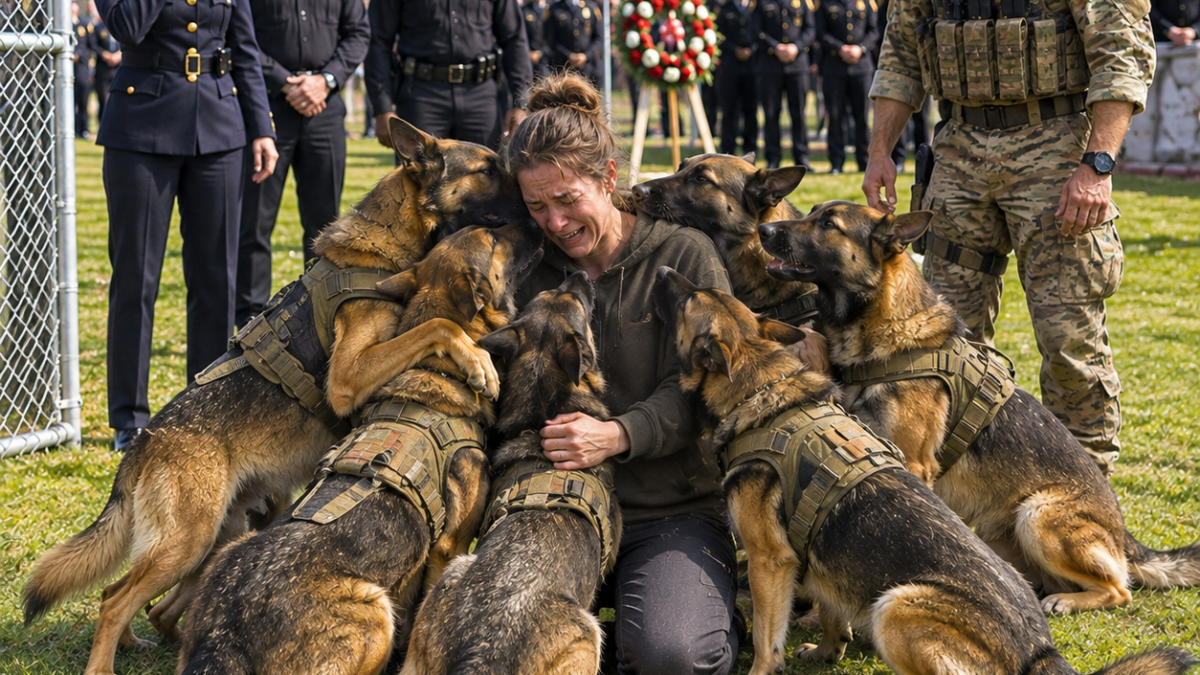
Nobody Recognized the Quiet Woman at the K9 Ceremony—Until Seven Police Dogs Broke Formation and Ran Straight to Her.
Nobody at the ceremony knew the young woman in the oversized thrift-store jacket had once been blamed for destroying one of the most respected police-dog programs in Atlantic Canada.
Seven decorated K9s knew her immediately—and when they tore away from their handlers to reach her, the man who had built his career on her family’s disgrace suddenly realized the past he buried was standing forty yards away.
By sunset, a sealed training report, a terrified former employee, and one detail hidden in the dogs’ original records would expose why Mara Callaway had disappeared—and who had profited from making the world believe she was dangerous.
Nobody noticed Mara Callaway when she arrived at Garrison Grounds.
That was exactly what she wanted.
She parked three blocks away because the streets around the Halifax ceremony had been partially closed, then walked toward the harbor with both hands buried in the pockets of a navy fleece jacket that had belonged to somebody larger than she was.
The November wind smelled like salt, wet pavement, and diesel from the waterfront.
It cut through the fleece anyway.
Mara was thirty-one years old, but cold weather made the knuckles of her right hand ache like they belonged to someone twice that age.
She flexed them once before joining the crowd.
Faded jeans.
Scuffed work boots.
No makeup.
Dark hair twisted into a loose knot.
Nothing about her suggested that she belonged anywhere near the officials gathering under the temporary white canopy at the front of the grounds.
That was deliberate too.
Three years earlier, Mara had owned tailored jackets.
She had spoken at animal-behavior conferences.
She had taught workshops for trainers from police departments, search-and-rescue teams, and private security organizations across Canada and the northeastern United States.
She had known how to stand under bright lights without shrinking.
Now she knew which loading dock at the Truro distribution center stayed warmest after midnight.
Life could rearrange a person that thoroughly.
She bought a coffee from a street cart outside the grounds because standing empty-handed made her feel exposed.
Then she spent twenty minutes holding it without drinking.
At the front of the gathering, television cameras pointed toward a temporary stage decorated with blue-and-silver banners.
RCMP officers stood in formal dress.
Families filled rows of folding chairs.
A military band waited beneath a flat gray Nova Scotia sky.
The ceremony was honoring twelve police K9 teams for distinguished service in drug interdiction, search and rescue, firearms detection, and major criminal investigations across Atlantic Canada.
Mara had almost thrown away the program when she picked it up at the entrance.
Then she saw three names.
Rook.
Duchess.
Cole.
Her fingers had gone numb around the paper.
She knew those names without needing the page.
She had given them those names.
Three years earlier, they had been eight-week-old Belgian Malinois puppies tumbling over one another in a training yard outside Dartmouth.
Rook had slept with one ear standing and one folded.
Duchess refused to eat from a metal bowl unless somebody sat beside her.
Cole, the biggest of the litter, had been terrified of blue plastic tarps until Mara spent six days turning the tarp into a game.
Treat beneath tarp.
Treat beside tarp.
Paw on tarp.
Nose under tarp.
Sleep on tarp.
By the end of the week, Cole would drag one around the yard if you let him.
Now they were working RCMP dogs.
Uniformed handlers stood beside them.
Their bodies were lean and powerful.
Their eyes were focused.
PART2:
Their posture carried the quiet self-control of animals that understood work.
Exactly what Mara had hoped they would become.
She moved to the back of the grounds near a chain-link fence where she could see without being easily seen.
No one knew her.
That should have made things easier.
It did not.
A senior officer stepped to the podium and began speaking about courage.
Partnership.
Duty.
Public service.
Mara listened with her jaw tight.
Those words had once been normal words to her.
Now each one carried a shadow.
Seven active-duty dogs stood in a line off to the right of the stage.
Rook was among them.
Mara recognized him immediately.
Not by his coat.
Not by his body.
His ears.
The left sat slightly higher than the right.
It had been that way since twelve weeks.
She could still remember taking photographs of him for her mother, Carol.
“Looks crooked,” Mara had said.
Carol had laughed.
“Good.”
“Good?”
“Perfect dogs make boring teachers.”
Mara had rolled her eyes.
Carol had tapped the photograph.
PART3:
“You learn more from what doesn’t fit the plan.”
The memory arrived so clearly that Mara almost smiled.
Then Rook looked up.
Across forty meters.
Across officers.
Across families.
Across cameras and noise.
Directly at Mara.
Her chest stopped moving.
Rook froze.
His entire body changed.
The shift was almost invisible to anyone who did not know dogs.
Weight forward.
Mouth closed.
Eyes locked.
Ears lifted.
His handler, Corporal Dennis Beaumont, felt the leash tighten and looked down.
“Rook.”
The dog did not move.
Beaumont gave a light correction.
Rook ignored it.
Mara knew that was unusual before Beaumont did.
Then Duchess turned.
Then Cole.
Then Nero.
Then Pax.
Then Cricket.
Then Juno.
Within less than forty seconds, all seven dogs were facing the back fence.
Every one of them.
Leashes taut.
Low sounds gathering in their throats.
Not barking.
Not aggression.
Something more confusing.
Recognition fighting discipline.
Handlers exchanged glances.
A sergeant touched her radio.
The officer at the podium faltered in the middle of a sentence.
Several people turned.
Then dozens.
Then hundreds.
Mara suddenly found herself standing beneath four hundred pairs of eyes.
She could have walked away.
Two years of practice had taught her how.
Leave early.
Avoid questions.
Don’t correct strangers.
Don’t explain Bridgeline.
Don’t explain Carol.
Don’t explain why somebody with a graduate degree in animal behavior now spent ten-hour shifts moving shipping boxes beneath fluorescent lights.
Mara did not run.
She looked at Rook.
Something inside her face broke open.
Slowly, she lowered the untouched coffee to the pavement.
Rook exploded forward.
Beaumont was prepared for obedience, not desperation.
The leash tore through his gloved hand.
Rook crossed the grass in seconds.
Someone shouted.
A photographer stumbled backward.
The Malinois reached the chain-link fence and slammed to a stop against it.
He pushed his nose through one of the openings.
Then he whimpered.
Not barked.
Whimpered.
The sound hit Mara harder than any accusation ever had.
“Roo.”
Her voice cracked.
Rook pawed at the metal.
Duchess escaped next.
Her handler grabbed for the trailing lead and missed.
Cole followed.
Then Nero.
Then Pax.
Within moments all seven highly trained police dogs were packed against the fence.
Leashes dragging through the wet grass.
Handlers hurrying after them.
The animals made sounds the officers later described in official reports as distress vocalizations.
The phrase was technically correct.
Emotionally, it was useless.
They sounded like dogs who had found someone they had believed was gone forever.
Mara crouched outside the fence.
Her hands trembled.
“Hi, Roo.”
Rook pushed harder.
His tail struck the fence with violent, rhythmic thumps.
“Hi, Duchess.”
Duchess clawed at the bottom rail.
“Hi, Cole.”
Cole barked once.
A sharp, almost offended sound.
Mara laughed.
Then cried.
“Okay.”
Her voice returned instinctively to the soft rhythm she had used when they were puppies.
“I see you.”
The dogs grew louder.
“Easy.”
Not a command.
A memory.
“I’m here.”
Rook pressed his forehead against the wire.
“I know.”
Duchess whined.
“I know.”
Mara closed her eyes for half a second.
“Look at you.”
Cole shoved his nose through the fence.
“You big idiot.”
A few people in the crowd laughed uncertainly.
Mara didn’t hear them.
Staff Sergeant Patricia Okafor reached her first.
She was in her mid-forties, compact and calm, with the controlled posture of someone who had spent years deciding which situations deserved urgency and which required patience.
“Ma’am.”
Mara looked up.
“Can I ask your connection to these animals?”
“I raised them.”
Okafor glanced at the seven police dogs behaving as though normal protocol had been temporarily repealed.
“What do you mean?”
“From eight weeks.”
Mara swallowed.
“My mother’s facility outside Dartmouth.”
Okafor’s eyes sharpened.
“Bridgeline?”
Mara corrected automatically.
“Bridgeline.”
“You worked there?”
“My mother created it.”
“What’s your name?”
“Mara Callaway.”
The change in Okafor’s expression was small.
But Mara saw it.
“Carol Callaway?”
“My mother.”
“Was?”
“Is.”
The single word came out hard.
“She’s alive.”
Okafor immediately understood the mistake.
“I’m sorry.”
“It’s fine.”
It was not.
But Mara had survived worse words spoken more politely.
Two handlers arrived.
Beaumont looked more shocked than angry.
He stared between Rook and Mara.
“He has never done this.”
Mara looked through the fence.
“He wouldn’t have before today.”
Beaumont frowned.
“What does that mean?”
“It means you’re his person now.”
Rook whined again.
Mara’s mouth trembled.
“But I was one of his first.”
Beaumont studied her differently after that.
Not suspiciously.
Trying to understand.
A ceremony coordinator hurried over carrying a clipboard.
“We need to restore the dogs to position. We’re already behind schedule.”
Nobody moved.
Then Commander Louise Tran crossed the grounds from the stage.
She was a small woman with close-cropped gray hair and an expression that suggested she had long ago stopped confusing authority with volume.
She examined Mara.
The dogs.
The handlers.
Then she asked, “Are you the person who trained them?”
“My mother designed the methodology,” Mara said. “I did most of the foundation work for these seven.”
Tran looked at Okafor.
“Open the gate.”
The civilian coordinator stepped forward.
“Commander, the program—”
“Open the gate.”
Okafor lifted the latch.
Mara went down on one knee before the dogs reached her.
Because she remembered them.
Rook came from the left.
Exactly as he always had.
Cole tried climbing her shoulder.
Duchess shoved her entire head beneath Mara’s chin and refused to move.
Nero circled twice before pressing against her back.
Cricket licked her cheek.
Pax sat on her boot like a fifty-pound puppy.
Juno paced around the group, whining with a pitch that made several handlers look away.
Mara used both hands.
One dog at a time.
Touch.
Voice.
Movement.
No commands.
“Easy.”
“I’m here.”
“I know.”
“Look at you.”
“My God, look at you.”
Cole shoved harder against her.
Mara laughed through tears.
The handlers stood several feet away.
They had worked hundreds, in some cases thousands, of hours with these animals.
They had entered abandoned buildings with them.
Tracked missing children with them.
Slept beside them during multi-day searches.
Taken them home.
Cleaned their paws.
Trusted them in darkness.
None of that disappeared.
But the officers were witnessing something older.
Foundation.
The first person who had taught those dogs that strange surfaces were safe.
That human hands could be trusted.
That loud noises did not always mean danger.
That failure was not punishment.
That the world could be predictable enough to explore.
Beaumont would later struggle to describe what he saw.
The word he eventually used was parent.
Mara heard only breathing.
Paws in wet grass.
Whining.
Her own voice.
For two years, she had forced herself to believe that Bridgeline ended when the doors closed.
That the work had disappeared because the building did.
Seven dogs had just crossed an entire ceremony ground to tell her otherwise.
Then a man’s voice came from behind the handlers.
“Well.”
Mara went still.
She did not need to turn.
Some voices remained in the body long after you stopped hearing them.
“Looks like nostalgia makes a good spectacle.”
Rook felt the change in her immediately.
His head lifted.
Mara stood.
Victor Harlan was fifty-eight now.
He had gained weight.
His silver hair was shorter.
His dark overcoat looked expensive enough to cover three months of Mara’s rent.
But the smile was the same.
Polite.
Patient.
Almost paternal.
A smile designed to make cruelty look reasonable.
Three years earlier, Victor had been the regional operations director for NorthStar Tactical Canine.
Now, according to the ceremony program, he was vice president of national working-dog partnerships.
NorthStar’s logo appeared on one of the sponsor banners beside the stage.
Victor glanced toward the dogs.
Then at Mara.
“I didn’t realize you’d been invited.”
“I wasn’t.”
“Of course.”
He said it softly.
Like he was embarrassed for her.
Mara felt the old reflex rise.
Leave.
Do not give him anything.
Do not let him make you emotional in public.
He had always been best when other people were watching.
Commander Tran stepped closer.
“You know Ms. Callaway?”
Victor’s expression arranged itself into regret.
“We crossed paths professionally.”
Mara almost laughed.
Crossed paths.
As though he had bumped into her in a hallway.
Victor continued.
“Bridgeline was one of several early-stage suppliers we evaluated years ago.”
“Suppliers?” Mara said.
His eyes returned to her.
There.
The flash.
Annoyance.
Gone instantly.
“We don’t need to do this here, Mara.”
“You’re right.”
Her voice was quiet.
“You already did it everywhere else.”
Silence spread around them.
Beaumont looked from one to the other.
Commander Tran asked, “What happened at Bridgeline?”
Victor exhaled.
A compassionate man burdened by history.
“There was an investigation.”
Mara stared at him.
“Into what?”
Victor’s smile tightened.
“Animal-welfare concerns. Documentation irregularities. Training methods that raised questions.”
One of the handlers glanced down at his dog.
Mara noticed.
Of course she noticed.
That was how Victor worked.
He did not need to prove the stain.
Only point to where it might be.
Mara said, “No animal-welfare violation was ever substantiated.”
Victor tilted his head.
“Mara.”
“No violation.”
“This probably isn’t the place.”
“You just made it the place.”
Commander Tran looked at Victor.
“Were findings issued?”
“There were concerns.”
“That wasn’t my question.”
Victor paused.
“No formal conviction or prosecution, if that’s what you mean.”
“Were findings issued?”
“The facility closed before the review process fully concluded.”
Mara’s face burned.
“That is not what happened.”
Victor looked almost sad.
“You walked away.”
“My mother had a stroke.”
Nobody spoke.
Mara continued.
“You knew she had a stroke.”
Victor’s expression changed.
Only slightly.
The cameras were turning now.
That was when Mara understood something worse than being seen.
They were filming.
She stepped back.
Victor noticed.
He always noticed fear.
He softened his voice.
“You don’t owe anyone an explanation, Mara.”
That sentence did it.
Not because it was kind.
Because it was exactly the kind of kindness he had used while destroying her.
She looked at him.
“No.”
Victor waited.
Mara said, “I think I do.”
Victor’s jaw shifted.
Commander Tran turned to the ceremony coordinator.
“Delay the next presentation ten minutes.”
“Commander—”
“Twenty.”
The woman stopped talking.
Victor gave a small laugh.
“This is absurd.”
Rook moved to Mara’s side.
Beaumont reached for the leash.
Then stopped.
The dog wasn’t threatening Victor.
He was watching Mara.
Mara put two fingers against Rook’s shoulder.
The contact steadied her more than it steadied him.
Three years earlier, Victor Harlan had arrived at Bridgeline carrying a bottle of wine.
Mara remembered that more clearly than the investigators.
It had been October.
Rain against the office windows.
Carol Callaway had been sixty, red-haired, stubborn, and irritated because one of the kennel heaters kept shutting off.
Victor had placed the wine on her desk.
“Peace offering.”
Carol had looked at the label.
“Too expensive.”
“That’s how peace works.”
“No. That’s how bribes work.”
Victor had laughed.
Carol had not.
Bridgeline Canine Development Center was never large.
At its peak, it employed eleven people.
Two trainers.
Three kennel staff.
A veterinary technician.
A part-time veterinarian.
Two administrative employees.
Mara.
Carol.
And an older maintenance man named Bernie Pike who could repair anything except the coffee machine because, as he insisted, “Some machines want to die.”
They did not train finished police dogs.
That distinction mattered to Carol.
Bridgeline specialized in development before specialization.
Confidence.
Environmental stability.
Problem solving.
Recovery after surprise.
Human attachment without dependency.
The unglamorous foundation before detection work, tracking, apprehension, or search and rescue.
Carol used to say that everyone wanted a brave dog at eighteen months but nobody wanted to admit bravery was built in five-second decisions at ten weeks.
Mara had grown up around that philosophy.
When other children brought home stray cats, Mara brought home traffic cones because she wanted to know whether her mother could teach a nervous Labrador puppy to walk between them.
Carol had looked at the cones.
Then at eleven-year-old Mara.
“Did you steal these?”
“No.”
“Your hesitation was too long.”
Mara had eventually admitted she borrowed them from a construction site.
Carol made her return every one.
Then bought six.
By the time Mara finished graduate school, Bridgeline had begun attracting attention from agencies looking for dogs with lower washout rates and better recovery under stress.
The numbers were good.
Too good, Victor Harlan once told them.
Carol did not understand that he meant dangerous.
NorthStar Tactical Canine was larger.
Much larger.
They supplied dogs, equipment, consultants, and training services across multiple provinces.
Victor wanted Bridgeline’s developmental program folded into NorthStar.
He said partnership.
Carol heard acquisition.
He said scalability.
Carol heard ownership.
He offered money.
Real money.
Enough for Carol to retire.
Enough for Mara to run research full-time.
Enough to replace the leaking roof, rebuild the south kennel, and stop worrying about payroll every February.
Carol refused.
Victor came back with a better offer.
Carol refused again.
The third time, he stopped smiling.
“You’re sentimental about control.”
Carol leaned back in her chair.
“I’m protective of standards.”
“You’re running eleven employees out of an aging property.”
“And?”
“You could be influencing national programs.”
“We already influence the dogs that leave here.”
Victor looked at Mara.
“What about you?”
Mara remembered the moment.
His voice had been friendly.
“What about me?”
“You want to spend the next thirty years fixing kennel heaters?”
Carol said, “Victor.”
He ignored her.
“You’re younger. You understand scale. Research. Data. This could be bigger than your mother’s little yard.”
Mara had looked at Carol.
Then back at Victor.
“I like the yard.”
That was the moment something ended.
Mara could see it now.
At the time, she had thought Victor was disappointed.
Later, she understood he had simply moved to another strategy.
The first complaint arrived six weeks later.
Anonymous.
Allegation of excessive aversive conditioning.
False.
Then a second.
Improper isolation of juvenile dogs.
False.
Then someone sent a short video to an oversight office.
It showed a Malinois puppy trembling in the corner of a training enclosure while a Bridgeline employee stood nearby holding a plastic noise device.
The clip lasted fourteen seconds.
It looked terrible.
What it did not show was the preceding seven minutes.
The puppy, named Cleo, had been rescued from a high-volume breeder and arrived terrified of sudden sound.
The device had not been used on her.
It was sitting in the trainer’s hand because they had stopped the session the instant Cleo froze.
Mara was outside the frame kneeling six feet away.
The session ended with Cleo being carried to a quiet room.
But the cropped clip circulated without that context.
Then a provincial procurement reviewer requested records.
Then two pending contracts were suspended.
Then a local reporter called.
Then another.
Victor telephoned Carol.
Mara remembered listening from the office doorway.
“I heard.”
Carol said nothing.
Victor continued.
“This is getting serious.”
“Seems to be.”
“I can help.”
“No.”
“Carol.”
“No.”
“If Bridgeline temporarily came under NorthStar management, we could stabilize the contracts.”
Carol laughed once.
Not because anything was funny.
“There it is.”
“What?”
“The fourth offer.”
Victor’s voice hardened.
“You think I caused this?”
“I think you never call unless something benefits you.”
He hung up.
Three days later, a second video appeared.
Then financial documents suggesting Bridgeline had billed two agencies for training hours that never occurred.
The invoices were real.
The billing entries were altered.
Mara found the discrepancy herself.
She remembered running into Carol’s office with printed records.
“Look.”
Carol read them.
Her face changed.
“That isn’t our entry.”
“I know.”
“Who exported this?”
“I don’t know.”
The internal software showed an administrator login.
Carol’s.
Except Carol had been in Moncton the date the data was modified.
Mara had been with her.
They had hotel receipts.
Training photos.
A conference attendance log.
It should have been enough.
It wasn’t.
Because suspicion grows faster than correction.
NorthStar offered emergency placement for dogs whose agencies had paused work with Bridgeline.
Seven of those dogs were Rook, Duchess, Cole, Nero, Pax, Cricket, and Juno.
Mara cried the morning they left.
She tried not to.
The dogs were young.
Transfer was part of the profession.
They would be safe.
They would continue working.
Still, when Beaumont’s predecessor loaded Rook into a transport crate, the dog screamed until Mara walked out of sight.
She had never forgotten that sound.
Two weeks later, Carol collapsed in the Bridgeline office.
Mara found her between the desk and filing cabinet.
At first Mara thought she had tripped.
Then she saw the right side of her mother’s face.
The ambulance came in eleven minutes.
The stroke took much of Carol’s speech.
It took strength from her right arm.
It took the easy certainty from her gait.
And because life sometimes chooses brutality over fairness, it arrived the same morning a national article ran under a headline suggesting Bridgeline was under investigation for abuse and financial misconduct.
Carol read it in the hospital.
She tried to say something.
Couldn’t.
Then she turned her face toward the wall.
Bridgeline closed six weeks later.
Not because the allegations were proven.
Because contracts disappeared.
Insurance costs tripled.
Employees needed jobs.
Legal fees became impossible.
The bank would not extend the line of credit.
Mara sold equipment.
Then vehicles.
Then the property.
NorthStar bought the client database through a liquidation intermediary.
For months, Mara believed that was the worst part.
Then she applied for training work.
No response.
She applied elsewhere.
Nothing.
One hiring manager finally called her privately.
“You should know your name is being flagged.”
“By who?”
“I can’t tell you that.”
“For what?”
Silence.
Then, “Professional conduct.”
Mara laughed.
She had been standing in her kitchen.
“What conduct?”
“I’m sorry.”
The call ended.
Six months later, Mara took a night warehouse job.
It paid rent.
It included health coverage.
It did not ask her to explain dogs.
That became her life.
Move boxes.
Drive to rehab appointments.
Help Carol button her coat.
Ignore internet comments written by people who had never met them.
Do not search Bridgeline.
Do not search NorthStar.
Do not search the names of the dogs.
Until three weeks before the ceremony, when Mara saw a photograph online.
Rook.
Receiving an award.
She stared at the photograph for twenty minutes.
Then bought a bus ticket to Halifax.
Standing now beside that same dog, with Victor Harlan twenty feet away, Mara could feel the three lost years folding together.
Commander Tran asked, “Ms. Callaway, did you ever receive a final report from the investigation?”
“No.”
“Why?”
“They said the review was suspended when the company ceased operations.”
Victor said, “Which is standard.”
Mara looked at him.
“You know a lot about it.”
“Mara, this is becoming inappropriate.”
“No. What happened was inappropriate.”
Tran’s attention stayed on Victor.
“How involved was NorthStar in the review?”
“We weren’t.”
Mara laughed.
Victor’s eyes flashed again.
“NorthStar took possession of the dogs.”
“As a temporary continuity measure.”
“You took our contracts.”
“Agencies made their own decisions.”
“You hired two of our employees.”
“They applied.”
“You copied our foundation manual.”
That silenced him.
Not dramatically.
Just enough.
Commander Tran noticed.
“What manual?”
Mara looked toward the stage.
The NorthStar logo on the banner moved in the wind.
“They renamed it the Adaptive Stability Framework.”
Beaumont’s eyebrows rose.
“That’s the system we use.”
Mara looked at him.
“Of course it is.”
He frowned.
“Our foundation protocol?”
“My mother wrote most of it between 1998 and 2015.”
Victor stepped forward.
“That is false.”
Mara met his eyes.
“Page twenty-seven. Recovery after auditory startle. Three-stage disengagement. Page forty-one, unstable surface progression. Never repeat the failed surface immediately after a freeze response. Page sixty-three, handler neutrality during exploratory hesitation.”
Beaumont slowly turned toward another handler.
Victor said, “Those are common principles.”
Mara nodded.
“Then maybe the typo is common too.”
Victor stopped.
Commander Tran asked, “What typo?”
Mara felt her heart pounding.
She had not thought about it in years.
“Page ninety-two.”
Her voice was quieter.
“My mother typed ‘threshold’ as ‘threshhold.’ Two H’s.”
Okafor almost smiled.
Mara continued.
“She hated computers. Never fixed it. It stayed in every internal Bridgeline edition through version six.”
One of the handlers pulled out his phone.
Victor said sharply, “This is ridiculous.”
The handler was already searching a digital manual.
Beaumont looked over his shoulder.
His face changed.
“What?”
Tran asked.
Beaumont looked up.
“Page ninety-two.”
Victor stared at him.
Beaumont turned the screen.
“Two H’s.”
Nobody spoke for three seconds.
It was only a typo.
A tiny thing.
Nothing by itself.
But Victor Harlan looked at that phone as though someone had placed a loaded weapon on the grass.
Then he recovered.
“Training documents evolve from shared industry knowledge. Legacy materials may have been incorporated years ago.”
“Incorporated?” Mara asked.
“I don’t know the document history.”
“You signed the introduction.”
Another silence.
This one lasted longer.
The ceremony coordinator had stopped pretending to check her clipboard.
Two reporters were openly recording.
Commander Tran’s voice became colder.
“Mr. Harlan, I think we should continue this conversation somewhere private.”
Victor smiled.
“I agree.”
Mara said, “I don’t.”
Everyone looked at her.
Her courage was not clean.
It did not feel powerful.
Her legs were shaking.
Her mouth was dry.
She wanted to leave so badly that every muscle in her back hurt.
But she had spent three years being ashamed in private for something done to her in public.
She was tired.
“If you move this behind a door,” she said, “he’ll change the story before I reach the parking lot.”
Victor’s face hardened.
“There are legal issues here you clearly do not understand.”
“No.”
Mara looked at the cameras.
“I understand them now.”
Victor leaned closer.
“Be careful.”
Beaumont heard him.
So did Okafor.
So did the nearest microphone.
Mara actually smiled.
Victor realized his mistake a second too late.
Commander Tran said, “Mr. Harlan, step back.”
He did.
Mara stroked Rook once behind the ear.
Then she said, “There was a woman named Leah Mercer.”
Victor’s expression emptied.
Mara saw it.
For the first time that afternoon, she knew she had found something he feared.
“Who is Leah Mercer?” Tran asked.
“She handled administration at Bridgeline for eighteen months.”
Victor said, “A disgruntled former employee.”
Mara turned toward him.
“I thought you barely knew our company.”
“I reviewed personnel during the transfer.”
“Three years later you remember a junior administrator’s name?”
Victor said nothing.
Mara continued.
“Leah disappeared the week before my mother’s stroke.”
“Disappeared?” Okafor asked.
“She quit. No notice. Wouldn’t answer calls. Her apartment was empty two days later.”
Victor shook his head.
“This is turning into conspiracy fantasy.”
“Maybe.”
Mara reached into her jacket.
Several officers shifted reflexively.
She pulled out her phone.
“My mother got a message from Leah seven months after Bridgeline closed.”
Victor went completely still.
Mara had never shown it publicly.
She had shown it to one lawyer, who told her that without corroborating evidence it was suggestive but insufficient.
The message contained only eleven words.
I am sorry. Check the export logs. I should have stopped him.
Commander Tran asked, “Do you still have it?”
“Yes.”
“Who is ‘him’?”
“I don’t know.”
Victor exhaled loudly.
“Exactly.”
Mara looked at him.
“You seem relieved.”
That was when another voice came from the crowd.
“He shouldn’t be.”
Everyone turned.
A man stood near the third row of chairs.
Late thirties.
Thin.
Dark suit.
Face pale.
Mara did not recognize him at first.
He had shaved his beard.
His hair was shorter.
Then he took off his glasses.
Her stomach dropped.
“Eli?”
Eli Rowe had been Bridgeline’s software consultant.
Not an employee.
He had installed their record system.
Managed upgrades.
Recovered files when Carol accidentally deleted things.
Mara had not seen him since the investigation.
Eli walked toward them slowly.
Victor spoke first.
“Do not involve yourself in this.”
And there it was.
The sentence that changed the temperature of the entire scene.
Eli looked at Victor.
Then at Commander Tran.
“I think I already did.”
Mara felt suddenly cold despite the crowd.
“What did you do?”
Eli swallowed.
“I gave them access.”
Her face went blank.
“To what?”
“The server.”
Victor said, “Stop talking.”
Commander Tran turned sharply.
“Mr. Harlan.”
Eli kept going.
“NorthStar contacted me nine months before Bridgeline closed. They said they were considering a partnership and needed a compatibility assessment.”
Mara stared.
“Nine months?”
“Yes.”
“That was before the complaints.”
“I know.”
His eyes filled.
Mara hated that his guilt looked sincere.
She wanted him cruel.
Cruel would have been easier.
Eli said, “I gave them temporary remote credentials.”
“Why?”
“They paid me.”
The words were small.
“I was behind on my mortgage. My wife was pregnant. I told myself it was just technical review.”
Mara’s voice shook.
“Did my mother authorize it?”
“No.”
“Did I?”
“No.”
“Did anyone?”
“No.”
She looked away.
Rook leaned against her leg.
Eli continued.
“I disabled the access after forty-eight hours.”
Victor said, “That proves nothing.”
Eli nodded.
“You’re right.”
He reached inside his coat.
This time Okafor moved fast.
“Hands where I can see them.”
Eli froze.
“Phone.”
“Slowly.”
He removed a phone and handed it to her.
“I saved the logs.”
Mara looked at him.
“Why?”
“Because they accessed billing tables.”
Victor’s face changed.
Eli said, “That wasn’t part of any compatibility review.”
Okafor passed the phone to Tran.
Eli kept speaking.
“They copied training files. Employee records. Client contacts. Then someone with the NorthStar remote credential opened the billing database.”
Victor said, “That is a fabrication.”
Eli looked at him.
“You used an executive VPN endpoint in Moncton.”
Victor laughed.
“Anyone could spoof—”
“The access certificate was assigned to your corporate account.”
For the first time, Victor Harlan had no immediate answer.
Eli turned to Mara.
“I confronted them.”
“Them?”
“Victor and Daniel Wirth.”
Mara knew the second name.
Everybody in the Atlantic working-dog world knew it.
Daniel Wirth had been a procurement advisor responsible for coordinating contract standards for several public agencies.
He had testified during the Bridgeline review.
He had described their billing practices as “deeply concerning.”
He had later left public service.
Six months afterward, NorthStar hired him as director of government partnerships.
Mara’s knees almost weakened.
“You knew?”
Eli nodded.
“I knew something was wrong.”
“Did you tell investigators?”
“No.”
“Why?”
He looked at Victor.
“Because two days after I confronted them, somebody emailed me photographs of my daughter outside her daycare.”
A sound moved through the crowd.
Mara stared at Victor.
He looked almost bored.
“That is an extraordinary allegation.”
Eli nodded.
“I reported the email anonymously. Then I moved my family.”
Commander Tran handed the phone to Okafor.
“Preserve this. Nobody touches the device except digital evidence.”
The ceremony was over.
Not officially.
But everyone knew.
The band had lowered their instruments.
Families remained in their seats.
Reporters were speaking rapidly into phones.
Handlers stood in small clusters.
Victor looked toward the exit.
Commander Tran noticed.
“Mr. Harlan, I would strongly recommend you remain available.”
“Am I under arrest?”
“No.”
“Then your recommendation has no legal force.”
“No.”
Tran’s voice remained calm.
“But walking away from seven cameras immediately after a witness accuses you of unauthorized system access and intimidation may create questions I suspect your attorney would prefer you not answer on a sidewalk.”
Victor stared at her.
Then stayed.
Mara almost admired Tran for that.
Almost.
Then one of the older dogs barked.
Duchess.
Her handler, Constable Maya Sutherland, bent down.
“Easy.”
Duchess stared at Mara.
Mara saw the posture.
She knew it.
Something tightened behind her ribs.
“Can I see her?”
Sutherland hesitated.
Then nodded.
Mara crouched.
Duchess walked toward her.
Slowly this time.
Mara put out both hands.
The dog sniffed her wrists.
Then her jacket.
Then shoved her nose insistently toward Mara’s right pocket.
Mara frowned.
“There’s nothing there.”
Duchess sat.
Stared.
Then pawed once.
Mara froze.
Sutherland asked, “What?”
Mara whispered, “She remembers.”
“What?”
Mara reached into the pocket.
Her fingers found something she had forgotten was there.
A brass token.
Small.
Round.
Worn smooth.
She carried it because it had belonged to Carol.
One side had a tiny bridge stamped into the metal.
Bridgeline’s first logo.
Carol had made thirty of them years ago to use during scent discrimination games.
Duchess stared at it.
Mara held the token near her knee.
The dog touched it with her nose.
Then looked left.
Right.
Back to Mara.
Mara’s throat closed.
Sutherland said, “What is she doing?”
“An old search game.”
She looked at the dog.
“Find bridge.”
Duchess shot away.
Sutherland instinctively reached for the leash.
Mara said, “Let her.”
The dog moved across the grass.
Sniffing.
Searching.
Past the stage.
Past folded chairs.
Toward the equipment area behind the K9 display tents.
Sutherland followed.
So did Beaumont.
Then Okafor.
Mara did not understand what she expected.
The game had been simple when Duchess was a puppy.
Find the brass token.
Return to Mara.
Nothing more.
But Duchess was not searching for the token in Mara’s hand.
She was searching for the scent associated with it.
The old Bridgeline storage kits had been treated with the same beeswax compound Carol used on the brass pieces.
Duchess stopped beside a large black transport trunk bearing the NorthStar logo.
She scratched once.
Then sat.
Victor said, “That means nothing.”
Mara had not realized he followed them.
Commander Tran looked at the trunk.
“Who owns this equipment?”
A NorthStar representative near the tent raised his hand uncertainly.
“Our demonstration unit.”
“What’s inside?”
“Training materials.”
“Open it.”
Victor stepped forward.
“No.”
Tran looked at him.
“No?”
“That trunk contains proprietary materials.”
A reporter behind Mara whispered, “Oh my God.”
Tran’s face was unreadable.
“Then you can open it voluntarily, or we can document its location while appropriate legal authority is obtained.”
Victor smiled thinly.
“This is theater.”
Duchess pawed the trunk again.
Mara watched Victor’s face.
He was afraid.
Not of the dog.
Of the box.
The NorthStar representative slowly unlocked it.
Victor said his name sharply.
“Caleb.”
The man stopped.
Commander Tran said, “Mr. Harlan, do not interfere.”
Caleb opened the trunk.
Inside were bite sleeves.
Harnesses.
Training tugs.
Scent tins.
Two tablets.
A stack of laminated manuals.
Old equipment beneath them.
Mara stepped closer.
Her breath left her.
At the bottom of the trunk sat a blue plastic case.
She had packed hundreds like it.
Bridgeline had used them for puppy development kits.
Blue polyethylene.
Two gray latches.
A faded strip of orange tape on the handle.
Mara reached toward it.
Okafor stopped her.
“Don’t touch.”
Mara nodded.
Her eyes stayed on the orange tape.
There was handwriting beneath the dirt.
C-7.
She felt eighteen different memories strike at once.
“That’s ours.”
Victor said immediately, “It came with transferred equipment.”
Mara looked at him.
“No.”
“It’s an old box.”
“No.”
She pointed.
“C-7 was Cohort Seven.”
Victor shrugged.
“So?”
“We never sold those kits.”
“Assets were liquidated.”
“Not that one.”
“How could you possibly know?”
“Because my mother hid something in it.”
Victor went pale.
Not metaphorically.
The color left his face.
Mara saw it.
So did Commander Tran.
Mara turned toward Okafor.
“Open the false bottom.”
Victor said, “There is no false bottom.”
Mara looked at him slowly.
Nobody moved.
Victor realized what he had said.
Mara whispered, “How do you know?”
The silence that followed felt physical.
Okafor put on gloves.
Caleb stepped away from the trunk.
Mara directed her.
“Inside left corner. Under the foam. There’s a release tab.”
Okafor removed the training equipment.
Lifted the foam.
Found the tab.
A thin panel released.
Inside lay a plastic envelope.
Yellowed at the edges.
Mara covered her mouth.
Carol had told her about the hiding space only once.
It had been a joke.
“If anyone ever steals Cohort Seven, they’ll get my grocery receipts too.”
Mara had forgotten.
Inside the envelope were not grocery receipts.
There was a flash drive.
Three folded documents.
And a small black notebook.
On the cover, in Carol Callaway’s handwriting, were four words.
NorthStar meeting. Do not discard.
Mara began crying before anyone opened it.
Victor turned toward the exit.
This time two officers stepped into his path.
He stopped.
Commander Tran said, “I believe the recommendation to remain available just became considerably stronger.”
Victor’s lawyers arrived before sunset.
So did investigators.
The ceremony grounds were cleared slowly.
Handlers moved the dogs away.
Reporters were pushed behind a wider perimeter.
Mara sat on a folding chair beneath the empty canopy with a blanket around her shoulders because someone had decided she looked cold.
She was.
But not because of the weather.
Beaumont sat beside her.
Rook lay between them.
For several minutes neither spoke.
Then Beaumont said, “He sleeps with one ear folded sometimes.”
Mara looked down.
Rook’s eyes were closed.
“You noticed.”
“First week.”
She smiled faintly.
“I thought he’d grow out of it.”
“He didn’t.”
“Good.”
Beaumont glanced at her.
“Good?”
“Perfect dogs make boring teachers.”
He waited.
Mara looked toward the harbor.
“My mother used to say that.”
Beaumont nodded.
After a while he asked, “Do you want to know about him?”
Mara’s eyes filled again.
“Yes.”
“He’s good.”
She laughed softly.
“I can see that.”
“No. I mean… he’s really good.”
Beaumont rubbed the back of his neck.
“He found a seven-year-old boy in Cape Breton two winters ago. Kid wandered away from a cabin during a snowstorm.”
Mara turned toward him.
“Rook tracked him?”
“Four kilometers.”
“In snow?”
“Mostly.”
Mara looked at the sleeping dog.
Beaumont continued.
“Boy was hypothermic. Rook curled around him while we waited for the rescue team.”
Mara stopped breathing for a moment.
“That sounds like him.”
“You knew he’d do that?”
“No.”
She wiped her face.
“But when he was ten weeks old, another puppy got scared during a thunderstorm. Rook climbed into the crate with him.”
Beaumont smiled.
“He still does that.”
“What?”
“Acts like everybody’s his responsibility.”
Mara laughed.
The sound surprised her.
It had been a long time since laughter arrived without permission.
“What about Duchess?”
“Search and rescue.”
“Of course.”
“Why of course?”
“She cheated at every scent game.”
Beaumont looked confused.
“She’d watch where your eyes went.”
“That’s not cheating.”
“It is when you’re ten weeks old and smarter than the trainer.”
He laughed.
Mara realized people were approaching.
Commander Tran.
Okafor.
And a woman in plain clothes who introduced herself as Inspector Claire Donnelly from federal professional standards liaison.
Her face was serious.
“Ms. Callaway, we need to ask you some questions.”
Mara glanced at Rook.
Then stood.
“How many?”
Donnelly almost smiled.
“A lot.”
The investigation lasted eleven months.
That sentence would later appear in articles as though eleven months were one thing.
They were not.
They were 334 separate mornings.
Phone calls.
Statements.
Lawyers.
Old files.
Recovered emails.
Digital forensic reports.
Witness interviews.
Moments when Mara believed everything would finally make sense.
Moments when she regretted ever walking into Garrison Grounds.
The flash drive from the blue case changed everything.
Carol had copied correspondence she distrusted.
Victor had asked for internal access.
She refused.
Daniel Wirth had requested raw procurement data outside normal review procedures.
She questioned it.
NorthStar had offered to “stabilize” Bridgeline contracts before the first public complaint ever appeared.
She saved the emails.
The black notebook contained dates.
Names.
Short comments.
Victor called again. Wants sale.
D. Wirth asked about failure rates not yet submitted.
How does he know Cohort 7 exists?
Leah upset. Says billing export changed.
Call Eli?
Then one entry, written six days before Carol’s stroke.
I think someone is building a case backward.
Investigators recovered server logs from Eli.
They found NorthStar credentials.
They recovered archived access certificates.
They found data copied from Bridgeline months before the allegations.
They found billing records altered after remote access.
Then Leah Mercer came forward.
Not because police found her.
Because she saw Mara on television.
She had been living in Edmonton under her married name.
When she called, Mara was at the warehouse.
Her supervisor found her sitting on a pallet of paper towels at 2:17 in the morning.
“Mara?”
She held up one finger.
The voice on the phone said, “I should have called sooner.”
Mara could not speak.
Leah cried.
“I was scared.”
Mara finally said, “So was my mother.”
“I know.”
“Did you change the invoices?”
“No.”
“Do you know who did?”
“Yes.”
Mara closed her eyes.
Leah whispered, “Daniel Wirth.”
The case widened.
Wirth denied everything.
Then investigators found payments routed through a consulting company registered to his brother-in-law.
NorthStar had paid the company for “strategic market analysis.”
The first payment occurred three weeks before the first Bridgeline complaint.
The second occurred two days after the altered billing records were exported.
The third came after Bridgeline’s largest contract was suspended.
Victor Harlan claimed he knew nothing about the payments.
Then a deleted email was recovered from an old corporate backup.
Good. Keep pressure until acquisition becomes inevitable.
It was sent from Victor’s account.
His lawyer argued context.
Investigators found the context.
It was worse.
The cropped animal-welfare video had come from Leah’s internal files.
She had sent full training footage to Wirth after he requested examples during a procurement review.
The fourteen-second clip later provided anonymously to an oversight office matched that footage frame for frame.
Metadata linked the edited copy to a computer used by a NorthStar communications contractor.
The conspiracy no longer sounded like conspiracy.
It sounded like paperwork.
That was the strange thing about evil, Mara learned.
When people imagine corruption, they imagine whispered meetings.
Cash in envelopes.
Dark rooms.
Sometimes it was that.
More often it was calendar invitations.
Consulting invoices.
Forwarded attachments.
People using clean language to describe dirty choices.
Competitive repositioning.
Risk mitigation.
Market consolidation.
Reputational leverage.
Words that did not show a woman finding her mother on an office floor.
Words that did not show eleven employees carrying boxes from a facility they loved.
Words that did not show Mara lying awake at 3:00 a.m. wondering if maybe she really had failed everyone.
Carol’s recovery had plateaued two years earlier.
She could walk with a cane.
Her right hand remained weak.
Her speech was slow but understandable when she had time.
Mara had delayed telling her about the ceremony for three days.
She was afraid hope might hurt more than silence.
When she finally showed Carol the video of the seven dogs running toward her, her mother watched it twice.
Then a third time.
On the fourth, she began to cry.
Mara sat beside her.
Carol touched the screen where Rook pressed against the fence.
“Crooked.”
Mara laughed through tears.
“Still crooked.”
Carol nodded.
“Good.”
Months later, when investigators came to interview her, Carol wore lipstick.
Mara found her sitting at the kitchen table in a blue blouse.
“You don’t have to dress up.”
Carol glared.
“Police.”
“So?”
Carol pointed to herself.
“Suspect?”
“No.”
“Then lipstick.”
Mara laughed so hard she had to sit down.
Carol’s testimony was slow.
Painful.
Precise.
When Donnelly asked why she had refused Victor’s acquisition offers, Carol took nearly twenty seconds to form her answer.
“Dogs.”
Donnelly waited.
Carol continued.
“Not… products.”
Victor’s attorneys eventually tried to portray Carol as an aging founder hostile to corporate growth.
That strategy collapsed when three former NorthStar employees came forward.
One described Victor ordering staff to “find vulnerabilities” in Bridgeline.
Another remembered discussions about acquiring its client base “after regulatory pressure.”
The third had retained a slide deck.
The title was Project Crossing.
Bridgeline appeared on slide four.
Under Strategic Objective:
Neutralize independent competitor and absorb developmental IP.
Mara read that sentence in a lawyer’s office.
She did not cry.
She expected to.
Instead, she stared at the word neutralize.
Eleven employees.
Her mother.
Her career.
The dogs.
Everything reduced to a verb.
Her lawyer asked, “Are you okay?”
Mara looked up.
“No.”
Then she added, “But I will be.”
The public reckoning came fourteen months after the ceremony.
Not in a dramatic courtroom packed with cameras.
At first.
Daniel Wirth pleaded guilty to fraud-related charges, unauthorized computer access conspiracy, and breach-of-trust offenses connected to procurement manipulation.
He agreed to cooperate.
That agreement turned Victor Harlan’s legal problem into a disaster.
Wirth provided messages.
Meeting notes.
Voice recordings.
One recording had been made because Wirth did not trust Victor.
In it, Victor complained that Carol Callaway was “too stubborn to understand when she’s already lost.”
Another voice asked what happened if regulators cleared Bridgeline.
Victor answered:
“They won’t finish before she runs out of money.”
That sentence played in court.
Mara sat beside Carol.
Her mother’s cane rested against the bench.
Victor stared straight ahead.
The prosecutor played the next portion.
Wirth asked, “And the daughter?”
Victor responded, “She’ll disappear when the mother does.”
Mara did not realize she was holding Carol’s hand until her mother squeezed.
Victor had been right about one thing.
Mara had disappeared.
For a while.
She looked across the courtroom.
Not anymore.
Victor was convicted after a six-week trial on multiple counts related to fraud, conspiracy, intimidation, and unlawful access to protected business information.
NorthStar was not destroyed.
That mattered to Mara.
Hundreds of people worked there who had done nothing wrong.
Handlers depended on equipment and support contracts.
Dogs depended on continuity.
Justice did not require burning every room because one man had poisoned the foundation.
The company’s board removed executives connected to the scheme.
An independent compliance monitor was appointed.
Government contracts were reviewed.
Several were temporarily suspended.
NorthStar paid substantial civil settlements to former Bridgeline employees and agencies affected by manipulated procurement.
The Adaptive Stability Framework was formally reattributed.
Not to Mara.
To Carol Callaway and the Bridgeline development team.
Carol cried when she saw the revised manual.
On the first page, beneath the title, was a line:
Foundational principles developed through the Bridgeline Canine Development Program, 1998–2023.
She touched the words slowly.
Mara stood behind her.
“Well?”
Carol looked up.
“Typo?”
Mara laughed.
“No typo.”
Carol frowned theatrically.
“Boring.”
The largest settlement was offered to Mara and Carol.
It would have been enough to live comfortably.
Enough for Mara to never see another distribution warehouse.
Enough to buy a beautiful house far from kennels and courtrooms.
Carol looked at the number.
Then at Mara.
“What?”
Mara already knew that expression.
“No.”
Carol tapped the paper.
“No.”
“You haven’t even said what you want.”
“Dogs.”
Carol smiled.
Speech had become easier over time.
Not fast.
But clear.
“Dogs.”
Mara leaned back.
“You want to start again?”
Carol shook her head.
“You.”
Mara felt something close in her chest.
“I don’t know if I can.”
Carol waited.
Mara stood and walked toward the window.
Outside, snow covered the small backyard.
“I don’t know if I want to be the person everyone looks at when they hear Bridgeline.”
Carol said nothing.
“I don’t want every conversation to start with what happened.”
Silence.
“I don’t want to prove anything anymore.”
Carol nodded.
“Good.”
Mara turned.
“Good?”
“Wrong reason.”
“What is?”
“Proving.”
Carol tapped her chest.
“Do… because… yours.”
Mara’s eyes filled.
Her mother had always been able to say too much in too few words.
Three months later, Mara resigned from the warehouse.
Her supervisor hugged her near loading bay four.
“You know, I always figured you were overqualified.”
Mara smiled.
“You hired me.”
“You looked terrifying.”
“I weighed a hundred and twenty pounds.”
“You looked like a hundred and twenty pounds of somebody who knew where bodies were buried.”
She laughed.
The new facility did not use the Bridgeline name.
That surprised everyone.
Reporters expected a triumphant reopening.
Mara did not want one.
She called it Harbor House Working Dog Foundation.
Nonprofit.
Small.
Independent.
Its mission was broader than police-dog development.
They worked with high-drive dogs entering law-enforcement programs.
Search-and-rescue prospects.
Service-dog candidates that needed confidence rehabilitation.
Retired working dogs struggling to transition into civilian homes.
And, by Carol’s insistence, “difficult idiots.”
That phrase appeared nowhere in the official paperwork.
It became an unofficial category anyway.
The first dog to arrive was a ten-month-old German shepherd named Atlas.
Returned by two trainers for environmental sensitivity.
He was terrified of elevators.
Mara spent four days sitting beside an elevator without asking him to enter.
On the fifth day, Atlas stepped in by himself.
Mara cried after the doors closed.
Not because of Atlas.
Because she had forgotten what it felt like to witness courage before somebody gave it a medal.
Carol visited twice a week.
She moved more slowly now.
Used a cane.
Complained about everybody’s coffee.
Every young employee feared her for approximately three days.
Then they discovered she carried cheese cubes in her pockets.
One morning, Mara found her sitting outside a puppy enclosure while an eleven-week-old Malinois slept against her shoe.
“You’re contaminating the neutrality protocol,” Mara said.
Carol looked down.
“Research.”
“On what?”
Carol lifted a cheese cube.
“Cheese.”
A year after the Halifax ceremony, Commander Tran invited Mara back to Garrison Grounds.
Mara almost refused.
The invitation sat on her desk for six days.
There would be cameras.
Officials.
People who knew her name now.
She hated that.
Carol found the invitation.
“You go.”
“I went once.”
Carol pointed at her.
“Coward.”
Mara stared.
“Did you just call the woman who publicly confronted Victor Harlan a coward?”
Carol nodded enthusiastically.
“Rude.”
“Go.”
So Mara went.
This time she parked in the official lot.
Not because she felt important.
Because Beaumont had reserved a space and threatened to make her walk beside Rook in the parade if she parked three blocks away again.
The November air was almost identical.
Gray sky.
Harbor wind.
Wet grass.
Mara wore a simple dark coat.
Not expensive.
Not borrowed.
Hers.
She walked through the main gate.
People recognized her.
That part was still uncomfortable.
One woman thanked her.
A retired officer shook her hand.
A young trainer asked if Carol still taught.
Mara said, “Mostly against everyone’s will.”
Then she saw seven handlers waiting near the field.
And seven dogs.
Rook saw her first.
Of course he did.
His body shifted.
Weight forward.
Ears up.
Beaumont laughed.
“Don’t you dare.”
Rook looked at him.
Then back at Mara.
Beaumont sighed.
“Fine.”
He released the leash.
Rook ran.
Not desperately this time.
Joyfully.
Mara crouched.
He hit her hard enough to knock her backward onto the grass.
She laughed.
Duchess arrived next.
Then Cole.
The others followed.
For a few seconds, Mara disappeared beneath fur, harnesses, tongues, paws, and handlers pretending they had no control over the situation.
Cameras clicked.
Mara did not care.
When the dogs settled, Beaumont helped her stand.
“You know,” he said, “you ruined their discipline.”
“Apparently I’m dangerous.”
He smiled.
“I heard.”
Commander Tran approached.
She carried a small presentation case.
Mara groaned.
“No.”
“You haven’t seen it.”
“If it’s an award, no.”
“It isn’t.”
“Promise?”
“No.”
Tran opened the case.
Inside was the old brass Bridgeline token.
The one Duchess had scented at the ceremony.
It had been held as evidence until the cases concluded.
Mara stared at it.
Tran said, “We thought this belonged with you.”
Mara picked it up.
The small bridge stamped into the metal was worn nearly smooth.
For years, Mara had believed a bridge was something that failed when the weight became too great.
She understood differently now.
A bridge was not built to avoid weight.
It was built to carry it.
She closed her fingers around the token.
“Thank you.”
Tran nodded toward the field.
“There’s somebody else who wanted to see you.”
Mara turned.
At the edge of the grounds stood Carol.
Blue coat.
Cane.
Hair almost entirely gray now.
Mara laughed in disbelief.
“You said you weren’t coming.”
Carol lifted one shoulder.
“Lied.”
Mara walked toward her.
The seven dogs followed.
So did the handlers.
Carol saw them coming and planted her cane in the grass.
Rook slowed first.
Mara watched something remarkable happen.
He approached Carol differently than he approached her.
No explosion.
No jumping.
He walked the last six feet slowly.
Carefully.
As though some old part of him understood fragility.
Carol lowered one hand.
Rook placed his head beneath it.
Her fingers trembled against his ears.
She looked at the left one.
Still slightly higher.
“Crooked.”
Beaumont smiled.
Mara began crying.
Carol looked at Duchess.
Then Cole.
Then the others.
One by one they gathered around her.
The woman who had designed the earliest lessons they ever learned.
The woman whose name had been erased from manuals.
The woman newspapers had treated as a question mark.
The woman Victor Harlan believed would run out of money before anyone discovered the truth.
Carol stood in a field surrounded by the living proof that her work had survived him.
A reporter approached carefully.
“Mara?”
Mara turned.
“Could I ask one question?”
She almost said no.
Then she looked at Carol.
At Rook.
At Beaumont.
At the brass token in her hand.
“One.”
The reporter glanced toward the dogs.
“What did you think the first time they ran to you last year?”
Mara remembered the coffee slipping from her hand.
The fence.
Rook’s face against the wire.
The shame she had carried into the grounds like an invisible sentence.
She had thought the dogs were remembering her.
That was true.
But it was not the whole truth.
Mara looked at the reporter.
“I thought they remembered who I used to be.”
The reporter waited.
Mara smiled faintly.
“I was wrong.”
“What were they doing?”
She looked toward the seven dogs surrounding Carol.
“They were reminding me that I was still her.”
The reporter lowered his microphone.
For once, nobody asked another question.
That afternoon the ceremony continued.
There were awards.
Speeches.
Photographs.
Handlers standing proudly beside dogs whose courage would be described in polished language.
Mara stayed in the back at first.
Old habits.
Then Beaumont found her.
“You’re doing it again.”
“What?”
“Hiding.”
“I’m standing.”
“Behind a tree.”
“It’s a good tree.”
He pointed toward the front row.
“There’s a chair.”
“I can see it.”
“Sit in it.”
“No.”
“Mara.”
She looked at him.
Beaumont folded his arms.
Rook sat beside him, wearing the smug expression of a dog who knew exactly which human had the weaker position.
Mara sighed.
“You two are obnoxious.”
Beaumont smiled.
“He learned from his foundation trainer.”
She followed him.
The empty chair was beside Carol.
Mara sat.
Nobody announced her.
Nobody called attention to it.
That mattered.
For most of Mara’s life, she had believed dignity meant surviving what people did to you without allowing them to see the damage.
She had been wrong about that too.
Dignity was not silence.
It was not disappearing so cruel people could remain comfortable.
It was not pretending injustice did not hurt.
Sometimes dignity was showing up in a second-hand jacket when everyone had been taught to doubt your name.
Sometimes it was kneeling in wet grass while seven dogs told the truth more clearly than people had.
Sometimes it was opening an old file.
Answering a phone call.
Giving a statement.
Returning to the place where humiliation began.
And sometimes dignity was simply sitting in the front row beside your mother after spending years believing you no longer belonged there.
At the end of the ceremony, handlers began leading the dogs toward transport vehicles.
Rook stopped.
Beaumont tugged lightly.
“Come on.”
Rook looked back at Mara.
She smiled.
This time there was no panic in his face.
No desperate whining.
No fence between them.
Mara raised two fingers.
Their old signal.
Go ahead.
Rook watched her another second.
Then turned.
Walked beside Beaumont.
Exactly where he belonged.
Mara watched until they reached the vehicle.
Carol nudged her arm.
“Sad?”
“A little.”
Carol nodded.
“Good.”
Mara laughed.
“You say that about everything.”
Carol took her time answering.
“Means… mattered.”
Mara looked at her mother.
Then toward the harbor.
The wind was cold.
The sky was gray.
Nothing about the day looked miraculous.
Maybe that was why it felt real.
Three years earlier, Mara had believed Victor Harlan took everything.
Bridgeline.
Her reputation.
Her career.
Her confidence.
Even the future she thought she understood.
But cruel people often make the same mistake.
They measure what they destroyed by what they can see.
A closed building.
An erased name.
A lost contract.
A frightened employee.
A woman working nights in a warehouse.
Victor had looked at all of that and believed he had won.
He never counted what remained inside seven dogs.
He never counted an old trainer’s notebook.
A forgotten server log.
A scared man’s backup files.
A woman in Edmonton who finally found the courage to call.
A mother who survived.
A daughter who eventually stopped running.
He had understood leverage.
Money.
Reputation.
Power.
He had not understood memory.
And memory, Mara learned, was not passive.
Memory could wait.
For years, if necessary.
It could sleep quietly inside an animal trained to follow a hundred newer commands.
It could remain inside a misspelled word on page ninety-two.
Inside an old brass token.
Inside a frightened witness.
Inside a daughter who thought she had buried her anger because carrying it hurt too much.
Then one day, somebody opened a gate.
And everything remembered at once.
Mara stood.
Carol took her arm.
Together they walked slowly toward the parking lot.
Halfway there, Carol stopped.
“What?”
Carol looked at Mara.
“Coffee.”
Mara frowned.
“What about coffee?”
“Last time.”
Mara remembered.
The untouched cup beside the fence.
She laughed.
“I never drank it.”
“Waste.”
“That is your takeaway from the entire story?”
Carol nodded.
“Expensive.”
Mara laughed harder.
People turned.
She did not care.
They bought two coffees from the same street cart outside the grounds.
Carol complained hers was weak.
Mara told her she complained about every coffee.
Carol said that did not make her wrong.
They stood near the harbor drinking while officers, families, dogs, reporters, and officials drifted away behind them.
No cameras pointed at Mara.
No one was asking her to explain herself.
For the first time in years, silence did not feel like hiding.
It felt like peace.
Mara looked down at the brass token in her palm.
Then she slipped it into her pocket.
Not because she needed proof anymore.
The proof was walking, breathing, healing, working, laughing.
The proof had names.
Rook.
Duchess.
Cole.
Nero.
Pax.
Cricket.
Juno.
Carol bumped Mara’s shoulder.
“Home?”
Mara looked toward the road.
Toward Harbor House.
Toward a young shepherd named Atlas who would probably bark at the elevator again tomorrow.
Toward kennels needing cleaning.
Training plans needing revision.
Difficult dogs.
Imperfect teachers.
A life she had once lost and had chosen, carefully, to build again.
“Yeah,” Mara said.
Then she smiled.
“Let’s go home.”








