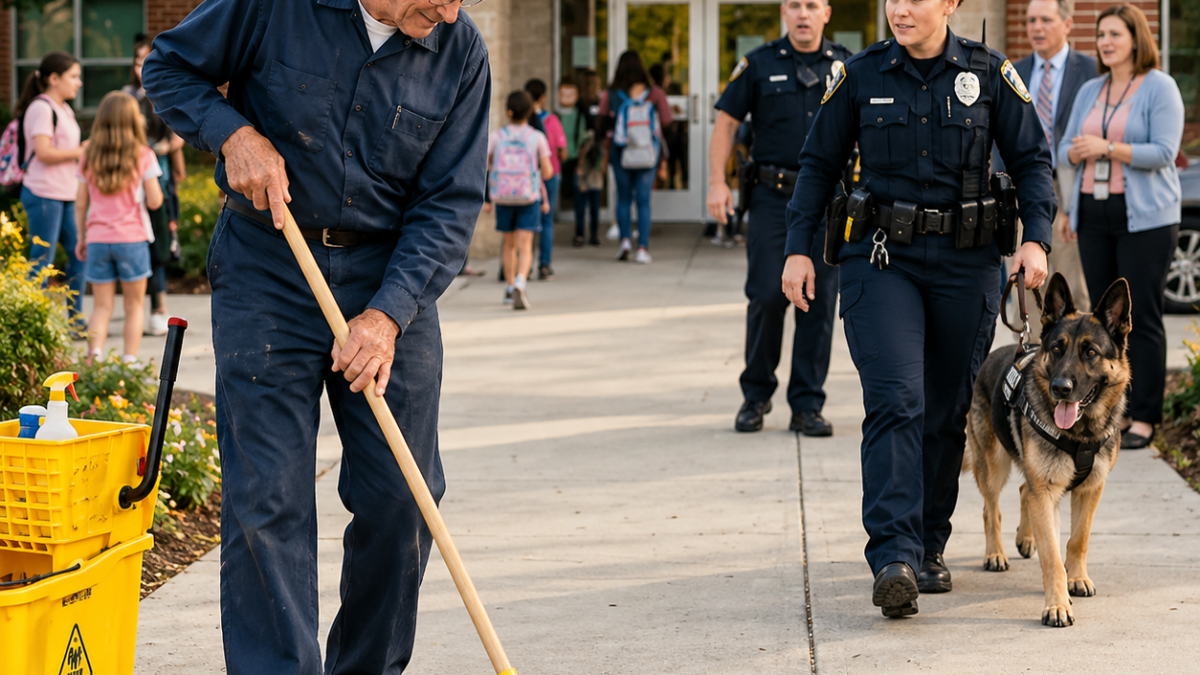
A Military K9 Broke Formation in Front of 300 People and Ran Straight to the School Janitor—Then the Dog Did Something That Silenced the Entire Yard.
PART2:
PART3:
Walter turned his head slightly.
It may have been the first time she had ever used his name like it belonged to a full human being.
“What just happened?” she asked. “Do you have some kind of history with military dogs?”
Walter’s jaw tightened.
Diesel’s body shifted immediately.
The dog angled himself in front of Walter’s legs, not aggressively, but protectively.
Ramirez noticed it.
So did Major Daniel Hutchins, one of the visiting Army officers standing near the front row.
“He’s guarding him,” Ramirez said quietly.
Major Hutchins looked at him.
“What was that, Sergeant?”
“Diesel is guarding him,” Ramirez repeated. “That’s not random. That’s not panic. I’ve seen that exact posture with wounded handlers overseas. He’s protecting him.”
The murmurs started again.
Protecting the janitor?
From what?
From whom?
Walter heard all of it.
He always heard more than people thought.
He had spent most of his life hearing what others missed.
Footsteps beyond a wall.
The click of a safety.
The silence right before an explosion.
The tiny shift in breathing that told him a young man was about to panic.
A crowd whispering about him was nothing.
And somehow, it hurt more than worse things had.
One father near the back leaned toward his wife and muttered, “Maybe the dog smells something on him.”
Another parent whispered, “Why won’t he answer?”
A teacher said softly, “He never told us he was military.”
Walter kept one hand on Diesel’s head.
He did not defend himself.
He did not explain.
He had learned a long time ago that people preferred simple answers.
Quiet old janitor.
Harmless man with a mop.
Invisible helper.
That was simple.
The truth was not.
Major Hutchins stepped forward.
His tone was polite, but his eyes were sharp.
“Sir, may I ask where you served?”
Walter looked up at him.
“It was a long time ago.”
“That is not really an answer, sir.”
A ripple passed through the crowd.
The word sir changed the air.
Major Hutchins was not speaking to Walter like a custodian.
He was speaking to him like a soldier recognizes another soldier even when the uniform is gone.
Walter looked down at Diesel.
The dog had found the scar on his right hand.
A thin white line across Walter’s knuckles.
Old.
Nearly invisible unless you knew what to look for.
Diesel pressed his nose against it once.
Then again.
Then he whined.
Major Hutchins saw the scar.
His face went still.
“That’s a contact wound,” he said. “Shrapnel, maybe. Close range.”
Walter curled his hand slightly, old habit taking over before he could stop it.
“It’s old.”
“It matters to him,” Ramirez said.
Diesel rested his entire head against Walter’s forearm.
His eyes were half-closed now, the tension draining from his frame in slow waves.
Not fear.
Relief.
Major Hutchins studied Walter with a new intensity.
“Sir,” he said, “I need to ask you something, and I would appreciate an honest answer.”
Walter already knew the question.
The past had finally caught him.
Not through a file.
Not through a uniform.
Not through a man.
Through a dog.
“What is your full name?”
The schoolyard went completely silent.
Walter looked across the rows of children sitting in the grass.
He saw a little boy holding a paper flag.
A girl with her hands pressed over her mouth.
Principal Whitfield with tears forming in her eyes, though she did not yet know why.
Ramirez kneeling near Diesel, pale and stunned.
Major Hutchins waiting.
Police Chief Castillo no longer writing in her notebook.
Mayor Pierce leaning forward like the answer might change the shape of the whole morning.
Walter looked back down at the dog.
For eighteen years, he had almost succeeded.
He had erased the man he used to be.
He had hidden behind quiet work, early mornings, long walks, and a gray uniform no one questioned.
He had become no one.
Diesel had refused to let him stay there.
“Walter Briggs,” he said quietly.
Then, after a pause, he added four words that made Major Hutchins go pale.
“Used to be Master Chief.”
A gasp moved through the schoolyard.
Master Chief.
Some parents did not understand the weight of the title immediately.
But every veteran did.
Every service member did.
Major Hutchins straightened as if his spine had been pulled by a wire.
“Master Chief of what unit, sir?”
Walter took a breath.
“Naval Special Warfare. Twenty-six years. Retired as Command Master Chief out of Coronado.”
This time, the sound that moved through the crowd was not a gasp.
It was disbelief.
Teachers turned to one another with wide eyes.
Parents stared.
The children looked confused, sensing only that the old man who fixed the sinks had suddenly become someone very important.
A boy near the front raised his hand, forgot he was not in class, and blurted, “Is Mr. Briggs a superhero?”
No one laughed.
Diesel stood.
Slowly, deliberately, the German Shepherd sat in front of Walter, lifted one paw, and placed it against Walter’s chest.
Almost like a salute.
Ramirez stared at his own dog.
“I think Diesel already knew exactly who you were,” he whispered.
Walter closed his eyes.
Not because he wanted the attention.
Because he did not.
Attention brought memory with it.
And memory brought faces.
Corporal Danny Whitlock.
Twenty-two years old.
Married six months.
Laughing in dust beside a dog named Bravo.
Then smoke.
Concrete.
Steel.
Radio static.
A building coming down faster than anyone could run.
Walter opened his eyes again.
Major Hutchins excused himself to make several calls.
Principal Whitfield approached with a bottle of water, holding it with both hands like an offering.
“I’m sorry,” she said softly.
Walter looked at her.
“For what?”
“For eleven years,” she said, voice breaking slightly. “For walking past you every day and never once asking who you were before this school.”
Walter took the bottle.
“Most people don’t want complicated answers.”
“That’s not an excuse.”
“No,” he said. “But it is usually true.”
She stood beside him for a moment while Diesel lay across Walter’s boots, refusing to move.
The assembly had dissolved into murmurs.
Teachers tried to keep students calm.
Parents whispered into phones.
Reporters checked their cameras with trembling hands.
The mayor stood uselessly near the podium, looking like a man who had arrived expecting a simple ceremony and discovered the ground underneath it was deeper than he knew.
Principal Whitfield lowered her voice.
“Why did you hide it?”
Walter turned the water bottle in his hands.
His fingers were thick, scarred, calloused.
Hands that had carried rifles.
Hands that had pulled wounded men through rubble.
Hands that had opened milk cartons for first graders and tightened loose screws on classroom chairs.
“Because the man I used to be cost me things,” he said. “People I couldn’t save. Choices I still wake up inside of some nights.”
Diesel lifted his head.
Walter looked down at him.
“It was easier to become nobody than to keep being someone who remembered all of that.”
Principal Whitfield wiped her cheek.
Before she could answer, Major Hutchins returned.
His expression had changed entirely.
He held a tablet in one hand.
Behind him came two more uniformed officers who had clearly driven over from the regional base the moment the phone calls went out.
The schoolyard quieted again.
“Master Chief Briggs,” Hutchins said.
The formality in his voice made several nearby adults straighten automatically.
Walter looked tired.
More tired than old.
“I pulled your service record,” Hutchins said. “Or what remains of it that isn’t still classified.”
Walter’s mouth tightened.
“Major, that isn’t necessary.”
“I respectfully disagree, sir.”
The major looked down at the tablet.
“Twenty-six years of service. Naval Special Warfare. Three Bronze Stars. Silver Star with valor device. Multiple commendations for K9 handler training programs still being used today. Programs you personally developed for working dogs in high-stress combat environments.”
Ramirez’s mouth fell open.
Hutchins continued.
“There is a training manual still in circulation. Your name was scrubbed from it for operational security, but every handler who comes through the program learns techniques from it.”
Ramirez looked from Hutchins to Walter.
“The Coronado method,” he said softly.
Walter did not answer.
Ramirez swallowed.
“The bonding protocol I used with Diesel when he was a puppy, the one that teaches K9s to identify protective postures around wounded handlers… that was you?”
Walter looked away.
“It was a team.”
“Sir,” Ramirez said, voice thick, “half the working dogs in my unit were trained on methods you wrote.”
Diesel let out a heavy sigh against Walter’s boot.
As if this was not news to him at all.
Then Hutchins’s voice grew quieter.
“There is something else.”
Walter stilled.
The schoolyard seemed to hold its breath.
“A heavily redacted note in your record. Eighteen years ago. Joint operation overseas. A collapsed structure. A K9 unit trapped inside. The handler did not survive, but the report says a senior NCO carried the dog out under fire despite serious shrapnel injuries to his own hands and forearm.”
Walter’s fingers moved over the scar across his knuckles.
Hutchins looked directly at him.
“Sir, was that you?”
For a long moment, Walter said nothing.
The children did not understand the full meaning of the silence.
The adults did.
Finally, Walter spoke.
“That dog’s name was Bravo.”
His voice was rough now.
“He was three years old. His handler was Corporal Danny Whitlock. Twenty-two. Married six months.”
Walter stared past the schoolyard.
Past the flagpole.
Past the sunny Ohio morning.
“The building came down fast. We got to Bravo before the secondary collapse. I couldn’t reach Danny.”
He swallowed.
“I carried Bravo out because nobody else could get close enough.”
His hand closed into a fist.
“And because leaving him there felt like losing one more person I couldn’t save.”
Several parents were crying now.
No one tried to hide it very well.
Even Mayor Pierce wiped his face quickly and looked away, as if dignity could still survive timing that poor.
Hutchins scrolled further.
“Bravo was reassigned after that,” he said softly. “He served another six years.”
Walter looked up.
He had not known that.
“He did?”
“Yes, sir. Six more years.”
Walter’s face shifted.
For the first time all morning, something like peace flickered there.
Not enough to heal eighteen years.
Enough to enter them.
Hutchins turned the tablet outward.
On the screen was a faded photograph.
Bravo.
Younger.
Proud.
Standing beside a litter of German Shepherd puppies at a training facility.
Ramirez leaned closer.
His eyes widened.
“No,” he whispered.
Hutchins nodded.
“Diesel’s bloodline traces back through that exact program. Three generations removed.”
The crowd reacted in waves.
Confusion.
Awe.
Whispers.
Shock.
But Ramirez only stared at Diesel.
“Sir,” he said slowly, “I don’t think he recognized only your scar or your voice.”
Walter looked down at the dog.
Diesel gazed back at him with steady brown eyes.
“I think something in him knew,” Ramirez said. “Not in a way we can write cleanly in a report. But through training, scent, instinct, bloodline, repetition, something. Everything passed down from Bravo’s line, everything built from the programs you created… somehow, Diesel knew he was standing in front of the man who refused to leave Bravo behind.”
Walter lowered one hand to Diesel’s head.
The dog leaned into it.
The entire schoolyard went silent again.
There are moments that cannot be explained without making them smaller.
This was one of them.
Maybe Diesel had smelled something old in Walter’s skin.
Gun oil.
Desert dust.
Scar tissue.
Maybe he heard the command inside Walter’s voice.
Maybe the training Walter designed lived inside Diesel’s muscles, passed down through handlers and dogs and repetition until it became instinct.
Maybe loyalty has its own memory.
Whatever the reason, the result was there in front of them.
A dog had found a forgotten man.
And would not let the world forget him anymore.
The final piece arrived an hour later.
A black government sedan pulled quietly into the school parking lot.
By then, the assembly was no longer an assembly.
It was a vigil.
Children sat with snacks beneath trees.
Parents lingered.
Teachers spoke in hushed voices.
Reporters waited, unsure whether they were witnessing a local human-interest story or something far greater.
The driver stepped out first.
Then a tall, gray-haired man in a perfectly pressed navy uniform emerged from the back seat.
He moved slowly, deliberately, every step controlled.
Major Hutchins saw him and straightened.
“Rear Admiral Thomas Whitlock,” he said quietly.
Walter heard the name.
His face drained of color.
Whitlock.
The same surname he had tried not to think about for eighteen years.
The admiral crossed the grass.
Diesel rose immediately, placing himself at Walter’s side.
For a long moment, Walter and the admiral stood facing each other while three hundred people watched without making a sound.
“Master Chief Briggs,” Admiral Whitlock said.
His voice held steady, but only barely.
“Sir,” Walter answered.
“Do you have any idea how long the Navy has been looking for you?”
Walter blinked.
“I retired eighteen years ago, Admiral. I didn’t think anyone was looking for anything.”
The admiral’s jaw tightened.
“My son was Corporal Danny Whitlock.”
The schoolyard went utterly still.
Walter’s hand dropped to Diesel’s harness.
Not for support.
Not exactly.
But close.
Admiral Whitlock stepped nearer.
“Danny’s wife wrote to me every year for ten years asking if anyone ever found out who pulled Bravo from that collapse. The report was sealed. Your name was redacted. By the time the restrictions lifted, you had vanished.”
Walter looked down.
“We wanted to thank you,” the admiral said. “We wanted Danny’s daughter, who was born four months after he died, to know the name of the man who saved her father’s dog when no one else could reach him.”
Walter’s throat moved.
For eighteen years, he had carried one sentence like a sentence carved into bone.
I could not save him.
He had believed it so completely that nothing else from that day had survived.
Not the dog.
Not the mission.
Not the lives protected afterward.
Only Danny Whitlock’s stillness beneath concrete and dust.
“Sir,” Walter said, voice low, “I didn’t think anyone would want to find a man who couldn’t save the one life that mattered most that day.”
Admiral Whitlock’s eyes filled.
“You saved a life that mattered too.”
Walter looked up.
“Bravo lived six more years because of what you did. Six more years of service. Six more years protecting other handlers. Six more years of Danny’s story continuing in the world.”
The admiral reached inside his jacket and removed a small velvet box.
His hands were not entirely steady.
“This belongs to you,” he said. “It should have been presented eighteen years ago. The Navy does not forget its own, Master Chief, even when its own tries very hard to disappear.”
Walter stared at the box.
He did not reach for it.
So Admiral Whitlock opened it himself.
Inside was a medal Walter had never seen in person.
A commendation for the action the official record had nearly buried.
The admiral stepped forward and pinned it to Walter’s gray janitor’s uniform with the same precision he would have used on formal dress blues.
The medal looked strange there.
Against faded fabric.
Above a name patch that simply read W. Briggs.
Beside a stain from floor wax that had never fully washed out.
And somehow, that made it more powerful.
Diesel sat perfectly still through the entire moment.
Watching.
As if he understood.
Then the admiral turned toward the sedan.
“There is one more thing.”
A young woman stepped out.
Early twenties.
Dark hair.
Red eyes.
A folded photograph held carefully in both hands.
Walter knew before anyone said it.
Danny’s daughter.
She approached slowly, as if afraid that sudden movement might shatter the man in front of her.
“Master Chief Briggs,” Admiral Whitlock said, voice softening, “this is my granddaughter. Danny’s daughter. She has wanted to meet the man who carried her father’s dog out of that building for most of her life.”
The young woman stopped in front of Walter.
Her voice trembled.
“My mom always told me whoever saved Bravo gave my dad’s memory one more chapter.”
Walter’s face crumpled slightly.
She held out the photograph.
It showed a young soldier with his arm around a German Shepherd, both squinting into desert sunlight.
Danny and Bravo.
Alive.
Smiling.
Before the collapse.
Before the redactions.
Before Walter’s eighteen years of silence.
“Bravo protected other soldiers for six more years because of what you did,” she said. “I just wanted you to know my dad’s name was never forgotten.”
Her own tears fell now.
“And neither was yours. Even when you tried very hard to make sure it would be.”
Walter took the photograph.
His hands shook for the first time all day.
The entire schoolyard watched eighteen years of careful invisibility crack open in one old man’s face.
“Thank you,” Walter whispered.
His voice broke on the words.
“Thank you for not letting him be forgotten.”
Diesel rose and pressed himself against Walter’s legs again.
This time, his tail wagged slowly.
Steadily.
The posture of an animal who had watched something finally return to its proper place.
The applause started uncertainly.
One person near the front.
Then another.
Then a row of parents.
Then the teachers.
Then the children.
Within seconds, all three hundred people were on their feet.
The sound rolled across the schoolyard, past the flagpole, past the folding chairs, past the gymnasium doors Walter had unlocked before dawn without knowing his life was about to be returned to him in front of everyone.
Major Hutchins saluted first.
Ramirez followed.
Then the two visiting officers.
Then Police Chief Castillo.
Then every veteran in the crowd who understood exactly what they were honoring.
Walter stood in his gray janitor’s uniform with a medal pinned to his chest, a photograph in one hand, and Diesel pressed to his side.
For the first time in eighteen years, he did not look like a man trying to disappear.
Principal Whitfield stepped to the microphone.
Tears were streaming openly down her face now.
She did not try to hide them.
“Ladies and gentlemen,” she said, voice shaking, “I think we owe Master Chief Walter Briggs a long overdue introduction.”
The applause rose again.
This time, Walter bowed his head.
Not from shame.
From the weight of being seen.
In the weeks that followed, Fairview changed.
Not perfectly.
People do not become wiser overnight just because a dog embarrassed them into paying attention.
But something shifted.
Teachers stopped saying “the janitor” and started saying “Mr. Briggs.”
Then, sometimes, “Master Chief,” though Walter still looked uncomfortable every time.
Students waved in the hallways.
Some saluted him badly.
He corrected their form once, then regretted it because after that, the salutes became a game.
Children asked questions.
Real ones.
“Did you know brave dogs?”
“Were you scared?”
“Do heroes mop floors?”
Walter answered some.
Not all.
When a second-grade boy asked if he had ever been in danger, Walter said, “Everybody is in danger sometimes. What matters is who you are trying to protect when danger comes.”
The boy thought about that for three days and then wrote it on a poster.
The Fairview Gazette ran a front-page story titled:
**The Hero Hiding in Plain Sight**
Walter hated it.
Principal Whitfield apologized.
The reporter apologized.
The town loved it.
Walter kept working.
He still arrived before sunrise.
Still checked the boiler room first.
Still made sure the cafeteria trash was emptied before lunch.
Still fixed leaky faucets and squeaky doors and chair legs that wobbled.
But now, people noticed his hands.
The precision.
The scars.
The way he moved through a room with awareness no janitorial training had given him.
They noticed how he always positioned himself with a clear view of exits.
How he instinctively stepped between children and anything that looked unsafe.
How he never raised his voice and still somehow made chaos settle.
The school board voted unanimously to rename the small courtyard outside the gymnasium Briggs Square.
Walter argued against it.
He lost.
He only won one concession.
The plaque would not mention rank.
Not medals.
Not classified service.
Not the headline.
Only this:
**In honor of those who serve without needing to be seen.**
Walter stood in front of the plaque the day it was unveiled, hands in his pockets, jaw tight.
Diesel sat beside him.
Ramirez had received special permission to bring him.
The moment Diesel entered the school gates, he ignored every excited child, every waving teacher, every outstretched hand, and went straight to Walter.
As always.
Walter knelt and opened his arms.
This time, he smiled before the dog reached him.
That smile became famous at Lincoln Heights.
Not because it was large.
It was not.
But because everyone understood it had taken eighteen years and one stubborn German Shepherd to bring it back.
Diesel began visiting every few months.
Officially, it was part of continued community outreach.
Unofficially, everyone knew the truth.
Diesel came to see Walter.
He would trot through the gates, scan the yard once, then find him.
By the maintenance shed.
Beside the gym doors.
In the hallway with a mop bucket.
Near the flagpole.
Always.
Handlers changed.
Schedules shifted.
Ceremonies ended.
But Diesel never failed to find him first.
Sometimes, after the students left and the school settled into afternoon quiet, Walter sat on the steps near Briggs Square.
Diesel would lie across his boots when visiting.
Walter would hold the photograph of Danny and Bravo.
He did not look at it every time.
Some days were still too hard.
Healing did not erase grief.
It taught grief where to sit.
That was all.
One afternoon, Principal Whitfield found him there after dismissal.
She almost walked past, afraid to intrude.
Then she remembered the lesson Diesel had forced upon them all.
Do not walk past people and assume there is nothing to ask.
So she stopped.
“Walter?”
He looked up.
“Ma’am.”
She smiled faintly.
“You can call me Karen after eleven years.”
“That would be unprofessional.”
“I think we are past that.”
He almost smiled.
She sat a few feet away.
For a while, neither spoke.
Children’s voices faded near the buses.
A flag rope clicked softly against the pole.
Finally, she said, “Does it get easier?”
Walter looked at the photograph in his hands.
“No.”
She nodded slowly.
“Does it get better?”
He thought about Diesel.
About Admiral Whitlock.
About Danny’s daughter.
About Bravo’s six extra years.
About children calling him by name in the hallway.
“Sometimes,” he said. “It gets less alone.”
Karen wiped one tear quickly.
“Less alone is something.”
“Yes, ma’am,” Walter said. “It is.”
Life did not turn Walter Briggs into a public speaker.
He refused most interviews.
He hated ceremonies.
He declined invitations to veterans’ banquets, television appearances, and one podcast that promised to “capture his brand.”
Walter did not know what that meant.
He did not want to know.
But he did agree to one thing.
Every year during Military Appreciation Week, he spoke to the fifth graders.
No reporters.
No cameras.
No mayor.
No podium if he could avoid it.
Just children sitting on the library carpet while Walter sat in an old wooden chair with Diesel at his feet whenever Ramirez could bring him.
He never told war stories.
Not the exciting kind.
He talked about responsibility.
About dogs who trusted handlers.
About handlers who owed their dogs discipline, patience, and courage.
About service that did not always look like medals.
“Sometimes service looks like showing up early and doing a job nobody notices,” he told them once.
A girl raised her hand.
“Like cleaning the school?”
Walter nodded.
“Like cleaning the school.”
A boy asked, “Is that as brave as being a SEAL?”
Walter looked at Diesel.
Then at the children.
“Bravery is not the job,” he said. “Bravery is doing what needs doing when nobody claps for it.”
The librarian wrote that sentence down.
By the next morning, it was printed and taped above the checkout desk.
Walter pretended not to notice.
He noticed.
Years passed.
Diesel grew older.
His muzzle whitened.
His hips stiffened.
He still found Walter first.
Every time.
On Diesel’s final visit to Lincoln Heights, Ramirez no longer wore active duty confidence. He looked tired in the way men look when they know a faithful companion is nearing the end.
Diesel walked slower through the gate.
The children had been told not to rush him.
They stood quietly along the sidewalk, holding handmade cards.
Diesel ignored the cards.
He walked to Walter.
Step by step.
Slow.
Certain.
Walter lowered himself to one knee, though it took him longer than it once had.
Diesel pressed his gray muzzle into Walter’s chest.
No dramatic whine this time.
No breaking formation.
No gasp from the crowd.
Just an old dog and an old warrior greeting each other like two survivors who knew words were unnecessary.
Walter held him for a long time.
Ramirez looked away.
So did Principal Whitfield.
When Diesel finally lay down, he placed one paw over Walter’s boot.
Walter rested his hand on the dog’s head.
“You did good, boy,” he whispered.
Diesel closed his eyes.
The schoolyard was quiet around them.
Not shocked quiet.
Respectful quiet.
The kind of silence people offer when they have finally learned how not to fill every sacred thing with noise.
Diesel died three weeks later.
Ramirez called Walter before anyone else at the school.
Walter said only, “Thank you for telling me.”
Then he hung up, sat at his kitchen table, and placed both hands flat on the wood until they stopped shaking.
He had lost men.
He had lost dogs.
He had lost parts of himself.
You would think loss would become familiar.
It never did.
But the next morning, he still woke at 4:30.
Still walked five miles before dawn.
Still unlocked Lincoln Heights by six.
Still checked the boiler room.
Still cleaned what was dirty.
Fixed what was broken.
Opened doors.
Replaced bulbs.
Answered children when they called, “Morning, Mr. Briggs.”
Only now, when he passed Briggs Square, he stopped.
Just for a moment.
A new small plaque had been added beside the first.
It read:
**Diesel**
**A dog who remembered what people forgot.**
Walter stood there until the bell rang.
Then he picked up his mop and went back to work.
Because that was who he was.
Not a man who needed applause.
Not a man who wanted the world to know every detail of his service.
Not a forgotten hero waiting to be discovered like treasure.
Walter Briggs was a man who had spent his life protecting others, then tried to disappear because he believed the lives he could not save mattered more than the ones he did.
Diesel had disagreed.
In the stubborn, loyal, unexplainable way only a dog can.
And because Diesel refused to obey one command on one cold Tuesday morning, an entire town learned to look again.
At the janitor.
At veterans.
At old men with quiet routines.
At people who sweep floors, fix leaks, carry trash, and move through the edges of daily life without demanding attention.
Maybe that was the real lesson.
Not that Walter Briggs had been a Navy SEAL.
Not that he had medals.
Not that generals still knew his name or training manuals still carried his invisible fingerprints.
The lesson was that greatness does not always announce itself.
Sometimes it unlocks the gym before dawn.
Sometimes it pushes a broom.
Sometimes it eats alone at a kitchen table with one chair.
Sometimes it hides scars beneath work gloves.
Sometimes it answers to “janitor” for eleven years without complaint.
And sometimes, when the rest of the world has grown too busy to notice, a dog remembers.
Walter still works at Lincoln Heights Elementary.
Older now.
Slower.
Still steady.
The children know his name.
The teachers ask how he is and wait for the answer.
Principal Whitfield keeps coffee for him in the office, though he pretends not to like it.
On quiet afternoons, he sits near the flagpole, looking out over Briggs Square, thinking of Danny Whitlock, Bravo, Diesel, and all the names the world almost loses when people stop asking questions.
He understands now what he did not understand for eighteen years.
Hiding from the past does not heal it.
Being forgotten does not make grief lighter.
And sometimes the thing that brings a man back to himself does not arrive with speeches, medals, or human wisdom.
Sometimes it arrives on four paws.
Breaks formation.
Ignores every command.
Finds the person everyone else overlooked.
And refuses to leave.








