Nobody Knew the Scarred ER Nurse Had Been a Combat Medic—Until an Aging Military K9 Broke Free to Reach Her, and Veterans Began Arriving With Letters From the Lives She Saved
PART3:
Beneath the rusted metal staircase by the loading dock, a medium-sized dog lay curled against the concrete. Its tan coat was soaked flat against its ribs. One rear leg stretched out at an unnatural angle, not broken, Mara thought immediately, but injured enough that standing hurt. Blood ran steadily down the fur near the hock, diluted by rain into pink trails on the pavement.
The dog tried to rise when it saw her.
Its front legs pushed weakly.
The injured rear leg buckled.
It collapsed with a sharp cry.
Mara was already moving.
“Easy,” she said, lowering herself into a crouch several feet away. “Easy, buddy. I see you.”
The dog bared its teeth.
Not aggressively.
Fearfully.
Mara knew the difference.
She kept her hands visible and her voice low.
“I’m not going to hurt you.”
Rain slid down the back of her neck. Her scrubs clung cold beneath her jacket. She ignored both.
Slowly, she removed the jacket.
Not to keep herself dry.
To cover the trembling animal.
Years of trauma medicine had taught her that fear often needed warmth before words. The dog flinched when the fabric touched its back, then froze. Mara waited. No rushing. No grabbing. Pain had a rhythm, and if you moved against it, fear bit back.
“There you go,” she whispered.
The dog’s breathing slowed by a fraction.
Mara shifted closer, inch by inch, until she could see the wound clearly. Deep laceration. Jagged edges. Probably caught on twisted metal or struck by debris from a vehicle. Blood loss was not catastrophic, but it was not nothing. The dog was cold, frightened, and weakening.
Mara opened the small emergency kit she always carried in her truck.
People teased her about it.
Evelyn called it “Mara’s apocalypse purse.”
Tonight, it earned its place again.
She cleaned the wound gently with sterile saline, speaking to the dog the entire time in a soft, even stream.
“I know. I know it hurts. You’re doing good. That’s it. Don’t look at the gauze. Look at me. You’re tougher than you think.”
The dog watched every movement. Its lips trembled. Its ears remained pinned back. But it did not bite.
Mara wrapped the leg with sterile gauze, secured pressure just tightly enough to slow the bleeding without cutting circulation, then slid her arms beneath the animal’s body.
It weighed around forty pounds.
Lighter than it should have.
The dog stiffened as she lifted it, then suddenly rested its head against her shoulder.
That small surrender hurt more than its fear.
Across the street, through sheets of rain, blue letters glowed on a low brick building.
Harborlight Veterinary Emergency Clinic.
Mara carried the dog across the flooded street with water soaking through her shoes. A car honked somewhere to her left. She ignored it. By the time she pushed through the clinic’s automatic doors, her arms burned from effort and old scars pulled tight across her shoulder.
The waiting room was crowded despite the hour.
A family held a trembling golden retriever wrapped in a beach towel. A teenage girl sat beside an injured rabbit carrier, whispering prayers through the mesh door. A man paced near the window while speaking quietly into his phone. The air smelled of wet fur, antiseptic, coffee, and worry.
The receptionist barely looked up.
“Do you have an appointment?”
“No.”
“We’re currently running about three hours behind.”
“This dog is bleeding.”
“So are four others.”
Mara nodded. No anger. No drama.
“I understand.”
The receptionist sighed and reached for a clipboard.
“We’ll put you on the list.”
Mara gently lowered the dog onto a blanket near the counter.
“Please,” she said. “He’s frightened, cold, and losing blood. The pressure bandage will hold for a while, but not all night.”
The receptionist glanced at the bandaged leg.
Before she could answer, a young veterinary technician hurried over from the treatment hallway. She was maybe twenty-four, with dark blond hair escaping a messy bun and paw-print Crocs squeaking against the floor.
Her name tag read EMILY.
“Oh my goodness,” Emily said, crouching beside the stray. “You wrapped this?”
Mara nodded.
“It’ll hold for a little while.”
Emily examined the bandage, her face changing from concern to surprise.
“Whoever applied this knew exactly what they were doing. Pressure is perfect. Circulation is intact. The wound’s been cleaned really well, considering…” She looked up. “Are you a vet?”
“No. Nurse.”
“ER?”
Mara nodded again.
Emily smiled.
“I can tell.”
Only then did Emily notice the scars beneath Mara’s rolled sleeve. Her eyes lingered for half a second too long before she caught herself.
Her smile faded.
“I’m sorry.”
“For what?”
“I shouldn’t stare.”
Mara looked down at her arm as if remembering it existed.
“You don’t have to apologize.”
Emily looked embarrassed, then grateful. Before either woman could say more, the automatic doors slid open again.
Three men entered together.
They did not wear uniforms, but the military was still on them.
In the way they scanned the room.
In the way they stood without blocking each other’s line of movement.
In the way one kept his back slightly toward the wall without seeming to think about it.
The oldest of the three was broad-shouldered, with dark hair graying at the temples and a faded tactical jacket darkened by rain. Beside him walked an aging German Shepherd. The dog’s muzzle had silvered with age, and one ear carried a notch near the tip, but his eyes were bright, alert, and disciplined.
A technician behind the counter smiled warmly.
“Evening, Caleb.”
“Evening,” the man said.
The German Shepherd walked calmly into the lobby.
Then stopped.
Every muscle in his body went rigid.
His ears lifted.
His nose twitched once.
Twice.
The man holding the leash looked down.
“What is it, Ranger?”
The old shepherd’s eyes locked onto Mara.
For one heartbeat, the clinic seemed to freeze.
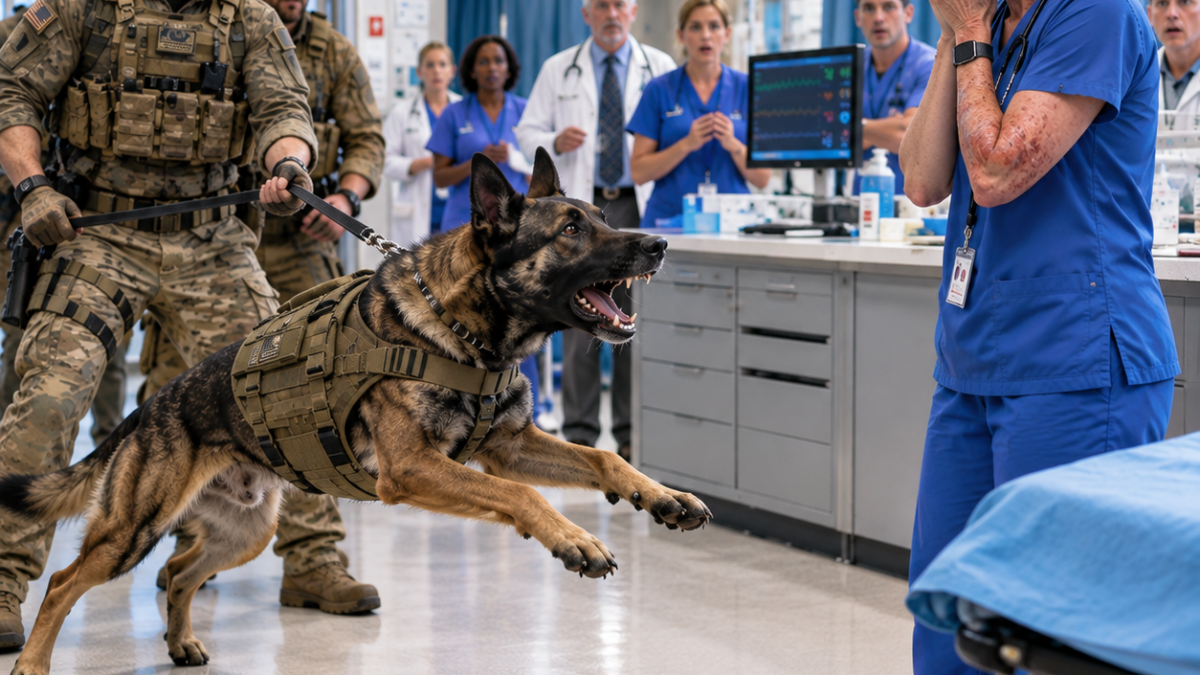
Then Ranger exploded forward.
The leash slipped from Caleb’s hand.
Someone shouted.
A child screamed.
The family with the golden retriever pulled back so quickly their chairs scraped the floor. The receptionist ducked behind the counter. Emily gasped, one hand instinctively moving toward the injured stray.
Everyone expected the dog to attack.
Mara did not move.
She simply turned toward him.
Recognition flickered across her face before she could hide it.
“No,” she whispered.
The word escaped before she realized she had spoken.
Ranger reached her at full speed.
But instead of barking, lunging, or jumping, the old German Shepherd dropped heavily at her feet.
His front legs folded.
His chest hit the floor.
His entire body trembled.
A long, heartbreaking whine rose from deep in his throat.
Then he pressed his head against the scarred arm resting at Mara’s side.
The room went silent.
Mara stared down at him.
Her hand hovered in the air as if afraid touching him would make him vanish.
Then her fingers slowly found the top of his head.
Ranger’s eyes closed instantly.
“You can’t,” she whispered. “You can’t possibly remember.”
Across the room, Caleb Roark stood perfectly still.
Rain dripped from his jacket onto the clinic floor.
He looked from Mara’s scarred arm to the old military dog lying against her, then finally to the expression on her face.
His own face drained of color.
He took one slow step forward.
Then another.
His voice barely rose above a whisper.
“Doc?”
Mara closed her eyes.
Not here.
Not after all these years.
Not like this.
The entire veterinary clinic watched in complete silence as the overlooked ER nurse and the military dog she had once carried through fire found each other again.
Caleb Roark had not heard anyone call her name in almost eight years.
Not her full name.
Not her rank.
Not the name the unit used when everything went wrong and everyone looked toward the one person who never seemed to panic.
Doc Ellison.
For a moment, he stood in the middle of Harborlight Veterinary Emergency Clinic with the leash hanging loose from his hand, unable to make his body move. Ranger lay at Mara’s feet like a dog who had finally reached home after years of searching.
The other customers watched with wide eyes, not sure whether they were witnessing a reunion, a miracle, or something too sacred for strangers to understand.
Mara’s hand rested on Ranger’s head.
She did not look at Caleb.
That was how he knew.
If she had been a stranger, she would have laughed nervously or asked what was happening. If she had merely been surprised, she would have stepped back. If she had wanted attention, she would have let the whole room lean into the drama.
Instead, she stood with her eyes lowered, fingers trembling slightly in the old German Shepherd’s fur, wearing the expression of someone whose past had just walked through the door and refused to leave.
Caleb took another step.
“Mara.”
Her shoulders tightened.
He remembered those shoulders under a combat vest. Remembered them squared against chaos. Remembered them bent over wounded men while fire crawled across wreckage around her. Remembered thinking, more than once, that if Doc Ellison was still moving, then the world had not ended yet.
“I go by Ellison here,” she said quietly.
The answer was controlled.
Too controlled.
Caleb almost smiled because even now, even in a veterinary clinic with a military dog crying at her feet, she was still trying to manage the room.
“Fine,” he said. “Nurse Ellison.”
Her eyes lifted.
Just enough.
A warning.
Not fear.
Never fear.
Caleb swallowed hard.
“I thought you were dead.”
Something shifted across her face, gone almost before anyone else could see it.
“I wasn’t.”
“No,” he said softly. “I can see that.”
Ranger whined and pressed his nose against the scarred skin of her forearm.
Mara looked down at him, and all the hardness in her face cracked for half a second. The dog remembered the place where the fire had touched her. That was what finally undid Caleb.
Ranger remembered not only her scent or her voice.
He remembered her wound.
The dog’s muzzle rested exactly where the burn scars began, as if he understood what had been left behind after the night she saved him.
Emily finally found her voice.
“You know her?”
Caleb looked around the room.
Every person was listening now.
Mara immediately said, “No.”
At the same time, Caleb said, “She saved my life.”
The contradiction landed heavily.
Mara closed her eyes.
Caleb did not take the words back.
He had spent years wishing he could say them to her face. Now that he finally had the chance, he would not help her disappear again.
“She saved my life,” he repeated. “She saved Ranger’s too.”
The receptionist stepped slowly out from behind the counter.
“This nurse?”
Mara’s expression hardened.
“Can we not do this?”
Caleb looked at her.
“No.”
The single word surprised even him.
Mara stared.
He softened his voice.
“No, Doc. Not this time.”
The old nickname moved through the room like a current.
Doc.
Not because she had been a physician.
Because in the unit, when someone was bleeding and afraid and certain they were about to die, she was the voice they called for.
Doc.
Caleb turned slightly, addressing the room without taking his eyes off her.
“It was Kandahar Province. Night extraction. We had wounded personnel, civilians, two dogs, no reliable communication, and a convoy that got torn open before we reached the evacuation point.”
Mara’s jaw tightened.
“Caleb.”
He continued.
“Our lead vehicle burned. We had people trapped. Ranger took shrapnel protecting his handler. I caught fragments through the side and couldn’t stand. Everyone thought the rescue was over.”
The clinic was utterly still.
Only the rain spoke against the windows.
“Then she went in.”
Mara’s face emptied.
That was the look he remembered from the field. The one that meant she had pushed every feeling into some locked room inside her so her hands could keep working.
Caleb’s voice grew quieter.
“She went into the burn zone three times. She pulled out Sergeant Boon. Pulled out Farid, our interpreter. Treated Ranger while debris was falling around them. And when the fuel line went up, she used her own body to shield him.”
Ranger pressed closer to her leg.
The old shepherd’s eyes were half closed now, his breathing slow.
The room seemed to understand before Caleb finished.
The scars.
The neck.
The arm.
The silence Mara carried like armor.
Emily looked at Mara with tears in her eyes.
“You got burned saving him?”
Mara gently removed her hand from Ranger’s head and stepped back.
The dog immediately stood and followed.
“Don’t make it prettier than it was,” she said. “People died that night.”
Caleb nodded.
“Yes, they did.”
Her eyes flashed.
“Then say that too.”
“I do,” he said. “Every time.”
For the first time, the anger in her face faltered.
Caleb stepped closer. Not too close. He had learned long ago that Mara Ellison did not retreat because she feared people. She retreated because being thanked felt like another wound.
“But don’t make the dead the only truth,” he said. “Boon’s children still have a father because of you. Farid made it to Virginia because of you. Ranger is standing here because of you.”
“He was dragged out by his handler.”
“No,” Caleb said. “His handler was unconscious. You dragged both of them.”
The room seemed to inhale.
Mara looked away first.
That, more than anything, told Caleb how much pain she was still carrying.
The wounded stray on the blanket whimpered, breaking the spell.
Mara turned instantly.
The past vanished from her face, replaced by focus.
“He still needs treatment.”
Emily blinked, startled back into motion.
“Yes. Yes, of course.”
Ranger tried to follow Mara as she knelt beside the stray, but Caleb caught the leash and crouched beside him.
“Stay.”
For the first time since entering the clinic, Ranger obeyed.
But his eyes never left Mara.
The veterinary surgeon arrived moments later and took the stray into the back for care. The clinic slowly resumed movement, but nothing returned to normal. Every person looked at Mara differently now. Not with pity. Not even with curiosity. With the cautious respect people show when they realize a quiet person has been carrying a story too large for ordinary conversation.
Mara hated every second of it.
By the time the stray was stabilized and Ranger’s appointment finished, the storm outside had worsened. Rain flooded the gutters. Thunder rolled over Savannah, and the streetlights flickered in the clinic parking lot.
Mara stood beneath the awning, arms folded, waiting for the rain to lighten.
Caleb stepped beside her.
Ranger positioned himself between them.
For a while, neither person spoke.
Then Caleb said, “Why did you disappear?”
Mara laughed once.
A small, tired sound.
“You keep asking questions like there are clean answers.”
“I’m not asking for clean.”
She watched rain spill from the awning’s edge.
“The mission was classified. The reports were sealed. The ceremony came and went without me. I was in a burn unit for most of it.”
“I tried to find you.”
“I know.”
He turned.
“You knew?”
“Commander Voss sent messages. Your unit sent letters. I didn’t answer.”
“Why?”
Mara looked at him then.
Because you lived, her eyes seemed to say.
Because some didn’t.
Because gratitude felt unbearable when grief was louder.
But what she said was, “I couldn’t be Doc anymore.”
Caleb understood more than she expected. Maybe because he had spent years trying to be someone other than the man who survived that convoy. Maybe because survival rearranged a person in ways outsiders mistook for healing.
Mara continued, voice low.
“There was a corpsman. Nineteen years old. His name was Eli Mercer. He was trapped under the rear axle.”
Caleb lowered his eyes.
“I remember Eli.”
“I got to him twice. The third time, the fire shifted and I couldn’t reach him.” Her voice did not rise, but something inside it broke. “I promised him I’d come back.”
“Mara.”
“I promised.”
The word shattered.
Not loudly.
Not dramatically.
Enough.
Ranger rose and pressed against her side.
Mara’s hand found his fur automatically.
“I woke up six weeks later,” she said. “And everyone kept telling me who I saved. No one knew what to do with the one I didn’t.”
Caleb had no answer.
There was not one.
Some grief did not want comfort.
It wanted witness.
So he stood there and witnessed it.
The next morning, Caleb called the first number.
Then the second.
Then the third.
By noon, half the old unit knew.
By evening, veterans from Georgia, Florida, and the Carolinas were making plans to come to Savannah.
Mara did not know any of this until two days later, when she arrived for her night shift at Chatham County General and found three men standing quietly near the ER entrance.
One held a folded flag.
One held an old photograph.
One held a child’s drawing sealed in plastic.
Mara stopped walking.
Her breath left her.
The man with the photograph stepped forward first. He had a cane now, gray in his beard, and a limp that had not been there in Kandahar.
“Doc,” he said.
Mara shook her head slightly.
“Not again.”
His smile trembled.
“My daughter drew this for you.”
He handed her the plastic sleeve.
Inside was a crayon drawing of a woman in blue scrubs holding hands with a soldier and a dog. The woman had bright orange hair because children used the colors they liked, not the colors reality demanded. On the bottom, in uneven letters, it said:
Thank you for saving my dad.
Mara stared at it until the hallway blurred.
The man’s voice trembled.
“She’s seven. She wouldn’t exist if you hadn’t pulled me out.”
Behind him, the second veteran unfolded the old photo.
The third removed a letter from his jacket.
More people arrived over the next hour.
Not a crowd.
Not yet.
Just enough to make the ER hallway feel smaller and the past feel less buried.
Nurses watched from the station.
Doctors paused in doorways.
Patients whispered.
Mara stood in the center of it all, scarred arm wrapped around a child’s drawing, unable to retreat.
Then Ranger came through the automatic doors.
Caleb followed behind him.
The old K9 crossed the ER without hesitation and sat beside Mara’s feet.
The veterans smiled because they understood.
Ranger had brought them back to her not to reopen the wound, but to show her what had grown around it.
Mara looked down at the dog.
His tail thumped once.
A simple sound, soft against the hospital floor.
For the first time in years, Mara Ellison wondered if the story she had been telling herself was incomplete.
Maybe she had not failed because one life was lost.
Maybe she had survived because many others still needed to come home.
And maybe the dog at her feet had remembered the truth before she could.
By the third day, Mara could no longer pretend the veterans were only passing through.
They came quietly at first, one or two at a time.
A man with a cane waited near the hospital coffee cart.
A woman in a faded Navy sweatshirt sat outside the emergency department with a sealed envelope in her lap.
A former interpreter stood near the ambulance bay holding a photograph of his family like proof that survival had continued beyond the worst night of their lives.
Mara tried to keep working.
She checked vitals.
Started IVs.
Calmed frightened patients.
Gave discharge instructions in the same steady voice she had used for years.
But everywhere she turned, the past stood waiting with older faces, gray hair, wedding rings, children, and stories she had never allowed herself to hear.
Caleb Roark did not apologize for making the calls.
He only stood beside Ranger at the edge of the hallway and watched as the life Mara thought had ended in fire began returning in pieces.
One veteran brought a letter from Sergeant Daniel Boon, written before cancer took him three years earlier.
Mara recognized the name before she recognized the handwriting.
Boon had been pinned beneath twisted metal the night the convoy burned. He had begged her to leave him twice. The third time, he had apologized to his children because he believed apology traveled better than prayer.
Mara had dragged him out by his vest while flames rolled under the vehicle like something alive.
Now his oldest son was seventeen, tall, serious, and standing in the ER lobby holding his father’s letter.
“My dad told me to give this to you if we ever found you,” the boy said.
Mara did not take it at first.
Her hands refused.
The boy waited.
He had his father’s patience.
Finally, she reached for the envelope.
Inside, Boon had written in uneven strokes:
Doc, I got sixteen extra years. I saw my daughter graduate middle school. I taught my son to drive. I held my wife when her mother died. I ate bad birthday cake. I complained about taxes. I watched football on Sundays. I got ordinary time. You gave me ordinary time, and there is no medal big enough for that.
Mara read it once.
Then again.
The letters blurred.
She pressed the page to her chest and closed her eyes.
Farid, the interpreter she had helped evacuate, arrived the next morning with his wife and two sons. He had been younger in Kandahar, thin and terrified, with English learned from soldiers and American movies. Now his beard was fuller, his shoulders broader, and his voice steadier. He wore a dark suit despite the Georgia heat.
He placed his citizenship certificate in Mara’s hands.
“This is partly yours,” he said.
“No.”
“Yes.” His smile was gentle but firm. “My youngest son’s first English word was safe. My wife used to tell him the story of the American medic who refused to leave us behind. She would say, ‘We are safe because she stayed.’ So he learned safe before hello.”
Mara looked at the little boy holding Farid’s hand.
The boy hid halfway behind his father’s leg, then peeked out.
“Thank you,” he whispered.
Mara had treated gunshot wounds without flinching.
She had worked mass casualty nights where blood slicked her shoes.
She had held pressure on arteries while families screamed.
But that little boy’s whisper nearly brought her to her knees.
She handed the certificate back carefully.
“I didn’t do it alone.”
Farid nodded.
“No one survives alone. That does not mean we forget who held the door open.”
Mara listened to each of them with the same expression.
Calm.
Guarded.
Almost painfully still.
The nurses who knew her understood that stillness meant she was holding herself together by force.
Ranger understood too.
Each time someone approached, the old German Shepherd moved closer.
Sometimes he pressed his shoulder against her leg. Sometimes he simply sat beside her, steady and silent, as if reminding her that she did not have to stand alone while the world finally told her what she had done.
Not everyone at the hospital understood.
Some did.
Some watched with wet eyes and quiet respect.
Others whispered.
“She never told anyone?”
“Why hide something like that?”
“I heard she wasn’t even official military.”
“Combat medic, civilian contractor, whatever. Sounds dramatic.”
“People love a hero story.”
Mara heard those whispers too.
They hurt less than gratitude.
That surprised her.
Doubt was familiar. Suspicion she could carry. Judgment from strangers slid off old armor. But kindness kept finding gaps.
On the fourth night, Savannah was hit by the kind of storm that made windows tremble in their frames.
Rain came sideways across the hospital parking lot, flooding gutters and turning the streets into black glass. The emergency department filled quickly. Car accidents. Slips on wet steps. Asthma attacks. Elderly patients frightened by power flickers and thunder. A family of four from a hydroplaned minivan arrived wet, shaken, but alive.
Across the street, Harborlight Veterinary Emergency Clinic was full too.
Mara had just finished treating a construction worker with a deep hand laceration when the call came from Caleb.
His voice was controlled, but she knew him well enough now to hear the fear beneath it.
“It’s Ranger.”
Everything inside her went quiet.
“What happened?”
“He collapsed. They think internal bleeding. Surgeons are stuck behind flooding on Victory Drive. They’re trying to stabilize him, but—”
“I’m coming.”
She did not ask permission.
She did not explain.
She handed her chart to Evelyn, grabbed a raincoat from the staff room, and crossed the flooded street with water soaking through her shoes before she reached the clinic door.
Inside, the veterinary team was moving fast, but panic had started creeping into the edges.
Ranger lay on a treatment table, his breathing shallow, gums too pale. Caleb stood beside him with one hand on the dog’s neck, his face ashen.
Mara approached the table.
The years fell away.
Not because Ranger was a dog.
Because Ranger was Ranger.
The same animal who had dragged himself toward her through smoke. The same animal who had lain bleeding beneath her hands while she told him to stay. The same animal who had returned years later to remind her she had once been more than scars and silence.
Emily looked up, relief flooding her face.
“We don’t have a surgeon yet. His pressure’s dropping. We’re giving fluids, but he’s not responding.”
Mara nodded once.
“What do you have for blood products?”
“Limited canine packed red cells. We started one unit.”
“Good. Keep it going. Warm him. Check his abdomen again. Any free fluid?”
“Yes. Ultrasound shows fluid. Likely splenic bleed or old shrapnel adhesion tearing loose.”
Caleb looked at her.
“Can you help him?”
Mara placed her hand on Ranger’s head.
The dog’s eyes opened slightly.
He saw her.
His tail moved once.
That almost broke her.
Instead, she leaned closer and whispered the words she had said years ago under fire.
“Stay with me, soldier.”
Ranger’s breathing hitched, then steadied slightly.
The room changed.
Everyone felt it.
Mara was not a veterinarian, and she did not pretend to be one. But trauma had a language, and she spoke it fluently. Bleeding was bleeding. Shock was shock. Fear was fear.
She helped the staff organize what they already knew but could not access through panic. She had Emily monitor pressure and perfusion. She had another tech prepare additional fluids and warming blankets. She asked for suction readiness, abdominal prep, oxygen support, and a count of what blood remained. She walked Caleb through slow breathing because his fear was becoming a second emergency.
“Look at me,” she told him.
“I can’t lose him.”
“I know.”
“I can’t.”
“Caleb. Look at me.”
His eyes found hers.
“Breathe in. Hold. Out. Again.”
“I should have noticed something was wrong.”
“He’s old. Old soldiers hide pain.”
“So do old medics.”
Her eyes flashed.
“Breathe.”
He did.
When Ranger’s pressure dipped again, Mara helped position him carefully and maintain support until the veterinary surgeon finally burst through the back door, soaked to the bone, surgical bag in hand.
By then, Ranger was still alive.
Barely.
But alive.
The surgeon took one look at the setup and nodded.
“Who organized this?”
Every eye turned to Mara.
She looked down.
“Your team did.”
The surgeon did not argue.
There was no time.
Ranger was rushed into surgery.
Mara and Caleb waited in the hallway outside the operating room, soaked, exhausted, and silent for nearly two hours. Neither spoke. The storm beat against the roof. Lights flickered once, then steadied.
Caleb sat with his elbows on his knees and his hands clasped so tightly his knuckles turned white.
Finally, he said, “I can’t lose him.”
Mara stared at the floor.
“I know.”
“He found you.”
“I know.”
“I think he came back because he knew we both needed saving.”
Mara looked at him then.
Caleb’s eyes were wet, but he did not look away.
The operating room door opened before she could answer.
The surgeon stepped out, mask lowered, face tired but calm.
“He made it.”
Caleb covered his face with both hands.
Mara closed her eyes.
The surgeon continued.
“Old scar tissue tore near the spleen. We repaired what we could and removed the damaged section. He’s not young, and recovery will be slow, but he’s stable.”
Mara nodded.
Professional.
Controlled.
Then she sat down hard in the nearest chair because her legs had stopped working.
Ranger survived again.
Two weeks later, Caleb told Mara there was a routine follow-up at Harborlight.
That was the only reason she agreed to go.
She arrived expecting a quiet appointment.
Maybe Emily, the surgeon, Caleb, and Ranger.
Instead, the parking lot was full.
Veterans stood beneath the clinic awning. Nurses from Chatham County General gathered near the entrance. Vet techs, former patients, families, children, and local first responders filled the sidewalk despite the heat. Someone had placed chairs inside the clinic lobby. Someone else had brought flowers.
The wounded stray Mara had carried in weeks earlier was there too, now healing, wearing a bright red bandana and wagging his tail at everyone.
Mara stopped in the doorway.
“No.”
Caleb appeared beside her.
“You can be mad later.”
“I’m mad now.”
“I know.”
“I hate you.”
“I know that too.”
Ranger, still moving slowly from surgery, walked from the front row to her side. He leaned gently against her leg.
The entire crowd quieted.
Commander Elias Voss stepped forward.
Mara had not known he was coming.
Seeing him nearly made her turn around.
Ranger leaned harder, blocking the retreat like an old professional.
Voss was older now, retired, his once-black hair almost fully gray. But he still carried the same quiet command presence that had steadied frightened young soldiers without making them feel small.
“Doc Ellison,” he said.
Mara sighed.
“You people don’t listen.”
“No,” Voss said. “We learned that from you.”
A few people laughed, but the sound was tender, full of tears already waiting.
The ceremony was not grand.
That made it worse.
Mara could have survived flags and speeches and official words. She had armor for that.
She had no armor for Daniel Boon’s daughter walking up with a photograph of her father.
No armor for Farid’s son reading a thank-you note in careful English.
No armor for Caleb standing in front of everyone and saying, “You carried us out of the fire. Then you carried the fire alone for years. You don’t have to carry it alone anymore.”
Mara looked away.
Ranger lifted one paw and placed it gently on her scarred forearm.
The room broke.
So did she.
Not loudly.
Not completely.
But enough.
Her hand covered Ranger’s paw, and for the first time since Kandahar, she let herself cry in front of people who knew why.
Nobody rushed her.
Nobody tried to turn it into a perfect moment.
Emily cried behind the front desk. Evelyn wiped both eyes with the heel of her hand while pretending she was not. Caleb stood close but did not touch her until she reached for him first.
Mara cried for Boon and Farid and Caleb and Ranger.
She cried for Eli Mercer, nineteen years old, trapped beneath an axle, still apologizing because he thought dying would inconvenience her.
She cried for the years she had mistaken survival for punishment.
She cried for all the ordinary time she had never imagined mattered.
And when she finally lifted her head, the room was still there.
No one had left.
That was the thing that undid her most.
The world did not end when she broke.
Months later, the Ranger Response Initiative opened in a renovated wing connecting Chatham County General and Harborlight Veterinary Emergency Clinic.
Officially, it was a joint emergency preparedness program for veterans, service dogs, K9 medical crisis response, and trauma coordination.
Unofficially, everyone knew it was Mara’s program, though she fought that description every time someone said it.
The initiative trained nurses to handle veterans in crisis. It taught veterinary teams how to coordinate with human emergency departments when service animals were involved in medical emergencies. It created protocols so K9s were not treated like luggage, distractions, or afterthoughts when their handlers collapsed. It built a fund for veterans who could not afford emergency veterinary care. It taught calm under fear.
Veterans came with their dogs.
Nurses came after shifts.
Veterinary students volunteered on weekends.
Caleb ran drills.
Emily became the program’s first coordinator.
Evelyn pretended she was only helping with scheduling, then quietly took over half the logistics because nobody argued with Evelyn Carter and won.
Mara taught quietly at first.
Her first class had six nurses, two vet techs, Caleb, Ranger, and the healed stray dog, who had been adopted by Emily and renamed Dock because everyone in the clinic had a sense of humor Mara claimed to hate.
Mara stood at the front of the small training room, uncomfortable with every set of eyes.
“We’re starting with pressure control,” she said.
A young nurse raised her hand.
“For humans or dogs?”
Mara looked at Ranger.
“Bleeding doesn’t care what species you are.”
The class laughed softly.
Mara did not, but something near the corner of her mouth shifted.
She taught pressure control.
Triage awareness.
Breathing under panic.
How to speak to frightened veterans without trapping them inside too many questions.
How to read a service dog’s body language during a medical crisis.
How to stop assuming calm people were fine.
And eventually, she taught the lesson she had learned too late to spare herself years of guilt.
“Saving lives does not mean saving everyone,” she said one Friday afternoon, standing beside a whiteboard while rain streaked the windows. “And losing one person does not erase every person who lived.”
The room went quiet.
Caleb sat near the back with Ranger’s head on his boot.
Mara continued.
“Some of you will carry names. You will remember faces nobody else remembers. You will ask yourself whether one more minute, one more decision, one more attempt would have changed the outcome. Maybe sometimes it would have. Maybe sometimes it wouldn’t. You still have to keep living after that question. If you don’t, the loss takes more than it already took.”
A photograph hung in the main hallway.
Mara kneeling beside Ranger, his gray muzzle pressed against the scars on her arm.
Beneath it was a plaque.
Some scars are not proof of what broke you. They are proof of who you carried through the fire.
Mara hated the plaque at first.
“It’s too dramatic,” she told Caleb.
“You are too dramatic,” he said.
“I am clinically reserved.”
“You once crossed a flooded street in a thunderstorm to yell at a veterinary team into saving my dog.”
“That was medical support.”
“That was you being dramatic with excellent technique.”
She rolled her eyes.
Ranger thumped his tail as if voting with Caleb.
Mara still worked nights.
She still spoke softly.
She still avoided cameras when she could.
But when patients looked at her scars now, she no longer folded her arms or turned away.
Sometimes children asked if they hurt.
She would smile and say, “Not as much as they used to.”
Every Friday afternoon, Caleb brought Ranger to the clinic.
The old German Shepherd moved slower now, but he never needed directions. He walked through the lobby, past the front desk, past the exam rooms, and straight to wherever Mara happened to be.
If she was teaching, he lay by her chair.
If she was treating a patient, he waited outside the door.
If she was standing alone in the hallway, remembering too much, he pressed his head into her hand until she came back to the present.
He did not come because she was wounded.
He came because she was home.
On the first anniversary of the night Ranger found her, Harborlight Veterinary Emergency Clinic held a small gathering. Emily insisted it was not a ceremony because Mara had threatened never to attend anything called a ceremony again.
There was cake.
There were folding chairs.
There were far too many people for Mara’s liking.
The stray dog Dock wore a bow tie and attempted to steal a sandwich from Commander Voss, who let him because even retired commanders sometimes made poor tactical decisions.
Boon’s daughter brought a new drawing.
This one showed Mara, Ranger, and a crowd of people standing behind them. At the bottom, in much neater letters now, it said:
Some heroes come back late.
Mara stared at that sentence for a long time.
The girl looked nervous.
“Do you like it?”
Mara crouched carefully, knees protesting, and looked her in the eye.
“I love it.”
“My dad said you didn’t like being called a hero.”
“He was right.”
“Then what should I call you?”
Mara glanced at Ranger, who leaned against her as if he already knew the answer.
She thought of all the names she had tried to bury.
Doc.
Ellison.
Medic.
Survivor.
Failure.
She looked back at the girl.
“Mara is enough.”
The girl smiled.
“Okay, Mara.”
It should not have mattered.
It did.
Later that night, after everyone left, Mara stood alone in the clinic hallway where the photograph hung. The lights had been dimmed. Rain whispered against the windows, softer than the storm a year before.
Caleb found her there.
Ranger, as always, found her first.
“You okay?” Caleb asked.
Mara kept looking at the photo.
“I spent years thinking I had disappeared.”
“You didn’t.”
“No.” She touched the edge of the frame. “I hid.”
“There’s a difference?”
“Yes.” She looked at him. “Disappearing means nobody can find you. Hiding means part of you still hopes someone will try.”
Caleb’s expression softened.
“Ranger tried.”
Mara looked down at the old dog.
“He did.”
Ranger leaned his head into her hand.
Outside, an ambulance siren wailed in the distance, rising and falling through the wet Savannah night. Mara listened to it without flinching.
That was new.
Not healed.
Not finished.
But new.
In the end, that was what nobody had understood about the overlooked scarred ER nurse.
She had not been quiet because she had nothing to say.
She had not been humble because she had done nothing worth remembering.
She had not hidden her past because it lacked honor.
She had been carrying a battlefield inside her, carefully, silently, alone, because she thought the one life she failed to save mattered more than all the lives that had continued because she stayed.
Until Ranger remembered.
Until Caleb spoke.
Until the veterans returned one by one, bringing photographs, children, letters, citizenship papers, and ordinary lives that had grown from the night she thought had ended everything.
Until the scars everyone stared at finally became what they had always been.
Not shame.
Not damage.
Proof.
Proof that Mara Ellison had walked through fire carrying others.
And somehow, after all those years, the ones she carried had finally come back to carry her.








