Nobody Knew the Quiet ER Nurse Had Served in Combat—Until Veterans Returned With the K9 She Carried Through Fire
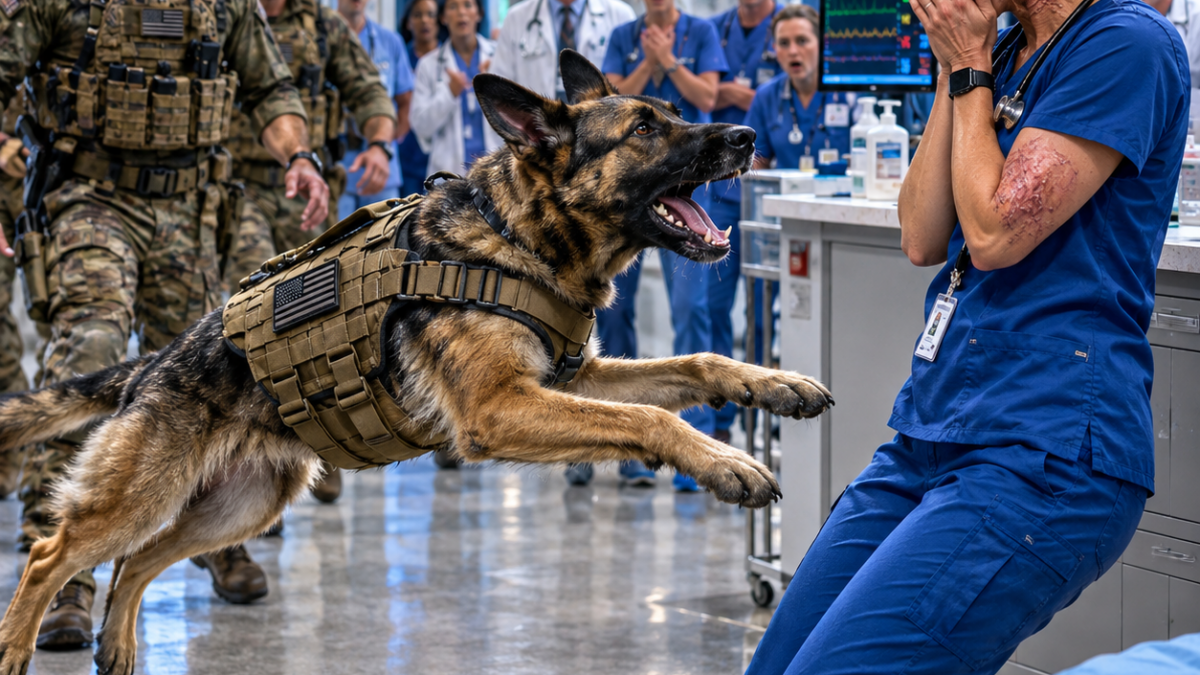
PART2:
Old canvas shoes because expensive ones ended up covered in the same things anyway.
New employees usually noticed her calm first.
Then the scars.
They began beneath her left ear.
Pale, irregular.
Disappeared under the neckline of her scrubs.
Reappeared across the shoulder.
Then down the outside of her forearm.
Burn scars.
Fragment scars.
Surgical scars.
Most people did not know enough to identify which was which.
Mara preferred it that way.
Adults tried not to stare.
Children were more honest.
One little boy had asked:
“Did that hurt?”
PART3:
“Yes.”
“Does it still hurt?”
“Sometimes.”
“Are you okay?”
“I am.”
That had been the entire conversation.
Adults usually invented explanations on their own.
Car accident.
House fire.
Workplace explosion.
Mara never corrected them.
The truth belonged to another life.
Near the end of her shift, she finished charting and leaned against the nurses’ station for what she intended to be thirty seconds.
Charge nurse Evelyn Carter glanced at her.
“Go home.”
“I still have discharge paperwork.”
“Done.”
Mara looked up.
“You did my paperwork?”
“You’ve covered three extra shifts.”
“I’m fine.”
“You always say that.”
“It’s often true.”
“It isn’t tonight.”
Mara smiled faintly.
Evelyn had been a charge nurse for almost twenty years.
There was no winning.
“You have thirty seconds before I clock you out myself.”
“You cannot legally—”
“Twenty-five.”
Mara raised both hands.
“Leaving.”
She took her backpack.
Said good night.
Stepped through the ambulance entrance.
Rain struck immediately.
Cold.
Heavy.
The parking lot smelled of wet asphalt and diesel.
Lightning flashed somewhere toward the Savannah River.
Mara crossed toward her aging pickup.
That was when something moved beneath the loading dock staircase.
She stopped.
At first she assumed raccoon.
Then:
whimper.
Low.
Weak.
She changed direction.
Beneath the rusted stairs, a tan mixed-breed dog lay pressed against the concrete.
Maybe forty pounds.
Soaked.
One rear leg bleeding.
The dog saw her and tried to rise.
Collapsed.
Mara crouched.
“Easy.”
Teeth showed.
Not a threat.
Fear.
“I know.”
She stayed outside biting range.
Hands visible.
“I’m not going to hurt you.”
The dog trembled.
Mara removed her rain jacket.
Moved slowly.
Laid it over him.
The teeth disappeared.
She examined without forcing much movement.
Deep laceration on the rear leg.
Blood loss significant but not yet catastrophic.
No obvious arterial spray.
She went to her truck.
Emergency kit.
Everyone at Chatham made fun of it.
Bandages.
Gloves.
Gauze.
Saline.
Basic supplies.
“Of course you carry a trauma bag in your personal truck,” Evelyn once said.
“Cars break down.”
“That doesn’t explain hemostatic gauze.”
“People break too.”
Tonight, the dog needed it.
Mara cleaned only what she safely could.
Controlled bleeding.
Wrapped the wound.
Checked distal circulation.
The dog watched her hands.
Breathing slowed.
“There.”
She scratched lightly behind one ear.
“You’re tougher than you think.”
Then she lifted him.
Forty pounds.
He should have fought.
Instead his head settled against her shoulder.
Across the street, the blue sign for Harborlight Veterinary Emergency Clinic glowed through the rain.
Mara carried him across.
The clinic was nearly as crowded as the human ER.
Golden Retriever trembling beside a family.
Teenager holding a rabbit carrier.
Man pacing near the windows.
Receptionist typing without looking up.
“Appointment?”
“No.”
“We’re running close to three hours.”
“This dog is bleeding.”
“So are four others.”
No cruelty.
Just overload.
Mara nodded.
“I understand.”
She lowered the dog onto a blanket.
“Please put him wherever your triage system needs him.”
The receptionist finally looked closely at the bandage.
A veterinary technician hurried over.
Young woman.
Twenty-four, maybe.
Name badge:
EMILY.
“Oh.”
Emily crouched.
Examined the wrap.
“You did this?”
“Yes.”
“Are you a veterinarian?”
“No.”
“Nurse.”
“ER.”
Emily checked the paw.
“Pressure’s good.”
She looked up.
“You cleaned this?”
“As much as I could safely.”
Emily smiled.
“I can tell.”
Then she noticed Mara’s arm.
The smile faded.
“I’m sorry.”
“For?”
“I stared.”
Mara looked at the scars.
“You don’t need to apologize.”
Automatic doors opened.
Three men entered.
Every one moved with military economy.
Not identical.
Just recognizable.
The oldest wore a faded tactical jacket.
Gray beginning at his temples.
He held a leash attached to an aging German Shepherd.
The dog’s muzzle had gone silver.
His gait was slower than it once had been.
His eyes were not.
A technician called:
“Evening, Caleb.”
“Evening.”
The German Shepherd entered.
Then stopped.
Every muscle locked.
His nose lifted.
Once.
Twice.
The man holding the leash looked down.
“Ranger?”
No response.
“Ranger.”
The dog stared across the clinic.
At Mara.
Caleb Roark frowned.
“What is it?”
Ranger surged forward.
The leash slipped.
A woman screamed.
Someone grabbed a child.
The receptionist ducked instinctively.
Seventy pounds of old military German Shepherd crossed the waiting room toward Mara.
Emily gasped.
Mara did not move.
Something changed in her face.
Recognition.
Fear.
Disbelief.
“No.”
Ranger reached her.
Then did the opposite of what everyone expected.
He dropped.
Hard.
At her feet.
His entire body trembled.
A long whine came from his chest.
Then he pressed his muzzle against the scarred arm hanging beside her.
Mara stared.
Her hand rose.
Slowly.
Touched his head.
Ranger closed his eyes.
“You can’t.”
Her voice broke.
“You can’t possibly remember.”
Across the clinic, Caleb stood still.
Rainwater ran from his jacket.
His leash lay loose in one hand.
He stared at Mara’s scars.
At Ranger.
At her face.
Then he whispered:
“Doc.”
Mara closed her eyes.
Not here.
Not like this.
Not after eight years.
Ranger pressed harder against her.
Caleb took one step.
Then another.
“Mara.”
Her shoulders tightened.
“I go by Ellison here.”
Caleb almost laughed.
Even now.
Even with Ranger shaking at her feet.
She was trying to control the room.
“All right.”
He swallowed.
“Nurse Ellison.”
Her eyes lifted.
Warning.
Familiar warning.
Caleb had seen it beneath a helmet.
Behind protective glasses.
Covered in dust.
“I thought you were dead.”
Something moved through her expression.
Gone quickly.
“I wasn’t.”
“No.”
He breathed out.
“I can see that.”
Ranger shifted his muzzle.
Pressed his nose precisely against the upper section of scar tissue on her forearm.
Mara looked down.
That nearly broke her composure.
Emily whispered:
“You know her?”
Mara immediately said:
“No.”
At the same moment, Caleb said:
“She saved my life.”
Silence.
Mara’s eyes closed.
Caleb did not retreat.
“She saved Ranger too.”
“Caleb.”
“No.”
Her eyes opened.
The force in them made Emily take a step back.
Caleb softened.
“No, Doc.”
“Not this time.”
Mara’s jaw tightened.
The nickname hung in the room.
Doc.
She had never been a physician.
It did not matter.
When people were bleeding, scared, trapped, or certain they were dying, “Doc” was what they called the person whose hands might keep them alive.
Caleb looked around.
People were listening.
Mara hated that.
“It was Kandahar province.”
“Caleb.”
“Night extraction.”
She turned away.
“We had wounded personnel.”
“Civilians.”
“Two working dogs.”
“Communications barely functioning.”
“And the convoy got hit before the evacuation point.”
Rain hammered the windows.
Caleb continued.
“Lead vehicle burned.”
“People trapped.”
“Ranger took shrapnel.”
“I got fragments through my side.”
“I couldn’t stand.”
Mara’s face went blank.
Emily noticed.
Not indifference.
Armor.
Caleb’s voice dropped.
“She went back.”
Mara stared at him.
“Three times.”
“Caleb.”
“She pulled Boone out.”
Pause.
“Farid.”
Another.
“She treated Ranger with debris still falling.”
Ranger leaned closer.
Caleb looked at Mara’s arm.
“And when fuel ignited, she used herself to cover him.”
Emily’s eyes filled.
“You were burned protecting him?”
Mara withdrew her hand.
Ranger stood immediately.
“Do not make it prettier than it was.”
Nobody spoke.
“People died.”
Caleb nodded.
“Yes.”
“Then say that too.”
“I do.”
“Every time.”
Her anger faltered.
Caleb stepped closer.
Not too close.
“But don’t make the dead the only truth.”
Mara looked away.
“Boone’s children still had their father.”
“Farid made it out.”
“Ranger is standing here.”
Mara snapped:
“His handler dragged him.”
“No.”
Caleb’s answer was immediate.
“His handler was unconscious.”
“You dragged both.”
The clinic seemed to inhale.
Mara looked away first.
Then the wounded stray whimpered.
Everything inside her changed.
Past gone.
Nurse returned.
“He needs treatment.”
Emily blinked.
“Yes.”
“Right.”
She moved.
Ranger tried following Mara.
Caleb caught the leash.
“Stay.”
For the first time since entering, Ranger obeyed.
But he watched Mara the entire time.
The wounded stray was taken back.
Stabilized.
The veterinary surgeon examined him.
No fracture.
Deep laceration.
Blood loss.
Treatable.
Mara should have left.
Instead she remained until she knew the dog would live.
By the time she stepped outside, rain had worsened.
She stood beneath the clinic awning.
Arms crossed.
Caleb came beside her.
Ranger positioned himself between them.
For a while, nobody spoke.
Then:
“Why did you disappear?”
Mara laughed once.
No humor.
“You ask questions like they have clean answers.”
“I’m not asking for clean.”
She watched rain spill from the roof.
“The mission was classified.”
“Some reports sealed.”
“The ceremony happened while I was still hospitalized.”
“I know.”
“No, you know paperwork.”
She looked at him.
“I woke up six weeks later.”
“People kept telling me who I saved.”
Caleb waited.
“No one knew what to do with the person I didn’t.”
He understood immediately.
“Eli.”
Mara’s face changed.
Nineteen.
Corpsman.
Eli Mercer.
Trapped beneath the rear axle after the convoy blast.
Mara had reached him twice.
First time:
fire blocked access.
Second:
vehicle shifted.
Third:
fuel ignited.
She had promised him.
“I’m coming back.”
She had.
Just not far enough.
“I promised him.”
Her voice fractured.
Caleb said nothing.
“I promised.”
Ranger stood.
Pressed against her leg.
Mara’s hand disappeared into his wet fur.
“I woke up and everyone wanted to say thank you.”
She looked at Caleb.
“For what?”
He remained silent.
“Eli was dead.”
“That doesn’t erase—”
“It did for me.”
The rain filled the space between them.
Some grief does not want reassurance.
It wants witness.
Caleb finally understood that.
So he stopped trying to correct her.
He stood there.
The next morning, he began making calls.
Mara did not know.
First:
Boone.
Then Farid.
Then former members of the medical support team.
Handlers.
Veterans.
Georgia.
Florida.
Carolinas.
Some still had contact with one another.
Others did not.
The message spread.
We found Doc Ellison.
Two days later, Mara arrived for night shift.
Three men stood near the emergency entrance.
She stopped.
One held a folded flag.
One held an old photograph.
One carried a plastic sleeve.
The man with the sleeve stepped forward.
Cane.
Gray in beard.
Limp Mara did not remember.
“Doc.”
Mara shook her head.
“No.”
He smiled through tears.
“Please.”
“Not again.”
“My daughter drew this.”
He handed it to her.
Inside:
crayon drawing.
Woman in blue.
Soldier.
Dog.
At the bottom, uneven letters:
THANK YOU FOR SAVING MY DAD.
Mara stared.
The hallway blurred.
The veteran said:
“She’s seven.”
His voice trembled.
“She wouldn’t exist if you hadn’t gotten me out.”
Mara said nothing.
Another veteran unfolded a photograph.
A family.
Three children.
A backyard.
Barbecue.
Ordinary life.
“This was last summer.”
Mara looked at him.
“I wanted you to see what happened after.”
The third veteran held out a letter.
Then more people arrived.
Not a parade.
Not cameras.
One or two at a time.
Old faces.
Older bodies.
Canes.
Braces.
Gray hair.
Wedding rings.
Children’s photographs.
Mara remained in the hallway holding the drawing.
Nurses watched from the station.
Doctors paused.
Nobody had known.
Then the automatic doors opened.
Ranger entered.
Caleb behind him.
The old German Shepherd crossed the emergency department.
Ignored everyone.
Sat at Mara’s feet.
Tail hit the floor once.
Soft.
Mara looked down.
For eight years, she had told herself one version of Kandahar.
Eli died.
She survived.
Therefore she failed.
Now people kept arriving with evidence that life had continued in directions she had refused to look.
The following days made hiding impossible.
A veteran with a cane waited near the coffee cart.
A woman in a faded Navy sweatshirt arrived holding an envelope.
Farid came.
The interpreter she had helped evacuate.
He was older.
American citizen now.
Married.
Children.
He handed Mara his citizenship certificate.
She stared.
“You don’t need to give me this.”
“I’m not giving it.”
“I’m showing you.”
“Why?”
“Because you never answered my letters.”
Mara looked ashamed.
Farid smiled gently.
“My youngest son’s first English word was safe.”
Mara’s eyes lifted.
“My wife used it when she told him about you.”
Mara looked away.
Farid continued.
“The woman who kept saying, ‘You’re safe, stay with me.’”
Ranger sat beside her.
Closer whenever somebody approached.
Not guarding.
Grounding.
One veteran brought a letter written by Sergeant Boone before cancer killed him years later.
Boone had survived the convoy.
Returned home.
Raised children.
Coached baseball.
Developed cancer.
Died surrounded by family.
His letter said, in part, that surviving that night had not made every day afterward easy, but it gave him days he otherwise would not have had.
Mara read it alone.
Then again.
The sentence that stayed:
Do not measure yourself only by the people you could not carry.
She folded the letter.
Unfolded it.
Read again.
The fourth night, another storm hit Savannah.
Worse.
Rain sideways.
Power flickers.
Traffic collisions.
Falls.
Asthma attacks.
Chatham County General filled.
Across the street, Harborlight Veterinary filled too.
Mara had just finished treating a construction worker when her phone vibrated.
Caleb.
She answered.
“What?”
“It’s Ranger.”
Everything inside her went still.
“What happened?”
“He collapsed.”
“Where?”
“Harborlight.”
“What are they saying?”
“Internal bleeding.”
“Surgeon?”
“Stuck in flooding.”
“I’m coming.”
She did not explain much.
Evelyn saw her face.
“Go.”
Mara crossed the flooded street.
Water soaked her shoes.
Harborlight was controlled chaos.
Ranger lay on a veterinary treatment table.
Gums pale.
Breathing shallow.
Caleb’s hand against his neck.
Emily looked up.
Relief.
“Pressure is dropping.”
Mara approached.
Ranger opened his eyes.
Saw her.
Tail moved once.
That almost destroyed her.
She put one hand against his head.
“Stay with me.”
Old words.
Old voice.
Then she looked at the veterinary team.
“What do you need?”
Important distinction.
Not:
I’ll take over.
Mara was a human emergency nurse.
Not a veterinarian.
The clinic staff had already identified abdominal free fluid and suspected internal hemorrhage.
They had started canine blood products under veterinary orders.
Warming.
IV access.
Monitoring.
Their problem was not ignorance.
It was overload and a delayed surgeon.
Mara helped where the team explicitly asked and where her trauma experience translated safely.
Organization.
Timing.
Monitoring trends.
Communication.
Keeping Caleb from becoming another patient.
One technician said:
“Pressure dropping.”
Emily responded.
Mara asked:
“What does your veterinarian want at this threshold?”
Emily answered.
They followed the protocol.
No heroics.
No pretending human medicine and veterinary medicine were interchangeable.
But shock has patterns.
Panic has patterns.
Teams under stress sometimes benefit from one calm voice reminding everyone what has already been decided.
Mara did that.
Ranger’s pressure remained dangerous.
But he remained alive.
The veterinary surgeon finally came through the back entrance soaked to the skin.
She looked at the setup.
“Who coordinated?”
Emily pointed at Mara.
Mara shook her head.
“Your team.”
The surgeon did not argue.
No time.
Ranger went to surgery.
Mara and Caleb sat outside.
Nearly two hours.
The storm battered the roof.
Caleb’s hands clenched.
“I can’t lose him.”
Mara stared at the floor.
“I know.”
“He found you.”
“I know.”
“I think he came back because—”
“Don’t.”
Caleb stopped.
Mara looked at him.
“Don’t make him responsible for saving me.”
Caleb thought.
Then nodded.
“Okay.”
“That’s too much to put on a dog.”
“Okay.”
She softened.
“He reminded me of something.”
“What?”
“I don’t know yet.”
The operating-room door opened.
Surgeon came out.
Mask lowered.
“He made it.”
Caleb covered his face.
Mara closed her eyes.
“Old scar tissue tore near the spleen.”
“We controlled the bleeding.”
“He’s stable.”
“Recovery will be slow.”
Mara nodded.
Then sat hard in the nearest chair.
Her legs had stopped cooperating.
Ranger survived.
Again.
Two weeks later, Caleb told Mara Ranger had a routine follow-up.
She agreed to meet them.
Bad decision.
The clinic parking lot was full.
Veterans.
Nurses.
Families.
First responders.
Former patients.
Children.
Mara stopped at the entrance.
“No.”
Caleb appeared.
“You can be angry later.”
“I’m angry now.”
“I know.”
“I hate you.”
“I know.”
Ranger walked slowly from the front row.
Still recovering.
He leaned against Mara’s leg.
The crowd quieted.
Commander Elias Voss stepped forward.
Mara nearly turned around.
Ranger leaned harder.
“Doc Ellison.”
She sighed.
“You people do not listen.”
Voss smiled.
“We learned from you.”
A few people laughed.
The ceremony was not grand.
That made it worse.
Flags and formal speeches would have been easier.
Mara knew how to survive official language.
She had no defense for Boone’s daughter walking toward her holding a photograph of her father.
No defense for Farid’s son reading a thank-you note in careful English.
No defense for a veteran saying:
“You changed whether my children had a father.”
Then Caleb stood.
Mara stared at him.
“Don’t.”
He did.
“You carried us out of the fire.”
“Caleb.”
“Then you carried the fire alone for eight years.”
Her jaw tightened.
“You don’t have to carry it alone anymore.”
Ranger lifted one paw.
Placed it against her scarred forearm.
The room broke.
Mara did too.
Not loudly.
No collapse.
No cinematic scream.
Her face simply folded.
Tears.
Her hand covered Ranger’s paw.
For the first time since Kandahar, she cried in front of people who understood why.
Not because they told her she had nothing to feel guilty about.
Survivor guilt rarely disappears because someone presents a better argument.
She cried because, finally, the people who lived were standing beside the memory of the person who did not.
Both truths in the same room.
Eli died.
Boone lived.
Farid lived.
Caleb lived.
Ranger lived.
Mara lived.
No sentence cancelled another.
That mattered.
After the gathering, Mara found Voss alone near the parking lot.
“You should have told me.”
“Told you what?”
“That they were coming.”
“You would’ve disappeared.”
“Yes.”
“That’s why.”
Mara glared.
Then:
“Did Eli have family?”
Voss went still.
“Yes.”
“Do they hate me?”
“No.”
“How do you know?”
“Because his mother wrote to you.”
Mara stared.
“I never got it.”
“You did.”
Silence.
“The sealed packet sent to your rehabilitation hospital.”
Mara remembered.
A box she never opened.
She had placed it in storage with everything from deployment.
Voss said:
“She thanked you for going back.”
Mara’s eyes filled again.
“She knew?”
“She had the after-action report.”
“I promised him.”
“She knew that too.”
Mara looked away.
“Did she blame me?”
“No.”
“Maybe she should.”
Voss’s expression hardened.
“Stop deciding other people’s grief for them.”
Mara looked at him.
He continued.
“You can carry your guilt.”
“I cannot order you not to.”
“But you don’t get to rewrite his mother’s feelings because punishment feels easier.”
That angered her.
Which was probably why she heard it.
Weeks later, Mara opened the storage box.
Uniform patches.
Old watch.
Medical notes.
Photographs.
Letters.
At the bottom:
Eli Mercer’s mother.
She read it sitting on the floor.
The letter did not absolve her.
That was why it worked.
Eli’s mother wrote about her son.
How he hated tomatoes.
Called every Sunday.
Wanted to become a physician assistant after service.
How losing him split the family open.
Then:
We know you went back.
Twice.
We know why you could not reach him the third time.
Please do not turn our son into the reason you stop living.
Mara stopped reading.
Hours later, she finished.
She began seeing a therapist again.
That part rarely appeared in the version people later told.
It should have.
Veterans returning did not cure survivor guilt.
Ranger recognizing her did not heal burns.
One ceremony did not undo eight years of avoidance.
Mara needed professional help.
Time.
Sleep.
Boundaries.
Conversations she did not want.
She began learning to remember Kandahar without forcing every memory through the single moment she lost Eli.
That was work.
Meanwhile, the hospital and Harborlight began discussing something practical.
The storm that nearly killed Ranger had exposed gaps.
Human emergency teams sometimes encountered veterans with service animals.
Veterinary staff sometimes received working dogs connected to handlers undergoing human medical emergencies.
Communication between systems was poor.
Who took responsibility for a service dog if a handler was unconscious?
How were medications, mobility equipment, and veterinary records coordinated?
What happened during evacuation?
What happened when both handler and dog were injured?
People had improvised for years.
Improvisation was not a plan.
The Ranger Response Initiative began as three meetings.
Then five.
Then a proposal.
Joint emergency-preparedness protocols between Chatham County General and Harborlight Veterinary Emergency Clinic.
Veterans.
Service animals.
Working dogs.
Human trauma.
Veterinary trauma.
Mara resisted having her name anywhere near it.
“Use Ranger.”
Caleb laughed.
“You’re fine naming it after the dog?”
“Yes.”
“Not you?”
“Absolutely not.”
So Ranger it became.
Emily became the first coordinator.
Mara taught.
At first reluctantly.
Pressure control.
Triage awareness.
How to communicate with injured veterans who might be more concerned about their dog than themselves.
When not to separate a service animal unnecessarily.
When separation was medically necessary.
How to speak clearly.
How not to turn fear into conflict.
She told nursing students:
“You cannot promise everything will be okay.”
One raised a hand.
“What do you say?”
“The truth.”
“What truth?”
“Whatever you know.”
She demonstrated.
“We’re here.”
“We’re treating you.”
“Your dog is being evaluated across the hall.”
“I don’t know the outcome yet.”
“We will update you.”
“Why is that better?”
“Because trust survives uncertainty better than false reassurance.”
That came from war.
But also from the years after.
The initiative grew.
Not huge.
Useful.
Protocols.
Drills.
Phone numbers.
Cross-training.
Veterinary students volunteered.
Nurses attended after shifts.
Caleb ran scenarios.
Ranger showed up when his health permitted.
A photograph hung in the hallway.
Mara kneeling.
Ranger’s gray muzzle pressed against her forearm.
Below it:
SOME SCARS ARE NOT PROOF OF WHAT BROKE YOU.
THEY ARE PROOF THAT YOU WERE THERE WHEN SOMETHING NEEDED CARRYING.
Mara objected to the wording.
“Too dramatic.”
Emily said:
“You object to everything.”
“Correct.”
The photograph stayed.
Mara continued night shifts.
Still quiet.
Still disliked attention.
Still sometimes covered her scars automatically.
But less.
When children asked:
“Does it hurt?”
She answered:
“Not as much as it used to.”
Sometimes:
“How did it happen?”
If appropriate:
“I got hurt helping people a long time ago.”
That was enough.
Every Friday, Caleb brought Ranger.
The old German Shepherd no longer needed directions.
Through the clinic.
Past reception.
Find Mara.
If she taught, he lay near the chair.
If she treated a patient, he waited.
If she stood alone in a hallway too long, he pressed his head against her hand.
People began saying:
“He knows when she’s having a bad memory.”
Mara corrected them.
“He knows when I stand still and smell familiar.”
It was important to her that Ranger remain a dog.
A remarkable dog.
Not a supernatural therapist.
His bond with her was meaningful without turning every behavior into magic.
One Friday, Mara asked Caleb:
“Why did he remember me?”
Caleb considered.
“Scent.”
“Probably.”
“Voice.”
“Maybe.”
“History.”
She looked at him.
“What does that mean?”
“He associated you with safety.”
Mara looked toward Ranger.
That possibility hurt.
Because she had not associated herself with safety.
Not for years.
Ranger had.
So had Caleb.
Farid.
Boone.
Eli’s mother, in a different way.
The story she told about herself was becoming harder to defend.
A year after Ranger’s reunion, Mara visited the veteran family event associated with the initiative.
She almost left when she saw how many people were there.
Then a girl ran toward Boone’s daughter.
Friends now.
Children of survivors.
Children who had no concept of Kandahar except as the place where their fathers once served.
They played tag.
Ordinary.
Mara watched.
Caleb came beside her.
“You okay?”
“No.”
“Want to leave?”
She thought.
“No.”
That was progress too.
Not being okay.
Staying anyway.
Ranger grew older.
Silver became white.
Hips stiffened.
His hearing declined.
His nose remained excellent.
Caleb shortened walks.
Adjusted food.
Added ramps.
Mara noticed every change.
“You’re hovering.”
Caleb said.
“I’m assessing.”
“You are a human nurse.”
“I have eyes.”
“You call Emily every time he sneezes.”
“That happened twice.”
“Five times.”
“Exaggeration.”
Ranger sneezed.
Mara looked down.
Caleb pointed.
“Do not.”
She laughed.
The sound came easier now.
Years after reunion, Ranger’s health began failing in ways no amount of attention could reverse.
Arthritis.
Kidney disease.
Age.
Not tragedy.
Time.
Caleb and the veterinary team managed comfort.
Mara attended appointments when she could.
The final week, Ranger stopped enjoying food.
Stopped wanting the yard.
Struggled to rise.
Caleb called.
“I think it’s time.”
Mara sat in silence.
“I’m coming.”
They gathered at Harborlight after hours.
No crowd.
Emily.
Veterinarian.
Caleb.
Mara.
Ranger on a thick blanket.
His breathing slow.
Mara sat beside him.
His head found her scarred arm.
Even now.
She laughed through tears.
“You’re ridiculous.”
Tail moved faintly.
Caleb knelt on the other side.
“He always liked you better.”
“No.”
“Absolutely.”
“He had lower standards with me.”
The veterinarian gave them time.
Mara rubbed the old Shepherd’s ear.
Years earlier, inside smoke and debris, she had told him:
“Stay.”
Now, finally, that would have been the wrong thing to ask.
She leaned closer.
“You don’t have to stay for us.”
Caleb’s face broke.
Mara’s did too.
“You did enough.”
Ranger died peacefully.
Mara stayed with him afterward.
No rush.
Her hand remained on the fur until it cooled.
For days, the initiative hallway felt wrong without him.
People suggested replacing the photograph with a memorial.
Mara said no.
“Leave it.”
The picture showed him alive.
That mattered.
Months later, a nursing student named Olivia joined the program.
She wore a leg brace after a serious car accident.
Young.
Quiet.
Constantly apologizing for moving slowly.
Mara noticed.
Of course.
During a simulation, Olivia struggled standing from the floor.
“I’m sorry.”
Mara held out a hand.
“For what?”
“I’m slowing everyone down.”
“No.”
“I am.”
“You’re moving differently.”
“That is not the same thing.”
Olivia looked at Mara’s scars.
Then the brace.
“Did you ever feel like everybody saw the injury first?”
“Yes.”
“What did you do?”
“Got angry.”
Olivia laughed.
“Helpful.”
“Eventually I learned people looking isn’t always judgment.”
“Sometimes they just don’t know where to look.”
Olivia nodded.
Mara continued.
“And sometimes I stopped hiding.”
That conversation stayed with Olivia.
Months later, when Blue Ridge’s rehabilitation garden officially opened, administrators again asked Mara to cut the ribbon.
“No.”
Evelyn groaned.
“You are exhausting.”
“Thank you.”
Mara invited Olivia.
“I don’t belong there.”
Mara smiled.
“I used to say that.”
“Did it help when people told you that you did?”
“No.”
“Then why are you telling me?”
“I’m not.”
Mara handed her the scissors.
“I’m asking you to stand there anyway.”
Together they cut it.
The plaque read:
HEALING BELONGS TO EVERYONE.
SEEN WOUNDS.
UNSEEN WOUNDS.
EVERY LIFE DESERVES DIGNITY.
Afterward, Caleb approached.
Older now.
More gray.
No Ranger beside him.
That absence remained visible.
“You know what he did, right?”
Mara looked toward the photograph near the garden entrance.
“He recognized me.”
“He found you.”
“I was across the street.”
“You know what I mean.”
Mara smiled.
“Yes.”
Caleb waited.
She continued.
“He didn’t rewrite my past.”
“No.”
“He didn’t erase Eli.”
“No.”
“He didn’t make what happened good.”
“No.”
Mara looked around.
Veterans.
Nurses.
Veterinary staff.
Families.
Service dogs beneath trees.
“But he forced me to look at the parts I had stopped looking at.”
Caleb nodded.
“That’s enough.”
“Yes.”
It was.
The story spread anyway.
Nobody realized the quiet nurse was a combat medic.
Military K9 recognizes forgotten hero.
Veterans return to thank scarred nurse.
Mara disliked almost every headline.
Technically, she had been a military trauma nurse, not a battlefield legend assembled for social media.
She had made mistakes.
She had been afraid.
She had survived.
She had helped.
She had failed to save one young man she desperately wanted to save.
She had saved others.
Every one of those statements could coexist.
That was the truth she eventually learned to live with.
Not:
I was a hero.
Not:
I was a failure.
I was there.
I did what I could.
Some lived.
One I loved could not be reached.
I survived too.
And surviving created obligations she had once refused to see.
Not obligations to become inspiring.
Not to speak publicly.
Not to turn pain into motivational language.
Only to keep living honestly.
To allow the people she helped to say what her actions meant to them.
To stop treating gratitude as an accusation.
To ask for help when grief became too heavy.
To remember Eli as more than the person she failed to save.
She eventually contacted his mother.
The first call lasted nine minutes.
Mara cried for eight of them.
Eli’s mother did not tell her:
“It wasn’t your fault.”
That would have been too simple.
She said:
“Thank you for remembering his name.”
Mara answered:
“I always will.”
“That’s enough.”
They spoke again months later.
Eli’s mother told her stories.
Tomatoes.
Sunday calls.
How he once failed a driver’s test because he hit the curb before leaving the parking lot.
Mara laughed.
That mattered.
For eight years, Eli existed in her memory only beneath a burning vehicle.
Now he became nineteen again.
Annoying.
Funny.
Loved.
More than the worst moment of his life.
Mara realized she had done to him what she had done to herself.
Reduced an entire person to one disaster.
She stopped.
Years later, new nurses at Chatham County General knew Mara as the woman who ran the Ranger Response Initiative.
Some knew the combat story.
Some did not.
That was fine.
She still worked.
Still charted.
Still covered shifts she should not.
Evelyn, approaching retirement, still told her to go home.
One night, a young resident saw the scars.
He hesitated.
Mara noticed.
“You can ask.”
He looked embarrassed.
“What happened?”
“I got hurt overseas.”
“Military?”
“Yes.”
“Were you a medic?”
“Trauma nurse.”
“Oh.”
Mara waited.
He said:
“I’m sorry.”
“For?”
“The scars.”
Mara looked down.
Then smiled.
“They’re old.”
The resident nodded.
A moment later, a trauma alert came.
Everything moved.
Mara became what she had always been.
Calm.
Precise.
Present.
Nothing mystical.
No flashback.
No grand revelation.
Work.
After the patient stabilized, the resident found her near the nurses’ station.
“I get it now.”
Mara frowned.
“Get what?”
“Why people call you steady.”
She looked at him.
“Nobody calls me that.”
He smiled.
“Apparently they used to.”
Mara groaned.
“Caleb.”
The resident laughed.
She walked away.
But this time she was smiling.
That was how healing eventually looked.
Not forgetting.
Not erasing.
Being able to hear an old name for yourself without feeling the room disappear.
Being able to look at a scar without immediately returning to fire.
Being able to let a person say thank you without answering with the name of someone who died.
Being able to remember both.
One rainy evening, years after Ranger’s death, Mara finished another shift.
Almost identical to the night everything had changed.
Rain against the ambulance bay.
Wet asphalt.
Diesel.
She stepped outside.
For a second, she looked toward the veterinary clinic.
No dog beneath the staircase.
No emergency.
Just light in the windows.
Emily, now senior coordinator of the Ranger Initiative, was locking one side door.
She saw Mara.
Waved.
Mara waved back.
Then she noticed something mounted near the hospital entrance.
A new photograph.
She walked closer.
The image showed the first veterans returning.
Boone’s daughter holding the drawing.
Farid beside his citizenship certificate.
Caleb.
Ranger sitting at Mara’s feet.
Mara herself looked overwhelmed.
Almost cornered.
Beneath it:
THE PEOPLE SHE CARRIED CAME BACK TO REMIND HER SHE DID NOT HAVE TO CARRY THEM FOREVER.
Mara stared.
Then immediately texted Caleb.
You wrote that.
Reply came quickly.
Prove it.
She laughed.
Standing alone in rain.
Years earlier, she would have torn the plaque down.
That night, she left it.
Because by then she understood what Ranger had actually returned to her.
Not heroism.
Not status.
Not some forgotten military identity.
Context.
For eight years, Mara had looked at her scars and remembered only one thing:
someone she could not save.
Ranger touched those same scars and remembered something else.
The hands that treated him.
The body that shielded him.
The voice that stayed calm when he was terrified.
Then Caleb returned.
Then Boone’s family.
Then Farid.
Then the others.
One by one, they added pieces to a story Mara had told incorrectly for years.
Not falsely.
Incompletely.
That was the difference.
The fire happened.
Eli died.
Mara carried that.
But the fire was not the whole story.
People came home.
Children were born.
Families continued.
Ranger grew old.
Veterans became fathers and mothers.
Farid became a citizen.
A frightened stray survived because Mara stopped in the rain.
A hospital and veterinary clinic built protocols that helped other veterans and animals.
Olivia became a nurse.
Mara kept working.
Life kept multiplying beyond the worst night she could remember.
And eventually, when people looked at the scars on her arm, Mara stopped wondering what they assumed.
Sometimes children still asked.
“Did that hurt?”
“Yes.”
“Are you okay now?”
Mara would think about that question.
Years earlier, she had answered automatically.
I am.
Now she understood the answer was more complicated.
So sometimes she said:
“Most days.”
And smiled.
That was enough.
Because courage had never been about walking through fire without fear.
Mara had been terrified.
It had never been about saving everyone.
She could not.
It had never been about carrying pain silently forever.
She had tried.
The real courage came later.
Letting people find her.
Letting them tell her what happened after.
Allowing grief to exist beside gratitude.
Allowing Ranger to remember the version of her she had spent eight years trying to forget.
And accepting, finally, that the quiet ER nurse everyone thought they understood had never really been hiding because she was weak.
She had been carrying a battlefield alone.
Until one old German Shepherd crossed a veterinary waiting room, put his head against her scars, and refused to let her past remain buried.
Then the veterans came.
One by one.
With canes.
Letters.
Photographs.
Children who existed because their parents had come home.
Stories Mara had never allowed herself to hear.
Ranger sat beside her as each one spoke, steady and silent, until the life she remembered only as fire began returning in pieces.
And in the years that followed, Mara stopped telling herself that surviving one terrible night meant she had failed the person who did not.
She began teaching younger nurses that saving lives does not mean saving everyone, that invisible wounds deserve the same dignity as visible ones, and that sometimes the person who appears strongest is simply the person who has practiced carrying too much without asking anyone to help.
Ranger had remembered before she did.
Not the explosion.
Not the medals.
Not the fire.
Her.
The person who had once put both hands on a terrified young working dog and stayed calm long enough for him to believe he might survive.
Eight years later, when Mara Ellison could no longer see that woman in herself, Ranger crossed the room and found her anyway.
And eventually, so did everyone else she had carried home.








