Nobody Could Touch the Blind Retired K9—Then a Night Nurse Turned Off the Lights and Whispered the Call Sign He Hadn’t Heard Since Afghanistan
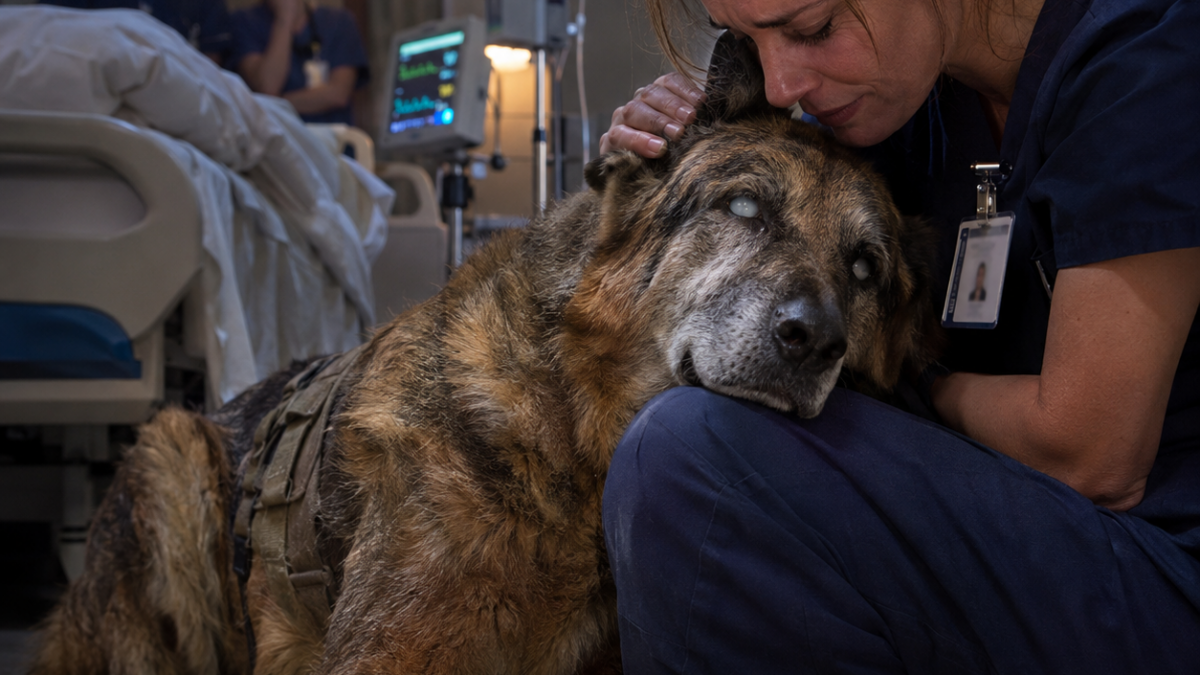
Nobody Could Touch the Blind Retired K9—Then a Night Nurse Turned Off the Lights and Whispered the Call Sign He Hadn’t Heard Since Afghanistan.
For three days, every nurse, veterinarian, and military handler who tried to approach Atlas watched the blind retired K9 flatten himself against the hospital wall, teeth bared at footsteps he could no longer identify and hands he could no longer see coming.
Then Nurse Claire Bennett quietly asked everyone to leave, switched off the lights in a room where darkness no longer mattered to the dog, and whispered one forgotten call sign that had not appeared in Atlas’s official records for more than a decade.
What happened when the trembling German Shepherd recognized that voice would force Claire to confront a promise she had never spoken about, a soldier nobody at the hospital knew she had once loved, and the reason Atlas had been waiting for one sound from his past.
At 2:13 in the morning, Atlas heard the cart before anyone opened the door.
His head snapped up.
Metal wheels.
Rubber soles.
A plastic cup rattling in a tray.
Two sets of footsteps.
One heavy.
One light.
He could no longer see the white hospital walls.
He could no longer see the stainless steel examination table.
He could no longer see the green blanket beneath his body or the IV line taped carefully to his front leg.
But blindness had not taken sound from him.
If anything, the world had become sound.
Sound and smell.
Sound told Atlas where danger lived now.
And danger was coming closer.
His body tightened.
The German Shepherd pushed himself backward until his spine touched the wall.
The heavy footsteps stopped outside the room.
A male voice said, “Easy, Atlas.”
The dog’s lips pulled back.
A low growl filled the room.
The man did not move.
“See?” another voice whispered from the hallway. “He’s doing it again.”
Atlas heard the whisper.
The whisper mattered more than the words.
People whispered before reaching for him.
People whispered before the needle.
Before the restraint.
Before the strange hands.
The growl deepened.
Dr. Marcus Levin stood outside the doorway holding a medication syringe.
He was a civilian veterinarian contracted to support the Army medical center’s working-dog rehabilitation program.
Forty-six.
Calm.
Experienced.
He had handled frightened military dogs, police dogs with trauma histories, retired dogs with neurological problems, and once a Belgian Malinois that had bitten through a leather muzzle while recovering from surgery.
He did not frighten easily.
Atlas frightened him.
PART2:
Not because the dog was vicious.
Marcus did not believe Atlas was vicious.
That was the problem.
Atlas was terrified.
And terrified dogs were unpredictable.
“He needs the pain medication,” Marcus said.
The young veterinary technician beside him nodded.
“I know.”
“Did he eat?”
“No.”
“Water?”
“Maybe half a cup.”
Marcus exhaled.
“How long since anyone touched him?”
The technician glanced at the chart.
“Almost nine hours.”
Marcus looked into the room.
Atlas’s head moved slightly as if tracking the silence.
The dog was eleven years old.
Retired three months earlier.
A decorated military working dog with two deployments to Afghanistan and one to Iraq.
His service file showed explosive detection, patrol work, route clearance support, and more than a dozen documented combat alerts.
It also showed progressive retinal degeneration.
Then cataracts.
Then complete blindness.
PART3:
His handler, Staff Sergeant Mason Hale, had fought to keep Atlas at home after retirement.
Two weeks later, Mason suffered a massive heart attack while driving.
He survived.
Barely.
Now Mason lay four floors above Atlas in the cardiac intensive care unit.
And Atlas had not understood why his handler had vanished.
Nobody had been able to explain it to him.
The dog had been brought to the hospital because Mason’s sister refused to leave him alone in an empty house while Mason remained unconscious.
The plan had been simple.
A temporary veterinary admission.
Fluids.
Medication.
Monitoring.
Then family placement until Mason recovered.
Instead Atlas had stopped allowing anyone near him.
First the veterinary technician.
Then the attending veterinarian.
Then a military handler from the base kennel.
Then another.
Each attempt ended the same way.
Atlas backed into a corner.
Pressed his body against the wall.
Bared his teeth.
Trembled so hard his legs shook.
The hospital began discussing sedation.
A muzzle.
Chemical restraint.
Marcus hated all three options.
But he hated the possibility of Atlas injuring himself more.
He looked at the syringe again.
“We’re going in.”
The technician swallowed.
“Together?”
“No.”
Marcus placed the syringe back on the cart.
“Bring the barrier panel.”
Before she could move, a woman’s voice came from behind them.
“What are you doing?”
Marcus turned.
Nurse Claire Bennett stood twenty feet down the corridor.
She was wearing navy scrubs under a gray cardigan, a paper coffee cup in one hand and a patient chart in the other.
Thirty-eight years old.
Brown hair tied low behind her neck.
No makeup.
Tired eyes.
The kind of posture nurses developed after years of long shifts—alert even when exhausted.
Marcus knew her.
Everyone on the overnight floor knew Claire.
She worked cardiac step-down.
She was good.
Quiet.
Not sentimental.
Almost impossible to rattle.
“What are you doing down here?” Marcus asked.
“Transport delay upstairs.”
She looked through the doorway.
“Is that the retired K9?”
Marcus nodded.
“Atlas.”
Claire stopped moving.
The coffee cup lowered slightly.
“What?”
“Atlas.”
Marcus pointed toward the room.
“Staff Sergeant Hale’s dog.”
Claire stared.
The name had changed her face.
Marcus noticed.
“You know him?”
Claire’s eyes stayed on the dog.
“I knew a dog named Atlas.”
“Well, there can’t be that many blind retired military German Shepherds named Atlas.”
Claire said nothing.
Marcus frowned.
“You okay?”
She took one slow step toward the doorway.
Atlas heard her.
His growl stopped.
Not fully.
It thinned.
Marcus noticed that too.
Claire whispered, “How old?”
“Eleven.”
Her face went pale.
“When did he retire?”
“Three months ago.”
“Handler?”
“Staff Sergeant Mason Hale.”
Claire closed her eyes briefly.
Marcus stared.
“You do know him.”
Claire opened her eyes.
“No.”
“You just reacted to the handler’s name.”
“I knew someone who worked with him.”
“Who?”
She did not answer.
Atlas shifted against the wall.
Claire listened.
Not looked.
Listened.
The dog’s breathing was shallow.
Rapid.
Every few seconds his paws scraped the floor.
Marcus said, “He’s been like this since admission.”
“Why are the lights on?”
Marcus looked up.
“What?”
“The lights.”
“He’s blind.”
“I know.”
“So?”
Claire stared at him.
“So he knows everyone else can see.”
Marcus did not understand.
She stepped closer.
Atlas’s ears rose.
He growled again.
Claire stopped immediately.
“Don’t move,” Marcus warned.
“I’m not.”
“He may bite.”
“He might.”
Marcus stared.
She did not sound afraid.
Claire set her coffee cup down.
Then she looked at the technician.
“Could you step back?”
The technician glanced at Marcus.
“Why?”
“Because he can hear your shoes.”
The young woman looked down.
Her shoes squeaked slightly against the floor.
Claire looked at Marcus.
“And you.”
“I’m not leaving you alone with that dog.”
“He doesn’t know me.”
“Exactly.”
Claire’s voice softened.
“He doesn’t know any of you either.”
Marcus folded his arms.
“What are you suggesting?”
She turned toward the room.
“Turn off the lights.”
Marcus almost laughed.
“He can’t see.”
“I’m aware.”
“Then what difference does it make?”
Claire looked at him.
“It changes the people.”
Silence.
She continued.
“When people can’t see well, they move slower.”
Marcus stared.
“They stop staring.”
Another pause.
“They stop reaching.”
Atlas’s breathing filled the room.
Claire said, “He’s blind. You’re not. Right now he’s the only one in the room who doesn’t control where anything comes from.”
Marcus slowly looked at the dog.
Then at the bright fluorescent lights.
Claire asked, “How many people tried to touch him tonight?”
“Four.”
“And how many announced where their hands were?”
Marcus did not answer.
Claire set down her chart.
“Please.”
Marcus hesitated.
Then nodded toward the technician.
She turned off the overhead lights.
The room became almost completely dark except for faint corridor illumination.
Claire stepped backward.
Not forward.
Atlas’s ears moved.
She took off her shoes.
Marcus blinked.
“What are you doing?”
“Making less noise.”
She placed them beside the wall.
Then she sat on the floor outside the doorway.
Not inside.
Outside.
Atlas’s head turned toward her.
Claire did not speak.
For nearly thirty seconds, nobody moved.
Then Claire inhaled slowly.
Her voice came barely above a whisper.
“Rook Six.”
Atlas stopped breathing.
Marcus looked at her.
“What did you say?”
Claire did not answer.
The dog’s ears rose.
His head lifted.
The trembling stopped.
Claire whispered again.
“Rook Six.”
Atlas made a sound.
Not a growl.
A soft, broken whine.
Marcus’s eyes widened.
Claire’s face crumpled for half a second before she controlled it.
“Hey, old man.”
Atlas moved.
One paw forward.
Then another.
His nails clicked softly on the floor.
Marcus instinctively shifted.
Claire raised one hand without looking at him.
Do not move.
Atlas reached the doorway.
His nose worked frantically.
He smelled Claire’s scrubs.
Coffee.
Soap.
Hospital disinfectant.
And something older.
Something buried beneath years.
His body lowered.
Claire remained still.
The dog stepped through the doorway.
He touched her knee with his nose.
Claire’s lips trembled.
Atlas inhaled.
Then slowly lowered his head into her lap.
The entire corridor went silent.
Claire closed her eyes.
Her hand hovered over him.
But she did not touch.
Not yet.
“Hi, Atlas.”
The dog exhaled.
She whispered, “You remember.”
Atlas pressed closer.
Marcus looked between them.
“What the hell is Rook Six?”
Claire finally opened her eyes.
“A call sign.”
“Whose?”
She stared down at Atlas.
“Someone who died twelve years ago.”
Marcus frowned.
“But Atlas responded to you.”
Claire’s fingers finally settled into the fur behind the dog’s ears.
Her voice cracked.
“I know.”
The dog stopped trembling.
Completely.
Marcus lowered himself slowly to one knee.
“You need to tell me what’s happening.”
Claire rubbed Atlas’s neck.
“I can’t.”
“Can’t?”
“Not tonight.”
Marcus looked at the dog.
“He hasn’t let anyone touch him in almost nine hours.”
“I heard.”
“You say two words and he comes across the room.”
Claire swallowed.
“I heard that too.”
“Claire.”
Her eyes filled.
“Please.”
Something in her expression stopped him.
Marcus nodded.
“Okay.”
He lowered the syringe.
“Can you keep him calm while I give the medication?”
Claire’s body stiffened.
Atlas noticed immediately.
His head lifted.
Claire looked at Marcus.
“Not yet.”
“He needs it.”
“Give me five minutes.”
“Claire—”
“Five.”
Marcus checked the time.
“All right.”
He backed away.
Claire remained on the floor with Atlas’s head against her knee.
In the darkness, the dog looked almost young.
Claire looked anything but.
Five minutes later, Atlas allowed Marcus to administer the injection while Claire whispered quietly to him.
Not commands.
Memories.
“Easy.”
“You’re okay.”
“Good boy.”
Then, once more:
“Rook Six.”
Each time the phrase came, Atlas relaxed.
When the medication was finished, Marcus stepped back.
He looked at Claire.
“I’m not dropping this.”
“I know.”
“Tomorrow.”
She nodded.
“Tomorrow.”
But neither of them knew that by sunrise, Atlas’s response would already have reached someone who had spent twelve years making sure the words Rook Six never appeared anywhere they could be connected to Claire Bennett.
At 6:40, Claire finished her shift.
She did not go home.
She went upstairs.
Cardiac intensive care occupied the fourth floor.
Staff Sergeant Mason Hale lay in Room 417.
Machines breathed quietly around him.
His face was swollen.
A ventilator tube had been removed the day before, but he remained heavily sedated.
His sister, Rebecca, slept in a chair beside the window.
Claire stood outside the glass.
She had never met Mason.
Not formally.
But she knew his face from photographs.
Older now.
Grayer.
Still recognizable.
Rebecca woke and noticed her.
She stood.
“Can I help you?”
Claire entered.
“I’m Claire Bennett. Cardiac step-down.”
Rebecca looked at her badge.
“Is something wrong?”
“No.”
Claire hesitated.
“I met Atlas tonight.”
Rebecca’s expression changed immediately.
“Oh.”
“He’s downstairs.”
“I know.”
“He was having a hard time.”
Rebecca looked exhausted.
“He’s been having a hard time since Mason collapsed.”
Claire nodded.
Rebecca studied her.
“You know dogs?”
“A little.”
“Military dogs?”
Claire looked toward Mason.
“A long time ago.”
Rebecca folded her arms.
“What happened?”
Claire tried to keep her voice neutral.
“He calmed down.”
Rebecca’s eyes widened.
“How?”
Claire hesitated too long.
Rebecca noticed.
“What did you do?”
“I used a call sign.”
Silence.
“What call sign?”
Claire looked back at Mason.
“Rook Six.”
Rebecca’s face changed.
Not confusion.
Recognition.
Claire saw it.
“You know it.”
Rebecca took one step backward.
“Who are you?”
Claire’s pulse accelerated.
“I told you.”
“No.”
Rebecca’s voice sharpened.
“Who are you?”
Claire looked at Mason.
“I knew Patrick.”
Rebecca went pale.
The name hit the room like something dropped.
For several seconds, nobody spoke.
Then Rebecca whispered, “Patrick Bennett?”
Claire nodded.
Rebecca sat down.
“Oh my God.”
Claire stared.
“You knew him?”
Rebecca laughed once in disbelief.
“Mason never stopped talking about him.”
Claire’s throat tightened.
“He never mentioned Mason.”
Rebecca looked up.
“That’s impossible.”
Claire’s expression hardened.
“No.”
She looked toward the sleeping soldier.
“What’s impossible is that I spent twelve years being told Patrick died instantly and alone.”
Rebecca’s eyes widened.
“He didn’t.”
Claire stopped breathing.
“What?”
Rebecca froze.
The silence that followed changed the room.
Claire stepped closer.
“What did you just say?”
Rebecca swallowed.
“I shouldn’t have said that.”
“You already did.”
“Claire—”
“Did Patrick die alone?”
Rebecca looked at Mason.
Then at the door.
“No.”
Claire’s body went cold.
“Who was with him?”
Rebecca’s eyes filled.
“Mason.”
Claire stared at the unconscious man.
“No.”
“Yes.”
“No.”
“He was there.”
Claire shook her head.
“The casualty officer told me Patrick’s team had already moved.”
Rebecca covered her mouth.
“Mason was ordered never to contact you.”
Claire whispered, “Ordered by whom?”
“I don’t know.”
“That’s a lie.”
Rebecca’s voice broke.
“I don’t know the name.”
“You’re telling me your brother watched my husband die and nobody told me?”
“I’m telling you Mason spent twelve years carrying something he believed he wasn’t allowed to give you.”
Claire’s knees weakened.
Rebecca grabbed a chair.
“Sit down.”
Claire did not.
“What?”
Rebecca was crying now.
“What was he carrying?”
“I don’t know everything.”
“What was he carrying?”
Rebecca looked toward Mason.
“A message.”
Claire stopped.
Rebecca continued.
“Patrick left you a message.”
The hospital noises seemed to disappear.
Claire whispered, “Where?”
“I don’t know.”
“Where is it?”
“Mason never said.”
“Did he hear it?”
“I think so.”
“You think?”
“Mason wouldn’t talk about Afghanistan.”
Claire stepped toward him.
“But he talked about Patrick?”
“All the time.”
“What did he say?”
Rebecca wiped her face.
“That Patrick saved his life.”
Claire laughed bitterly.
“That sounds like Patrick.”
“He said Patrick took Atlas from him during the final movement.”
Claire frowned.
“Atlas belonged to Mason?”
“Originally.”
Claire stared.
Rebecca nodded.
“Mason was his first handler.”
Claire looked toward the elevator.
Then back.
“Why did Atlas respond to Patrick’s call sign?”
Rebecca’s face tightened.
“Because Patrick became his handler after Mason was wounded.”
Claire had never known.
Patrick had written dozens of letters from deployment.
Not once had he mentioned Atlas by name.
Military security had restricted details.
He called the dog “the mutt.”
She had assumed it was a joke.
Suddenly memories began moving.
A letter.
March 14.
The mutt stole my glove again.
April 2.
The mutt sleeps better than I do.
May 19.
If I ever come home with a German Shepherd, don’t pretend you’re surprised.
Claire’s hand flew to her mouth.
“Oh my God.”
Rebecca asked softly, “What?”
Claire laughed through tears.
“The mutt.”
“What?”
“He wrote about Atlas.”
Rebecca smiled sadly.
“He loved that dog.”
Claire stared toward the floor.
“I didn’t know.”
Upstairs, Mason slept.
Downstairs, Atlas began refusing food again the moment Claire left.
By 8:00, Marcus called her.
She was sitting in the staff lounge staring at Patrick’s old contact information in her phone.
She had never deleted it.
Marcus said, “You need to come back downstairs.”
“I’m off.”
“He’s pacing.”
“Give him time.”
“He’s looking for you.”
Claire closed her eyes.
“I can’t do this.”
“Do what?”
“Become something he needs.”
Marcus paused.
“He already decided that.”
Claire looked toward the fourth floor.
“I need to go home.”
“Okay.”
But she did not.
Instead she went back to Atlas.
He heard her bare feet before she reached the room.
This time his tail moved.
Once.
Claire sat outside the kennel area.
“Hey.”
Atlas approached.
She touched him.
No growling.
No shaking.
Marcus watched.
“What happened to you?”
Claire looked at him.
“What?”
“You look like you got hit by a truck.”
“I found out someone lied to me for twelve years.”
Marcus stopped.
“That sounds bad.”
“It is.”
“You want to tell me?”
“No.”
“Okay.”
She appreciated that.
Marcus crouched.
“I pulled Atlas’s archived file.”
Claire looked at him.
“Why?”
“Because you scared me.”
“I scared you?”
“You knew a classified call sign.”
“That isn’t classified now.”
“It’s not in the dog’s current records either.”
Claire frowned.
Marcus continued.
“I found older handling notes.”
Her pulse quickened.
“What do they say?”
“Atlas had three handlers.”
“Mason?”
“First.”
“And?”
“Then your husband.”
Claire stared.
Marcus had discovered her connection.
“You searched Patrick?”
“I did.”
Claire’s face hardened.
“That wasn’t your business.”
“Atlas is my patient.”
“My husband isn’t.”
“No.”
Marcus met her eyes.
“But his death might explain what’s happening to the dog.”
Claire looked away.
Marcus lowered his voice.
“Patrick Bennett became Atlas’s handler after Mason Hale was wounded during a route-clearance mission.”
Claire said nothing.
“Ten months later, Patrick was killed.”
She closed her eyes.
Marcus continued.
“Atlas was recovered with Mason’s team.”
Claire’s eyes opened.
“Recovered?”
“That’s the word.”
“Recovered from where?”
“The file is vague.”
“How vague?”
“Very.”
Claire stood.
“What exactly does it say?”
Marcus opened a tablet.
“After-action note: MWD Atlas separated from assigned handler during hostile contact. Recovered approximately nine hours later with secondary element.”
Claire stared.
“Nine hours.”
“Yes.”
“Patrick died during that hostile contact.”
“Yes.”
“So Atlas was with him.”
Marcus looked at her.
“Probably.”
“No.”
Claire’s voice hardened.
“Not probably.”
She took the tablet.
“He was with Patrick.”
Marcus watched her.
Claire scrolled.
Most details were redacted.
But one line remained.
Behavioral observation post-recovery: extreme resistance to physical handling in enclosed spaces, resolved after reintroduction to familiar auditory cue.
Claire’s breath caught.
“What cue?”
Marcus shook his head.
“Not listed.”
She stared at Atlas.
“Rook Six.”
Marcus nodded slowly.
“Seems likely.”
Claire whispered, “This happened before.”
Atlas turned toward her voice.
She crouched.
Twelve years earlier, Patrick died.
Atlas lost his sight much later.
But somewhere in those nine missing hours, something had frightened him badly enough that closed rooms and approaching hands became associated with terror.
Blindness had brought it back.
Claire whispered, “What happened to you?”
Atlas pressed his head against her chest.
That afternoon, Mason woke.
Rebecca called Claire from the hallway.
“He’s asking for Atlas.”
Claire hurried upstairs.
Mason looked terrible.
But awake.
Eyes barely open.
Voice weak.
Rebecca leaned close.
“Mason, there’s someone here.”
He turned.
Claire stepped forward.
His face changed immediately.
Not confusion.
Recognition.
He whispered, “Claire.”
She stopped.
“You know me.”
Mason closed his eyes.
“Yes.”
Claire’s anger rose so fast it almost overwhelmed her.
“You knew who I was.”
“Yes.”
“For twelve years.”
Mason swallowed.
“Yes.”
“You knew where I lived?”
“No.”
“You could have found me.”
“Yes.”
Claire stared.
“Why didn’t you?”
Mason’s eyes filled.
“Because I was a coward.”
Rebecca whispered, “Mason.”
He ignored her.
Claire stepped closer.
“You were there.”
“Yes.”
“When Patrick died.”
“Yes.”
“Did he suffer?”
Mason closed his eyes.
Claire’s voice cracked.
“Look at me.”
He did.
“Did my husband suffer?”
Mason struggled to speak.
“He was hurt.”
“That’s not what I asked.”
“Yes.”
Claire turned away.
She gripped the rail.
For twelve years, she had held onto the official sentence.
Instantaneous death.
No prolonged suffering.
No awareness.
No pain.
The lie had been cruel.
But comforting.
Mason said, “I’m sorry.”
Claire spun back.
“Don’t.”
“I should have—”
“You had twelve years.”
“I know.”
“You had twelve years to tell me the truth.”
“I know.”
“Did he say my name?”
Mason began crying.
Claire went still.
That answered before he spoke.
“Yes.”
Her knees nearly failed.
Rebecca caught her arm.
Claire pulled away.
“What did he say?”
Mason looked terrified.
“Claire.”
“What did he say?”
“I promised him.”
“Promised what?”
Mason started coughing.
The monitor alarmed.
Claire instinctively reached toward him as a nurse.
Then stopped.
Another nurse entered.
“Everyone out.”
Claire did not move.
“Mrs. Bennett.”
“Everyone out.”
Rebecca guided her into the hallway.
Claire stood there trembling.
Twenty minutes later, Mason stabilized.
He asked for Claire again.
This time she entered alone.
Mason held something in his hand.
A small key.
Claire stared.
“What is that?”
“My storage unit.”
She frowned.
“Why?”
“Patrick’s things.”
The room tilted.
“What things?”
“What I recovered.”
“Recovered from where?”
Mason looked toward the door.
“From him.”
Claire’s throat tightened.
“Why do you have my husband’s things?”
“Because I was told they were evidence.”
“For twelve years?”
“No.”
Mason looked ashamed.
“Later they were returned to me because his formal property had already been processed.”
Claire stared.
“You kept them.”
“I couldn’t throw them away.”
“What’s there?”
“His radio notebook.”
“Anything else?”
“Dog tags.”
Claire’s eyes filled.
“I was given dog tags.”
“Second set.”
She laughed bitterly.
“Of course.”
Mason continued.
“His field watch.”
Claire covered her mouth.
Patrick’s father had given him that watch.
A scratched black military watch he wore everywhere.
The Army told Claire it had been destroyed.
“And?”
Mason hesitated.
“A recorder.”
Claire stopped breathing.
“What recorder?”
“Patrick carried a little voice recorder.”
She remembered it.
Patrick recorded grocery lists because he forgot everything.
Once he recorded himself snoring to prove Claire was lying about how loud he was.
She had laughed until she cried.
Mason whispered, “He used it at the end.”
Claire turned away.
“No.”
“It’s there.”
“No.”
“I never listened to all of it.”
She turned back.
“You listened?”
“Enough.”
Claire looked like she might hit him.
Mason deserved it.
“I’m sorry.”
“Stop saying that.”
He nodded.
Claire picked up the key.
“Where?”
Mason gave her the address.
The storage facility sat twenty minutes from the hospital.
Claire drove there after sunset.
She almost brought Rebecca.
Then changed her mind.
Some things had already belonged to too many people.
The unit was small.
Six by eight.
Inside were boxes.
A duffel bag.
Military gear.
An old dog harness.
Claire touched it.
ATLAS had been written in faded black marker along the side.
Her knees weakened.
She sat on a plastic storage bin.
Then she saw the metal ammunition box.
Locked.
The key fit.
Inside were Patrick’s things.
Watch.
Tags.
Notebook.
A folded photograph of Claire.
She stared at it.
Patrick had taken that photo at the beach.
She was laughing.
Hair blown across her face.
She remembered yelling at him to stop taking pictures.
On the back, Patrick had written:
HOME.
Claire cried quietly.
At the bottom of the box sat a small digital recorder sealed in plastic.
Her hand shook when she picked it up.
The battery was dead.
Of course.
She brought everything back to the hospital.
Marcus found an old universal charger.
It took forty minutes.
Claire sat in an empty conference room.
Atlas lay beside her chair.
She had brought him upstairs with veterinary approval.
Mason was awake in his room.
But Claire did not want him there.
The recorder turned on.
Seventeen files.
Most were ordinary.
Patrick joking about weather.
Equipment notes.
Voice reminders.
One recording of Atlas barking while Patrick laughed.
“Yeah, yeah, I heard you.”
Claire smiled through tears.
Then File 17.
Time stamp.
The day Patrick died.
Claire pressed play.
Static.
Breathing.
Gunfire far away.
Patrick’s voice.
Weak.
“Mason?”
Another voice.
“I’m here.”
Claire recognized Mason.
Patrick coughed.
“Atlas?”
“He’s here.”
A whine.
Claire looked down.
Atlas’s head lifted.
The dog heard his younger self.
On the recording, Patrick said, “Good boy.”
Atlas whined beside Claire.
She covered her mouth.
Patrick’s breathing became ragged.
“Mason.”
“Save your air.”
“Shut up.”
A weak laugh.
Even dying, Patrick sounded like Patrick.
Claire cried.
Then:
“Claire.”
Mason said, “You’ll tell her.”
Patrick answered, “No.”
“You’re going to tell her yourself.”
“No.”
Long pause.
“Listen.”
“I’m listening.”
“If I don’t…”
“You will.”
“If I don’t.”
Silence.
“Tell Claire…”
Patrick coughed.
The recording distorted.
Then his voice returned.
“…tell her I wasn’t scared.”
Claire closed her eyes.
Patrick continued.
“Tell her I lied.”
Mason laughed softly through tears.
“About what?”
“The dog.”
Claire froze.
Patrick’s voice weakened.
“I’m bringing him home.”
Atlas lifted his head.
Claire started crying harder.
Patrick whispered, “She’ll pretend she doesn’t want him.”
Mason said, “Yeah.”
“She’s a terrible liar.”
Claire laughed through tears.
On the recording, Patrick breathed slowly.
Then:
“Tell her…”
Static.
“…I loved every stupid morning.”
Claire pressed both hands to her face.
His voice came again.
“And every fight.”
Pause.
“And tell her…”
Silence.
Long.
Claire thought the recording had ended.
Then Patrick whispered:
“Rook Six is home.”
Atlas stood.
Claire stared at him.
The dog trembled.
Not fear.
Recognition.
Patrick’s last clear words continued.
“Take him home.”
The recording ended.
Claire sat frozen.
Atlas walked toward the recorder.
Sniffed it.
Then pressed his nose against Claire’s hand.
She collapsed over him.
For twelve years, Claire thought Patrick’s final thoughts were unknown.
Now she knew.
Home.
Her.
Atlas.
Not war.
Not duty.
Not medals.
Not even fear.
Home.
Mason had carried that message for twelve years and said nothing.
Her grief turned to anger again.
Claire went straight to his room.
The recorder was in her pocket.
Atlas remained with Marcus downstairs.
Mason saw her face and knew.
“You listened.”
“Yes.”
He closed his eyes.
Claire stood beside the bed.
“Why?”
Mason looked at her.
“I was told Patrick’s final recording contained classified operational information.”
“That recording?”
“The entire device.”
“So you gave it up.”
“Yes.”
“And then?”
“Years later, it came back.”
“How many?”
“Four.”
Claire stared.
“You had it for eight years.”
“Yes.”
“You could have found me.”
“Yes.”
“Why didn’t you?”
Mason looked away.
“Because by then I had built a life around not opening that box.”
Claire said nothing.
He continued.
“I was drinking.”
Rebecca had hinted at that.
“I lost my first marriage.”
Claire’s anger remained.
“I had nightmares.”
She folded her arms.
“And?”
“And every time I thought about calling you, I imagined hearing your voice and having to explain why I had waited.”
Claire’s eyes hardened.
“So you waited longer.”
“Yes.”
“That’s pathetic.”
“Yes.”
No defense.
That made her angrier.
Mason looked at her.
“I don’t expect forgiveness.”
“Good.”
“I deserve that.”
“Yes.”
Silence.
Then he said something she did not expect.
“But Patrick deserved better than my fear.”
Claire’s expression shifted.
Mason’s eyes filled.
“He died saving me.”
Claire looked at him.
“What happened?”
Mason took a long breath.
“The report was wrong.”
She waited.
“We were hit outside the route corridor.”
“Atlas?”
“With Patrick.”
Mason looked toward the window.
“The first explosion threw me into a ditch.”
“Patrick came back?”
“Yes.”
“Why?”
“Because I was still moving.”
Claire closed her eyes.
Of course.
Mason continued.
“He left cover.”
“Idiot.”
“Yes.”
That sounded like Patrick too.
“He dragged me behind a wall.”
“And Atlas?”
“Stayed on him.”
Mason paused.
“Second blast hit the wall.”
Claire’s face tightened.
“Patrick took most of it.”
She stared.
“He knew?”
“Immediately.”
Claire swallowed.
“What happened to Atlas?”
“Muzzle injury. Shrapnel. Confused.”
Mason’s voice changed.
“Then enemy fighters entered the compound.”
Claire felt cold.
“We had to move.”
“Patrick couldn’t.”
“No.”
“You left him?”
Mason’s eyes filled.
“Not exactly.”
“What does that mean?”
“We moved him to a storage room.”
Claire stared.
“The room Atlas is afraid of.”
Mason looked at her.
“What?”
She explained.
The enclosed spaces.
Blindness.
Hands approaching.
The archived behavioral note.
Mason went pale.
“Oh God.”
“What?”
He covered his face.
“Atlas stayed with Patrick.”
Claire’s breathing stopped.
“How long?”
“Nine hours.”
“The report said Atlas was separated.”
“That was the version they wrote.”
“Why?”
“Because we weren’t supposed to leave the dog.”
Claire whispered, “You left him with Patrick.”
Mason nodded through tears.
“Patrick ordered it.”
Claire stared.
“Mason.”
“He said Atlas would keep anyone away.”
“From him?”
“From the room.”
Claire remembered the teeth.
The wall.
The terror.
“What happened?”
Mason’s voice cracked.
“When we got back, Patrick was gone.”
Claire’s face changed.
“Gone?”
“Dead.”
“But where was Atlas?”
“Still against the door.”
Mason wiped his face.
“He wouldn’t let us inside.”
Claire stared.
“We called him.”
“No response.”
“We tried commands.”
“Nothing.”
“Then I used Patrick’s call sign.”
“Rook Six.”
“Yes.”
“And?”
“He stopped.”
Mason looked devastated.
“He let us touch him.”
Claire turned away.
That was it.
Twelve years later.
Blind.
Confused.
Handler hospitalized.
Strange room.
Hands approaching.
Atlas had been returned to that night.
Not literally.
But in his body.
A dark enclosed space.
A missing handler.
Footsteps he did not trust.
People reaching.
The memory had survived deeper than sight.
Claire whispered, “He wasn’t aggressive.”
Mason shook his head.
“No.”
“He was guarding Patrick.”
“Yes.”
“Still.”
“Yes.”
Claire left the room.
Downstairs, Atlas was asleep.
She sat beside him.
For the first time, she understood why turning off the lights had worked.
Why the call sign mattered.
Why the dog pressed himself against the wall.
Why hands terrified him.
Atlas was not fighting the hospital.
He was back in a storage room in Afghanistan.
Blindness had erased his ability to confirm that the world had changed.
So his body remembered for him.
Claire made a decision.
The next morning, she met with Marcus and the military canine program director.
“No more forced contact.”
Marcus nodded.
“I agree.”
“No barriers.”
“Okay.”
“No surprise handling.”
“Done.”
“I want one consistent sound before anyone touches him.”
“What sound?”
Claire thought.
“Two taps.”
“On what?”
“Anything.”
Marcus wrote it down.
“Two taps, pause, then voice.”
“And nobody approaches from behind.”
“Obviously.”
“It wasn’t obvious three days ago.”
He accepted that.
She continued.
“Give him a map.”
Marcus frowned.
“He’s blind.”
“Exactly.”
She explained.
Consistent furniture placement.
Same bed.
Same water bowl.
Same entrance.
Textured mats to mark boundaries.
A low fan near the door so Atlas could locate airflow.
Different scent markers for food, rest, medication.
Marcus smiled.
“You’ve done this before.”
“No.”
“You sound like you have.”
Claire looked at Atlas.
“I spent twelve years working with cardiac patients who wake up not understanding why their body betrayed them.”
Marcus nodded.
“Fair.”
Then Claire added one more rule.
“No Rook Six unless he’s panicking.”
Marcus looked at her.
“Why?”
“Because that belongs to Patrick.”
Over the next week, Atlas changed.
Slowly.
He still startled.
Still pressed against walls when unexpected footsteps approached.
But he stopped baring his teeth at familiar staff.
Marcus used the two-tap signal before medication.
Atlas learned it.
A technician named Ava hummed before changing his water.
Atlas began recognizing her.
Claire visited before and after shifts.
Sometimes she brought the recorder.
Not File 17.
Never that one.
The funny recordings.
Patrick complaining about the dog stealing a glove.
Patrick calling Atlas a criminal.
Atlas barking.
The dog would lie with his head on Claire’s shoe.
Sometimes his tail moved.
Mason improved too.
By the second week, he transferred out of intensive care.
Claire avoided him.
She was not ready.
He did not push.
Then one afternoon, Mason appeared downstairs in a wheelchair.
Rebecca pushed him toward the veterinary rehabilitation area.
Atlas was sleeping.
Mason whispered, “Hey.”
The dog’s head lifted.
His ears moved.
Mason’s face broke.
“Buddy.”
Atlas stood.
He sniffed.
Then ran.
Not fast.
Not gracefully.
But straight toward Mason.
He hit the wheelchair with his chest.
Mason laughed and cried at the same time.
Atlas climbed halfway into his lap.
Claire watched from the doorway.
Something inside her loosened.
Not forgiveness.
Not yet.
But understanding.
Mason held Atlas’s face.
“I’m sorry.”
Claire almost told him not to apologize to the dog.
Then stopped.
Maybe he needed to.
Atlas licked his hand.
Mason laughed.
“You always were easier than people.”
Claire finally stepped closer.
Mason looked up.
“I’m being discharged tomorrow.”
“I heard.”
“Rehab facility.”
“Yes.”
Rebecca said, “They don’t allow large dogs.”
Mason looked at Atlas.
Claire understood immediately.
“What happens to him?”
Mason looked ashamed.
“I don’t know.”
The canine program director had already discussed options.
Temporary foster.
Military retirement home.
Special-needs adoption.
Claire’s chest tightened.
Atlas had lost Patrick.
Then Mason once.
Now Mason again.
Blind.
Old.
Traumatized.
He would be moved to another unfamiliar place with unfamiliar footsteps.
“No,” Claire said.
Mason looked up.
“What?”
“No.”
Rebecca stared.
Claire crossed her arms.
“He’s not going to another facility.”
Mason said, “Claire—”
“He’s eleven.”
“Yes.”
“He’s blind.”
“Yes.”
“He knows me.”
“Yes.”
Claire looked at Atlas.
The dog was leaning against Mason.
“I’ll take him.”
Silence.
Mason stared.
“What?”
“Temporarily.”
Rebecca smiled.
Claire pointed at her.
“Do not smile.”
“I’m not.”
“You are.”
Rebecca looked away.
Mason said, “Claire, you don’t owe him.”
Claire’s expression changed.
“I know.”
“You don’t owe Patrick.”
“I know.”
“You definitely don’t owe me.”
Her eyes hardened.
“That part is extremely clear.”
Mason almost smiled.
Claire looked at Atlas.
“I want him.”
The dog turned toward her voice.
Mason whispered, “Patrick wanted you to have him.”
Claire swallowed.
“That’s not why.”
It was partly why.
She knew that.
But not all of it.
Atlas came home with Claire three days later.
Her house was small.
One story.
Quiet neighborhood outside Fayetteville.
The first night, Atlas mapped every wall.
Every doorway.
Every piece of furniture.
Claire followed behind but did not guide unless necessary.
He bumped one chair.
Stopped.
Sniffed.
Walked around it.
At the kitchen, he found the water bowl.
Claire had placed a lavender-scented mat beneath it.
Food used cedar.
His bed used unscented wool.
She kept the layout simple.
At 2:00 a.m., Atlas began pacing.
Claire woke.
She found him in the hallway.
He was facing the front door.
“Atlas?”
His ears moved.
She approached carefully.
Two taps against the wall.
Pause.
“It’s me.”
The dog relaxed.
Claire sat on the floor.
“You looking for him?”
Atlas stood beside the door.
Claire knew she could mean either man.
Patrick.
Mason.
Maybe both.
She leaned against the wall.
“I spent a long time doing that too.”
Atlas lowered himself beside her.
Claire looked into the darkness.
“For years, I expected Patrick’s key in the lock.”
She laughed softly.
“Ridiculous.”
Atlas rested his head on her thigh.
“I knew he was dead.”
Silence.
“Knowing isn’t the same as believing, is it?”
The dog breathed.
Claire rubbed behind his ears.
For the first time in twelve years, she spoke to Patrick out loud.
Not at the cemetery.
Not in prayer.
Not in anger.
Just aloud.
“You idiot.”
Atlas’s ear moved.
Claire smiled through tears.
“You really were going to bring him home.”
Weeks passed.
Atlas adapted.
Claire changed too.
She began leaving work on time.
Her colleagues noticed.
One asked if she had started dating someone.
Claire replied, “He’s eighty pounds and sheds.”
Rumors followed.
She ignored them.
Atlas learned the house.
Front door.
Kitchen.
Bedroom.
Back patio.
He learned her schedule.
Morning coffee.
Work shoes.
Car keys.
He waited beside the garage at 6:20 p.m.
Claire hated that at first.
Then loved it.
Mason called once a week.
Claire did not always answer.
When she did, they spoke mostly about Atlas.
His rehab progressed slowly.
Walking again.
Then stairs.
Then short outings.
One afternoon, Mason asked:
“Does he still wake at 2:13?”
Claire went quiet.
“How do you know?”
“He used to do it after Patrick died.”
“What happened at 2:13?”
Mason hesitated.
“That was the time we recovered the room.”
Claire closed her eyes.
Atlas remembered.
Down to the minute.
“Not every night now.”
“Good.”
Mason sounded relieved.
Claire asked, “Why didn’t anyone treat him then?”
“We did.”
“For what?”
“Anxiety.”
“That’s not what I asked.”
Mason sighed.
“We didn’t understand.”
“You had the same signs.”
“We were soldiers.”
“That’s not an excuse.”
“No.”
Claire heard the shame.
She softened.
“What happened after?”
“After Patrick?”
“Yes.”
“Atlas became mine again.”
Claire frowned.
“You handled him?”
“For another six years.”
“So he lost Patrick and went back to you.”
“Yes.”
“And then retirement.”
“Yes.”
Claire understood why Atlas broke when Mason collapsed.
Mason was not just his handler.
He was the last living bridge to Patrick.
Losing him reopened everything.
Mason whispered, “He never forgot him.”
Claire looked toward Atlas sleeping in the kitchen.
“Neither did I.”
Three months later, Mason visited.
He walked with a cane.
Atlas heard the car.
Before Claire opened the door, his tail was already moving.
Mason entered.
Atlas went straight to him.
Mason knelt carefully.
“Hey, brother.”
Claire watched.
Brother.
That was the right word.
Not owner.
Not handler.
Not asset.
They had survived each other.
Mason stayed for dinner.
Awkward at first.
Then less.
He told Claire stories about Patrick.
Not the heroic ones.
The stupid ones.
Patrick once fell into an irrigation ditch because he was trying to impress locals with his balance.
He burned coffee over a field stove.
He sang badly.
He cheated at cards.
He snored louder than Atlas.
Claire laughed until she cried.
Then cried because she had laughed.
Mason understood.
He did not apologize.
That helped.
Later, he asked, “Want to know why Patrick used Rook Six?”
Claire looked at him.
“Yes.”
“Rook was the name of his high school chess club.”
Claire stared.
“You’re kidding.”
“No.”
“He told me it was tactical.”
Mason laughed.
“He lied.”
Claire shook her head.
“That is so Patrick.”
“Six was his team position.”
She smiled.
“For twelve years I thought it meant something dramatic.”
“Nope.”
They laughed.
Atlas slept between them.
Forgiveness did not happen in one evening.
It happened in pieces.
Mason helped repair Claire’s fence.
Claire drove him to one of his rehab appointments when Rebecca was sick.
Mason apologized without asking to be absolved.
Claire became angry without ending every conversation.
Eventually she stopped punishing him for surviving.
Eventually he stopped punishing himself for it.
A year after Atlas came home, the Army invited Claire to a memorial dedication.
A small plaque honoring Patrick and the working dogs attached to his unit.
Claire almost refused.
Then Mason said, “Atlas should go.”
So they went.
Crowds made Atlas nervous.
Claire used the two taps.
Pause.
Voice.
He stayed beside her.
During the ceremony, an officer spoke about Patrick’s service.
Awards.
Courage.
Duty.
Claire listened politely.
But those were not the Patrick she carried.
Her Patrick left socks on the floor.
Forgot milk.
Loved bad action movies.
Called Atlas “the mutt.”
Wanted to bring a military dog home without asking his wife.
That man mattered more than the polished one in the speech.
Afterward, a young soldier approached Claire.
“Ma’am?”
“Yes?”
“My dad served with Sergeant Bennett.”
Claire smiled.
“What was his name?”
“Daniel Ross.”
Claire knew it.
Patrick had mentioned Ross in letters.
The young soldier crouched near Atlas but did not touch.
“My dad said this dog found an IED that would’ve killed eight men.”
Claire looked down.
Atlas’s ears moved.
“He did?”
The soldier nodded.
“My dad said Atlas saved them.”
Mason, standing nearby, said, “More than once.”
The young soldier smiled.
Then said something Claire never forgot.
“My dad said Sergeant Bennett used to tell everybody the dog wasn’t brave.”
Claire frowned.
“What?”
“He said Atlas didn’t know what brave meant.”
Claire smiled.
“That sounds like Patrick.”
The soldier continued.
“He said Atlas just knew who was his.”
Claire looked down.
Atlas leaned into her leg.
Who was his.
Patrick.
Mason.
Now Claire.
Maybe that was the entire story.
Atlas did not understand death.
Rank.
Classified reports.
Hospital policy.
Trauma terminology.
He understood presence.
Absence.
Voice.
Scent.
Trust.
Who stayed.
Who came back.
Who was his.
When Atlas turned thirteen, his health began to fail.
Arthritis first.
Then kidney disease.
Claire recognized it before Marcus said anything.
She was a nurse.
She knew the look professionals used when medicine had changed from fixing to comforting.
Marcus sat with her in the veterinary clinic.
“We can manage symptoms.”
“How long?”
“I don’t know.”
“Weeks?”
“Maybe months.”
Claire looked at Atlas.
He slept on a blanket.
Blind eyes closed.
Gray muzzle.
The once-powerful military dog had become thin.
Claire whispered, “No hospital.”
Marcus understood.
“No hospital.”
“No restraints.”
“No needles unless necessary.”
“Okay.”
“No strangers touching him without warning.”
“I promise.”
She looked at Marcus.
“And when it’s time…”
He nodded.
“Home.”
Claire took Atlas home.
Mason visited every weekend.
Rebecca came too.
The four of them formed a strange family around an old dog and a dead man.
Some evenings Claire played Patrick’s recordings.
Not the last one.
The funny ones.
Atlas’s tail would move.
Sometimes Mason laughed.
Sometimes nobody spoke.
One night, Claire finally played File 17 for Mason.
He had not heard it in twelve years.
When Patrick said, Rook Six is home, Mason covered his face.
Claire held his hand.
Neither mentioned forgiveness.
They did not need to.
Atlas’s final night came quietly.
Rain against the windows.
Claire was on the floor beside his bed.
He had stopped eating the day before.
Stopped drinking that afternoon.
Marcus had warned her.
Claire knew.
At 2:13 a.m., Atlas lifted his head.
Claire looked at the clock.
Of course.
Always 2:13.
He tried to stand.
Could not.
Claire tapped twice on the floor.
Pause.
“It’s me.”
Atlas relaxed.
She lay beside him.
“Hey, old man.”
His ear moved.
Claire’s eyes filled.
Mason was on his way.
But she knew he would not make it.
Atlas’s breathing slowed.
Claire rubbed his neck.
“You don’t have to guard the room anymore.”
The dog exhaled.
She whispered, “Patrick’s not in there.”
Another breath.
“He’s not waiting behind a door.”
Atlas’s body softened.
Claire cried.
“You did your job.”
His paw moved slightly.
She held it.
“You did all of it.”
The rain continued.
Claire pressed her forehead against his.
Then whispered the words she had once used in a dark hospital room.
“Rook Six.”
Atlas’s ears lifted.
Just barely.
Claire smiled through tears.
“Home.”
His breathing slowed again.
“One more thing.”
She kissed his head.
“You can stop waiting.”
Atlas exhaled.
The old German Shepherd’s body became still.
Claire remained beside him.
At 2:19, Mason arrived.
He entered quietly.
Saw them.
Stopped.
Claire looked up.
“He waited six minutes.”
Mason covered his mouth.
Then knelt.
He placed one hand on Atlas.
“Good boy.”
No medals.
No uniforms.
No flag.
Just two people and a dog who had spent most of his life carrying memories nobody else knew how to hold.
Atlas was cremated.
Claire kept his collar.
Mason kept the old harness.
They buried a small portion of his ashes beside Patrick.
At the grave, Claire placed the faded photograph Patrick had carried in Afghanistan beneath the flowers.
Not the original.
A copy.
She was not giving up the original.
Mason smiled.
“Patrick would call that cheating.”
Claire said, “Patrick is dead. He doesn’t get a vote.”
Mason laughed.
So did she.
Then Claire looked at the headstone.
“For twelve years I thought your last word belonged to war.”
She paused.
“It didn’t.”
Wind moved through the cemetery grass.
Claire smiled.
“It belonged to home.”
Years passed.
Claire remained a nurse.
But she changed specialties.
With Marcus’s help, she created a hospital protocol for retired service dogs and working animals accompanying wounded handlers.
Quiet-room procedures.
Consistent auditory cues.
Reduced crowding.
No surprise contact.
Handler-history review.
Trauma-informed veterinary coordination.
The policy began because one blind German Shepherd had been called aggressive when he was actually terrified.
Eventually other hospitals adopted versions of it.
Claire never called it Atlas Protocol.
Everyone else did.
She hated the name at first.
Then stopped arguing.
One night, years later, a young nurse found Claire standing outside a room with a retired police dog that had bitten at two technicians.
The nurse asked, “Should we sedate him?”
Claire listened.
The dog was growling.
Pressed against the wall.
Old.
Confused.
Claire shook her head.
“Not yet.”
“What do we do?”
Claire reached for the light switch.
The nurse frowned.
“He can see.”
Claire smiled faintly.
“This isn’t always about what the dog can see.”
She dimmed the room.
Then sat outside the doorway.
No reaching.
No staring.
No forcing.
The young nurse watched.
“How long?”
Claire thought of Atlas.
Patrick.
Mason.
A storage room in Afghanistan.
A hospital corridor.
A call sign buried for twelve years.
“As long as it takes.”
The nurse sat beside her.
They waited.
And Claire understood, finally, why Atlas had come to her that first night.
It had not been magic.
It had not been because she somehow replaced Patrick.
Nobody could.
Atlas had been blind, frightened, and trapped inside an old memory.
Every strange hand had felt like danger.
Every unfamiliar footstep had sounded like the men outside that room.
Every attempt to control him had driven him deeper into the only job his body still remembered.
Guard.
Wait.
Do not let them take him.
Then Claire turned off the lights.
The people slowed down.
The room became quiet.
And she spoke the one sound that told Atlas the worst night of his life had already happened.
Rook Six.
Not a command.
Not really.
A bridge.
Between Afghanistan and North Carolina.
Between Patrick and Claire.
Between the soldier Atlas had lost and the woman he had spent twelve years unknowingly carrying a piece of him toward.
In the end, Atlas had not calmed because he suddenly trusted the hospital.
He calmed because one familiar call sign told him something nobody else had been able to explain.
The room was different.
The war was over.
Patrick was gone.
And he no longer had to hold the door alone.








