Nobody Could Calm the Seven Combat K9s at the Shelter—Then a 76-Year-Old Veteran Walked Past the Fence, and Every Dog Suddenly Fell Silent
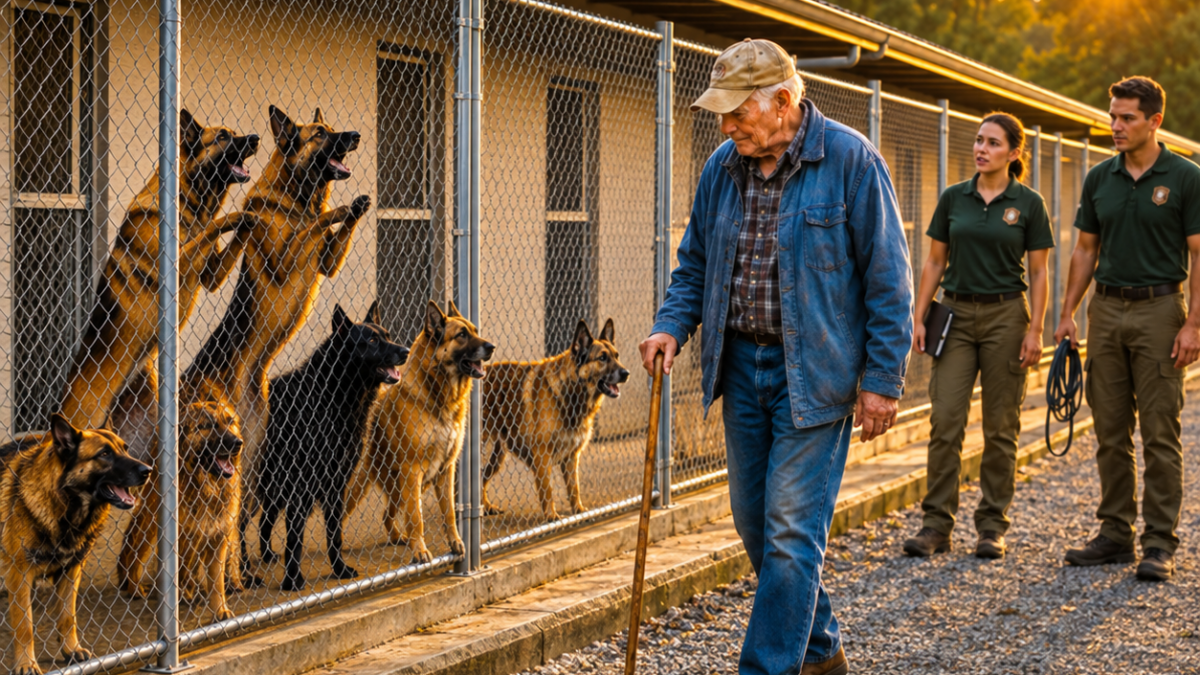
PART3:
“All seven. Same second. Every time he gets close. I’ve never seen them do that for anybody. Not you. Not me. Not the meds.”
“Dogs settle for all kinds of reasons that aren’t the reason we think,” I said.
It was true.
That was the problem.
A statement can be true and still used wrong.
“Could be his gait,” I continued. “Could be scent. Could be nothing and you’re pattern matching because you want an answer that isn’t there.”
Brock looked toward the back runs.
“These dogs are more damaged than we hoped,” I said, gentler. “I appreciate you watching them closely. That is your job. But we can’t build a treatment plan around a stranger walking a fence line.”
He nodded.
He did not argue.
I went back to the tablet.
He went back to run six.
And the old man came again.
That afternoon, Sloan tried a softer approach.
“I really can’t let you get closer, sir,” she told him. “Corporate insurance. Honestly, it’s not even our rule.”
EMTT stopped where he was.
Thirty feet from the fence.
Legal distance.
Safe distance.
Useless distance.
“They’re not dangerous,” he said. “They’re grieving. There’s a difference, and it isn’t in your paperwork.”
Sloan did not know what to do with that sentence.
Neither would I have, if I had heard it then.
So she let it pass.
But Brock heard enough of it to tell me later.
“They’re grieving,” he repeated.
I almost corrected him.
Almost.
Instead, I said nothing.
Because by then A6 had stopped eating whenever staff came near. A3 had reopened a wound on the side of his muzzle from striking the gate. A5 trembled under the cot after every cleaning cycle. A2 guarded the back corner so intensely we had to slide food under the barrier. A4 slept standing up. A1 circled until his paw pads reddened. A7 watched every door like it might become a battlefield.
And Friday noon kept moving closer.
On Thursday morning, Brock unlocked the gate for EMTT.
Not because anyone told him to.
Because EMTT asked.
Three quiet sentences, Brock said later.
No demand.
No drama.
Just a request.
“Let me sit with the gray one.”
Brock knew he could be fired.
He unlocked the gate anyway.
By the time I came around the corner, EMTT was ten feet inside the restricted run.
A6 came off the back wall in a low charge, teeth bared, the whole kennel filling with the sound that had lived in our walls for nineteen days.
“Absolutely not,” I snapped, tablet raised. “Get him out of there. That dog put one man in the hospital.”
The sentence stopped in my mouth.
Because EMTT did not retreat.
He did not raise a hand.
Did not command.
Did not shout.
He stopped walking.
That was the first stage.
He stood with his hands at his sides, palms open, and let A6 close half the distance.
Then he lowered himself.
Not quickly.
In stages.
One hand to the wet concrete.
One knee.
Then the other.
A careful descent shaped by age, bad joints, and no fear of looking weak.
He settled with his back against the cinder block, small and slow and entirely unthreatening.
A6 stopped four feet short.
Hackles high.
Breath hard.
Teeth still visible.
EMTT turned his head slightly aside, not away, not submissive exactly, just angled. The way someone looks past a frightened thing instead of directly at it.
His left hand rested open on the concrete.
Palm up.
The tremor in it was visible now.
Unhidden.
Ninety seconds passed.
No one moved.
Then A6 crossed the last four feet.
Not in a charge.
In a stiff-legged, exhausted walk.
Head low.
Shoulders shaking.
He pressed his full weight sideways into EMTT’s bent knee.
And went still.
Not calm.
Not fixed.
Still.
The shaking left him all at once, like water wrung from cloth.
EMTT’s tremor stopped too the instant his hand came to rest flat against the dog’s ribs.
He did not pet him.
Not at first.
He simply felt for the rise and fall of breath.
Like a man checking for a rhythm he already trusted was there.
Nobody in the doorway said anything.
Brock had one hand over his mouth.
Sloan was crying.
My thumb hovered above the tablet screen, useless.
The forty-one data points were still there.
The dog in front of me was still there too.
For the first time, they did not look like the same truth.
Relief did not last.
By noon, I had pulled EMTT’s “miracle,” as Brock called it, against the county intake system and found nothing that could survive a Friday hearing.
“I want to be clear,” I told Brock, “that I saw what I saw. But what I saw isn’t documentation. It’s anecdote.”
Brock stared at me.
“Anecdote?”
“I don’t mean it didn’t matter.”
“You watched A6 choose him.”
“I did.”
“And?”
“And a county oversight committee doesn’t cancel a determination because an undocumented old man sat on a floor and one dog leaned on him.”
I hated every word as I said it.
But it was true.
The recommendation already existed in triplicate.
Nineteen days of scoring.
Forty-one data points.
A3 and A6 at the bottom.
My signature already dry at the bottom of the form.
A euthanasia determination scheduled to finalize Friday at noon.
I had signed it in good faith.
Because the file contained nothing that argued otherwise.
That was the deeper problem.
When Brock pulled the original transfer paperwork, hoping to find some note, some prior evaluation, some scrap that might buy us time, he found seven lines on a spreadsheet.
Kennel numbers.
Intake weights.
Vaccination dates.
No names.
No ranks.
No unit designations.
No handler histories.
No service jackets.
Nothing to indicate these dogs had ever worn working collars instead of shelter ones.
“That can’t be right,” Brock said.
His voice changed as he scrolled.
“Military transfers come with full service jackets. I looked it up. Dogs like this are supposed to have records.”
“They’re supposed to,” I said.
I dug deeper into the digital archive and found the gap exactly where he found it.
A transfer three years old.
Prior files marked in one administrative note:
Streamlined per updated intake protocol to reduce processing time and liability exposure.
No name attached.
No explanation.
No accountability.
Just bureaucratic dryness covering erasure.
“So there’s nothing,” Brock said. “Nothing that says what they did. Nothing that says who trained them. Nothing that says these dogs were ever anything but strays somebody dumped on us.”
For the first time since I had known him, Brock sounded truly angry.
Not emotional.
Not frustrated.
Angry in the way people get when they realize a wrong was not an accident, only convenient.
“How do you argue for keeping something the county has no record of ever mattering?” he asked.
I had no answer.
I looked at my signature on the determination form.
A3.
A6.
Two kennel numbers.
Until that morning, they had been the entirety of what I knew.
The tablet in my hand no longer felt like a tool.
It felt like a wall I had helped build around a question nobody had asked.
Friday arrived gray and cold.
Colonel Wendell Aldridge came for what his calendar listed as a routine oversight visit.
Seventy-four years old. Retired. Still built like a man who had once run physical training at five in the morning because he considered sleep negotiable. He moved through the intake area briskly, courteously, asking questions he expected to answer with signatures.
I walked beside him, reciting scores from my tablet.
We were halfway past the back gate when Brock’s voice drifted in from the outer fence.
He had asked EMTT again what exactly he used to do.
The old man answered plainly.
“Corda Falls program. Sixty-eight through seventy-one. Yansy.”
Just that.
A place.
A span of years.
A name.
Colonel Aldridge stopped walking.
His hand fell from where it had been gesturing toward my tablet.
Then his spine straightened in a way I had never seen outside old war footage.
He came to attention.
Full.
Formal.
Absolute.
He crossed the gravel to the fence in maybe eight steps.
“Sir,” Aldridge said.
The word held for half its length.
Then broke down the middle.
“It’s an honor.”
Nobody moved.
My tablet was still raised.
Forgotten.
Brock stood beside EMTT, eyes wide.
Sloan went still near the hose.
Behind the fence, A6 stood silent, watching.
EMTT did not return the posture.
He only nodded once.
“Wendell.”
No rank.
No title.
Just the plain first name of a man he had known before age and history layered over them both.
Aldridge’s face changed.
“You’re supposed to be a name in a filing cabinet,” he said. “I’ve told that story to three commanding officers who didn’t believe half of it.”
“Wasn’t much of a story,” EMTT said. “Just a job.”
I lowered the tablet slightly.
“I’m sorry,” I said. “Can someone tell me what I just watched?”
No one answered at first.
Aldridge was looking at EMTT the way a man looks at a debt he thought had gone unpaid for so long it had stopped being owed.
Finally, he turned to me.
“Your numbers weren’t wrong,” he said.
That surprised me.
“That’s the first thing you need to understand. Whatever your app measured in those dogs, it measured true. Trauma reads the same on a screen as it does in a man’s hands, if you know how to look at either.”
He glanced toward A6.
“What it can’t measure is a name. It can’t measure who used to hold the other end of the leash.”
“I don’t understand,” I said.
It cost me something to say it.
I had built three years of professional identity on understanding.
Aldridge looked at EMTT again.
“Fifty-one years ago,” he said, “I lost a sentry dog on night patrol outside a wire perimeter neither of us is going to name in a shelter parking lot.”
The old man said nothing.
“Dog went missing in bad country. I filed the kind of paperwork that ends careers. A young handler two units over, who didn’t owe me a thing, spent four nights on his own time working a trail nobody else believed was there. He brought her back alive on the fifth morning.”
Aldridge’s jaw tightened.
“Then he wrote it up as a routine recovery so it wouldn’t read as a rescue and embarrass anybody up the chain. My file stayed clean because of three sentences he chose not to write.”
He looked at EMTT.
“I have spent fifty years wondering if I’d ever get to say thank you to a name instead of a memory.”
“Didn’t do it to be thanked,” EMTT said.
Flat.
Plain.
Final.
Like closing a ledger he considered settled long ago.
It was Aldridge who pushed for the folder.
He remembered a stateside program from 1970 built to teach handlers how to work with dogs coming home damaged from combat zones. Corda Falls. Training doctrine almost nobody living still used by name. A program filed under designations that had probably never been digitized.
“If a connection exists,” Aldridge said, “it won’t be in your current system.”
Brock found the folder two hours later in a storage room behind the old admin wing.
He was on his knees with a flashlight, going through boxes nobody currently employed had known existed.
The folder was thin.
Manila.
Soft at the corners.
Label faded to the color of weak tea.
Inside were mimographed pages from a 1970 handling curriculum. Diagrams. Notes. A hand-drawn two-note whistle signal with intervals marked. A section on dogs returning from combat trauma. Recovery posture. Silence periods. Handler proximity. The importance of not facing a distressed working dog head-on unless absolutely necessary. The importance of names.
Near the back was a typed roster.
YANSY, E.
Third name down.
The seven dogs currently in our back runs had come from a private training kennel that had operated for decades on that same curriculum, passed handler to handler, litter to litter.
The whistle.
The stillness.
The wordless waiting.
Taught forward without anyone ever writing EMTT’s name on the newer paperwork.
He had built the alphabet fifty-one years earlier.
And somehow, every dog behind our fence still knew the language.
Aldridge held the folder like it might crumble.
“This should have your name on the exhibit,” he said. “Not just a program number. Your name.”
EMTT shook his head slowly.
“Put their names on it.”
I looked at him.
“A3. A6. All seven,” he said. “They earn names before they earn numbers. That’s the only correction I’m asking for.”
Then he turned to me.
My chest tightened, expecting blame.
He gave none.
“Your scores were right,” he said. “Every one of them. You measured what was there. You just didn’t have a column for what was missing.”
The words landed quietly.
Harder than accusation would have.
“Next dog like this comes through your gate,” he continued, “you don’t need me. You need thirty minutes of silence and the nerve to sit down on a wet floor. That’s all it ever was.”
That evening, with paperwork still unresolved and Friday’s noon deadline bearing down, EMTT asked to sit alone with the seven.
Brock let him in.
No one stopped him this time.
He lowered himself against the cinder block the same slow staged way he had before.
Back to the wall.
Hands open.
Head angled.
No command.
No performance.
One by one, the dogs came.
A6 first.
Then A3.
Then A1.
Then the others.
Not quickly.
Not without hesitation.
But they came.
Seven animals who had gone nineteen days without letting a living soul close enough to touch gathered around an old man in a barn coat on wet concrete.
His left hand rested flat against whichever ribs were nearest.
The tremor stopped.
He hummed low.
Three bars.
Then three more.
A hymn I did not know then, though later I learned his wife Eleanor had hummed it over the kitchen sink at dusk, back when the sound of that tune meant home was still whole.
I stood in the doorway and finally understood what Brock had been trying to tell me.
The dogs were not dangerous in the way our paperwork suggested.
They were waiting.
Waiting for a voice.
A posture.
A rhythm.
A language.
Waiting for someone to come back who was never coming back.
EMTT rested his palm against A6’s flank.
“He’s not aggressive,” he said quietly. “He’s waiting for someone who isn’t coming.”
Then he looked at the dogs around him.
“So I came instead.”
At 11:40 Friday morning, twenty minutes before the deadline, I withdrew the euthanasia determination.
I wrote the revised report myself.
Not because Aldridge told me to.
Because I had finally learned enough to be ashamed of the first one.
I recommended transfer of all seven dogs into a private consultation and rehabilitation arrangement under EMTT Yansy, with Colonel Aldridge as board liaison and oversight authority. I included the recovered 1970 curriculum, the missing transfer-history issue, the stripped service files, and my own updated observations.
I named them.
All seven.
Not kennel numbers.
Names restored from old litter and training records that had been buried elsewhere in the paper trail.
A6 became Rook.
Gray muzzle.
Ruined nerves.
Unbroken faith.
Rook was the only one EMTT asked to keep himself.
The others were placed slowly, carefully, over the following weeks with handlers Aldridge personally helped vet. Not adopters looking for heroic dogs. Not people wanting a story. Handlers. Homes with quiet routines, experience, patience, and respect for the fact that service does not end cleanly just because paperwork does.
I visited twice that first month.
Unofficially.
Off the clock.
Mostly to watch and take notes I never filed.
EMTT lived on a small piece of land outside town, smaller every year because age had a way of negotiating borders. The porch sagged slightly. The fields behind the house had gone partly wild. Eleanor’s old garden still produced tomatoes because EMTT tended it like neglecting it might offend her.
Rook slept on the porch the first time I visited.
Not lightly.
Not with one ear monitoring the world.
Deeply.
Bonelessly.
Like an animal whose body had finally stopped listening for footsteps that would not come.
The cracked brass leash clasp sat on the porch rail beside EMTT.
Not in his pocket anymore.
Its faint stamped number caught what was left of the sun.
I asked about it once.
He looked at the clasp for a long moment.
“Belonged to a dog named Mabel,” he said.
“The one Colonel Aldridge lost?”
He nodded.
“You kept it all these years?”
“Some things keep you.”
That was all he said.
But I understood enough.
Some debts do not come due in money.
Some come due in silence.
Some in names restored.
Some in a porch where a dog finally sleeps.
Brock came once and stood at the porch steps without saying much. EMTT handed him coffee. Rook opened one eye, decided Brock was acceptable, and went back to sleep. Brock looked like a young man standing in a place that mattered more than he had words for.
Sloan came too, later. She brought blankets from the shelter and cried when Rook let her touch his shoulder.
As for me, I changed my forms.
Not officially at first.
Official systems do not change as fast as guilt.
I added a section to my private notes.
Name history.
Handler history.
Known commands.
Songs, whistles, routines.
Who held the other end of the leash?
Not every dog had an answer.
But I asked.
Every time.
The next time an old working dog came through the shelter with a stripped record and eyes too old for his body, I sat on the wet floor for thirty minutes before opening my tablet.
No data point ever again came before the question.
Years later, people still talk about the seven combat K9s at Millbrook County.
Some tell it like a miracle.
The old veteran walked by, and the dogs knew him.
That version is not wrong.
It is just too small.
The miracle was not that EMTT Yansy had magic.
He did not.
He had memory.
Discipline.
Patience.
A body that knew how to become safe in front of a frightened dog.
A hand that shook until it had purpose.
A hymn that carried home inside it.
A name written in an old folder nobody thought to open.
And a stubborn refusal to let living creatures be reduced to numbers simply because numbers were easier to file.
The last time I saw him, October light lay gold across his porch.
Rook slept at his feet.
Fully asleep.
The leash clasp rested on the rail.
Eleanor’s glasses sat on the windowsill behind him, dusted that morning, same as every morning.
EMTT hummed under his breath.
Three low bars.
Rook’s ear twitched once toward the sound.
Then went still again.
At peace.
I thought of the first morning at the shelter, when seven dogs went silent at the mere sound of an old man’s walk.
Before we knew his name.
Before we knew theirs.
Before I knew how much my tablet could measure and how much it could miss.
Some debts take fifty years to come due.
When they do, they ask for less than we expect.
Not applause.
Not medals.
Not a speech.
Sometimes all they ask for is a porch, a dog finally sleeping, and an old man who never once stopped keeping faith with names everybody else forgot to write down.








