Nobody Came to the Veteran’s Funeral — Until 100 Hells Angels Revved Their Engines
PART3:
Pastor Thomas O’Connor arrived with his Bible wrapped in a plastic grocery bag. He was seventy-two, thin as a rail, with fogged glasses and a voice that trembled in cold weather but grew strong when prayer required it.
He looked at the empty chairs.
Then at me.
“Do you think anyone else is coming?”
I checked my watch.
10:15.
The service had been scheduled for 10:00.
“No,” I said.
My breath showed in the air.
“I called the VFW. I called the American Legion. I put a notice in the local paper. I even called the county office twice to see if they found any distant relatives.”
“And?”
“Nothing.”
Pastor O’Connor looked down at the pine casket.
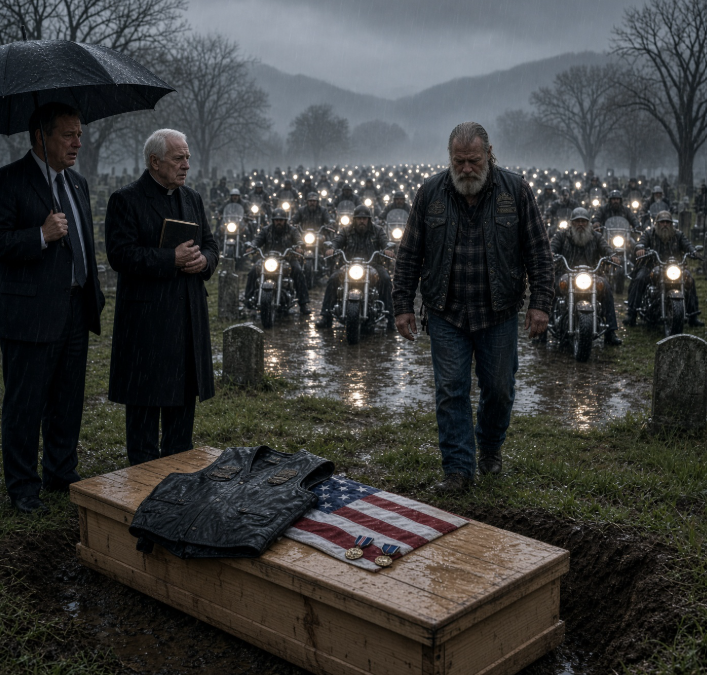
It was simple. State-funded. Unadorned. Rain tapped against the wood like fingers on a door nobody planned to open.
“A tragedy,” he murmured. “To serve one’s country, survive the jungle, and fade away in the dark.”
I looked toward the cemetery worker, Greg, who stood beside the backhoe several yards away smoking a cigarette and scrolling on his phone. He was not cruel. Just young. Detached. He had graves to close, hours to log, lunch to get after.
To him, William Hayes was another burial.
To me, that morning felt like a failure.
Not mine alone.
The whole town’s.
“We should begin,” I said quietly. “There’s no dignity in making him wait in the rain.”
Pastor O’Connor nodded and stepped closer to the grave. He opened his Bible to Psalms, the pages already dampening at the edges.
“We gather here today,” he began, voice thin against the wind, “in the presence of God to lay to rest William Hayes, a soldier, a neighbor, and a child of the Creator. Though his earthly family is not here to see him off, he is not abandoned.”
I bowed my head.
But those words hurt.
He is not abandoned.
I wanted them to be true.
I wanted faith to be enough to fill forty empty chairs.
I silently promised William I would come back the following week to clean the mud from his temporary marker. Maybe I would bring flowers myself. Maybe I would call again and ask if someone from the veterans groups could at least visit his grave when the weather cleared.
It was not enough.
But it was something.
“The Lord is my shepherd,” Pastor O’Connor continued. “I shall not want.”
Then he stopped.
At first, I thought the wind had stolen his voice.
Then I realized I could not hear the wind anymore.
Something else was rising from the south.
A low vibration.
Deep.
Mechanical.
Growing.
The puddles around my shoes began to ripple.
Pastor O’Connor lifted his head.
“What is that?”
I looked toward the cemetery entrance.
“I don’t know.”
The sound grew louder, rolling across the cemetery like an earthquake made of steel.
Greg dropped his cigarette.
Through the gray wall of rain beyond the wrought-iron gates, two headlights appeared.
Then two more.
Then ten.
Then so many I stopped trying to count.
Motorcycles.
A column of motorcycles turned through the cemetery gates, riding two abreast with slow, disciplined precision. Chrome and black steel. Rain running off helmets and leather. Engines roaring so loudly the storm disappeared beneath them.
My heart began pounding.
As the lead riders came closer, I saw the backs of their leather cuts.
The winged death’s head.
The red letters.
Hells Angels.
California.
Oregon.
Nomad.
Pastor O’Connor took a step back and nearly tripped over the green turf around the grave.
“David,” he whispered, “are we in danger?”
I did not answer because I did not know.
There were more than a hundred of them.
They circled the burial site with quiet control, not chaotic, not reckless. Their engines idled in a deep rhythm that felt like a mechanical heartbeat. One by one, they killed the ignitions.
The sudden silence afterward was even heavier than the noise.
Boots hit wet gravel.
Side stands snapped down.
Leather creaked.
Rain fell.
And one hundred bikers stood in a wide perimeter around William Hayes’s grave.
I stepped in front of Pastor O’Connor without thinking.
“Gentlemen,” I called, raising my hands slightly, “this is a private service for a veteran. We don’t want any trouble.”
The crowd parted.
From the middle walked a man built like a mountain.
He was at least six-foot-four, broad enough to block the rain, with a gray beard, a jagged scar running down one side of his neck, and a president patch on his chest. His leather vest was soaked. His boots sank into the mud with each step.
He stopped a few feet from me.
His eyes were hard.
But not cruel.
“We ain’t here to cause trouble, suit,” he said.
His voice was deep enough to command the whole cemetery without shouting.
“My name’s Dan Jenkins. Everybody calls me Grizzly.”
“Mr. Jenkins,” I said carefully, “this is the funeral for William Hayes.”
“I know exactly whose funeral this is.”
His voice changed on the name.
Softened.
He stepped around me and walked to the casket.
For a moment, the entire cemetery seemed to hold its breath.
Dan removed his gloves and placed one massive hand on the wet pine lid.
“You guys really put him in a pine box,” he murmured.
There was no accusation in it.
Only grief.
“Guess he really did give everything away.”
Pastor O’Connor found his courage.
“Sir,” he said gently, “how did you know William? The state records showed no family. No associates.”
Dan turned toward us.
“State records don’t know a damn thing about brotherhood.”
Then he reached inside his vest.
My body tensed.
But he did not pull a weapon.
He pulled out a faded photograph sealed inside a plastic sleeve.
He handed it to me.
It was a Polaroid, probably from the late 1970s. In it, a group of younger Hells Angels stood outside a clubhouse in Oakland. In the center sat a man on a custom chopper, grinning like he owned the road and every mile beyond it.
I stared at the face.
Younger.
Stronger.
Wild eyes.
Broad shoulders.
Same jaw.
Same brow.
William Hayes.
“Forty years ago,” Dan said, “he was Wild Bill. Vice president of the Oakland charter. Rode with the founders. Took a bullet for the club in Nevada. Did five years in San Quentin on a federal charge that kept three of our brothers free, and never said one word to the feds.”
I looked at the photograph.
Then at the cheap pine casket.
The distance between those two images felt impossible.
“This man fixed lawn mowers in a trailer park,” I said.
Dan gave a dry laugh.
“No. That man hid inside a trailer park.”
“Why?”
The rain ran down Dan’s beard.
His expression changed.
“His daughter.”
The bikers around us remained silent.
Not one shifted.
Not one spoke.
“When Bill got out,” Dan said, “his little girl was sick. Leukemia. He told the club he had to step away. Get a straight job. Health insurance. Be a full-time father. In our world, you don’t just walk away.”
He paused.
“But the club loved Bill. The founders gave him a pass. He turned in his patch, packed up, and vanished so he could take care of that kid.”
Pastor O’Connor’s face softened.
“She didn’t survive?”
Dan shook his head.
“Passed when she was twelve. After that, Bill couldn’t face the old life, and he couldn’t face the new one. So he punished himself by disappearing.”
He looked back at the casket.
“We never stopped looking. Finally tracked him down last week.”
His jaw tightened.
“Three days too late.”
I closed my eyes.
All at once, William Hayes was no longer the quiet dead man in a state-funded file.
He was a soldier.
An outlaw.
A father.
A man who had given away identity, brotherhood, freedom, and finally comfort, all for people he loved.
Dan looked at me again.
“You were going to put him in the dirt with nobody watching.”
My throat tightened.
“Yes.”
“We couldn’t let that happen. Not to Wild Bill.”
The rain fell harder.
But the cemetery no longer felt empty.
It felt like history had ridden through the gates on chrome and thunder.
Pastor O’Connor stepped forward, his Bible pressed to his chest.
“Mr. Jenkins,” he said, voice breaking slightly, “I confess that when I looked over this empty field, I felt despair for William. I thought the world had forsaken him.”
Dan said nothing.
The pastor looked around at the silent wall of leather and rain.
“I see now that I was wrong.”
Dan lifted two fingers.
Two bikers stepped forward carrying a polished mahogany shadow box between them. One was huge, heavily tattooed, with a patch that read Iron. The other was older, wiry, and walked with a severe limp.
They carried the box the way soldiers carry a flag.
Dan opened it.
Inside was a leather vest.
Old.
Sun-faded.
Frayed at the edges.
The red letters had darkened with age, road dust, sweat, and time.
I realized what it was before he said it.
William’s original cut.
The one he had surrendered more than forty years earlier.
Dan lifted it with both hands.
“We didn’t come just to watch him go into the dirt,” he said. “We came to give him back his armor.”
He draped the vest over the pine casket.
The contrast nearly broke me.
A cheap state-funded box beneath the symbol of a brotherhood that had ridden through rain to honor him.
“He turned this in because he thought he was failing us,” Dan said. “But he never failed us. We never replaced him. His seat in Oakland has been empty since 1982.”
The older biker with the limp stepped forward.
He pulled a tarnished silver Zippo from his pocket and held it in his palm.
“You read his military record?” he asked me.
I nodded.
“Purple Heart. Silver Star. Tet Offensive, 1968. The file didn’t give details.”
The older man gave a bitter laugh.
“Files don’t tell you what happened in the jungle. I do. I was there.”
He rolled up his sleeve.
A long scar ran from his wrist past his elbow.
“Our platoon got hit outside Hue City,” he said. “Mud was so thick you couldn’t run. I took shrapnel in my leg and arm. I was bleeding out in a trench, waiting to die. Everybody had to pull back.”
He swallowed.
“Not Bill.”
No one moved.
“Bill laid down covering fire until his rifle burned hot. Then he picked me up, threw me over his shoulder, and carried me two miles under mortar fire. Took a round to the shoulder and didn’t even stumble. Got me to the medevac chopper.”
He placed the Zippo on top of the casket beside the leather vest.
“When we got back, the world spit on us. Bill introduced me to the club. Gave me a family when I had nothing.”
His voice cracked.
“I owe him my life.”
I looked toward Greg, the young cemetery worker.
He had put away his phone.
His hard hat was off.
He held it against his chest.
Dan turned to Pastor O’Connor.
“Pastor, if you don’t mind, finish the service. Send our brother off right.”
Something changed in the pastor.
He stood straighter.
He stepped to the edge of the grave, no longer afraid of the men surrounding him.
“I have presided over hundreds of funerals,” Pastor O’Connor began, and this time his voice rang clearly over the rain. “I have buried the wealthy in polished bronze, and I have buried the poor in humble wood. But never have I stood in the presence of such profound loyalty.”
The bikers stood in the freezing rain.
No umbrellas.
No complaints.
No movement.
“William Hayes lived a life of sacrifice,” the pastor continued. “He sacrificed his body for his country. He sacrificed his freedom for his brothers. And he sacrificed his identity for his child.”
Rain drummed against the casket.
Against leather.
Against stone.
Against empty chairs that no longer seemed empty because something greater than attendance had filled the cemetery.
The final prayers were spoken.
Then came the moment I dreaded.
Lowering the casket.
Usually, we used a mechanical lowering device. A button. A quiet motor. Clean. Efficient.
I stepped forward to signal Greg.
Dan raised one hand.
“No machines,” he said softly. “We carry our own.”
Six bikers broke rank.
They moved to the casket and wrapped the canvas straps around their tattooed hands. With careful strength, they lifted the box just enough for the lowering frame to be removed.
Dan stood at the head of the grave.
“Easy,” he ordered. “Take him down slow.”
Hand over hand, the six men lowered William Hayes into the earth.
The leather cut and silver Zippo stayed perfectly balanced on the lid as the casket descended into the dark.
When it reached the bottom, the bikers pulled the straps free.
Dan stepped to the edge.
He took a handful of wet Oregon soil and held it for a long moment.
“Ride free, Wild Bill,” he whispered.
Then he dropped the earth.
It struck the wood with a hollow sound that went through me.
Dan turned sharply toward the line of motorcycles.
He did not yell.
He simply raised his fist and twisted his wrist like he was opening a throttle.
One hundred Hells Angels moved at once.
They mounted their bikes.
Turned keys.
Kicked starters.
And the cemetery erupted.
The sound was not noise.
It was grief given an engine.
One hundred V-twins roared into the freezing rain, a unified thunder so powerful it vibrated in my ribs and rattled the water in the puddles around my shoes.
It was an outlaw twenty-one-gun salute.
For three full minutes, they revved their engines toward the sky.
Fury.
Respect.
Loss.
Brotherhood.
A declaration so loud that if there was any justice in heaven, William Hayes heard it from wherever he had gone.
Nobody came to the veteran’s funeral.
That was what I had thought.
I was wrong.
His brothers came.
They came late, but they came like thunder.
When the engines finally settled into a low rumble, Dan walked back to me.
He held out his hand.
“Thank you, Mr. Carmichael.”
I took it.
His grip was like iron.
“For what?”
“For treating him with dignity when nobody was watching.”
My eyes burned.
“It was an honor,” I said. “I only wish I had known who he was. A man like that deserved more than a pine box.”
Dan looked toward the grave.
“You think Bill died broke because he failed?”
I frowned.
“He had fourteen dollars to his name.”
Dan reached inside his vest again and pulled out a weathered leather notebook stuffed with receipts, notes, and folded papers.
He handed it to me.
“We went through his trailer before we came. Found this under the kitchen floorboards.”
I opened it.
At first, I did not understand what I was looking at.
Invoices.
Parts lists.
Payment receipts.
Customized pediatric wheelchairs.
Medical braces.
Mobility scooters.
Repairs for hospital equipment.
Next to each entry was a stamp.
Paid in full.
Anonymous donor.
Page after page.
Year after year.
Thousands upon thousands of dollars.
My hands began to shake.
“What is this?”
Dan’s voice softened.
“When his daughter was sick, Bill saw families going broke trying to get medical equipment for their kids. After she died, he started fixing broken wheelchairs and medical gear. Bought parts with whatever money he made repairing engines. Donated everything to the children’s ward.”
I looked down at the ledger.
William had not died poor because life defeated him.
He had died poor because he had given everything away.
Every spare dollar.
Every skill he had.
Every comfort he might have bought himself.
“The pine box,” Dan said quietly, “is exactly what he would have wanted.”
I looked at him.
“A fancy casket would have meant one less wheelchair.”
The rain blurred my vision.
Maybe it was only rain.
Maybe not.
Dan tucked his gloves back on.
“But don’t worry about the hospital,” he said as he turned toward his motorcycle. “The club is taking over Bill’s donations from here on out. His legacy doesn’t end today.”
He climbed onto his bike and fired the engine.
One by one, the others followed.
The procession rolled out of the cemetery slowly, not with chaos but with ceremony. Their taillights glowed red in the gray mist, fading one after another down the winding road until only the rain remained.
Pastor O’Connor stood beside me.
Greg stood behind us.
None of us spoke.
The silence that returned to the cemetery was not the same silence as before.
Before, it had felt empty.
Now it felt holy.
I looked down at William Hayes’s grave.
The mud.
The flowers.
The tracks left by heavy boots.
The empty chairs still standing in crooked rows.
I thought about the man I had dressed in the basement of my funeral home.
I had seen a lonely old mechanic.
The state had seen a file.
The county had seen an expense.
The landlord had seen late rent.
The town had seen a ghost.
But the truth was so much larger.
William Hayes had been a soldier who carried a wounded man through fire.
An outlaw who went to prison rather than betray his brothers.
A father who gave up his identity to care for his dying daughter.
A grieving man who turned pain into anonymous mercy for other children.
A legend who had vanished so completely that only thunder could bring his name back into the world.
The following week, I went to the cemetery as promised.
The mud had dried some, but tire tracks still marked the path where the motorcycles had circled the grave. The temporary marker stood crooked, and rain had splashed dirt across it.
I cleaned it myself.
Then I placed a small American flag beside it.
A few days later, a permanent stone was ordered.
Not by the county.
By the club.
When it arrived, I went to see it.
The stone read:
**WILLIAM “WILD BILL” HAYES**
**Soldier. Father. Brother.**
**He Gave Everything.**
Beneath that, small but unmistakable, was a carving of a motorcycle wheel and a child’s wheelchair side by side.
I stood there a long time.
Funerals teach you many things.
They teach you that grief does not always look like tears.
Sometimes it looks like a man staring at a casket with both fists clenched.
Sometimes it looks like a pastor finding strength in freezing rain.
Sometimes it looks like a hundred dangerous men standing silently around a grave because loyalty outlived distance, time, and shame.
They teach you that records rarely tell the whole truth.
A bank account does not measure generosity.
A trailer does not measure legacy.
An empty funeral does not always mean an unloved life.
And true greatness is almost never as loud as people think.
William Hayes did not ask for applause.
He did not display his medals.
He did not call newspapers when he repaired wheelchairs for children who would never know his name.
He did not keep enough money for a better casket because comfort, to him, had become less important than usefulness.
For forty years, he worked in shadows.
And when he died, the shadows finally answered.
They came in leather.
They came in rain.
They came on a hundred motorcycles, engines roaring like heaven had cracked open over Grants Pass.
People still ask me about that funeral.
They ask if I was scared when the Hells Angels arrived.
I tell them yes.
At first, I was.
Then I understood.
They had not come to frighten the living.
They had come to wake the dead.
To tell the sky, the earth, the cemetery, the town, and anyone else who cared to listen:
William Hayes was here.
William Hayes mattered.
William Hayes was loved.
And in the end, maybe that is what every funeral is supposed to do.
Not prove a life was perfect.
Not pretend grief can fix what time has taken.
But stand beside the grave and say:
We remember.
We witnessed.
You were not nothing.
You are not going into the dark alone.
On the morning William Hayes was buried, I thought nobody came.
Then the ground shook.
And I learned that sometimes the people who love us are not standing where the world expects them to be.
Sometimes they are still on the road.
Still searching.
Still carrying an old photograph in a plastic sleeve.
Still keeping an empty seat at the table.
And sometimes, when everyone else has forgotten, they arrive like thunder to bring their brother home.








