Nobody at the Hospital Knew the Quiet Nurse’s Past—Then Five Retired Military K9s Broke Formation and Surrounded Her
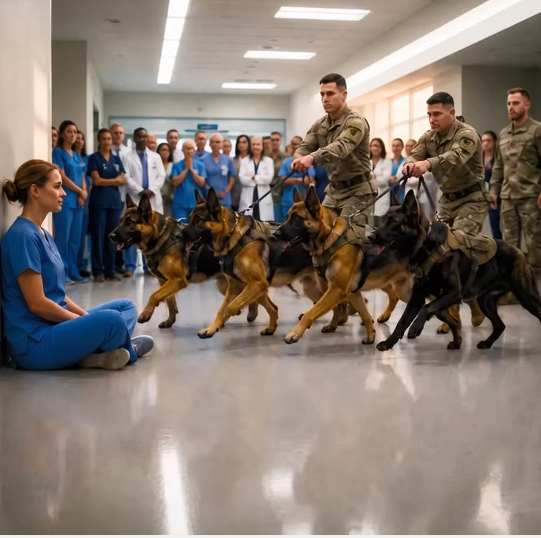
Nobody at the Hospital Knew the Quiet Nurse’s Past—Then Five Retired Military K9s Broke Formation and Surrounded Her.
The first retired war dog broke formation without a command, crossed a crowded hospital hall, and pressed his silver muzzle against a quiet nurse’s leg as if he had been searching for her for fourteen years.
When four more decorated military K9s abandoned their handlers and surrounded the same woman, the soldiers in the room realized the nurse they had barely noticed was connected to the worst days of every dog’s life.
But when the oldest German Shepherd finally reached her and a forgotten letter from his dead handler surfaced hours later, the secret Clare Duvall had buried since Afghanistan left an entire room of soldiers crying in silence.
I had spent three years becoming invisible.
Not literally.
People saw me every day at Fort Bellwood Regional Medical Center.
They saw the navy-blue scrubs.
The badge clipped beneath my left collarbone.
CLARE DUVALL, RN.
They saw me push medication carts through the general medical wing, change IV tubing, adjust oxygen, carry warm blankets, take blood pressure, document fluid intake, and help elderly veterans sit upright when their bodies no longer cooperated.
They knew I drank coffee black.
They knew I volunteered for early shifts.
They knew I hated fluorescent lights and kept the lamp on in my office whenever hospital policy allowed it.
They knew I almost never joined birthday lunches.
They knew I rarely talked about myself.
They knew I never raised my voice.
That was roughly everything.
People saw me.
They simply never looked long enough to know me.
I had arranged it that way.
Fort Bellwood sat along the edge of a sprawling Army installation in central Texas, where military life and civilian life had grown into each other so completely that nearly every grocery store, church, elementary school, and waiting room contained somebody with a deployment story.
Our hospital treated active-duty service members.
Retirees.
Spouses.
Children.
Civilian employees.
Veterans whose uniforms belonged to wars younger nurses had only read about.
Every floor held a different kind of memory.
In orthopedics, men with artificial knees traded stories about Vietnam as though it had happened last Thursday.
In rehabilitation, twenty-three-year-olds learned to balance on prosthetics beside seventy-year-olds learning the same skill for entirely different reasons.
In oncology, wives who had survived deployments beside their husbands sometimes discovered that cancer frightened them more than mortars ever had.
Pain was everywhere.
So was ordinary life.
A grandson bringing his grandfather barbecue.
A soldier teaching his daughter to shuffle cards on a bedside tray.
A nurse slipping an extra pudding cup to a man pretending he wasn’t hungry.
The hospital had taught me that most important moments occurred without witnesses.
A blood pressure stabilizing.
A confused veteran recognizing his wife.
A man squeezing his son’s hand after a stroke.
A patient who had refused physical therapy standing for eleven seconds.
Nothing dramatic.
Everything important.
I was good at noticing those moments.
My coworkers said I was calm.
PART2:
Patrice Coleman, a nurse who had worked two stations down from me for almost three years, once told a new hire:
“Clare doesn’t miss anything.”
I heard her.
I pretended not to.
Patrice continued:
“She notices when the patient says fine but stops making eye contact.”
“She notices when the wife who hasn’t sat down in sixteen hours is about to faint.”
“She notices when somebody’s angry because they’re scared.”
The new nurse asked:
“How?”
Patrice lowered her voice.
“No idea.”
Then, because Patrice could never resist one more sentence:
“Clare isn’t unfriendly. She’s just closed.”
I almost smiled.
She was right.
There was a door somewhere inside me.
Fourteen years earlier, I had shut it.
I believed it was locked.
My name had been Clare Morgan then.
Twenty-five years old.
PART3:
Army medical officer attached to a forward surgical unit.
Combat medic training before nursing specialization.
Afghanistan.
I had treated men whose blood pressure disappeared while I was still cutting away uniforms.
I had packed wounds under mortar fire.
I had held pressure on arteries while someone screamed for a helicopter that could not land yet.
I had learned to sleep beside generators.
Eat standing.
Cry in bathrooms.
Work eighteen hours and call it a good day because everybody I touched was still breathing when my shift ended.
And because war did not care about staffing plans, I treated military working dogs too.
Not because I was a veterinarian.
I wasn’t.
The first time somebody brought me a wounded German Shepherd, I actually said:
“You know I’m the people nurse, right?”
The handler looked at me and said:
“Doc’s twenty minutes out.”
The dog was bleeding now.
That was how it started.
Need does not always wait for proper credentials.
I learned from veterinary technicians.
Handlers.
Field manuals.
Phone calls with veterinarians three countries away.
I learned enough to stabilize.
Enough to clean.
Enough to recognize shock.
Enough to know when not touching an animal was safer than forcing care.
And more than anything else, I learned to sit.
That sounds embarrassingly small compared with everything else people imagine about war.
Sitting.
But frightened working dogs could be more dangerous than injured soldiers.
They were trained to bite.
Track.
Detect.
Protect.
They could not understand why their handler was unconscious.
Why a room smelled like blood.
Why the sky kept exploding.
Why strangers were approaching with scissors and needles.
So sometimes medicine began by doing nothing.
Sit.
Turn sideways.
Lower your eyes.
Breathe normally.
Let the animal decide you are not another threat.
I became good at stillness.
Later, when I returned to America, people called that calm.
They did not know where I learned it.
They did not know I still woke sometimes smelling burned rubber.
They did not know that when a metal tray fell in the hospital, my hands occasionally went cold before my mind remembered Texas.
They did not know there were photographs I had not looked at in fourteen years.
They did not know I had changed my name after my divorce.
Duvall was my maiden name.
Morgan had belonged to a marriage that failed partly because I came home physically and never arrived emotionally.
My ex-husband once asked:
“Why won’t you tell me what happened?”
I answered:
“Nothing happened.”
That was the problem.
Too much had happened.
There was no single thing.
People wanted war memories to behave like stories.
Beginning.
Middle.
End.
A reason.
A lesson.
My memories were mostly fragments.
A dog refusing water.
A nineteen-year-old calling for his mother.
A generator dying during surgery.
A medic named Avery singing terribly because silence felt worse.
A boot with no foot in it.
A handler sleeping on the floor outside a kennel because his dog cried whenever he moved.
The weight of a German Shepherd’s head on my knee while we waited for news that never became good.
There was no shape.
So I stopped trying to explain.
I came to Fort Bellwood.
General medicine.
Ordinary patients.
Ordinary schedules.
No dogs.
No questions.
Three quiet years.
Then my supervisor stopped me beside the medication room on a Saturday morning.
“Clare.”
I knew that tone.
“No.”
She laughed.
“I haven’t asked anything.”
“You said my name like you need coverage.”
“See? This is why you’re useful.”
“That isn’t flattering.”
“The K9 retirement showcase.”
My stomach tightened.
“No.”
She blinked.
“You really don’t like dogs?”
“I like dogs.”
“Then perfect.”
“I’m assigned Ward C.”
“Ward C is overstaffed.”
“I’m not event staff.”
“You’re medical coverage.”
“There are paramedics.”
“Outside with the vehicle team.”
“I need someone inside.”
I looked at her.
She smiled.
Supervisor smile.
The kind in which a favor has already become an expectation.
“There’ll be elderly veterans, children, heat, animals, and local media.”
“I would rather take an extra twelve-hour shift tomorrow.”
“Clare.”
“No.”
She stared.
I rarely refused anything.
That made her soften.
“You okay?”
“Yes.”
“Something about the dogs?”
“No.”
Lie.
She waited.
I hated people who learned my technique.
Finally she said:
“You’re the calmest nurse in the building.”
The sentence hit harder than it should have.
I almost told her:
You don’t know why.
Instead I took the first-aid kit.
The event hall smelled like coffee, floor polish, dog treats, and wet grass from the open doors leading to the courtyard.
Rows of folding chairs filled the center.
Tables lined the walls.
Military working-dog program banners hung from portable stands.
A local television reporter interviewed a handler beside a retired Belgian Malinois.
Children laughed.
Veterans reached down to touch gray muzzles.
Volunteers handed out brochures about retired K9 adoption.
I stayed near the back.
Medical bag beside my ankle.
My plan was simple.
Be furniture.
Forty-five minutes.
Maybe an hour.
Leave.
Then I saw five dogs near the center of the room.
Everything inside me went silent.
The first was Duke.
German Shepherd.
Gray muzzle now.
Scar beneath left shoulder.
I knew the shape of that scar before I remembered his name.
Duke.
No.
Impossible.
Beside him sat Ranger.
Belgian Malinois.
Lean.
Dark eyes.
Always watched doors.
Coach was third.
Dutch Shepherd.
Broad chest.
A torn piece missing from right ear.
Nova.
Smaller German Shepherd.
White patch under chin.
And then Atlas.
I forgot to breathe.
Atlas was enormous even with age.
Silver almost completely covering his muzzle.
Dark saddle faded.
Hips heavier.
But the posture remained.
Front feet square.
Head up.
Eyes moving.
Fourteen years disappeared without permission.
I knew those dogs.
More accurately, some part of me knew them before the rest of my mind accepted it.
I told myself names repeated.
Scars changed.
Dogs aged.
Memory lied.
But bodies know things before logic negotiates them away.
I moved farther back.
There was nowhere farther.
Wall.
I stood beside it.
Fifteen minutes into the ceremony, Duke lifted his head.
Barely.
His handler, Ben Harris, did not notice initially.
Duke’s nose moved.
Once.
Again.
His ears turned.
Toward me.
I felt blood leave my face.
Ben felt leash tighten.
“Easy, old man.”
Duke stood.
“Duke.”
The dog ignored him.
Not aggressively.
Not pulling hard.
He simply started walking.
Ben gave a soft correction.
“Sit.”
Duke kept moving.
People shifted chairs.
He passed a child holding a treat.
Ignored it.
Passed another dog.
Ignored it.
Passed the reporter.
Straight toward me.
I could not move.
Every rational part of me said:
Different dog.
Coincidence.
Scent association.
Then Duke reached me.
Sat.
Pressed his entire gray muzzle against my thigh.
The room vanished.
Canvas.
Dust.
A younger Duke on his side.
Blood around left shoulder.
His handler three beds away after an IED strike.
Duke growling at everyone.
Me sitting beside him.
I whispered:
“Hi.”
Ben stopped.
“I’m sorry. He’s never done that.”
My hand moved.
I crouched.
Placed palm against Duke’s cheek.
His eyes closed.
His whole weight leaned into me.
Exactly as he had when the pain medication finally took effect fourteen years earlier.
Ben stared.
“Do you know him?”
I swallowed.
“It’s been a long time.”
“How long?”
“Fourteen years.”
He frowned.
“That’s impossible.”
Duke pressed harder.
Ben looked between us.
“He was overseas fourteen years ago.”
“I know.”
“You were there?”
I could have answered.
I didn’t.
Because Ranger stood.
Staff Sergeant Marissa Cole held his leash.
“Ranger?”
His head locked toward me.
Not confusion.
Recognition.
Or something very close to it.
He walked.
Marissa tried to cue heel.
“Ranger, heel.”
He moved anyway.
Calm.
Certain.
The room grew quieter.
The camera turned.
Ranger reached my other side.
Sat.
Leaned his body against my hip.
I put my free hand on his shoulder.
My fingers shook.
Marissa stared.
“Do you know my dog?”
“I think so.”
“You think so?”
“He was younger.”
“How much younger?”
I looked at Ranger.
“Four.”
Marissa’s expression changed.
Ranger was nine now.
Maybe not the same timeline exactly—records moved, ages estimated after transfers—but the body, eyes, behavior—
Then Coach stood.
Malik Turner called him.
Coach ignored the command.
Nova followed.
Her handler Elena Vasquez whispered:
“Nova?”
Both crossed the hall.
They did not rush.
That made it stranger.
If five dogs had broken loose chaotically, everyone would have understood excitement.
This was deliberate.
Coach came to my left.
Nova pressed her shoulder into my knees.
Four dogs formed a loose circle.
My coworkers were staring from the wall.
Patrice among them.
Three years beside me.
She had never seen my hands shake.
Now both were resting on military dogs.
Colonel Nathan Reyes approached.
Sixty-one.
Veterinary officer.
Four decades in military working-dog programs.
He knew enough not to interrupt.
Then movement came from the front.
Atlas rose.
His handler, Carl Jennings, loosened leash automatically.
Atlas took one step.
Stopped.
Second.
His age showed.
Every movement cost him.
He continued.
The room became completely silent.
No children.
No chairs.
No camera crew whispering.
Atlas crossed twenty yards.
Stopped three feet from me.
Looked directly into my face.
Then he made a sound.
Low.
Broken.
Half exhale, half whine.
I had not heard it in fourteen years.
My knees nearly failed.
“Atlas.”
His entire body moved into mine.
Not gently.
He pressed against me with enough weight to knock me backward.
I wrapped both arms around his neck.
Silver fur.
Different smell.
Older.
But underneath—
memory.
“Hello, Atlas.”
His body shuddered.
One long breath came out.
I buried my face against him.
Suddenly I was twenty-five again.
Three in the morning.
Canvas tent.
Atlas underneath a field table after Sergeant Wyatt Price died.
Four days without food.
Teeth exposed at anyone who came close.
Me sitting three feet away because everyone else had run out of ideas.
Carl stood behind him with leash hanging loose.
Nobody spoke.
Finally Marissa did.
“How do they know you?”
Not accusatory.
Almost frightened.
I raised my head.
“My name is Clare Duvall.”
“We know.”
“No.”
I looked at the dogs.
“You know Clare Duvall.”
Colonel Reyes’s eyes sharpened.
“What name did you serve under?”
I looked at him.
He had guessed.
“Clare Morgan.”
He inhaled.
Not recognition exactly.
Administrative connection.
“Were you medical?”
“Yes.”
“Forward surgical?”
“Yes.”
“Afghanistan?”
“Yes.”
“What year?”
I told him.
His face changed fully now.
He looked at dogs.
Then me.
“You were attached to Working Dog Recovery Support during the Kandahar rotation.”
“Unofficially.”
“What does that mean?”
“It means veterinary personnel were short and dogs kept arriving.”
Ben looked at Duke.
“What did you do?”
I looked around room.
Everybody waiting.
The door I had closed fourteen years earlier stood open.
Not because I chose.
Five dogs had pushed through it.
I told them about Duke first.
Two years old then.
Vehicle strike.
Shrapnel beneath shoulder.
Handler alive but evacuated separately.
Duke would not eat.
Would not sleep.
Would not lie down.
Growled if anybody approached his left side.
“What did you do?” Ben asked.
“Changed his bandages.”
“How?”
“Slowly.”
“He let you?”
“Eventually.”
“What changed?”
“Nothing dramatic.”
I had moved a cot near his kennel.
Slept there three nights.
Told him his handler was alive though I had no way to know if he understood a word.
His handler returned in a wheelchair.
Duke smelled him before seeing him.
I watched from doorway.
Ben wiped his face.
“He still sleeps beside my wheelchair sometimes.”
I looked.
“You use one?”
“Bad days.”
Duke rested against him now.
“Then he remembers.”
Marissa asked about Ranger.
That story hurt differently.
Ranger’s handler died during evacuation.
He was injured too.
Had bitten two medics.
People called him aggressive.
He wasn’t.
He was terrified.
Transport crate.
Gunfire.
Blood.
Pain.
Hands.
Every human approach predicted something bad.
“I sat outside his kennel.”
“How long?”
“Four days before he let me near.”
“What did you do?”
“Read.”
Marissa laughed once.
“Read?”
“Anything.”
“Letters.”
“Medical notes.”
“A terrible paperback someone left.”
“Why?”
“So my voice stopped meaning something was about to happen.”
Ranger looked at me.
“On fifth day he let me clean the wound.”
Marissa whispered:
“He still listens when people read aloud.”
I closed my eyes briefly.
“Of course he does.”
Malik asked about Coach.
Coach lost much of hearing after blast.
The world became unpredictable.
Commands vanished.
Footsteps vanished.
Vehicles appeared suddenly.
Hands came from nowhere.
He startled constantly.
“So we made signals.”
I raised one finger.
Coach immediately froze.
The entire room reacted.
Open palm.
Coach held position.
Two fingers toward my eyes.
Coach looked at my face.
Slow circular movement with hand.
Coach’s shoulders lowered slightly.
Malik stared.
“No.”
“What?”
“Those signals.”
“What about them?”
“They’re still in his current protocol.”
I looked at Coach.
“I didn’t know.”
“The program adopted them for hearing-loss dogs.”
My throat closed.
Something I made in a dusty tent because one frightened dog needed a language had outlived me.
Elena asked about Nova.
I smiled.
“She was pregnant.”
“What?”
“Five puppies.”
Elena covered mouth.
“Records say four.”
“Records are wrong.”
Nova had come dehydrated, exhausted, close to delivery.
No veterinarian.
Headlamp.
Towels.
Medic bag.
First puppy stuck.
I was terrified.
Nova more terrified.
We got through.
Five puppies before dawn.
All alive.
Afterward Nova rested chin on my boot.
Exactly the way she was doing now.
Elena cried openly.
Then Colonel Reyes looked toward Atlas.
“What about him?”
The room changed.
Even the other dogs seemed quieter.
Atlas was still pressed against me.
I touched the white fur around his muzzle.
“His handler died.”
Carl nodded.
“We know.”
“Sergeant Wyatt Price.”
Carl looked surprised.
“You remember his name.”
“I remember every name I wish I didn’t.”
Atlas arrived four days after Wyatt died.
Would not eat.
Would not respond to commands.
Would not leave beneath a table.
Anyone approaching got teeth.
Not biting.
Warning.
Enough.
I sat three feet away.
First night nothing.
Second, he lifted head.
Third, one paw forward.
Fourth, muzzle on floor between us.
Fifth, touch shoulder.
Sixth—
“He slept.”
My voice cracked.
“For first time since Wyatt died, he slept.”
Nobody moved.
“For three weeks I went to him after shift.”
“What did you tell him?” Carl asked.
“Nothing useful.”
“Did you tell him Wyatt was gone?”
“Eventually.”
“How?”
“I said his name.”
Atlas had stood.
Crossed the distance.
Pressed into me.
Exactly as today.
“I never promised Wyatt would come back.”
“Why not?”
“Because he wasn’t.”
Silence.
“I had spent all day telling families things like we’re doing everything we can.”
“I couldn’t lie to a dog too.”
Carl looked down.
Atlas exhaled against me.
Colonel Reyes asked:
“Why did you leave?”
“My deployment ended.”
“Why apologize to him?”
Because I had whispered I’m sorry when Atlas arrived.
Everyone heard.
“I left.”
“You went home.”
“Same thing to him.”
“No.”
Reyes’s voice firm.
“Not same.”
I looked.
He continued:
“You are not responsible for every being you once helped.”
I almost laughed.
“That’s easy to say.”
“No.”
His expression softened.
“It took me thirty years.”
Patrice started crying.
I had forgotten coworkers were still there.
She wiped cheeks.
“I thought you just hated lunch.”
A laugh moved through room.
Small.
Needed.
“I do hate group lunch.”
“But not us?”
I looked at her.
“No.”
That was the first time I admitted it.
The formal ceremony never happened.
Nobody cared.
The chaplain put notes down.
Reporter stopped asking questions.
Camera stayed on.
For almost an hour, handlers sat on floor beside dogs while I told stories.
Not heroic stories.
Real ones.
Duke sleeping with head on folded uniform.
Ranger biting because a tray crashed.
Coach learning floor vibrations.
Nova licking five newborn puppies.
Atlas waiting at an entrance for a man already dead.
At some point I realized I had stopped hiding.
Not because I wanted attention.
Because the people asking were not asking for entertainment.
They wanted pieces of the dogs they loved.
Where had Ranger’s fear started?
Why did Duke dislike anyone touching left shoulder?
Why did Coach watch hands more than faces?
Why did Nova paw blankets before lying down?
Some answers I knew.
Others I didn’t.
Ben asked:
“Did Duke ever stop limping?”
“No.”
“He still does.”
“I know.”
Duke stood stiffly.
I smiled.
“But he stopped thinking the limp meant he couldn’t belong.”
Ben looked.
“Because of you?”
“No.”
“Because people kept giving him life after injury.”
That distinction mattered.
Marissa asked:
“Did Ranger trust people again?”
“Yes.”
“How long?”
“Slow enough that you can’t see it happening.”
She waited.
“One day you realize he’s standing beside you.”
Marissa looked at Ranger.
“That’s exactly what he does.”
“Then he’s okay.”
“Because you fixed him?”
“No.”
I shook head.
“I didn’t fix any of them.”
Colonel Reyes found me later by water station after dogs moved to quieter side room.
“You keep saying that.”
“Because true.”
“You think doing something important requires fixing?”
I looked at him.
He continued.
“These dogs bonded to people under extreme conditions.”
“Scent.”
“Voice.”
“Breathing.”
“Body chemistry.”
“Touch.”
“The nervous system remembers safety.”
I looked toward room.
“Fourteen years?”
“Apparently.”
“I thought dogs forgot.”
“They forget details.”
“Maybe.”
“But they retain associations.”
“The feeling of someone.”
He paused.
“They didn’t run because they remembered Clare Morgan’s name.”
“They ran because their bodies remembered what happened when you were near.”
My throat tightened.
“You stayed.”
“That was enough.”
“It doesn’t feel like enough.”
“It never does to person who stayed.”
That afternoon Atlas refused to leave.
Carl coaxed gently.
Treats.
Patience.
Atlas followed.
But every few steps he looked back.
As though I might disappear.
I stood in doorway until he turned corner.
Then I locked myself in staff bathroom.
Both hands on sink.
Memory hit all at once.
Not controlled doses.
Duke’s blood.
Ranger’s eyes.
Coach confusion.
Nova labor.
Atlas trembling.
Avery laughing.
Mortar alarms.
Wyatt’s empty cot.
Faces.
Names.
I cried.
Quietly.
A knock.
“Clare?”
Patrice.
“I’m fine.”
“No.”
“I will be.”
“I have coffee.”
“I don’t want coffee.”
“I brought two.”
Despite everything, I laughed.
Opened door.
She handed cup.
“You should’ve told us.”
“I didn’t know how.”
“You could start with dogs.”
“It wasn’t dogs.”
“I know.”
She leaned wall.
“I’m sitting with you at lunch Monday.”
“You don’t have to.”
“I know.”
That sentence.
I know.
No obligation.
Choice.
Patrice became first person in years to sit beside me without trying to get something open.
The video spread by evening.
Duke crossing hall.
Ranger.
Coach.
Nova.
Atlas.
No dramatic music.
Reporter later told me she refused editing package.
“Raw was better.”
I hated word better.
But understood.
People saw dogs choose.
That mattered.
My supervisor entered office Monday.
“I saw news.”
“I assumed.”
“You were combat medic.”
“Yes.”
“You treated those dogs.”
“Yes.”
“Why didn’t you tell me?”
“You never asked.”
She sat.
“That’s not fair.”
“No.”
“It’s true though.”
“Yes.”
She glanced at photograph on desk.
The one I kept turned slightly away.
“Is that one?”
I turned frame.
Young me.
Uniform.
Canvas tent.
Atlas with head against knee.
She stared.
“You kept this?”
“I forgot.”
Lie.
I remembered every day.
“Do you want time off?”
“No.”
“Clare.”
“I have work.”
She looked long.
“You don’t have to be person who holds everyone together.”
“That’s nursing.”
“No.”
She shook head.
“That’s what people ask nurses to do.”
The sentence followed me.
I had built safety out of usefulness.
If someone needed medication checked, wound dressed, discharge explained, I did not have to ask what I needed.
The dogs no longer needed treatment.
They came anyway.
That bothered my logic.
A week later I visited the sanctuary.
Forty minutes outside Bellwood.
Mesquite.
Wide yards.
Shade structures.
Pools.
Ramps.
Soft beds.
Retired working dogs living with handlers, foster families, sanctuary staff.
I told myself I was going for Atlas.
Duke came first.
Then Ranger.
Coach.
Nova.
All five eventually.
Not frantic.
Not magical every time.
Recognition became ordinary.
That was better.
Duke waited at gate.
Ranger circled once before lying by my feet.
Coach watched hands.
Nova brought toy.
Atlas leaned.
No demand.
No medical emergency.
We sat.
I began remembering without collapsing.
Marissa joined one afternoon.
Ranger’s head on my lap.
“Do you think he remembers ambush?”
“Yes.”
“Do you think he remembers you?”
I stroked ear.
“I think he remembers how he felt with me.”
“Different?”
“Not to him.”
She stared.
“When I first got him, I thought he was refusing to trust me.”
“You were stranger.”
“I was handler.”
“Not same.”
That landed.
Handlers sometimes expected role to equal relationship.
It didn’t.
Trust had timeline.
Months later, Ranger trusted Marissa because she stayed too.
One month after showcase, a man approached sanctuary.
Late thirties.
Slight limp.
Civilian clothes.
“Clare Duvall?”
“Yes.”
“Daniel Ochoa.”
“Retired first sergeant.”
I waited.
He looked at Atlas.
“I knew Wyatt Price.”
Everything inside me tightened.
Atlas lifted head at name.
Daniel saw.
“Yeah.”
“He still does that.”
“You were close?”
“My best friend.”
He showed phone.
Old photographs.
Wyatt younger.
Atlas black muzzle.
Daniel beside.
Then letter.
Faded handwriting scanned.
I read.
There is a medic who sits with Atlas at night.
I don’t know her name.
She doesn’t talk much, but she doesn’t leave when he gets scared.
She sits outside his tent like she has nowhere else to be.
Atlas trusts her more than anyone right now.
If something happens to me, I hope she keeps looking after him.
The words blurred.
“I didn’t know he noticed me.”
“Wyatt noticed everything about Atlas.”
Daniel scrolled.
“He called you Quiet One.”
I laughed through tears.
“Accurate.”
Another letter.
She never tries to make Atlas forget me.
I don’t know why that matters, but it does.
I lowered phone.
“I couldn’t make him forget.”
“That’s probably why he trusted you.”
Daniel sat.
Told me Wyatt’s last weeks.
He had written one sentence before mission:
If I don’t come back, tell Atlas I tried.
I closed eyes.
Fourteen years earlier, nobody had told me that.
Nobody knew to.
“Did Atlas know?” Daniel asked.
“That Wyatt was gone?”
“Yes.”
“Yes.”
“How?”
I looked at old dog.
“Animals know when pattern stops.”
“Then why did he keep waiting?”
That question broke something.
I answered:
“Because waiting was how he loved him.”
Daniel cried.
So did I.
He had come looking for facts.
Left with something else.
Before leaving he touched Atlas’s back.
Atlas accepted.
Then returned to me.
Daniel smiled.
“Wyatt would’ve liked you.”
“I think I would’ve liked him.”
Six months after showcase, Colonel Reyes submitted service commendation.
I tried to withdraw.
He called.
“No.”
“I don’t need award.”
“Not about you.”
“Convenient.”
“The next quiet medic who thinks sitting with wounded animal doesn’t matter should see record saying it did.”
I went.
Small room.
Fifty people.
Coworkers.
Handlers.
Daniel.
Patrice front row.
Dogs not present because Atlas too tired for crowd.
Reyes did not call me hero.
Thank God.
He called me steady.
He described field care.
Improvised working-dog support.
Methods for frightened and hearing-impaired dogs.
Then:
“Some people save lives by acting quickly.”
“Others save lives by refusing to leave.”
Certificate.
Applause.
Gentle.
I stayed through it.
Fourteen years earlier I would have slipped out.
That afternoon I went sanctuary.
Atlas beneath tree.
I sat.
Head across lap.
“You’re getting old.”
Sigh.
“So am I.”
One eye opened.
“I know.”
“I look amazing.”
Eye closed.
I laughed.
Duke came.
Ranger.
Coach.
Nova.
Five dogs around me.
Five pieces of life I buried.
Not peace.
Recognition.
The past no longer felt like enemy.
It was simply somewhere I had been.
That distinction took years.
The following winter I transferred part-time into long-term veteran trauma rehabilitation.
Coworkers surprised.
“Why?”
“I realized I’ve been treating injuries without asking what people carry afterward.”
We changed small things.
Quiet rooms.
Less fluorescent light.
Service animals during certain procedures.
Staff training.
Ask before touch.
Don’t call anger noncompliance automatically.
Don’t mistake silence for agreement.
Don’t tell frightened people to relax.
One first patient:
young soldier.
Hearing loss.
Flinched at doors.
Wouldn’t talk.
I pulled chair corner.
Sat.
Ten minutes.
He finally asked:
“What are you doing?”
“Waiting.”
“For what?”
“You deciding whether I’m worth talking to.”
“Are you?”
“I don’t know.”
He stared.
“Most nurses tell me try harder.”
“Most nurses are tired.”
“Are you tired?”
“Yes.”
“Why stay?”
I thought of Atlas.
“Because leaving is easier.”
He came back next week.
Then again.
He spoke slowly.
Not because I found perfect words.
Because I stopped demanding them.
Dogs taught me.
A year after first showcase, hospital held another.
This time I volunteered.
Patrice nearly fainted from surprise.
I entered hall.
Five handlers.
Five dogs.
Atlas older.
Much older.
Daniel stood nearby too.
Atlas saw me.
I stopped.
Did not call.
He deserved choice.
One step.
Another.
Room quiet.
He crossed.
Leaned.
Then Duke.
Ranger.
Coach.
Nova.
This time nobody asked how they knew me.
They knew.
I crouched.
Touched each head.
“Thank you.”
Duke leaned.
Ranger eyes closed.
Coach paw lifted.
Nova nose into palm.
Atlas muzzle against shoulder.
For fourteen years I believed I had left them behind.
I had not understood they carried me too.
My scent.
Voice.
Breathing.
The version of me who stayed while their worlds burned.
When I returned to Fort Bellwood, I wasn’t invisible anymore.
Some people became awkward.
Some asked too many questions.
A few called me brave.
I corrected when energy allowed.
But I no longer needed to disappear.
That mattered.
I could eat lunch alone because I wanted quiet.
Not because connection felt dangerous.
I could talk about past without turning it into entertainment.
Remember dead without believing isolation proved loyalty.
I could help wounded people without convincing myself I had to carry all of them home.
And then Atlas began declining.
Slow.
Hips.
Kidneys.
Age.
No tragedy.
Just time.
Carl told me first.
“Vet says months.”
I nodded.
Then cried in parking lot.
Atlas had already survived more than anyone expected.
Still loss does not become easy because predictable.
I visited more.
Not obsessively.
I had learned presence did not require abandoning my own life.
One evening Daniel brought another letter.
Wyatt.
Never mailed.
Found among his mother’s things after her death.
He handed it over.
I read aloud softly beside Atlas.
If the Quiet One is still there, tell her thank you.
She thinks nobody sees what she does.
I see it.
Atlas sees it too.
I stopped.
Could not continue.
Daniel finished.
If I don’t come back, don’t let him wait forever.
Let him belong to somebody again.
Atlas’s ears moved at Wyatt’s name.
I put letter down.
Fourteen years too late.
And exactly when I needed it.
For years I thought I had failed Atlas by leaving.
Wyatt had wanted him to belong again.
He had.
Carl.
Sanctuary.
Handlers.
Me.
Others.
Love had continued without replacing anybody.
That was lesson I never understood in war.
New attachment did not betray old attachment.
Healing did not erase grief.
Living did not disrespect dead.
Atlas died in early autumn.
Texas sun.
Golden grass.
Not hospital.
Sanctuary.
Carl.
Daniel.
Me.
Reyes came later.
The other dogs nearby but not forced close.
Atlas lying on blanket under tree.
I sat beside.
Head against chest.
Heartbeat slow.
“I’m here.”
Ears moved.
“I’m not going anywhere.”
Then stopped.
Old habit.
Impossible promise.
I corrected.
“I’m not going anywhere tonight.”
That I could give.
Not forever.
Not against death.
Not against time.
Tonight.
Atlas exhaled.
I read Wyatt’s last line again.
Let him belong to somebody again.
“You did.”
My voice broke.
“You did, Atlas.”
Veterinarian administered medication when his breathing worsened.
No rush.
No drama.
Atlas’s body relaxed.
The last thing he did before sedation deepened was push his nose into my palm.
Exactly the way Duke had pressed against my leg one year earlier.
Exactly the way terrified animals had done in tents.
Contact.
Recognition.
Enough.
His heart stopped beneath my hand.
I did not feel abandoned.
That surprised me.
Broken.
Yes.
Grieving.
Yes.
But not abandoned.
Because for first time I understood leaving and abandonment were not synonyms.
Death was not rejection.
Deployment ending was not betrayal.
My divorce was not proof I could never belong anywhere.
People could leave because life moved.
Bodies failed.
Orders changed.
Time ended.
Love did not become false because it had an ending.
Weeks later, the sanctuary held no ceremony for Atlas.
Carl requested that.
Small plaque.
ATLAS
MILITARY WORKING DOG
HE WAITED.
HE HEALED.
HE WAS LOVED.
I asked to change one line.
Not “he healed.”
Too clean.
We wrote:
HE WAITED.
HE LIVED.
HE WAS LOVED.
Better.
Duke died following year.
Coach two years later.
Nova lived longest.
Ranger surprised everyone.
Gray.
Slower.
Still watched doors.
I kept visiting.
Not because I owed them.
Because I wanted to.
That distinction became center of everything.
Years after first showcase, young nurse approached after training.
“You’re Clare Duvall?”
“Yes.”
“My instructor told your K9 story.”
I braced.
“What version?”
She laughed.
“The one about dogs recognizing you.”
“Okay.”
“She said you taught that sometimes treatment is sitting.”
“That sounds suspiciously wise.”
The young nurse hesitated.
“I have a patient.”
“Doesn’t talk.”
“Angry.”
“Everyone calls him difficult.”
“What do I do?”
I thought.
“Make sure he’s medically safe.”
“Yes.”
“Then stop trying to get a performance.”
“What?”
“Don’t ask for gratitude.”
“Don’t ask him to relax.”
“Don’t demand eye contact.”
“Sit where he can see you.”
“Give exit.”
“Tell him what you’re doing before you move.”
“Wait.”
“How long?”
“As long as care allows.”
She nodded.
“What if he never talks?”
“Then you still didn’t make day worse.”
She smiled.
“Is that medicine?”
I looked at her.
“What do you think medicine is?”
The question had come full circle.
Years after Atlas was gone, hospital displayed one photograph from first showcase.
Not heroic image.
No flag.
No formation.
Just me crouched on floor.
Duke against one side.
Ranger other.
Coach and Nova nearby.
Atlas leaning.
My face almost hidden in his fur.
Beneath it was not my name.
I asked them not to make display about me.
The caption read:
SOMETIMES THE BODY REMEMBERS WHO MADE IT FEEL SAFE.
People stopped.
Read.
Moved on.
Most never knew whole story.
That was fine.
Stories did not have to belong to everyone.
On the fifth anniversary of showcase, Colonel Reyes retired.
In speech he said something I had never forgotten.
“We train military dogs to remember commands.”
“But we underestimate what else they remember.”
“A voice.”
“A touch.”
“A person who waited.”
“The absence of force.”
“Safety.”
He looked at me.
“Sometimes the deepest training is not what we deliberately teach.”
He was right.
The dogs taught me that too.
For years I believed I had disappeared successfully.
Changed name.
Changed unit.
Changed country.
Changed life.
But the nervous system does not understand paperwork.
Neither did those dogs.
Duke did not care what my badge said.
Ranger did not care that my hair was gray at temples.
Coach did not care that I wore scrubs instead of uniform.
Nova did not care that fourteen years passed.
Atlas did not remember me because databases matched.
They recognized something beneath names.
Breathing.
Stillness.
Scent.
The person who had sat when everybody else kept moving.
And by crossing a crowded hospital hall, five old war dogs did something no human being had managed to do in fourteen years.
They made me turn around.
They made me look directly at the life I had survived.
Not as evidence of damage.
Not as a heroic chapter.
Not as something shameful.
Simply as part of me.
The nurse nobody remembered had been remembered by five animals with no reason to flatter her.
They did not want a speech.
They did not know cameras were there.
They could not read my badge.
They did not care who was watching.
One by one, they broke formation.
One by one, they came.
And the oldest one carried a dead soldier’s message across fourteen years without ever knowing he was carrying it.
You stayed.
He remembered.
It mattered.
That was the secret Atlas brought back to me.
Not that I had saved him.
I hadn’t.
Not alone.
I had only sat beside him until the world stopped feeling impossible.
But sometimes that is the beginning of rescue.
And sometimes, fourteen years later, the one you once sat beside finds you in a crowded room—
and returns the favor.








