No One Wanted the Job at a Hells Angels Bar—But I Took It and Found the Life I Thought I’d Lost
PART3:
The bar.
The tables.
The pool cues.
The faces.
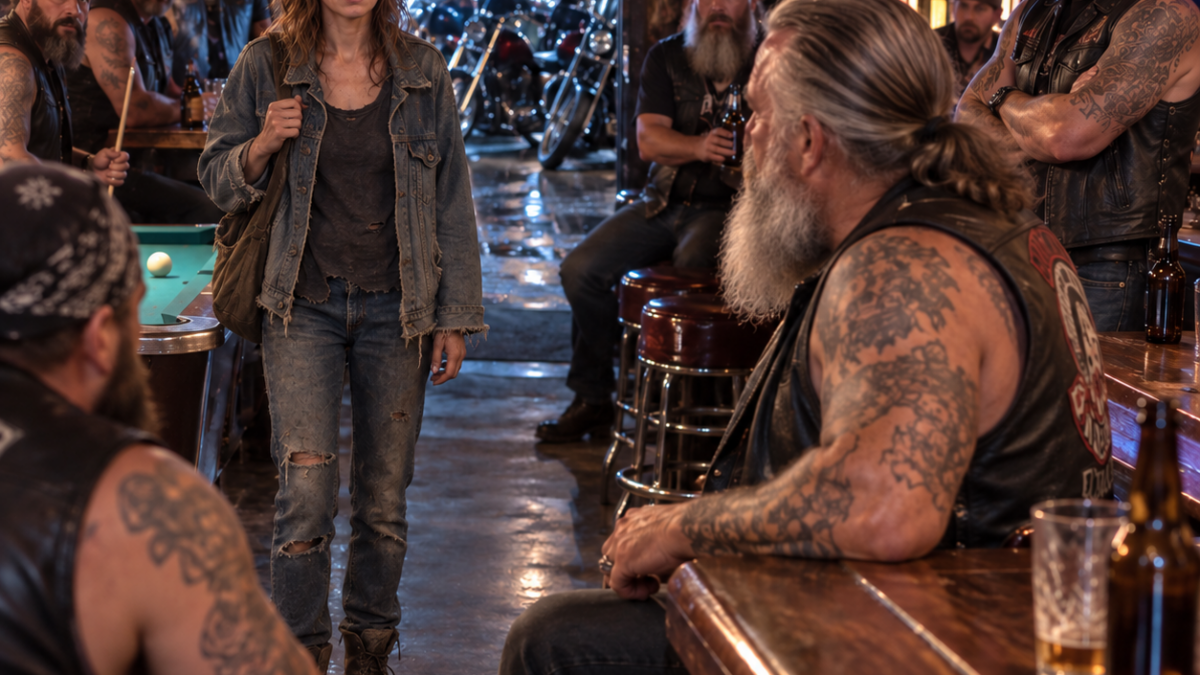
Men in leather cuts stood or sat throughout the room, patches across their backs, ink on their arms, gray in their beards, hard life in their eyes. I felt every stare move over my frayed jacket, my cheap boots, my split lip healing badly, the makeup I had used to soften the shadow near my cheekbone.
The room went quiet.
A mountain of a man at the center of the bar slowly turned on his stool.
Thick graying beard.
Arms sleeved in faded tattoos.
A jagged scar running from below his left ear into the collar of his shirt.
The patch on his chest said President.
“You lost, sweetheart?” he asked.
His voice was deep enough to vibrate in my chest.
“Church choir is three blocks down.”
A few men laughed.
Not kindly.
Not cruelly either.
Testing.
That was something I understood.
Men always test a woman when she enters a room they believe belongs to them.
The trick is knowing which test matters and which one only wants you to flinch.
I forced my trembling legs forward.
“I’m looking for the boss.”
“You found him.”
“The sign says you need a bartender.”
His eyes narrowed.
Up close, I saw he was older than I first thought. Late fifties, maybe. Maybe sixty. A man worn by road and weather and choices he probably did not discuss with strangers.
“What’s your name?”
“Samantha.”
“Samantha what?”
“Collins.”
He looked me over again.
Not the way Ruben’s friends looked at women.
Not hungry.
Assessing.
“You don’t look like you can lift a keg, Samantha Collins.”
“I can roll one.”
The corner of his mouth moved.
“You don’t look like you can handle the clientele.”
“I pour fast, I don’t short the till, and I don’t ask questions.”
That got a few murmurs.
I kept my eyes on him.
“I need a job. You need someone who isn’t afraid of the dark. I think we can help each other.”
A younger man leaned against the liquor cabinet behind him. Dark hair. Rigid posture. Blue eyes so cold they seemed almost pale under the bar lights. His patch read Sergeant-at-Arms.
Wyatt.
“She’s running from something,” Wyatt said.
His voice held no emotion.
“Trouble follows runners.”
I turned my head to him.
“The trouble I’m running from wears a suit and pays other men to call him honorable.”
No one laughed then.
Wyatt’s gaze stayed fixed on me.
“He come looking here?”
“If he’s stupid enough.”
“And if he brings police?”
“Then they were already his before they were yours.”
The president raised one massive hand.
The room went silent.
“I’m Emery Patterson,” he said. “Most call me Grizzly.”
That fit him.
He crushed a cigarette into an ashtray.
“Trial run. You start now. Minimum wage under the table until I know you won’t steal, fold, or scream. You mess up drinks, you’re out. You listen at doors, you’re out. You bring trouble to my house and lie about it, you’re out.”
He paused.
“If trouble comes honest, that’s different.”
My throat tightened.
“Understood.”
“Jenna!” he called.
A woman emerged from the far end of the bar, wiping her hands on a towel. She was in her forties, sharp-eyed, with silver hoops in both ears and the weary calm of someone who had seen men break bottles and egos with equal regularity.
“Show her the taps,” Grizzly said.
Jenna looked me over.
“Can you count change?”
“Yes.”
“Can you move fast?”
“Yes.”
“Can you keep a drunk man from thinking your smile is a contract?”
My voice went quiet.
“Yes.”
Her eyes paused on mine.
Something passed between us.
Recognition, maybe.
“Good,” she said. “Tie your hair back.”
That first night was a baptism by fire.
Orders came fast.
Whiskey neat.
Cheap drafts.
Bourbon rocks.
Shots with names I refused to repeat.
Men slammed empty glasses down to see if I startled. They told crude jokes and watched for blush or anger. They called me sweetheart, honey, little girl, and once, by a prospect with more confidence than sense, princess.
I ignored most of it.
When a massive biker named Meat grabbed my wrist as I handed him a beer, my heart jumped so hard I almost dropped the glass.
I did not scream.
I did not pull away.
I looked at his hand.
Then at his face.
“If you spill that beer, Meat, you’re paying for it twice.”
For one breath, the room held.
Then Meat threw his head back and laughed.
A booming, chest-deep sound.
He let go and slapped a fifty on the bar.
“Keep the change, Sammy.”
From his corner booth, Grizzly watched.
He caught Wyatt’s eye and gave one nearly invisible nod.
I had passed the first test.
Not because I was fearless.
Because I knew how to keep moving while fear walked beside me.
By two in the morning, my feet ached, my hands smelled like lime and beer, and my nerves felt scraped raw. Jenna showed me where to lock the cash drawer. Grizzly counted it twice, found it exact, and said nothing. In that room, silence could be criticism or praise. I was too tired to know which.
I slept that day in the tiny room above the stockroom, where an old cot sat beneath a buzzing light and the walls shook faintly whenever trucks passed on the road outside.
No one asked why I needed to sleep there.
No one told me I could stay.
No one told me I could not.
That was how my new life began.
Not with kindness.
With usefulness.
For the first few weeks, I learned The Devil’s Keep the way a prisoner learns a cell and the way a survivor learns a possible shelter.
The front door stuck in damp weather.
The second tap foamed if pulled too hard.
The jukebox skipped on track seventeen.
The far-left pool table tilted toward the back wall.
The men at the bar had hierarchy even when they pretended not to.
Fully patched members first.
Old-timers before young ones.
Prospects last.
Guests only when someone vouched for them.
I learned what not to ask.
When the men filed into the soundproof back room for church, their club meeting, I turned up the jukebox, locked the front door, and scrubbed the bar. If voices rose behind the wall, I did not hear them. If men came out angry, I poured coffee before whiskey. If Wyatt’s jaw was tight, I kept everyone else’s glass full and stayed out of his path.
The Devil’s Keep was not gentle.
I will not pretend it was.
There were fights in the parking lot sometimes. Men came in bleeding and called it nothing. Certain names made the room go still. Certain envelopes passed hand to hand and disappeared. There were rules I did not understand and boundaries I learned not to cross.
But inside the chaos was a code.
Not a pretty one.
Not always a lawful one.
But real.
A man paid what he owed.
A guest did not touch the bartender.
No one raised a hand to Jenna.
No one harassed the women who came in with members.
No one mocked a veteran’s tremor.
No one made jokes about a dead brother.
And after the third week, no one called me sweetheart unless I allowed it.
I became Sammy before I became anything else.
Not Samantha Collins, runaway wife of Councilman Ruben Bowman.
Not bruised woman.
Not victim.
Sammy behind the bar.
Sammy who could pour four drafts at once.
Sammy who remembered Meat liked too much ice, Dutch hated lemon, and Wyatt drank coffee black when he wanted whiskey but did not trust his temper.
Wyatt remained my biggest skeptic.
He watched everything.
The door.
The mirrors.
The way strangers looked at me.
The way I flinched when someone moved too fast.
He never asked about Ruben.
That made me trust him more.
Men like Ruben demanded confessions so they could use them later. Wyatt seemed to believe a person’s story was theirs until they spent it.
Once, a non-member came in drunk and put both hands on the bar, leaning too close.
“You new here?” he asked me.
“New enough.”
“You friendly?”
“No.”
He grinned and reached toward my hair.
Wyatt appeared beside him so silently I did not see him cross the room.
“Hand back,” he said.
The drunk man turned.
“What?”
“Hand. Back.”
The man looked at Wyatt’s face and sobered by several degrees.
“I wasn’t doing anything.”
Wyatt waited.
The hand dropped.
The man left five minutes later.
I did not thank Wyatt.
He did not ask me to.
That was the strange thing about protection at The Devil’s Keep. No one wrapped it in soft language. No one made me feel weak for needing it. They simply adjusted the room until I could keep working.
One night, while closing, I found Grizzly sitting alone at the bar with a cup of coffee gone cold.
“You got family?” he asked.
The question came so suddenly I almost lied.
“No.”
“Everyone’s got family.”
“Not everyone keeps them.”
He accepted that.
“You got papers?”
I looked at him.
“Identification?”
“Yes.”
“Some.”
“Keep copies somewhere that isn’t your room.”
My stomach tightened.
“Why?”
“Because runners lose things. Fire happens. Doors get kicked. Men like the one you’re running from know what to steal first.”
I stared at him.
His eyes remained on the coffee.
“Jenna’s got a lockbox in her office. You want copies kept there, give them to her. You don’t, don’t.”
He stood and left.
No pity.
No demand.
Just information.
The next morning, I gave Jenna copies of everything I had.
Birth certificate.
Social security card.
Divorce papers.
A photograph of bruises I had taken in a gas station bathroom two days after leaving.
Jenna looked at the photograph for exactly one second.
Then placed it under the papers and locked the box.
“Anybody here asks about this, they answer to me first,” she said.
I believed her.
That belief terrified me.
Trust is frightening when you have spent years surviving betrayal.
The night that changed my position in the bar came in late November during a storm hard enough to make the building feel underwater.
The bar was nearly empty. Grizzly was out of town. Jenna had gone home with a migraine. Wyatt sat near the back with two prospects playing pool, though I suspected he had not taken his eyes off the room for a full game.
I was in the stockroom taking inventory when the rear delivery door rattled.
Deliveries never came at night.
I froze with a clipboard in one hand and a tequila bottle within reach of the other.
The door opened before I could move.
Tommy stumbled in.
Tommy was a prospect barely twenty-two, all nervous energy and desperate loyalty. He was soaked through, pale, bleeding from a cut near his hairline, and clutching a heavy black duffel bag to his chest.
“Sammy,” he gasped. “I messed up.”
“What happened?”
He dropped the bag onto a pallet of beer kegs. It sagged open.
Inside were sealed envelopes, donation cash bands, medical supply vouchers, and folders labeled with names of veterans’ families.
Not weapons.
Not drugs.
Paper.
Money.
Proof of something the club was doing quietly through a veterans’ charity ride Grizzly never advertised because, as Jenna once said, “He’d rather eat glass than let the city call him generous.”
Tommy was shaking.
“The Vipers knew about the transport,” he said. “They hit us near Highway 9. I got away, but they saw me turn in. If they get this, those families lose the fund. If Grizzly finds out I brought heat back—”
He stopped, breathing too fast.
Then engines sounded in the alley.
Unfamiliar engines.
Hard.
Close.
Tommy looked ready to bolt, leaving the bag and me behind.
Something inside me sharpened.
I knew panic.
I knew what it did to a person.
I had lived with a man who used panic like a leash.
“Shut up and listen to me,” I snapped.
Tommy stared.
“Grab that tarp. Cover the bag. Push it behind the empty kegs. Now.”
He obeyed.
“Take off your cut.”
“What?”
“You’re bleeding on the floor. Take off the leather, put on that apron, grab a mop. You’re a barback cleaning a spill.”
“Sammy—”
“If they come through that door, you do not speak. I do the talking.”
He moved.
Seconds later, the back door kicked open.
Three men in green and black stepped into the stockroom, rain on their shoulders, adrenaline in their faces. The lead one had a pistol visible beneath his jacket, though his hand stayed off it.
That detail mattered.
I saw it.
I filed it.
I stood with my clipboard and let rage cover fear.
“Are you boys lost?”
The leader sneered.
“Where is he?”
I looked at their muddy boots.
“You are tracking filth across a floor my barback just mopped.”
Tommy bent over the mop, face turned down, apron covering his shirt, his cut hidden beneath a pile of rags.
The Viper stepped closer.
“Don’t play stupid, sweetheart. A kid on a Harley came into this alley carrying something that belongs to us.”
“The only thing that came through that alley was a stray cat,” I said. “Then you three.”
His eyes narrowed.
“I don’t know who you think you are.”
“I’m the person who has to explain to Grizzly Patterson why strangers kicked open his delivery door during a storm.”
The name shifted the room slightly.
So did the next one.
“And Wyatt Mitchell is thirty feet away in the main bar. Should I get him, or would you prefer to leave quietly and pretend you boys still have judgment?”
The three men exchanged a glance.
Wyatt’s reputation had traveled farther than his patience.
The leader looked at me.
Then at Tommy.
Then at the covered pallets.
For one terrifying second, I thought he would step closer.
Instead, he spat on the floor.
“This isn’t over.”
“It is in my stockroom.”
They left.
I waited until their engines faded into the storm before my knees almost gave out.
Tommy slid down the wall, shaking.
“You saved my life.”
“Clean up the blood,” I whispered.
My voice trembled now.
“When I walk out there, Wyatt will already know.”
Tommy looked terrified.
He had reason.
When I returned to the bar, Wyatt was standing near the stockroom door with a lit cigarette between two fingers.
He had not been playing pool.
He had heard everything.
I stopped.
My heart hammered so hard I could feel it in my wrists.
I waited for anger.
For accusation.
For him to tell me I had crossed into club business and would regret it.
Instead, Wyatt reached across the bar, took two shot glasses, and poured top-shelf whiskey into both.
He slid one toward me.
Then raised his own.
“To the newest prospect,” he said.
For the first time since I met him, Wyatt smiled.
Small.
Dangerous.
Almost warm.
I picked up the glass with shaking fingers.
“I don’t ride.”
“You lie better than half the men who do.”
I laughed before I could stop myself.
Then drank.
That was the night the room changed.
I was not just a bartender after that.
Not one of them.
Never that.
But not outside either.
A strange middle place opened, and I stepped into it carefully.
The men still tested me, but differently now. They brought problems to the bar like offerings. Meat asked me to read a letter from his daughter because he trusted my voice not to mock the spelling. Dutch wanted help filling out a benefits form because government websites made him want to punch furniture. Tommy brought every cut on his knuckles to me before Jenna because he said I made fewer disappointed noises.
Wyatt kept watching.
But the suspicion changed into something else.
One evening, I found him in the back hall after closing, cleaning blood from his knuckles under the sink.
I stopped in the doorway.
“Do I want to know?”
“No.”
“Is the other person alive?”
His eyes lifted to mine.
“Yes.”
“Then use soap.”
He almost smiled.
I stepped closer, handed him a towel, and noticed the scars on his forearms. Not fresh. Not all from fights. Some looked older, deliberate in the way pain can become a language for people who never learned another one.
He caught me looking.
“Careful, Sammy. Ask enough questions and I might answer one.”
“I wasn’t asking.”
“No,” he said. “You rarely do.”
“I know what it feels like when people demand the worst story you’ve got before they decide whether you deserve kindness.”
The faucet ran between us.
Wyatt shut it off.
For a moment, he looked less like an enforcer and more like a tired man with wet hands.
“That why you don’t tell yours?”
I folded the towel once.
“I’m still deciding who deserves it.”
He nodded.
“Good.”
Two days later, Ruben found me.
It was a Thursday afternoon.
The bar was closed until five. Grizzly was supposed to be at a meeting across town. Jenna was out buying supplies. Most of the men were gone. I was wiping down the taps with my back to the entrance when the bell above the front door jingled.
“We’re closed,” I called. “Come back at five.”
“I don’t think so, Samantha.”
The rag slipped from my hand.
It hit the floor with a wet slap.
Every part of me went cold.
I knew that voice.
Smooth.
Cultured.
Amused.
The voice that had once told a room full of donors that I was his rock.
The voice that had whispered through clenched teeth later that night that if I ever embarrassed him again, he would make sure no one believed a word I said.
I turned slowly.
Ruben Bowman stood just inside the steel door in a tailored charcoal suit, hair perfect, shoes polished, wedding ring still on his finger like a threat. He looked completely out of place in The Devil’s Keep, and somehow that made him more frightening.
Because he had come anyway.
He let the door swing shut behind him, cutting off the daylight.
“Did you really think,” he said, “that you could hide from me in a place like this?”
Fear washed through me so fast the room blurred.
For one second, I was not Sammy behind the bar.
I was Samantha Bowman in a white kitchen, calculating how far I stood from the nearest exit.
Ruben smiled.
“There she is.”
My hand closed around the edge of the bar.
“Get out.”
He looked around the room with theatrical disgust.
“My God. You really lowered yourself, didn’t you?”
“I said get out.”
“You disappear for weeks, ignore my calls, leave legal nonsense on the counter, and now I find you pouring beer for criminals.”
His eyes moved over me.
“I should have known you’d run toward filth. You always did confuse attention with worth.”
The old words found old bruises.
For years, he had trained me to collapse inward when he spoke that way. He never needed to shout first. He only had to remind me of the version of myself he had built: unstable, ungrateful, dramatic, too emotional, too dependent, too stupid to survive without him.
I forced my eyes to meet his.
“I am not your wife anymore.”
His smile sharpened.
“You are whatever I say you are until a judge says otherwise.”
“I left the papers.”
“You left a tantrum.”
“You have no power here.”
That amused him.
“No power?” He stepped closer, dress shoes clicking against the floorboards. “Samantha, I am a sitting city councilman on the verge of a mayoral run. The police chief eats dinner at my table. The judges play golf with my donors. I am power.”
He leaned against the bar, invading the space between us.
“You are going to walk out that door with me. You are going to come home. You are going to smile at Tuesday’s campaign event. Then, privately, you and I are going to have a very serious conversation about loyalty.”
The word made my stomach turn.
“No.”
His eyes changed.
There it was.
The private man beneath the public suit.
“You still think this is a negotiation.”
His hand shot across the bar toward my wrist.
Before his fingers touched me, a heavy hand clamped around his forearm.
Ruben gasped.
Wyatt stood beside him, having emerged from the dark hallway so silently neither of us had heard him.
He wore no leather cut, only a plain white T-shirt that showed tattooed arms and thick muscle. His blue eyes were flat, cold, and locked on Ruben’s face.
“The lady told you to leave,” Wyatt said.
Ruben tried to yank free.
Wyatt did not move.
“Take your hands off me,” Ruben hissed. “Do you know who I am?”
“Yes,” Wyatt said.
The simplicity of it unsettled Ruben more than ignorance would have.
“I could make one phone call and have this illegal dive raided before dinner.”
“You could try.”
The front door opened.
Grizzly stepped inside.
Behind him came Jenna, Dutch, Meat, and two others. Not rushing. Not shouting. No weapons in their hands. Just presence filling the room until Ruben finally understood he had walked into a place where his usual performance had no audience willing to applaud.
Grizzly locked the door.
Then flipped the sign to CLOSED.
The click sounded final.
“Councilman Bowman,” Grizzly said. “Been expecting you sooner or later.”
Ruben’s face paled, but arrogance fought to stay alive.
“This is kidnapping.”
“No,” Jenna said from near the door. “This is you refusing to leave after being told. The camera above the bar has audio.”
Ruben’s eyes flicked upward.
He had not noticed the camera.
Men like Ruben hate being recorded by anything they do not control.
Grizzly walked slowly toward him.
“You pushed the zoning law that shut down the Eastside Community Center.”
Ruben’s mouth tightened.
“Public record.”
“You took campaign money from the developers who bought the land six months later.”
“Baseless.”
“Maybe,” Grizzly said. “But the investigative reporter who called me yesterday seemed real interested in the timing.”
Ruben looked at me.
The first crack appeared.
“You’ve been talking?”
I said nothing.
Jenna did.
“She’s been documenting.”
Ruben’s nostrils flared.
“Anything she says is the product of an unstable woman under the influence of criminals.”
“No,” said a new voice.
The side door opened, and a woman stepped in wearing a navy blazer over jeans, her hair pulled back, a leather satchel over one shoulder. I recognized her from a card Jenna had placed beside my bed weeks earlier.
Marisol Vega.
Domestic violence advocate.
Former prosecutor.
The first professional in months who had spoken to me like I was a witness to my own life, not a problem to be managed.
Ruben stared at her.
“What is this?”
“A very bad afternoon for you if you keep talking,” Marisol said.
She opened her satchel and removed a folder.
“Medical photographs. Text messages. Voicemails. A sworn statement from Mrs. Collins. A copy of the divorce filing. A report package ready for the state ethics commission. And, as Ms. Patterson mentioned, a bar camera recording you threatening to force her home against her will.”
Jenna smiled faintly at Ruben’s confusion.
“Yes,” she said. “I’m Ms. Patterson. Grizzly’s sister. And the owner on paper of this filthy little establishment.”
Ruben looked from Jenna to Grizzly.
“You think this scares me?”
“No,” Grizzly said. “I think losing control scares you. There’s a difference.”
Wyatt released Ruben’s arm.
Not violently.
Not gently.
He simply let go.
Ruben stumbled back, rubbing his wrist.
The absence of Wyatt’s grip seemed to frighten him more than the grip itself. Now there was nothing physical to fight, nothing dramatic to claim. Only facts, witnesses, cameras, and a woman he had counted on staying too afraid to speak.
Marisol turned to me.
“Samantha, this is your choice. You can ask him to leave. You can call police. You can let me file the emergency protection request today. You can do all three.”
My throat tightened.
Everyone looked at me.
Not the way Ruben used to look at me, waiting to see if I would obey.
They waited because the next word belonged to me.
That almost hurt worse.
Freedom is heavy when your hands have been trained for chains.
Ruben saw my hesitation and lunged for it.
“Samantha,” he said, suddenly soft. “Think carefully. These people are using you. I know you’re scared. I know you’ve been confused. Come home and we can handle this privately.”
There it was.
The old door.
The one he had opened a hundred times.
Come back.
Be quiet.
Let me rewrite what happened.
For a second, I saw every version of myself that had accepted that door.
The wife smoothing makeup over bruises.
The woman apologizing to guests because Ruben had slammed a cabinet hard enough to crack it.
The person whispering it wasn’t that bad because survival sometimes requires lying to yourself before breakfast.
Then I looked at Wyatt, standing still beside the bar.
At Jenna, chin lifted.
At Grizzly, arms crossed but silent.
At Marisol, holding the folder.
At the camera above the bar.
At the steel door behind Ruben.
I had walked through that door desperate.
I would not leave it captive.
“Get out,” I said.
Ruben’s face hardened.
“Sam—”
“Get out. Do not come to this bar again. Do not come to any place I work. Do not call me. Do not send anyone to find me. Any communication goes through my attorney or Marisol.”
He laughed once, ugly and weak.
“You think a biker bar gives you courage?”
“No,” I said. “It gave me witnesses.”
That landed.
Marisol lifted her phone.
“I’m filing the protection request now.”
Jenna nodded toward the door.
“And you are trespassing.”
Ruben looked at Grizzly.
“You’ll regret this.”
Grizzly did not move.
“No, Councilman. You will. But not because of us.”
His voice lowered.
“Because she finally stopped protecting your reputation from your behavior.”
Ruben stood there for one breath too long.
Then another.
No one touched him.
No one threatened him.
No one needed to.
He straightened his cuffs with shaking hands and walked to the door.
Before leaving, he turned back to me.
I expected one final threat.
Instead, he saw my face and seemed to realize something had changed beyond his reach.
The door opened.
Sunlight cut across the floor.
Then he was gone.
The door shut behind him.
For several seconds, nobody moved.
Then Wyatt picked up the rag I had dropped and tossed it to me.
“Spill on the counter, Sammy,” he said. “We open in ten.”
A laugh burst out of me.
Not because anything was funny.
Because my body had survived fear and did not know what else to do with the air.
I caught the rag.
My hands shook.
Jenna came around the bar and, without asking permission, set a glass of water in front of me.
“Drink.”
I drank.
Grizzly looked at Marisol.
“How fast can that order move?”
“Fast enough,” she said. “Especially with the recording.”
“And the reporter?”
“Already has public records. Anything else waits on Samantha’s consent.”
Grizzly looked at me.
“No one spends your story but you.”
That sentence became the foundation of my second life.
Ruben’s fall did not happen in one cinematic moment.
Real power does not usually collapse that cleanly.
It leaks.
The protection order came first.
Then the ethics complaint.
Then the reporter’s article about zoning favors and campaign donations. Then former staffers came forward. Then a contractor talked. Then a woman I had never met called Marisol and said Ruben had hurt her years ago too, before he had learned to hide it better.
He withdrew from the mayoral race.
Then resigned from the council “to focus on his family,” which would have been funny if it had not made me want to throw something.
The criminal case took longer.
They always do.
Ruben hired expensive attorneys. They called me unstable. Bitter. Influenced. They tried to turn The Devil’s Keep into proof that I was unreliable, as if working near rough men meant I had invented violence from a polished one.
But Jenna had the video.
Marisol had the records.
I had photographs.
And for the first time in years, I had people willing to sit beside me in ugly rooms and tell the truth without flinching.
Wyatt came to the courthouse once.
Just once.
Not into the courtroom. He waited outside near the vending machines with two coffees and the expression of a man who hated fluorescent lights personally.
When I came out shaking after a preliminary hearing, he handed me one.
“Sugar?”
“No.”
“Good. Forgot it.”
I almost smiled.
He leaned against the wall.
“You did good.”
“I cried.”
“Still did good.”
“I forgot dates.”
“Marisol didn’t.”
“I felt stupid.”
“You weren’t.”
The words were simple.
They held.
That became Wyatt’s way.
Never more comfort than I could carry.
Never less truth than I needed.
Over the months that followed, The Devil’s Keep changed shape around me.
Or maybe I changed enough to see it properly.
It was still loud.
Still rough.
Still full of men polite society would rather fear from a distance than understand up close.
But I began to learn their stories.
Meat had a daughter in Arizona who sent him drawings of horses. He kept every one folded inside a cigar box beneath the bar.
Dutch volunteered twice a week at a recovery center and threatened anyone who called it charity.
Jenna had bought The Devil’s Keep with money from a divorce settlement and turned it into the only business on that street that never bounced a paycheck.
Grizzly had indeed done things I did not ask about, and some of those things probably lived outside the law. But he also paid for three funerals, kept an emergency fund for families of incarcerated members, and once drove six hours to pick up the teenage son of a former member who had called from a bus station with nowhere to sleep.
People are not clean lines.
That is what I learned there.
Ruben had looked clean and lived rotten.
The men at The Devil’s Keep looked dangerous and sometimes were, but danger was not the only thing they carried.
For a while, I struggled with that.
I did not want another world of men and rules and loyalty I did not control. I did not want to trade one cage for another, even one with better locks and stronger guards.
Jenna understood before I said it.
“You’re getting restless,” she told me one afternoon.
I was polishing glasses before opening.
“No.”
“Lie better.”
I set the glass down.
“I don’t want to belong to anyone.”
Jenna nodded.
“Good.”
That surprised me.
She leaned against the counter.
“This place saved you because you needed a door Ruben wouldn’t walk through easily. That doesn’t mean you owe it your whole life.”
“I work here.”
“Yes.”
“I’m grateful.”
“Gratitude is not ownership.”
I looked at her.
She continued, “You want a future, Sammy, build one. Don’t just hide in ours.”
That night, I applied for a community college program in bookkeeping.
I had always been good with numbers. Ruben had mocked it, called it cute, then let me manage household expenses while keeping real money hidden from me. At The Devil’s Keep, I had started helping Jenna reconcile supply invoices because the old system was a shoebox, two notebooks, and faith.
Within three months, I was doing payroll.
Within six, I was taking classes online from the little room above the stockroom.
Wyatt found me there once at two in the morning, surrounded by receipts and a textbook.
“You planning to take over the world?”
“Accounts payable first.”
“Ambitious.”
“I like knowing where things go.”
He stood in the doorway.
“Money?”
“Money. Inventory. Time. People.”
His eyes met mine.
“People don’t always stay where you put them.”
“No,” I said. “But you can stop pretending they disappeared when someone moved them.”
He nodded as if that made sense.
Maybe it did to him.
The first time I testified against Ruben, I wore a navy dress Jenna bought and claimed was “bar uniform adjacent,” which was a lie so obvious even Meat snorted. Grizzly drove. Marisol sat beside me. Wyatt rode his bike behind the car, not because anyone expected trouble, but because he said parking was easier.
Ruben did not look at me when I entered the courtroom.
That gave me strength.
Not because he feared me.
Because he could no longer force me to organize myself around his gaze.
On the stand, his attorney asked why I had gone to a Hells Angels bar instead of a shelter.
I answered honestly.
“Because I knew my husband would look for me in every respectable place first.”
The courtroom went quiet.
The attorney tried to make me look ashamed.
I refused to help him.
“Were you aware of the reputation of this establishment?”
“Yes.”
“And you considered that safe?”
“I considered it less dangerous than my home.”
Marisol later told me that answer mattered.
To me, it was simply the truth.
Ruben eventually took a plea on some charges while investigations into corruption continued separately. The details were messy and unsatisfying in the way legal endings often are. He did not vanish into prison forever like a villain in a story designed to soothe people. But he lost his office. Lost his campaign. Lost the polished shield that had protected him.
Most importantly, he lost access to me.
The day the final protection order was granted, I returned to The Devil’s Keep before opening.
The bar was empty except for Wyatt sitting at the far end, cleaning a glass badly.
“You’re terrible at that,” I said.
“Yes.”
“Why are you doing it?”
“Jenna said look useful.”
“You failed.”
He set the glass down.
“How’d it go?”
“It’s done.”
He watched me.
“Done done?”
“As done as the law can make it.”
“That enough?”
I thought about it.
“No.”
He nodded.
“But it’s something,” I said.
“Something counts.”
I stood behind the bar, running my hand along the scarred wood.
The first time I had walked in, I thought stale beer and old leather smelled like danger.
Now they smelled like work.
Like survival.
Like a place that had seen me terrified and let me become more than that.
Grizzly came in an hour later with flowers.
Actual flowers.
A grocery store bouquet wrapped in plastic.
Everyone stared at him.
He glared back.
“What?”
Meat grinned.
“Nothing, boss.”
Grizzly set the bouquet on the bar in front of me.
“Jenna said people do this.”
Jenna, from behind him, said, “I said decent people do this.”
“Same thing.”
I touched the plastic.
“Thank you.”
Grizzly shifted, uncomfortable.
“You earned more than flowers.”
“I know.”
That made him laugh.
The whole bar seemed to exhale with him.
Later that night, when the place was full, Jenna climbed onto a chair and announced that from then on, I was no longer under the table, no longer temporary, and no longer sleeping in the stockroom unless I wanted to avoid people, which she understood but did not recommend as a permanent housing strategy.
“You’re on payroll,” she said. “Assistant manager, effective Monday.”
The men cheered.
I cried in the walk-in cooler for seven minutes.
Wyatt stood outside the door and pretended not to hear.
I moved into a small apartment two weeks later.
Not fancy.
Not safe in the storybook sense.
But mine.
Second floor.
Bars on the window.
A stove that clicked three times before lighting.
A bedroom door with a lock I chose.
The first night, I slept twelve hours.
The second, I woke at three in the morning convinced Ruben was in the hall.
He wasn’t.
Healing is not a straight road.
It is a room you keep entering and realizing the danger is no longer there, even though your body still reaches for armor.
Sometimes I still flinched when a man raised his voice.
Sometimes I still checked locks three times.
Sometimes a cologne like Ruben’s passed me in a grocery aisle and my hands went numb.
But I also learned new habits.
I learned to fill out financial aid forms.
I learned payroll software.
I learned that Jenna sang off-key when doing inventory.
I learned that Grizzly secretly liked peach tea and would deny it until death.
I learned that Wyatt owned exactly seven white T-shirts and somehow looked threatening in all of them.
I learned that men could disagree loudly in a room and no one had to be hurt.
I learned that my no could be heard the first time.
One year after I knocked on the steel door, The Devil’s Keep held a fundraiser for the rebuilt Eastside Community Center.
That was Jenna’s idea.
Grizzly pretended to hate it.
He donated the most.
The building Ruben helped shut down had been bought back by a nonprofit after the scandal cracked open several deals. It was not a perfect victory. Nothing undone is ever entirely restored. Years had been lost. Programs had disappeared. Families had moved on. But the doors opened again.
The fundraiser filled the bar with people who never would have stepped inside before.
Teachers.
Veterans.
Single mothers.
Mechanics.
A pastor who looked terrified until Meat handed him lemonade.
Marisol came and brought three women from the advocacy center who were still in the frightened early stages of leaving. I recognized their faces. Not their features, but the shape of their vigilance. The way they sat with their backs to the wall. The way they watched doors. The way they smiled too quickly when men approached.
I served them myself.
One of them, a young woman named Lila, looked at my vest—not a club cut, never that, but a black denim vest Jenna had given me with The Devil’s Keep stitched over the pocket.
“You work here?” she asked.
“I do.”
“Were you scared at first?”
“Yes.”
“How did you know they wouldn’t hurt you?”
I looked around the room.
At Grizzly arguing with the pastor about raffle tickets.
At Wyatt moving silently behind a drunk man before the man could step too close to anyone.
At Jenna counting donations with a pencil behind one ear.
At Marisol laughing for the first time all evening.
“I didn’t know,” I said.
Lila looked disappointed.
I leaned closer.
“I learned. Slowly. And I kept my own exit until I trusted the door.”
She absorbed that.
“Do you think I’ll ever stop being scared?”
“No.”
Her face fell.
“You’ll stop being only scared,” I said. “That’s different. And it’s enough to begin.”
Months later, Lila came back to tell me she had a job at a bakery and a room above her aunt’s garage.
She brought cupcakes.
Grizzly ate three and said they were acceptable, which from him was practically poetry.
Wyatt and I never became what some people expected.
People love turning protection into romance because it makes fear prettier.
The truth was better.
Wyatt became my friend.
A difficult friend.
A silent, irritating, overprotective, blunt instrument of a friend who once spent four hours teaching me how to change a tire and then made me do it again because I had not tightened the lug nuts in the right order.
I became his friend too.
The kind who noticed when he stopped drinking whiskey for a month and did not ask why until he was ready to tell me.
The kind who drove him to a VA appointment because Dutch had the flu and Wyatt claimed buses were “government punishment.”
The kind who told him, after he frightened a teenager by looming too close, “You are not a shadow with boots. Use words first.”
He looked offended.
Then he used words.
That was our friendship.
Corrections accepted grudgingly.
Care given sideways.
No ownership.
No debt.
No pretending either of us was softer than we were.
Two years after I first entered The Devil’s Keep, I stopped working full shifts behind the bar.
Not because I left.
Because I had become the business manager for Jenna’s three properties: the bar, a small garage next door, and the newly rented upstairs office where Marisol held free legal clinics twice a month for women who needed help before they could afford it.
My desk faced a window.
A real one.
It looked out over cracked pavement and motorcycles and men smoking beside the alley, but it was a window all the same.
Sunlight came through in the afternoon.
The first time I sat there alone with payroll reports open and my own name on the office door, I cried again.
Not the desperate crying from motel bathrooms.
Not the terrified crying after Ruben’s threats.
This was quieter.
A grief for the woman who had believed survival was the most she would ever be allowed to want.
Jenna found me and pretended not to notice.
“You’re smudging invoices,” she said.
“I’m having a moment.”
“Have it away from tax documents.”
I laughed through tears.
That was family at The Devil’s Keep.
Never soft when dry humor would do.
Always present when it mattered.
Ruben tried once more.
Not in person.
Men like him rarely risk direct confrontation after power stops obeying them.
A message came through a fake account.
You think they can protect you forever?
I stared at it for a long time.
My hands did not shake.
That was how I knew I had changed.
I screenshot it, sent it to Marisol, filed it with the court, and blocked the account.
Then I walked downstairs and opened the bar.
That was all.
No panic.
No collapse.
No old instinct to run.
The door held.
So did I.
Years later, people still tell the story wrong.
They say I was saved by outlaws.
They say a terrified woman walked into a Hells Angels bar and found bigger monsters to scare away the one chasing her.
That version is dramatic.
It is not true enough.
The men at The Devil’s Keep did not save me by being scarier than Ruben.
They helped me save myself by giving me work, witnesses, time, and a locked box for my papers.
They believed me before I could prove every bruise.
They let me speak when the choice was mine.
They did not make my gratitude into a collar.
That is the part people miss.
Ruben had called control love.
The Devil’s Keep taught me that loyalty without freedom is just another cage.
A rougher cage, maybe.
A louder one.
But a cage all the same.
So Grizzly never asked me to pledge anything.
Jenna never let me confuse shelter with debt.
Wyatt never touched me without permission after the first time he stopped Ruben’s hand from reaching mine.
And when I finally built a life beyond the bar, nobody called it betrayal.
They called it what it was.
Growth.
On the fifth anniversary of the night I knocked on the door, Jenna replaced the old cardboard sign.
The original was still taped inside her office, stained by weather and smoke.
Bartender wanted. Keep your mouth shut or don’t knock.
She framed it as a joke.
I hated it.
I loved it.
The new sign outside was cleaner.
HELP WANTED.
No experience necessary.
Must respect boundaries.
Ask for Samantha.
Grizzly stood beside me while Jenna taped it to the door.
“Looks too polite,” he grumbled.
“It’s a job posting,” Jenna said. “Not a threat.”
“Those can overlap.”
“Not anymore.”
I touched the corner of the sign.
A young woman might see it someday.
Maybe not as desperate as I had been.
Maybe worse.
Maybe with twenty dollars in her pocket and a shadow behind her.
Maybe she would knock.
Maybe she would not.
But if she did, I knew what I would say when she stepped inside with fear in her eyes.
You are safe enough to breathe.
You can work if you want work.
You can leave if you want to leave.
You owe us honesty, not your life.
And if trouble comes honest, tell us before it reaches the door.
That night, after closing, I stood behind the bar alone for a moment.
The jukebox was off.
The neon hummed.
The room smelled like old beer, lemon cleaner, leather, and rain.
I remembered the first time I had stood there, trembling and pretending not to.
I remembered Grizzly saying I did not look like I could lift a keg.
I remembered Wyatt saying trouble follows runners.
I remembered my own voice answering that the trouble chasing me wore a suit.
I had been right.
But I had been wrong about one thing.
I thought I had come to The Devil’s Keep because I had nowhere else to go.
Really, I had come because some buried part of me still believed there had to be a door somewhere Ruben did not control.
I found it.
Steel.
Black paint.
Bad neon.
Motorcycles at the curb.
A room full of men the world had already judged.
No one wanted the job at that bar.
I took it because desperation does not care about reputation.
I stayed because work became dignity.
Dignity became courage.
Courage became testimony.
Testimony became freedom.
And freedom, once I learned how to hold it, became a life.
Not a perfect life.
Not a clean one.
A real one.
Mine.








