No One Looked Twice at the Old Farmer in the Airport—Until Seven Military Dogs Saw Something Everyone Else Missed
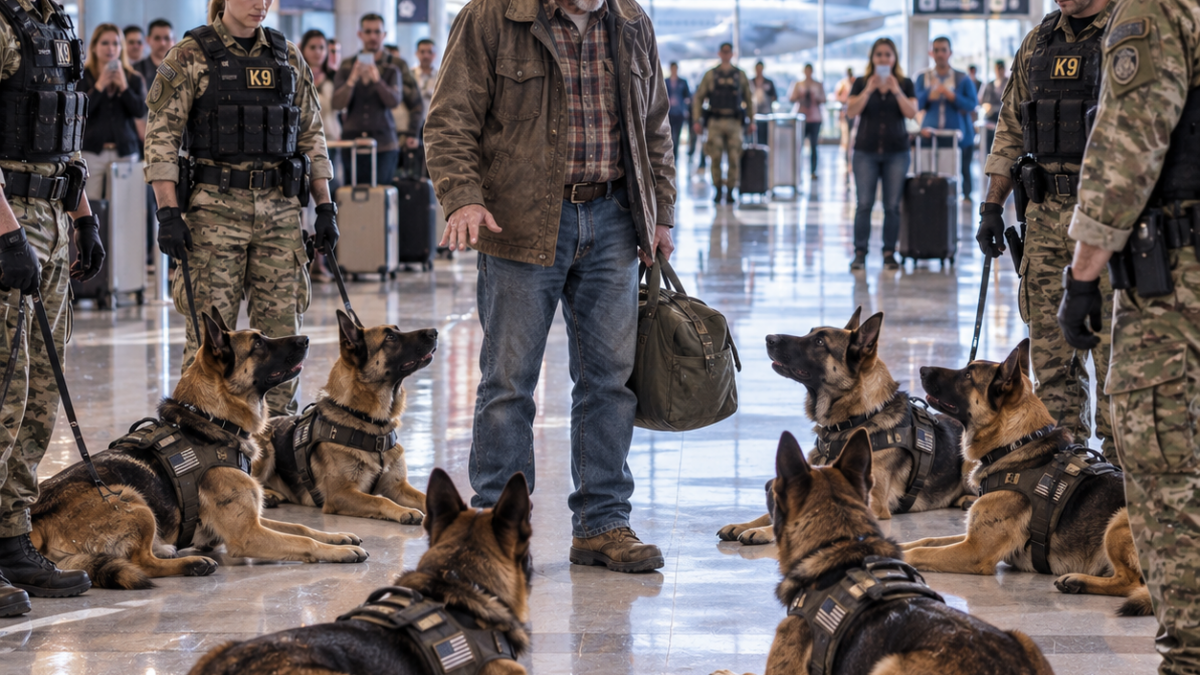
PART3:
Like someone had opened a barn door beneath forty million tons of concrete.
He stopped twenty feet from the first crate.
Looked at the dogs.
And just stood there.
I walked toward him.
“Sir.”
He looked at me.
Pale blue eyes.
Calm.
Not confused.
That should have been my first clue.
“Sir, you’ve taken a wrong turn. This is a restricted military transit corridor.”
He shifted the duffel slightly.
“Thought I might have.”
His voice was low.
Rough.
Not apologetic.
“Where are you trying to go?”
“Gate B4.”
I almost laughed.
“That’s upstairs and two terminals over.”
“So I’ve gathered.”
“There are signs at the escalator.”
“Missed one.”
“Clearly.”
That was unnecessary.
I know that now.
He glanced toward the crates again.
I stepped slightly into his line of sight.
“This corridor is closed to civilian traffic.”
“I understand.”
“Then I’ll need you to head back.”
He nodded.
But he didn’t move.
I felt irritation.
“Sir?”
His eyes were on Ares.
The dog was standing inside his crate.
Not pacing.
Just standing.
Watching him.
The old man said, almost to himself, “That’s a good-looking dog.”
I folded my arms.
“They’re working animals.”
“I can see that.”
“Then you understand why you can’t be here.”
He gave me another slow nod.
Still didn’t move.
Behind me, I heard a sound.
Ares whining.
Very low.
Garcia immediately crouched beside the crate.
“Easy.”
The old man’s eyes shifted.
Not toward Garcia.
Toward Ares’s front feet.
Then his breathing.
Then his ears.
It happened quickly.
But he wasn’t looking at the dog the way civilians looked at military K9s.
No admiration.
No fear.
No excitement.
He was reading him.
I didn’t understand that yet.
“Ares.”
Garcia tapped the crate lightly.
“Settle.”
Ares ignored him.
His nose worked against the ventilation opening.
He stared at the old man.
Then Ripley stood.
Her nails clicked against the transport crate.
One step.
Turn.
Step.
Turn.
Sergeant Cole looked at her.
“What is it?”
Vega’s ears came forward.
Dutch lifted his head.
Atlas began whining.
Within ten seconds, every dog was awake.
Focused.
On the farmer.
I tightened my jaw.
“Sir, I need you to leave now.”
The old man looked at me.
“They’re not upset.”
That irritated me more.
“I think our handlers understand their animals.”
“Yes.”
“Then leave.”
“They’re confused.”
I stared at him.
“Excuse me?”
“Confused.”
“How exactly would you know that?”
He looked past me again.
“Aggression carries forward.”
He pointed slightly toward Ares without lifting his arm fully.
“That’s conflict.”
“You need to go.”
Master Sergeant Mills was standing near a concrete pillar twenty feet away.
Silent.
Watching.
At the time, her silence bothered me.
I wanted support.
Later, I understood she was doing what I should have been doing.
Observing.
The old man finally looked toward the stairway.
For a second, I assumed he had decided to comply.
Then Ares slammed into the front of his crate.
The metal rattled violently.
Garcia jerked backward.
“Ares!”
The Malinois barked once.
Deep.
Sharp.
Ripley responded.
Then Atlas.
Within seconds, seven crates erupted.
Barking.
Whining.
Metal trembling.
Handlers giving commands.
“Down!”
“Quiet!”
“Settle!”
“Ripley!”
“Knox, down!”
Nothing worked.
Traveling airport employees appeared at the far end of the corridor.
A maintenance worker stopped.
Two military personnel from another unit looked around the corner.
Everything I had spent weeks organizing began collapsing in front of an audience.
I looked at the old man.
He was still calm.
Too calm.
That made me angry.
“You’re agitating the dogs.”
“No.”
“Yes.”
He looked toward Ares.
“I’m not causing what they’re feeling.”
“You appeared and this started.”
“That isn’t the same thing.”
I stepped closer.
“Sir, I’m giving you a lawful instruction to leave a restricted area.”
He nodded.
“Heard you the first time.”
“Then comply.”
He studied my face.
Not disrespectfully.
Worse.
Patiently.
Like a teacher waiting for a child to finish explaining something incorrectly.
My face burned.
“Move now or I’ll have airport security remove you.”
Mills finally spoke.
“Lieutenant.”
I turned.
“Yes, Master Sergeant?”
She was looking at the man’s hands.
Not me.
“Give it a second.”
“A second for what?”
“I don’t know yet.”
That answer infuriated me.
We were supposed to know.
We were supposed to control the environment.
Unknown civilian.
Agitated K9s.
Restricted corridor.
The answer seemed obvious.
Remove the variable.
I stepped toward the old man.
“Sir, I’m done asking.”
I reached for his upper arm.
I never touched him.
His left hand came up.
Palm outward.
Not aggressively.
Not toward me.
Just raised.
Wait.
That’s what the gesture said.
Not stop.
Not back off.
Wait.
Something in his posture changed.
I remember that more clearly than anything.
His shoulders straightened.
His chin lowered perhaps half an inch.
Feet repositioned.
Not dramatically.
The farmer seemed to disappear without actually going anywhere.
The man standing there suddenly looked military.
Not ceremonial military.
No chest puffed out.
No parade-ground stiffness.
Something deeper.
He became still.
Perfectly still.
Every dog noticed.
Ares stopped barking.
So did Ripley.
Atlas gave one final whine.
The corridor fell unevenly quiet.
The old man stepped forward once.
Seven sets of eyes locked onto him.
Mine too.
He looked from dog to dog.
Slowly.
Ares.
Ripley.
Vega.
Dutch.
Atlas.
Ranger.
Knox.
No hurry.
No uncertainty.
He seemed to acknowledge each animal individually.
Then he looked at Ares.
The Malinois pressed against the crate door.
Every muscle tense.
The farmer’s lips moved.
One word.
Quiet.
Soft enough that I almost missed it.
“Asa.”
All seven dogs dropped.
Not one after another.
Together.
Ares went first by perhaps a fraction of a second.
His chest hit the bottom of the crate.
Front paws forward.
Head lowered.
Ripley folded down.
Then Vega.
Dutch.
Atlas.
Ranger.
Knox.
Seven dogs.
Seven crates.
Perfect down positions.
No commands from their handlers.
No leash pressure.
No reward.
No repetition.
Silence swallowed the hallway.
I could hear the ventilation system.
Somewhere far above us, an aircraft engine spooled.
Garcia looked at me.
Then at Ares.
“What the hell?”
The old man relaxed.
Just like that.
The thing I had seen vanished.
His shoulders softened.
Farmer again.
He picked up his duffel handle.
I stared at him.
“What did you do?”
He didn’t answer.
“What was that?”
Master Sergeant Mills walked toward us.
Her face had lost color.
“Lieutenant.”
I barely heard her.
“Who are you?”
The farmer looked at Ares.
The dog was completely calm.
Not submissive.
Calm.
That distinction mattered.
Mills stopped ten feet away.
“Asa.”
The farmer finally looked at her.
She swallowed.
“I’ve seen that in archival training notes.”
His expression changed.
Barely.
Recognition.
Mills continued.
“Phoenix program.”
The name meant nothing to me.
Garcia looked just as confused.
The farmer sighed.
“You’ve been reading old things.”
Mills’s voice softened.
“My first handler instructor kept everything.”
The old man smiled faintly.
“Smart man.”
“Were you Phoenix?”
Silence.
Then he nodded once.
My irritation disappeared.
Replaced by curiosity.
“What is Phoenix?”
Neither answered immediately.
That annoyed me for an entirely new reason.
Mills looked at me.
“Experimental working-dog program. Late Cold War through early nineties.”
“How experimental?”
“Behavioral conditioning. Handler-dog communication. Stress state transitions.”
“Why isn’t it in current curriculum?”
“Parts of it are.”
She looked at the farmer.
“Just under different names.”
I turned toward him.
“What’s Asa?”
He set the duffel down again.
I think he realized we weren’t letting him leave without some explanation.
“Asa wasn’t really a command.”
“Seven dogs just obeyed it.”
“No.”
I frowned.
“They dropped.”
“Yes.”
“That sounds like obedience.”
He looked toward Ares.
“Did he look afraid?”
I looked.
No.
The Malinois lay comfortably.
Eyes soft.
Tail moved once.
“No.”
“Did he look suppressed?”
“No.”
“He was relieved.”
Garcia whispered, “He was.”
The old man nodded.
“Asa was an all-clear state.”
Mills folded her arms.
“A foundational release.”
“Yes.”
I asked, “Release from what?”
“Expectation.”
That answer confused me.
He noticed.
“A working dog spends its life reading states. Search. Alert. Track. Engage. Guard. Settle.”
He tapped his own chest.
“Humans think words control those states.”
“Don’t they?”
“Sometimes.”
He looked toward Garcia.
“Most times your body says it first.”
Garcia listened like he was being handed scripture.
The farmer continued.
“Phoenix worked on transferring states before formal commands. Scent. posture. breath. leash pressure. handler rhythm. Environmental patterning.”
Mills said, “Deep conditioning.”
“Too deep sometimes.”
There was something dark in that answer.
I heard it.
“So these dogs know that word?”
“No.”
“But they responded.”
“They don’t know me either.”
“Then explain it.”
The old man glanced toward the dogs.
“That’s harder.”
He moved closer to Ares’s crate.
Garcia watched carefully.
Ares lifted his head.
No barking.
The farmer crouched.
“May I?”
Garcia looked at me.
I wanted to say no.
I don’t know why.
Habit.
Control.
Mills nodded instead.
Garcia opened the upper access panel.
The farmer did not stick his hand inside.
He let Ares smell him.
The dog inhaled deeply.
Then pressed his muzzle against the opening.
The old man’s eyes softened.
“Phoenix dogs were trained around foundational lines.”
“Bloodlines?” Garcia asked.
“Partly.”
I frowned.
“You’re saying these seven animals genetically recognized a command?”
He shook his head immediately.
“No.”
I appreciated that.
“Anyone who tells you memory passes through blood like a recording doesn’t understand genetics.”
“Then what?”
“Patterns survive.”
He pointed lightly at Ares.
“Selection shapes behavior.”
Ripley.
“Breeding preserves tendencies.”
Then himself.
“And people preserve habits.”
Mills understood before I did.
“The handlers.”
The old man nodded.
“You all train from systems descended partly from Phoenix methods.”
I looked at him.
“So our body language resembles yours.”
“Somewhat.”
“But why did they react before you spoke?”
He looked toward his muddy boots.
“My farm.”
“Your farm?”
“Retired dogs.”
Garcia’s eyebrows lifted.
“How many?”
“Currently?”
“Yes.”
“Fourteen.”
All of us stared.
He shrugged.
“Mostly difficult ones.”
“What kind of difficult?”
“The kind people call broken when they’re tired of asking questions.”
That sentence shut me up.
He continued.
“I probably smell like kennels, working dogs, training equipment, livestock, old bite sleeves, God knows what else.”
Mills smiled.
“So they recognized familiar working-dog context.”
“Maybe.”
“And your posture?”
“Maybe.”
“And Asa?”
“That gave the conflict somewhere to go.”
I asked, “What conflict?”
He looked straight at me.
“They were seeing something familiar while their handlers were telling them everything was normal.”
I felt something uncomfortable move through my chest.
“They knew me as context, not person.”
He looked toward Garcia.
“Ares smelled something old. Something associated with foundational training environments. But nobody acknowledged it. He didn’t know whether to engage, wait, report, or ignore.”
Garcia looked at Ares.
“That’s why he was whining?”
“Likely.”
“What about the others?”
“Dogs read dogs.”
Mills nodded.
“Ares escalated, group followed.”
“Exactly.”
I looked around.
Seven dogs peacefully lying.
Seven handlers looking like their worldview had been opened with a crowbar.
I had another question.
“Who are you?”
He picked up his duffel again.
“Eli Sandoval.”
“That isn’t what I meant.”
“I know.”
“What were you in Phoenix?”
He glanced at Mills.
She looked almost amused.
“Lieutenant, I think you’re asking for a résumé from a man trying to catch a flight.”
“I think he just controlled seven military working dogs with one word.”
Eli smiled.
“Controlled is doing a lot of work in that sentence.”
Mills asked, “Handler?”
“Started there.”
“Instructor?”
“For a while.”
“Program development?”
Eli looked at her.
She went still.
“Oh.”
I turned.
“What?”
Mills’s expression became almost reverent.
“Sir… were you Sandoval from the early state-transition papers?”
Eli closed his eyes.
Only for a second.
There it was.
Answer enough.
Garcia whispered, “Who?”
Mills stared at Eli.
“The Sandoval papers.”
No one else understood.
She looked at us.
“You’ve all studied them.”
“I haven’t,” I said.
“Not under his name.”
She looked at Ares.
“The de-escalation ladder.”
Garcia’s mouth opened.
“That’s his?”
Mills continued.
“Threshold reset.”
Sergeant Cole said, “We still use that.”
“Yes.”
“Handler-state transfer?”
“Yes.”
I looked toward Eli.
“You wrote those?”
He sighed.
“Worked on them.”
“Your name isn’t on anything.”
“Good.”
“Why good?”
“Means people remembered the work.”
I stared.
That answer made no sense to the version of me standing in that corridor.
I had spent my career building evaluations.
Qualifications.
Performance reports.
Reputation.
Names mattered.
Credit mattered.
Visibility mattered.
Eli seemed genuinely relieved his had disappeared.
“You don’t care that nobody knows?”
He checked his watch.
“I care that my granddaughter thinks I’m going to miss her honor-roll dinner.”
Garcia laughed.
Eli pointed at him.
“Smart man.”
Then he started walking away.
I stepped after him.
“Wait.”
He stopped.
“I owe you an apology.”
That surprised even me.
The corridor went quiet again.
I felt everyone’s attention.
My instinct was to soften it.
Explain myself.
Tell him the area really was restricted.
Tell him my responsibility required caution.
Tell him he had been an unknown civilian near military assets.
All true.
None enough.
“I talked down to you.”
He watched.
“I assumed you were lost.”
“You weren’t entirely wrong.”
“I threatened to arrest you.”
“That was entertaining.”
Garcia looked down to hide a smile.
“I misread you.”
Eli nodded.
“Yes.”
No rescue.
No false reassurance.
Just yes.
Heat moved into my face.
Then he said, “That’s allowed.”
I looked at him.
“Mistakes are allowed, Lieutenant.”
He lifted one finger.
“Repeating them after you recognize them is where character starts showing.”
I swallowed.
“Yes, sir.”
“Don’t sir me.”
“Yes, sir.”
He almost smiled.
Then he looked at Garcia.
“You.”
Garcia straightened.
“Senior Airman Mateo Garcia, sir.”
“Stop saying sir.”
“Yes—”
Garcia caught himself.
Eli pointed toward Ares.
“You did well.”
Garcia looked genuinely shocked.
“I lost control of him.”
“No.”
“He ignored me.”
“Yes.”
“That’s losing control.”
“No.”
Eli stepped closer.
“When the dog became confused, what did you do?”
“Talked him down.”
“Did you correct him?”
“No.”
“Shock him?”
“No.”
“Punish the crate?”
“No.”
“Why?”
Garcia looked at Ares.
“Because I didn’t know what was wrong.”
Eli smiled.
“That’s handling.”
Garcia’s eyes changed.
Eli continued.
“A bad handler sees disobedience and asks how hard to correct it.”
He touched the crate lightly.
“A good one asks what changed.”
Ares’s nose moved toward his fingers.
Eli withdrew before contact.
“Keep asking.”
Garcia looked close to tears.
I didn’t understand why until years later.
Good handlers rarely receive praise for what they choose not to do.
Eli turned to me.
“Listen to him.”
“Ares?”
“Garcia.”
That surprised me.
“He knows the dog better than you do.”
I almost said, I know.
But I didn’t.
Because clearly I hadn’t been acting like it.
Eli looked at Mills next.
“Good instincts.”
“Thank you.”
“You waited.”
“I wasn’t sure.”
“Same thing sometimes.”
Then he lifted his duffel.
“My flight.”
I asked, “Can someone escort you?”
“No.”
“We can arrange a cart.”
“I’ve got legs.”
“At least let airport security—”
“I managed to get down here. I imagine I can escape.”
“You really are going to Montana?”
“Bozeman.”
“For your granddaughter?”
“Honor roll.”
A smile transformed his face.
Not trainer.
Not mysterious veteran.
Grandfather.
“She thinks algebra is difficult.”
“Is it?”
“At thirteen? Everything is difficult.”
He began walking toward the escalator.
Mills said, “Mr. Sandoval.”
He looked back.
She hesitated.
Then saluted.
Not theatrically.
Clean.
Formal.
Eli stared at her.
For a second, I thought he might refuse.
Instead, he set down his duffel.
Straightened.
Returned it.
His salute was older.
Sharper.
Beautiful.
Then gone.
He picked up the bag.
Looked toward us.
“Take care of your dogs.”
His eyes landed on me.
“And Lieutenant?”
“Yes?”
“Rank makes people listen.”
He pointed toward the crates.
“Trust makes them tell you things.”
Then Eli Sandoval walked away.
I watched until he disappeared up the escalator.
For perhaps thirty seconds, nobody spoke.
Then Garcia asked:
“Who the hell was that?”
Mills exhaled.
“I don’t know all of it.”
I looked at her.
“Find out.”
She smiled.
“That an order?”
“Yes.”
“Thought you’d learned something.”
That irritated me.
Then I laughed.
My real education began that afternoon.
Our flight delay stretched to two hours.
The dogs remained calm.
Ares slept.
I sat beside his crate.
Garcia checked water.
“Can I ask you something?”
He looked at me cautiously.
“Of course, sir.”
“When he started acting up, what did you think?”
“Ares?”
“Yes.”
“I thought something was wrong.”
“With him?”
“No.”
“With what?”
“The environment.”
I nodded.
“Why?”
Garcia thought.
“Because he’s reliable.”
I waited.
“And if reliable behavior changes suddenly,” he continued, “something changed first.”
There it was.
So simple.
So much wiser than my approach.
I had seen the same behavior and thought:
Enforce.
Garcia thought:
Investigate.
I asked, “Did I make it worse?”
His face tightened.
Junior enlisted people do not enjoy questions that could become career traps.
“Honestly.”
He looked at Ares.
“Yes, sir.”
“How?”
“When you started confronting Mr. Sandoval.”
“Why?”
“Ares watched your tension.”
Of course he had.
“Then I was part of the context.”
“Yes, sir.”
I looked at the sleeping dog.
That hurt.
Good.
Some lessons should.
Three days later, Mills walked into my office carrying an old binder.
Not a file.
A binder.
Thick.
Photocopied pages.
Handwritten notes.
Declassified material.
She set it on my desk.
“You wanted Sandoval.”
I opened it.
The first photograph stopped me.
Eli.
Thirty years younger.
Dark hair.
Mustache.
Lean.
Military fatigues.
Kneeling beside two German Shepherds.
The eyes were identical.
“What was his rank?”
Mills sat.
“Master Sergeant when he retired.”
“Air Force?”
“Started Army. Joint assignments later.”
“And Phoenix?”
She leaned back.
“Complicated.”
The Phoenix Working Dog Initiative had begun as a small cross-service research effort during the final years of the Cold War.
The goal was not breeding superdogs.
Despite some later myths.
It focused on something less dramatic and more difficult.
Trust under cognitive overload.
Military K9s were trained extensively for tasks.
But high-level handlers had observed that certain dogs failed not because they lacked obedience.
They failed because contradictory signals created stress.
Handler fear combined with command.
Unfamiliar environments.
Transfer between handlers.
Operational arousal without release.
Loss of partner.
Repeated state switching.
Phoenix researchers wanted deeper methods to help dogs transition safely between high-alert and recovery states.
Eli Sandoval had been brought into the program after years of field handling.
He wasn’t a scientist.
Not formally.
He was what one report called:
Operational behavioral specialist.
Translation:
He understood dogs better than the people with advanced degrees studying them.
The “Asa” word appeared in a 1991 training appendix.
Not magic.
Not genetically encoded.
It had been selected because it was acoustically distinct from common English, German, and Dutch commands.
A neutral sound.
Used only in specific foundational calming routines.
Dogs were taught it alongside a complete environmental reset.
No threat.
No search.
No task.
Safe.
Finished.
Release mental pressure.
Purpose complete.
Mills pointed.
“Eli was right.”
“What?”
“The modern system still contains parts of this.”
“But not the word.”
“No.”
“Then how did seven dogs respond?”
“Probably multiple factors.”
She listed them.
Ares noticed unfamiliar but deeply familiar working-dog scent.
Eli’s posture resembled handler patterns associated with control.
Ares became uncertain.
Other dogs mirrored him.
Handlers became tense.
I became more tense.
Eli adopted an old state-transition posture.
Then used a vocal cue structurally similar to the early protocol.
The dogs followed Ares’s release.
“So it wasn’t supernatural.”
Mills smiled.
“Were you hoping?”
“No.”
“Yes, you were.”
“Maybe a little.”
She closed the binder.
“But that’s not the interesting part.”
“What is?”
“Sandoval disappeared from the records.”
I frowned.
“How?”
“Didn’t literally disappear.”
“What then?”
“Phoenix ended.”
“Budget?”
“Partly.”
“Why else?”
Mills looked serious.
“There was an incident.”
Of course there was.
Programs do not become legends without incidents.
A training team overseas lost a handler.
His dog survived.
Transferred to another handler.
The animal became unstable.
Not aggressive generally.
Specific.
It refused high-risk entry under the new handler.
Supervisors initially labeled the dog unsuitable.
Eli disagreed.
He argued the animal was grieving and still operating under the expectation that its original handler would return.
That language sounded sentimental to senior leadership.
Eli insisted it was operational reality.
He designed a multiweek transition protocol.
No forced bonding.
No dominance corrections.
Controlled scent introduction.
Task-sharing.
Neutral walks.
Rest.
The dog recovered.
Later performed successfully.
The protocol was absorbed into training.
But controversy followed.
Some leaders believed Eli’s methods were too slow.
Too emotionally framed.
Too dependent on individual judgment.
One report accused Phoenix personnel of “anthropomorphic interpretation interfering with command reliability.”
I read that sentence twice.
“They criticized him for treating dogs like they had emotional states.”
“Basically.”
“But now that’s normal.”
“Exactly.”
“What happened?”
“Phoenix was reorganized. Research distributed. Sandoval retired.”
“Voluntarily?”
Mills hesitated.
“Sort of.”
I looked at her.
“What does that mean?”
“He refused a promotion.”
“Why?”
“He didn’t want the desk.”
“That doesn’t explain disappearing.”
She slid another page toward me.
A memo.
Recommend removal of individual attribution from doctrine intended for broad cross-service use.
I read it.
“What does that mean?”
“Once methods became official, authorship became institutional.”
“So his name came off.”
“And everybody else’s.”
“But why does your archive call them Sandoval papers?”
“Handlers remembered.”
That stayed with me.
Official history forgot.
Working memory didn’t.
I found myself irrationally angry.
“He deserved credit.”
Mills looked at me.
“You think he’d want it?”
“No.”
“Then who are you angry for?”
I didn’t have a good answer.
Maybe myself.
Because I had nearly arrested a man whose work lived inside our own training system.
Because I had looked at boots before hands.
Age before posture.
Civilian clothes before competence.
Because if the dogs had not reacted, Eli Sandoval would have walked away and I would have remained exactly as arrogant as I had been that morning.
I hated how accidental my lesson felt.
So I went looking for him.
Not physically at first.
I searched records.
Public databases.
Veterans archives.
Training journals.
Old handler forums.
A name appeared in strange places.
One retired handler wrote:
Sandoval taught me the leash wasn’t a steering wheel.
Another:
If your dog is wrong three times in a row, Sandoval said check yourself before correcting him.
A veterinary behavior paper thanked “M.S. E. Sandoval” for field observations.
A 1994 manual included a line:
Behavioral hesitation should be evaluated for environmental cause prior to corrective response.
No author.
I knew now.
Six weeks later, I found his farm.
Not through military records.
Through a retired handler named Thomas Breen.
When I called Breen, he laughed.
“You’re Croft?”
“Yes.”
“The airport lieutenant.”
My stomach dropped.
“He told you?”
“Everybody knows.”
“How?”
“Handlers gossip worse than hairdressers.”
“Mr. Breen—”
“Tom.”
“Tom, I want to speak with Master Sergeant Sandoval.”
“Why?”
“To apologize properly.”
“You already apologized.”
“How do you know?”
“Eli told me.”
“Then I want to learn.”
Silence.
That answer apparently mattered.
Tom gave me an address in western Colorado.
“Don’t show up in uniform.”
“Why?”
“He’ll assume you want something.”
“I do want something.”
“Exactly.”
So on a Saturday morning, I drove four hours in jeans and a sweatshirt.
No staff car.
No rank.
No clipboard.
Just me.
Sandoval Farm sat beyond a narrow county road surrounded by yellow grass, fencing, cottonwoods, and mountains rising blue-gray in the distance.
A faded sign hung beside the gate.
SANDOVAL STOCK & KENNEL
Below it:
CLOSE THE GATE. DOGS CAN’T READ YOUR EXCUSES.
I smiled.
A German Shepherd appeared before I reached the porch.
Old.
Black-and-tan.
Gray muzzle.
He stopped twenty feet away.
Watched.
I froze.
A voice came from the barn.
“He’s not going to eat you.”
Eli walked out.
Same flannel.
Different day.
He squinted at me.
“Airport.”
“Lieutenant Croft.”
“Same thing.”
The shepherd approached.
Sniffed me.
Then walked away.
“Friendly.”
“No.”
I looked toward the dog.
“He ignored me.”
“Exactly.”
Eli pointed toward the porch.
“Coffee?”
I had expected resistance.
Maybe suspicion.
Instead, five minutes later, I sat across from him drinking coffee strong enough to dissolve paint.
Dogs were everywhere.
Not chaotic.
Scattered.
A Lab sleeping beneath the steps.
Two retired Malinois in a fenced paddock.
A three-legged shepherd near the barn.
An enormous mixed-breed dog with one damaged ear watching cattle.
“How many?”
“Fourteen today.”
“Today?”
“Sometimes people bring me problems.”
“And you keep them?”
“Sometimes.”
“What makes them problems?”
“Usually humans.”
He said it casually.
I laughed.
He didn’t.
Then I realized he wasn’t joking.
“Why did you leave Phoenix?”
Eli looked at me.
“Straight to business.”
“Sorry.”
“No, you’re not.”
“No.”
He smiled.
“Program changed.”
“Because of you?”
“No.”
“Did leadership disagree with your methods?”
“Sometimes.”
“Did they remove your name?”
He stared into his coffee.
“Ah.”
“What?”
“You’ve been digging.”
“Yes.”
“Bad habit.”
“I’m military police.”
“Same thing.”
I waited.
Eventually he said:
“My name wasn’t important.”
“It was your work.”
“No.”
He pointed toward the yard.
“See that shepherd?”
The three-legged dog.
“Yes.”
“Name’s Riley.”
Riley lifted his head.
“He came here after biting a deputy.”
“Dangerous?”
“Yes.”
I frowned.
“You admit that?”
“Dangerous doesn’t mean evil.”
“What happened?”
“Hip pain. Deputy pulled him out of a vehicle by the collar. Dog bit.”
“Then?”
“County labeled him handler-aggressive.”
“And you took him.”
“Yep.”
“Why?”
“He was telling the truth.”
I stared.
“With his teeth?”
“Dogs have limited vocabulary.”
Eli drank his coffee.
“The bite mattered. So did the reason.”
There it was again.
Context.
“What did you do?”
“Vet fixed what could be fixed. We stopped grabbing his neck. Taught him better options.”
“And now?”
Eli whistled.
Riley rose.
Walked over.
Sat beside him.
Eli rested a hand on his head.
“Now he’s retired.”
I watched the dog.
“You really believe every behavior has a reason.”
“Everything living does.”
“What about bad behavior?”
“Still has a reason.”
“That doesn’t excuse it.”
“No.”
He smiled slightly.
“You’re learning.”
I told him about the archive.
The Sandoval papers.
The Phoenix material.
The memo removing attribution.
“You don’t care?”
He sighed.
“You young officers love credit.”
“I love fairness.”
“Sometimes same costume.”
“That isn’t an answer.”
“No.”
He looked toward the fields.
For a long time, he said nothing.
Then:
“My first dog was Mateo.”
I remembered Garcia.
“Your handler?”
“My dog.”
German Shepherd.
Military.
Early career.
Vietnam-era line though later service.
Mateo was brilliant.
Hard.
Sensitive.
Eli told me he almost ruined him.
“How?”
“Corrected everything.”
He looked embarrassed even decades later.
“I thought authority meant never letting uncertainty show.”
That sentence felt aimed directly at me.
“What changed?”
“He stopped trusting me.”
“How could you tell?”
“Stopped asking questions.”
I frowned.
“Dogs ask questions?”
“All day.”
He pointed toward Riley.
“Can I go there?”
The Lab.
“Is this safe?”
The Malinois by the fence.
“Do you want this?”
He looked at me.
“Good dogs check in constantly.”
“And Mateo stopped?”
“Yes.”
“He obeyed.”
“Perfectly.”
I didn’t understand.
Eli’s voice softened.
“That was worse.”
“How?”
“He obeyed like I wasn’t there.”
I felt something move through me.
“He had learned commands.”
Eli tapped his chest.
“He hadn’t learned me.”
“So Phoenix came from that?”
“Partly.”
“What happened to Mateo?”
Eli looked away.
“Died in service.”
“I’m sorry.”
“So am I.”
“You blame yourself?”
“For some things.”
He did not elaborate.
I didn’t push.
For once.
We spent the afternoon with dogs.
No formal lesson.
Which meant I learned more than I ever had in classrooms.
Eli showed me how Riley stiffened before feeling cornered.
How one Malinois licked his lips whenever another dog moved toward his food.
How the old Lab leaned slightly right because arthritis bothered his left shoulder.
“You see all that automatically?”
“No.”
He looked at me.
“I pay attention.”
Before I left, he asked about Ares.
“Good.”
“Garcia?”
“Good.”
“You?”
I laughed.
“Improving.”
“Slowly?”
“Apparently.”
“Best kind.”
At my car, I said:
“Can I come back?”
Eli shrugged.
“Gate works both directions.”
So I did.
Not every week.
Every month or two.
Sometimes Garcia came.
Eventually Mills.
Eli hated formal training requests but somehow taught constantly.
He never gave us command lists.
He asked questions.
“What changed?”
“What happened before?”
“What is the dog avoiding?”
“What are you adding to the picture?”
“What does your body say while your mouth says calm?”
He made us film ourselves.
That was humiliating.
I discovered I leaned forward when frustrated.
Dogs read that as pressure.
I shortened leashes before giving difficult commands.
Dogs anticipated conflict.
I raised my chin when trying to project authority.
Eli called it “peacocking.”
I hated that word.
He used it frequently.
My leadership changed too.
That part surprised me most.
One afternoon, an airman missed a transport deadline.
Old Croft would have started with:
Why didn’t you follow instructions?
Instead, I asked:
What changed?
His mother had called from an emergency room.
He was distracted.
Still responsible.
But context changed the response.
Another handler’s performance declined.
Instead of assuming laziness, we discovered he hadn’t slept more than four hours nightly because his newborn daughter had reflux.
Still had to meet standards.
But we adjusted temporarily.
Eli had been talking about dogs.
Somehow, I learned people.
Two years after the airport incident, Ares was injured during training.
Nothing dramatic.
Torn ligament.
Surgery.
Rehabilitation.
Garcia called me from the veterinary hospital.
“He won’t settle.”
I drove over.
Ares paced inside the recovery run.
Anesthesia fading.
Confused.
Garcia sat nearby.
“He keeps trying to get up.”
The veterinarian worried he’d damage the repair.
I watched.
Then thought of Eli.
“What changed?”
Everything.
Hospital.
Pain.
Medication.
Confinement.
Separation from routine.
Garcia whispered:
“Asa?”
I hesitated.
It wasn’t his trained cue.
But maybe the sound now carried association from the airport.
Garcia sat near the crate.
Not commanding.
Just there.
His shoulders relaxed.
Breathing slowed.
“Ares.”
The dog looked.
Garcia whispered:
“Asa.”
Ares did not drop.
This wasn’t magic.
Good.
Instead, he stood another thirty seconds.
Then lowered himself.
Slowly.
Head onto paws.
Garcia exhaled.
The veterinarian stared.
I smiled.
Context.
Years passed.
My promotions came.
First captain.
Then major.
Ares retired with Garcia.
Master Sergeant Mills retired too.
She opened a small training consultancy and became even more terrifying as a civilian because rank could no longer stop her from saying exactly what she thought.
Eli got older.
The farm remained.
Dogs came and went.
His granddaughter graduated high school.
Then college.
The honor-roll girl became a veterinarian.
Of course she did.
Her name was Sofia.
The first time I met her, she said:
“You’re airport guy.”
I groaned.
“Does everyone call me that?”
“In this family.”
“What does your grandfather call me?”
She smiled.
“Peacock.”
I considered leaving.
Eli laughed for a full minute.
By then, his hands shook more.
Walking became harder.
But place him near a dog and time seemed to reverse.
Not physically.
His attention sharpened.
He became exact.
At eighty-one, he finally agreed to speak to a new generation of military handlers.
Not at a ceremony.
He refused those.
At the farm.
Twenty handlers came.
No cameras.
No press.
He stood beside a fence.
“What do you want me to teach?”
Someone said:
“Asa.”
Eli rolled his eyes.
“Of course.”
He looked at me.
“This your fault?”
“Yes.”
He explained again.
Not magical word.
Not alpha mythology.
Not ancestral memory.
A tool from an old program built around state recognition.
“Don’t turn techniques into religion,” he warned.
“Anything works until context changes.”
One young handler asked:
“What is the most important command?”
Eli answered immediately.
“None.”
The group laughed nervously.
He didn’t.
“The most important skill isn’t commanding.”
He looked around.
“It’s noticing.”
He pointed toward a Malinois lying near its handler.
“That dog has been telling you for ten minutes his right paw hurts.”
The handler’s face changed.
“What?”
They checked.
Small thorn lodged between pads.
Eli said:
“You can have every command in the manual and still be useless if you’re the last one to know your partner is hurting.”
Nobody laughed after that.
At lunch, I sat beside him.
“You enjoy making people uncomfortable.”
“Efficient teaching tool.”
“You should’ve been an officer.”
He looked horrified.
“Take that back.”
I laughed.
Then he became serious.
“Caden.”
He almost never used my first name.
“What?”
“When I’m gone, don’t make Phoenix into something it wasn’t.”
I frowned.
“What do you mean?”
“Stories grow.”
I knew exactly what he meant.
The airport story had changed.
Depending on who told it, Eli became everything from a secret K9 commander to a CIA dog trainer who could control animals telepathically.
Ridiculous.
“You want the truth told.”
“Messy truth.”
“Which is?”
“We tried things.”
He shrugged.
“Some worked.”
“Some didn’t.”
“Some were stupid.”
“Which?”
“Not telling you. Preserve my reputation.”
I laughed.
He continued.
“Don’t make dogs mystical because people are too lazy to understand them.”
I nodded.
“And don’t make me special.”
“That part may be difficult.”
“Try harder.”
“What do you want people to remember?”
He looked toward the field.
“Listen before you correct.”
That was all.
Eli Sandoval died three years later.
Eighty-four.
Stroke in his sleep.
Sofia called me before sunrise.
I sat on the edge of my bed after hanging up.
For a long time, I didn’t move.
Then I thought of an airport corridor.
A hand raised.
One word.
Seven dogs dropping.
I thought that was the moment Eli changed my life.
It wasn’t.
That was merely the moment he got my attention.
The changing happened afterward.
Slowly.
Every time I caught myself confusing rank with wisdom.
Every time I asked what changed before deciding someone failed.
Every time a dog hesitated and I waited one extra second.
Every time a young handler told me something inconvenient and I listened instead of reminding him who was in charge.
That was Eli.
His funeral was small.
Farm.
Family.
Handlers.
Veterans.
Dogs.
Lots of dogs.
Sofia insisted.
His ashes were scattered partly on the farm.
Partly near Mateo’s old memorial marker at a military working dog cemetery.
At the service, Master Sergeant Mills stood beside me.
Retired now.
Hair mostly gray.
She looked toward the crowd.
“You remember Croft that morning?”
“Unfortunately.”
“I do.”
“How bad?”
“You almost arrested history.”
“Thank you.”
“I’ve been waiting years to say that.”
Garcia stood nearby with Ares.
The Malinois was old.
Gray muzzle.
Arthritic hips.
But still Ares.
When Sofia brought Eli’s canvas jacket outside, Ares lifted his head.
Smelled it.
Walked forward.
Pressed his nose into the fabric.
Then lay down.
Garcia’s face broke.
He whispered:
“Asa.”
Ares closed his eyes.
No drama.
No seven dogs.
No miracle.
Just an old working dog resting beside the scent of a man who once gave him clarity in a moment of confusion.
That was enough.
After the funeral, Sofia gave me Eli’s battered watch.
I refused.
She insisted.
“He wrote your name.”
“Why?”
“He said officers need clocks because they’re always making everyone hurry.”
“That sounds like him.”
On the back, scratched so lightly I almost missed it, were four words.
WHAT CHANGED BEFORE THIS?
I still wear it.
Years later, when I became responsible for training younger officers, I stopped starting leadership courses with regulations.
I started with the airport.
Not the viral version.
The embarrassing version.
Mine.
I told them:
I saw an old man.
I saw his clothes.
His age.
His location.
I categorized him.
Civilian.
Lost.
Unauthorized.
Problem.
All those observations contained truth.
None contained enough truth.
The farmer really was in the wrong corridor.
He really did lack authorization.
I really did have responsibility for safety.
My mistake wasn’t enforcing the restriction.
My mistake was believing the first correct fact gave me complete understanding.
That is how authority becomes dangerous.
Not always through cruelty.
Sometimes through premature certainty.
Then I told them about the dogs.
Ares did not know Eli Sandoval was a legendary handler.
He did not know Phoenix.
He did not know history.
He detected information.
Scent.
Posture.
Context.
Handler tension.
Other dogs.
Something didn’t fit.
So he communicated.
Garcia listened.
I didn’t.
That was the difference.
Students always asked about Asa.
“Does it still work?”
Wrong question.
I told them the same thing Eli told me.
It’s not magic.
It is not a secret control word.
Do not walk into a kennel whispering it at unfamiliar dogs unless you enjoy looking ridiculous.
The word mattered because of the state built around it.
The relationship.
The context.
The body.
The history.
Humans love shortcuts.
Magic words.
Ranks.
Titles.
Simple heroes.
Eli hated all of those.
He believed competence was quiet.
Trust was cumulative.
And behavior made sense if you were humble enough to admit you might not understand it yet.
That morning in the airport, I thought Eli Sandoval had disrupted my operation.
The truth?
I was the disruption.
My tension.
My certainty.
My need to regain control.
Eli didn’t overpower seven military K9s.
He noticed what they needed.
Then gave them permission to stop searching for an answer.
That is very different.
And much harder.
I sometimes return to that airport.
Not intentionally.
Military travel takes you everywhere eventually.
The corridor looks the same.
Concrete.
Fluorescent lighting.
Service doors.
Nothing marks the place.
No plaque.
No photograph.
Good.
Eli would have hated one.
One afternoon, I passed through with a young lieutenant who had heard the story.
He stopped.
“Was it here?”
“Yes.”
“Exactly?”
I pointed.
“Eli stood there.”
“And the dogs?”
“Along that wall.”
He stared at the tile as if expecting history to appear.
“Seven?”
“Seven.”
“And you threatened him with arrest?”
I sighed.
“Apparently that part is immortal.”
He smiled.
“Sorry, sir.”
“No, you’re not.”
He looked around.
Then asked the question I had asked for years.
“How did he do it?”
I checked the old scratched watch on my wrist.
Then looked at him.
“He listened before he spoke.”
The lieutenant frowned.
“That’s it?”
“No.”
I smiled.
“But start there.”
We walked toward the escalator.
Above us, thousands of travelers moved through the airport.
Farmers.
Soldiers.
Teachers.
Mechanics.
Doctors.
Grandparents.
People with titles.
People without them.
People carrying entire histories nobody around them could see.
I thought about Eli heading toward Gate B4 with his duffel bag because his granddaughter had made honor roll.
That may be my favorite part of the story.
Not Phoenix.
Not seven K9s.
Not Asa.
The fact that after turning my understanding of authority upside down, he checked his watch because he didn’t want to disappoint a thirteen-year-old girl.
Legends are easier when we imagine them existing only in legendary moments.
Eli refused that.
He was a military pioneer.
A farmer.
A stubborn old man in the wrong airport hallway.
A grandfather carrying a cheap canvas bag.
A handler who made mistakes.
A teacher who didn’t care whether anyone remembered his name.
All true.
That is why I tell the story carefully now.
Seven military dogs did not fall under the spell of a mysterious stranger.
They encountered an unfamiliar pattern wrapped in familiar signals.
They became conflicted.
Their handlers became tense.
One old man recognized what was happening because he had spent a lifetime learning that confusion looks different from defiance.
He changed his posture.
He lowered his voice.
And he said:
“Asa.”
Purpose complete.
Stand down.
You’re safe.
Seven dogs listened.
So did I.
It simply took me much longer to understand the command.
Because for dogs, standing down meant resting their bodies.
For me, it meant putting down something heavier.
Pride.
The need to always be the smartest person in the hallway.
The belief that a uniform made my interpretation more accurate than someone else’s experience.
The fear that changing my mind would weaken my authority.
Eli taught me the opposite.
A leader who cannot change his mind after receiving better information is not strong.
He’s trapped.
That morning, I walked into the airport believing leadership meant being the person with the answer.
An old farmer showed me that sometimes leadership means being the first person willing to admit you missed the question.
Seven K9s understood him before I did.
Maybe that was fitting.
They were trained to detect what humans overlook.
And on that morning, the thing they found wasn’t an explosive.
It wasn’t contraband.
It wasn’t a threat.
They found experience.
Quiet, weathered, almost forgotten experience walking through an airport in muddy boots.
I nearly had it arrested.
The dogs knew better.
And after Eli Sandoval spoke one forgotten word, they all dropped.
Years later, I realized I was the one who truly needed the command.
Asa.
The search is over.
Stop fighting the room.
Listen.
You might finally learn something.








