No One Could Get Near the “Dangerous” K9 Marked for Death at 8 A.M.—Then a Former Navy SEAL Saw One Scar in His Photo and Whispered, “Ranger.”
PART3:
Lauren hated those names.
She also understood where they came from.
Three days earlier, animal control officers had found him behind a seafood warehouse near the Elizabeth River.
He was limping.
Bleeding from one paw.
Half-starved.
Yet when Eddie Mason tried to guide him into a transport crate with a catch pole, the dog twisted so violently that he bent the aluminum shaft.
Eddie had worked animal control twenty-six years.
A pit bull had once torn through his glove.
A Rottweiler had broken two fingers.
A raccoon had bitten his cheek.
He told those stories like funny weather reports.
But after Stray 617 hit the catch pole, Eddie sat in the truck for six minutes before speaking.
Now his right shoulder was taped under his uniform.
“He isn’t bluffing,” Eddie said.
Dr. Natalie Brooks crouched beside Lauren.
Veterinary behaviorist.
Dark hair pinned up.
Glasses constantly sliding down her nose.
One of the calmest people Lauren knew.
Even Natalie had stopped making reassuring noises.
Inside the kennel, the German Shepherd stopped pacing.
His head lowered.
Nostrils moved.
The muscles along his shoulders tightened.
Natalie whispered:
“He’s tracking us.”
Lauren looked at her.
“Every dog tracks us.”
“Not like that.”
“What do you mean?”
Natalie kept her eyes on the dog.
“He isn’t reacting randomly.”
The Shepherd took one step toward the gate.
Stopped.
“He’s maintaining a perimeter.”
Lauren almost laughed.
“This is ten feet of concrete.”
“Not to him.”
Natalie stood slowly.
“To him, that’s ground.”
She pointed.
“That’s his wall.”
Then toward the feeding slot.
“That’s a breach point.”
Then toward Eddie.
“Catch pole was an intrusion.”
Lauren’s stomach tightened.
“And Paige?”
Natalie’s expression changed.
Three days earlier, twenty-four-year-old volunteer Paige Sullivan had tried to feed him chicken and rice.
Paige knew every animal.
Even when they didn’t have names.
She called terrified hounds “honey.”
She sang badly to cats during vaccinations.
She once spent half an hour sitting on the floor because a traumatized Chihuahua wouldn’t stop shaking unless the dog could see her shoes.
She had approached Kennel 17 talking softly.
“You’re okay.”
No reaction.
“Nobody wants to hurt you.”
Still nothing.
She had slid the bowl toward the feeding opening.
The German Shepherd froze.
Then launched.
Not toward the food.
Toward Paige’s wrist.
His teeth struck the steel frame less than an inch from her hand.
The impact echoed through isolation.
Rice flew across the concrete.
Paige fell backward against a stack of towels.
The dog immediately reset behind the gate.
No barking frenzy.
No continued lunging.
Just position.
Ready.
Waiting.
Paige hadn’t entered isolation alone since.
Natalie said quietly:
“He warned her.”
Lauren looked at her.
“He almost took her hand.”
“Yes.”
“That’s a strange definition of warning.”
“He could have struck the food tray earlier.”
Natalie pointed toward the gate.
“He waited until her hand crossed his threshold.”
Lauren looked again.
“You’re saying he’s trained.”
“I’m saying he understands lines.”
Eddie rubbed his taped shoulder.
“Well, his lines hurt.”
Nobody laughed.
Lauren checked the form.
EUTHANASIA SCHEDULED.
8:00 A.M.
The shelter was beyond capacity.
Two court-ordered bite holds.
Six parvo-exposed puppies.
Three injured cats.
A kennel cough outbreak beginning in adoption.
No rescue would take Stray 617.
Lauren had contacted three working-dog organizations.
The first director watched the video for seventeen seconds.
“No.”
The second said:
“My insurance carrier would cancel us before lunch.”
The third watched everything.
Then called Lauren personally.
“That dog is either too damaged for civilians or too trained for civilians.”
Lauren remembered the woman’s exact words.
“Either way, you cannot keep asking your staff to bleed for hope.”
Hope.
Lauren hated when common sense used words she loved against her.
She looked down at the euthanasia authorization.
Paige stood at the isolation doorway carrying folded laundry.
Her face was still pale.
“If we had another scanner…”
Eddie sighed.
“We scanned him twice.”
“Regular scanners.”
“They scan chips.”
“Most chips.”
Eddie looked at her.
“Paige.”
She hugged the laundry tighter.
“My dad was Navy.”
Nobody spoke.
Paige continued.
“He told me some military dogs use different tracking systems.”
Natalie looked at her.
“Some identifiers aren’t standard civilian microchips.”
Paige nodded quickly.
“Exactly.”
Lauren rubbed her forehead.
“Do military dogs end up starving behind seafood warehouses?”
Paige looked at Kennel 17.
“I don’t know.”
The dog stared back.
Lauren had spent her career asking for one more hour.
One more rescue call.
One more foster.
One more behavioral evaluation.
But every person responsible for animals eventually reaches the moment where hope has to answer to safety.
She signed.
The pen made a tiny black mark.
Stray 617 resumed his patrol.
Four steps.
Turn.
Three.
Stop.
Lauren swallowed.
“Draw the medication.”
Paige’s breath caught.
“No one opens that gate,” Lauren said. “We do this as peacefully as possible.”
Natalie didn’t argue.
That hurt most.
Three cities away, at 5:12 that morning, Ryan Callahan woke reaching for a dog who wasn’t there.
His hand struck cold floor beside the bed.
The dream remained.
White dust.
Concrete.
Yemen.
Radio chatter.
Gunfire.
Ranger’s harness beneath Ryan’s fingers.
Then the second burst.
Ryan sat upright.
His lungs couldn’t decide whether the danger had ended.
The apartment above Klein’s Boat Repair slowly reappeared.
Water stain on ceiling.
Gray light through blinds.
Coffee cup near the sink.
His old field jacket on the chair.
Titanium brace leaning against the wall.
And beside it—
a faded green leash.
Ryan looked away.
He had carried Ranger’s leash for three years.
No rational reason.
The military report said Ranger died in action.
The report was clean.
Too clean.
MILITARY WORKING DOG RANGER.
NAVAL SPECIAL WARFARE SUPPORT OPERATIONS.
PRESUMED KILLED FOLLOWING HOSTILE CONTACT AND STRUCTURAL COLLAPSE.
RECOVERY IMPOSSIBLE DUE TO ACTIVE FIRE.
Ryan hated the phrase recovery impossible.
It meant men had tried.
It also meant they had stopped.
Ryan had been half-conscious when they evacuated him.
His right knee destroyed.
Blood running into one eye.
Ranger had dragged him several yards by the harness after the first blast.
Ryan remembered that.
He remembered trying to stand.
Couldn’t.
Remembered Ranger disappearing into smoke.
Ryan screamed his name.
Then another explosion.
Then helicopter rotors.
Then nothing.
For months, Ryan asked whether they had recovered Ranger.
No.
Then:
Not yet.
Then:
Probably not.
Then:
Callahan, you need to accept this.
Acceptance had become a word other people used when they wanted his grief to become quieter.
His phone vibrated.
COMMANDER MARK ELLIS.
Ryan grabbed it.
Message:
BRO. I KNOW THIS SOUNDS INSANE.
Another message.
CHESAPEAKE RESCUE PAGE. LAST DOG. LOOK AT THE EYE.
Ryan stared.
Mark had done this before.
Every few months someone sent a sable Shepherd photo.
Dog in Texas.
Dog in California.
Working-dog rescue in Arizona.
A police K9 in Ohio.
Ryan opened every picture.
Every time hope stood up.
Every time it got shot again.
He nearly deleted the message.
Instead he opened the link.
Urgent euthanasia list.
Pit mix.
Hound.
Senior beagle.
Then the last photograph loaded.
Bad lighting.
Chain-link blur.
German Shepherd mid-lunge.
Teeth exposed.
Amber eyes lit by flash.
Caption:
STRAY 617 — SEVERE AGGRESSION — NO RESCUE COMMITMENT — EUTHANASIA 8:00 A.M.
Ryan stared at the right eye.
White scar.
His fingers went numb.
He enlarged the image.
Left ear.
Missing triangle.
He dropped the phone.
“No.”
He picked it up.
Looked again.
The scar above Ranger’s eye came from a wire fence during a night operation.
The left ear happened months later when Ranger hit a door frame while refusing to release a suspect.
Ryan knew both injuries.
He knew the way Ranger shifted his weight before striking.
Rear legs loaded.
Shoulders low.
Head angled.
Not random aggression.
Geometry.
Ryan whispered:
“Ranger.”
The room seemed to tilt.
Time.
6:09.
Less than two hours.
Ryan called the shelter.
Busy.
Again.
Busy.
He called the rescue contact.
Voicemail.
“This is Ryan Callahan. Former Naval Special Warfare. The German Shepherd in Kennel 17 is a military working dog. His name is Ranger. Do not euthanize him. Call Joint Expeditionary Base Little Creek. Call Commander Mark Ellis. His chip may require military equipment. Do not touch that dog until I get there.”
He hung up.
He realized he had been shouting.
Someone downstairs banged the ceiling.
Ryan pulled on jeans.
Brace.
Boots.
Jacket.
Ranger’s leash went into his pocket.
He grabbed the old records box.
Photos.
Training documents.
Veterinary records.
An identification sheet.
And one letter he’d written three years earlier.
DEAR WHOEVER FINDS HIM…
Ryan had never mailed it anywhere.
Because there was nowhere to send a letter to a dead dog.
He drove through rain.
Too fast at first.
Then forced himself down.
Ranger hated stupid driving.
The thought nearly broke him.
He called Mark.
“It’s him.”
Mark was silent.
“You sure?”
“The scar.”
“Ryan—”
“The ear.”
Silence again.
Then Mark’s voice changed.
Military.
Focused.
“I’m calling Dana Reeves at Little Creek. She handles working-dog liaison. Keep driving.”
“Eight o’clock.”
“I know.”
“Mark.”
“We’re moving.”
Ryan drove.
Every light turned red.
Every slow car felt personal.
At 7:31, the shelter phone rang once.
Then disconnected.
At 7:43, Ryan pulled into the Chesapeake shelter so fast the truck ended crooked across two spaces.
He left it running.
His knee almost collapsed when he jumped out.
He caught the rail.
Kept moving.
Inside, Paige stood at reception.
She saw a soaked man in an olive field jacket coming toward the desk.
Tall.
Unshaven.
Metal brace visible beneath one pant leg.
Eyes that looked like sleep had not touched them in years.
“Kennel 17.”
The receptionist blinked.
“Sir?”
“Stray 617.”
Ryan’s voice cracked.
“Stop the procedure.”
“Public hours begin—”
“I’m not here for public hours.”
Paige stepped forward.
“Are you with a rescue?”
Ryan looked at her.
“I’m with the dog.”
Something about that sentence made Paige’s stomach drop.
Ryan put the cracked phone on the counter.
“His name is Ranger.”
Paige stared.
“He’s a Navy military working dog.”
The receptionist looked uncertain.
“Sir, we need—”
“His chip may be encrypted or military registry only. Your scanner may not read it.”
Paige’s face changed.
She had said that.
Nobody had listened.
Ryan continued.
“Call Little Creek.”
A door opened.
Lauren entered.
Eddie behind her.
“I’m Lauren Whitaker, shelter director.”
Ryan looked at her.
“You were about to kill my dog.”
Lauren stiffened.
“I need you to take one step back.”
Ryan didn’t.
Eddie shifted.
Ryan saw the taped shoulder.
“You tried to restrain him.”
Eddie stared.
“You know that how?”
“Your shoulder.”
Lauren said:
“The dog has severely aggressive behavior. He injured staff and almost bit a volunteer.”
Paige surprised herself.
“He warned me.”
Everyone looked at her.
She swallowed.
“He could’ve bitten me.”
Ryan looked at Paige for the first time properly.
Then somewhere beyond the double doors—
metal crashed.
Chain link shuddered.
Ryan turned.
“Where is he?”
Lauren moved in front.
“You cannot enter isolation.”
Another crash.
Ryan’s body changed.
No longer exhausted.
No longer limping in his mind.
“Where?”
“Sir—”
Ryan stepped around her.
Eddie reached.
Ryan turned so quickly Eddie’s grip slid away.
Brochures spilled from a rack.
“I’m sorry,” Ryan said automatically.
Then he hit the isolation doors.
Dogs barked everywhere.
Ryan didn’t hear them.
He heard one body striking chain link.
Resetting.
Striking.
Resetting.
He followed it.
Natalie stood outside Kennel 17 with a pole syringe angled toward the feeding slot.
Inside, the Shepherd was attacking the insertion point.
Ryan shouted:
“STOP!”
Natalie turned.
The dog hit the gate again.
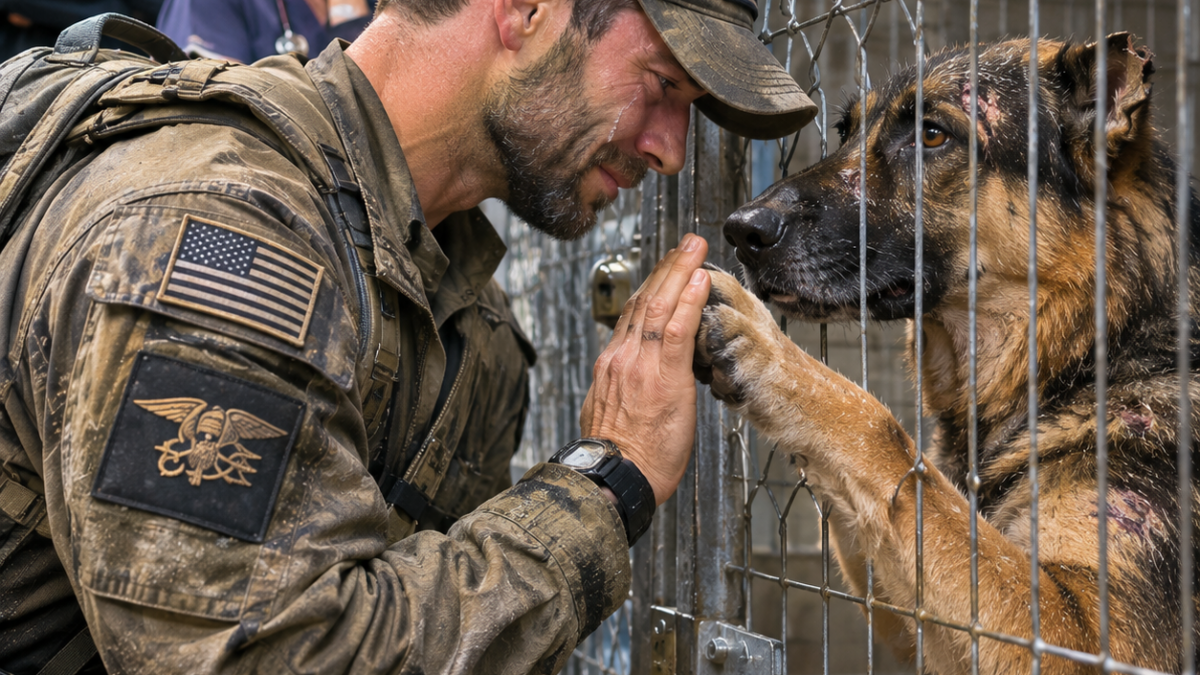
Ryan crossed the yellow line.
Lauren grabbed for him.
Missed.
“Get back!”
Ryan shoved the pole downward.
Needle scraped concrete.
Natalie stumbled.
“Are you insane?”
“Possibly.”
Then Ryan walked directly to the gate.
Ranger hit it.
The chain link bowed.
Teeth flashed inches from Ryan’s face.
Paige screamed.
Eddie swore.
Lauren shouted:
“BACK AWAY!”
Ryan didn’t.
Spit struck his cheek.
The dog growled.
Ryan stared through the wire.
Up close, the Shepherd looked worse.
Ribs.
Cracked tooth.
Neck abrasion.
Infected shoulder.
Split paw.
Fear wearing discipline like armor.
Ryan saw the lightning scar.
The ear.
Amber eyes.
He whispered:
“Everybody quiet.”
Nobody truly became quiet.
But the hallway changed.
Ryan moved closer.
Forehead almost touching wire.
The Shepherd’s lips pulled back.
Ryan could smell bleach.
Blood.
Wet fur.
Then beneath it—
something impossible.
Old dog.
Memory.
Home.
Ryan whispered one word.
“Ranger.”
The dog froze.
Not relaxed.
Not gentle.
Frozen.
Teeth still visible.
But his eyes changed.
Ryan’s chest collapsed inward.
“Ranger.”
The Shepherd’s nose moved rapidly.
Ryan could almost watch scent becoming memory.
Engine oil.
Salt water.
Gun cleaner.
Leather.
Ryan.
The dog whined.
A tiny, broken sound.
Paige covered her mouth.
Ryan’s voice shook.
“Stand down.”
Ranger remained standing.
Ryan reached into his jacket.
Everyone tensed.
He pulled out the faded green leash.
Ranger saw it.
His ears shifted.
Forward.
Back.
Forward.
Ryan changed his voice.
Not louder.
Older.
Handler voice.
“Down.”
Ranger trembled.
Then dropped flat to the concrete.
Perfect military obedience.
Chest down.
Head up.
Eyes locked on Ryan.
Eddie whispered:
“Jesus.”
Paige began crying.
Lauren’s clipboard lowered.
Natalie stared.
Ten seconds earlier that same dog had been trying to tear through steel.
Now he lay beneath Ryan’s command.
Ryan crouched.
His bad knee shook.
“Good boy.”
Ranger crawled forward.
One inch.
Then another.
Pressed his muzzle through the chain-link diamond.
Ryan touched the wire over his nose.
“I looked for you.”
Ranger closed his eyes.
Ryan’s voice broke.
“I looked everywhere.”
Lauren finally spoke.
“You said military chip.”
Ryan nodded without looking away.
“Call Dana Reeves.”
Lauren did.
Commander Mark Ellis answered first.
Lauren put the phone on speaker.
“I have a man here identifying this dog as MWD Ranger.”
Mark replied immediately:
“He is.”
Lauren swallowed.
“You’ve confirmed?”
“Sergeant Reeves and I are driving there with a DoD-capable scanner.”
Lauren looked at the euthanasia cart waiting at the end of the hall.
“How long?”
“Twenty-five minutes.”
Lauren took the euthanasia form from her clipboard.
Wrote:
HOLD.
She looked at Natalie.
“No medication.”
Natalie nodded.
Ryan remained at the gate.
Ranger remained down.
Twenty-seven minutes later, boots struck the hallway.
Sergeant Dana Reeves entered carrying a black hard case.
Mark followed.
Ryan glanced back.
Mark stopped when he saw Ranger.
His face lost years.
“Oh my God.”
Ranger’s head lifted.
Ryan said:
“Hold.”
Ranger held.
Dana approached slowly.
Opened the scanner.
“Ryan.”
“Do it.”
She moved the device near Ranger’s shoulder from outside the gate.
The scanner chirped.
Dana looked at the display.
Her jaw tightened.
Then softened.
“Confirmed.”
Nobody breathed.
Dana read:
“Military Working Dog Ranger. Naval Special Warfare support registry.”
She looked up.
“Status: killed in action.”
Ryan closed his eyes.
Ranger whined.
Lauren reached for the padlocks.
“Then let’s fix at least one record.”
The first opened.
The second stuck.
Eddie muttered something.
Ranger’s ear twitched.
Ryan said:
“Nobody talks.”
Eddie closed his mouth.
Lauren freed the second lock.
Ryan gave instructions.
“Open six inches.”
“Then?”
“Step behind me.”
“You sure?”
“No.”
That answer made everyone more nervous.
Lauren opened the gate.
Ryan slipped inside.
Ranger didn’t attack.
He crawled.
Seventy-five scarred pounds flattened against concrete.
Crawling toward the man he had once followed through gunfire.
Ryan dropped to both knees.
Ranger pressed his muzzle against Ryan’s knee brace.
Sniffed.
Then chest.
Hands.
Face.
Inventory.
Proof.
And then Ranger launched.
Not with teeth.
With his entire body.
He drove his head into Ryan’s chest so hard Ryan hit the wall.
Ryan wrapped both arms around him.
The sound Ryan made didn’t sound like a Navy SEAL.
It sounded like someone finding a grave empty.
“I got you.”
Ranger trembled violently.
“I got you, buddy.”
Ryan buried his face in the dog’s coat.
“I’m sorry.”
Ranger whined.
Ryan cried openly.
“I’m sorry I left you.”
Mark looked away.
Dana swallowed.
Paige sobbed silently.
Eddie rubbed his face.
Natalie sat on the concrete outside the kennel because her legs had stopped cooperating.
Ranger climbed half into Ryan’s lap.
Trying to become small enough to fit against the person he’d been missing.
Ryan ran his hands along his body.
Ribs.
Shoulder.
Neck.
Paws.
Then stopped at a thick scar hidden beneath fur.
“Cable.”
Natalie looked up.
“What?”
Ryan touched it.
“Something restrained him.”
Dana’s expression hardened.
Ranger licked Ryan’s cheek.
Ryan laughed through tears.
“You smell terrible.”
Ranger pressed closer.
The shelter had spent three days calling him dangerous.
Ryan saw something else.
A working dog who had spent three years waiting for his perimeter to make sense again.
Natalie examined him later at her emergency clinic.
Only on the floor.
Ranger refused the exam table.
He planted his paws and gave Natalie a look that ended negotiations.
She spread blankets.
Ryan sat beside him.
Ranger allowed treatment as long as Ryan’s hand remained touching him.
Infection near the shoulder.
Dehydration.
Malnutrition.
Cracked canine.
Worn lower teeth.
Split pads.
Metal fragment beneath the left shoulder.
And the cable scar.
Natalie shaved carefully around the chip site.
Then stopped.
“Ryan.”
He looked.
A burn mark.
Dana stepped closer.
Natalie said:
“Somebody tried to damage the chip.”
The room changed.
Ryan’s voice became flat.
“He wasn’t lost.”
Dana said nothing.
Ryan looked at her.
“He was held.”
“Possibly.”
“For three years?”
“We don’t know.”
Ranger’s head lifted.
Paige stood near the towel warmer.
She looked sick.
Natalie continued examining.
Then found something tangled deep beneath Ranger’s coat.
Small plastic tag.
Black.
Scratched.
Logo almost gone.
A shield over blue waves.
HARBOR SHIELD SECURITY.
Dana went still.
Ryan noticed.
“You know them.”
“I know the name.”
“What do they do?”
“Private maritime security. Overseas subcontracting in the past.”
Ryan stared.
“Dog handling?”
“Not officially.”
“Officially.”
Dana didn’t answer.
That answer was enough.
Mark searched old military logistics records.
At 1:36 the next morning, he called.
Two days after Ryan’s final mission in Yemen, a private recovery team had entered the outer site.
Official purpose:
recover damaged communications equipment.
Company:
Harbor Shield Security.
Ryan stood beside a sleeping Ranger.
“You telling me they found him?”
“I’m telling you Harbor Shield was there.”
“Why wasn’t he reported?”
“We don’t know.”
Ryan looked at the neck scar.
“I know.”
Dana stopped him.
“No.”
Ryan stared.
“No what?”
“No storming a warehouse.”
“I didn’t say anything.”
“Your face did.”
The next morning Paige arrived with three old shelter records.
She had spent half the night searching archived intakes.
Large working dogs.
Unreadable chips.
Found near port properties.
Unusual restraint injuries.
Three matches.
Belgian Malinois.
Black Shepherd.
Labrador.
All within eighteen months.
One survived.
One transferred.
One euthanized.
Lauren sat down when she saw the last record.
“Who handled that case?”
She already knew.
She had signed it.
The black Shepherd had been labeled severe aggression.
No chip.
No rescue.
Gone within forty-eight hours.
Lauren stared at the paperwork.
“What if…”
Nobody answered.
She pressed her fingers against her mouth.
Paige said quietly:
“We didn’t know.”
Lauren’s eyes filled.
“We didn’t ask.”
That distinction would haunt her.
Dana found links between two intake locations and Harbor Shield leased facilities.
Then Lauren called Harbor Shield.
Warren Pike answered personally.
Company founder.
Silver hair.
Tailored suit in his website photograph.
Voice smooth.
“Ms. Whitaker, shelters do such admirable work.”
Lauren said:
“We recovered an item bearing your company logo from a dog.”
“A dog?”
“Former military working dog.”
Silence.
Tiny.
But Ryan heard it from across the room.
Pike recovered.
“We don’t operate kennels.”
“Did Harbor Shield ever take custody of military working dogs overseas?”
“Absolutely not.”
“Did your company work a recovery site in Yemen three years ago?”
Another pause.
“Our contractors have supported many operations.”
“Did you recover a German Shepherd?”
“I wouldn’t have access to that level of detail.”
Ryan’s fists tightened.
Then Pike said something strange.
“Perhaps Harbor Shield could cover the dog’s veterinary bills as goodwill.”
Lauren looked at Dana.
“No.”
“Ms. Whitaker—”
“We don’t need your money.”
Pike sighed.
“Dangerous dogs and wounded veterans create emotional stories.”
Ryan stood.
Pike continued:
“Emotional stories often make poor evidence.”
Dana disconnected before Ryan could speak.
“Why’d you hang up?”
“Because he wanted you angry on a recorded line.”
“I am angry.”
“Exactly.”
Ranger stood.
Pressed against Ryan.
Ryan looked down.
“Traitor.”
Ranger leaned harder.
That afternoon, an anonymous shelter voicemail changed the investigation.
Miguel Ortiz.
Warehouse employee.
Portsmouth.
He had seen crates moved after a raid on an unrelated facility.
One crate had blood on the latch.
Scratching inside.
When Harbor Shield employees left, Miguel opened the outer shipping container.
The inner dog crate was broken.
Whatever had been inside escaped.
Six days later, Ranger was found near the Elizabeth River.
Miguel had one photograph.
Broken crate.
Blood.
Scratched plywood.
And green webbing.
Ryan put Ranger’s old leash beside the image.
Same military weave.
Dana obtained authorization to search the port facility.
Container Nine smelled like fear.
Old blood.
Urine.
Chemical sedatives.
Steel crates.
Bolted water dishes.
Hair in seams.
Rubber flooring clawed nearly through.
Paige stood frozen.
Lauren whispered:
“How many?”
Natalie said:
“More than one.”
Ryan was forced to wait outside the active area.
Conflict.
Evidence.
Protocol.
He hated every word.
Ranger stood beside him.
Then suddenly pulled east.
Nose high.
Body rigid.
Ryan tightened the leash.
“Hold.”
Ranger stopped.
But every muscle pointed toward a maintenance road.
Dana noticed.
“What is he doing?”
“Alerting.”
“To what?”
Ryan looked at Ranger.
“Something he remembers.”
The search expanded.
At a service shed, investigators found ground-down identification tags.
Expired veterinary sedatives.
Dog restraint cables.
And records linked to another Harbor Shield-controlled property in Suffolk County.
Warren Pike arrived before the search ended.
Navy suit.
Raincoat.
Attorney behind him.
Pike smiled.
“Sergeant Reeves.”
Dana stared.
“I would’ve appreciated notice.”
“You weren’t entitled to it.”
His smile remained.
Then he saw Ranger.
The smile didn’t disappear.
But his eyes did something.
Stopped.
Ranger sat.
No growl.
No bark.
Just stared.
Pike looked away first.
Ryan saw it.
So did Dana.
Paige whispered:
“He knows him.”
Ryan said:
“Ranger knows him.”
That night Ryan couldn’t sleep.
Neither could Ranger.
Ryan stood at two in the morning.
Reached for his boots.
Ranger immediately got up.
Moved between Ryan and the door.
Ryan stared.
“Seriously?”
Ranger didn’t move.
“I am going to find that farm.”
Ranger remained planted.
“You want those dogs left there?”
Nothing.
“You’re supposed to follow me.”
Ranger yawned.
Ryan sat back down.
Five minutes later someone knocked.
Ryan reached for the nearest solid object.
A shell-shaped lamp.
A woman’s voice came through the door.
“If you hit me with whatever stupid thing you’re holding, Ryan Callahan, I will personally embarrass you at your funeral.”
Ryan closed his eyes.
“Mom.”
Ruth Callahan entered carrying a thermos and a grocery bag.
Sixty-six.
Small.
Silver-haired.
Unstoppable.
Paige stood behind her looking guilty.
“I called her.”
Ryan stared at Paige.
“You what?”
“You looked like a man about to do something heroic and dumb.”
Ruth walked past him.
“Move.”
Then she saw Ranger.
Everything stopped.
Ranger approached.
Sniffed her coat.
Ryan’s mother had mailed him packages overseas.
Sweaters.
Cookies.
Home.
Ranger remembered something.
He leaned into her.
Ruth’s face collapsed.
“Oh, sweetheart.”
She put both hands around his cheeks.
“You found him.”
Ryan looked away.
Ruth corrected herself.
“No.”
She looked at Ryan.
“You found each other.”
Then she opened the thermos.
“I’m making everyone eat soup.”
“Mom, it’s two in the morning.”
“Bad decisions hate soup.”
Paige nodded.
“Medical fact.”
By morning, authorities had the Suffolk warrant.
The property was an abandoned farm rented through a shell corporation.
Inside the barn:
Six empty cages.
Two occupied.
A black Labrador wearing remnants of a tactical vest.
A Belgian Malinois so thin her hips protruded.
Paige crouched near the Labrador.
She didn’t reach.
“I’m not here to be brave at you.”
The dog watched.
“I’m just here.”
Ryan heard that.
He remembered Paige’s fear at Kennel 17.
Fear hadn’t disappeared.
She had simply stopped letting it make every decision.
Investigators found:
Sedation logs.
Forged vaccination records.
Shaved military IDs.
Transfer invoices.
Maps of ports.
Private airfields.
Overseas routes.
Then Ranger pulled toward a rear corner.
He began pawing.
Not frantic digging.
Indication.
Search behavior.
Ryan looked at Dana.
She nodded.
Deputies cleared straw.
Metal case.
Inside:
Broken military identifiers.
Memory card.
And Ranger’s original training tag.
Ryan reached.
Stopped before touching it.
Evidence.
Dana bagged it.
Beneath it was a waterproofed USB drive.
Words written across the tape:
IF I DIE, CALL LITTLE CREEK.
The files on the drive shattered Harbor Shield’s story.
Warehouse footage.
Emails.
Invoices.
Dog transfer lists.
Recovered assets.
That was the phrase.
Recovered canine assets.
Military dogs who survived overseas incidents were classified unofficially as salvage by corrupt contractors.
Some were sold to private security companies.
Some to foreign handlers.
Some used for illegal training programs.
Identifying chips damaged.
Records obscured.
Paper trails routed through shell companies.
Dogs became equipment.
Equipment could disappear.
Ranger appeared in seven seconds of video.
Ryan watched once.
No more.
The footage showed Ranger thinner.
Cable around neck.
Two men forcing him into a crate.
He fought until the video ended.
Ryan stood.
Mark closed the laptop.
“Enough.”
Ryan’s hands shook.
“I left him.”
“No.”
“I left him.”
“You were evacuated unconscious.”
“He waited.”
Mark grabbed Ryan’s shoulder.
“You were dying.”
“So was he.”
“And somehow both of you lived.”
Ryan looked at Ranger.
The dog slept beneath the table.
Even asleep, one paw touched Ryan’s boot.
The federal hearing began three days later.
Warren Pike arrived with attorneys.
He denied everything.
Unauthorized subcontractors.
Misfiled assets.
Contaminated evidence.
Emotional interpretation.
Then he looked at Ryan.
“Mr. Callahan suffered significant trauma.”
Ryan stared.
Pike continued gently.
“Trauma can make good men hear ghosts.”
Ranger lifted his head.
“A dog resembling an animal he lost does not prove institutional wrongdoing.”
Dana introduced the military scanner confirmation.
Mark introduced the Yemen recovery logs.
Natalie testified about Ranger’s injuries.
Lauren testified about the shelter’s failures.
She didn’t protect herself.
“We almost euthanized him.”
Pike’s attorney asked:
“Because he was dangerous?”
Lauren paused.
“Because we had incomplete information.”
“Was he dangerous?”
“Yes.”
The attorney smiled.
Lauren continued.
“And frightened.”
The smile faded.
“Those are not mutually exclusive.”
Then Paige testified.
Twenty-four.
Hands trembling.
Voice not.
“When Ranger arrived, I was terrified.”
She glanced toward him.
“I wanted him gone.”
Pike’s attorney looked interested.
Paige continued:
“I thought my fear was evidence.”
She swallowed.
“It wasn’t.”
She explained the old intake records.
The patterns.
The unreadable chips.
The working-dog behaviors.
Then said:
“We were too busy labeling the animal to ask what had happened to him.”
Objection.
Judge warned her to stay factual.
Paige nodded.
Then listed every fact.
The courtroom listened.
During recess, Warren Pike passed Ryan.
Ranger lay beneath his chair.
Pike leaned closer.
“Keep pushing and old Yemen files become public.”
Ryan looked up.
Pike’s voice remained soft.
“That mission wasn’t as clean as your memorial speeches suggested.”
Ryan’s stomach turned.
“Some families may not enjoy learning what really happened.”
Then Pike walked away.
The threat worked.
For several hours.
There were things from Yemen Ryan had never discussed publicly.
Bad intelligence.
A delayed extraction.
Arguments over whether to continue search efforts.
Men lost.
Choices made with incomplete information.
Ranger disappearing.
Pike was offering Ryan a trade.
Silence for silence.
That evening Ryan sat in a small church near his mother’s house.
Ranger across his boots.
Ruth lit candles.
One for Paige’s father, Daniel Sullivan, a Navy corpsman killed overseas.
One for Ryan’s team.
One for the dogs whose names nobody knew.
Mark sat beside Ryan.
“Pike’s bluffing some.”
“Some.”
“Not all.”
“No.”
“Relevant mission records could become evidence.”
Ryan stared at the candles.
“Families were told clean versions.”
“Families were told what could be released.”
“That’s not always the same thing.”
“No.”
Ruth spoke from the pew ahead without turning.
“Truth doesn’t become evil because an evil man threatens to tell it.”
Ryan looked at her.
“You listening?”
“I’m a mother in a quiet church. I can hear eyebrows move.”
Mark almost laughed.
Ruth turned.
“Son.”
Ryan’s jaw tightened.
“You have spent three years punishing yourself because Ranger didn’t come home.”
She looked down at the dog.
“Now he’s here.”
Ranger raised his eyes.
“Don’t let Pike build you another cage.”
Ryan signed the statement the next day.
Everything relevant.
No heroic polishing.
No clean mythology.
He admitted confusion.
Anger.
Injury.
He admitted screaming at command.
He admitted trying to return after Ranger.
He admitted being physically restrained before evacuation because he couldn’t stand.
He admitted he spent three years believing Ranger died because Ryan chose life.
The statement gave investigators what they needed.
Warrants widened.
Harbor Shield offices were searched.
Chip readers.
Forged transfer records.
Contractor payments.
Animal sale agreements.
More shell companies.
More dogs.
Warren Pike was arrested forty-eight hours later.
Ryan watched five seconds of the news.
Then turned it off.
Revenge felt smaller than he’d imagined.
Ranger’s survival mattered more.
The rescued Labrador recovered.
The Malinois required surgery but survived.
Two more dogs were located through records.
One former police dog living with a private security handler in Georgia.
One retired military Labrador in North Carolina.
The black Shepherd from Paige’s archived file could not be brought back.
Lauren carried that one.
She redesigned the shelter’s euthanasia review.
Paige called the proposal:
LAST CHECK.
Before euthanasia, any high-risk dog of unknown origin with signs of specialized training would receive:
Multiple chip scans.
Expanded scanner access.
Review for military or police identifiers.
Behavioral analysis distinguishing guarding from indiscriminate aggression.
Photo circulation to qualified working-dog networks.
Military liaison contact when indicated.
And one rule Eddie added.
“No stupid monster nicknames.”
Lauren wrote it more professionally:
Staff language must describe behavior, not moral character.
A sign appeared in isolation.
WORDS SHAPE DECISIONS.
USE BETTER ONES.
Someone added underneath:
YES, EDDIE, THIS MEANS YOU.
Eddie claimed vandalism.
Nobody investigated.
Ranger remained medically fragile.
Ryan assumed reunion would repair everything.
It didn’t.
Some nights Ranger woke attacking the room.
Not Ryan.
The room.
Corner.
Doorway.
Window.
Perimeter.
Ryan learned not to grab him.
“Ranger.”
No response.
“Down.”
Nothing.
Then the old command:
“With me.”
Ranger found him.
Every time.
Ryan had nightmares too.
Sometimes Ranger woke first.
Pressed his body against the bed.
Waited.
Two survivors teaching each other what year it was.
At first, Ryan wouldn’t leave Ranger alone.
Not for groceries.
Not for work.
Not for ten minutes.
His mother noticed.
“You know that isn’t sustainable.”
“He was stolen.”
“I know.”
“Three years.”
“I know.”
“I leave and he thinks—”
Ruth interrupted.
“You are not rebuilding safety if neither of you is allowed to survive a closed door.”
Ryan hated that.
Natalie agreed.
Which made him hate it more.
They trained separation.
Thirty seconds.
Ryan walked outside.
Returned.
Ranger stood at door.
One minute.
Returned.
Five minutes.
Ranger paced.
Returned.
Ten.
Twenty.
Over weeks, Ranger learned:
Ryan leaves.
Ryan returns.
Ryan learned the same lesson about Ranger.
Healing had an embarrassingly repetitive curriculum.
Ryan’s military retirement paperwork for Ranger eventually arrived.
Official adoption.
Lauren invited everyone.
Ryan complained.
“I sign papers all day.”
“No, you don’t.”
“Fine.”
They sat in the shelter conference room.
Dana.
Mark.
Paige.
Natalie.
Eddie.
Lauren.
Ruth.
Ranger beside Ryan.
Ryan stared at the signature line.
He had wanted this moment three years.
Now his hand wouldn’t move.
Signing couldn’t restore time.
Couldn’t erase the crate.
Couldn’t change Yemen.
Couldn’t remove scars.
Ranger put one paw on Ryan’s boot.
Ryan looked down.
“Bossy.”
Ranger kept the paw there.
Ryan signed.
Ruth cried.
Eddie pretended the air vent had attacked his eyes.
Paige laughed.
Lauren stamped the form.
“Congratulations.”
Ryan looked at Ranger.
“Apparently you’re mine.”
Ranger leaned against him.
Mark said:
“Always was.”
One year later, Ryan and Ranger walked Virginia Beach at sunrise.
No dramatic music.
No cameras.
Cold Atlantic folding against sand.
Ranger’s coat had returned.
Glossy sable.
Still gray around muzzle.
White scar above right eye.
Missing left ear tip.
Ryan’s knee still hurt.
His left hand still trembled after bad nights.
But he no longer lived above the boat-repair shop.
He rented a small house near Norfolk.
Two bedrooms.
Fenced yard.
His mother had a key.
Paige had somehow acquired a key because Ruth had given it to her and announced that “young people with medical training should know where stubborn men live.”
Ryan objected.
Nobody cared.
He continued repairing boat engines.
Ranger went with him.
Customers loved him.
Ranger distrusted jet skis.
Ryan considered that evidence of intelligence.
Tuesday evenings, Ryan volunteered with a retired working-dog program.
Handlers came with animals who had stopped knowing whether they were still working.
Police dogs.
Military dogs.
Search-and-rescue dogs.
Security dogs.
Ryan taught people to recognize the difference between aggression and fear.
Between disobedience and confusion.
Between a dog being difficult and a dog being unable to understand why every rule vanished overnight.
Mostly, he learned along with them.
Paige entered veterinary school.
She almost didn’t apply.
Ryan found out.
“Why?”
“Money.”
“That’s solvable.”
“Grades.”
“Good enough.”
“Confidence.”
“Overrated.”
Paige stared at him.
“You broke into a shelter.”
“I walked aggressively through an unlocked door.”
“You knocked Eddie into a brochure rack.”
“He grabbed me.”
“You shoved Natalie’s syringe pole.”
“Medical disagreement.”
She laughed.
Then applied.
Lauren wrote recommendation.
Natalie wrote another.
Eddie wrote:
SHE IS BRAVE WHEN SHE IS SCARED, WHICH IS THE ONLY KIND THAT COUNTS.
Paige kept that one.
Lauren turned Last Check into a regional pilot.
Within eighteen months, seven dogs were identified as former working animals whose histories had been missed.
Not all became adoptable.
Lauren insisted on honesty.
Some dogs remained unsafe despite every intervention.
Last Check wasn’t a promise to save every animal.
It was a promise not to confuse speed with certainty.
That difference mattered.
Miguel Ortiz eventually left the warehouse business.
He took a job managing shelter supplies.
Shy dogs liked him because he never reached first.
Ruth said:
“That’s because guilt teaches manners.”
Miguel accepted this.
Harbor Shield collapsed.
Warren Pike pleaded guilty to multiple federal offenses involving fraud, obstruction, unlawful transport, and animal cruelty.
Civil cases followed.
The news called the case a scandal.
Ryan disliked that word.
Scandal sounded temporary.
Like something people watched before weather.
The dogs had lived inside consequences long after headlines disappeared.
At Pike’s sentencing, the prosecutor asked whether Ryan wanted to speak.
He almost refused.
Then Ranger looked at him.
Ryan stood.
Pike sat beside counsel.
Ryan did not talk about vengeance.
He said:
“You called them recovered assets.”
The courtroom remained silent.
“They were dogs.”
He looked at Pike.
“Working dogs.”
“Partners.”
“Animals who had been trained to trust people enough to walk into places people were afraid to enter.”
Ryan’s voice tightened.
“You exploited that trust because they couldn’t testify.”
Ranger lay beside him.
“You thought being unable to speak meant being unable to tell.”
Ryan glanced down.
“You were wrong.”
Pike looked away.
Ryan sat.
That was enough.
Three years after Ranger’s return, his health began declining.
Not suddenly.
Age.
Damage.
Years of restraint.
Arthritis.
Chronic kidney disease.
Natalie monitored him.
Ryan refused to discuss the inevitable.
Ruth finally said:
“You know avoiding the word doesn’t stop the calendar.”
“Mom.”
“You taught him how to stand down.”
Ryan stared.
“Eventually you’re going to have to listen when he tells you.”
Ryan left her house angry.
He came back the next day.
“How do I know?”
Ruth took his hand.
“You’ll know when keeping him becomes about your fear instead of his life.”
Ryan hated that answer.
Because it was good.
Ranger remained Ranger for another year.
He loved the beach.
Chicken.
Sleeping near Ryan’s boots.
Hating the vacuum.
Inspecting boats.
Ignoring Paige unless she carried cheese.
One November morning, Ranger couldn’t stand.
He tried.
Front legs.
Failed.
Ryan lifted him.
Ranger growled softly.
Not anger.
Protest.
He tried again.
Collapsed.
Ryan called Natalie.
She came to the house.
No clinic.
No steel table.
Ranger lay on his favorite blanket near the back door where he could smell cold air.
Ruth came.
Mark came.
Paige drove from school.
Dana arrived without uniform.
Lauren stood near the kitchen crying before she even entered the room.
Eddie brought muffins and forgot to remove the price sticker.
Nobody commented.
Ryan sat on the floor.
Ranger’s head in his lap.
“You dragged me once.”
Ranger breathed.
“So I guess we’re even.”
Ranger’s eyes opened.
Ryan smiled through tears.
“No.”
He stroked the scar above the eye.
“Not even close.”
Natalie explained everything.
Ryan heard almost nothing.
He bent toward Ranger.
“For three years I thought you died alone.”
His voice broke.
“You didn’t.”
Ranger breathed.
“You survived.”
Ryan pressed his forehead to Ranger’s.
“And then I almost lost you again because we were all too stupid to look closer.”
Lauren cried harder.
Ryan looked at her.
“Not blaming you.”
“I know.”
“Good.”
Ranger’s breathing became shallow.
Ryan reached for the old green leash.
Placed it beside him.
The brass clip was worn nearly smooth.
“Ranger.”
The dog’s ear moved.
Ryan swallowed.
“Stand down.”
Ranger’s eyes remained on him.
“Mission complete.”
Ranger exhaled.
Ryan whispered the final command.
“Home.”
Natalie gave the medication.
Ranger did not look afraid.
His head became heavier in Ryan’s lap.
His breathing slowed.
Then stopped.
Nobody moved for a long time.
Paige sat against the wall.
Lauren held Eddie’s hand without realizing it.
Mark stared through the window.
Ruth placed one palm against Ryan’s back.
Ryan cried into Ranger’s coat.
For years he had believed loving Ranger meant saving him from death.
Ranger taught him something harder.
Sometimes love meant being present when saving was no longer possible.
Months later, Chesapeake Animal Care renovated the isolation wing.
Kennel 17 remained.
Lauren refused suggestions to turn it into a memorial.
“Animals still need it.”
Instead, beside the yellow line, they mounted one photograph.
Ranger.
Scar visible.
Sitting beside Ryan.
Paw on his boot.
No dramatic inscription.
Only:
LOOK AGAIN.
Paige suggested it.
Ryan approved.
Last Check expanded statewide.
Shelters received military-capable scanners.
Working-dog databases improved.
Law-enforcement liaisons became easier to reach.
Training changed.
Not because every dangerous-looking dog was secretly heroic.
That would have been another dangerous simplification.
But because Ranger’s case proved behavior without history could be misunderstood.
Fear remained important.
Safety remained important.
So did curiosity.
Ryan kept volunteering.
Without Ranger at first.
That was unbearable.
The empty space beside his left leg felt physical.
One evening a retired police Malinois named Echo refused to enter the training room.
Her handler tugged.
Echo backed away.
Ryan watched.
Then said:
“Stop.”
The handler frowned.
“She’s being stubborn.”
“No.”
Ryan crouched several feet away.
“What’s behind that door?”
“Room.”
“Floor?”
“Rubber.”
“Her kennel floor?”
“Concrete.”
“Previous training?”
“Tile.”
Ryan pointed.
“She doesn’t know what rubber means.”
The handler looked embarrassed.
Ryan smiled.
“Neither did I.”
They let Echo investigate.
Three minutes.
Then she crossed.
No force.
No drama.
Ryan stood.
For a second, he felt Ranger beside him.
Not a ghost.
A lesson.
Paige graduated veterinary school two years later.
At the ceremony, Ruth shouted loud enough to embarrass entire rows.
Ryan stood beside Lauren, Natalie, Eddie, Dana, Mark, and Miguel.
Paige walked across the stage.
Later, she found Ryan near the parking lot.
“There’s something I need to tell you.”
“Sounds dangerous.”
“I’ve accepted a job.”
“Where?”
“Chesapeake.”
Ryan smiled.
“Lauren knows?”
“Lauren cried.”
“Expected.”
“Natalie threatened to make me work holidays.”
“That’s how affection works.”
Paige hesitated.
“Ryan.”
“Yeah?”
“That morning…”
He knew.
“Kennel 17.”
“I was scared.”
“Reasonably.”
“I wanted him euthanized.”
“You were twenty-four and almost bitten.”
“I still think about it.”
Ryan looked at her.
“So do something useful with it.”
She frowned.
“What?”
“Guilt’s lazy if all it does is hurt.”
Paige stared.
Then nodded.
Years later, she would repeat that sentence to frightened new volunteers.
Ryan never knew.
Ruth died at seventy-eight.
Peacefully.
Cancer.
Ryan sat beside her bed.
At one point, she woke and looked toward the empty corner.
“Where’s Ranger?”
Ryan froze.
Then realized.
Maybe medication.
Maybe memory.
Maybe something else.
He took her hand.
“Home.”
Ruth smiled.
“Good.”
Then closed her eyes.
After her funeral, Ryan found a box in her closet.
Inside:
Ranger’s old photographs.
Ryan’s childhood pictures.
Newspaper clippings.
And every shelter update about Last Check.
Ruth had saved them all.
On the inside lid she had written:
MY BOYS CAME HOME DIFFERENT.
STILL HOME.
Ryan sat on the floor and cried again.
He was older by then.
Grief didn’t become easier.
Only more familiar.
At sixty-one, Ryan returned to Chesapeake Animal Care for the twentieth anniversary of Last Check.
The shelter had changed.
New building.
Better ventilation.
Larger kennels.
More daylight.
But Kennel 17’s old gate had been preserved in the training room.
Not because Lauren wanted mythology.
Because training needed artifacts.
Paige was now medical director.
Gray beginning at her temples.
Eddie had retired and become intolerable as a volunteer because he believed employment rules no longer applied.
Lauren retired too.
She attended with a cane.
Mark’s hair had gone completely white.
Dana still looked capable of ending nonsense at fifty yards.
Young staff gathered.
Some hadn’t been born when Ranger disappeared in Yemen.
Paige introduced Ryan.
He hated introductions.
“Former Navy SEAL…”
He looked at her.
She corrected.
“Boat mechanic.”
People laughed.
Ryan stood beside the old gate.
Someone asked:
“What was Ranger really like?”
Ryan thought.
Not the legend.
Not the heroic version.
“Bossy.”
Laughter.
“Stole food if he thought regulations were weak.”
More laughter.
“Hated being wet but walked into water if I did.”
Someone asked:
“Was he dangerous?”
Ryan paused.
“Yes.”
The room quieted.
“He was trained to be.”
He touched the old chain link.
“But dangerous isn’t the same as evil.”
Nobody moved.
“Fear isn’t the same as madness.”
“Pain isn’t the same as bad character.”
“And training doesn’t disappear just because everyone who understands the language is gone.”
A young kennel technician asked:
“How did you know he’d respond?”
Ryan smiled sadly.
“I didn’t.”
“But you crossed the line.”
“Yes.”
“Why?”
Ryan looked at the yellow stripe preserved beneath the gate display.
“I knew him.”
“Would you tell us to do what you did?”
“No.”
That surprised them.
Ryan continued.
“I’d tell you to call someone who knows.”
He pointed toward the scanner cabinet.
“Use the tools.”
Then the liaison list.
“Use the people.”
Then the behavior forms.
“Write what the animal does, not what you think the animal is.”
He looked at them.
“And when you’re afraid, respect the fear.”
Pause.
“Just don’t let fear be the only witness.”
No applause at first.
Good.
They were thinking.
Later, Ryan walked alone down the hall.
Kennel 17 was occupied.
A nervous hound.
Nothing dramatic.
The dog backed into the corner.
Ryan stopped outside.
Didn’t reach.
Didn’t talk.
Just stood sideways.
The hound sniffed.
Ryan smiled.
“Take your time.”
He continued toward the exit.
Outside, rain had begun.
Gray Virginia rain.
Almost identical to the morning Ranger came back.
Ryan stood beneath the shelter awning.
For a second he could hear everything again.
Chain link.
Barking.
Paige crying.
Lauren saying nobody opens the gate.
His own voice:
Ranger.
Down.
Home.
People still told the story wrong sometimes.
They said:
No one could touch the vicious K9 until a Navy SEAL walked in and instantly made him gentle.
That wasn’t what happened.
Ranger never stopped being dangerous in the way a highly trained military dog could be dangerous.
He didn’t magically become harmless.
He became understood.
There was a difference.
He had spent three years being restrained, transported, sold, hidden, injured, and finally abandoned.
Then strangers approached with poles.
Needles.
Hands through openings.
They saw aggression.
Ranger saw another capture.
Ryan didn’t possess magic.
He possessed context.
A name.
A scent.
A leash.
A command.
A history.
That was enough to change the meaning of everything the shelter had seen.
Ranger wasn’t attacking randomly.
He was holding a perimeter.
He wasn’t refusing food.
He was protecting a breach.
He wasn’t untrainable.
He was waiting for a language nobody there spoke.
And behind all of it was a dog who had never stopped believing the handler he lost might someday return.
Ryan had spent three years believing Ranger died because he couldn’t save him.
Ranger spent those same years surviving as if Ryan might still be looking.
Both were right about one thing.
Neither had truly stopped.
One photograph connected the two searches.
A scar.
A damaged ear.
A shelter volunteer willing to wonder whether ordinary equipment had missed something.
A friend willing to send a message that sounded impossible.
A director willing to pause a decision she’d already signed.
A liaison willing to bring the right scanner.
A frightened young woman willing to admit fear had made her judgment smaller.
A warehouse worker willing to speak.
An old military dog willing to keep fighting until one familiar voice finally reached him.
That was the real miracle, if Ryan ever allowed himself to call it one.
Not that Ranger survived.
Survival alone could be cruel.
The miracle was that after everything people did to him, Ranger could still recognize home.
And the first time Ryan whispered that word through the chain link, the animal everyone else had labeled a monster didn’t need another command.
He already knew exactly where to go.








