Nine Minutes Before He Was Gone, a One-Eyed Shelter Cat Touched My Silent Daughter’s Face
PART3:
Speech therapy.
Art therapy.
Routine.
Gentleness.
No pressure.
Small choices.
Safe exposure.
Breathing exercises.
Patience.
So much patience that I sometimes hated the word.
People praised me for being patient, but they did not see the nights when I sat alone at the kitchen table after Emily fell asleep, staring at her lunchbox and wondering whether I had missed some door back to the child she used to be.
Because she had been loud once.
That is what people who met her later never understood.
Emily had not always been a quiet child.
Before the trauma, she sang nonsense songs while brushing her teeth.
She narrated her dolls’ lives in dramatic voices.
She asked questions so quickly I used to beg for five minutes of peace and then hate myself later for ever wanting quiet.
She had a laugh that started small and then took over her whole body.
Afterward, her laughter vanished with her voice.
Sometimes I thought I could still hear it in the house like an echo.
Then I would turn and find her sitting cross-legged on the carpet, drawing cats with wings or houses with too many locks.
We had a cat before Oliver.
Her name was Mabel, a gentle old orange tabby we adopted from Pine Hollow Animal Shelter when Emily was four. Mabel was already eleven then, round and arthritic, with one cloudy eye and a deep distrust of men wearing hats. She chose Emily immediately. Climbed into her lap at the shelter, kneaded her dress, and refused to move.
For two years, Mabel slept at the foot of Emily’s bed.
After the trauma, Mabel became one of the few living things Emily still reached for without hesitation. She did not speak to her, not with words, but she brushed her, fed her treats, pressed her forehead gently against Mabel’s side when the world became too much.
Then Mabel died at thirteen.
Kidney failure.
Peacefully, the vet said.
In her sleep, the way everyone hopes.
Emily did not cry in front of me.
She sat beside Mabel’s empty bed for three hours holding her whiteboard.
Finally, she wrote:
Gone too?
Two words.
A question no father can answer well.
After Mabel died, I packed away the bowls, the remaining prescription food, the unopened medication, the records, the little pink brush Emily had used every night. I intended to donate them to Pine Hollow because Mabel had come from there and because I could not keep walking past those things in the laundry room.
It took me four months to do it.
That is why Emily and I were at the shelter on November 14.
We were not there to adopt.
That is the first thing I tell people.
We were not brave.
We were not looking for a miracle.
We were only returning the leftovers of one loss when we found another living creature waiting nine minutes from the end of his life.
Pine Hollow opened at 7:30 on weekdays for drop-offs and scheduled appointments. The morning was cold, gray, and wet in that quiet late-autumn way where the sky seems tired of itself. Leaves clung to the windshield. Emily sat in the passenger seat because she was finally tall enough and because being in the back sometimes made her anxious.
She held the whiteboard in her lap.
I glanced over.
“You okay going in?”
She gave one small nod.
“We can just leave the box and go.”
Another nod.
“You don’t have to see the cat rooms.”
She looked out the window.
Then wrote:
Mabel came from here.
“Yes,” I said softly. “She did.”
Emily erased the board with the corner of her sleeve.
Then wrote:
I remember.
I parked near the front entrance.
The shelter looked the way animal shelters always look to people who have loved animals: hopeful and heartbreaking at the same time. A faded sign. A donation bin near the door. Paw-print decals on the window. Inside, the distant barking of dogs rose and fell like weather.
A volunteer at the counter recognized Mabel’s name when I explained why we had come.
“Oh,” she said, her face softening. “Mabel. The orange senior girl.”
I nodded.
“She passed in July.”
“I’m so sorry.”
“Thank you.”
“This is her person?” the volunteer asked, smiling gently at Emily.
Emily looked down.
I said, “Yes.”
The volunteer did not push for a response.
I noticed that.
Her name tag said Claire.
Claire Morgan.
I would remember her name forever.
She took the box of food, medication, and records with both hands.
“This will help someone,” she said. “Senior supplies are always needed.”
Emily looked up at that.
Claire crouched slightly, not too close.
“Mabel helped other cats today,” she said.
Emily’s fingers tightened around the whiteboard.
Then she nodded once.
We should have left then.
If life were only made of plans, we would have.
But as Claire carried the box into the back room, a sound came from the cat corridor.
Not a meow exactly.
A low, rough cry.
Emily turned her head.
I felt her hand find my sleeve.
“You want to look?” I asked.
She hesitated.
Then wrote:
Just once.
So we walked down the hall.
The cat room smelled of disinfectant, litter, food, and fear. Rows of cages lined the walls. Some cats came forward when we entered, rubbing against bars. Others hid in boxes. A white kitten batted at a toy mouse. A calico watched us with royal suspicion. A huge orange male slept like he paid rent.
Emily’s shoulders relaxed by a fraction.
Animals did that for her.
They made the world less human.
Then she stopped.
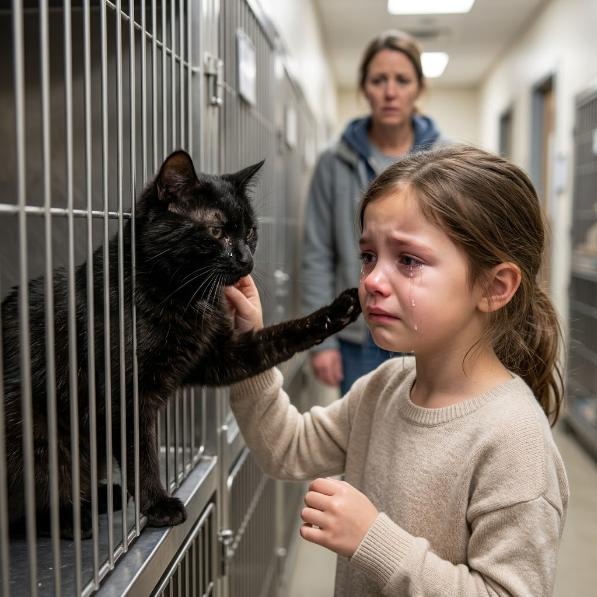
At the very end of the row, in the last cage, sat a black cat.
He was larger than most of the others, thin but broad-headed, with fur so dark it swallowed the dull fluorescent light. His left eye was missing. Not clouded. Gone. The socket had healed long ago, but a pale scar ran from that empty place down toward his jaw. His right ear had a notch near the tip. His tail bent sharply near the end, an old break that had healed crooked.
He did not come forward.
He did not hiss.
He sat facing the door of his cage, perfectly still, watching us with one amber eye.
There was a paper clipped to the front.
Black cat, male, approximately six years.
Fourth return.
Behavior: aggressive in cage.
Adoption outlook: none.
Underneath, in red ink:
Euthanasia scheduled: November 14, 8:00 a.m.
I stared at the line.
Then at the clock on the wall.
7:47.
My throat tightened.
Emily stepped closer.
“Sweetheart,” I whispered, “don’t put your fingers near the cage.”
She did not.
She stood just out of reach, whiteboard clutched to her chest, staring at the cat.
The cat stared back.
Not the way animals stare when they are hunting or frightened.
He looked at her as if he recognized waiting.
Claire had followed us into the room. When she saw where we were standing, her face changed.
“That’s the one I told them to wait on,” she said softly.
I looked at her.
“He’s scheduled?”
Claire glanced toward the office door.
“He’s been returned four times. He doesn’t do well in cages. He lashes out when people reach in. Last adopter said he frightened her children because of his face.”
The words made me angry in a helpless way.
“His face?”
Claire’s mouth tightened.
“People can be cruel when they’re disappointed.”
Emily had not moved.
“What’s his name?” I asked.
Claire swallowed.
“He came in as Midnight the first time. Then Shadow. Then Jasper. Last time, they didn’t bring a name. Intake just wrote black male.”
“No name?”
“They stopped using one on the floor after the third return. Staff rotate so much. Some didn’t want to get attached.”
She looked ashamed.
“Did you?”
Claire’s eyes filled.
“I wrote about him in my journal every night.”
“What did you call him?”
She looked at Emily before answering.
“Waiting.”
I felt that in my chest.
Waiting.
Because that was exactly what he looked like.
A creature everyone had stopped choosing, sitting upright at the end of the line, eye fixed on the door as if the person meant for him had simply been late.
Emily lifted one hand.
I caught my breath.
“Em—”
Before I could stop her, the black cat slowly rose.
Claire went still.
The cat did not bare his teeth.
Did not flatten his ears.
Did not growl.
With painful care, he stepped toward the front of the cage.
Then he did something Claire later said she had never seen him do.
He slipped one black paw through the bars.
Slowly.
Deliberately.
As if he understood sudden movement could ruin everything.
His paw reached toward Emily’s face.
I should have pulled her back.
Every protective instinct in me screamed to.
But Emily stood perfectly still, eyes wide, breathing shallowly. And something in the way that cat moved—scarred, broken-tailed, one-eyed, condemned by a paper sign and still impossibly gentle—made me wait one second longer.
His paw touched her cheek.
Not a scratch.
Not a grab.
Just the soft pads of his toes against her skin.
Then he left it there.
Emily closed her eyes.
The room stopped.
Claire covered her mouth.
I forgot how to breathe.
My daughter raised her hand.
She did not take the paw away.
She pressed her small palm against it.
Cat and child.
Both silent.
Both watched too closely by a world that had mistaken fear for danger.
Then Emily spoke.
Her voice was tiny.
Rusty.
Almost not a voice at all.
But it was there.
One word.
“Him.”
I thought I had imagined it.
For three years, I had dreamed of her voice so often that my mind knew how to manufacture it from longing. I looked at Claire because I needed another witness to keep from falling apart.
Claire’s eyes were wide with tears.
“She said—”
“I heard,” I whispered.
Emily opened her eyes and looked at me.
Her hand remained against the cat’s paw.
“Him,” she said again.
The second time broke me.
I dropped to my knees beside her.
Not to hug her. Not yet. I was afraid to move too much, afraid the moment would shatter like thin glass.
“You want him?” I asked.
Emily nodded.
Then, very slowly, she erased her whiteboard without looking away from the cat.
She wrote one word.
Please.
I stood so fast I nearly lost balance.
Claire was already moving.
“Wait here,” she said.
She ran toward the office.
The clock read 7:51.
Nine minutes.
That was all.
Nine minutes between a red mark on a form and my daughter’s first word in 1,096 days.
The next few minutes were chaos disguised as procedure.
Claire brought the shelter manager, Anita Ruiz, a tired woman in navy scrubs with reading glasses on her head and a face that looked like it had said too many hard yeses and harder noes. Behind her came Dr. Patel, the staff veterinarian, who had been preparing the morning schedule with a quiet heaviness no one had needed to explain.
“This is the family?” Anita asked.
Claire nodded. “He touched her. Gently. She spoke.”
Anita looked from Claire to me to Emily.
The black cat had withdrawn his paw but remained at the front of the cage, still watching Emily.
“He has a bite history,” Anita said.
“I understand.”
“He has been returned four times.”
“I understand.”
“He may hide. He may never become social. He may need medication for anxiety. He may react badly if cornered. He has trauma.”
I looked at my daughter.
“So does she.”
Anita stopped.
That was the truth in its plainest form.
Emily reached toward the cage again, stopping just short of the bars.
The cat leaned forward and pressed his face against them, scarred side first, as if offering the part everyone else had rejected.
Emily’s lips moved.
No sound came.
Then she whispered, “Please.”
Anita closed her eyes for one second.
When she opened them, she looked at Dr. Patel.
“Cancel it.”
Dr. Patel did not ask what.
She only nodded and left the room quickly.
Claire began crying outright.
I signed every form they placed in front of me.
Adoption agreement.
Medical waiver.
Behavior history acknowledgment.
Medication instructions.
Indoor-only policy.
Emergency contact.
Senior and special-needs care explanation.
I would have signed my name a hundred times if it kept that cat alive and kept Emily’s hand reaching forward instead of pulling back into silence.
When they asked what we wanted to name him, I turned to Emily.
The cat sat in a carrier now, placed on the counter between us. He had not fought when Claire moved him. He had gone stiff with fear, but he had not scratched. His amber eye stayed on Emily the whole time.
“What’s his name?” I asked her.
She looked at him.
Then at the photograph wall behind the desk, where pictures of adopted animals smiled from frames and bulletin boards.
She took the purple marker.
Wrote:
Oliver.
Then, after a pause, she said it.
“Oliver.”
Claire pressed both hands to her mouth.
Anita looked away.
I bent over the counter because my legs had forgotten their job.
Oliver.
It was the first name my daughter had given out loud in three years.
The shelter waived every fee.
Food, carrier, medication, follow-up appointment, everything. Anita said it briskly, as if this were simply policy, but her eyes were wet when she turned away. Claire carried Oliver to our car herself.
Outside, the morning had brightened slightly. Wet leaves stuck to the pavement. Emily walked beside the carrier, one hand resting on top of it through the plastic handle.
I opened the back door.
Claire placed Oliver carefully on the seat.
“He may need a quiet room at first,” she said. “Don’t force contact. Don’t reach over his head from the blind side. Let him come to you. Watch for appetite changes. Call us if anything worries you. Call me if anything worries you.”
She handed me a piece of paper with her personal number written on it.
Then she crouched in front of Emily.
“I think he was waiting for you.”
Emily looked at Oliver through the carrier door.
Then whispered her second sentence.
“Me too.”
Claire started crying again.
So did I.
In the car, I sat behind the wheel for almost five minutes before I could drive.
Emily buckled herself in, then turned sideways so she could look at Oliver. He sat in the carrier, body low, one eye wide. His crooked tail was tucked along his side.
Halfway home, Emily reached her fingers toward the carrier door.
Not inside.
Just close.
Oliver pressed his nose against the metal.
Emily smiled.
A real smile.
Small, but alive.
Then she said the second word that would become part of our family’s history.
“Mine.”
I almost had to pull over.
For three years, I had longed for any word.
Any sound.
But the words she chose were not random.
Him.
Oliver.
Me too.
Mine.
She was not returning to speech the way a faucet turns back on.
She was claiming connection one word at a time.
We set Oliver up in Emily’s room because she insisted with a look so fierce I did not argue. I moved slowly, following the shelter instructions. Litter box in the corner. Food and water apart. A soft bed near the radiator. A cardboard box with a towel inside. No loud noises. No sudden grabbing. No expectations.
Oliver came out of the carrier after twenty minutes.
He did not explore much.
He walked straight beneath Emily’s bed and stayed there.
Emily lay on the floor beside the bed, cheek pressed to the carpet, looking into the shadows.
I sat in the hallway with my back against the wall, afraid to intrude.
After a while, I heard her whisper.
“Hi.”
One word.
So quiet I might have missed it if the house had not been built around listening by then.
Oliver did not come out.
Emily did not seem disappointed.
She slid her hand under the bed, palm up.
A long silence followed.
Then a black paw rested gently on her fingers.
That night, I stood outside her bedroom door and listened to my daughter speak to a cat who had been scheduled to die that morning.
At first, only single words.
“Safe.”
“Stay.”
“Food.”
“Scared?”
Then broken little sentences.
“You can hide.”
“I hide too.”
“They looked at your face.”
“I like it.”
I pressed my hand over my mouth because the sound of her voice was too sacred to interrupt.
For three years, doctors had asked her to speak.
Teachers had encouraged her.
Family members had begged, bribed, prayed, cried, and sometimes, terribly, scolded.
Oliver did none of that.
He simply existed beside her in a way she understood.
He had been stared at and misunderstood. She had been stared at and misunderstood.
He had been labeled aggressive because fear made him strike when trapped. She had been labeled withdrawn because silence was the only door she could close.
He was not pretty in the way people wanted cats to be pretty.
She had not been easy in the way adults wanted children to be easy.
Maybe that was why she trusted him first.
The first week was not a miracle montage.
I need to say that clearly.
Oliver did not become a perfect cat overnight.
Emily did not wake up speaking in full paragraphs to everyone.
Healing is not a movie scene.
Oliver hissed at the vacuum cleaner so violently I thought the machine might apologize. He scratched me once when I reached from his blind side without thinking. He hid whenever the doorbell rang. He refused dry food, knocked over his water bowl twice, and stared down a visiting aunt until she whispered, “That cat knows my sins.”
Emily spoke only to Oliver at first.
Not to me.
Not to her therapist.
Not to her teacher.
To him.
At breakfast, she remained silent.
At school, silent.
At therapy, silent.
But every night, behind her bedroom door, I heard her voice.
Small at first.
Then steadier.
She read him picture books she had long outgrown.
“Once there was a rabbit,” she whispered one night.
Oliver sat on her pillow, one-eyed and solemn, listening as if literature had finally found its purpose.
Another night, she told him about Mabel.
“Mabel was orange,” she said. “She was soft. She died. I didn’t say goodbye out loud.”
A pause.
Then: “I’m saying it now.”
I slid down the hallway wall and cried silently into my sleeve.
The first time Emily spoke to me, it was eighteen days after Oliver came home.
I was in the kitchen making pancakes because Saturday mornings had once meant noise and syrup and arguments over chocolate chips, and I was trying to rebuild old rituals without asking too much from them.
Emily came in wearing pajamas, hair tangled, Oliver moving stiffly beside her like a shadow with arthritis.
She pointed to the cabinet.
“Plate?” I asked.
She shook her head.
“Water?”
No.
“Medicine for Oliver?”
She looked frustrated.
Then she opened her mouth.
“Bowl.”
The spatula fell out of my hand.
It hit the floor.
Emily flinched.
I froze.
Every instinct screamed to celebrate, to grab her, to say you spoke, you spoke to me, oh my God, you spoke.
But I had learned something from Oliver.
A frightened creature does not need your explosion of joy.
It needs steadiness.
So I picked up the spatula slowly.
“Sure,” I said, voice shaking only a little. “His blue bowl?”
She nodded.
I handed it to her.
She filled Oliver’s water.
Then left the room.
I turned off the stove, walked into the pantry, closed the door, and sobbed into a bag of flour.
After that, words came like cautious animals.
Not when chased.
Not when praised too loudly.
Only when the room stayed safe enough.
“Cold.”
“Dad.”
“Oliver scratched the chair.”
“Can we read?”
“Don’t tell Grandma yet.”
That last one came one night when I found Emily sitting by the window with Oliver in her lap. Snow had started falling outside, soft against the dark glass.
“Don’t tell Grandma yet,” she whispered.
“About talking?”
She nodded.
“Okay.”
“She’ll cry loud.”
I almost smiled.
“She might.”
“I don’t want loud.”
“I won’t tell her until you’re ready.”
Emily looked down at Oliver’s scarred face.
“People grab words,” she said.
I sat carefully on the edge of the bed.
“What do you mean?”
She stroked Oliver’s head, always approaching from the right side where he could see her.
“When I say one, people want more.”
There it was.
The burden adults had placed on every attempt.
One word was never allowed to remain one word.
It became a door everyone rushed.
Say that again.
Can you say my name?
Can you talk at school?
Why now?
Are you better?
Do you remember?
Can you tell us what happened?
No wonder her words stayed hidden.
Oliver never asked for more than she gave.
He accepted one word like a feast.
“I’m sorry,” I said.
Emily looked at me.
“I did that too.”
She nodded.
Not cruelly.
Truthfully.
“I’ll try not to grab,” I said.
Oliver blinked his one eye slowly, as if approving the policy.
When we returned to Dr. Landry, Emily’s therapist, in December, I warned her privately in the hallway.
“She’s been speaking at home. Mostly to Oliver. Some to me. But she doesn’t want pressure.”
Dr. Landry’s eyes softened.
“Then we won’t pressure.”
Emily entered the room carrying Oliver’s blanket in her backpack. We did not bring Oliver to that appointment; the shelter had advised against too many transitions at first. But Emily wanted the blanket.
Dr. Landry noticed.
“May I sit near you?” she asked.
Emily nodded.
For twenty minutes, nothing happened.
They drew.
Dr. Landry asked yes-or-no questions.
Emily answered with nods.
Then Dr. Landry drew a black cat with one eye and a crooked tail.
Emily watched her.
Dr. Landry said, “I don’t know if I drew him right.”
Emily took the pencil.
Added the scar.
Then whispered, “His tail is more bent.”
Dr. Landry did not gasp.
Did not cry.
Did not celebrate.
She simply nodded.
“Thank you for telling me.”
That was why she was good at her job.
Later, in her notes, she wrote something I would read months afterward:
The cat did not cure Emily. That is not clinically accurate. What appears to have occurred is the creation of a safe relational bridge through a nonverbal attachment figure who shared visible vulnerability without demanding reciprocal performance.
At the bottom, in plainer language, she added:
Oliver may have helped Emily feel seen without feeling pursued.
Seen without pursued.
I thought about that for days.
Because that was what Oliver had done at the cage.
He had looked at my daughter.
Not through her.
Not past her.
Not at the diagnosis.
At her.
One eye had been enough.
At school, progress came slower.
Emily’s teacher, Ms. Harper, was patient and kind, but classrooms are not quiet bedrooms. There were bells, chairs scraping, children shouting, questions asked too fast. Emily continued using her whiteboard in class through most of December.
But she began whispering to one girl, Nora, during art.
Then to Ms. Harper at the classroom sink.
Then, one afternoon, she raised her hand during reading group.
Ms. Harper told me later she nearly stopped breathing.
Emily read one sentence aloud.
Just one.
From a book about a fox in winter.
Her voice trembled, but she finished it.
The other children stared.
Nora, apparently wiser than most adults, said, “Good sentence,” and turned the page.
That became the class rule.
No clapping.
No cheering.
No making Emily’s voice into a performance.
Good sentence.
Turn the page.
At home, Oliver became king of our house.
A wounded, suspicious, one-eyed king with a crooked tail and strong opinions about tuna.
He slept against Emily every night.
At first near her feet.
Then beside her knees.
Then curled against her stomach, one paw resting on her pajama shirt as if confirming she remained there.
He watched the bedroom door.
Always.
Even in sleep, his face angled that way.
I asked Dr. Patel about it during a follow-up.
“Hypervigilance,” she said. “Common in animals with repeated abandonment or trauma. Doors mean change. Change has not been kind to him.”
That sentence hurt.
It also explained Emily, who still watched doors too.
So we made doors kinder.
We announced before entering.
We knocked.
We let Oliver smell visitors’ hands before they reached.
We gave Emily control over whether people came into her room.
Small things.
Life-changing things.
In January, Claire visited.
She had asked first, through me, with no pressure. Emily agreed by writing yes on her board, then whispering, “But quiet.”
Claire arrived with a little bag of toys and sat on the living room floor like someone approaching royalty.
Oliver appeared after ten minutes.
He stood in the hallway, one amber eye fixed on her.
Claire’s face crumpled immediately.
“Hi, Waiting,” she whispered.
Emily looked at me.
“Waiting?” she asked aloud.
Claire wiped her cheek.
“That’s what I called him at the shelter. Because he always looked like he was waiting for someone.”
Emily sat beside Oliver and placed one hand on his back.
“He was.”
Claire pressed her lips together.
“For you?”
Emily thought about that.
Then said, “For home.”
Claire closed her eyes.
Oliver walked slowly across the rug and climbed into her lap.
Just like that.
The same cat staff had labeled aggressive in cage settled on the lap of the volunteer who had begged for more time and purred so loudly we all heard it.
Claire did not move.
For several minutes, nobody said anything.
It was one of the holiest silences I have ever known.
There are silences made of fear.
There are silences made of grief.
And then there are silences made because words would only make the moment smaller.
After Claire left, Emily asked, “Was he scared there?”
“At the shelter?”
She nodded.
“Yes,” I said. “I think he was.”
“Did people hurt him?”
“I don’t know all of it.”
“They called him ugly.”
My throat tightened.
“Yes.”
Emily touched the scar beneath Oliver’s missing eye.
“He’s not.”
“No,” I said. “He isn’t.”
She looked up at me.
“I was ugly quiet?”
The question knocked the air from me.
I moved carefully.
“No. Never.”
“People looked sad at me.”
“Yes.”
“And scared.”
“Sometimes.”
“And wanted old me.”
I sat on the floor beside her.
“Yes,” I whispered. “Sometimes I missed the way things were so much that I forgot to show you I loved who you were right then.”
Her eyes filled.
“I’m sorry,” I said. “You were never ugly quiet. You were hurt. And you were still my Emily every second.”
Oliver pressed his head into her hand.
Emily cried then.
Not loudly.
But with sound.
Small broken breaths.
I held out my arms, asking without grabbing.
She leaned into me.
It was the first time in three years she had cried in my arms instead of beside me.
Oliver, trapped between us, complained once.
Emily laughed.
A real laugh.
Rusty.
Shaky.
Beautiful.
I had not heard it since she was six.
Spring came.
Oliver’s fur grew glossy. His weight improved. He still startled easily, still disliked strangers, still hated being picked up unless Emily did it. But he never showed the aggression listed on that red-marked form. Not in our house. Not with rules that respected his fear.
That taught me something I wish everyone understood.
Behavior is not identity.
A trapped animal may bite.
A terrified child may go silent.
A grieving man may seem distant.
A scared person may look angry.
A label can describe a moment and still lie about a soul.
Oliver had been called aggressive because cages made him desperate.
Emily had been called nonverbal because trauma locked her words away.
Neither label told the whole truth.
By summer, Emily was speaking in full sentences at home and short ones at school. She still had quiet days. We learned not to treat them as failure. Words that return from hiding must be allowed to rest.
One evening, she asked if Oliver could come to show-and-tell.
I nearly dropped the laundry basket.
“At school?”
She nodded.
“You want to talk about him?”
She looked nervous.
Then whispered, “Maybe.”
We planned carefully.
Dr. Patel wrote a note saying Oliver could tolerate a short, calm visit if kept in his carrier. Ms. Harper prepared the class. No crowding. No reaching without permission. No loud reactions. Nora appointed herself assistant manager of cat respect.
On the day of the visit, Oliver sat in his carrier on a table at the front of the room, looking like an ancient pirate king deeply unimpressed with public education.
Emily stood beside him.
Her hands shook.
I stood at the back of the classroom pretending not to.
She looked at Ms. Harper.
Then at Nora.
Then at Oliver.
“This is Oliver,” she said.
The room stayed still.
“He has one eye. His tail is bent. He was at the shelter.”
A boy in the front whispered, “Cool.”
Nora elbowed him.
Emily continued.
“Some people thought he was scary.”
She touched the top of the carrier.
“He is not scary. He is scared sometimes. That’s different.”
Ms. Harper put one hand over her heart.
Emily looked at the class.
“If he hides, we let him. If he comes close, we are gentle. If someone looks different, you don’t say ugly.”
The room was silent.
Then Nora said, “Good speech.”
And turned her worksheet over like that settled the matter.
I cried in the hallway afterward where no second graders could judge me.
That autumn, one year after Oliver reached through the bars, Pine Hollow invited us to their adoption event. Not to perform. Not to make Emily into a miracle child. Anita had learned better than that. They asked if we would allow Oliver’s story to be shared in writing, without pressure on Emily to speak.
Emily surprised everyone by saying, “I want to go.”
So we went.
Claire was there wearing a shelter T-shirt and crying before we even got inside. Anita hugged me. Dr. Patel crouched to greet Oliver in his carrier.
“You look magnificent,” she told him.
Oliver blinked once.
High praise from him.
The last cage at the end of the cat room was empty that day, cleaned and open, sunlight falling across the metal floor. Emily stood in front of it for a long time.
“That was his?” she asked.
“Yes.”
She looked at the clock.
It was not 7:51.
It was afternoon.
A different hour.
A different life.
Emily reached for my hand.
“I’m glad we were late,” she said.
I looked down at her.
“What do you mean?”
“If we came earlier, maybe we would leave before seeing him. If we came later…”
She did not finish.
She did not have to.
I have thought the same thing more times than I can count.
If I had left her in the car that morning.
If I had not finally packed Mabel’s food.
If Claire had not told them to wait.
If Oliver had not lifted his paw.
If Emily had not stopped.
If the clock had reached eight.
Some miracles are terrifying because they show you how narrow the bridge was.
I squeezed her hand.
“We came when we came.”
Emily nodded.
“Oliver waited.”
“Yes.”
This time, she smiled.
“He’s good at that.”
Years have passed now.
Emily is older.
Her voice is no longer something people treat like glass. She reads aloud in class. She orders for herself at restaurants. She argues with me about homework, vegetables, bedtime, and whether Oliver is allowed on the kitchen table.
He is not.
He disagrees.
She still has quiet moments when anxiety rises. We do not panic. We make room. She has learned that silence can be a choice now, not a prison.
Oliver is still with us.
Older.
Slower.
More scarred by time but no less himself.
His one eye still watches doors.
His tail is still crooked.
His ear is still notched.
The long scar down his face remains.
People who meet him sometimes pause for half a second before they remember their manners.
Emily notices.
She always notices.
“He’s handsome,” she says before they can decide otherwise.
And somehow, once she says it, people see him differently.
Every night, Oliver sleeps beside her.
Not at her feet anymore.
Against her chest.
His purr is rougher now, his body heavier with age, his movements careful. Sometimes I stand in the doorway and see them asleep together—my daughter, who found her voice slowly, and the cat who had been given nine days, then nine minutes, then a whole life after all.
Claire still visits once a year on November 14.
She brings no gifts except one small can of tuna, which Oliver accepts as his legal right. She sits on the floor. Oliver climbs into her lap if he feels generous, which he always does eventually. For a few minutes, no one says a word.
We do not need to.
The silence has changed.
That is the thing.
The house still has silence in it. All houses do. Morning silence. Reading silence. Snowfall silence. The warm, breathing silence of a cat sleeping in a patch of sun.
But it is no longer the silence of words trapped behind fear.
It is no longer the silence that kept me awake at night wondering whether my daughter was lost somewhere I could not reach.
Oliver reached her.
Not because he was magic.
Not because love fixes trauma in one scene.
Not because a scarred cat can replace therapy, patience, safety, or time.
He reached her because he did not demand that she be different before choosing her.
He looked at her with one eye and saw enough.
She looked at him and felt seen.
That was the beginning.
Everything else took work.
Brave, slow, ordinary work.
Words at breakfast.
Whispers at bedtime.
Therapy appointments.
School accommodations.
Bad days.
Good days.
Setbacks.
Laughter returning like an animal that had to sniff the room first.
I still think about the paper on his cage.
Unadoptable.
Aggressive.
No adoption outlook.
Euthanasia scheduled.
So many final words written by people who were tired, overworked, heartbroken, and maybe trying to protect themselves from hope.
I do not blame them in the simple way I once wanted to.
Shelters carry impossible burdens. Staff make decisions no person should have to make. Some animals arrive broken by humans who never pay the cost. Resources run out. Time runs out. Space runs out.
But I know this too:
A label is not a prophecy.
A deadline is not a soul.
And sometimes the one everyone has stopped naming is still waiting for the one person who will say his name.
Oliver.
My daughter named him, and in naming him, found one of her own first words again.
If you ask me what happened that morning, I can tell you the facts.
A black cat had been abandoned four times.
He had one eye, a scar, a notched ear, and a broken tail.
He was scheduled for euthanasia at eight.
My daughter and I arrived at 7:30 to donate our late cat’s supplies.
At 7:51, he reached through the bars and touched her face.
She said, “Him.”
I adopted him immediately.
Those are the facts.
But facts are only the bones of the thing.
The truth is harder to explain.
The truth is that my daughter had been disappearing behind silence for three years, and I had become so focused on bringing back her voice that I sometimes forgot to meet her where she was.
Oliver did what I could not.
He did not stand outside her silence knocking.
He sat beside it.
He knew cages.
He knew staring.
He knew what it meant to be called difficult when fear was the only language left.
And because he asked nothing, she gave him the first word.
Sometimes I still hear it.
Him.
One tiny word in a cold shelter room.
Soft as breath.
Strong enough to cancel death.
Strong enough to open a door none of us had been able to unlock.
My daughter once told Dr. Landry, months after Oliver came home, “He only has one eye, but he still looked at me. Everybody else was waiting for me to talk. He was just waiting for me.”
I keep that sentence written in my journal.
On hard days, I read it again.
Because it reminds me what love is supposed to do.
Not force.
Not perform.
Not fix on command.
Look.
Wait.
Stay.
Oliver is asleep beside Emily now as I write this.
His scarred face rests on her blanket. His crooked tail twitches in a dream. His one amber eye is closed, though I know if the floor creaks, it will open toward the door.
He still watches.
Some part of him may always watch.
But he no longer waits alone.
And my daughter, the little girl who did not speak for 1,096 days, now reads to him every night in a voice that fills the hallway softly.
Sometimes she reads stories about lost animals.
Sometimes about brave children.
Sometimes about magic.
Oliver prefers the ones where everyone comes home.
So do I.
Because on November 14, at 7:51 in the morning, nine minutes before the world gave up on him, a one-eyed black cat reached through the bars and touched my daughter’s face.
People call that the miracle.
Maybe it was.
But I think the real miracle is what happened after.
We brought him home.
He stayed.
She spoke.
We listened.
And a creature no one wanted became the reason my little girl remembered that her voice still belonged to her.








