Nine Minutes Before He Was Gone, a One-Eyed Shelter Cat Touched My Silent Daughter’s Face
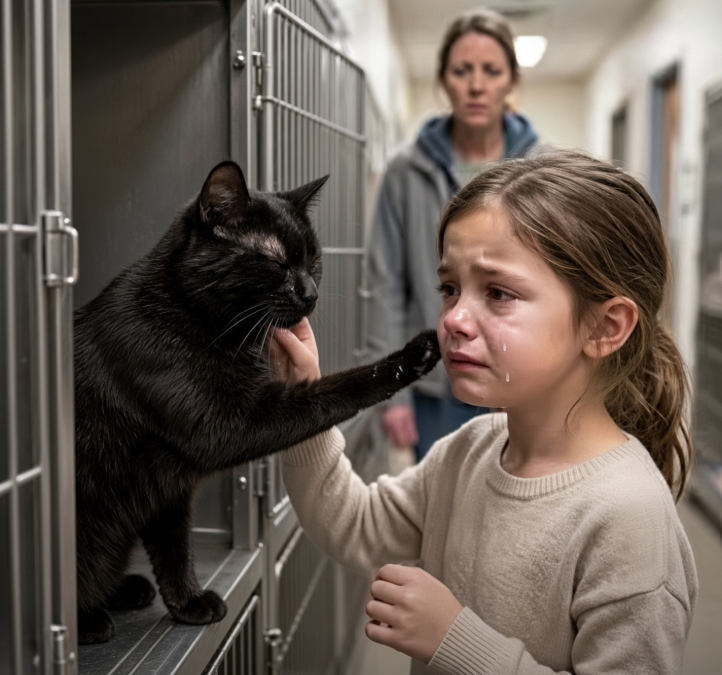
Nine Minutes Before He Was Gone, a One-Eyed Shelter Cat Touched My Silent Daughter’s Face
The shelter had already marked the scarred black cat as unadoptable, and by eight o’clock that morning, his cage was supposed to be empty forever.
My nine-year-old daughter had not spoken a single word in three years—not to me, not to her therapists, not even in her sleep.
Then, at exactly 7:51, the one-eyed cat reached through the bars, rested one paw against Emily’s cheek, and my daughter opened her mouth for the first time in 1,096 days.
My name is Daniel Mercer.
For three years, I measured my daughter’s life in silence.
Silence at breakfast.
Silence in the car.
Silence at bedtime when I read stories and still paused at the funny parts, forgetting there would be no laugh afterward.
Emily had been six when she stopped speaking.
Before that, she was loud.
She sang nonsense songs while brushing her teeth.
Gave every stuffed animal a different voice.
Asked so many questions that I once begged her for five minutes of quiet.
I would have given anything to take those words back.
Then came the night that changed her.
There had been shouting in the apartment next door.
Broken glass.
Police lights.
A neighbor Emily loved was carried outside beneath a white sheet.
I reached her too late to stop her from seeing it.
The following morning, my daughter did not speak.
At first, doctors called it shock.
Then trauma.
Selective mutism.
Severe anxiety.
Complicated grief.
The names changed.
Emily didn’t.
She communicated through nods, drawings, hand squeezes, and eventually a small whiteboard with a purple marker tied to it.
One blink meant no.
Two meant yes.
A tap against her sleeve meant too loud.
A flat hand against her chest meant:
I need to leave.
Once, after therapy, she wrote:
MY WORDS ARE HIDING.
I waited until she fell asleep before I cried.
We tried everything.
Speech therapy.
Play therapy.
Art therapy.
Routine.
Patience.
No pressure.
Every professional told me the same thing.
Don’t force the voice.
Make her feel safe enough for it to return.
Three years passed.
Then one Saturday morning, Emily and I walked into an animal shelter.
We weren’t planning to adopt.
I thought looking at cats might help her.
Most cages were loud.
Kittens meowed.
Young cats reached through the bars.
Families gathered around the friendly ones.
Then Emily stopped.
Bottom row.
Far corner.
A black cat sat pressed against the back wall.
One eye was gone.
A scar crossed the empty side of his face.
One ear was torn.
His remaining eye followed Emily.
The card on his cage had been marked differently from the others.
I asked a shelter worker about him.
Her expression changed.
“He’s had a rough time.”
PART2:
“Is he available?”
She hesitated.
“Not really.”
I looked at the clock.
7:47.
“What does that mean?”
She lowered her voice.
“He hasn’t let anyone handle him. He keeps shutting down. We’re overcrowded.”
I understood before she finished.
“When?”
“Eight.”
My stomach tightened.
Emily had already sat down on the floor.
She placed her whiteboard beside her.
The cat watched her.
She didn’t reach inside.
Didn’t tap the cage.
Didn’t try to make him perform.
She just sat there.
7:49.
The cat slowly stood.
One step.
Then another.
7:50.
He came to the front of the cage.
The shelter worker whispered:
“He’s never done that.”
Emily lifted her hand but kept it outside the bars.
The cat smelled her fingers.
Then looked directly into her face.
7:51.
Very slowly, he pushed one paw between the bars.
Emily didn’t move.
His paw touched her cheek.
Just once.
Softly.
My daughter’s eyes filled with tears.
Then her lips parted.
The shelter worker grabbed my arm.
I forgot how to breathe.
And nine minutes before that cat was supposed to disappear forever, Emily whispered the first word I had heard from her in three years…








