Nigel Had Been Overlooked 417 Times—Then the Red Card Appeared on His Cage and One Man Asked, “Does He Have to Perform Before I Can Love Him?”
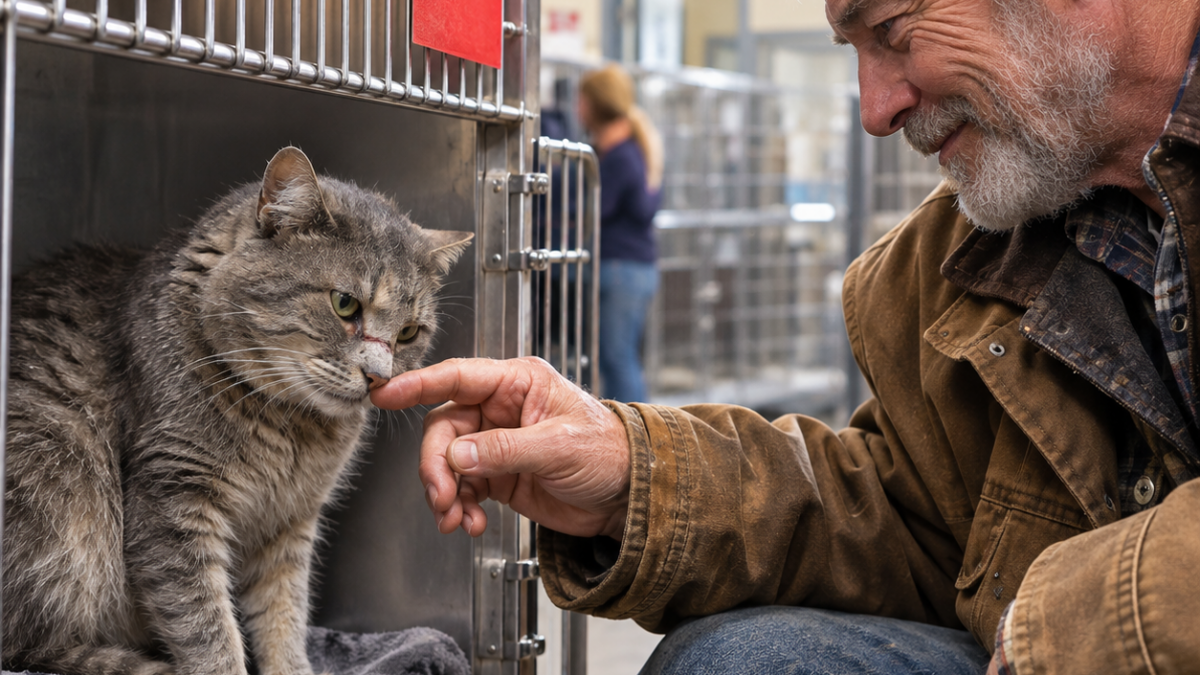
Nigel Had Been Overlooked 417 Times—Then the Red Card Appeared on His Cage and One Man Asked, “Does He Have to Perform Before I Can Love Him?”
Nigel had watched 417 people stop in front of his cage, glance at his scarred gray face, and eventually choose another cat because he would not come forward and perform for them.
Then one Tuesday morning, a red card appeared above his kennel—the quiet signal that he was about to disappear from the public adoption floor where almost nobody would ever see him again.
I opened his cage to say goodbye, but before I could close the door, a widower in a mud-stained brown jacket stopped beside us and asked the one question nobody had asked in eleven months: “Does he have to prove anything before I’m allowed to love him?”
The morning the red card appeared, Nigel did something I had never seen him do before.
He turned toward the wall.
Not the back of the cage.
The wall.
He pressed his nose into the corner and sat with his shoulders hunched as though he had somehow understood what that little piece of red laminated paper meant.
Maybe he hadn’t.
I know that.
Cats do not understand shelter bureaucracy.
They do not know intake numbers.
Adoption statistics.
Kennel capacity.
Public-floor rotation.
They certainly do not know that red cards are placed above animals scheduled to move into long-term holding.
But Nigel understood change.
He understood when humans behaved differently around him.
He understood doors closing.
And he understood disappearing.
I stood outside Cage 26 holding a stainless-steel water bowl and stared at the card.
LONG-TERM HOLDING TRANSFER.
TUESDAY — 4:00 P.M.
My stomach dropped.
My name is Sarah Bennett.
At the time, I had volunteered at Jefferson County Animal Shelter in western Pennsylvania for almost six years.
It was a county facility.
Not glamorous.
Not cruel.
Just constantly full.
Dogs barking behind concrete walls.
Cats housed in two connected rooms.
A small medical wing.
A laundry machine that broke whenever the shelter was busiest.
And a staff that spent every week making impossible decisions about space.
I want to be clear about something.
The red card did not mean Nigel was going to die that afternoon.
People hear “back room” and imagine the worst.
That was not what was happening.
PART2:
The shelter had a long-term holding area for cats who had spent too much time occupying highly visible adoption kennels.
Cats moved there when newer, more adoptable animals needed front-floor space.
They still received food.
Medical care.
Cleaning.
Volunteer visits.
But the public almost never went back there.
And for Nigel, visibility had always been the problem.
He had been invisible even when people were looking directly at him.
Move him somewhere visitors could not see him at all?
I knew what that probably meant.
Weeks.
Months.
Maybe longer.
I set the water bowl down.
“Nigel.”
His ear moved.
That was all.
I opened the cage.
Usually he would glance toward me.
Sometimes blink.
That morning he remained facing the wall.
I sat on the floor.
“I’m sorry.”
His shoulders rose and fell slowly.
“I’m really sorry.”
Nothing.
I leaned against the lower kennel door.
“Four hundred seventeen.”
That number had become almost absurd to me.
I knew because I kept records.
Not officially.
The shelter software tracked serious applications and meet-and-greets.
I kept something simpler.
Every time a visitor seriously paused for Nigel—asked his name, read his card, requested information—I made a tiny mark on the back of his volunteer sheet.
Four hundred seventeen.
Some people stayed three seconds.
Some three minutes.
A few sat with him.
Nobody chose him.
Nigel had been at Jefferson County for eleven months.
He arrived on a freezing Thursday night in January.
Animal control found him beneath the porch of an abandoned rental house after a neighbor reported hearing an animal crying.
The officer expected a kitten.
Instead she found a full-grown gray cat wedged behind rotting latticework.
He did not fight when she pulled him out.
That surprised everyone.
Most trapped, frightened cats fight.
Nigel collapsed into himself.
That was his survival strategy.
Disappear.
Even when disappearing was physically impossible.
The intake photograph still bothers me.
Gray fur thin and greasy.
Ribs visible.
A faded scar crossing the bridge of his nose.
Another smaller mark near his shoulder.
One ear tipped slightly sideways from an old injury.
His green eyes looked enormous because the rest of him was so thin.
Estimated age:
Five to seven years.
Weight:
7.3 pounds.
Adult male.
Neutered.
No microchip.
No collar.
No owner came looking.
His blood work was decent.
A few nutritional deficiencies.
Mild dental disease.
Nothing severe.
Physically, Nigel recovered quickly.
Emotionally?
That was different.
He never hissed.
That was what fooled people.
Everyone expects a traumatized cat to look dramatic.
Growling.
Swatting.
Teeth.
Flattened ears.
Nigel did none of that.
He made himself small.
If a person walked past quickly, Nigel pushed backward until his spine touched the cage wall.
If somebody reached inside, he lowered his head.
Closed his eyes.
And waited.
That waiting haunted me.
He did not defend himself.
He simply prepared himself.
For whatever came next.
The shelter veterinarian, Dr. Emily Rowan, examined him during his first week.
She touched the scar on his nose.
Nigel closed his eyes.
Emily stopped.
“What?”
I asked.
“Watch him.”
She lifted her hand again.
Nigel lowered his head.
No escape attempt.
No aggression.
Emily slowly touched his cheek.
He froze.
Every muscle.
“He’s learned not moving is safer.”
I looked at her.
“Safer than what?”
She shook her head.
“We’ll never know.”
That phrase follows rescue work everywhere.
We’ll never know.
No microchip.
No history.
No explanation.
Animals arrive carrying evidence without testimony.
Scars.
Broken teeth.
Fear of boots.
Fear of raised hands.
Fear of men.
Fear of women.
Sometimes none of those.
Sometimes only a body that flinches before anything happens.
Nigel’s first weeks were almost motionless.
I would arrive at seven in the morning.
There he was.
Back corner.
Blanket partially covering him.
I would clean.
Feed.
Replace water.
Leave.
Food remained untouched until the room emptied.
At first I thought he had appetite problems.
Then one morning I hid behind the doorway.
Thirty seconds after I left, Nigel approached the bowl.
Humans were the problem.
Not food.
That afternoon I tried something different.
I sat six feet away.
No eye contact.
No reaching.
I had an old issue of National Geographic from the break room.
So I read.
Out loud.
An article about volcanic islands.
Nigel did nothing.
The next day I read grocery advertisements.
“Chicken thighs, two ninety-nine a pound.”
Nothing.
“Laundry detergent, buy one get one.”
One ear moved.
“Okay. So you care about sales.”
Nothing.
The third day, I brought a paperback mystery novel somebody had abandoned near the volunteer lockers.
I read for twenty minutes.
Nigel remained beneath the blanket.
I left.
The fourth day, same thing.
Then fifth.
Then sixth.
I became the shelter volunteer who sat on the floor reading nonsense to a cat who appeared not to listen.
Other volunteers teased me.
“Book club?”
“Yes.”
“Does he contribute?”
“Mostly criticism.”
After two weeks, Nigel began watching me.
Not directly.
He would keep his head lowered but his eyes open.
Three weeks after I started reading, something happened.
I was halfway through a truly terrible detective novel when I heard a tiny sound.
Crunch.
I stopped.
Nigel stood beside his food bowl.
Eating.
While I was still in the room.
I almost looked straight at him.
Stopped myself.
Kept reading.
My voice shook.
“Detective Warren approached the abandoned warehouse…”
Crunch.
“…knowing somebody inside had already seen him.”
Crunch.
I barely understood the words.
Nigel ate for thirty seconds.
Then returned to the corner.
It was nothing.
And it was enormous.
The next day he did it again.
A week later, he ate for several minutes.
Then came the first time he sat at the front of the cage.
Two months after intake.
I opened the cat room door and stopped.
Nigel was sitting behind the bars.
Front.
Not hiding.
He saw me.
Immediately backed two steps.
But didn’t run all the way to the corner.
“Morning.”
His ears turned.
I went through our routine.
Cleaning.
Talking.
No pressure.
Over time, Nigel began making tiny decisions.
He stopped hiding beneath the blanket.
Then stopped retreating when I changed his water.
Then allowed me to sit closer.
Four months after arrival, I tried leaving my hand near the cage entrance.
Palm down.
Completely still.
I did not call him.
I did not wave treats.
I simply rested it there while reading.
Nigel watched my fingers.
Ten minutes.
Nothing.
Fifteen.
Then he stood.
One step.
Stopped.
Another.
I kept reading.
My heart was pounding so hard I was sure he could hear it.
He came within a foot.
Then six inches.
Then slowly lowered his head.
His forehead touched the tip of my index finger.
Less than one second.
Warm fur.
Then he jumped backward.
I wanted to cry.
Actually, I did cry later.
Not then.
I stayed absolutely still.
Because that moment was Nigel’s.
People make a mistake with frightened animals.
We celebrate progress so loudly that sometimes we turn their courage into another demand.
They approach.
We grab.
They sniff.
We pet.
They sit near us.
We pull them closer.
We think:
He trusted me!
Now I get something.
But Nigel had spent his entire life learning that approaching people came with consequences.
So I gave him none.
He touched me.
I let him leave.
That was probably the first promise I ever kept to him.
From then on, progress came slowly.
Beautifully.
Nigel began blinking at me when I entered.
Once.
Slow.
Cat language.
I blinked back.
He started sitting beside me during cage cleaning.
Still inside.
Never touching.
One rainy afternoon, a five-month-old kitten named Charlie was placed in the kennel next to him.
Charlie had been surrendered that morning.
He cried nonstop.
Loud.
High.
Desperate.
For almost an hour.
Every cat in the room became irritated.
One swatted at the divider.
Another hid beneath a bed.
Nigel did something different.
He walked to the shared wall.
Lay down.
Pressed his entire body against it.
Charlie kept crying.
Then sniffed the divider.
Nigel stayed.
Ten minutes later, Charlie curled against the other side.
The crying stopped.
I sat watching them.
Nigel never looked at me.
That was when I realized something visitors rarely saw.
Nigel was gentle.
Not timid.
Gentle.
There is a difference.
Fear made him quiet.
Kindness was separate.
He had kindness even while he was afraid.
But shelters are difficult places for animals like Nigel.
Adoption is often theater.
Not intentionally.
Visitors enter with limited time.
Children excited.
Families hopeful.
Cats react.
Some rush forward.
Some roll onto backs.
Some put paws through cage bars.
Some meow.
Some perform affection instantly.
Those cats deserve homes too.
Of course they do.
But Nigel could not compete with them.
A family would approach.
Nigel would retreat.
“He doesn’t like us.”
“No,” I would explain. “He’s scared.”
A child would stick fingers toward the cage.
Nigel would close his eyes.
“He’s boring.”
“He’s overwhelmed.”
One couple spent ten minutes with him.
The woman said:
“We need a cat who’ll greet us after work.”
I said:
“He might eventually.”
“How long?”
“I can’t promise.”
They adopted an orange tabby named Pumpkin.
Pumpkin jumped directly into the man’s arms.
Hard to compete with that.
Another family asked:
“Does he cuddle?”
“Not yet.”
“Lap cat?”
“Probably not right away.”
“Kids?”
“Older, calm children might work.”
They kept walking.
Sometimes people were polite.
Sometimes unintentionally cruel.
“Why does he look like that?”
“What happened to his face?”
“Is his ear broken?”
“He looks sad.”
“Why would anyone want the scared one?”
I became defensive.
Too defensive.
The shelter manager, Claire, noticed.
“Sarah.”
“What?”
“You can’t guilt people into choosing him.”
“I’m not.”
“You are.”
I folded my arms.
“They don’t give him a chance.”
“They’re choosing a pet for fifteen years.”
“I know.”
“They need the right match.”
“I know.”
“And Nigel needs someone who genuinely wants Nigel, not someone you emotionally corner into saving him.”
That hurt because it was true.
So I stopped selling him.
I simply told the truth.
Nigel is quiet.
Nigel is scared.
Nigel has never hurt anyone.
Nigel needs time.
Nigel may hide for weeks.
Nigel might never become a traditional lap cat.
Nigel likes other calm cats.
Nigel enjoys sitting near people once he trusts them.
Nigel does not like sudden movement.
Nigel is making progress.
Then I let people choose.
They chose somebody else.
Again.
Again.
Again.
I started keeping marks.
At one hundred, I stopped thinking about the number.
At two hundred, I became angry.
At three hundred, I stopped believing the right person was definitely coming.
At four hundred, I felt ashamed of that.
Nigel knew none of this.
He simply woke.
Ate.
Watched.
Sometimes touched my finger.
Sometimes comforted neighboring cats.
Sometimes slept in sunlight when it reached Cage 26 around two in the afternoon.
Then came Tuesday.
Red card.
I sat beside him.
“I’m sorry people keep expecting you to prove you deserve love.”
Nigel finally turned from the wall.
Green eyes.
Scar over nose.
That slightly tilted ear.
He looked tired.
Maybe I imagined it.
Probably.
Human beings love assigning meaning to animal expressions.
Still.
That morning, he looked tired.
“I wish I could explain.”
Nigel blinked once.
Then the front door opened.
Shelter bell.
I heard Claire greet someone.
Male voice.
Low.
“Morning.”
I stood.
Wiped my eyes.
A man entered the cat room.
Early sixties.
Maybe mid-sixties.
Silver hair.
Old brown canvas jacket.
Work boots with dried mud around the soles.
He looked around but did not immediately approach any cages.
That was unusual.
Most visitors scan quickly.
This man stood.
Listened.
Then asked:
“Are these the adult cats?”
“Yes.”
“I’m James.”
“Sarah.”
He nodded.
“I’m looking for an older one.”
That got my attention.
“How old?”
He shrugged.
“Older than kitten.”
“Any personality preference?”
“Not really.”
“Other pets?”
“No.”
“Children?”
“No.”
“Indoor only?”
“Yes.”
“Experience with cats?”
“My wife had them.”
Had.
I noticed the past tense.
I showed him Murphy first.
Eight-year-old tuxedo.
Friendly.
Confident.
Murphy rubbed his face against the door the second James approached.
James smiled.
“Good-looking guy.”
Murphy reached one paw toward him.
James scratched beneath his chin.
Then continued.
Next was Daisy.
Nine.
Sweet.
Talkative.
She meowed the instant James stopped.
He smiled.
“Hello.”
Daisy meowed again.
“You have opinions.”
Another smile.
Then he moved on.
I started wondering what he wanted.
Then he reached Cage 26.
Nigel saw him.
Immediately retreated.
Back corner.
Not wall-facing this time.
James stopped.
Read the cage card.
NIGEL.
Approx. 6 years.
Quiet home.
Patient adopter.
Needs time to build trust.
James looked at the red card.
“What’s that?”
My throat tightened.
“He’s being moved this afternoon.”
“Where?”
“Long-term holding.”
“Why?”
“He’s been here eleven months.”
“Is he sick?”
“No.”
“Aggressive?”
“No.”
“Then why move him?”
“Space.”
James nodded.
No judgment.
Just understanding.
He looked at Nigel again.
“How long has he been like this?”
“We don’t know what happened before he came here.”
I explained.
Abandoned house.
Under porch.
Thin.
Scarred.
No owner.
Fear.
Progress.
James listened.
Did not interrupt.
I gave him the speech I had given hundreds of times.
“Nigel needs patience.”
James nodded.
“He may hide for weeks.”
Okay.
“Maybe months.”
Okay.
“He probably won’t greet you at the door.”
Fine.
“He may never become comfortable being picked up.”
“I don’t need to pick him up.”
“He may not be a lap cat.”
James looked at me.
Then asked:
“Does he have to perform for me before I can love him?”
I stopped.
Nobody had ever asked anything remotely like that.
“What?”
James glanced toward Nigel.
“You keep explaining everything he might not do.”
I looked down.
“I just want people to understand.”
“I understand.”
“He’s afraid.”
“Yes.”
“He could take a long time.”
James nodded.
“So?”
I didn’t know what to say.
He pointed toward the floor.
“Can I sit?”
“Sure.”
I opened Nigel’s cage.
Not wide.
Enough that Nigel could choose.
James sat cross-legged several feet away.
He didn’t call Nigel.
Didn’t hold out his hand.
Didn’t offer treats.
Didn’t make little clicking sounds.
He simply sat.
Ten minutes.
Nigel remained in the corner.
James looked around the room.
“This place always this loud?”
“Pretty much.”
“Hard place to be scared.”
I looked at him.
“Yes.”
Fifteen minutes.
Nigel did not move.
Twenty.
James shifted one leg.
I thought:
Here it comes.
He’s done.
People have limits.
Then Nigel stood.
I froze.
James noticed but did not react.
Nigel stepped to the cage opening.
Stopped.
Looked at James.
One step out.
Then another.
He had almost never voluntarily left his cage during visitor hours.
Nigel crossed maybe four feet.
Stopped three feet from James.
Sat.
That was all.
No purring.
No rubbing.
No touching.
James smiled.
Not big.
Just enough.
“Hello, Nigel.”
Nigel watched him.
James rested both hands on his knees.
“That’s close enough for today.”
Something inside me broke.
I turned away.
Pretended to organize food packets.
When I looked back, Nigel had lowered himself onto the floor.
Three feet away.
Still watching.
James stayed another fifteen minutes.
Then stood slowly.
Nigel returned to the cage.
James asked:
“What do I need to do?”
“For what?”
“To take him home.”
I stared.
“You want to adopt Nigel?”
“Yes.”
“Today?”
“If possible.”
“James.”
He looked at me.
“You don’t need more time?”
“I think he does.”
That answer nearly finished me.
We started paperwork.
Name.
Address.
Veterinary reference.
Home status.
Emergency contact.
When we reached previous pets, James went quiet.
“Cat?”
I asked.
“My wife’s.”
“What happened?”
“Kidney disease.”
“Recently?”
“Three years.”
He nodded toward Nigel.
“My wife died two years ago.”
I put the pen down.
“I’m sorry.”
“Thank you.”
He said it like someone who had heard those words hundreds of times.
Not irritated.
Just familiar.
James looked through the glass door toward Nigel.
“After Linda died, everybody wanted me to get better.”
I stayed quiet.
“They meant well.”
He rubbed his thumb against the edge of the paperwork.
“My daughter kept telling me to travel.”
“My brother said join a club.”
“Friends wanted me to date.”
“Neighbors invited me to everything.”
He laughed without humor.
“One woman from church kept telling me, ‘James, you need to smile again.’”
His eyes lowered.
“It felt like my grief made other people uncomfortable.”
I knew better than to interrupt.
“So they needed me to act okay.”
He looked toward Nigel.
“Not be okay.”
“Look okay.”
There it was.
I understood.
James continued:
“I stopped going places.”
“Because?”
“I got tired of performing recovery.”
He nodded toward Cage 26.
“Maybe he’s tired of performing too.”
My eyes filled.
James noticed.
“Sorry.”
“No.”
I wiped them.
“You’re fine.”
He smiled faintly.
“I don’t need Nigel to fix anything.”
“I don’t want a therapy cat.”
“I don’t need him sleeping on my chest.”
“I don’t care if he hides under the bed.”
He looked at me.
“I just don’t want him sitting in a room somewhere thinking nobody chose him.”
That was when I excused myself.
Bathroom.
Closed door.
Cried for three minutes.
Then washed my face.
When I returned, the red card was still above Cage 26.
I took it down.
Claire saw.
“What happened?”
“Adoption.”
Her eyebrows rose.
“Nigel?”
“Yes.”
“To who?”
I pointed.
James was sitting again.
Nigel was still three feet away.
Claire watched for a moment.
Then smiled.
“Right person?”
I nodded.
“Looks like it.”
Getting Nigel into the carrier was not easy.
That mattered.
There was no miraculous transformation.
He did not suddenly trust James.
When the carrier appeared, Nigel panicked.
Retreated.
Pressed himself against the cage wall.
James stepped backward.
“Should I leave?”
“No.”
“You sure?”
“Yes.”
I covered the carrier.
Used a towel.
Moved slowly.
Nigel never bit.
Never scratched.
But his body shook.
Once inside, he curled into the far corner.
James crouched.
“I know.”
Nigel’s eyes were huge.
James whispered:
“I don’t like moving either.”
Then he carried him out.
I stood beside the shelter door.
James placed the carrier carefully in the back seat.
Seat belt through the handle.
He closed the door.
Then turned toward me.
“Anything else?”
“Don’t rush him.”
“I won’t.”
“Keep him in one room initially.”
“Okay.”
“Food, water, litter.”
“Got it.”
“Don’t pull him from hiding.”
“I won’t.”
“Let him approach.”
“Yes.”
“And James?”
He waited.
“If you feel discouraged…”
“I’ll call.”
I nodded.
Then said something I hoped was true.
“He’s worth waiting for.”
James looked through the car window.
“I know.”
They drove away.
Cage 26 was empty.
I had wanted that for eleven months.
I hated it.
The next morning, I automatically walked toward it with Nigel’s breakfast.
Stopped.
Empty.
New cat arriving later.
A young tabby.
Friendly.
Probably adopted quickly.
That was shelter life.
You love.
You release.
You make room.
Three days passed.
No message.
I resisted calling.
One week.
Still nothing.
I finally texted:
How are you two doing?
James replied:
Good.
One minute later:
I think.
Then a photograph.
Bedroom.
Bed.
Nightstand.
No Nigel.
I zoomed.
Nothing.
Message:
He’s under there.
I laughed.
I wrote:
Eating?
Yes. Only after I leave.
Litter box?
Yes.
Any aggression?
None.
Then:
I sit on floor every night and read.
I stared.
What do you read?
James:
Fishing magazine.
Then:
He’s probably bored.
I smiled.
Two weeks.
Another photo.
Nigel’s face barely visible beneath the bed.
Three weeks.
A chair beside James’s recliner.
Nigel asleep on it.
One paw stretched toward the edge.
James’s hand rested nearby.
Not touching.
The space between them was maybe two inches.
Caption:
Progress.
I cried again.
At two months, James sent a video.
Front hallway.
Door opening.
James entered.
Nigel stood at the far end.
He did not run forward.
Did not meow.
Did not rub against legs.
He simply waited.
James said:
“Hi, buddy.”
Nigel blinked.
Then walked away slowly toward the living room.
James wrote:
He waits there every day now.
I watched it six times.
At four months, the first touch.
James sent no picture.
Just a message.
He let me pet his head tonight.
I replied too quickly:
HOW?
James:
I was watching baseball.
He sat beside chair.
I put hand down.
He touched it.
I scratched once.
Stopped.
Then he came back.
Perfect.
That was exactly right.
Stop before the animal asks you to stop.
Let trust request more.
At six months, James invited me over.
I almost said no.
Sometimes former shelter cats act differently when old shelter people return.
Scent.
Memory.
Stress.
But I wanted to see him.
James lived forty minutes outside town.
Small ranch house.
Quiet road.
No children.
Large maple tree in front.
I knocked.
James opened.
“Come in.”
The house was neat without being overly neat.
Photographs of a woman everywhere.
Linda.
Wedding.
Beach.
Christmas.
Hospital fundraiser.
Life before grief.
Nigel was nowhere visible.
I expected that.
James pointed toward the living room.
“Wait.”
We sat.
Five minutes.
Nothing.
Ten.
Then Nigel appeared at the hallway entrance.
He saw me.
Stopped.
For a second, my heart sank.
Maybe I reminded him of shelter.
Then his ears moved.
He took several steps.
I stayed still.
“Hi, Nigel.”
He looked at me.
Then at James.
James sat in an old brown recliner.
Nigel walked toward him.
Jumped onto the cushion beside his hip.
I nearly gasped.
James smiled.
“He started doing this last week.”
Nigel turned once.
Then lay beside him.
His head rested against James’s forearm.
James touched the faded scar across Nigel’s nose with one finger.
Nigel closed his eyes.
Not the old closing.
Not the frightened bracing for impact.
This was sleep.
Safety.
James looked at me.
“He never needed fixing.”
I swallowed.
“No.”
“He just needed to stop being afraid.”
Nigel’s paw rested against his wrist.
James continued:
“People keep asking if I rescued him.”
I smiled.
“What do you tell them?”
“I signed paperwork.”
He looked down.
“He did the hard part.”
That was true.
Trust is work.
Especially after fear.
Nigel never became a different cat.
That is important.
His story would be easier if I said he transformed completely.
He did not.
He remained quiet.
Strangers still frightened him.
When James’s daughter visited, Nigel usually disappeared for the first hour.
He hated the vacuum.
Thunder sent him beneath the bed.
He never enjoyed being picked up.
If somebody reached too quickly, he flinched.
Some histories remain inside the nervous system long after danger ends.
Safety does not erase memory.
It teaches the body something new beside it.
Nigel learned:
This house is safe.
This chair is safe.
This man is safe.
Food appears every morning.
Nobody drags me from hiding.
Nobody demands affection.
Doors open.
Doors close.
James comes back.
That last part mattered.
James always came back.
For the first year, whenever he left home, Nigel waited at the hallway.
At first far back.
Then closer.
Eventually beside the front door.
One evening, James returned from the grocery store.
Nigel was sitting six feet from the entrance.
James set the bags down.
“Hey.”
Nigel walked forward.
Rubbed his cheek once against James’s leg.
Then left.
James called me immediately.
“You’re not going to believe this.”
I did.
I absolutely believed it.
Because trust often grows when nobody is measuring it.
One year after the adoption, I visited again.
Nigel looked healthier.
His coat thick.
Gray fur silver in sunlight.
He had gained two pounds.
The worried tilt of one ear remained.
Scar remained.
But his posture had changed.
He took up space.
That sounds small.
It wasn’t.
At the shelter, Nigel compressed himself.
Shoulders inward.
Head low.
Body curved.
At James’s house, he stretched across an entire couch cushion.
Feet extended.
Belly partially exposed.
Not because anyone trained him.
Because safe animals occupy space.
James had changed too.
The first time I met him, he looked exhausted.
At the one-year visit, he still missed Linda.
Obviously.
There was no miracle cure there either.
Her photographs remained.
Her mug stayed in the kitchen cabinet.
He still visited the cemetery every Sunday.
But grief had changed shape.
James joined a woodworking group.
Not because people nagged him.
Because one day he wanted to.
He started having coffee with his brother again.
He planted tomatoes.
Badly.
Nigel destroyed one seedling.
James sent me a photo.
Murder suspect at scene.
Nigel sitting beside a broken plant.
I replied:
No remorse.
James:
None.
People occasionally told James:
“Looks like that cat helped you heal.”
He disliked that.
One afternoon he explained why.
“Nigel didn’t heal me.”
“What do you mean?”
“He sat with me while I was hurting.”
He looked toward Nigel.
“That’s different.”
I understood.
We are too quick to turn love into medicine.
Some things do not cure us.
They accompany us.
That can be enough.
James never asked Nigel to replace Linda.
Nigel never asked James to become happy.
They simply shared rooms.
Meals.
Quiet.
Long winter afternoons.
That relationship worked because neither demanded performance from the other.
Years later, I still think about the 417 people.
I do not blame them.
Mostly.
Adoption is personal.
People should choose animals appropriate for their homes.
A family with toddlers may not have been right for Nigel.
Someone wanting an outgoing cat would have been disappointed.
Some cats genuinely thrive in busier households.
Matching matters.
But I wish more people understood what fear looks like.
It does not always snarl.
Sometimes fear sits quietly.
Sometimes it refuses eye contact.
Sometimes it makes an animal appear uninterested when the truth is the animal desperately wants connection but has learned connection is dangerous.
The same can be true of people.
I learned that from James.
The world rewarded obvious need.
Cry loudly enough, somebody asks what’s wrong.
Ask for help, somebody may offer it.
But Nigel never asked.
James stopped asking too.
Both had learned to make grief private.
One because he was an animal.
One because people kept trying to hurry him through it.
Then they found each other.
Not dramatically.
No instant bond.
No cat leaping into his arms.
No magical purring scene.
Just three feet of floor.
Nigel sat.
James stayed.
That was their beginning.
The red card from Nigel’s cage is still in my desk.
Technically I probably should have thrown it away.
I didn’t.
LONG-TERM HOLDING TRANSFER.
TUESDAY — 4:00 P.M.
Sometimes new volunteers ask about it.
I tell them.
Not as guilt.
As reminder.
The cat facing the wall may not be hopeless.
The cat who doesn’t approach may not be unfriendly.
The animal who takes months may still have years of love inside them.
You just may not get to see it immediately.
The shelter eventually changed how we handled long-stay cats.
We created quiet meet-and-greet spaces.
Videos showing cats after hours when the building was calm.
Foster weekends.
Profiles focused less on what animals could not do.
Nigel’s profile today might say:
Quiet companion.
Enjoys peaceful homes.
Likes sitting near trusted people.
Gentle with other cats.
Needs an adopter who values slow relationships.
That sounds very different from:
Shy.
Hides.
Not affectionate.
Needs time.
Language changes what people imagine.
One year, we started something called Sit With Me Saturday.
Visitors could enter quiet rooms with shy cats and simply read.
No touching required.
No pressure.
I borrowed the idea from Nigel.
It worked.
Not magically.
But enough.
An elderly tabby named Rose who had spent seven months hiding was adopted by a teacher after four reading sessions.
A frightened black cat named Oliver went home with a college student who studied beside his enclosure twice a week.
A bonded pair nobody could touch found a retired couple willing to give them an entire spare bedroom and six months.
Small successes.
Nigel never knew he started any of that.
James thought it was hilarious.
“You made him a program?”
“He has branding now.”
“Does he get royalties?”
“No.”
“Exploitative.”
I laughed.
James sent me a photograph.
Nigel sprawled on the recliner.
Caption:
Union representative will contact you.
At three years after adoption, Nigel had one health scare.
Dental abscess.
Needed anesthesia.
James called me from the veterinary parking lot.
His voice shook.
“He’s okay.”
“You sure?”
“Vet says yes.”
“Then breathe.”
Silence.
Then:
“I didn’t know I could get this attached again.”
That sentence broke my heart.
After Linda died, James had protected himself too.
Not just socially.
Emotionally.
Loving Nigel meant eventually losing Nigel.
He knew that.
Still chose him.
That is another kind of courage people rarely describe.
Love after loss is not proof the loss mattered less.
It means you accepted the possibility of pain again.
Nigel recovered.
Lost two teeth.
Became dramatically offended by medication.
James called him “the world’s least cooperative patient.”
Nigel responded by hiding beneath the couch.
At four years, Nigel finally became something close to a lap cat.
Not often.
Only during winter.
Only when James covered his legs with Linda’s old wool blanket.
One night, Nigel stepped onto the recliner.
Turned.
Climbed onto James’s thighs.
Lay down.
James did not move for forty-five minutes.
His legs fell asleep.
He called me later.
“I almost died.”
“Worth it?”
“Yes.”
“Did you pet him?”
“No.”
“Why?”
“I wasn’t risking it.”
Correct.
The next week Nigel did it again.
Then again.
By February it had become routine.
The cat who had once closed his eyes when hands approached now slept while James rested one hand on his back.
No performance.
No training.
No deadline.
Just time.
Six years after I first met Nigel, James sent me a photograph on the anniversary of his adoption.
Nigel was older.
More silver around his face.
Still scarred.
Still worried-looking because of that crooked ear.
He was asleep beside James.
The caption said:
He waited 417 people for me.
I replied:
Maybe you waited 417 people for him too.
James responded:
Probably.
That is how I think about them now.
Not rescuer and rescued.
Two quiet lives arriving at the same moment.
Nigel had spent almost a year being passed over because he would not become what strangers wanted quickly enough.
James had spent two years listening to people tell him grief should move faster.
Neither needed transformation.
They needed room.
That is what love sometimes looks like.
Not changing someone.
Not rescuing them from every difficult feeling.
Not dragging them toward the version of happiness we understand.
Sometimes love is sitting three feet away.
Hands in your lap.
No expectation.
Saying:
That’s close enough for today.
And meaning it.
Nigel taught me that before I had words for it.
He never ran toward anyone.
Never begged.
Never climbed the bars.
Never presented himself like an advertisement for adoption.
He sat quietly.
And for 417 people, quiet looked like nothing.
James saw something else.
He saw a cat who had survived by disappearing.
Then gave him a home where disappearing was no longer necessary.
Nigel did not become louder.
He became visible.
There is a difference.
The last photograph James sent me recently showed Nigel sleeping completely stretched across the middle of their bed.
Not tucked into a corner.
Not beneath furniture.
Not pressed against a wall.
Right in the center.
Taking up as much room as he wanted.
James wrote:
Look who owns the place now.
I stared at that photograph for a long time.
Then I thought about the morning of the red card.
Nigel facing the wall.
Making himself smaller.
Trying, in whatever way frightened animals do, to disappear before the world could move him somewhere nobody would ever see him again.
He had no idea that the front door was about to open.
No idea a tired man in muddy boots was walking toward Cage 26.
No idea that for the first time in eleven months, somebody was about to look at everything Nigel could not give and decide none of it mattered.
James never asked him to be playful.
Never asked him to be cuddly.
Never asked him to greet visitors.
Never asked him to stop being afraid on anyone else’s schedule.
He asked only one thing.
Nothing.
And because of that, eventually Nigel gave him everything he knew how to give.
A place beside the chair.
A paw near his hand.
A quiet wait at the end of the hallway.
A forehead against his fingers.
A body sleeping without fear.
Trust.
Some animals do not need us to teach them how to love.
They already know.
They are simply waiting to discover whether loving us is safe.
Nigel waited eleven months.
He was overlooked 417 times.
Then one man sat on the floor and refused to make him prove anything.
For Nigel, that was finally enough.








