My Wife Asked for One Maine Coon Kitten for Valentine’s Day—Then the Mother Cat Cried When We Tried to Take Her Baby Away
PART3:
Every time one appeared online, she showed it to me.
Huge paws.
Tufted ears.
Ridiculous tails.
Cats that looked like miniature forest animals but behaved like oversized house pets.
She had once joked that if we ever got one, she wanted one big enough to pay rent.
“You’ve researched this,” I said.
“A little.”
“How little?”
She looked guilty.
“I know three shelters and two rescue groups within forty miles that currently have Maine Coon mixes.”
I stared.
“Rachel.”
“What?”
“That isn’t a little.”
“Fine.”
She pulled the blanket higher.
“I’ve been looking for about two weeks.”
That told me more than she intended.
I sat up.
“Why didn’t you tell me?”
She shrugged.
“I didn’t know if I actually wanted one.”
“You absolutely want one.”
“I know.”
“So why are you acting like you’re asking permission to buy a yacht?”
Her eyes dropped.
And suddenly I understood that the kitten was not really what she was afraid to ask for.
She said quietly, “I don’t want you thinking I’m trying to replace something.”
The room changed.
There were conversations in a marriage where you could joke.
And there were conversations where one wrong sentence could sit between you for years.
I took her hand.
“I don’t think that.”
“You didn’t even let me explain.”
“You don’t have to.”
Her eyes filled.
“Ben…”
“No.”
I moved closer.
“You wanting something to love does not mean you’re replacing anything.”
She looked toward the window.
“I know it sounds ridiculous.”
“It doesn’t.”
“I just…”
Her voice became thin.
“I’m tired of our house feeling empty.”
I did not answer right away because I knew what empty meant.
It did not mean furniture.
Our house had too much furniture.
It did not mean noise.
The refrigerator hummed.
The television played.
My tools clattered in the garage.
Rachel listened to podcasts while cooking.
Empty meant the bedroom at the end of the hall.
The one we had painted pale yellow six years earlier.
The one we had jokingly called “the future.”
Then the future had changed.
It had changed in a doctor’s office with beige walls and a print of sailboats hanging behind a reproductive endocrinologist named Dr. Lawson.
I remembered everything about that appointment.
The rain outside.
Rachel’s blue sweater.
The way the doctor kept turning his pen between his fingers.
Words like diminished ovarian reserve.
Complications.
Low probability.
Further testing.
Options.
Rachel heard only one sentence.
Pregnancy may not happen naturally, and even with intervention, the chances may be significantly reduced.
The doctor did not say never.
Rachel heard never.
We tried anyway.
Tests.
Appointments.
Medication.
Procedures.
Waiting.
Hope.
Bloodwork.
More waiting.
Then disappointment.
Again.
Again.
Again.
There came a point when the medical language became unbearable.
Follicles.
Cycles.
Numbers.
Percentages.
Everything reduced to measurements.
We stopped after two years.
Not because we had accepted it.
Because Rachel’s body and our marriage were becoming laboratories.
I told her I wanted her more than I wanted a child.
That was true.
She believed me.
Mostly.
But grief is strange when the person you love is grieving something you cannot fix.
You start noticing small disappearances.
Rachel stopped going to baby showers unless she absolutely had to.
Then she hated herself for avoiding them.
She smiled when friends announced pregnancies and cried in the car afterward.
She became the best aunt in our family and then sat silently during the drive home.
Our yellow room slowly became storage.
Christmas decorations.
Boxes.
An old treadmill.
Things placed where a crib had once existed only in imagination.
I never pushed.
Neither did she.
We built a good life.
Actually good.
Not the version people say is good because they are trying to survive disappointment.
We traveled.
We renovated our kitchen.
Rachel changed careers and became a speech therapist at an elementary school.
I started my own small electrical contracting business.
We loved each other.
We laughed.
We fought about laundry.
We hosted Thanksgiving.
We had friends.
But some sadness does not cancel happiness.
It simply lives beside it.
So when Rachel said the house felt empty, I knew she was not saying our life had no value.
She was saying she wanted something alive inside it that needed us.
I squeezed her hand.
“What shelter?”
She looked at me.
“What?”
“The kitten.”
“Ben.”
“You said there are three shelters.”
“You’re serious?”
“I’m already dressed emotionally.”
“You’re wearing pajama pants.”
“Temporary setback.”
She laughed.
Then covered her face.
“Oh my God.”
“What?”
“I’m actually going to cry.”
“Please don’t. I haven’t even put on shoes.”
She lowered her hands.
“You really want to?”
“I really want you to stop pretending this is complicated.”
“It is complicated.”
“No. The other things are complicated.”
I kissed her forehead.
“This one is easy.”
Two hours later, we were driving toward a county animal shelter twenty-five minutes from our house.
Rachel had already shown me the kitten online.
The shelter listing had been posted the night before.
Female Maine Coon mix.
Approximately ten weeks old.
Brown tabby.
Available pending medical clearance.
The picture showed a tiny ball of fur with absurdly large ears and one paw resting against the kennel door.
“I swear,” Rachel said for the fourth time, “if somebody already adopted her, I’m not going to be upset.”
“You’ve refreshed the listing fourteen times.”
“Fifteen.”
“Strong emotional detachment.”
“I’m prepared.”
“You named her in your head?”
Silence.
I looked over.
“Rachel.”
“She looks like a Luna.”
“She already has a shelter name.”
“Buttons is a terrible name.”
“It’s not terrible.”
“It’s humiliating.”
“She’s a cat.”
“Exactly. Dignity matters.”
We pulled into the shelter parking lot shortly before eleven.
There were paper hearts taped to the front windows.
ADOPT YOUR VALENTINE was written across a sign near the entrance.
Rachel groaned.
“That is aggressively cheesy.”
“You love it.”
“I do.”
Inside, the shelter smelled like disinfectant, dog shampoo, and the unmistakable presence of too many animals.
Barking echoed from the back.
A receptionist named Karen greeted us.
“We’re here about Buttons,” Rachel said.
I watched her face when she said the shelter name.
Physical pain.
Karen smiled.
“The Maine Coon kitten?”
“Yes.”
“She’s still available.”
Rachel grabbed my hand so hard my wedding ring pressed into my finger.
“Wonderful.”
Karen pulled up the record.
“She just finished her veterinary check this morning.”
“Healthy?”
“Looks good.”
She glanced at the screen.
“She’ll need to come back for her spay appointment because she’s still a little young, but everything else is fine.”
Rachel exhaled.
“Can we meet her?”
“Of course.”
A volunteer named Megan led us through the cat wing.
Cats watched from kennels.
Some slept.
Some reached through the bars.
One black cat shouted at us as though personally offended we had not already opened his door.
I stopped.
“That guy has opinions.”
Megan laughed.
“That’s Walter.”
Walter shouted again.
“What’s his problem?”
“Existence.”
“Understandable.”
Rachel was barely listening.
She was looking ahead.
Megan stopped at a larger enclosure near the end.
“There she is.”
Rachel’s face changed instantly.
“Oh.”
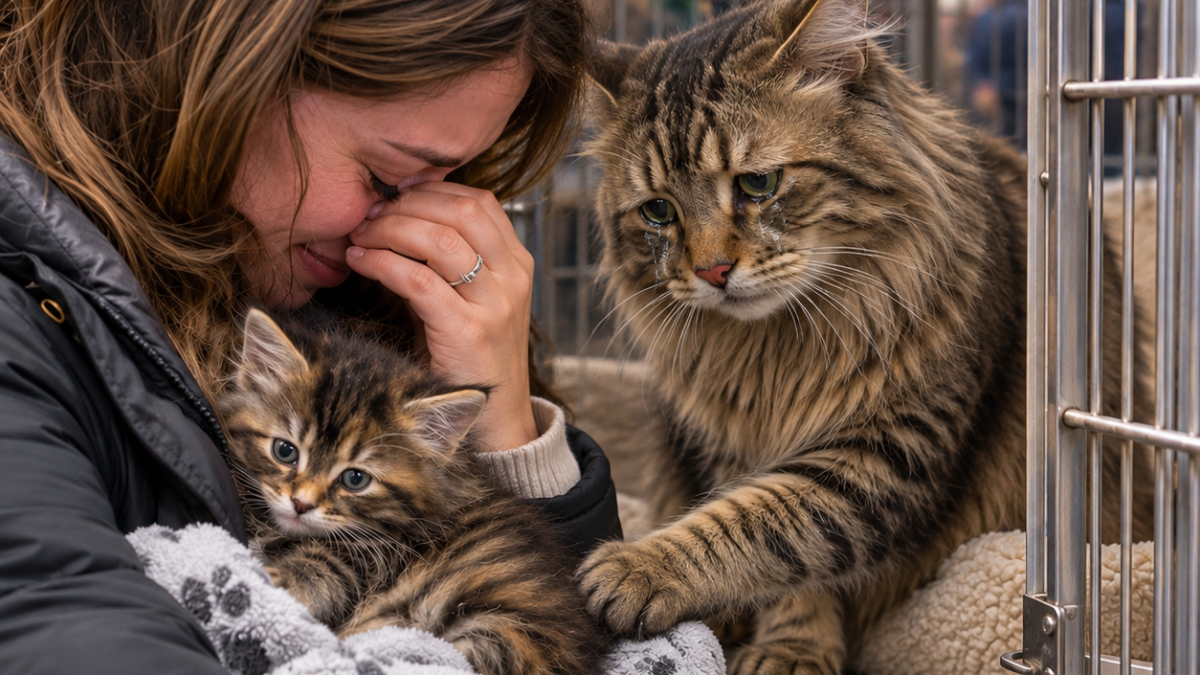
Luna—still officially Buttons—was even smaller than she looked online.
Fluffy brown fur.
Dark tabby markings.
White around her chin.
One ear folded slightly at the tip, giving her a permanently curious expression.
She was sitting near a larger cat.
I noticed the adult before Rachel did.
She was magnificent.
Long brown coat.
Deep green eyes.
Heavy plume of a tail curled around her paws.
Her body looked tired, though.
Thin beneath the fur.
One small scar crossed her nose.
Her coat had mats along the back that someone had started carefully trimming.
Luna climbed over her mother’s front leg.
The adult cat lowered her head and groomed the kitten’s ear.
Rachel whispered, “That’s her mom?”
Megan nodded.
“Yep.”
“What’s her name?”
“Willow.”
I looked at the enclosure card.
Willow.
Female.
Approximately four years.
Maine Coon mix.
Found abandoned with litter.
Rachel frowned.
“A litter?”
“She had four kittens when animal control found them.”
“Where are the others?”
“Two were adopted yesterday.”
“And the fourth?”
“Male. He’s being held for someone who put in an application this morning.”
Rachel looked at Willow.
“So she’s losing all of them.”
Megan’s expression shifted slightly.
“Well…”
She did not answer directly.
Rachel noticed.
“How long has Willow been here?”
“About seven weeks.”
“And Luna?”
“Same.”
Megan opened the enclosure.
“Want to hold her?”
Rachel nodded.
Megan lifted Luna carefully.
The kitten immediately curled into Rachel’s arms.
That was it.
Rachel disappeared.
Emotionally.
Mentally.
I lost my wife to eight pounds of future cat.
“Oh my God.”
Luna pushed her face beneath Rachel’s chin.
“Oh, Ben.”
“I see her.”
“Look at her paws.”
“I see them.”
“They’re enormous.”
“They’re paws.”
“She’s going to be huge.”
“You sound proud already.”
Rachel laughed.
A sound I had not heard enough in recent years.
Not polite laughter.
Not the laugh she used at work parties.
This came from somewhere deep.
Luna started purring.
Rachel’s eyes closed.
I watched her hold that kitten.
One hand supporting her body.
The other moving slowly through the fur.
I felt something in my chest break open.
Not because I imagined Rachel as a mother.
I had learned not to turn every tender moment into that.
It was simpler.
She looked happy.
Completely.
Without hesitation.
Megan handed me the adoption folder.
“We can start paperwork if you’re interested.”
Rachel looked at me.
I said, “Obviously.”
She smiled.
“Luna.”
Megan raised an eyebrow.
“Luna?”
“That’s her new name.”
I nodded gravely.
“Buttons has been legally challenged.”
Megan laughed.
“Fair enough.”
We filled out the application.
Home ownership.
Veterinary reference.
Indoor-only agreement.
Spay commitment.
Emergency contact.
Then came the checkout process.
Rachel carried Luna.
I carried paperwork.
Megan walked us toward the lobby.
We were twenty feet from the door when we heard it.
A sound from behind us.
Quiet.
Almost too quiet to notice.
“Mrrrow.”
Rachel stopped.
So did I.
She turned.
Willow was standing against the front of the enclosure.
Not yowling.
Not clawing.
Not panicking.
Just looking toward us.
Toward Luna.
She made the sound again.
Low.
Questioning.
Luna’s ears lifted.
Her head came up from Rachel’s chest.
She answered.
A tiny chirp.
Willow pressed closer to the enclosure door.
Rachel’s face changed.
“No.”
I knew immediately what she was feeling.
“Rachel.”
She stared at Willow.
Megan stopped beside us.
“What happens to her?”
“To Willow?”
“Yes.”
“She’ll stay available for adoption.”
“For how long?”
Megan hesitated.
“There’s no deadline.”
“That’s not what I asked.”
I touched Rachel’s shoulder.
Megan answered carefully.
“Adult long-haired cats can sometimes wait.”
“How long?”
“Depends.”
“Weeks?”
“Yes.”
“Months?”
“Sometimes.”
Rachel looked down at Luna.
Then back at Willow.
Megan added gently, “Kittens usually go quickly.”
Rachel’s eyes filled.
“But mothers don’t.”
Megan did not answer.
She did not need to.
Willow made the sound again.
Rachel’s lower lip trembled.
“She’s about to lose her baby.”
I saw it happen.
Not decision.
Recognition.
Something in Rachel looked at Willow and understood too much.
A mother.
A baby.
Separation decided by other people.
A future that changed without consent.
I wanted to tell her not to project.
I wanted to protect her from turning someone else’s story into her own pain.
But I looked at Willow.
And I could not pretend the cat did not know Luna was leaving.
Luna stretched one paw toward the enclosure.
Rachel whispered, “Oh God.”
She turned to me.
I already knew.
“You want her too.”
Rachel wiped her face.
“That’s ridiculous.”
“You want her too.”
“We came for one cat.”
“We also came for dinner tonight. Plans change.”
“Ben.”
I looked toward Willow.
“Ask.”
Rachel stared.
“Seriously?”
“Ask.”
She turned to Megan.
“Can we adopt Willow too?”
Megan froze.
“What?”
“Her mother.”
“You mean together?”
“Yes.”
Megan smiled slowly.
“Absolutely.”
Rachel looked at me again.
“Are we crazy?”
“Yes.”
“Two Maine Coons.”
“Financially irresponsible amounts of fur.”
“She’s an adult.”
“That is generally how mothers work.”
Rachel laughed while crying.
Megan opened Willow’s enclosure.
Willow did not immediately come out.
She looked at Luna.
Luna chirped.
Then Willow stepped forward.
She sniffed Rachel’s hand.
Then her daughter.
Luna pushed her face against Willow’s.
Willow began licking the kitten’s forehead.
Rachel completely lost it.
She turned into my chest.
“I can’t.”
I put my arms around her.
“You don’t have to.”
“I’m happy.”
“I know.”
“I hate that I’m crying.”
“You cry at dog-food commercials.”
“That golden retriever was old.”
“Deeply manipulative advertising.”
Megan stood quietly.
Her own eyes were wet.
“Do people ever adopt moms with kittens?” Rachel asked.
“Sometimes.”
“But not often.”
“Not as often as we’d like.”
Rachel looked at Willow.
“Why?”
Megan shrugged.
“Kittens are easier to imagine starting fresh with.”
The sentence stayed with me.
Starting fresh.
As if adults came with too much history.
As if having survived something made an animal less desirable.
Rachel reached down.
Willow sniffed her fingers.
“Can I hold her?”
“Let her decide.”
Rachel crouched.
Willow took several seconds.
Then walked forward and pressed her forehead into Rachel’s palm.
Rachel closed her eyes.
“That’s it.”
I smiled.
“What?”
“I’m not leaving her.”
An hour later, we left the shelter with two cats.
This time, I insisted both travel in secure carriers.
Rachel wanted Luna and Willow together.
Megan approved one large carrier temporarily because the cats were bonded and the drive was short.
I placed them on the back seat.
Luna curled against Willow’s stomach.
Willow wrapped her tail around the kitten.
Rachel sat in the passenger seat twisted around to watch them.
“They’re holding each other.”
“Yes.”
“She knows.”
“Probably.”
“She knows we kept them together.”
“I don’t know if she knows that exactly.”
Rachel turned.
“Why do you ruin things?”
“I’m an electrician. Precision matters.”
“Drive.”
“Yes, ma’am.”
Halfway home, I glanced in the rearview mirror.
Willow was awake.
Watching us.
Luna slept beneath her chin.
For some reason, the sight made me emotional.
Not because we had done something heroic.
We had not.
We had adopted cats.
People did it every day.
But there was a quiet relief in knowing that one relationship did not have to be broken simply because it was convenient.
We could afford two.
We had space for two.
So we chose two.
At home, Willow refused to leave the carrier.
Luna did not.
The moment I opened the door, Luna marched into our living room as though she had paid the mortgage.
She sniffed the couch.
Attacked a rug tassel.
Discovered a cardboard box.
Forgot the rug.
Returned to attack the rug again.
Rachel sat on the floor laughing.
Willow remained inside the carrier.
“Is she okay?”
“Probably scared.”
Rachel crawled closer.
“Should we get her out?”
“No.”
“But—”
“Remember Megan.”
Rachel nodded.
“Let her decide.”
We put food and water nearby.
Moved Luna’s litter box into the guest bathroom.
Then we sat.
Twenty minutes.
Thirty.
Luna climbed into Rachel’s lap.
Willow watched.
At forty-five minutes, one paw emerged from the carrier.
Rachel noticed but did not react.
Then Willow’s head.
Then shoulders.
She stepped out.
Low to the ground.
Every muscle cautious.
She sniffed the carpet.
Looked at me.
Looked at Rachel.
Looked toward Luna.
Luna chirped.
Willow crossed the room.
She went straight to her kitten.
Licked Luna’s face.
Then sat beside her.
Rachel whispered, “She was making sure.”
“Making sure what?”
“That Luna was really here.”
I did not argue.
That first week transformed our house.
Luna behaved like someone had loaded chaos into a small furry body.
She climbed curtains.
Knocked pens from tables.
Tried to enter the refrigerator.
Attacked my shoelaces while I was wearing them.
At three in the morning, she discovered that sprinting down the hallway produced an excellent echo.
Willow was the opposite.
Quiet.
Watchful.
Careful.
She inspected each room before settling.
She rarely climbed onto furniture.
She never approached food until Luna had eaten.
That bothered Rachel.
“Why does she do that?”
“Do what?”
“Wait.”
I watched.
Luna ate from one bowl.
Willow sat three feet away.
Only after Luna wandered off did Willow approach.
“Maybe she’s used to feeding kittens first.”
Rachel’s face tightened.
“How long was she outside?”
I had read the shelter paperwork.
“Unknown.”
“Where did they find them?”
“Behind an apartment complex.”
“With four babies.”
“Yes.”
“Was someone feeding her?”
“Animal control report says a maintenance worker had seen her around dumpsters.”
Rachel looked at Willow.
“How long?”
“We don’t know.”
Rachel hated those words.
We don’t know.
They were too familiar.
We did not know why fertility treatment had failed.
We did not know whether another attempt would have worked.
We did not know whether stopping had been the right decision.
We did not know what our life would have looked like if one number had been different.
Uncertainty can become its own wound.
Rachel started trying to solve Willow.
Extra food.
Different bowls.
Private feeding spaces.
The first time Willow ate before Luna finished, Rachel came into my office like someone had won the lottery.
“She ate.”
“She eats every day.”
“First.”
I looked up.
“What?”
“She started before Luna.”
“That’s good?”
“Yes.”
“Then congratulations.”
“You don’t understand.”
“I clearly don’t.”
“She trusts that there will be enough.”
That stopped me.
Rachel leaned against the doorframe.
“She doesn’t have to wait anymore.”
I watched her face.
Sometimes people heal by recognizing healing somewhere else.
Willow gained weight.
Her coat improved.
The mats disappeared.
The scar on her nose remained.
Luna grew at a ridiculous rate.
At three months, she was all paws.
At four, she learned to open cabinet doors.
At five, she could jump from the kitchen island to the top of the refrigerator, an achievement Rachel applauded and I strongly discouraged.
“They’re not children,” I said one evening after discovering Luna inside a cupboard.
“I know.”
“You just told her ‘Mommy said no.’”
Rachel froze.
The room changed instantly.
I regretted it.
Not the observation.
The way I had said it.
Rachel looked down.
“Sorry.”
“No.”
“Ben—”
“No. I’m sorry.”
She walked toward the sink.
I followed.
“You can call yourself whatever you want.”
“That’s not what I meant.”
“I know.”
She gripped the counter.
“Sometimes it just comes out.”
“Okay.”
She looked at me.
“I know a cat isn’t a baby.”
“I know you know.”
“I’m not confused.”
“Rachel.”
Her eyes filled.
“I hate feeling like people are watching me.”
“Who?”
“Everyone.”
“Who is everyone?”
“My sister. Your mother. Friends.”
“About the cats?”
“About me.”
She wiped beneath one eye.
“Like they’re all wondering if I’m turning into some stereotype because we couldn’t have kids.”
Anger moved through me.
“Has anyone said that?”
“No.”
“Then don’t give imaginary people real power.”
“It’s not that easy.”
“I know.”
She looked toward the hallway.
Luna was chasing Willow’s tail.
“I love them.”
“That is allowed.”
“I know.”
“You can love them a stupid amount.”
She laughed weakly.
“How stupid?”
“I bought Willow a heated bed yesterday.”
Rachel stared.
“You said that was excessive.”
“I changed my position.”
“You bought it?”
“Delivery tomorrow.”
Her smile returned.
“Hypocrite.”
“Correct.”
We learned quickly that Willow had one particular fear.
Men wearing heavy boots.
The first time my brother came over after work, still wearing steel-toed construction boots, Willow disappeared under the bed.
She would not come out for hours.
We did not know why.
The shelter had no history beyond the apartment complex.
Maybe nothing.
Maybe something.
We stopped needing answers.
My brother started leaving his boots at the door.
“Your cat gets accommodations now?”
“Yes.”
“What about me?”
“Socks are permitted.”
Willow slowly began trusting visitors.
Not everyone.
She liked older women.
Ignored children.
Hated my friend Jason for reasons none of us understood.
Jason took it personally.
“What did I do?”
Rachel shrugged.
“Cats sense character.”
“That’s insulting.”
“Take it up with Willow.”
Luna loved everybody.
The plumber.
Delivery drivers.
A woman conducting a neighborhood survey.
Once she climbed inside an electrician’s tool bag and nearly left the house.
I was the electrician.
Rachel found that especially funny.
Six months after the adoption, something happened that I did not understand until later.
Rachel started opening the yellow-room door again.
It had been storage for years.
One Saturday, I found boxes in the hallway.
Christmas decorations.
Old tax records.
The treadmill.
“What are you doing?”
“Cleaning.”
“Why?”
She shrugged.
“I want this room back.”
“For what?”
“I don’t know.”
I looked at her.
“Okay.”
We cleaned.
No discussion about babies.
No discussion about what it had once been intended for.
We painted over the pale yellow with soft green.
Rachel added a chair near the window.
Bookshelves.
A desk.
Cat shelves along one wall.
Willow claimed the chair.
Luna claimed everything.
The room became Rachel’s reading room.
Sometimes she worked there.
Sometimes she simply sat with the cats.
One evening I stood in the doorway.
Rachel was reading.
Willow slept beside her.
Luna sprawled across the windowsill.
The room was full.
Not the way we had once imagined.
But full.
Rachel looked up.
“What?”
“Nothing.”
“You’re staring.”
“I like this room.”
She smiled.
“Me too.”
That was the first time in years I stopped thinking of it as the nursery that never happened.
It was just a room.
Ours.
A year after Valentine’s Day, the shelter emailed us.
Megan had stayed in touch because Rachel sent too many pictures.
The email subject read:
YOU’RE NOT GOING TO BELIEVE THIS.
Rachel opened it at breakfast.
Then gasped.
“What?”
“Ben.”
“What?”
She turned the laptop.
The message explained that Willow had been part of an ongoing cruelty and neglect investigation connected to the apartment complex where she had been found.
Not because someone had intentionally hurt her directly.
Because investigators had identified the person believed to have abandoned her.
A former tenant named Darren Cole.
According to neighbors, Willow had belonged to Darren’s girlfriend.
When she moved out after a domestic dispute, she believed Darren would keep the cat temporarily.
Instead, he put Willow outside.
Unspayed.
Pregnant.
He moved weeks later.
Rachel stared at the email.
“She had a home.”
“Apparently.”
“He threw her out.”
“Looks like it.”
“Pregnant.”
“Yes.”
Rachel’s eyes hardened.
“Do they know where the girlfriend is?”
“There’s more.”
We kept reading.
The woman’s name was Ava.
She had contacted the shelter after seeing Willow in a social media update.
She had spent months looking for her.
Darren had told her Willow had escaped.
Rachel put one hand over her mouth.
“Oh no.”
Ava had been living in another state with family after leaving the relationship.
She had reported the cat missing but never found her.
Now she knew Willow was alive.
And adopted.
Rachel went completely still.
I knew the fear before she said it.
“She wants her back.”
“We don’t know that.”
“She’s her cat.”
“Was.”
Rachel looked at me.
“Ben.”
“Read the rest.”
Megan wrote that Ava was not requesting legal ownership.
She wanted only to know whether Willow was safe.
If we were comfortable, she hoped to see a photograph.
Rachel read the sentence twice.
Then began crying.
“Send everything.”
“What?”
“Pictures.”
“Rachel.”
“All of them.”
“That’s approximately nine thousand photographs.”
“Fine. Pick fifty.”
We sent twelve.
Willow asleep in the green room.
Willow grooming Luna.
Willow on the couch.
Willow stealing turkey.
Willow lying beside Rachel.
Willow wearing the Christmas bow she tolerated for three seconds.
Ava replied that evening.
Thank you for keeping her baby with her.
Rachel read that sentence and had to leave the room.
I found her in the green room.
Willow was on her lap.
Rachel’s face was buried in the cat’s neck.
I sat beside them.
“She called Luna her baby.”
“Yeah.”
Rachel wiped her face.
“She didn’t ask for Willow back.”
“No.”
“She could have.”
“Maybe.”
“I would have understood.”
I was not sure I would have, but I said nothing.
Rachel looked at me.
“Would we have had to?”
“I don’t know.”
“But she didn’t.”
“No.”
Rachel stroked Willow.
“She lost her too.”
I understood.
The connection was immediate.
Two women.
Different grief.
Different circumstances.
Both separated from a future they expected.
A week later Ava asked if she could visit.
Rachel said yes before consulting me.
I did not mind.
She arrived on a Saturday afternoon.
Thirty-two.
Dark hair.
Nervous.
She stood on our porch holding nothing.
No carrier.
No bag.
No attempt to reclaim anything.
Just herself.
When Rachel opened the door, Ava started crying.
“I’m sorry.”
Rachel immediately hugged her.
They had never met.
I stood in the kitchen feeling like I had entered the emotional section of a movie halfway through.
Willow was upstairs.
We did not bring her down.
We let her choose.
Ava sat in the living room.
She told us about getting Willow as a kitten.
She had named her Juniper.
Not Willow.
Rachel smiled.
“Juniper.”
“I called her Juni.”
Ava looked ashamed.
“I should have taken her when I left.”
“You thought she was safe.”
“I should have known better.”
Rachel did not tell her it was not her fault.
That phrase is often too simple.
Instead she asked, “Why didn’t you?”
Ava stared at her hands.
“I left in one night.”
Her voice shook.
“He had hit me.”
Silence.
“I went to my sister’s.”
She swallowed.
“I couldn’t take everything.”
I felt my jaw tighten.
“He told me he’d keep Juni until I got settled.”
Rachel whispered, “Then told you she ran away.”
Ava nodded.
“I believed him.”
“Why?”
“Because sometimes believing the lie is how you survive long enough to get away.”
Rachel sat beside her.
No one spoke for a moment.
Then we heard a sound from the stairs.
Willow.
She stood halfway down.
Ava froze.
“Oh my God.”
Willow stared.
Ava did not move.
“Juni?”
The cat’s ears lifted.
Rachel looked at me.
Willow took one step.
Then another.
Ava’s entire face collapsed.
“Baby.”
Willow reached the bottom.
She stood ten feet away.
Sniffed.
Ava covered her mouth.
“I don’t know if she remembers me.”
Rachel whispered, “Give her time.”
Willow walked forward.
Five feet.
Three.
Then stopped.
Ava lowered one hand.
Willow sniffed.
For a second nothing happened.
Then Willow pushed her face into Ava’s fingers.
Ava sobbed.
Not pretty crying.
Not controlled.
She folded forward as though the sound had been punched out of her.
Willow rubbed against her hand again.
Ava whispered, “I’m sorry.”
Rachel turned away.
I did too.
Some moments feel private even when they happen in your living room.
Luna came downstairs because Luna believed every emotional event required her participation.
She approached Ava.
Ava laughed through tears.
“That’s her?”
“Luna.”
“She looks like Juni.”
“Willow,” Rachel corrected automatically.
Then stopped.
Ava smiled.
“Willow is better.”
“No.”
Rachel shook her head.
“Juniper was hers first.”
Ava looked at the cat.
“She can have both.”
Willow climbed onto the couch between them.
Rachel on one side.
Ava on the other.
Luna jumped into the middle.
For almost an hour, the two women talked.
Not only about cats.
Loss.
Fear.
Starting over.
Ava was rebuilding her life after abuse.
Rachel was still rebuilding hers after infertility.
Different wounds.
No competition.
No comparison.
Just recognition.
At one point Ava looked at Rachel.
“I almost didn’t come.”
“Why?”
“I thought seeing her happy without me would hurt.”
Rachel nodded.
“Does it?”
Ava looked at Willow.
“Yes.”
Then smiled.
“And no.”
Rachel understood immediately.
Later, when Ava left, Willow followed her to the door.
Rachel’s face tightened.
Ava knelt.
“You stay.”
She kissed Willow’s forehead.
“You’re exactly where you belong.”
Willow watched through the window as Ava walked to her car.
Then she turned.
Walked back to Rachel.
Jumped onto the couch.
Curled beside her.
Rachel cried again.
That night, she said something I had not heard her say before.
“I think I’m okay.”
We were in bed.
Luna asleep between our feet.
Willow in the hallway.
I turned.
“With what?”
“All of it.”
I knew better than to celebrate too quickly.
“What does okay mean?”
Rachel stared at the ceiling.
“It doesn’t mean I don’t wish things had been different.”
“Okay.”
“It doesn’t mean I don’t still get sad.”
“Okay.”
“It doesn’t mean I suddenly think everything happened for a reason.”
I nodded.
She hated that phrase.
“So what does it mean?”
She thought.
“I think I’ve stopped waiting for my old life to show up.”
That sentence stayed with me.
She continued.
“For years, every good thing felt like something I was doing while waiting for the real thing.”
My chest tightened.
“Our trips.”
“Yes.”
“The house.”
“Yes.”
“Work.”
“Yes.”
“Me?”
She looked over.
“No.”
I raised an eyebrow.
“Correct answer.”
She smiled.
“You were the one real thing.”
“Better.”
“But I kept thinking someday I’d become the version of myself I was supposed to be.”
“A mother.”
“Yes.”
She looked toward the doorway where Willow had appeared.
“I don’t think there’s a supposed to anymore.”
I reached for her hand.
“That sounds exhausting anyway.”
“It was.”
Luna woke, climbed between us, and placed one enormous paw on Rachel’s face.
Rachel laughed.
“Very moving moment ruined.”
“I blame your daughter.”
Rachel looked at me.
I froze.
She smiled.
“Our cat daughter.”
“Obviously.”
“I knew what you meant.”
“I value my life.”
Another year passed.
Then another.
Luna grew into an absurd animal.
Eighteen pounds.
Huge tail.
Tufted ears.
A personality best described as management.
Willow remained more reserved.
She loved Rachel fiercely.
She tolerated me affectionately.
She continued hating Jason, which became a family tradition.
On our third Valentine’s Day with them, Rachel found the shelter adoption paperwork in a drawer.
She brought it to me.
“Look.”
The original form listed:
Animal requested: Buttons.
One cat.
Then beneath it, handwritten:
ADDITIONAL ADOPTION: WILLOW—MOTHER.
Rachel smiled.
“We were so unprepared.”
“You bought one litter box.”
“I thought that was enough.”
“For two Maine Coons.”
“We learned.”
“We own five now.”
“They have preferences.”
“They have bathrooms.”
“Stop.”
Rachel sat beside me.
“Best Valentine’s gift ever.”
“I thought I gave you the kitten.”
“You gave me two cats.”
“I paid the fees.”
“That’s not what I mean.”
I looked at her.
She touched the handwritten note.
“You said yes when I was scared to want something.”
I did not know what to say.
So I joked.
“Very expensive yes.”
She elbowed me.
Then her expression softened.
“Do you ever wish we had kept trying?”
There it was.
Years later.
Still possible.
Still painful.
I answered truthfully.
“Sometimes.”
Rachel looked surprised.
“You do?”
“Yes.”
“I thought you were done with all that.”
“Done isn’t the same as never wondering.”
She nodded.
“I wonder too.”
“Does that scare you?”
“No.”
She looked toward the green room.
“Not anymore.”
Later that year, Rachel began volunteering at the shelter.
She did not tell me for two weeks because she knew I would tease her about bringing home more cats.
I did.
“Absolutely not.”
“I didn’t ask.”
“We are at maximum cat.”
“There is no official maximum.”
“There is in our marriage.”
“What number?”
“Two.”
“We already have two.”
“Exactly.”
She volunteered every Sunday.
Mostly in the cat wing.
She became especially drawn to mother cats.
Of course she did.
Pregnant strays.
Nursing mothers.
Cats whose kittens were adopted first.
She never framed it dramatically.
She cleaned cages.
Changed water.
Did laundry.
Talked to adopters.
But Megan noticed.
One afternoon, a family chose the last kitten from a litter while the mother remained.
Rachel watched.
The mother called after the carrier.
Rachel went into the supply room and cried.
Then came back.
She did not adopt the mother.
That mattered.
She had learned something.
Compassion did not require bringing every wound home.
Sometimes it required staying long enough to help somebody else carry it.
Rachel made a sign for adult mothers.
It read:
SHE RAISED THE KITTENS YOU CAME TO SEE.
NOW COME MEET HER.
It worked.
Not magically.
But enough.
One mother adopted that week.
Another the next month.
Megan printed more signs.
Soon shelters in neighboring counties asked for copies.
Rachel hated the attention.
I loved it for her.
On the fifth anniversary of Luna and Willow’s adoption, the shelter asked Rachel to speak at a fundraiser.
She refused.
Then accepted.
Then tried to refuse again.
I made her go.
“You’re a terrible husband.”
“I paid for the dress.”
“I could still leave.”
“I have your keys.”
“Controlling.”
“Efficient.”
She stood in front of about two hundred people.
Willow’s picture was projected behind her.
Not the sad shelter photo.
A recent one.
Willow lying in sunlight.
Luna sprawled across her back.
Rachel looked at the audience.
“I came here five years ago because I wanted a kitten.”
She paused.
“I was hurting.”
I sat in the back.
“I had spent years believing that becoming a mother was a future I could earn if I wanted it enough, tried hard enough, prayed hard enough, or endured enough.”
The room became quiet.
“That future didn’t happen.”
She looked toward Willow’s picture.
“And for a while, I thought any happiness I built afterward would be consolation.”
My throat tightened.
“I was wrong.”
She smiled.
“We came for Luna.”
“Then we heard Willow call for her.”
Rachel paused.
“I thought we were saving a mother from losing her baby.”
She looked down.
“But over time, I realized something.”
“Keeping them together did not replace the family I once imagined.”
“It gave me permission to stop treating the life I actually had as second place.”
That hit me harder than I expected.
She continued.
“Willow taught me that survival does not mean getting back the life you were supposed to have.”
“It means learning that a changed life can still be whole.”
No one moved.
Rachel laughed softly.
“She also taught me that Maine Coons shed enough hair to build additional cats.”
The room laughed.
Tension broke.
“And Luna taught me that cabinet locks designed for toddlers are apparently useful for cats.”
More laughter.
Then Rachel looked at me.
I knew immediately I was in trouble.
“My husband taught me that love is sometimes very simple.”
I shook my head slightly.
Do not.
She smiled.
“He said yes.”
My eyes burned.
“When I asked for one kitten, he said yes.”
“When I asked for the mother too, he said yes.”
“When I cried because everything felt too close to the grief I was carrying, he stayed.”
Rachel’s voice shook.
“And sometimes that’s all love can do.”
“Stay.”
After the speech, people came up to her.
Some had infertility stories.
Some had lost pregnancies.
Some had lost spouses.
Some had rescued animals.
A woman in her sixties hugged Rachel and whispered something I could not hear.
Rachel cried.
Then the woman cried.
I waited nearby holding Rachel’s purse.
Marriage is glamorous.
Years continued.
Willow reached ten.
Then eleven.
She developed arthritis.
We bought stairs for the couch.
Luna refused to use them and jumped over them.
Willow used them carefully.
Rachel started lifting her onto the bed.
One winter, Willow’s kidney values changed.
Nothing catastrophic.
Management.
Special food.
More veterinary visits.
Rachel handled it well.
Better than I expected.
She had spent years fearing loss so intensely that she sometimes avoided joy.
Now she seemed to understand that loving something always included the possibility of losing it.
That did not make love a bad bargain.
Ava still visited occasionally.
She remarried.
Had a little boy named Noah.
The first time she brought him over, Willow sniffed him carefully.
Noah touched her scar.
“What happened?”
Ava said, “She had a hard time for a while.”
“Why?”
“Sometimes people make bad choices.”
Noah considered this.
“Is she okay now?”
Ava looked at Rachel.
“Yes.”
Rachel smiled.
“She’s okay now.”
One afternoon, when Willow was twelve, she stopped eating.
Rachel noticed immediately.
Veterinarian.
Bloodwork.
Ultrasound.
The diagnosis was lymphoma.
Treatable.
Maybe.
Curable.
Unlikely.
We had options.
Of course we did.
Life loves offering options when what you want is certainty.
Chemotherapy.
Steroids.
Supportive care.
Time measured in months.
Possibly longer.
Rachel listened.
Asked intelligent questions.
Took notes.
Then sat in the car afterward without speaking.
I waited.
Finally she said, “I don’t want to become that person again.”
“What person?”
“The person who thinks one more treatment will make reality change.”
I understood.
“This isn’t fertility treatment.”
“I know.”
“But it feels familiar.”
We sat in silence.
“What do you want?”
“I want Willow.”
“That wasn’t the question.”
She looked at me.
“I want whatever time she has to feel like her life.”
We chose treatment that prioritized comfort.
Willow responded well at first.
Three good months.
Then four.
She ate.
Slept in sunlight.
Groomed Luna.
Sat with Rachel in the green room.
On good days, we forgot.
On bad days, we remembered immediately.
Luna knew before we did.
She became unusually protective.
She stopped ambushing Willow.
Slept beside her.
Groomed her ears.
The mother-daughter roles had quietly reversed.
One evening, I found Luna washing Willow’s face.
Rachel stood behind me.
“She’s taking care of her.”
“Yeah.”
Rachel leaned against my shoulder.
“She kept her baby safe.”
I took her hand.
“Now Luna’s staying.”
Willow died at home in early spring.
We had the veterinarian come.
Ava came too.
So did Megan.
Rachel sat on the floor with Willow in her lap.
Luna pressed against her mother’s side.
I had been afraid Rachel would collapse into old grief.
Instead, she was devastatingly calm.
She whispered to Willow.
“You kept her.”
Her hand moved through the long fur.
“You did such a good job.”
Willow’s green eyes were tired.
Rachel kissed her forehead.
“You don’t have to watch anymore.”
Luna nudged her mother.
Ava covered her mouth.
“I’m sorry, Juni.”
Willow’s ear moved at the old name.
Rachel smiled through tears.
“She heard you.”
The veterinarian gave the medication.
Willow relaxed.
Rachel continued stroking her.
“You’re safe.”
Another breath.
“Luna’s safe.”
Willow’s body softened.
Rachel whispered the last thing.
“I promise.”
Then Willow was gone.
Luna stayed beside her for several minutes.
She sniffed her face.
Waited.
Then walked into Rachel’s lap.
Rachel held her.
And cried.
Not the kind of crying I remembered from years earlier.
Not hopeless.
Not secret.
Not ashamed.
Grief had changed too.
She let me see it.
Let Ava see it.
Let it exist.
That night Luna wandered the house calling.
We left every door open.
For several days she searched Willow’s usual places.
Green chair.
Bedroom.
Window.
Rachel followed her once.
Then stopped.
“She needs to look.”
I nodded.
Two weeks later, Luna slept in Willow’s chair for the first time.
Rachel sat on the floor beside her.
“You okay?” I asked.
“No.”
Then she smiled.
“But I will be.”
That was enough.
We had Willow cremated.
Rachel placed the urn in the green room.
Beside it, she put the original shelter photograph.
Mother and kitten.
Willow sitting quietly.
Luna against her side.
The photograph that had started everything.
Months later, Rachel returned to volunteering.
The first time she entered the mother-cat room, she had to step back outside.
Megan came with her.
“You don’t have to.”
“I know.”
“Take more time.”
Rachel shook her head.
“I’m not here because I’m ready.”
“Then why?”
Rachel looked through the glass.
“Because they’re still here.”
She went in.
That winter, the shelter created a program specifically promoting bonded mothers and kittens for joint adoption when appropriate.
They called it the Willow Project.
Rachel hated the name at first.
Then cried.
Then approved it.
The first successful placement was a gray mother named Pearl and her remaining kitten.
An older couple adopted both.
Rachel processed the paperwork.
When they carried the pair out together, she stood in the lobby smiling through tears.
Megan whispered, “You okay?”
Rachel nodded.
“Yeah.”
She watched the door close.
“This one got to stay.”
Years after Willow died, Luna remained enormous, demanding, and deeply convinced that every room belonged to her.
She slept in the green room often.
Always in Willow’s chair.
Rachel’s life kept moving.
So did mine.
We got older.
My business grew.
Rachel became a supervisor at her clinic.
We traveled less.
Hosted more.
The yellow room that became green never changed again.
Sometimes nieces and nephews slept there.
Sometimes friends.
Mostly Luna.
One Valentine’s morning, more than a decade after that first shelter trip, I woke to find Rachel staring at me.
“What?”
She smiled.
“Happy Valentine’s Day.”
“Happy Valentine’s Day.”
“I want something.”
I groaned.
“No animals.”
“I didn’t say animal.”
“No barns.”
“Why would I ask for a barn?”
“Experience.”
She laughed.
“I want breakfast.”
“That I can afford.”
We went downstairs.
Luna was sitting beside Willow’s photograph.
Rachel stopped.
“She’s old.”
“So are we.”
“Speak for yourself.”
Luna meowed loudly.
Rachel poured her breakfast.
I made coffee.
Nothing dramatic happened.
That was the beauty of it.
After everything, our life had become ordinary.
Beautifully ordinary.
Rachel sat across from me.
Sunlight came through the kitchen.
Luna ate.
A grocery list sat on the refrigerator.
There were bills to pay.
A dripping faucet I had ignored.
Dinner reservations that evening.
No grand revelation.
No tragedy.
Just a life.
Rachel reached across the table.
“Do you remember what I said that morning?”
“Which morning?”
“The day we got them.”
“You said Buttons was an unacceptable name.”
“That too.”
She smiled.
“I asked if we could get a kitten.”
“I remember.”
“You didn’t hesitate.”
“No.”
“Why?”
I thought about it.
“You looked like you needed something to look forward to.”
She nodded.
“I did.”
“Did it work?”
Rachel looked toward Luna.
Then toward the green room beyond the hall.
“Yes.”
She squeezed my hand.
“But not how I thought.”
That was the truth of the whole thing.
We had gone to the shelter looking for one small thing that might make Rachel happy.
A kitten.
Something cute.
Something warm.
Something simple.
Instead, we met a mother who had already lost almost everything except one remaining baby.
And when we tried to walk away with that baby, she called after her.
One sound.
That was all.
She did not understand Valentine’s Day.
She did not understand adoption paperwork.
She did not know about Rachel’s fertility diagnosis.
She did not know how many nights my wife had cried.
She did not know what motherhood meant to a woman who had spent years grieving the chance to experience it.
Willow simply knew her kitten was leaving.
Rachel heard her.
And because she heard her, she turned around.
That turn changed our home.
Willow came with history.
Luna came with chaos.
Neither repaired the past.
They were never supposed to.
They did something better.
They filled the present.
Willow learned food would always come.
Luna grew up without losing her mother.
Ava learned the cat she had loved survived the man who tried to erase her from her life.
Rachel learned that grieving one future did not mean every different future was a consolation prize.
I learned that sometimes the moment that changes a marriage is not a wedding, diagnosis, promotion, death, or grand decision.
Sometimes it is your wife standing twenty feet from a shelter exit with a kitten in her arms, hearing a mother cat cry behind her.
And turning around.
People later told us what a wonderful thing we had done.
Keeping the family together.
Adopting an adult cat.
Giving Willow a home.
I never liked when they made it sound heroic.
We had a house.
We had money for food.
We had room.
The difficult thing would have been hearing her and continuing to walk.
So we turned around.
We signed one more form.
Paid one more fee.
Bought one more bowl.
Then another.
Then somehow five litter boxes.
We brought a mother and daughter home together.
And for years afterward, every time I saw Luna sleeping pressed against Willow, I remembered that little sound from the shelter.
The sound that stopped us.
The sound Rachel understood before I did.
Maybe because she knew what it felt like to love a child she could not keep.
Maybe because she had carried her own invisible grief long enough to recognize it somewhere else.
Or maybe because compassion sometimes has nothing to do with shared experience.
Maybe sometimes you simply look at another living thing and decide you do not want to be the person who makes its world smaller.
Our Valentine’s Day gift was supposed to be Luna.
It turned out to be Willow too.
And eventually I understood that Rachel had been given something else entirely.
Not motherhood in the way she had once dreamed.
Not a replacement.
Not a substitute.
Permission.
Permission to love the life that actually arrived.
Permission to stop comparing it to the one that did not.
Permission to let happiness be happiness without apologizing because it came in a different form.
Years after Willow was gone, her photograph remained in the green room.
The mother.
The kitten.
Still together.
Sometimes Rachel would stop beside it.
Touch the frame.
Smile.
Then move on.
Not because Willow mattered less.
Because grief no longer required her to stand still.
That may have been Willow’s final gift.
She had once sat behind shelter glass while people chose her kittens and walked away.
She had no control over who stayed.
No control over who left.
Until one woman heard her voice.
Turned around.
And chose not to separate them.
We thought we were keeping a cat family together that Valentine’s Day.
For a long time, that was how I told the story.
Then I realized the truth was a little bigger.
We kept Willow and Luna together.
And somehow, in return, they helped my wife gather the scattered pieces of a life she had once believed would never feel complete again.
Not by replacing anything.
Not by making the past disappear.
Simply by giving her two warm bodies to come home to.
One frightened mother.
One reckless kitten.
A thousand ordinary mornings.
And enough love to teach her that a family does not become real only when it looks the way you once imagined.
Sometimes family begins with the future you planned.
Sometimes it begins with the person you marry.
And sometimes it begins in an animal shelter on Valentine’s Day, when you are halfway to the door with one kitten in your arms and hear her mother crying behind you.
Then you turn around.
And this time, nobody gets left behind.








