My Stepsister Humiliated Me as “Just a Nurse” Before 140 Wedding Guests—Then the Groom’s Father Saw My Pearl Earrings, Stood Up, and Said, “I’ve Been Searching for You for Three Years”
PART3:
On Friday afternoon, I drove to Severn Point Estate in a rented car because my ten-year-old sedan had a habit of making coughing noises on highways, and Patricia had once joked that if it broke down near one of Kelsey’s events, “at least people would know which side of the family had arrived.”
The estate appeared beyond a long tree-lined drive.
White columns.
Manicured lawns.
A private waterfront terrace overlooking the Chesapeake Bay.
Valet parking.
Stone steps.
Huge windows reflecting the water like sheets of silver.
It was the kind of place where everything seemed designed to tell you exactly how much it cost.
I arrived in a soft blue dress, low heels, my hair pinned back, and my mother’s pearls at my ears.
For a moment, before I stepped out of the car, I looked at myself in the mirror.
I did not look glamorous like Kelsey.
I did not look wealthy like Patricia.
But I looked like myself.
That felt like enough.
Inside, the estate coordinator directed me toward the bridal suite because family photographs were beginning soon. When I entered, the room smelled of hairspray, perfume, champagne, and lilies.
Kelsey stood near a tall mirror in a silk robe, surrounded by bridesmaids in pale gold dresses. Her blond hair was pinned in careful waves. Her makeup was flawless. Even barefoot, she somehow managed to look like she had been professionally arranged.
Patricia sat on a velvet sofa holding a glass of champagne.
My father stood near the window in a tuxedo, looking proud and slightly overwhelmed.
Kelsey saw me in the mirror before turning around.
“Nora,” she said, stretching my name into something sweet enough to hide the blade. “You made it.”
“I did.”
Her eyes moved over my dress.
“This is nice.”
From Kelsey, that could mean anything.
“Thank you.”
Then her gaze stopped at my earrings.
For one second, something changed in her expression.
Recognition.
Not affection.
Assessment.
“Are those your mother’s?”
“Yes.”
Patricia’s smile tightened from the sofa.
“Oh,” she said. “How sentimental.”
I touched one pearl lightly.
“They were hers.”
Kelsey turned back to the mirror.
“Well, just be careful not to look too serious in the pictures. This is a wedding, not a hospital shift.”
One bridesmaid laughed.
I smiled politely.
That was another skill nursing had taught me.
How to remain calm while people confused cruelty with humor.
The photographs were exactly what I expected.
Kelsey and Patricia.
Kelsey and my father.
Kelsey with both families.
Kelsey with bridesmaids.
Kelsey with Ethan’s parents.
When it was time for the blended family photo, Patricia waved me in as if she had just remembered I existed.
“Come here, Nora. Maybe stand at the end.”
The photographer arranged us beneath an arch of white flowers.
I stood at the edge.
Kelsey stood in the center beside Ethan, who smiled warmly at everyone, including me. I had met him only twice before, but he seemed kind in the slightly distracted way grooms often are during wedding weekends.
His parents stood nearby.
His mother, Vivian Carver, was elegant and composed, with silver hair cut neatly at her jaw. His father, Graham Carver, stood beside her, tall, dignified, wearing a dark suit and a burgundy tie. He had a face I felt I should recognize but could not place.
Sometimes, in the hospital, you meet people in the worst hours of their lives.
You remember the blood pressure.
The injury.
The way their family cried.
But not always the face after healing has returned color to it.
Graham’s eyes passed over me once during the photos.
Then again.
Briefly.
Not inappropriately.
Just as if something about me tugged at a memory he could not locate.
I looked away first.
After the photographs, Patricia pulled me aside near the hallway.
“Nora, sweetheart, Kelsey is very nervous about tonight.”
“I figured.”
“She’s worked so hard. The rehearsal dinner is important because Ethan’s family has many influential guests attending.”
“Okay.”
“So if anyone asks about your work…”
I waited.
Patricia smiled with practiced gentleness.
“Maybe don’t go into too much detail.”
I stared at her.
“About my own job?”
“She’s trying to make a good impression.”
“Why would making a good impression require changing my life?”
Patricia sighed as if I were exhausting her.
“Nora, this weekend isn’t about you.”
I nodded slowly.
That sentence had followed me through most of my life.
When my mother died and Patricia moved in too quickly.
When Kelsey took over my room because hers “had better light” and Dad asked me to be flexible.
When my nursing school graduation dinner became a celebration of Kelsey’s internship offer because Patricia thought it would be “efficient” to combine good news.
When Dad missed my pinning ceremony because Kelsey had a dress fitting crisis.
Nora, this isn’t about you.
At some point, a person stops arguing with a wall.
“I won’t embarrass anyone,” I said.
Patricia patted my arm.
“I knew you’d understand.”
I did understand.
Just not in the way she hoped.
The rehearsal dinner began at seven.
About 140 guests filled the waterfront ballroom. White flowers covered the tables. Tall windows overlooked the Chesapeake Bay, now darkening under an evening sky streaked with violet. Soft lights reflected from glass chandeliers above us. Every plate was perfectly set. Every menu card had gold lettering. Every detail announced that Kelsey had built a world where nothing was out of place.
Except me.
My father and Patricia were seated near the front.
Kelsey sat beside Ethan and his parents at the head table.
My place card was at Table Seventeen, near the service entrance.
At first, I thought it was a mistake.
Then I remembered the invitation.
Nora Whitman.
I quietly asked the coordinator whether the seating assignment was correct.
She checked her tablet.
“Yes, Ms. Whitcomb. The bride personally approved the final seating chart.”
I thanked her.
There was no reason to argue.
My table was filled with distant acquaintances, two cousins I barely knew, a retired neighbor of Patricia’s, and a florist who had apparently been invited because Kelsey believed vendors who became “family friends” made weddings look warmer.
Dinner passed peacefully.
I answered polite questions.
Yes, I lived in Baltimore.
Yes, I worked in emergency medicine.
Yes, nursing was demanding.
No, I did not mind being seated near the kitchen.
That last one was a lie.
But lying politely is often cheaper than explaining pain to people who only asked because they noticed the seating chart before I could pretend not to.
Then the speeches began.
My father went first.
He praised Kelsey for becoming the woman he always knew she would be.
Beautiful.
Driven.
Gracious.
A blessing to the family.
He did not mention that I existed.
Patricia spoke next.
She talked about family loyalty, about showing up for one another, about how weddings reveal the strength of the bonds we build.
I stared at my water glass and almost smiled.
Then Ethan stood.
His speech was warm, nervous, and genuine. He spoke about Kelsey with affection. He thanked both families. Then he looked toward his parents.
“My father taught me that success means very little if it isn’t accompanied by character,” he said. “And my mother taught me that love is not what people say in public, but what they practice in private.”
Vivian reached for Graham’s hand.
Graham smiled at his son.
Something about that smile struck me again.
Familiar.
But not enough.
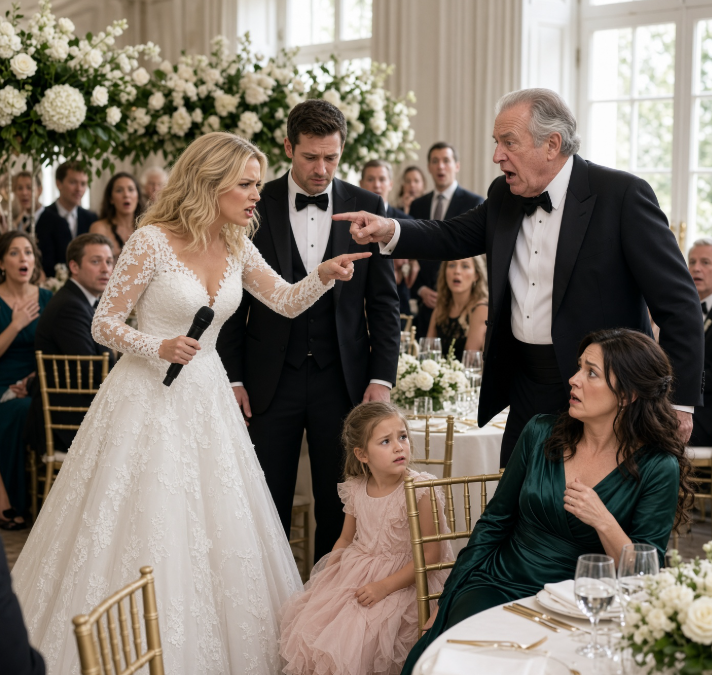
Then Kelsey took the microphone.
She looked radiant beneath the chandelier light.
She thanked Patricia.
She thanked my father.
She thanked Ethan’s family for welcoming her so generously.
Then her eyes traveled across the ballroom until they reached Table Seventeen.
My stomach tightened.
I knew that expression.
“And I suppose I should mention my stepsister somewhere back there.”
People turned around.
My hand tightened around my napkin.
“Nora,” Kelsey said brightly, then tilted her head, “or whatever name she’s using tonight.”
A few guests laughed.
My father laughed too, because he had never learned the difference between keeping peace and joining the person disturbing it.
Kelsey smiled wider.
“I’m kidding. She’s Nora. She’s just a nurse, so we’re lucky she managed to escape the hospital long enough to appear in our family photographs.”
More laughter scattered through the room.
My face heated.
Patricia smiled into her wineglass.
Dad shook his head as if Kelsey had told an adorable joke.
I said nothing.
For most of my life, silence had been my survival strategy.
If I did not react, Kelsey became bored.
If I did not complain, Patricia could not accuse me of jealousy.
If I did not challenge my father, I did not have to hear another explanation for why keeping peace mattered more than protecting me.
So I lowered my eyes.
Then Kelsey added, “Don’t worry, Nora. We saved you a seat close to the kitchen in case anyone needs medical help with dessert.”
This time, the laughter was thinner.
A few people smiled because they thought they were supposed to.
Some looked uncomfortable.
At my table, the florist stopped eating.
I looked down at my hands.
My mother’s pearls brushed my neck as I swallowed.
All I wanted was to disappear.
Then I heard a chair scrape near the head table.
The sound cut through the ballroom.
Graham Carver had stood.
Kelsey turned toward him, still smiling, probably expecting her future father-in-law to add another charming toast.
Graham held out one hand.
“May I have the microphone?”
Kelsey handed it to him.
Her smile did not falter.
Not yet.
Graham did not look at her.
He looked across the room at me.
“Nora,” he said, his voice steady but strangely quiet, “would you mind standing for a moment?”
Every head turned.
I stared at him, confused.
Ethan looked from his father to me.
Vivian’s expression shifted, as if she had suddenly realized something was happening that did not belong to the wedding program.
I stood slowly.
My chair felt impossibly loud against the floor.
Graham stepped away from the head table.
“Were you driving on Route 50 during a major storm about three summers ago?”
The room blurred slightly.
Route 50.
Rain.
Headlights.
Broken glass.
A dark vehicle near the barrier.
My stomach tightened.
“Yes,” I said.
My voice sounded too small for the room.
Graham swallowed.
“Did you stop to help someone trapped inside a black SUV?”
I stared at him.
Then the memory opened fully.
The storm had been violent that night, the kind that turned highways into mirrors and made every pair of headlights look like they were floating toward you. I had been coming home from a late hospital training session, exhausted, hungry, and frustrated because traffic had slowed to a crawl.
Then I saw the accident.
A black SUV had spun near the barrier after being struck by another vehicle. Cars were slowing, swerving, passing. Rain hammered the road. People hesitated in the way they do when danger is obvious but responsibility is not.
I pulled over.
I remembered running in my work shoes.
Remembered water soaking through my coat.
Remembered a man inside the SUV, disoriented, trying to move.
Remembered blood near his hairline.
Remembered telling him, “Sir, I need you to stay still.”
He kept saying he had to get out.
I told him no.
I told him my name was Nora.
I told him help was coming.
I kept one hand near his shoulder without forcing movement. I watched his breathing. I kept him talking. I asked about his family, his son, where he was headed. I told him not to turn his neck. I told him to look at me.
At one point, he stared at my earrings.
Those were my mother’s? he asked.
No.
That was not right.
He had asked if they were real.
I had laughed despite the storm and said, “They were my mom’s. So to me, yes.”
Then the paramedics arrived.
They took over.
I gave a report as best I could, stepped back, and let the professionals work.
By then traffic had worsened, rain had soaked me through, and another nurse from a different vehicle had come over to help direct people away from the wreck.
I never learned the man’s name.
I never asked.
In emergency work, sometimes people pass through your hands for minutes and remain in your memory only as a voice, a pulse, a pair of frightened eyes.
Now that man was standing in a ballroom, looking at me as if those minutes had lasted three years.
“That was you?” I whispered.
Graham nodded.
“I’ve been trying to find you for three years.”
The ballroom went silent.
Not quiet.
Silent.
Kelsey’s smile finally collapsed.
Vivian covered her mouth with one hand.
Ethan stepped away from his chair.
Graham turned toward the guests, still holding the microphone.
“Three years ago,” he said, “I was involved in a serious highway accident during a storm. I suffered a head injury and a cervical spine injury. I was confused, frightened, and trying to move because I thought I needed to get out of the vehicle.”
He looked back at me.
“A woman I had never met stood in the rain beside me and refused to leave.”
My hands began trembling.
“She told me not to move,” he continued. “She kept me awake. She kept talking to me when I wanted to close my eyes. She asked me questions about my son, my wife, my work—anything that would keep me present until emergency services arrived.”
My father’s face had gone pale.
Patricia stared at me as though seeing a person she had not realized was in the room.
Graham’s voice softened.
“I remembered her pearl earrings because she told me they had belonged to her mother.”
Without thinking, I touched one pearl.
Graham saw the movement.
“That was how I knew,” he said. “The moment I saw them today, I knew I had seen them before. I just could not place where until Kelsey pointed you out.”
No one moved.
The sentence hung there.
Until Kelsey pointed you out.
The joke that was meant to make me small had identified me to the man I had helped save.
Graham continued.
“Later, doctors told my family that staying still during those minutes mattered enormously. They told Vivian that if I had forced myself out of that vehicle, my injury could have worsened severely. The choices made before paramedics arrived helped prevent a much more serious outcome.”
Vivian was crying now.
Graham walked toward my table.
Guests turned in their chairs to follow him.
When he reached me, he handed the microphone to Ethan, who had followed silently, then took my hands in both of his.
“You were never ‘just a nurse,’ Nora,” Graham said, loudly enough for the room to hear without the microphone. “You were the person who stayed beside a stranger in the rain when you could have driven home.”
My eyes filled with tears.
“I was only doing what I knew how to do.”
He shook his head.
“That does not make it small.”
For a moment, I could not speak.
Because no one in my family had ever said it that way.
Nursing had always been useful when someone needed advice, a prescription explained, a wound looked at, a fever assessed, a hospital bill interpreted, a grandmother checked, a child calmed.
But in rooms like this, it became “just.”
Just a nurse.
Just practical.
Just service.
Just something that did not belong beside chandeliers and waterfront estates.
Graham squeezed my hands.
“My family has spent three years trying to find the woman who helped me that night. The police report mentioned a nurse, but not your full name. The hospital could not release information. We checked with emergency services. We asked everyone we could. I wanted to thank you properly.”
“You don’t have to—”
“Yes,” he said. “I do.”
Then he turned back toward the ballroom.
“This woman saved me before she knew who I was. Before she knew whether I was wealthy, connected, important, or useful to her. She stopped because someone was hurt. That is character.”
The room remained still.
Then Ethan began applauding.
Not politely.
Firmly.
His mother joined him.
Then the florist at my table stood.
Then an older man near the windows.
Then another guest.
Within seconds, nearly the entire ballroom rose.
Applause filled the room.
I stood frozen, tears spilling down my face while people who had laughed minutes earlier now looked at me as if I had become visible all at once.
My father stood too, but his hands came together slowly.
Patricia did not stand right away.
Kelsey remained seated, white-faced, microphone-less, no longer centered in the room she had designed around herself.
Ethan approached me carefully.
“Nora,” he said, “I had no idea.”
“Neither did I.”
He looked embarrassed, but not for himself.
“For what it’s worth, I’m sorry.”
I nodded because I did not know what else to do.
Graham released my hands only long enough to pull Vivian forward.
She hugged me.
It was not one of those polite wedding hugs where shoulders touch and bodies remain separate.
She held me like she had imagined this moment for years.
“Thank you,” she whispered. “Thank you for bringing my husband back to me.”
That undid me.
I cried against the shoulder of a woman I barely knew while my father watched from across the ballroom.
The rest of the evening did not recover.
How could it?
Dinner plates remained half-finished. Champagne glasses sat untouched. People whispered behind hands. Guests came to my table one by one—not in a mob, not dramatically, but quietly.
A woman told me her daughter was in nursing school.
A man told me a nurse had caught his stroke symptoms before he collapsed.
An elderly guest touched my arm and said, “Don’t let anyone make your work sound small.”
I kept saying thank you.
I kept feeling as if I had stepped into someone else’s life.
Kelsey avoided me for nearly an hour.
Then she appeared near the terrace doors, still in her perfect rehearsal dinner dress, jaw tight, eyes bright with anger she had no safe place to put.
“Nora,” she said.
I turned.
Behind her, the bay was black beneath the windows.
“Kelsey.”
She glanced around, making sure no one was close enough to hear.
“I didn’t know.”
“About Graham?”
“Obviously.”
I waited.
She folded her arms.
“That joke was not meant to be cruel.”
I almost smiled.
Not because it was funny.
Because of course that was where she started.
“I think it was,” I said softly.
Her expression sharpened.
“It was a wedding speech. People tease each other.”
“You changed my name on the invitation.”
She blinked.
“What?”
“My invitation said Nora Whitman.”
“Oh my God, Nora, are you seriously bringing that up right now?”
“Yes.”
Her mouth tightened.
“It was probably the printer.”
“The coordinator said you personally approved the seating chart.”
“What does that have to do with anything?”
“You placed me by the kitchen. You joked about it in front of everyone. You called me ‘just a nurse.’ You made sure everyone knew exactly where you thought I belonged.”
Kelsey stared at me.
For once, I did not lower my eyes.
Her voice dropped.
“You always do this.”
“Do what?”
“Make yourself the victim.”
I laughed once, very quietly.
“No, Kelsey. I make myself quiet. That’s why you’re confused right now.”
Her face flushed.
“You think you’re better than me because Graham praised you?”
“No.”
“Then what do you want?”
I thought about that.
For years, I would have wanted an apology so badly I might have accepted any version of one.
A fake one.
A defensive one.
A sentence Patricia coached her to say.
I would have held it like proof that maybe I mattered.
But standing there with my mother’s pearls against my skin, with the memory of rain and Graham’s shaking voice still in the room, I realized I did not want to beg Kelsey for recognition anymore.
“I don’t want anything from you tonight,” I said.
She scoffed.
“That’s convenient.”
“No,” I said. “It’s honest.”
I turned to leave.
She grabbed my wrist lightly.
“Nora, wait.”
I looked down at her hand.
She let go.
For one brief second, her expression changed.
Beneath the anger, I saw fear.
Not regret.
Fear that the story of the weekend had changed and she could not control it.
“I’m getting married tomorrow,” she said.
“I know.”
“You’re not going to ruin it, are you?”
There it was.
Even now.
Even after everything.
Her concern was not what she had done.
It was whether my hurt might inconvenience her.
“No,” I said. “You can do that all by yourself.”
Then I walked away.
My father found me outside on the terrace twenty minutes later.
The night air smelled like salt and damp grass. Music drifted faintly through the glass doors behind us. I stood near the railing, looking out at the dark water.
“Nora.”
I did not turn.
He came to stand beside me.
For a while, neither of us spoke.
Then he said, “I didn’t know about the accident.”
“I know.”
“You never told me.”
I looked at him then.
“Would you have remembered if I had?”
His face flinched.
That was crueler than I meant it to be.
Or maybe exactly as cruel as truth sometimes has to be.
“Nora…”
I shook my head.
“I’m tired, Dad.”
He looked older than he had that afternoon.
“I should have said something when Kelsey made that joke.”
“Yes.”
“I thought ignoring it would keep things from getting worse.”
“That’s what you always think.”
He rubbed one hand over his face.
“I didn’t realize…”
“You didn’t realize what?”
“That it hurt you so much.”
I stared at him.
“Dad, you raised me. My mother died, and after that, I spent years trying not to take up space in your house because Patricia and Kelsey made it clear I was extra. I became useful because useful was safer than needy. I learned not to complain because when I complained, you asked me to understand them.”
His eyes glistened.
“I loved you.”
“I know.”
That was the hardest part.
I did know.
My father loved me in the quiet, passive, conflict-avoiding way some people love.
He paid bills.
Asked about my car.
Sent birthday texts.
Helped when asked.
But he had not protected me from the slow daily erosion of being treated like an inconvenience.
And sometimes love that refuses to act leaves damage anyway.
“I’m sorry,” he said.
The words came out rough.
I looked back at the water.
“I believe you.”
He seemed relieved.
But I was not finished.
“I believe you’re sorry right now. I don’t know yet what that means tomorrow.”
He nodded slowly.
That was new.
Usually, he would have rushed to make peace, to close the conversation before it became too uncomfortable. This time, he stood beside me and let silence do its work.
Behind us, the ballroom doors opened.
Ethan stepped out.
He looked between us.
“Sorry,” he said. “I don’t mean to interrupt.”
My father cleared his throat.
“I’ll go check on Patricia.”
He squeezed my shoulder once, awkwardly, then left.
Ethan stepped closer to the railing but kept respectful distance.
“I wanted to apologize again,” he said.
“You didn’t say it.”
“No. But I should have known enough about the woman I’m marrying to stop it sooner.”
I did not know what to say.
Ethan looked out at the water.
“My father doesn’t speak about the accident much. He made it through, but recovery was hard. Neck brace. Therapy. Nerve pain. Nightmares. My mother used to say there was someone in the rain who kept him alive until help came. We never knew who.”
I touched my earrings again.
“I didn’t know what happened after.”
“He came home,” Ethan said. “Eventually.”
There was so much inside that one word.
Eventually.
We both understood it.
“I’m glad,” I said.
Ethan turned toward me.
“Tomorrow may be uncomfortable.”
I gave a short laugh.
“It was always going to be uncomfortable.”
He smiled sadly.
“Kelsey is angry.”
“I assumed.”
“She thinks Dad embarrassed her.”
I looked at him.
“Do you?”
“No.”
That answer came quickly.
Then he added, “I think she embarrassed herself.”
For the first time all evening, I felt something loosen in my chest.
“I’m not trying to ruin your wedding.”
“I know.”
“I may leave early after the ceremony.”
“I would understand.”
He hesitated.
Then said, “But my parents would like you seated with us tomorrow. Not at the back. Not near the kitchen. With our family.”
I turned fully toward him.
“That might make things worse.”
“Maybe,” he said. “But my father said if character is going to be honored in public, we should start immediately.”
A laugh escaped me before I could stop it.
“That sounds like him.”
“You knew him for twenty minutes in a storm.”
“Sometimes twenty minutes tells you enough.”
Ethan smiled.
Then his face grew serious.
“Nora, I need to ask you something, and you can tell me to mind my business.”
“Okay.”
“Is this how Kelsey treats people when she thinks they don’t matter?”
The question hung between us.
It was not my job to save Ethan from his own marriage.
It was not my place to decide his future.
But I would not lie.
“Yes,” I said.
His jaw tightened.
“Thank you.”
“For what?”
“For answering plainly.”
He went back inside a few minutes later.
I stayed on the terrace until the air cooled and the music changed.
The next morning, I almost did not go to the ceremony.
I stood in my hotel room wearing the blue dress again because I had not brought another formal option, staring at my reflection.
My eyes looked tired.
The pearl earrings glowed softly beneath the bathroom light.
My phone buzzed.
A message from Vivian.
Good morning, Nora. Graham and I saved you a seat with us. We would be honored if you used it.
A minute later, a message from my father.
I know I haven’t earned this, but I would like to sit with you today if you’ll allow it.
Then, surprisingly, a message from Kelsey.
Please don’t make today about last night.
No apology.
No acknowledgment.
Just a request that I keep her story intact.
I put the phone down.
Then I picked it back up and replied to Vivian.
Thank you. I’ll be there.
The ceremony was beautiful.
That was the truth.
The waterfront glittered under a pale morning sun. White chairs faced the bay. Flowers moved gently in the breeze. A string quartet played near the aisle. Guests wore soft colors and expensive shoes that sank slightly into the grass.
I sat in the second row beside Graham and Vivian.
My father sat on my other side.
Patricia sat beside him, stiff and silent.
Kelsey noticed immediately.
From where she stood at the end of the aisle, one arm linked with her uncle’s because my father was seated with me, her eyes flicked toward our row.
Her expression tightened.
Only for a second.
Then she smiled for the cameras.
The ceremony began.
Ethan looked handsome, but tense. Kelsey looked flawless. Her dress was stunning, fitted with lace sleeves and a long train that caught the light beautifully.
When she reached Ethan, he smiled at her.
But I noticed something in his face.
Not doubt exactly.
Awareness.
Sometimes truth does not stop a wedding.
Sometimes it simply enters the room and refuses to leave.
They said their vows.
They exchanged rings.
Guests applauded.
They kissed.
The marriage began.
I hoped, sincerely, that they would be kinder to each other than Kelsey had been to me.
At the reception, the seating chart had changed.
I did not know who changed it.
My card now sat at a table near the front with Graham, Vivian, Ethan’s aunt, an older family friend, and my father.
Patricia sat two tables away.
Kelsey saw it.
She said nothing.
The reception moved smoothly on the surface. Music, photographs, champagne, the first dance, cake cutting, polite laughter.
But beneath it, something had shifted.
Guests approached me throughout the afternoon, not with pity, but with respect. A trauma surgeon from Washington asked about my hospital. Ethan’s aunt told me her late husband had been cared for by “the most extraordinary nurses on earth.” One of Graham’s business partners said his company funded medical scholarships and wanted my opinion about emergency nursing education.
I answered carefully.
Honestly.
I did not try to sound grander than I was.
That was the strange thing.
The more they listened, the less I felt the need to prove anything.
Late in the evening, Graham found me near the dessert table.
“Nora,” he said, “there is something I did not want to say last night because I did not want to overwhelm you further.”
I smiled faintly.
“After last night, I’m not sure overwhelm has much meaning left.”
He chuckled, then grew serious.
“My family foundation has been trying to establish a scholarship for nurses pursuing emergency and trauma care training. I wanted to name it after the person who helped me that night, but we could not find you.”
I stared at him.
He continued.
“If you are comfortable, we would like to name the scholarship in honor of your mother’s pearls. Not your full name if you don’t want that. Something like The Pearl Light Nursing Scholarship. A symbol of the woman in the storm.”
For a moment, the ballroom sounds faded.
“My mother was a school librarian,” I said quietly. “She loved helping students who thought they weren’t smart enough.”
Graham’s face softened.
“Then perhaps it would honor her too.”
I looked down.
The pearls blurred through tears.
“I don’t know what to say.”
“You don’t have to decide tonight.”
Across the room, Kelsey was watching us.
This time, I did not look away.
Graham followed my gaze but said nothing.
I realized then that the most powerful part of the evening was not applause.
It was not Kelsey’s embarrassment.
It was not even Graham’s public gratitude.
It was the fact that I was no longer trying to shrink enough for my family to tolerate me.
The wedding ended with fireworks over the bay.
Guests gathered outside as gold sparks reflected on the water. Kelsey and Ethan stood together beneath the lights, smiling for photographs. Patricia kept close to the photographer, making sure the angles were right.
My father stood beside me.
“I missed a lot,” he said.
I knew he did not mean the fireworks.
“Yes.”
“I don’t know how to fix it.”
I watched light scatter across the dark water.
“Start by not asking me to make things easy when someone else is being cruel.”
He nodded.
“I can do that.”
I looked at him.
“You’ll have to do more than say it.”
“I know.”
Maybe he did.
Maybe he did not.
But for the first time, he sounded less like a man asking me to help him avoid discomfort and more like a father realizing discomfort might be the price of honesty.
Kelsey approached us after the fireworks.
Her wedding dress trailed behind her. Her makeup was still perfect, but her expression was tired.
“Dad,” she said, then looked at me. “Nora.”
I waited.
She took a breath.
“I’m sorry if what I said last night came out wrong.”
There it was.
The almost-apology.
The kind people offer when they want credit for regret without admitting intent.
My father shifted beside me.
For once, he did not jump in to smooth it over.
I met Kelsey’s eyes.
“It didn’t come out wrong,” I said. “It came out clearly.”
Her face flushed.
“I was trying to be funny.”
“At my expense.”
She looked away.
Ethan, standing a few feet behind her, said nothing.
Kelsey’s jaw tightened.
Then, slowly, something in her posture changed.
Maybe it was the exhaustion of the day.
Maybe the weight of too many witnesses.
Maybe the fact that for once, no one was rescuing her from accountability.
“I shouldn’t have said it,” she said.
It was small.
Not enough for years.
But more honest than before.
“No,” I said. “You shouldn’t have.”
She nodded once.
“I’m sorry.”
This time, the words stood alone.
No if.
No joke.
No explanation.
I accepted them with a nod.
I did not hug her.
I did not reassure her that everything was fine.
Because everything was not fine.
But something true had entered the space between us, and truth was better than the polite lies we had lived with for years.
When I drove home the next morning, the pearls were still in my ears.
The highway was clear. Sunlight moved across the windshield. My rented car hummed steadily along Route 50, the same road where three years earlier rain had hammered so hard I could barely see ten feet ahead.
I passed a stretch of barrier that looked familiar.
Maybe it was the place.
Maybe not.
Highways can make memory uncertain.
But I slowed slightly anyway.
I thought about the woman I had been that night.
Tired.
Cold.
Soaked.
Running toward a damaged vehicle because someone inside needed help.
I had not felt heroic.
I had felt trained.
Useful.
Present.
That was nursing most of the time.
Not glory.
Not applause.
Not dramatic speeches in ballrooms.
Just presence.
A hand on a shoulder.
A voice in chaos.
A medication checked twice.
A frightened person kept awake.
A family guided through the worst minutes of their life.
A stranger in the rain told, “Stay with me.”
I had spent so long letting my family’s language make my work feel small that I had forgotten something important.
Small acts are only small to people who are not the ones being saved by them.
When I reached my apartment, I placed the wedding invitation on the counter.
Nora Whitman still glimmered in gold lettering.
For a moment, the wrong name hurt again.
Then I opened the wooden box on my dresser and took out my mother’s note.
For Nora, when she needs to remember who she is.
I placed the pearls beside it.
Then I picked up the invitation, tore it neatly in half, and dropped it into the trash.
Not in anger.
In release.
My name was Nora Whitcomb.
I was my mother’s daughter.
I was an emergency nurse.
I was the woman who stopped in a storm.
And I was done sitting quietly at tables near the kitchen so people like Kelsey could feel taller beneath chandeliers.
Three months later, The Pearl Light Nursing Scholarship was announced at St. Agnes Medical Center.
Graham insisted that I speak.
I told him I hated public speaking.
He told me he hated car accidents, so we all had our burdens.
The room laughed.
I stood at the podium wearing my navy scrubs because I had come straight from a shift and refused to apologize for it.
My father sat in the front row.
So did Vivian and Graham.
Ethan came alone.
Kelsey did not attend.
That was probably best.
When I looked out at the nursing students, I thought of my mother.
I thought of rain.
I thought of pearls.
Then I said, “There will be days when someone makes you feel invisible because they do not understand the work you do. There will be rooms where people treat your compassion like a service they can request, then dismiss. Do not let them define the size of your calling.”
A young student in the second row wiped her eyes.
I continued.
“You may not always know what happens after you leave the room. You may not know who survives, who remembers, who tries to find you years later because your voice stayed with them in the worst moment of their life. But the work matters even when no one claps. It matters because people matter before anyone knows their name.”
Graham bowed his head.
My father covered his mouth.
I touched one pearl earring.
“And sometimes,” I said, “what the world calls ‘just a nurse’ is the person standing between fear and hope, telling someone in the storm not to move, not to give up, and not to close their eyes.”
The applause that followed felt different from the applause at the wedding.
This was not surprise.
Not spectacle.
Not a room correcting itself after laughing at the wrong joke.
This was recognition.
Not just of me.
Of all of us.
Every nurse who had ever been underestimated until someone needed them.
Every quiet act of care no one photographed.
Every exhausted person who still stopped.
Afterward, my father hugged me in the lobby.
“I’m proud of you,” he said.
I believed him.
Maybe he had been proud before.
Maybe he had simply never known how to show it when it mattered.
This time, he said it where other people could hear.
That mattered too.
Healing, I was learning, did not always come as a grand apology or a perfect ending.
Sometimes it came as a corrected sentence.
A changed seat.
A father not laughing.
A name spoken properly.
A pearl earring noticed by the right person at the right time.
And sometimes justice did not look like humiliation for the person who hurt you.
Sometimes it looked like no longer needing them to tell the room who you were.
Because now, I knew.
I had always known, somewhere beneath the silence.
But that night in the ballroom, when Graham Carver stood and told 140 people what Kelsey never bothered to see, the truth finally became louder than the insult.
I was not just a nurse.
I was Nora Whitcomb.
And I had never been small.








