My Son’s School Said His Deployed Dad Didn’t Count for Father’s Day—Then 50 Veterans Rode In So No Military Child Would Sit Alone
My Son’s School Said His Deployed Dad Didn’t Count for Father’s Day—Then 50 Veterans Rode In So No Military Child Would Sit Alone
My eight-year-old son didn’t cry when his school told him his deployed father wouldn’t count for the Father’s Day celebration—and somehow, his silence hurt more than tears ever could.
His dad was seven thousand miles away serving overseas, but according to one yellow sheet of paper, Ethan would spend the celebration in the library because he didn’t have an “approved male guest” sitting beside him.
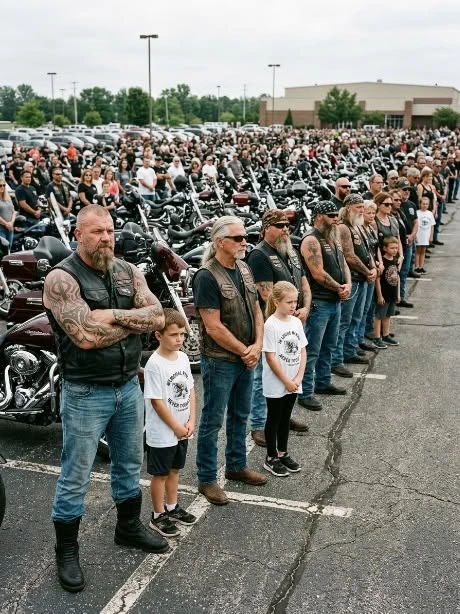
Then fifty military veterans arrived with signed guardian forms in their saddlebags, and before that morning ended, the school would learn exactly why none of those men were willing to let a military child sit alone.
My name is Rachel Mercer.
I knew something was wrong the moment Ethan came home and didn’t ask what was for dinner.
He always asked.
Sometimes before taking off his backpack.
That Tuesday, he walked inside our small rental house outside Killeen, Texas, placed his shoes neatly by the door, and went straight to his bedroom.
At six thirty, he put himself to bed.
I followed him.
He was sitting on the edge of the mattress holding a folded yellow sheet.
His face had that careful blankness children wear when they believe showing emotion will make something worse.
“What happened?”
He handed me the paper.
OAK RIDGE ELEMENTARY.
FATHER’S DAY CELEBRATION.
FRIDAY — 10:00 A.M.
Children could attend with their father or a registered male guardian.
Students without an approved guest would attend supervised enrichment in the library.
I read it twice.
“Did your teacher explain?”
Ethan shrugged.
“She said we have to return it tomorrow.”
“What about dads who can’t come?”
He stared at the carpet.
“Caleb’s dad is dead.”
I stopped.
“What’s Caleb doing?”
“Library.”
“Anyone else?”
“Jamal’s dad is in jail. Sophia doesn’t know hers.”
He hesitated.
“Mason has two moms, but the paper says male.”
Then came the sentence that made my anger turn cold.
“Mrs. Brennan said rules are rules.”
Ethan’s father, Staff Sergeant Daniel Mercer, had been deployed for ten months.
To Ethan, the geography was simple.
Far away.
Hot.
Dangerous.
Daniel called whenever he could.
Sometimes at two in the morning.
Sometimes during school.
Once, the connection dropped unexpectedly and Ethan held the phone against his ear for almost a full minute.
When I asked what he was doing, he whispered:
“I’m waiting in case Dad is still talking.”
Since Daniel left, Ethan had been sleeping in his father’s old Army sweatshirt.
The sleeves covered his hands.
The fabric smelled mostly like our detergent now.
Ethan insisted he could still smell Dad.
“Can Dad video call?” he asked.
“We’ll ask.”
“He can wake up.”
Of course Daniel would.
He would finish a night patrol, stay awake exhausted, and smile through a grainy screen because his son needed him.
But Ethan shouldn’t have to prove he still had a father.
“You’re not going to the library,” I said.
He looked down.
“But I don’t have anybody.”
I took his hand.
PART2:
“You have your father.”
“He can’t come.”
“That is not the same thing.”
The next morning, I called the school.
By lunchtime, I had spoken to the teacher, principal, and district office.
Everyone was polite.
Everyone explained capacity.
Scheduling.
Security.
Policy.
Nobody seemed to hear the part where children were being separated according to which kind of absence their families carried.
That evening, Daniel called.
I tried not to tell him.
Ethan did.
There was silence on the line.
Then Daniel said:
“Give the phone to Mom.”
His voice sounded different.
“Rachel, call Marcus Cole.”
I knew the name.
Retired Army First Sergeant.
President of a veterans’ motorcycle association Daniel occasionally rode with before deployment.
“What am I supposed to tell him?”
Daniel paused.
“Tell him Ethan needs somebody in that chair.”
Friday morning, the school parking lot began to tremble.
Not from speeding motorcycles.
From dozens of heavy engines arriving together.
Fifty veterans parked in perfect rows.
Men from the Army, Marines, Navy, and Air Force.
Some carried helmets.
Some walked with canes.
Every one of them carried signed paperwork.
And at the front stood Marcus Cole.
He looked at the principal and said quietly:
“We heard you had some empty chairs.”
Then Ethan noticed the photograph pinned inside Marcus’s vest.
A little boy in a school uniform.
Marcus saw him staring.
His expression changed.
And that was when I realized those fifty veterans hadn’t come only for Ethan.








