My Son Spotted a Sniper at a Hells Angels Funeral—Then 700 Bikers Turned Around as One
PART3:
At first, I thought it was construction equipment beyond the cemetery wall. Then the sound deepened, multiplied, and rolled toward us like weather made of engines.
Caleb turned toward the main gate before I did.
The motorcycles came through in a column so long that, to my son, it must have looked endless.
Large American bikes.
Chrome flashing hard in the sun.
Engines idling low and heavy, not chaotic, but deliberate.
At the front was a black hearse.
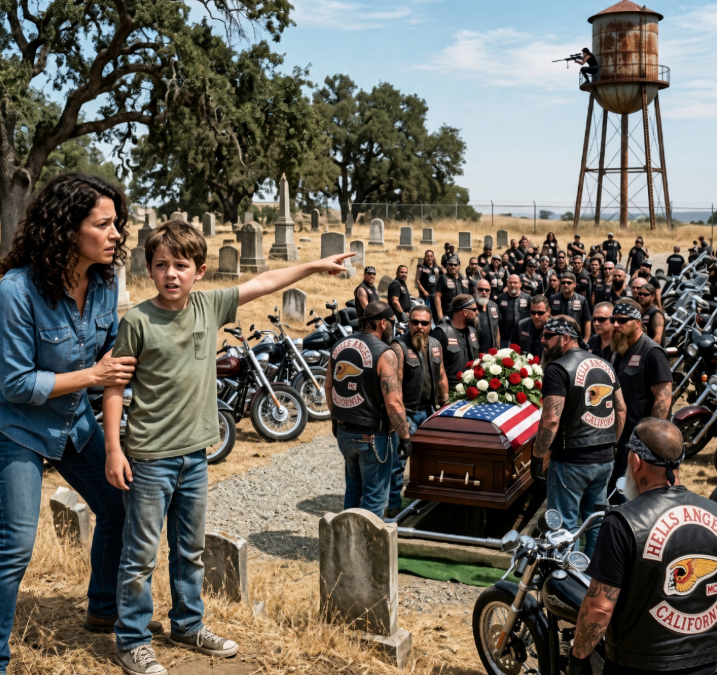
Behind it came motorcycles two by two, then fanning out along the wider cemetery roads as the procession entered. The riders wore black leather vests with a winged skull patch in red and gold. When the closest men passed, I saw the words on their backs.
Hells Angels.
California.
MC.
My hand closed around Caleb’s.
“Come on,” I said quietly. “Let’s give them space.”
He did not move.
I did what most people would have done.
I judged.
Not out loud.
Not proudly.
But I did.
I saw leather, tattoos, chains, heavy boots, thick arms, hard faces, and I felt my body prepare to leave. I did not know any of them. I did not know the man in the hearse. I did not know why hundreds of them had come.
But the story wrote itself in my head before a single fact arrived.
Mob.
Threat.
Avoid.
That is what fear does when it wants to sound like common sense.
Six men lifted a polished dark wooden casket from the hearse. Red and white roses lay across the top, bright as signal flags in the sun. A very old man with a white beard stepped to the head of the casket and placed both hands on its edge. His face did not collapse. It held. But it held the way a dam holds water.
“Caleb,” I whispered. “Now.”
He was not looking at the casket.
He was looking past the northern edge of the cemetery.
At the old water tower rising beyond the fence.
His arm lifted.
“Mom.”
“Not now.”
“There’s someone up there.”
I looked.
At first, I saw only rusted steel supports and flat blue sky.
Then something flashed.
Tiny.
Precise.
Gone.
Like a mirror catching sunlight at the wrong angle.
My stomach tightened.
“Where?”
Caleb pointed again.
“There. On the top.”
I pulled his hand down.
Do not point at danger.
It is ridiculous what rules appear inside a mother’s mind when fear enters.
Do not point.
Do not stare.
Move slowly.
Keep your child behind you.
But the cemetery had already begun to change.
A deputy near the main road had noticed something too. I had seen him earlier by the gate, watching the procession with the hard concentration of a man expecting trouble from the crowd in front of him. Now he was looking up at the water tower, one hand reaching for his radio.
The old biker with the white beard left the casket and walked toward him.
I was too far away to hear everything then.
Later, when statements were taken, I learned their names.
The deputy was Marcus Pruitt.
Twenty-four years with the Alameda County Sheriff’s Office.
The old biker was Gerald Maddox.
He had been riding with the club longer than I had been alive.
At that moment, all I saw was a deputy looking up at a possible sniper and an old man in a leather vest asking him not to move too fast.
I tightened both hands on Caleb’s shoulders.
“We’re leaving,” I said.
“No,” Caleb said.
It was not defiance.
It was focus.
That frightened me more.
He had stopped looking at the tower.
His eyes had moved south, toward the main gate where the iron bars opened onto Piedmont Avenue.
“Mom,” he said softly. “There’s a white van.”
I looked.
A plain white cargo van sat at the curb outside the gate, engine running. No company markings. Driver window down. Someone inside was looking through the bars.
My hands tightened on Caleb’s shoulders.
The cemetery felt suddenly wrong.
The bikes.
The casket.
The tower.
The van.
The deputy.
The old man.
All of it arranging itself into a shape I could not understand.
I wanted to leave.
But to leave, I would have had to move toward the gate.
Toward the van.
So I pulled Caleb backward into the partial shade of the oak and held him there.
“Stay still,” I whispered.
For once, he obeyed.
The crowd of bikers had begun to shift.
Not dramatically.
Not like a mob.
No shouting.
No running.
But the loose gathering around the grave widened, then tightened, then reoriented. Men at the edges turned outward. Others stepped inward near the casket. The pattern looked accidental until suddenly it did not.
A perimeter.
I did not know that word then.
Not in my bones.
But I felt it.
These men had done this before—not at funerals maybe, not exactly, but in bars, parking lots, roadside stops, places where danger moved fast and nobody official arrived in time. They did not need spoken orders. They read shoulders, spacing, eye lines, silence.
Seven hundred men in leather and grief quietly became a shield.
I found out later that the woman on the water tower had been there for nearly six hours.
Her name was Diane Slade.
Former Army.
Two deployments.
A licensed security consultant.
Thirty-eight years old.
Short military-cut hair.
Gray eyes people described as cold because most people do not understand the difference between cold and careful.
She had climbed onto the water tower platform before dawn and lain on her stomach on the steel grating through hours of cold, then heat, watching three sightlines: the cemetery, the gate, and the stretch of Piedmont Avenue beyond the fence.
She had memorized the white van’s license plate.
Written it on her wrist in marker.
Watched the driver.
Watched the passenger.
Watched the way the passenger’s right arm hung slightly away from his body, the way people hold themselves when weight rests under a jacket.
She had not been aiming at the funeral.
She had been covering it.
Because the man being buried was Raymond Asguth.
The old biker in the casket.
Raymond had been more than a patch on a vest.
He had served in the Marine Corps from 1974 to 1982. Afterward, he worked sheet metal in Fremont, raised two children, buried his wife in that same cemetery, and ran a quiet veterans program called Anchorpoint out of a building on 35th Avenue.
Housing.
Job placement.
Legal help.
Counseling referrals.
Literacy support for children.
Funded largely through his own money and charity rides the club never advertised.
For eleven years, Raymond helped people who had no reason to trust help.
Diane had been one of them.
Years before, after two deployments and a discharge that sent her back into a country with no language for what war had taken from her, she slept in her car in an Oakland parking structure.
Doors locked.
Window cracked.
Money nearly gone.
At two in the morning, Raymond tapped on her window.
Not dramatically.
Not like a savior.
Just a broad-shouldered old man with a white beard and a voice without performance.
“Are you okay?”
She was not.
He got her a room that night.
A hot meal.
Legal contacts the next morning.
A referral to Anchorpoint.
Then he kept showing up.
That was how some people save lives.
Not with speeches.
By appearing again and again with the practical thing needed next, until the wall a person built around herself runs out of material.
Raymond had saved Diane in a way she rarely explained.
So when he died, she came to his funeral in the only way that made sense to her.
She stood watch.
What none of us knew then was that Raymond had spent the last four years filing formal complaints against a trafficking operation recruiting vulnerable people from transitional housing around Fruitvale and San Antonio.
Thirty-one complaints.
Official channels.
Names.
Dates.
Patterns.
No headlines.
No interviews.
No self-congratulation.
Just an old man making enemies because people with power were preying on people without any.
And that white van outside the gate had not come to pay respects.
At 2:17 p.m., the passenger door opened.
I saw it.
Caleb saw it too.
Two men stepped out.
One broad, wearing a light jacket wrong for the heat.
One lean, expression carefully blank.
They entered through the main gate and moved along the inner fence line, close to the bars, not directly toward the casket, but toward the access road where they could angle around the edge of the crowd before anyone fully registered them.
Deputy Pruitt saw them.
His hand moved to his holster.
Not drawing yet.
Calculating.
One deputy.
Two unknown men.
At least one concealed weapon.
Seven hundred bikers who might react in ways no report could predict.
I felt Caleb’s fingers close around my wrist.
The men stopped.
They had seen the formation now.
The bikers were no longer just mourners. They had become geometry. A living barrier with the casket at its center.
Then one of the men looked up.
The woman on the water tower was no longer hidden.
Diane had risen enough to be seen clearly against the sky.
The rifle was angled downward, not at the crowd, not at the men, but held with unmistakable competence.
For one frozen second, nobody breathed.
Then the shot cracked.
One clean rifle shot split the summer air.
I clamped both hands over Caleb before I understood where it had gone.
But no one fell.
No one screamed.
The bullet hit a strip of empty gravel left of the access road, far from any living person, kicking dust into the air three yards from the nearest vehicle.
A warning.
A message.
I am here.
I see you.
This is what I am choosing not to do.
The echo bounced off the old stone building at the north end of the cemetery and came back half a second later.
Then the silence was absolute.
The man who had looked up dropped something.
Metal struck gravel.
His partner backed toward the gate, fast but not quite running.
At the same time, the bikers moved.
Not outward.
Inward.
Every man on the edge pulled toward the center, creating a wall of leather, bodies, and grief between the casket and the gate. No one shouted instructions. No one asked what to do. They simply did it.
Seven hundred people operating in a language they all understood.
Deputy Pruitt moved then.
“Stop! Police!”
His badge was out.
His weapon drawn but angled toward the ground.
Sirens arrived almost immediately afterward—two cruisers through the Piedmont entrance, another from the east access road. The sirens cut off as soon as the cars entered, as if even the officers understood that sound could still turn the moment into something worse.
The two men were secured on the access road.
A second firearm was found in the van.
The cemetery stayed silent in the strange way places do after something almost happens and does not.
My legs felt weak.
Caleb looked up at me.
“Mom?”
I knelt in front of him so fast my knees hit the grass.
“You scared me,” I whispered.
“I saw the light.”
“I know.”
“No one was looking.”
I pulled him against me.
“I know.”
He did not understand why I was crying.
Maybe I did not either.
Later, I watched Diane Slade climb down from the water tower.
She moved carefully, methodically, rifle secured in a case across her back. At the bottom, Deputy Pruitt intercepted her with his badge still in hand, though even from a distance I could see the gesture had become habit more than threat.
She stopped.
Spoke calmly.
Then glanced past him toward the casket.
He stepped aside.
That was the moment I understood.
She had not come for the men in leather.
She had come for the man in the casket.
The crowd parted for her as she crossed the cemetery.
Not dramatically.
Not with performance.
With respect.
The kind people show when they recognize someone as their own, even if she wears no patch.
She stopped before Raymond’s casket and stood there for a full minute, looking at the roses.
Gerald Maddox stood beside her.
I could not hear all of what they said, but later, through witness statements and news reports, pieces surfaced.
“He told me about you,” Gerald said.
“He told me about you too,” she answered.
Gerald told her Raymond had said she was the best he had ever seen.
Diane said, “He saved my life.”
Not loudly.
Not for effect.
Like stating a fact too heavy for decoration.
Gerald said Raymond had saved different men in different ways.
Some from the worst decision of their lives.
Some by keeping them alive.
Some by keeping them human.
I have thought about that sentence more than anything else.
Keeping someone human.
That may be the hardest rescue there is.
The processing took the rest of the afternoon.
Statements.
Police tape.
Questions.
Names.
Timelines.
The two men from the van were later identified as associates of a trafficking network that had been operating for years in Oakland neighborhoods where people without protection are often treated as opportunities.
Raymond’s Anchorpoint program had disrupted their recruitment repeatedly.
He had filed reports.
Thirty-one of them.
Thirty-one times he had tried to make the official world see what was happening.
And still, that day at his funeral, most of us had looked at the bikers first.
Deputy Pruitt admitted it in his own way.
I was standing near the oak when he sat beside Diane on a bench after the formal questions were done. Caleb had picked a pale wildflower near my father’s grave and was turning it between his fingers.
Pruitt looked exhausted.
Not physically.
Morally.
“I spent forty minutes this morning watching the wrong thing,” he said.
Diane did not answer.
I respected her for that.
Not every confession requires comfort.
Sometimes silence is the only honest response.
Pruitt later read Raymond’s file.
I know because the story made the papers, though not the way tabloids would have wanted. The better reporters did not write about “biker gangs” and “snipers” as if the truth were that simple. They wrote about Anchorpoint. About veterans’ housing. Legal aid. Youth literacy. Charity rides. Formal complaints against traffickers. A man people had assumed they understood because of what was stitched onto his vest.
Gerald Maddox said something that stayed with me too.
“People see us, and the story writes itself before one fact arrives.”
He was right.
I had done it.
Deputy Pruitt had done it.
Most of the cemetery had done it.
Seven hundred men in leather had entered through that gate, and almost everyone looked at them as the danger.
Meanwhile, the actual danger sat outside in a white van.
And the woman we feared as a sniper was the reason no one bled.
The funeral resumed near sunset.
Quietly.
No engines then.
No spectacle.
Just men returning to the grave of someone they loved.
Someone brought a folded American flag and placed it beside the roses on Raymond’s casket. I later learned why.
United States Marine Corps.
1974 to 1982.
Honorable service.
Earned.
Caleb watched from under the oak, still holding the wildflower.
I thought he was ready to leave.
Instead, he walked toward the casket.
“Caleb,” I said softly.
He looked back once, and something in his face stopped me.
The remaining bikers near the grave stepped aside without being asked, the way adults make room for children in moments too honest to interrupt.
Caleb approached the casket, reached up, and placed the wildflower beside the roses.
A small pale flower from the base of a tree near his grandfather’s grave.
A child’s offering.
Nothing more.
Everything more.
Gerald Maddox stood at the head of the grave and watched him without expression. Then something in his face shifted—not softness exactly, but recognition.
As if the world had given him a living example of what he had been trying to say all afternoon.
Caleb returned to me.
I took his hand.
We walked out through the Piedmont Avenue gate into the ordinary sound of the city. Cars passing. A bus sighing at the curb. Someone laughing too loudly outside a coffee shop. Life continuing with its terrible indifference.
Behind us, the cemetery remained.
My father’s grave.
Raymond’s funeral.
The old water tower.
The place where a nine-year-old boy looked where nobody else was looking.
That night, Caleb asked me if the woman on the tower was bad.
I sat on the edge of his bed.
“No,” I said. “She was watching.”
“With a gun.”
“Yes.”
“That sounds bad.”
“Sometimes dangerous things can protect people.”
He frowned.
“Like guard dogs?”
“A little.”
“Or knights?”
“Maybe.”
He thought about that.
“Were the bikers bad?”
I had to sit with the question longer than I wanted.
“I don’t know all of them,” I said finally. “But today, they protected people.”
“So people can look scary and do good things?”
“Yes.”
“And people can look normal and do bad things?”
My throat tightened.
“Yes.”
He rolled onto his side.
“Grandpa would’ve seen the van.”
I smiled sadly.
“He might have.”
“And he would’ve liked the motorcycles.”
“He would have pretended not to.”
Caleb laughed.
A small sound.
A needed one.
After he fell asleep, I sat alone in the kitchen and thought about how quickly I had been willing to believe the easiest story.
Bikers meant danger.
A rifle meant threat.
A child’s observation meant distraction.
A plain white van meant nothing.
Every assumption had pointed me in the wrong direction.
The truth had been harder.
The bikers were mourners.
The woman with the rifle was a protector.
The child was the first person willing to say what he saw.
And danger looked ordinary.
That is what changed in me.
Not that I stopped being cautious.
I am still a mother.
I still watch parking lots, strangers, crosswalks, and my son’s shoelaces when he refuses to tie them.
But I try now to notice what I am expecting to see.
Because expectation can blind you as completely as fear.
I think about Diane Slade lying on steel grating for six hours because a dead man had once knocked on her car window at two in the morning and asked if she was okay.
I think about Raymond Asguth, who spent years quietly building a program to protect people most of the world walked past.
I think about Gerald Maddox placing his hands on the casket, not as a criminal saying goodbye to another criminal, but as an old man burying someone who had held a community together in ways outsiders never bothered to learn.
I think about Deputy Pruitt, brave enough in the end to admit he had been watching the wrong thing.
And I think about my son.
Caleb, in torn sneakers, holding my father’s grief in one hand and a wildflower in the other, looking up at a water tower because something flashed and no one else noticed.
He did not know what he was seeing.
He only knew he had seen something.
Sometimes that is where truth begins.
Not with certainty.
With attention.
Months later, we went back to Mountain View Cemetery.
Just the two of us.
My father’s grave was quiet beneath the oak. Raymond’s grave was a few sections away, marked properly now. There were flowers there, a small flag, and a smooth stone someone had placed near the base.
Caleb asked if we could visit him too.
I said yes.
We stood at Raymond’s grave for a while.
I did not know what to say to a man I had never met who had changed how I saw the world.
So I said the only thing that made sense.
“Thank you.”
Caleb placed another small flower on the ground.
Not a carnation.
Something he had picked near the path.
A weed, probably.
But given with sincerity.
As we walked back to the car, he looked up at the water tower.
No one was there.
Just rust, sky, and quiet.
Still, he waved.
“What are you doing?” I asked.
He shrugged.
“In case she’s watching.”
I looked up too.
For a second, I could almost see Diane there, still and patient, gray eyes scanning the places the rest of us forget to watch.
Then the wind moved through the cemetery grass, and the image was gone.
We walked on.
The world was still the world.
People still judged too quickly.
Danger still hid in ordinary places.
Goodness still wore forms we were taught to fear.
But my son had taught me something that day.
So had the woman on the tower.
So had seven hundred bikers who turned as one when it mattered.
Look again.
Look past the story your fear writes first.
Look where the child is pointing.
Because sometimes the person everyone fears is the one standing guard.
Sometimes the crowd everyone judges becomes the shield.
And sometimes the only thing between a funeral and a tragedy is one small voice saying:
“Mom, there’s someone up there.”








