My Son Hadn’t Spoken Since His Father’s Funeral—Then He Ran Toward a Biker and Said Two Words That Broke Us All
PART2:
The hand pressed against his chest meant he wanted his red truck, the one Caleb had given him before his last deployment.
Two taps on the table meant water.
Three meant tired.
His left hand in mine meant okay.
Both hands clenched meant not okay at all.
Owen was not empty.
That was what made strangers misunderstand him.
He understood almost everything.
Sometimes more than I wanted him to.
He laughed silently at cartoons, his shoulders bouncing while no sound came from his mouth. He frowned when adults spoke about him as if he were not there. He remembered where I put everything. He brought me tissues when I cried and pretended I had allergies. He lined his toy cars in perfect rows, blue ones first, then red, then black. He liked soft sweatshirts, chicken soup without carrots, the smell of old books, and sleeping with one hand wrapped around Caleb’s dog tags.
He was present.
He was kind.
He was trapped.
I would have traded anything to know where his voice had gone.
Our house became too full of absence after Caleb died.
His boots stayed by the garage door for six weeks because I could not move them. His motorcycle jacket hung in the hallway closet, still holding the faint smell of leather, smoke, and the pine soap he used. His coffee mug sat beside the sink until my mother came over one day, washed it without asking, and I screamed so hard Owen hid under the dining table.
I apologized to him for an hour.
He sat under the table with his toy truck and watched me cry.
After that, I moved us.
People judged me for it.
Some did it kindly. Some did not.
PART3:
Caleb’s mother, Ruth, thought I was running away from him.
Maybe I was.
But staying in that house felt like asking Owen to live inside the moment of the knock forever. Every hallway had an echo. Every room had a before and after. Every neighbor looked at us with wet eyes and careful voices.
So I packed what I could, boxed what I could not bear to decide about, and moved us north toward Denver, into a small townhouse near a school with a good support program and a grocery store close enough that I could walk there if the car broke down.
I told myself we were starting over.
That was not true.
You do not start over after losing the person who helped build your life.
You continue with missing pieces.
There is a difference.
The years passed in quiet routines.
Owen grew taller.
His hair darkened.
His baby roundness faded from his cheeks, and sometimes I would catch a glimpse of Caleb in the angle of his jaw or the way he studied something before touching it.
He still did not speak.
At school, they called him selectively mute at first. Then traumatically mute. Then minimally verbal, though he was not verbal at all. I stopped caring about the labels unless they brought services. Labels are doors in systems. Sometimes you need them. Sometimes they become cages.
His kindergarten teacher, Mrs. Anika Bell, was one of the good ones.
She did not force eye contact.
She did not speak about Owen in front of him as if he were furniture.
She made him a quiet corner with blue cushions and a picture schedule. She let him answer questions by pointing. She told other children, “Owen has words inside. We are patient while he finds the way he wants to share them.”
The first time she said that, I went home and cried in my car.
Not because it fixed anything.
Because she saw him.
By first grade, the pressure increased.
There were meetings with clipboards and conference tables and specialists who smelled like peppermint tea and printer paper. There were discussions about evaluations, alternative communication devices, additional supports, possible placements.
One man from the district, Mr. Landry, said, “At some point, we have to consider whether this environment is meeting his functional needs.”
I had learned by then that words like functional often meant someone was preparing to make a child smaller for administrative convenience.
Mrs. Bell, who had moved up with Owen into first grade because angels occasionally infiltrate public education, folded her hands and said, “Owen is learning. He is participating. He is communicating. He needs patience, not removal.”
Mr. Landry smiled the way people smile when kindness annoys them.
“Of course. But we also need measurable progress.”
I looked at my son through the observation window that day.
He was sitting at his desk, carefully coloring a picture of a mountain. He had chosen blue for the sky, green for the trees, and red for one tiny truck parked at the bottom of the page.
Caleb’s truck.
Always red.
“What would you consider measurable?” I asked.
Mr. Landry looked at his notes.
“Spoken language would be one benchmark.”
I wanted to hate him.
I did not have the energy.
Instead, I said, “My son is not a failed report because grief took his voice.”
The room went quiet.
Mrs. Bell looked down at her hands, but I saw her mouth tremble.
That was two weeks before the parking lot.
The afternoon it happened was so ordinary that I almost refused to trust it later.
It was July.
Hot enough that the air above the pavement shimmered. Denver summer had settled over the shopping center in waves of heat and exhaust and coffee smell from the café by the grocery store entrance. The sky was painfully blue. Someone’s car alarm chirped twice and went silent. A woman struggled with a stroller near the cart return. A teenage employee in a green apron pushed a long row of carts, earbuds in, face blank with summer-job misery.
I had not planned anything important.
That mattered.
There was no therapy appointment.
No school meeting.
No doctor visit.
No memorial date.
Just groceries.
Milk, bread, apples, cereal, dish soap, and the dinosaur-shaped chicken nuggets Owen would only admit he liked by placing them in the cart himself.
He walked beside me, his hand warm and small in mine.
At six, Owen was still thin, serious, and quiet in a way that made strangers soften their voices around him. He wore a navy sweatshirt despite the heat because soft sleeves helped him feel safe. In his other hand, he held Caleb’s old dog tags, wrapped twice around his fingers.
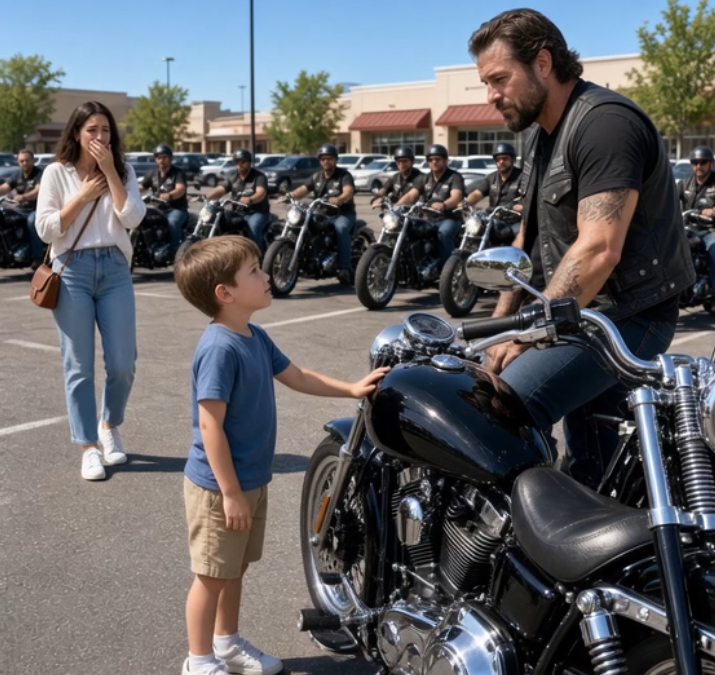
We were halfway across the parking lot when he stopped.
Not slowed.
Stopped.
His hand went rigid in mine.
I looked down.
“Owen?”
His eyes were fixed across the lot.
I followed his gaze.
A black motorcycle had just rolled into a parking space near the far curb.
It was large, polished, heavy-looking, the kind of bike Caleb used to admire with embarrassing enthusiasm. Chrome flashed in the sun. The engine gave one final low rumble before going quiet. The rider wore boots, dark jeans, a black T-shirt, sunglasses, and a leather vest covered in patches.
He looked rough around the edges.
Not dangerous.
Just weathered.
Like someone life had sanded down instead of polished.
Before I understood what was happening, Owen pulled his hand from mine.
And ran.
“Owen!” I shouted.
He did not stop.
My heart exploded into my throat.
For four years, Owen had moved through the world cautiously, never more than a few steps from me in unfamiliar places. He hated sudden sounds. He froze near traffic. He panicked if I moved out of sight.
Now he was running across a parking lot toward a stranger on a motorcycle.
I dropped the shopping list.
“OWEN!”
A car backing out of a space braked hard.
The driver shouted something.
I barely heard it.
I ran after my son, my sandals slapping against the pavement, my breath tearing in my chest. Every nightmare I had ever had after Caleb’s death seemed to rise at once. Losing Owen. Failing him. Watching the last piece of my husband disappear between parked cars because I had looked away for one second too long.
The biker saw him coming.
He did not move suddenly.
That may have saved everything.
He turned off the engine fully, removed both hands from the handlebars, and sat very still as Owen reached the motorcycle.
My son stopped in front of the bike, breathing hard.
His small hands trembled at his sides.
The biker looked from Owen to me as I came running up.
“I’m sorry,” I gasped. “I’m so sorry. He never does this.”
But Owen lifted one hand.
Slowly, almost reverently, he touched the chrome.
Then his lips moved.
At first, I thought the heat had tricked me.
Or grief.
Grief had tricked me before.
I had heard Caleb’s voice in grocery aisles. Seen his shoulders in crowds. Reached for my phone to text him something funny months after the funeral. The mind can be cruel when it misses someone badly enough.
So when Owen’s mouth formed sound, I did not believe it.
Not immediately.
Then I heard him.
“Daddy’s bike.”
The world stopped.
Not poetically.
Actually.
For one impossible second, the parking lot vanished.
No cars.
No heat.
No people.
No grocery store.
Only my son’s voice.
Small.
Rusty.
Real.
My knees almost gave out.
The biker removed his sunglasses.
His face changed as if he knew before he knew.
He was older than I first thought, maybe late forties, with sun-browned skin, a short dark beard threaded with gray, and eyes that had seen too much but had not gone hard.
“What did you say, little man?” he asked softly.
Owen looked up at him.
His voice came again.
Not loud.
But clear.
“Daddy said to look for the bikes.”
I covered my mouth with one hand.
A sound escaped me that was almost a sob and almost a prayer.
The biker lowered himself from the motorcycle slowly and crouched so he was not towering over Owen.
“What was your daddy’s name?”
I wanted to answer for him.
For four years, I had answered for him.
At doctor’s offices.
School meetings.
Family gatherings.
Grocery stores when cashiers asked him whether he wanted a sticker.
I had become his translator, his shield, his explanation.
But something held me still.
Owen swallowed.
His fingers tightened around Caleb’s dog tags.
“Caleb Parker.”
The biker’s face broke.
There is no other word.
The roughness, the caution, the stranger-mask—all of it fell away.
He stared at my son as if the parking lot had opened and given him back a ghost.
“Caleb Parker was your father?”
Owen nodded.
The man turned toward me.
“Ma’am,” he said, and his voice was suddenly unsteady. “Are you Tessa?”
I could not speak at first.
I nodded.
He stood slowly, one hand pressed against the motorcycle seat as if he needed it for balance.
“My name is Wade Lawson.”
I knew that name.
Not well.
Not enough.
But Caleb had mentioned a Wade.
A veteran.
A biker.
A man from a riding group he had joined before his final deployment.
“You knew my husband,” I whispered.
Wade’s eyes filled.
“Ma’am, Caleb was not just someone we knew. He rode with us. He ate at my table. He fixed my carburetor in the rain while calling me an idiot in three different ways. He was family.”
The word struck me in the chest.
Family.
For four years, I had believed Caleb’s memory existed mostly in boxes.
A folded flag.
A uniform in the back of my closet.
Photos on Owen’s dresser.
Dog tags.
A handful of voicemails I was terrified my phone would somehow lose.
I had not known there were men riding roads with his name still alive between them.
Wade looked back at Owen.
“Your dad talked about you all the time.”
Owen’s chin trembled.
“He said…” My son stopped.
My breath caught.
Wade waited.
He did not push.
He did not say, “Use your words.”
He did not lean in too close.
He simply waited the way someone waits beside a person in pain.
Owen tried again.
“He said the bikes make the loud go away.”
Wade closed his eyes.
His jaw tightened.
“Oh, Caleb,” he whispered.
I stared at him.
“What does that mean?”
Wade opened his eyes, and now they were wet.
“Your husband told us Owen got overwhelmed by noise. Even before… before everything. He said sometimes when the world got too loud, he’d sit with him in the garage and let him touch the bike while the engine was off. Then, when Owen was calm, Caleb would start it low. Said the rumble gave the noise somewhere to go.”
I remembered that.
Not fully.
Not clearly.
But in fragments.
Caleb and Owen in the garage.
My husband sitting cross-legged on the concrete beside his motorcycle while our toddler lined toy cars under the workbench. Caleb saying, “He likes the vibration, Tess. Watch.” Owen’s little hand resting on the bike frame. The slow smile that came over his face when the engine turned over.
I had forgotten.
No.
Worse.
I had buried it under everything that came after.
“Owen,” I whispered.
My son did not look at me.
He was looking at the motorcycle.
“Daddy said,” he continued, each word careful, as if pulling it from deep water, “if I get lost, look for the bikes.”
I began to cry then.
Openly.
In a grocery store parking lot beside a stranger’s motorcycle while people pretended not to stare and stared anyway.
Wade took out his phone.
His hand shook.
He looked at me first.
“May I?”
I did not know what he was asking exactly.
But I nodded.
He made a call.
The moment someone answered, Wade turned slightly away, though not enough for me to miss the words.
“It’s Caleb’s boy,” he said.
Silence.
Wade swallowed.
“He found us.”
Another pause.
“No. I’m not joking.”
His voice broke on the next line.
“Get everyone you can. Quiet. Respectful. Bring the box.”
The box.
Before I could ask, he hung up.
“What box?”
Wade looked at me, and for the first time, I saw guilt.
Not fresh guilt.
Old guilt.
The kind a person carries until it becomes part of their posture.
“Tessa, we tried to find you after the service.”
My stomach tightened.
“What?”
“Caleb left something with us. Instructions. We went to the house about two months after the funeral, but neighbors said you’d moved. We asked around. Called numbers we had. Some were disconnected. We didn’t want to intrude through official channels, and then…” He looked ashamed. “Then life got messy. But we never forgot.”
I wanted to be angry.
For one sharp second, anger rose like fire.
Where were you?
Where were all of you when I was packing Caleb’s clothes alone?
When Owen stopped speaking?
When I sat in school meetings with strangers reducing my son to benchmarks?
When I chose which bills to pay and which memories to store in plastic bins?
But Wade’s face stopped me.
He had been grieving too.
That was something widowhood can make you forget. Your loss is so huge that everyone else’s grief looks smaller from where you stand.
But Caleb had belonged to more people than me.
Not more deeply.
Not in the same way.
But truly.
“What is the box?” I asked again, softer.
Wade looked at Owen.
“Something your dad left for him.”
Owen’s eyes widened.
The low rumble came before the motorcycles appeared.
One engine in the distance.
Then another.
Then many.
The sound rolled across the parking lot like distant thunder.
Owen turned toward it.
His whole face changed.
Not fear.
Recognition.
Hope.
I had not seen hope on my son’s face in four years.
Motorcycles entered the shopping center one by one.
Black, silver, dark red, midnight blue. Heavy cruisers. Touring bikes. Old bikes with worn leather seats. Clean bikes with polished chrome. The riders moved slowly, carefully, as if they understood the ground they were entering was holy.
They parked in a quiet line near the far curb.
No revving.
No shouting.
No show.
One by one, they took off helmets.
Men and women.
Older mostly, but not all.
Gray hair, shaved heads, braided hair, weathered faces, military tattoos, worn leather vests, denim jackets, boots dusty from roads I would never know.
On their backs, most wore the same patch.
SENTINEL RIDERS VETERANS ASSOCIATION.
Beneath it, smaller patches.
Names.
Units.
Flags.
Dates.
One older rider stepped forward.
He had silver hair pulled into a short ponytail and moved with a limp. His vest was covered in patches, but one near his heart made my vision blur.
PARKER
CALEB S.
BROTHER ALWAYS
I made a sound.
The man stopped several feet away from us, removed his sunglasses, and held them in one hand.
“Mrs. Parker,” he said.
His voice was gravelly.
“My name is Frank Donnelly. Caleb called me Preacher, though I’ve never been fit for a pulpit.”
I almost laughed.
Caleb would have loved that.
Frank’s eyes moved to Owen, and everything in him softened.
“And this must be Owen.”
Owen stepped half behind my leg, not from fear exactly, but from the intensity of being seen.
Frank lowered himself slowly to one knee despite the obvious pain it caused him.
“Your daddy talked about you so much, I feel like I knew you before today.”
Owen stared at the patch on Frank’s vest.
Then he whispered, “You have his name.”
Frank pressed one hand over it.
“Yes, sir. I do.”
“Why?”
The word was small.
A question.
A miracle.
Frank’s mouth trembled.
“Because when someone is your brother, you carry him.”
A woman rider near the back turned away and wiped her eyes.
I stood there feeling the world rearrange itself.
For years, Caleb had been absence.
Now, suddenly, he was everywhere.
In Wade’s shaking hands.
In Frank’s patch.
In the line of motorcycles.
In the way these strangers looked at my son like he was not damaged, not behind, not a problem to solve, but someone they had been waiting to love.
Wade spoke quietly to me while Owen watched the riders.
“We met Caleb after his first rough patch coming home from deployment. He found us through a veterans’ mechanic program. Didn’t want therapy, didn’t want group talk, didn’t want anyone telling him to breathe into a paper bag.”
Despite everything, I smiled.
“That sounds like him.”
Wade smiled too.
“He came because he said his bike was making a noise. It was not making a noise. He just needed somewhere to be.”
My throat tightened.
“He told me he went riding sometimes.”
“He did. And after Owen was born, he talked about him constantly. Showed pictures until we begged him to stop. Then showed more.”
A broken laugh escaped me.
“He was obnoxious with baby pictures.”
“Professionally obnoxious.”
Owen looked up at us.
Wade crouched again.
“Your dad said you were brave.”
Owen’s mouth twisted.
“I was quiet.”
Wade’s face crumpled.
“Quiet can be brave.”
No one spoke.
The words landed in Owen like something he had been waiting years to hear.
Quiet can be brave.
I wanted to carve that into every school conference table where people had measured my child by sound.
Frank turned toward one of the riders.
“Mac.”
A broad man with a white beard opened the saddlebag of a deep red motorcycle and lifted out a small wooden box wrapped in dark cloth.
My heart began to pound.
Wade took the box and held it as if it contained bone.
The wood was worn at the edges. On top, taped carefully beneath a strip of plastic, was an envelope.
My name was written across it in Caleb’s handwriting.
Tessa.
I had not seen his handwriting on anything new in four years.
My knees weakened.
Wade stepped closer.
“He gave this to us before his last deployment,” he said. “Told us if anything happened, and if Owen ever needed us, this belonged to you both.”
I reached for the box.
My hands shook so badly that Wade did not let go until he was sure I had it.
The envelope came loose under my fingers.
For a moment, I could not open it.
Because sealed letters from dead people are terrible miracles.
Once opened, they become final in a new way.
Caleb had touched this paper.
Caleb had folded it.
Caleb had written my name when he was still breathing, still laughing, still thinking he might come home and tease me for crying over grocery store commercials.
Owen’s hand slipped into mine.
That gave me strength.
I opened the envelope.
The letter was short.
Not dramatic.
Not polished.
Just Caleb.
Tess,
If you’re reading this, I need you to breathe first. I know you. You’re holding everything in your chest like you can keep it from falling apart by force. Breathe, baby.
I did.
Right there in the parking lot.
A broken inhale.
Then another.
I kept reading.
I don’t want to write goodbye, because I don’t know how, and because I’m arrogant enough to hope I won’t need this letter. But if I don’t make it back, there are things I need you to know.
First, you and Owen were my life. Not part of it. Not the soft thing waiting outside the hard thing. You were the reason any of it mattered.
Second, if our boy gets quiet, don’t think he’s empty. Owen listens with his whole heart. He always has. He hears things the rest of us miss. When the world is too much, give him rhythm. Give him something steady. Rain. Drums. Engines. Your heartbeat. Mine helped him before. Yours will help him after.
I had to stop.
The words blurred.
Owen leaned against me, reading nothing, understanding everything.
Wade put one hand over his face.
Frank bowed his head.
I continued.
The Sentinel Riders know about him. They know about you. If there ever comes a day when Owen cannot find his voice, let him find the sound that reminds him he was never left behind.
One day, when the time is right, give him what’s in the box. Tell him it’s not a burden. It’s a road. He doesn’t have to ride it fast. He just has to know he has brothers on it.
I love you, Tess. I love our boy.
If love could bring me home, I’d already be at the door.
Caleb.
The letter folded in my hands.
No one moved.
A car passed too close, slowed, then continued when one of the riders gently waved it around.
The whole world had narrowed to a dead man’s handwriting and a six-year-old boy holding my hand.
Owen touched the box.
“Open?”
His voice.
Again.
I nodded because speaking was beyond me.
Wade helped lift the lid.
Inside, wrapped in tissue, was a tiny denim vest.
Small.
Too small for Owen now.
Made for the four-year-old he would have been when Caleb imagined giving it to him.
On the back was a patch.
OWEN PARKER
LITTLE ROAD BROTHER
Beneath it, stitched in smaller letters:
NEVER LEFT BEHIND
My legs gave out then.
I sank to my knees right there on the hot pavement, the vest clutched to my chest, and sobbed harder than I had since the funeral.
Not because I was sad.
Because Caleb had known.
Somehow, before the worst happened, he had known how to leave love in the world for our son.
Owen reached for the vest.
“Mine?” he asked.
That one word nearly destroyed every rider in the lot.
Frank made a rough sound and stood, turning away.
Mac wiped his beard.
The woman rider pressed both hands to her mouth.
I nodded.
“Yes, baby. It’s yours.”
Wade knelt and helped him put it on.
The vest was too small. Of course it was. Owen was six now, taller, older, shaped by years Caleb never got to see. But the riders adjusted it gently over his shoulders, leaving it open in front.
Owen looked down at himself.
Then at the motorcycles.
“Can they stay?”
It was the first question he had asked in four years.
I laughed and cried at the same time.
Wade smiled.
“As long as your mom says it’s okay.”
Owen turned to me.
His face was serious.
His voice small but clear.
“Mom… please?”
Mom.
The word hit me so hard I could not catch myself.
I pulled him into my arms.
He stiffened at first—he often did when emotion came too fast—but then his little body folded into mine.
“Say it again,” I whispered before I could stop myself.
I knew better.
Every therapist would have told me not to pressure him.
But I was only human.
Only a mother who had waited four years at the edge of one word.
Owen’s fingers curled in my shirt.
“Mom.”
I broke.
The riders stood around us in a loose circle, looking away and not looking away, giving us privacy while bearing witness. It felt strange and sacred, being surrounded by leather vests, chrome, tattoos, boots, and tears in a grocery store parking lot.
No one rushed him.
No one asked him to perform.
That mattered.
They did not take Owen on a ride that day.
I was grateful.
Wade asked gently, and I said no before he finished the sentence.
Owen was speaking, but he was still Owen. New joy did not erase old needs. He had run toward a motorcycle because some hidden memory had opened, but he still startled at sudden sound, still needed time, still needed the world to be careful.
The riders accepted that immediately.
“Then we don’t ride,” Frank said. “We sit.”
So they formed a quiet half-circle and let Owen approach the motorcycles one at a time.
Engines off.
Helmets on seats.
Hands visible.
Voices low.
Wade showed him the mirrors, the foot pegs, the throttle without twisting it, the fuel tank, the little guardian bell hanging near the frame. Mac explained patches. The woman rider, whose name was Jo Alvarez, showed Owen a photo of her granddaughter taped inside her saddlebag.
Owen listened with his whole body.
Sometimes he spoke.
One word.
Two.
A whisper.
“Black.”
“Bell.”
“Daddy.”
Each word felt like a stone being lifted off my chest.
At one point, Owen touched the small bell on Wade’s motorcycle.
“Daddy had one.”
Wade nodded.
“He did.”
“Where?”
Wade’s eyes flicked to me.
I did not know.
The garage had been packed by friends and family after Caleb died. His motorcycle had been sold by necessity six months later when bills became too heavy and keeping it felt like bleeding money and memory at the same time. I had kept his jacket, helmet, gloves, dog tags, photos, letters.
But not the bike.
The guilt rose sharp and sudden.
Wade saw it.
“His bell is safe,” he said quickly. “Caleb gave it to Frank before deployment.”
Frank reached into his vest pocket.
He pulled out a small tarnished metal bell on a leather cord.
My breath caught.
“That was his?”
Frank nodded.
“He told me to hold it until Owen was ready.”
Owen stepped forward.
Frank did not hand it to him right away.
He looked at me.
I nodded.
Only then did he place the bell in Owen’s palm.
Owen closed both hands around it.
For a moment, he did not move.
Then he pressed the bell to his chest, right over the tiny vest patch.
The sound it made was almost nothing.
A soft chime.
But Owen smiled.
Not his usual small smile.
A real one.
The first wide, open smile I had seen from him since before the knock.
That was when I understood that Caleb had not left us a motorcycle group.
He had left us a bridge.
We stayed in that parking lot for nearly two hours.
The groceries never happened.
The milk could wait.
The bread could wait.
The life I had been trudging through could wait while my son found the first pieces of his voice among the people who had carried his father’s memory on the road.
Before the riders left, Frank gave me a card.
“Every Saturday morning,” he said, “we meet at a diner off Highway 85. No pressure. No expectations. Just coffee, breakfast, bikes parked outside. You come if you want. You don’t if you don’t.”
I took the card.
“I don’t know.”
“I know.”
“Owen may not speak again tomorrow.”
Frank’s gaze softened.
“Then he doesn’t.”
I stared at him.
“We’re not here because he talked,” Frank said. “We’re here because he’s Caleb’s boy.”
For four years, every system in our life had focused on output.
Speech.
Progress.
Benchmarks.
Goals.
Frank offered belonging without performance.
I had no idea how badly we needed that until he gave it to us.
That night, Owen slept with the little denim vest beside his pillow.
He did not speak again before bed.
Not one word.
I tried not to let disappointment poison the miracle.
The therapists had warned me long ago that progress might not be linear. Trauma does not open like a door and stay open forever. Sometimes it cracks, lets in light, then closes again until the body believes it is safe.
Still, after he fell asleep, I sat on the floor beside his bed and cried quietly.
His hand rested on the vest.
Caleb’s bell lay near his pillow.
I touched my husband’s letter folded in my pocket.
“Thank you,” I whispered into the dark.
I did not know if I was speaking to Caleb, God, fate, or the version of myself that had managed to survive long enough for this day to find us.
Maybe all of them.
The next morning, Owen did not say Mom.
He did not say anything while brushing his teeth, eating cereal, or choosing his shirt.
But when I placed two cups on the table—blue for him, white for me—he pointed to my phone.
“You want something?” I asked gently.
He tapped the phone.
I opened it.
He touched the photo I had taken the day before: Owen in the too-small vest, standing beside Wade’s motorcycle while the riders stood behind him.
His finger rested on Caleb’s name patch on Frank’s vest.
“Ride family,” he whispered.
I froze.
Then, carefully, as if handling glass, I said, “Yes. They are your ride family.”
He looked at me.
“Daddy’s?”
“Yes.”
He looked back at the photo.
“Owen’s?”
The room blurred.
“Yes, baby. Yours too.”
That Saturday, we went to the diner.
I almost turned around three times.
Owen sat in the back seat wearing noise-reduction headphones, Caleb’s bell in one hand, the denim vest folded in his lap. He had not spoken since breakfast, but he had brought the vest himself.
The diner sat off Highway 85 between a gas station and an auto parts store. The sign flickered. The parking lot was half cracked asphalt, half gravel. And there, lined along the side, were the motorcycles.
Owen leaned forward in his seat.
“Bikes,” he whispered.
The word was enough to get me out of the car.
Inside, the diner smelled like coffee, bacon, syrup, and old vinyl booths warmed by decades of bodies. The riders sat in the back section around several pushed-together tables. When we entered, they did not cheer or make a fuss.
They simply made space.
That kindness undid me more than applause would have.
Frank slid out of a booth so Owen could sit where he could see the door and the bikes through the window.
Wade placed a small toy motorcycle on the table.
“Found this in my garage,” he said casually. “Figured it needed a mechanic.”
Owen touched it.
“Red.”
“Sharp eye. Caleb liked red.”
“My truck red,” Owen said.
Every head at the table lifted slightly.
No one reacted too much.
No one wanted to scare the words away.
Wade nodded like children who had been silent for four years spoke in diners every Saturday.
“Good color.”
Jo ordered Owen pancakes and asked whether he wanted syrup on the side.
Owen nodded.
Then, after a long moment, he whispered, “Side.”
Jo wrote it down as if taking orders from a general.
“Yes, sir.”
We went back the next Saturday.
And the next.
Not every time with words.
Some mornings, Owen spoke to everyone.
Some mornings, he spoke only to me.
Some mornings, he did not speak at all and sat under the table with his toy motorcycle while Frank told stories about Caleb.
We learned Caleb had once ridden forty miles in hail because Wade’s bike broke down and he refused to leave him. He had burned pancakes on a camping trip and blamed altitude. He had sung terribly. He had danced worse. He had carried extra gloves because someone always forgot theirs. He had once spent an entire charity ride making faces at a child in a minivan until she stopped crying.
Owen listened.
I listened too.
For years, grief had made Caleb into a photograph.
The riders made him human again.
Funny.
Annoying.
Brave.
Stubborn.
Alive in memory rather than frozen in death.
One Saturday, Frank brought a shoebox full of photos.
Caleb younger.
Caleb laughing.
Caleb leaning against his bike with sunglasses pushed into his hair.
Caleb kneeling beside a much younger Owen in our old driveway, helping him touch the motorcycle bell.
I had never seen that photo.
I pressed it to my chest.
“Can I keep this?”
Frank smiled.
“Made you copies.”
In the bottom of the box was a video on a flash drive.
Frank hesitated before handing it to me.
“He recorded this before deployment,” he said. “He asked us to give it with the box. I’m sorry we didn’t get it to you sooner.”
I took it home and stared at it for three days before watching.
When I finally played it, Owen sat beside me on the couch with Caleb’s bell in his lap.
The screen flickered.
Then Caleb appeared.
My husband.
Alive.
Sitting at the riders’ clubhouse, hair shorter than I liked, smile crooked, eyes tired but warm.
“Hey, Tess,” he said.
I sobbed once so hard I had to pause the video.
Owen touched my arm.
I breathed.
Pressed play.
Caleb smiled into the camera.
“If you’re watching this, I’m either gone or Frank lost a bet and decided to ruin everyone’s day.”
A broken laugh escaped me.
Owen leaned closer.
Caleb’s face softened.
“Hey, little man.”
Owen stopped breathing.
“It’s Daddy,” he whispered.
On the screen, Caleb looked straight ahead as if somehow he could see him across time.
“I don’t know how old you are when you get this. Maybe you’re still little. Maybe you’re big enough to roll your eyes at me. If you are, don’t. Your mother hates that.”
I laughed through tears.
Owen did not move.
Caleb continued.
“I want you to know something. If I don’t come home, it is not because I left you. I need you to hear that. I did not leave you. I would have come home every time if wanting it was enough.”
Owen made a sound.
Small.
Wounded.
I put my arm around him.
He allowed it.
Caleb’s voice wavered.
“You might get quiet. That’s okay. You don’t owe the world noise. But don’t let the quiet tell you that you’re alone. Your mom is there. She loves you more than breath. And the riders are there too. Look for the bikes if you need them. They’ll know you.”
Owen’s tears fell silently.
Caleb leaned closer to the camera.
“And Owen? Be kind to your mom. She’s tougher than me, but she forgets to eat when she’s sad.”
I covered my face.
My son turned toward me.
For the first time since Caleb’s death, Owen lifted his hand to my cheek and said, “Eat, Mom.”
I laughed and cried so hard that we had to pause the video again.
That video became part of us.
Not something we watched every day.
It was too powerful for that.
But on hard days, Owen would point to the drawer where we kept it.
And Caleb’s voice would fill the room, not as a ghost, but as a father still loving us through what he had prepared.
School changed slowly.
Mrs. Bell cried when I told her.
Professionally, she tried not to.
Personally, she failed.
Owen began using words in her classroom first with whispers.
“Blue.”
“Done.”
“Help.”
“No.”
That last one delighted her.
“No is a powerful word,” she told him.
Mr. Landry from the district attended another meeting two months later and looked startled when Owen answered a question by saying, “Need break,” in a soft but clear voice.
I wanted to be gracious.
I was, mostly.
Mrs. Bell was less subtle.
She looked straight at Mr. Landry and said, “Measurable progress.”
I loved her for it.
But Owen did not become a chatterbox.
This is important.
I have heard people tell his story later as if motorcycles magically cured him.
They did not.
Trauma is not a locked door that opens once and stays open because the right engine rumbles in a parking lot.
Owen still had silent days.
He still became overwhelmed.
He still used gestures when words were too far away.
He still needed therapy, routine, patience, and people who understood that speaking was not the only measure of healing.
But his voice was no longer buried.
It came and went like a shy animal returning to a yard where no one chased it.
The riders understood.
They never demanded words.
At the diner, if Owen spoke, they listened.
If he didn’t, they let silence sit at the table without making it awkward.
Frank taught him how to polish chrome.
Wade taught him the names of tools.
Jo taught him how to identify birds by their calls because she said motorcycles were wonderful but “not the only sound worth knowing.”
Mac built him a wooden display box for Caleb’s bell.
On Owen’s seventh birthday, the riders came to our townhouse.
Not with engines roaring.
They parked down the street and walked quietly to the door.
Owen opened it himself.
He wore a new denim vest.
This one fit.
On the back was the same patch.
OWEN PARKER
LITTLE ROAD BROTHER
NEVER LEFT BEHIND
Under it, Frank had sewn a smaller patch.
QUIET CAN BE BRAVE
Owen touched it with both hands.
Then he looked at Frank.
“Thank you.”
Frank turned and pretended to cough for almost a full minute.
Ruth, Caleb’s mother, came that day too.
Our relationship had been strained since I moved. Grief had made both of us sharp in places that used to be soft. She thought I had taken Owen away from Caleb’s memory. I thought she wanted me to stay in pain because leaving felt like betrayal to her.
The riders changed that too.
Not immediately.
But they created a place where Caleb belonged to all of us without anyone having to own him.
At Owen’s birthday, Ruth stood in my kitchen holding Caleb’s letter with trembling hands.
“I didn’t know,” she whispered.
“Neither did I.”
She looked at me then, really looked.
“I’m sorry I made you feel like moving was leaving him.”
My throat tightened.
“I’m sorry I shut you out.”
She reached for me.
We cried together beside the sink while the riders sang a terrible version of Happy Birthday in the living room and Owen laughed out loud.
Out loud.
Not silently.
The sound brought Ruth and me running.
Owen was laughing at Wade, who had somehow dropped an entire slice of cake into his own boot.
It was ridiculous.
It was perfect.
That night, after everyone left, Owen stood in the doorway of his room.
“Mom?”
I turned from loading the dishwasher.
Every time he said it, part of me still stopped.
“Yes, baby?”
He held Caleb’s bell.
“Daddy hear?”
I wiped my hands slowly.
“I don’t know exactly how that works.”
He looked down.
Then I knelt in front of him.
“But I think love hears love.”
Owen considered that.
“Then he heard cake boot.”
I laughed.
“Yes. I’m sure he heard cake boot.”
Owen smiled.
Then he went to bed.
Years passed.
Not easily.
But fully.
Owen grew into a boy with long legs, serious eyes, and a voice he used carefully. He was never loud. He never wasted words. But when he spoke, people listened.
At ten, he gave a short presentation in class about motorcycles and sound therapy. He used note cards. His hands shook. Mrs. Bell, who had moved to another grade by then but came specially to watch, cried in the back row.
At twelve, he joined the riders for his first short passenger ride in a controlled charity event, wearing full safety gear, with me following in a car behind him and almost biting through my own tongue from anxiety. Wade rode slowly, carefully, as if carrying glass and gold.
When Owen removed his helmet afterward, his face was pale.
“Too much?” I asked.
He shook his head.
His smile came slowly.
“Again someday.”
At fifteen, he volunteered with the Sentinel Riders’ annual fundraiser for families of fallen service members. He stood beside a table selling raffle tickets and spoke to a little girl whose father had died that year. She had not said a word all morning. Owen crouched, showed her Caleb’s bell, and said, “You don’t have to talk for people to stay.”
The girl took the bell in her hands.
Her mother started crying.
I walked away before anyone saw me fall apart.
At sixteen, Owen rebuilt an old motorcycle engine with Wade, though he cared more about understanding it than riding fast. He said machines made sense because every sound meant something.
At seventeen, he asked me for Caleb’s full service records because he wanted to know his father beyond the hero version.
We sat at the kitchen table for hours.
I told him the truth.
That Caleb was brave, yes.
But also stubborn.
That he loved him more than anything.
That he sometimes woke from nightmares and sat in the garage because he did not want to wake me.
That he hated asking for help.
That the riders may have saved him long before they saved us.
Owen listened.
Then said, “I wish I knew him now.”
The grief in that sentence was older than six.
I touched his hand.
“Me too.”
When Owen graduated high school, he spoke at the ceremony.
Not because he was valedictorian.
Not because he had become some inspirational symbol for other people to applaud.
He spoke because the senior class voted for him to give the reflection.
My son, who had once disappeared into silence, stood at a podium in a blue cap and gown while rows of families watched from folding chairs on a football field.
The Sentinel Riders stood along the back fence.
Every one of them wearing their vests.
Frank older now, leaning on a cane.
Wade gray in the beard.
Jo with her granddaughter beside her.
Mac gone the year before, but his patch sewn onto Frank’s vest in remembrance.
Ruth sat beside me, holding my hand.
Owen unfolded one sheet of paper.
He looked at the crowd.
Then at me.
Then at the line of riders.
He began.
“When I was little, I stopped speaking after my father died. People thought I had lost my voice. But I think now that my voice was waiting for a place where it felt safe to come back.”
The whole field seemed to still.
He continued, steady and clear.
“My mother waited for me without giving up. My teacher made room for me without forcing me. My father left love behind in the form of people I had not met yet. And a group of bikers taught me that family is not only who sits at your table. Sometimes family is who carries your name when you cannot carry it yourself.”
Frank bowed his head.
Wade wiped his eyes openly.
Owen looked down at his paper, then back up.
“I learned that silence is not emptiness. Grief is not weakness. And healing is not becoming who you were before. Healing is finding a way to live honestly with what happened, while still making room for what can happen next.”
I had no tissue left by then.
Ruth gave me hers.
Owen finished with one sentence.
“My dad once told me to look for the bikes if I got lost. I did. They brought me back to my mother, and then they helped me bring myself back to the world.”
When he stepped away from the podium, the applause came like thunder.
Owen flinched once.
Then smiled.
Because this thunder did not frighten him.
This thunder carried him.
After the ceremony, he walked straight to me.
I hugged him, cap and gown and all.
“You did it,” I whispered.
He held me tighter.
“We did.”
Then he turned to the riders.
Frank saluted him.
Not a casual salute.
A real one.
Owen stood straighter and returned it.
Caleb would have loved that.
Caleb would have cried and denied crying.
Caleb would have told Owen his speech was too good and therefore suspicious.
Caleb should have been there.
That ache never leaves.
But as I watched my son surrounded by men and women who had kept his father’s love alive on roads, in diners, in patches, in bells, in patient silence, I understood something I had fought for years.
Caleb was not there.
But his love was.
Not as a substitute.
Never that.
As an inheritance.
Owen is twenty-two now.
He does not ride as much as people expect after hearing the story. He prefers working on bikes to riding them. He became a mechanical engineer, which would have made Caleb unbearable with pride. On weekends, he volunteers with a program that adapts motorcycles and bicycles for veterans with disabilities and children with sensory needs.
He speaks.
Quietly.
Thoughtfully.
Sometimes sparingly.
He still has days when words feel heavy. He no longer apologizes for that.
The tiny denim vest hangs in a shadow box in our living room beside Caleb’s letter and the tarnished bell. Under it is a photo from the parking lot: Owen small and serious in the too-tight vest, Wade kneeling beside him, the riders behind them, and me on the edge of the frame with one hand over my mouth because my son had just said Mom.
People ask if I wish we had found the riders sooner.
Of course I do.
I wish Caleb’s box had reached Owen at four.
I wish I had known about the diner, the patches, the promise.
I wish the road back had been shorter.
But grief has taught me that wishing is a room you can visit but not live in.
We found them when we found them.
Or maybe, as Wade says, Owen found them when he was ready.
I still hear Caleb’s voice sometimes in the ordinary parts of the day.
Not like a ghost.
Like memory with warmth.
When I forget to eat, I hear him teasing me through that video.
When Owen gets very quiet, I hear him saying, Quiet can be brave.
When motorcycles pass in the distance, I no longer feel only the ache of what was lost. I feel the rumble of what remained.
Because that afternoon in the parking lot did not give me my husband back.
Nothing could do that.
It did not erase Owen’s trauma.
It did not magically repair the years of silence.
It did not turn grief into a beautiful lesson tied with a ribbon.
What it did was this:
It proved Caleb had loved us beyond his own lifetime.
It proved Owen’s voice had not been gone forever, only waiting for a sound that felt safe enough to follow home.
It proved I had not been carrying my husband’s memory alone.
And it proved that sometimes, when a child disappears into silence after goodbye, love must find another language.
For Owen, it was the low rumble of engines.
A tarnished bell.
A tiny denim vest.
A line of bikers standing quietly in a grocery store parking lot like guardians from a road his father had left behind.
And one word.
Mom.
The word I had prayed for.
The word that found me beside a motorcycle.
The word that still lives in me as proof that even after years of silence, a heart can hear its way home.








