My Scarred Orange Cat Was Branded a Neighborhood Menace—Then We Found Out Whose Lives He’d Been Saving
PART3:
He climbed onto the counter, knocked down a plant, used the fallen pot as leverage somehow, and got out anyway.
I tried keeping him indoors by force for two days.
He sat by the back door and yowled with the emotional force of a widower in a country song. He scratched the trim. He stared at me from across rooms with such deep disappointment that I started apologizing to him out loud.
“You are domesticated,” I would say.
He would look at me like, So are you, and look how that’s going.
Eventually, I gave in.
Not because it was responsible.
Because I was tired.
That is the shameful truth behind a lot of human decisions.
For a few months, it seemed harmless enough. He left in the morning. He came back by dinner. Sometimes he came back dusty. Sometimes he smelled like barbecue smoke. Once he came home with a pink baby sock in his mouth, and I spent an hour walking door to door trying to find the owner while every young parent on the block looked at me like my cat was leading an infant crime ring.
The complaints started quietly.
A note under my flowerpot.
Your cat was in our yard again.
Another taped to the mailbox.
Please keep your animal away from my bird feeder.
One was written in purple marker on a paper plate.
HE SAT ON MY CAR AND JUDGED ME.
That one, I believed completely.
At first, I apologized. I baked banana bread for the bird feeder woman. I offered to pay for scratched patio cushions. I bought Bandit a breakaway collar with a bell on it, which he removed somewhere within twenty-four hours and, I am almost sure, buried as an act of protest.
Then the notes changed.
They became less neighborly.
Your cat is a menace.
Control your animal before someone else does.
Some people should not own pets.
The handwriting on the harshest ones was always the same: sharp, slanted, pressed so hard into the paper that the letters nearly tore through.
I knew who wrote them before I could prove it.
Sharon Whitcomb.
Every neighborhood has one person who treats ordinary life like a committee meeting waiting to happen. On Marigold Lane, that person was Sharon. She lived in the largest house on the corner, a brick colonial with white columns, a perfect lawn, and seasonal wreaths that appeared on her door with military precision. She wore linen in summer, cashmere in winter, and a smile so polished it rarely reached her eyes.
She was not officially the head of anything.
That was part of the problem.
Our neighborhood was older, built before the newer developments came with formal homeowners’ associations and architectural standards and fines for having the wrong shade of beige. We had a voluntary neighborhood committee that planned block cleanups, argued about holiday decorations, and reminded people not to leave garbage bins out after pickup day.
Sharon had chaired it for six years.
Nobody remembered voting.
Nobody remembered being asked.
She simply began arriving with clipboards, agendas, and the tone of a woman correcting society one recycling violation at a time.
I tried to avoid her.
Bandit did not.
The first time Sharon confronted me directly, I was pruning the deadheads off my roses. Bandit sat on the sidewalk behind me, licking his shoulder with the lazy confidence of an animal who knew exactly how controversial he had become.
“Claire,” Sharon said.
That was me.
Claire Whitaker. Forty-seven. Freelance medical billing consultant. Owner of one aging Honda, one temperamental water heater, and one orange cat apparently capable of municipal unrest.
I turned with the pruning shears still in my hand.
Sharon stood at the end of my walkway in white capris and a navy blouse, holding her phone like evidence.
“I need to speak with you about your cat.”
Bandit looked up at her.
Then, with astonishing timing, he yawned.
Sharon’s mouth tightened.
“What did he do now?” I asked.
“He entered my sunroom yesterday.”
I lowered the shears.
“How?”
“My contractor left the door open.”
“So he walked through an open door.”
“He had no right to be there.”
“That sounds like something you should tell him.”
“I’m serious.”
“I can see that.”
She stepped closer, heels clicking on the walkway. “This neighborhood has standards, Claire. People here work hard to maintain safe, clean, respectful properties. Your cat wanders wherever he pleases, intimidates pets, climbs on vehicles, and creates unsanitary conditions.”
Bandit stretched one back leg straight into the air.
“Bandit is not unsanitary,” I said, then glanced at him. “He is occasionally socially inappropriate.”
“This is not funny.”
“I’m not laughing.”
“You may not care about how your choices affect others, but some of us do.”
There it was.
The sentence beneath the sentence.
Some of us belong here.
Some of us know how to behave.
Some of us do not bring shelter cats and overgrown roses and grief into a neighborhood Sharon had decided belonged to people with matching porch lights and better self-control.
I felt my face warm.
“I care,” I said. “I’ve tried to keep him indoors.”
“Try harder.”
Bandit rose then, slowly, and walked toward us. Sharon stiffened.
He did not hiss. He did not arch his back. He simply stepped onto the path between us, sat down, wrapped his tail around his paws, and looked up at Sharon with the calm judgment of a small orange magistrate.
Sharon took one step back.
“He’s aggressive,” she said.
“He’s sitting.”
“He’s staring.”
“He does that.”
“I am warning you, Claire. If you do not control him, the neighborhood will.”
Then she turned and walked away.
Bandit watched her go.
I looked down at him. “Could you maybe not make enemies with powerful women in linen?”
He bumped his head against my calf.
That was as close to remorse as he ever got.
The next morning, he came home with the scratch.
And something in me shifted.
Maybe it was fear. Maybe guilt. Maybe the ugly suspicion that Sharon’s warning had not been just words. The scar on his nose was small, but I could not stop thinking about that line in the note: before someone else does.
Had someone hurt him?
Had someone tried to scare him off?
Had he gotten into a fight because I kept pretending the problem was manageable?
I cleaned his paw. I called the vet. They told me to watch for swelling and bring him in if he worsened. He ate, complained, slept, woke, demanded more food, and by afternoon his limp had improved enough that I started doubting my own panic.
But that night, after the neighborhood went quiet, I stood in my kitchen and stared at the pet door.
Bandit sat beside it.
I knew what he wanted.
“No,” I said.
He lifted his chin.
“You’re staying in.”
He made a sound like a rusty hinge.
“I mean it.”
At 4:48 the next morning, I woke to the sound of plastic rattling.
By the time I reached the kitchen, Bandit had gotten halfway through the pet door and was stuck because I had wedged a broom handle across the flap. His front half was outside. His back half was inside. He turned his head, saw me, and froze as if perhaps I would not notice the orange criminal protruding through my wall.
“Really?”
He wriggled.
I removed the broom.
He shot into the yard like freedom itself had claws.
I grabbed my hoodie and followed.
I do not know what I expected.
Maybe I thought I would catch him stalking another cat, raiding a trash can, terrorizing Sharon’s begonias. Maybe I wanted proof that everyone was overreacting. Maybe I wanted proof that I was not a negligent pet owner who had let love become an excuse for laziness.
The dawn air was cold enough to make my eyes water. Grass soaked my sneakers. The houses along Marigold Lane sat quiet behind trimmed shrubs and sleepy windows. I stayed twenty yards behind him, moving from tree to parked car to hedge like a ridiculous middle-aged detective in an old hoodie.
Bandit did not wander.
That was the first surprise.
He crossed my yard, slipped through a gap beneath the Hendersons’ fence, cut behind two garages, paused near the alley, then moved with purpose toward the oldest house on the street.
George Miller’s house.
Everyone knew George and no one really knew him.
He had lived at 119 Marigold for forty years. The house was small, pale yellow, with a sagging porch, a leaning mailbox, and a wind chime shaped like birds that never seemed to ring even when the wind shook the maples. His wife, Eleanor, had died two winters earlier. Before that, I used to see them walking together in the evenings, slow and steady, her hand tucked through his arm. After she passed, George became one of those people neighbors mention in concerned tones without actually visiting.
“I should check on George sometime,” someone would say.
Then nobody would.
I had waved at him plenty.
He had nodded back maybe ten times.
Bandit climbed George’s back steps and sat in front of the door.
Then he waited.
Not like a cat hoping for food.
Like someone keeping an appointment.
I crouched behind a lilac bush at the edge of the yard and immediately felt ashamed of myself. I was spying on an old man because I had lost control of a cat. There was no way to make that dignified.
The back door opened.
George stood there in slippers and an old gray sweater, one hand on the doorframe. He looked thinner than I remembered, all sharp wrists and hollow cheeks, his white hair flattened on one side from sleep.
Then he saw Bandit.
His whole face changed.
Not dramatically. George did not seem like a man built for dramatic expressions. But something small and warm flickered through him, like a lamp switching on in a house everyone assumed was empty.
“Well,” he said softly. “You’re late.”
Bandit stood, stretched, and walked inside as if he owned the place.
My mouth fell open.
I should have left.
Instead, I stayed by the fence, hidden behind leaves, feeling like a criminal and unable to move.
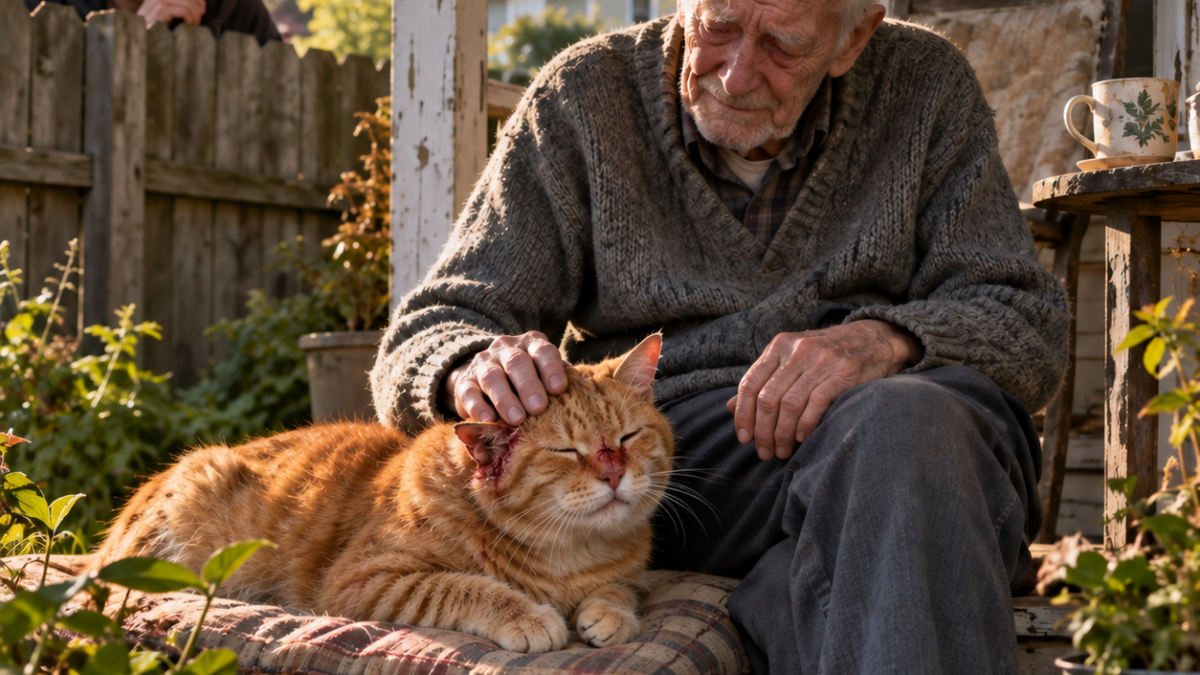
A few minutes later, George came back out carrying a faded floral cushion. He placed it carefully in the square of sunlight on the porch. Bandit followed, circled the cushion once, then lowered himself onto it with the heavy sigh of a creature who had important emotional labor ahead.
George sat beside him.
And talked.
At first, I could not hear the words. Just the low murmur of his voice, rough from disuse. Then the wind shifted.
“I watered them yesterday,” he said. “Don’t know why. Tomatoes still won’t come in right. Eleanor would’ve known what to do. Probably laugh at me first. She always did.”
Bandit blinked.
George rubbed one thumb over his other hand.
“Cabinet hinge came loose again. Been saying I’ll fix it since March. Still haven’t. Isn’t that something? Whole life I fixed other people’s engines, gutters, screen doors, radios. Now I can’t make myself tighten two screws.”
His voice cracked.
I pressed my hand to my mouth.
“Mornings are the worst,” he whispered. “I don’t know why people talk about nights being hard. Nights are honest. Everybody disappears at night. But mornings come in like they expect something from you.”
Bandit leaned against his leg.
George placed one thin hand on that scarred orange back.
“I know, I know,” he said. “You came for breakfast, not philosophy.”
Then Bandit lifted his head and looked straight toward the lilac bush.
George followed his gaze.
His eyes found me.
For one terrible second, none of us moved.
Then I stepped out from behind the bush, cheeks burning, hands raised like the police had caught me.
“I’m sorry,” I said quickly. “I’m so sorry. I followed him because he came home hurt, and I didn’t know where he’d been going. I didn’t mean to spy on you. I thought he was bothering people. I thought maybe he was bothering you too.”
George looked at Bandit.
Then back at me.
“Bothering me?”
“I just meant…”
He rested his hand on Bandit’s side.
My tough, arrogant cat closed his eyes.
George swallowed.
“This old bully,” he said, voice low, “is the only reason I get dressed before noon.”
The words hit me in the chest.
Harder than I expected.
George looked embarrassed after saying them, as if need were something indecent he had accidentally shown a neighbor. He stared down at Bandit and scratched under his chin.
“He started coming by last spring,” he said. “First time, he stole a piece of toast right off my plate.”
“That sounds like him.”
“I yelled at him. Told him to get out.”
“And?”
“He came back the next morning.”
I laughed softly despite the ache in my throat.
George’s mouth twitched.
“After a while, I started setting the cushion out. Then a bit of egg, when I had it. My doctor wouldn’t approve. Neither would you, probably.”
“I’m not his doctor.”
“No,” George said. “You’re his person.”
The phrase did something to me.
His person.
Not owner. Not master. Person.
Like Bandit had appointed me to a role I barely understood.
George looked toward the street. “I know folks complain. Sharon came by last week asking if he had been ‘trespassing.’ I told her he was welcome here.”
My shoulders tightened. “She came to you?”
“She comes to everybody.”
“That’s true.”
“She said outdoor animals reduce property values.”
I snorted. “Bandit has no respect for real estate markets.”
“She doesn’t like things she can’t schedule.”
That was the most words I had ever heard George say at one time, and every one of them felt like a door opening.
I stepped closer to the porch but did not come up the stairs. “George, did someone hurt him?”
His face darkened.
“What do you mean?”
“He came home scratched yesterday. Limping.”
George looked at Bandit’s nose and frowned. “He wasn’t hurt when he left here Monday.”
“Do you know where he goes after your house?”
“No.” He paused. “But he’s got rounds.”
“Rounds?”
“That’s what Eleanor used to call it when the old mailman stopped to talk to everybody. ‘Making rounds.’ Bandit’s like that. Doesn’t stay long everywhere. Just where he’s needed.”
I almost said, He’s a cat.
But I didn’t.
Because Bandit opened one eye at that exact moment, and somehow, absurdly, it seemed like he would have taken offense.
I walked home that morning with damp shoes, cold hands, and a heart full of uncomfortable questions.
I had thought I was following a menace.
Instead, I had found a widower on a sagging porch, talking to my cat because mornings hurt too much to face alone.
For the rest of that day, I moved through my work in a fog. Insurance codes blurred on my computer screen. Emails sat half answered. Bandit slept on my desk with his paw over my wrist, making typing impossible and apparently finding that acceptable.
I kept seeing George’s face when the door opened.
That small lamp in a dark room.
By evening, I had almost convinced myself that the discovery softened the problem. Bandit was not terrorizing George. He was helping him. That did not excuse stolen hot dogs or scratched cars, but it meant the story had more sides than Sharon allowed.
Then I found the flyer.
It was tucked beneath my flowerpot, printed in bold letters on bright white paper.
CAT OWNERS MUST CONTROL THEIR ANIMALS.
OUTDOOR CATS DAMAGE PROPERTY, THREATEN RESIDENTS, AND CREATE UNSAFE CONDITIONS.
EMERGENCY NEIGHBORHOOD MEETING THIS SATURDAY AT 4 PM.
ALL CONCERNED RESIDENTS ARE URGED TO ATTEND.
At the bottom, in smaller type, it said:
Failure to address ongoing disturbances may result in formal action.
No signature.
It did not need one.
I stood on my porch holding the flyer while Bandit sat on the railing behind me, calmly washing his chest.
“You’ve become a civic issue,” I told him.
He sneezed.
By Friday, the flyers had multiplied. One was taped to the mailbox cluster. Another pinned to the bulletin board outside the community center. Another tucked under the windshield wiper of Danielle’s car when she came over for dinner, which made her laugh so hard she nearly dropped the salad.
“This is insane,” she said, holding the paper under my kitchen light.
“It’s Sharon.”
“Of course it’s Sharon.”
Bandit sat on the chair beside her, trying to put one paw into her purse.
Danielle moved it without looking. “What did he steal this time?”
“Possibly her sense of control.”
“That’s a felony in Sharon’s jurisdiction.”
I wanted to laugh.
I did laugh.
Then I sat down hard at the table and covered my face.
Danielle’s voice softened. “Hey.”
“I don’t know what to do.”
“With Bandit?”
“With all of it.” I looked toward the living room, where he had abandoned the purse and was now licking butter off a piece of wax paper I was certain had not been on the floor thirty seconds earlier. “He can’t keep roaming. He’s getting hurt. People are angry. Sharon’s making it a whole campaign. But George…”
Danielle leaned back. “What about George?”
I told her.
The porch. The cushion. The tomatoes. The line about mornings.
Danielle stopped smiling.
“Oh,” she said.
“Yeah.”
“That’s…”
“Yeah.”
She looked at Bandit differently then. Everybody did, once they knew.
“That cat has layers,” she said.
“He has crimes.”
“He can have both.”
The meeting was held Saturday afternoon in the multipurpose room of the community center near the park. I almost did not go. For two hours beforehand, I walked around my house pretending to be busy while my stomach twisted.
I cleaned the already clean counter.
I folded a towel.
I fed Bandit early.
I stood in front of the bathroom mirror and told my reflection, “You are an adult woman. You can attend a meeting about a cat.”
My reflection looked unconvinced.
At 3:52, I locked Bandit inside, grabbed my keys, and walked down the block under a sky the color of wet cement.
The community center smelled like dust, old coffee, and floor cleaner. Beige walls. Folding chairs. A metal urn on a side table. A bulletin board crowded with flyers for piano lessons, missing bicycles, flu shots, and a church spaghetti dinner.
About thirty-five people had come.
For an orange cat.
That alone should have told me something was wrong with the modern world.
Sharon stood at the front with her clipboard. Beside her was a man I recognized vaguely as her nephew, Evan Whitcomb, who had moved into her basement after some vague business failure everyone was too polite to ask about. He wore a tight polo shirt, too much cologne, and the expression of a man who believed every room was waiting for him to explain it.
A small projector sat on a cart near them.
My stomach dropped.
Of course there was a slideshow.
The minute I walked in, heads turned.
Not all at once. That would have been kinder. Instead, attention moved across the room in little ripples, whispers and glances, people pretending not to look while making sure they looked enough.
I took a seat near the side aisle.
George sat two rows ahead of me, hunched in his gray sweater.
I had not expected him to come.
He glanced back and nodded once.
Somehow that helped.
Lydia from the blue house sat across the aisle, arms crossed, lips pressed tight. Her brother Sam was beside her, staring at the floor. I had seen him outside a handful of times, a tall man in his thirties with tired shoulders and a cigarette always held between two fingers like he had forgotten why he lit it. He looked like someone who had once been funny and now kept the evidence buried.
A young mother named Erin sat near the front with her two little girls coloring quietly at her feet. Mr. Delaney sat near the back, suspenders high, jaw set, looking prepared to dislike everyone equally. A nurse in burgundy scrubs leaned against the wall, checking the time like she had come straight from a shift.
Sharon tapped her pen against her clipboard.
“Thank you all for coming on such short notice,” she began.
Her voice had that public-meeting tone people use when they are thrilled to be upset in an organized way.
“We are here to address an ongoing issue affecting safety, cleanliness, property enjoyment, and neighborhood standards.”
She clicked a remote.
A blurry photo appeared on the wall.
Bandit sitting on Mr. Delaney’s truck hood.
Several people laughed before they could stop themselves.
Mr. Delaney scowled.
Sharon did not laugh. “This is not amusing.”
Evan stepped forward. “No, it isn’t. My aunt has received over twenty complaints about this animal.”
“Twenty?” I said before I could stop myself.
Sharon looked at me over her glasses. “You will have an opportunity to speak later, Claire.”
The way she said my name made it sound like she had found it stuck to the bottom of her shoe.
The next slide appeared.
Bandit on a patio chair.
Bandit near a birdbath.
Bandit walking along a fence.
Bandit outside George’s back door.
My hands curled around the edge of my seat.
“Where did you get that photo?” I asked.
Sharon ignored me.
Evan did not. “Residents have the right to document disturbances.”
“That’s George’s back porch.”
George slowly lifted his head.
The room shifted.
Sharon clicked the remote again too quickly.
The next slide showed a close-up of paw prints on someone’s car windshield.
“Residents should not be forced to tolerate trespassing animals,” Sharon said. “This cat has become a nuisance. It has scratched vehicles, invaded garages, intimidated pets, stolen food, upset children, and created a hostile environment.”
“A hostile environment?” Danielle would have loved that.
I did not laugh.
Because Sharon was not just complaining. She was building a case.
She spoke for ten minutes, citing city ordinances she did not fully understand, articles about outdoor cats, neighborhood guidelines from communities we did not belong to, and a typed list of alleged incidents. Some were probably true. Some sounded exaggerated. Some sounded impossible unless Bandit had learned to operate tools.
“June 14,” Sharon read. “Animal found inside screened porch, knocking over potted plants.”
“That was because my contractor left the door open,” Mrs. Bell called from the second row. “And he knocked over one plant.”
“June 22,” Sharon continued, louder. “Animal observed stalking songbirds near feeder.”
The birdwatching woman nodded gravely.
“July 3. Animal stole meat from outdoor grill.”
A man in a baseball cap raised his hand. “Half a hot dog.”
“July 11. Animal frightened Mrs. Whitcomb in her own yard








