My Rescue Cat Vanished for 20 Minutes Every Evening—So I Followed Her and Found the Secret She’d Been Keeping
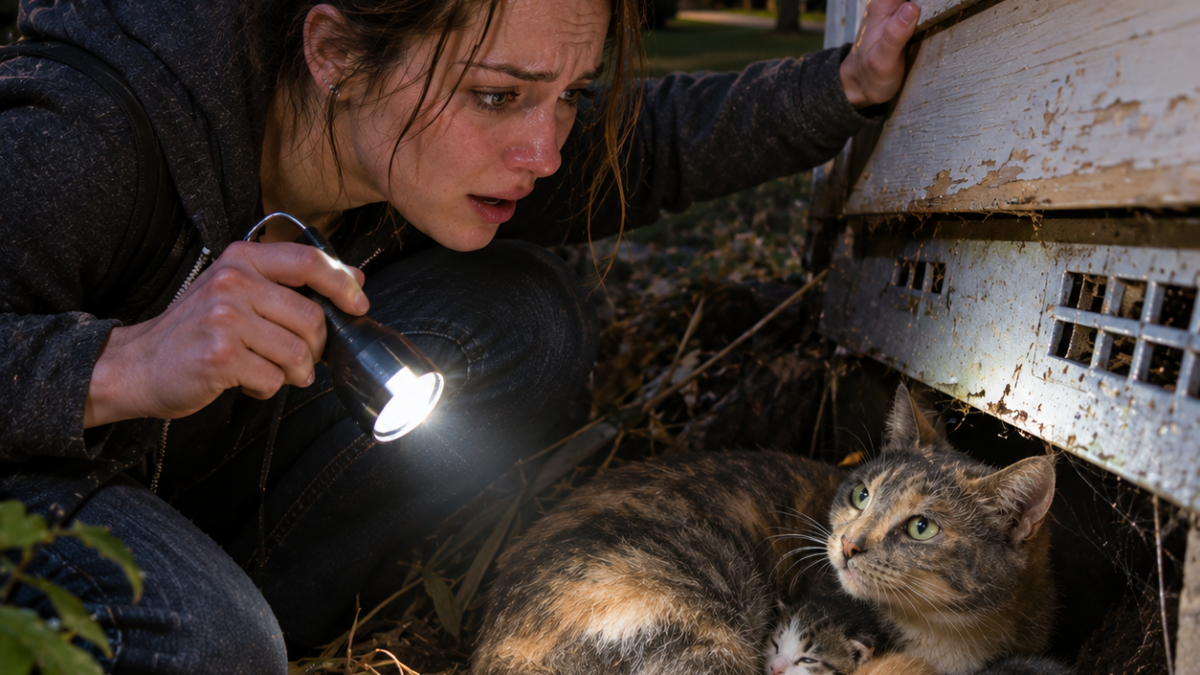
My Rescue Cat Vanished for 20 Minutes Every Evening—So I Followed Her and Found the Secret She’d Been Keeping
Every evening at exactly 8:20, my rescued cat slipped through the back door and vanished for twenty minutes—until the night she stopped at the gate, looked over her shoulder, and made it clear she wanted me to follow.
What I found beneath an abandoned house was not another stray cat, but three starving kittens Mika had been secretly keeping alive while someone in the neighborhood was trying to make sure nobody discovered they were there.
By morning, my landlord was threatening my lease, an angry property manager wanted the kittens removed before inspectors arrived, and I realized Mika’s twenty-minute disappearances had never been about leaving me at all—they were about keeping a promise no human had bothered to keep.
My name is Kendra Hall.
I was thirty-three when a blue-cream tortoiseshell cat taught me that trust sometimes arrives backward.
Not as an animal asking you to save her.
As an animal watching you long enough to decide whether you are safe enough to help save somebody else.
At the time, I lived in Eden Prairie, Minnesota, in a small rental house wedged between newer developments that seemed to appear every year.
My street was the kind of place where every lawn had an opinion.
Trimmed hedges.
Matching mailboxes.
Garages facing forward.
People who waved while walking dogs but did not necessarily know one another’s names.
My house was older than most of the homes around it.
Two bedrooms.
One bathroom.
Small fenced yard.
Detached garage.
A narrow concrete patio where I spent most evenings when the weather allowed.
I worked as a respiratory therapist at a rehabilitation hospital in Bloomington.
Twelve-hour shifts.
Sometimes three in a row.
Sometimes five if people called out.
My days involved oxygen.
Machines.
Families asking questions nobody really knew how to answer.
People learning how to breathe again after surgeries, strokes, infections, accidents.
By the time I came home, I rarely wanted conversation.
That was one reason Finn suited me.
Finn was my retired racing greyhound.
Eight years old.
Tall.
Black with white socks.
A narrow face that always looked mildly disappointed in humanity.
He had spent the first part of his life running because people told him to.
His retirement philosophy was apparently:
Never move unnecessarily again.
He slept eighteen hours a day.
He barked maybe twice a year.
PART2:
If somebody broke into the house, Finn would probably evaluate whether getting up was worth the effort.
I loved him more than I told anyone.
It had taken nearly a year after adopting him before he began sleeping fully on his side instead of curled tightly with his legs beneath him.
Rescue changes your definition of progress.
Sometimes progress is a dog dreaming deeply enough that his paws twitch.
Sometimes it is a cat sitting six feet away instead of twelve.
Mika began at twelve.
The first time I saw her, I was on my patio reading a paperback I had restarted three times because work had destroyed my attention span.
Finn lay on the outdoor mat beside me.
Late August.
Warm.
A little humid.
Mosquitoes beginning to appear.
I looked toward the garage and saw two pale green eyes.
The cat was tucked between the trash bins and fence.
Blue-cream tortoiseshell.
Gray-blue fur mixed with soft cream patches.
Slim.
One ear had a neat tip missing.
TNR.
Trap-neuter-return.
PART3:
I knew enough to recognize that.
She did not come closer.
I did not either.
“Hi.”
Finn opened one eye.
The cat watched him.
Finn closed his eye.
That apparently passed some kind of test.
I went inside.
Found a shallow bowl.
Filled it with water.
Set it near the garage.
Then returned to my chair.
No food.
I had made that mistake before.
The “I’ll just feed her once” mistake.
Four years earlier, before Finn, I found an injured stray near my apartment complex.
I fed him.
Drove him to a clinic.
Volunteered to hold him for three days.
He became attached.
I became attached.
Then his owner appeared.
The cat went home.
Everything worked exactly as it should.
I still cried for two days.
Afterward, I promised myself that caring did not require becoming emotionally stupid.
Mika clearly had not received that memo.
She came back the next afternoon.
Same location.
Same watchful posture.
On the third day, I left a little food.
On the fourth, she moved within eight feet.
On the sixth, rain started.
Hard Minnesota rain.
She stayed beneath the garage overhang.
I opened my screen door.
Finn looked up.
The cat looked at the doorway.
I stepped away.
“Your choice.”
Finn sighed.
The cat waited.
One minute.
Two.
Then she crossed the patio.
Entered.
Not dramatically.
No grateful rescue scene.
She moved into my mudroom with the cautious authority of a building inspector.
Laundry basket.
Boots.
Heating vent.
Dog leash.
Finn’s spare bed.
She sniffed everything.
Then stopped at the kitchen threshold.
Looked back at me.
I stayed near the counter.
“You can leave whenever.”
Her ears moved.
She stepped onto the mat beside the back door.
Sat.
That was where she spent the next hour.
Not comfortable.
Not hiding.
Checkpoint.
Watching both exits.
Finn came into the kitchen.
He stopped when he saw her.
She froze.
I held my breath.
Finn looked at her.
Then walked to his water bowl.
Drank.
Walked away.
Mika’s shoulders lowered by maybe half an inch.
That was their first conversation.
She stayed overnight.
The next morning she was gone.
I felt relieved.
Then disappointed.
That irritated me.
She returned that evening.
The next night too.
Eventually I took her to a vet.
No chip.
Spayed.
Healthy enough.
Probably two or three years old.
Ear-tipped through a local TNR program.
No registered colony associated with her tag number because the records were incomplete.
I posted her.
Found cat.
Blue-cream tortie.
Eden Prairie area.
Nobody claimed her.
Weeks passed.
Then months.
At some point I stopped saying she was visiting.
She had a food bowl.
Then a bed she ignored.
Then a scratching post she used only when I was trying to sleep.
Then a vet record with my name.
I called her Mika because I wanted something short.
Neutral.
Temporary sounding.
That was a lie.
Mika was never affectionate in the way people expect cats to be affectionate.
She did not climb into my lap.
Did not head-butt my face.
Did not sleep on my pillow.
She lived near me.
That was her love language.
If I read on the patio, she sat four feet away.
If I cooked, she watched from the doorway.
If I showered, she sat in the hallway and pretended she had not been waiting when I came out.
Finn and Mika developed what I can only describe as a professional partnership.
They never cuddled.
Never played.
But they shared rooms.
Finn would sleep.
Mika would watch.
If Mika became alert at a sound outside, Finn lifted his head.
If Finn became restless during storms, Mika sat near his bed.
No touching.
Just presence.
My little household became quiet and predictable.
Then Mika started disappearing.
The first night was September 14.
I remember because my hospital shift had been awful.
A patient named Mr. Lambert had been recovering from pneumonia for three weeks.
Seventy-six.
Funny.
Stubborn.
Called every respiratory treatment “the leaf blower.”
That morning he had declined suddenly.
By afternoon his family had gathered.
When I left, they were making decisions about comfort care.
I came home emotionally emptied.
I made tea.
Sat outside.
Finn stretched across the mat.
Mika watched birds from the edge of the patio.
At 8:20, she stood.
Walked to the screen.
Sat.
I looked at her.
“What?”
She looked at the door.
“You were outside all afternoon.”
Stare.
I opened it.
She slipped past me.
Normally she stayed in the fenced yard.
This time she went through a small gap near the side gate.
I stood.
“Mika.”
Gone.
My stomach tightened.
Not panic.
Not yet.
I checked the yard.
Garage.
Under the patio furniture.
No cat.
I walked to the gate.
Called quietly.
Nothing.
At 8:40, I heard scratching.
Mika stood outside the screen.
I let her in.
She walked to the mat.
Sat.
Licked one paw.
Completely normal.
“You’re rude.”
She blinked.
The next night, 8:20.
Same thing.
Mika waiting.
Door.
Gone.
8:40.
Back.
By the fifth night, I was checking the clock before she was.
8:18.
Mika grooming.
8:19.
Standing.
8:20.
At the door.
I began joking about it.
“Secret boyfriend?”
Finn sighed.
“Second family?”
Mika stared.
“Drug operation?”
Tail flick.
But beneath the humor, I was uneasy.
Outdoor cats disappear.
Cars.
Coyotes.
Dogs.
People.
I did not want her roaming.
Especially after dark.
So on the sixth night I decided I would not open the door.
8:20.
Mika sat.
I ignored her.
She stared.
I read.
She made one sound.
Small.
Not quite a meow.
I looked up.
She walked from the door to me.
Then back.
Paused.
Looked over her shoulder.
Something about it felt different.
Not demand.
Invitation.
I stood.
Mika immediately went to the door.
“Okay.”
Finn lifted his head.
“I’m probably about to discover you’re stealing rotisserie chickens from an elderly neighbor.”
I opened the screen.
Mika stepped out.
Then stopped.
She waited until I followed.
That was when the joke ended.
I grabbed my phone.
Small flashlight.
Shoes.
Finn stood.
“No.”
He looked offended.
“You stay.”
Finn stepped onto the patio anyway.
He would not pass the gate.
That was unusual.
He stood beneath the porch light, body stiff.
Mika looked at him.
Then at me.
Then walked.
I followed.
She stayed at the grass edge.
Never more than fifteen feet ahead.
Every few seconds she looked back.
Not checking whether danger followed.
Checking whether I did.
We passed two houses.
Then three.
At the end of the curve stood the vacant property.
I knew it.
Everyone did.
White siding turned gray with weather.
For-sale sign removed months earlier.
Grass too long.
One gutter hanging crooked.
The neighborhood association had complained about it repeatedly.
Someone eventually put plywood over one rear window.
The house seemed dead.
Mika crossed the yard.
I stopped at the sidewalk.
“No.”
She disappeared beside the porch.
“Mika.”
Nothing.
I looked around.
Dark windows.
No cars.
I stepped onto the property.
Every true-crime podcast I had ever listened to objected.
“Fantastic.”
I whispered.
“This is how women end up becoming cautionary episodes.”
Then I heard it.
Tiny.
Thin.
Mew.
I stopped.
Another.
From beneath the porch.
My chest tightened.
“Mika?”
I crouched.
She appeared beside a foundation vent.
One corner was bent.
She pushed through.
I knelt.
Turned on my flashlight.
Leaves.
Dirt.
Old insulation.
Then three kittens.
So small my brain rejected what I was seeing.
Maybe three weeks old.
Maybe less.
One gray.
One black-and-white.
One brown tabby.
Pressed together.
Mika curled around them.
Not nursing.
That was immediately obvious.
She had no swollen mammary glands.
No maternal body changes.
But she groomed them.
Pulled them close.
One kitten crawled beneath her front leg.
Mika lowered herself around it.
My eyes burned.
“Oh.”
There it was.
Twenty minutes.
Every evening.
She had not been exploring.
She had been visiting.
Keeping them warm.
Cleaning them.
Maybe bringing smells of food.
Maybe simply making sure they were not alone.
I whispered, “Where is their mother?”
Mika looked at me.
I searched.
No adult cat.
No food.
No water.
No bedding except leaves.
The kittens were thin.
Too quiet.
That frightened me.
Healthy hungry kittens complain.
These conserved energy.
I called a local rescue number.
Voicemail.
Another.
Voicemail.
Emergency veterinary line.
A technician answered.
I explained.
“How old?”
“I don’t know. Eyes open.”
“Walking?”
“Barely.”
“Cold?”
I reached.
Mika watched.
The gray kitten’s ears felt cool.
“Yes.”
“Bring them in if you can do so safely.”
“What about the adult cat?”
“Is she nursing?”
“No.”
“Then she may be acting as a surrogate. If she’s social enough, bring her too.”
I looked at Mika.
“Can I move them?”
“Keep them warm. Minimal stress.”
I removed my hoodie.
Folded it into a cradle.
Then reached slowly beneath the porch.
Mika did not hiss.
That meant more than people understand.
This cat who took weeks to enter my home watched me touch the creatures she had been protecting.
She chose not to stop me.
First kitten.
Too light.
Second.
Third.
Mika watched every movement.
When the last kitten left the dirt, she crawled out.
I stood.
Carrying the hoodie bundle.
“Home.”
Mika walked beside me.
Not ahead.
Beside.
The whole way.
Finn stood exactly where I had left him.
When we reached the patio, he sniffed the bundle.
His whole body softened.
Then he stepped back.
Mika entered.
Went directly to the laundry bathroom.
I made a nest.
Towels.
Low box.
Heating pad under half the box.
Water.
Kitten formula was impossible at that hour, but the emergency vet said not to feed until we had some idea of age and temperature.
Warm first.
Mika climbed in.
Curled around them.
Finn lay outside the door.
I sat on the floor.
At 9:31, my phone buzzed.
Landlord.
REMINDER: ANNUAL INSPECTION TOMORROW 9–11 AM. SMOKE/CO DETECTORS + PLUMBING ACCESS REQUIRED.
Then:
NEIGHBOR COMPLAINT RECEIVED REGARDING ANIMAL NOISE. LEASE PET LIMIT WILL BE ENFORCED.
I stared.
Two pets allowed.
Finn.
Mika.
Three kittens made five.
“Perfect.”
Mika lifted her head.
“Not your fault.”
She blinked.
I barely slept.
At 2:00 a.m., one kitten began crying.
Weak.
Repeated.
Mika groomed him.
I called emergency vet again.
We drove in.
All five of us.
Finn stayed home.
The kittens were approximately four weeks old.
Underweight.
Mild dehydration.
Fleas.
No severe illness.
The black-and-white female was weakest.
They gave fluids.
Warmed them.
Tested for common infections.
Negative.
The veterinarian asked where I found them.
“Vacant house.”
“Mother?”
“Missing.”
“Mika isn’t lactating.”
“No.”
The vet looked at her.
“She’s doing something unusual.”
“Apparently.”
“Female cats can show alloparental behavior even without nursing.”
“Meaning?”
“Helping care for kittens that aren’t theirs.”
I looked at Mika.
She was staring through the carrier door at the kittens.
“She was visiting them every day.”
The vet smiled faintly.
“Then she had a job.”
The clinic connected me with a foster network.
A woman named Susan called at 7:10 a.m.
“Can you keep them stable until afternoon?”
“My landlord is inspecting at nine.”
Pause.
“How strict?”
“I don’t know yet.”
“You want me to arrange emergency foster?”
I looked at Mika.
The kittens slept against her.
“No.”
The answer surprised me.
“I mean—maybe later. But don’t split them this morning.”
Susan understood immediately.
“Okay.”
“Is that stupid?”
“No.”
“Be honest.”
“It is inconvenient.”
“Those aren’t the same.”
“No.”
She laughed softly.
“They’re not.”
At 9:07, the doorbell rang.
I opened it expecting judgment.
The inspector’s name was Carl.
Late fifties.
Work jacket.
Tool bag.
He saw Finn.
Then Mika.
Then heard a kitten squeak.
His eyebrows lifted.
“You fostering?”
“Not officially.”
“Ah.”
I explained.
Quickly.
Defensively.
Carl held up one hand.
“You don’t need to convince me.”
That surprised me.
“You’re not the landlord?”
“Property maintenance contractor.”
He entered.
Checked smoke alarms.
Carbon monoxide detector.
Under-sink plumbing.
Then stopped near the bathroom.
Mika stood in the doorway.
Carl crouched slightly.
“Ear tip.”
“Yes.”
“TNR?”
“Yeah.”
“There’s been a colony around here for years.”
My pulse changed.
“Where?”
He looked toward the street.
“Vacant house.”
My heart jumped.
“What?”
“Behind it mostly. Old owner fed them.”
“Who?”
“Mrs. Kessler.”
I knew the name vaguely.
Older woman.
Had lived there before the house went vacant.
“What happened?”
“She went into assisted living last winter.”
“And the cats?”
Carl frowned.
“TNR people were supposed to monitor.”
“Do you know who?”
“Not names.”
He looked at Mika.
“I’ve seen her before.”
My skin prickled.
“At that house?”
“Yes.”
“How long?”
“Couple years maybe.”
I sat down.
Mika had not randomly discovered those kittens.
She had returned to a place she already knew.
Carl continued.
“Property company’s been trying to clean it up before sale.”
“What does that mean?”
“Sealing foundation gaps. Removing feeding stations. Cutting brush.”
I stood.
“They sealed gaps?”
“Supposed to.”
“Could kittens be trapped inside?”
Carl’s expression changed.
“Where exactly did you find them?”
“Under the porch through a broken vent.”
He put down his tool bag.
“There was another access point near the garage.”
“Was?”
“Maintenance crew sealed it last week.”
Cold moved through me.
“What if their mother was inside?”
Carl said nothing.
That was enough.
I called Susan.
Then animal control.
Then the city nonemergency line.
Within ninety minutes, five people were standing outside the vacant house.
Me.
Susan from rescue.
Carl.
An animal-control officer named Lena Ortiz.
And a property manager named Victor Hale.
Victor arrived angry.
That was his opening position.
“This is private property.”
Officer Ortiz showed credentials.
“We have a welfare concern involving potentially trapped animals.”
“There are no animals inside.”
“How do you know?”
“We cleared it.”
“When?”
“Last week.”
“Who cleared it?”
“My maintenance vendor.”
Carl quietly said, “They sealed crawlspace vents.”
Victor looked at him.
“You’re not employed by us.”
“No.”
“Then stay out of it.”
I disliked him immediately.
Not because he was necessarily guilty.
Because he was more offended by questions than concerned about the possibility of trapped kittens.
Susan crouched near the porch.
Mika was in a carrier beside me.
The second we approached the house, she became frantic.
Not screaming.
Pacing.
Pressing against the door.
Officer Ortiz noticed.
“That cat knows this property.”
“Yes.”
Victor sighed.
“It’s a stray.”
“She lived here before.”
“You don’t know that.”
Carl said, “I do.”
Victor glared.
Officer Ortiz raised a hand.
“Enough.”
We inspected the perimeter.
Most vents had metal mesh screwed over them.
One near the rear addition looked newly sealed.
Mika began making a low chirping sound.
Then we heard something inside.
Faint.
Scratch.
Everyone froze.
Again.
Scratch.
Officer Ortiz looked at Victor.
“Open the house.”
He hesitated.
“Now.”
He had keys.
We entered.
The smell hit first.
Dust.
Mildew.
Old house.
No obvious cat.
We moved quietly.
Kitchen.
Living room.
Basement stairs.
Then Mika began vocalizing from her carrier outside.
Louder.
A response came from below.
A weak meow.
Susan covered her mouth.
“Mother.”
We went downstairs.
Concrete basement.
Old furnace.
Storage shelves.
A section of wall opened into crawlspace beneath the addition.
Mesh had been placed across it from outside.
Behind old insulation, we found a tortoiseshell-and-white female cat.
Alive.
Barely.
Thin.
Dehydrated.
Mammary glands swollen.
Milk present.
The kittens’ mother.
She had been trapped when the vent was sealed.
I felt physically sick.
Officer Ortiz wrapped her in a towel.
Susan whispered, “Oh, baby.”
Victor stood behind us.
His face had gone white.
“I didn’t know.”
Nobody answered.
The cat was rushed to the vet.
Mika followed in another carrier.
I followed both.
The kittens were already there temporarily for checkup.
When the mother cat heard them, she began crying.
The kittens responded.
Four weeks old and exhausted, but they knew her.
The reunion was not cinematic.
The mother was too weak.
She lay on her side.
The gray kitten crawled toward her.
She licked him.
Once.
Then again.
The others followed.
Mika sat in the adjacent carrier.
Watching.
Completely still.
I began crying.
Dr. Patel—different clinic this time—looked at Mika.
“She kept them alive.”
Susan nodded.
“Looks that way.”
I whispered, “For how long?”
Nobody knew.
The property crew had sealed the access six days earlier.
Mika had started disappearing six days earlier.
Exactly.
She had been visiting after the mother became trapped.
Maybe Mika could hear her.
Maybe smell her.
Maybe she found the kittens emerging through the remaining vent and understood something was wrong.
Every evening she left my safe house.
Walked three blocks.
Spent twenty minutes grooming and warming three hungry kittens.
Then returned.
That was what she had been doing.
Not abandoning me.
Going back for them.
The mother cat survived.
We named her Maribel.
Not because I had naming rights.
Susan did.
She said every emergency foster deserved at least one unnecessarily pretty name.
Maribel recovered slowly.
Fluids.
Food.
Antibiotics for early mastitis.
Rest.
The kittens stayed with her under supervision.
Mika stayed nearby.
That first afternoon, when Maribel became stronger enough to sit up, Mika approached the kennel.
Maribel smelled her.
No hiss.
No aggression.
They touched noses through the bars.
Susan looked at me.
“They know each other.”
Carl later confirmed what we suspected.
Mrs. Kessler had fed several community cats.
Mika and Maribel were both part of that colony.
Possibly sisters.
Maybe simply companions.
Their TNR dates were only three weeks apart.
Same clinic.
Same area.
The records showed Mika had been trapped behind the Kessler house almost two years earlier.
Maribel had been trapped six months later.
Mika had not discovered random kittens.
She was caring for the babies of a cat she had known before she ever met me.
That was the real secret.
I thought she had built a new life and forgotten the old one.
She had not.
Safety had not erased loyalty.
The landlord problem arrived the same afternoon.
My actual landlord, Mr. Peterson, called.
“Kendra, we need to discuss the animal violation.”
“They’re not staying permanently.”
“You currently have five animals?”
“Technically eight if you count the mother now, but only two are inside my house.”
Silence.
“That is not funny.”
“It’s a little funny.”
“No.”
I explained everything.
He did not care.
Not cruelly.
Contractually.
“The lease allows two.”
“I have two.”
“The complaint says multiple animals.”
“The kittens were there one night because they were dying.”
“That still creates liability.”
“For what?”
“Damage. Sanitation. Noise.”
“They weighed maybe a pound each.”
“That’s not the point.”
I felt anger rise.
“What is the point?”
“The lease.”
That conversation taught me something.
Rules can be fair in general and cruel in a specific moment.
The pet limit existed for a reason.
People had abused rentals.
Animals had damaged property.
Landlords needed boundaries.
Still, there was something deeply absurd about being threatened over three half-starved kittens rescued overnight from a crawlspace.
Then Mr. Peterson said something worse.
“The HOA has also raised concerns.”
I laughed.
“My house is a rental inside an HOA now?”
“The property is.”
“What concerns?”
“Unregistered animals, feeding strays, attracting wildlife.”
My anger sharpened.
“I am not running a colony.”
“The report says food has been left outdoors.”
“I’ve fed Mika on my patio.”
“And apparently community cats are moving through the area.”
“They already lived here.”
“Kendra.”
“No.”
I surprised myself.
“No, you don’t get to frame this like I caused stray cats by putting down one bowl.”
He became quiet.
“I’m not arguing.”
“Neither am I.”
I absolutely was.
He ended with a formal warning.
No additional animals housed beyond forty-eight hours.
No outdoor feeding.
Follow-up inspection possible.
I hung up.
Susan looked at me.
“You okay?”
“No.”
“You can foster the kittens through us somewhere else.”
“I know.”
“Mika stays with you.”
“I know.”
“Then what are you angry about?”
I looked toward the vacant house.
“At how everyone keeps treating the consequence like the problem.”
“What do you mean?”
“The cats were here before me. The kittens were nearly killed because somebody sealed their mother inside a house. But the urgent violation is my food bowl.”
Susan smiled sadly.
“Welcome to community-cat work.”
The rescue filed a formal complaint with animal control about the property maintenance.
Officer Ortiz investigated.
Victor initially blamed the contractor.
The contractor blamed Victor’s written instructions.
Then we obtained the emails.
Because paperwork remembers arrogance.
Victor had sent:
ALL FOUNDATION OPENINGS MUST BE SEALED THIS WEEK. REMOVE FOOD DISHES, CAT SHELTERS, OR OTHER ATTRACTANTS BEFORE PHOTOS.
A maintenance worker replied:
We’ve seen cats entering crawlspace. Need trapping clearance first?
Victor answered:
NO. PROPERTY IS TO BE VACANT. SEAL EVERYTHING.
That changed the case.
He had been warned.
He had chosen appearance over welfare.
Not because he wanted cats dead.
That distinction matters.
He wanted a clean property.
Fast sale.
No visible colony.
No delays.
He believed the cats would move.
He never checked.
Indifference can be just as dangerous as cruelty when power is involved.
The city cited the property company for animal-welfare violations related to knowingly sealing access while community cats were present.
The fine was not enormous.
Victor did not go to jail.
But the company was ordered to cooperate with humane trapping before further structural sealing.
The house sale was delayed.
That mattered financially.
Suddenly Victor cared a lot.
He called me.
I should not have answered.
“I hope you’re satisfied.”
I stared at my phone.
“About what?”
“Our closing has been delayed.”
“Your crew trapped a nursing cat inside a basement.”
“We did not intentionally trap anything.”
“You were warned.”
“That’s under review.”
“I read the email.”
Silence.
Then:
“You people create these problems by feeding them.”
You people.
There it was.
“You mean people who don’t let animals starve?”
“I mean people who encourage colonies in residential neighborhoods.”
“Mika was already here.”
“They’re pests.”
My entire body went still.
“No.”
“I didn’t mean—”
“Yes, you did.”
I ended the call.
Then I did something unusual for me.
I documented it.
Time.
Date.
Exact words.
I sent the note to Officer Ortiz.
Not because calling cats pests was illegal.
Because patterns matter.
The HOA board held a meeting two weeks later.
I attended.
That was not something I normally did.
Neighborhood meetings are my natural predator.
But Susan came.
Carl came.
Two TNR volunteers came.
Officer Ortiz could not advocate but provided written information about lawful community-cat management.
Victor sat near the front.
One board member, a woman named Diane Mercer, opened by saying:
“We need to maintain property standards.”
Susan whispered beside me, “That sentence has killed more common sense than weather.”
I almost laughed.
Residents complained.
Cats in gardens.
Paw prints.
Food bowls.
Noise.
One man blamed cats for rabbits disappearing.
Another blamed rabbits for his flowers.
The meeting lost direction.
Then Carl stood.
“I’m a maintenance contractor.”
Everyone quieted.
He explained the inspection.
The kittens.
The sealed vent.
Maribel.
Then he said:
“You can dislike stray cats. That doesn’t make sealing them into a building reasonable.”
Simple.
Hard to argue with.
I stood next.
I had prepared notes.
I did not use them.
“I didn’t start feeding a colony.”
My voice shook.
“I took in one cat who started appearing behind my garage.”
Diane said, “And that attracts others.”
“No.”
I looked at Mika’s photograph on my phone.
“She was already part of a colony that existed here because an older resident had been caring for them before she went into assisted living.”
Several people recognized Mrs. Kessler’s name.
That changed the room.
“She trapped and sterilized cats with volunteers. Mika was one of them.”
I held up the photo.
“She left that colony and came into my house.”
Then another photo.
The kittens beneath the porch.
“But when Maribel was sealed inside, Mika went back every evening to keep her kittens alive.”
The room went quiet.
I continued.
“I am not asking anyone to love stray cats. I’m asking us to stop pretending ignoring them makes them disappear.”
That was the center of it.
The HOA had two choices.
Fight reality.
Or manage it.
They eventually chose management.
TNR volunteers received permission to maintain two discreet feeding stations away from homes.
Food had to be removed after set hours.
Shelters were placed on a church property nearby.
Cats were trapped, vaccinated, sterilized, and returned if unsocialized.
Friendly cats were evaluated for adoption.
Victor hated the agreement.
Most residents stopped caring within a month because the visible problem actually decreased.
Turns out organized management works better than angry email.
Imagine that.
My lease did not improve.
Mr. Peterson remained nervous about me.
Every communication felt like a warning wrapped in politeness.
Even after the kittens moved into official foster placement, I began feeling tense every time a truck stopped outside.
Mika noticed.
She would look toward the door when I did.
I hated that.
I had brought her inside to escape vigilance.
Now I was teaching her a new version.
So I made a decision.
I moved.
It was financially stupid.
Emotionally necessary.
The duplex I found was eleven minutes farther from work.
Two hundred and eighty dollars more a month.
Older carpet.
Smaller kitchen.
But the landlord, Mrs. Alvarez, owned two cats.
When I disclosed Finn and Mika, she said, “Send vaccination records.”
That was all.
No moral trial.
No HOA.
No pet limit beyond reasonable occupancy.
I signed.
The kittens stayed in foster with Maribel until weaning.
Mika visited twice.
Not daily anymore.
The first time, she walked into the foster room.
Maribel came forward.
They touched noses.
The kittens approached Mika.
She groomed the gray one for maybe thirty seconds.
Then walked away.
No panic.
No demand.
I realized her job had changed.
She had not been trying to become their mother.
She had been filling a gap.
Once Maribel was safe, Mika could stop.
That realization broke me more than any dramatic rescue moment.
Because humans often confuse love with possession.
Mika did not.
She stayed when they needed her.
Then stepped back.
The two most bonded kittens—Pip and June—were adopted together by a young couple named Elena and Mark.
They came to the foster home twice before adopting.
Sat on the floor.
Waited.
No grabbing.
No baby voices.
Pip crawled into Mark’s jacket.
June fell asleep against Elena’s leg.
Good people.
The third kitten, Otis, went to an older woman named Gloria.
Seventy-one.
Widowed.
Quiet condo.
No other pets.
Gloria sat on the foster-room floor for nearly an hour before Otis approached.
She never reached first.
When he finally touched her finger, she whispered, “There you are.”
I had to look away.
Maribel was social enough to adopt.
Carl took her.
That surprised everyone except Carl.
He had already built her a window shelf.
“I’m not adopting her,” he told me.
“She’s staying until someone better comes.”
Susan asked, “Better than the man who helped find her kittens and knows TNR?”
Carl frowned.
“That’s manipulation.”
Maribel slept on his bed the first night.
He adopted her officially three days later.
Justice does not always look like punishment.
Sometimes it looks like the frightened mother cat somebody sealed behind a foundation vent sleeping in a warm house owned by the maintenance worker who refused to ignore a scratch in the wall.
The vacant house eventually sold.
The new owners knew about the managed colony before closing.
That was part of the agreement.
They installed proper screened vents only after volunteers confirmed no animals were inside.
Victor was transferred to another regional office.
I found out because Diane from the HOA told Susan.
I felt no triumph.
Just relief.
The larger change mattered more.
The property company adopted a written humane-clearance procedure before sealing vacant structures in the region.
Visual inspection.
Thermal check when indicated.
Coordination with animal control if evidence of animals existed.
One email from Victor had nearly killed Maribel.
One investigation changed what the company required afterward.
That was the kind of justice I could live with.
Not humiliation for entertainment.
Prevention.
My new duplex felt strange at first.
Finn adjusted immediately.
Of course.
He located the softest rug and retired again.
Mika took longer.
She inspected everything.
Closets.
Windows.
Under the bed.
Laundry room.
Back door.
Then one evening, exactly at 8:20, she walked to the door.
I froze.
Months had passed.
Still, my body remembered.
8:20.
Mika sat.
I looked at the clock.
Then at her.
“You’re not doing this again.”
She looked outside.
My stomach tightened.
“What is it?”
She stood.
For a second I expected the old pattern.
A glance back.
A demand to follow.
Instead, Mika walked away from the door.
Jumped onto the windowsill.
Sat.
Watched the yard.
That was all.
8:21.
8:22.
She stayed.
At 8:40, she was still there.
I sat on the couch.
Something inside me loosened.
Those twenty minutes had been a job.
She was done.
I thought that was the end of the story.
It wasn’t.
Three months later, Mrs. Kessler’s daughter contacted the rescue.
Her name was Anna.
She had seen a neighborhood Facebook post about the TNR agreement.
She wanted to know whether any of her mother’s cats remained.
Susan called me.
“Do you have Mika’s old intake number?”
I did.
We matched it.
Mika had been one of Mrs. Kessler’s regular colony cats.
Her old nickname was Bluebell.
I laughed so hard I scared Finn.
“Bluebell?”
Mika stared at me.
“You do not look like a Bluebell.”
Anna sent photographs.
There Mika was.
Two years earlier.
Sitting beneath Mrs. Kessler’s porch.
Beside Maribel.
Another photograph showed Mika, Maribel, and a huge orange tom eating from shallow bowls.
Another showed Mrs. Kessler sitting on a lawn chair.
Mika five feet away.
Not touching.
Watching.
Same distance she had kept from me at first.
Anna told me her mother had dementia.
Before assisted living, routines began slipping.
Feeding times became inconsistent.
Neighbors helped.
Volunteers tried.
Eventually the house emptied.
Mika disappeared from the colony around the same time.
Then she appeared at my garage.
I sat with that for a long time.
Mika had lost a routine before.
Lost a person.
Lost a place.
Then built another.
No wonder she kept checkpoints.
No wonder she measured everything.
No wonder she watched doors.
At 8:20, when Maribel’s kittens needed her, she returned to the old world.
At 8:40, she returned to the new one.
Twenty minutes between two lives.
That was the part I finally understood.
I had thought Mika’s disappearances meant she had not fully chosen me.
The opposite was true.
She trusted her new home enough to leave it briefly and believe it would still be there when she returned.
That is a much deeper form of trust than never leaving.
Anna later brought Mrs. Kessler to visit.
I was nervous.
Mrs. Kessler was eighty-two.
Small.
Silver hair.
Her memory moved unevenly.
Some moments clear.
Some gone.
We met at my duplex because travel was difficult for her.
When Mika entered the living room, Mrs. Kessler stopped speaking.
Mika stopped too.
They stared at each other.
I held my breath.
Mrs. Kessler whispered:
“Blue?”
Mika’s ears moved.
“Bluebell?”
Mika took one step.
Then another.
She did not climb into her lap.
That would have made a better movie.
Real life gave us something smaller.
Mika approached.
Sniffed Mrs. Kessler’s hand.
Mrs. Kessler began crying.
Mika rubbed one side of her face against two fingers.
Once.
Then sat beside her shoe.
Anna covered her mouth.
I cried.
Finn slept through most of it.
Of course.
Mrs. Kessler stayed forty minutes.
Before leaving, she looked at me and asked:
“She lives here now?”
“Yes.”
“Inside?”
“Yes.”
“Warm?”
“Yes.”
She nodded.
“Good.”
Then she forgot the question and asked again five minutes later.
“She lives here?”
“Yes.”
“Warm?”
“Very.”
“Good.”
I answered every time.
After she left, Mika returned to the window.
No distress.
No searching.
She had remembered something.
Or perhaps simply recognized a familiar scent.
Either way, she stayed.
That visit changed how I thought about rescue.
We use the word as though a single person enters the story at the moment everything starts.
Rescuer.
Owner.
Adopter.
Foster.
But animals can have whole lives before us.
People who loved them.
People who failed them.
Places they survived.
Other animals they belonged to.
Routines.
Losses.
Mika did not become real when she entered my mudroom.
She arrived with history.
My job was not to erase it.
It was to become a safe next chapter.
Finn understood that before I did.
He never demanded Mika become different.
Never chased her.
Never forced friendship.
He simply left room.
Eventually Mika began sleeping near him.
Not touching.
Then one winter night, almost a year after she first came inside, I found her curled against his back.
Finn was asleep.
Mika’s chin rested on his hip.
I took one photograph.
Then left them alone.
No need to turn every moment into proof.
Finn got older.
Greyhounds do that too fast.
His muzzle whitened.
Stairs became slower.
At ten, arthritis arrived.
At eleven, heart disease.
Mika changed with him.
When Finn stopped following me room to room, Mika began doing it.
When he had bad nights, she slept beside his bed.
The afternoon we returned from the vet with the diagnosis that his heart was failing, I sat on the kitchen floor.
Finn lay beside me.
Mika came from the hallway.
She smelled him.
Then sat on my other side.
A quiet triangle.
No fixing.
Just staying.
Finn died at twelve.
At home.
On his bed.
Veterinarian beside us.
My hand on his chest.
Mika sat in the hallway.
Afterward, she approached his body.
Sniffed.
Waited.
Then walked away.
For days, she checked his bed.
Not dramatically.
Just once or twice.
Then stopped.
At 8:20 every evening, she still sat at the window.
Never the door.
I wondered sometimes whether she associated that hour with absence.
Maribel’s kittens.
Mrs. Kessler.
Finn.
Or whether I was the one giving the clock meaning.
Animals do not owe us symbolism.
Still, the hour became important to me.
A reminder.
Things leave.
Love can survive that.
Years after the kitten rescue, Pip and June were still together.
Their adopters sent photographs every few months.
Pip grew huge.
June stayed small and bossy.
Otis became Gloria’s shadow.
When Gloria had knee surgery, her daughter sent a picture of him sleeping beside the walker.
Maribel lived with Carl until she was old enough to become extremely round and entitled.
Susan called her “the basement queen.”
The managed colony decreased gradually.
Not because anyone poisoned cats.
Not because the HOA removed them.
Because TNR worked.
Fewer kittens.
Stable adults.
A handful of friendly cats adopted.
The church feeding station remained tidy.
People mostly stopped complaining.
That was another lesson.
Cruel solutions often feel faster.
Humane ones require patience.
But patience can actually solve things.
My landlord never apologized.
I did not need him to.
He returned my security deposit after I moved.
Full amount.
I considered that a spiritual victory.
Years later, Mr. Peterson emailed me out of nowhere.
He had another tenant who found kittens beneath a deck.
He asked:
Do you still know that rescue group?
I stared at the message for a long time.
Then sent Susan’s number.
People can learn too.
Sometimes slowly.
Sometimes only when the problem appears in their own yard.
Still counts.
Mika is older now.
Her blue-cream coat has softened.
She has a little white around the muzzle.
She is still not a lap cat.
I respect her consistency.
She sleeps beside me now, usually near my knees.
Sometimes she touches one paw against my leg.
That is enough.
I bought a house eventually.
Small.
No HOA.
That requirement was nonnegotiable.
There is a screened porch.
Mika loves it.
At 8:20 on summer evenings, she sometimes wakes from a nap and looks toward the yard.
Then at me.
I always notice.
I cannot help it.
For years I assumed the greatest sign of trust was staying.
An animal choosing your couch.
Your bed.
Your house.
Your hands.
Mika taught me something more complicated.
Sometimes trust is leaving and believing you are allowed to return.
The first night she disappeared, I thought twenty minutes meant I had failed to make her feel at home.
The sixth night, when she asked me to follow, I understood those twenty minutes had nothing to do with rejection.
She had been carrying two worlds.
The home that had failed.
The home that was becoming safe.
And three tiny lives hidden between them.
She could not nurse those kittens.
Could not free their mother from behind a sealed wall.
Could not call a rescue.
Could not argue with a property manager.
All she could do was show up.
Twenty minutes.
Groom them.
Warm them.
Keep them quiet.
Come home.
Then repeat.
Until she decided I might be useful.
That is what humbles me most.
Mika did not trust me because I fed her.
Lots of people had probably fed her.
She trusted me when she had something to lose.
That is different.
She led me to the abandoned house because the kittens mattered more than her fear of involving a human.
She put the most vulnerable thing she knew in my hands.
And then she watched what I did.
That night became a measurement.
Would I pick them up carefully?
Would I carry them home?
Would I stay awake?
Would I hand them off at the first inconvenience?
Would I disappear when the landlord complained?
Would I keep showing up after the dramatic part?
Rescue is easy to romanticize around the dramatic part.
Cat under porch.
Dog in traffic.
Kitten in storm drain.
Camera.
Tears.
Saved.
The real work happens afterward.
At two in the morning when somebody is dehydrated.
At nine when the landlord rings.
At noon when paperwork begins.
At the meeting where people care more about property values than living things.
At the moment you have to admit your current home is no longer compatible with the life you chose.
At the quiet adoption when you put an animal into someone else’s carrier and hope your judgment was good.
At the vet years later when the animal you love becomes old.
That is rescue too.
Staying through the unphotogenic parts.
I used to believe Mika was the rescue cat in our story.
Technically, she was.
She had no home.
I gave her one.
But she became the rescuer the moment Maribel disappeared.
Nobody appointed her.
Nobody rewarded her.
She saw three kittens alone and filled the gap.
Then she found me.
Or maybe tested me.
I sometimes imagine those six evenings from her perspective.
Leave Kendra’s house.
Cross the yards.
Reach the abandoned porch.
Kittens still alive.
Groom.
Warm.
Listen for Maribel.
Wait.
Return.
Maybe she knew Maribel was trapped.
Maybe she heard her through the walls.
Maybe that was why she was so precise.
Twenty minutes.
Long enough to care for the kittens.
Short enough to return to her own safe place before fear won.
I will never know.
Not every mystery gets solved.
That used to bother me.
Now I think unanswered pieces are part of respecting an animal.
Their inner lives do not belong entirely to us.
We can observe.
Infer.
Love.
But some part remains theirs.
Mika no longer disappears.
She does not need to.
Maribel is safe.
Her kittens grew up.
Mrs. Kessler got to see her again.
Finn is gone, but the bed where he slept has been replaced by a sunny patch on the screened porch Mika claims every afternoon.
Life moved.
That is what life does.
The twenty-minute ritual ended.
The trust did not.
One evening last month, I sat outside reading.
Different house.
Different patio.
Older Mika.
The sun dropped behind the trees.
I checked my phone.
8:19.
I smiled.
At 8:20, Mika stood.
My chest tightened out of habit.
She stretched.
Walked toward the porch door.
Stopped.
Looked at me.
For one ridiculous second, I wondered if another mystery was beginning.
Then she turned around.
Walked back.
Lay beside my chair.
Her body touched my ankle.
Barely.
I put the book down.
“You’re staying?”
One ear moved.
“Good.”
I looked toward the yard.
Nothing waiting.
Nothing hidden.
No tiny cries.
No dark house.
Just evening.
And I finally understood what I had spent years misunderstanding.
Those twenty minutes had never been Mika leaving home.
They had been proof that she had finally found one safe enough to come back to.








