My Neighbor Set Her Cat Beside the Moving Boxes and Said, “The New Place Won’t Allow Him”—Then He Reached Through the Carrier Door for Her
My Neighbor Set Her Cat Beside the Moving Boxes and Said, “The New Place Won’t Allow Him”—Then He Reached Through the Carrier Door for Her
The morning my neighbor set her old cat beside a stack of moving boxes and said the new apartment wouldn’t allow him, I judged her before I knew the truth.
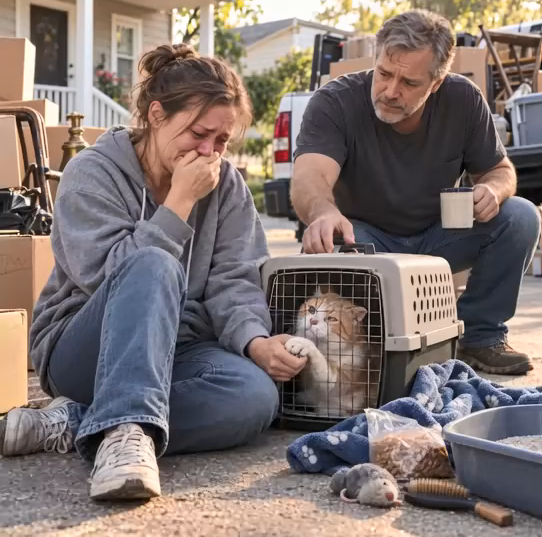
Then I saw the way that tired orange-and-white cat clawed at the carrier door when she turned away, and I realized this wasn’t a woman casually abandoning a pet—it was someone being forced to choose which part of her life she could still keep.
I thought I was about to watch a cat lose his home, but before that morning was over, Coby would make me question whether either of us understood what “home” actually meant anymore.
My name is Mark Ellis.
I was fifty-one.
Divorced.
No kids.
House too quiet.
Life too organized.
Exactly the kind of man who could stand on a porch with coffee and believe other people’s problems had obvious solutions.
Lisa lived across the street.
That morning, her driveway was covered with everything she owned.
Cardboard boxes.
Black trash bags.
A lamp without a shade.
A folding chair tied with rope.
A dented microwave lying sideways in the back of a rented pickup.
Then she carried out the cat carrier.
Inside was Coby.
Orange and white.
One torn ear.
Old enough that his face had gone pale around the muzzle.
He sat behind the scratched plastic door and stared out with the exhausted dignity of an animal who didn’t understand why the rules had suddenly changed.
“Where’s he going?” I asked.
Lisa stopped.
“Shelter.”
I lowered my coffee.
“You’re giving him up?”
Her eyes were red.
Not fresh tears.
The swollen kind that come after several nights of crying alone.
“You think I want to?”
I should have stopped there.
Instead, I said:
“The new place won’t take cats?”
“No pets.”
“And that’s it?”
Her face hardened.
“What do you want me to do, Mark?”
I opened my mouth.
Then made it worse.
“A pet’s family.”
“I know.”
“You don’t just—”
“I KNOW.”
That shut me up.
She went inside for another box.
PART2:
I stood there feeling righteous for maybe six seconds.
Then ashamed.
I walked across the street and crouched beside Coby’s carrier.
I had seen him hundreds of times.
Always in Lisa’s front window.
Same corner.
Same posture.
Watching the street.
There had been nights when I couldn’t sleep and sat in my own dark living room with the television muted.
Sometimes I would look across the street and see Coby awake too.
A little orange-and-white shape in the window.
Still.
Steady.
I know how ridiculous that sounds.
But knowing something else was awake made the neighborhood feel less empty.
“Well,” I whispered through the carrier door, “looks like we’re both having a morning.”
Coby blinked.
Lisa came back outside.
“I called the shelter.”
I looked up.
“They’ll take him.”
Her voice sounded defensive.
Like she had already spent hours arguing with people who thought every problem had an easy answer.
“I asked the landlord twice.”
“Pet deposit?”
“No.”
“Exception?”
“No.”
“What happened to your old place?”
She looked toward the boxes.
“Rent went up four hundred dollars.”
I stopped talking.
“My hours got cut.”
Another box landed in the truck.
“I can afford the new apartment.”
She swallowed.
“Or I can keep Coby and risk us both having nowhere to live.”
That sentence changed everything.
Then Lisa crouched beside the carrier.
“Come on, old man.”
Her voice broke.
“I’m sorry.”
Coby stood so quickly the carrier rattled.
Lisa turned her face away.
And that old cat shoved one paw through the narrow opening in the door.
Reaching.
Stretching.
Trying to touch her sleeve.
Lisa froze.
So did I.
Coby made one small, cracked sound.
Then reached farther.
And the next thing Lisa said was so quiet I almost didn’t hear it.
“He’s the only thing I have left from before everything fell apart.”








