My Neighbor Ran Half a Mile Through a Blizzard to Reach My Door—Then, Wrapped in My Shirt by the Fire, She Whispered, “I Feel Safer With You.”
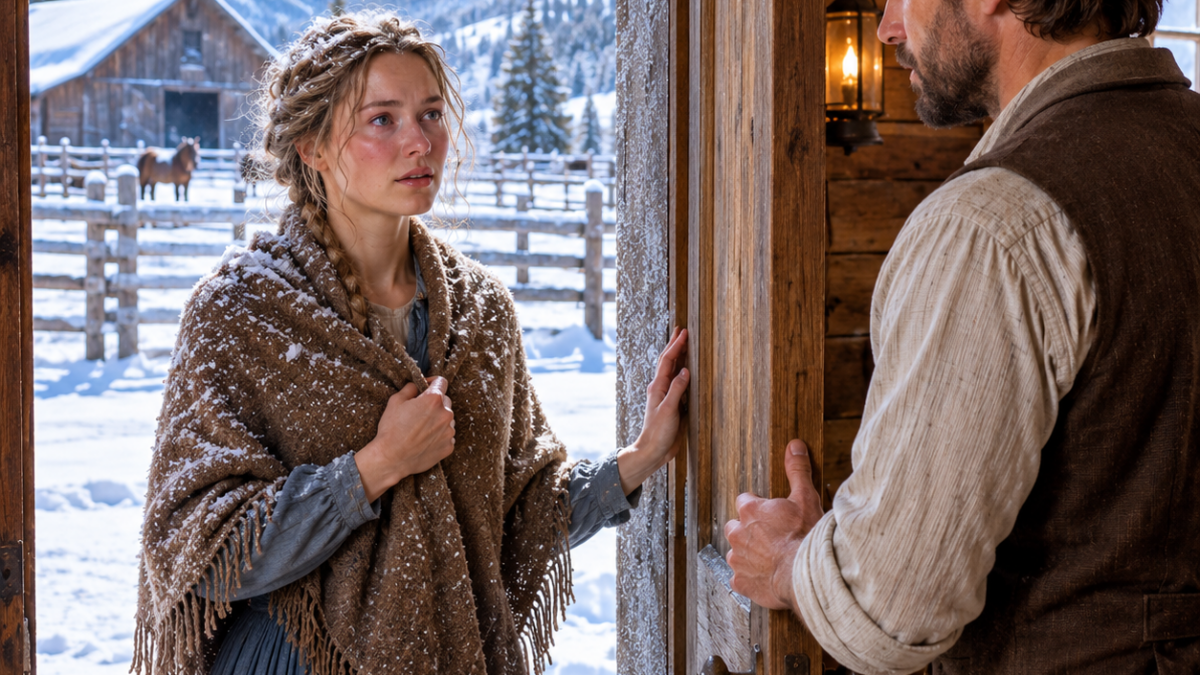
My Neighbor Ran Half a Mile Through a Blizzard to Reach My Door—Then, Wrapped in My Shirt by the Fire, She Whispered, “I Feel Safer With You.”
I spent three years proving I needed no man to save me, until a blizzard tore open my roof and forced me across a frozen field toward the one door I trusted.
The whole town thought I ran to Emmett Larkin because I was weak, but they did not know the secret humiliation that had taught me to fear needing anyone.
By spring, after lies, gossip, a stolen land paper, and one brutal public betrayal, the man I swore I did not need became the only person I wanted beside me when the next storm came.
My name is Ivy Marrow, and before the storm that changed my life, I had made a hard religion out of doing everything alone.
Not because I hated people.
People assumed that about me often enough.
In Dakota Territory, a woman living by herself on a homestead claim invited opinions the way spilled molasses invited flies. Men passing along the road watched me split kindling and decided I was either stubborn, unnatural, or in need of marrying before I turned bitter enough to spoil preserves. Women in town sometimes pitied me, sometimes admired me, and sometimes spoke of both feelings in the same breath as if pity and admiration were distant cousins.
“She manages well enough,” they would say.
That was the phrase.
Well enough.
It meant I had not failed visibly.
It meant no one had yet found me frozen beside my own barn or cheated out of my claim or weeping at the mercantile because a harness strap broke and I did not know how to mend it.
Well enough was what people said when they wanted to acknowledge a woman’s strength without admitting it made them uncomfortable.
I did manage.
Not perfectly.
Not prettily.
But I managed.
My father, Caleb Marrow, had brought me west after my mother died. I was twenty-six then, old enough for people back east to start using the word spinster gently around me, young enough to still believe I could outrun other people’s definitions if I put enough miles between them and myself. My father was not a soft man, but he was fair, and fairness in a father can build a daughter’s backbone better than praise.
He taught me to read weather by the color of the morning.
He taught me how to reset a gate hinge, how to judge a horse’s lameness, how to carry water without spilling half of it, how to sharpen an ax safely, and how to look a man in the eye when discussing money.
“Land doesn’t care whether your hands are delicate,” he told me once. “Only whether you use them.”
When illness took him, it did not do so quickly enough to be called merciful. For nearly a year, I ran the place while he faded inside the house. At first he argued. Then he instructed. Then he watched from the chair near the stove, wrapped in a blanket, shame sitting on his shoulders heavier than sickness.
The day before he died, he pressed his pocket watch into my palm.
It was silver, dented along one edge, and terrible at keeping proper time.
“Thing’s always been five minutes behind or ahead,” he whispered. “Much like me.”
I tried to smile.
Failed.
His fingers closed over mine.
“The claim is yours, Ivy. Not because I had no son. Because you earned every acre.”
Those were the last full words he gave me.
I proved up the claim in my own name the following spring.
That mattered.
More than some people understood.
Every fence post I set after that, every chicken I kept alive through winter, every load of water hauled through snow, every roof patch, every account paid, every seed put in ground was not simply work.
It was testimony.
I am still here.
PART2:
This place did not vanish when the man who owned it died.
I did not vanish either.
Across the open field half a mile west lived Emmett Larkin.
His land shared a boundary with mine, though the line between us had never needed arguing over. It ran across a strip of prairie grass, past a low wash, and toward a stand of winter-bent cottonwoods. Emmett worked his ranch alone, as I did mine. He was quiet, brown-haired, broad-shouldered, and steady in a way that made some women in town call him dull because they mistook steadiness for lack of fire.
He had fire.
I knew that before he ever gave me reason to.
You can tell things about a person by the way he treats animals when no one is watching. Emmett never jerked a horse’s mouth when a lower voice would do. He never kicked a dog out from underfoot. He never shouted at cattle simply because the day had tested his temper. His anger, when it came, seemed to move through him slowly, like deep water under ice, and because of that I trusted it more than I trusted men whose tempers flared and vanished conveniently after damage was done.
For two years, Emmett and I lived side by side without becoming close.
He greeted me at the fence.
I greeted him back.
If his cattle drifted too near my line, he moved them before I had to ask. If one of my hens decided his yard was more interesting than mine, he delivered her back in a flour sack with only the faintest amusement in his eyes.
He never offered help unless I asked.
I never asked unless not asking would have been foolish.
That was our arrangement.
Or so I told myself.
The truth was, I noticed him more than I admitted.
I noticed the lantern burning late in his window on nights when I woke restless. I noticed the way his porch remained swept even in hard weather. I noticed he bought coffee in town but rarely sugar. I noticed he avoided church suppers where the widows and unmarried daughters circled him like barn cats around a milk pail. I noticed he laughed little, but when he did, the sound changed his whole face.
I noticed.
That was all.
Noticing was safe.
Needing was not.
PART3:
I had learned that lesson back east from a man named Charles Whitcomb, though for years I tried not to give him the dignity of memory.
Charles had been my fiancé before my father fell ill. He had handsome hands, a good coat, a mother who considered herself refined because she owned six teaspoons engraved with initials, and an opinion of himself large enough to require extra seating. He courted me politely at first. Flowers. Walks. Church conversations. Letters written in a careful hand.
Then my father’s health failed, and I began managing accounts, speaking to creditors, bargaining with suppliers, and delaying wedding plans because our household had no one else to do it.
Charles endured that for three months.
Then one evening, standing in the parlor of my aunt’s house, he told me marriage required a proper order.
“A wife should be able to lean on her husband,” he said.
“I expect she should,” I replied, tired from a day of negotiating feed prices and uninterested in philosophy.
His mouth tightened.
“You misunderstand me.”
“I doubt that.”
He looked toward the window, as though hoping the glass might provide a more agreeable version of me.
“A woman who has trained herself to require no guidance makes a man feel unnecessary.”
I remember the lamp glow on his face.
I remember the sound of my aunt moving quietly in the kitchen, listening.
I remember thinking, with absolute clarity, that he was not angry because I lacked softness.
He was angry because my strength had become inconvenient to his vanity.
“Then perhaps you should find a woman who requires more rescuing,” I said.
He did.
Within a year, he married a girl from Providence who had fainted twice during a summer picnic and thereby proved her suitability.
I went west with my father and made a vow no preacher heard.
I would rather be unnecessary to a man than dependent on one who would leave the moment I proved I could stand without him.
For three years after my father died, that vow kept me upright.
It also kept me lonely.
But loneliness seemed safer than humiliation.
Then came the winter of 1886 into 1887.
Old-timers still spoke of that winter for years afterward, and when they did, their voices changed. Dakota winters were never gentle, but that one seemed to take offense at the idea of survival. Storm followed storm with barely enough pause between to dig out paths, haul water, and count losses before the next wall of weather came down. Cattle froze standing in coulees. Fences disappeared beneath drifts. Men rode out and returned half-blind from snow glare. Some did not return at all.
I spent December rationing feed so carefully I dreamed in measurements. January brought cold so sharp it made breathing feel like swallowing needles. Twice I woke before dawn to break ice in the water trough with an ax by lantern light, my hands burning inside wool gloves. My chickens survived because I had barred their coop low to the ground and stacked straw along the windward side until it looked like I was fortifying against an army.
I managed.
I kept telling myself that.
On the morning of the storm, the sky was gray but not threatening enough to frighten me.
That was how the worst ones came.
Not with theatrical warning.
No black clouds marching like soldiers.
No thunder.
Just a gray line on the horizon at midday, the wind shifting oddly, the animals uneasy, and an ache in old injuries you had almost forgotten you owned.
By supper, the world had vanished.
Snow drove sideways so fiercely that the barn lantern became a blurred orange smear only thirty yards away. Wind hit the house in long, body-heavy blows, each one testing seams my father had built twenty years earlier. I barred the chicken coop before dark, checked the barn twice, and brought extra kindling inside.
At first, I worried about the animals.
Then the wind found my kitchen roof.
A shriek of wood pulled me from the stove.
I looked up just as snow sifted through the ceiling seam above the north wall.
“No,” I said.
As though the storm might accept objection.
The next gust peeled the seam wider.
Cold rushed in.
I dragged a chair beneath it, climbed up with a quilt, and shoved fabric into the gap. Snow stung my face. Another gust sucked half the quilt upward and nearly took it from my hands. I climbed down, grabbed a board from the corner where I kept repair scraps, and wedged it against the wall.
For twenty minutes, pride kept me fighting.
I hammered.
Tied rope.
Shoved rags.
Braced boards.
Cursed the wind, my father’s nails, my own hands, and God in an order that would have scandalized church women had any been present to hear it.
Then the second board tore loose and struck the table hard enough to split a cup.
The hole widened.
Snow poured in properly now.
Not a little drift.
A storm entering my house like it had been invited.
I stood in my kitchen with my hair full of snow and understood, with the particular clarity cold and fear bring together, that staying meant risking more than damage to a roof.
It meant dying inside a house I had sworn to keep standing.
There was no one closer than Emmett Larkin.
Half a mile.
In summer, a simple walk.
In that storm, it looked longer than the road to judgment.
For one foolish moment, I considered trying to last until morning.
Then another gust shook the north wall so hard the shelves rattled.
My father’s pocket watch sat on the kitchen shelf where I had set it while kneading bread earlier. I reached for it, intending to take it, but a burst of snow hit the side of my face and blinded me. Something crashed near the stove. A pan fell. The lamp flickered.
I left the watch.
That small abandonment hurt worse than it should have.
I wrapped myself in every layer I owned. Coat. Shawl. Scarf. Gloves. My father’s old wool cap pulled low. I tied rope around the porch post and around my waist, more habit than plan, then stepped outside.
The wind struck so hard it drove me sideways into the doorframe.
I nearly fell before leaving my own porch.
The world was white violence.
I could see nothing beyond a few feet. My lantern blew out before I reached the yard gate. I kept one hand on the rope until it ran out, then moved by memory. Fence line. Low wash. Slight rise. Boundary stretch. Emmett’s barn should have been west by northwest, but direction becomes a cruel joke in a whiteout.
Twice the wind took my feet from under me.
The first time, I landed on my knees and felt cold bite through my skirts. The second time, I went down fully and lay for several seconds with snow packing against my cheek.
That was when fear finally found me.
Not worry.
Not practical concern.
Fear.
The kind that strips pride to bone.
I thought, If I die here, Emmett will find me when the storm clears.
Not because anyone else would come.
Because he was the only one close enough to notice.
That thought got me up.
By the time I reached his yard, I could not feel my hands well enough to knock properly. The ranch house appeared all at once, a darker blur through blowing snow, lamplight glowing in one window. I climbed the steps half crawling, half falling, and pounded on the door with the flat of my arm.
Once.
Twice.
It opened before I managed the third strike.
Emmett stood there in shirtsleeves, lamplight behind him, face changed instantly by what he saw.
He did not ask one useless question.
He pulled me inside.
The door slammed against the wind behind us.
Heat hit me like pain.
I stood dripping snow onto his floor, shaking so hard my teeth clicked, trying with the last of my pride to master what terror had done to me.
Emmett moved fast.
He bolted the door.
Built up the stove.
Dragged a chair nearer the heat but not too near.
Put water on for coffee.
Found a dry shirt, trousers, and thick socks from his own drawer, laying them near the stove to warm before handing them to me.
“There’s a room through there,” he said, nodding toward a door. “Change before those freeze on you. Take whatever time you need.”
His voice was calm.
That was what undid me more than panic would have.
I changed in the little bedroom with fingers stiff as sticks, fighting buttons, peeling off soaked layers, breathing through the shame of standing in another person’s house in borrowed clothes because my own roof had failed me.
His shirt swallowed me. The sleeves hung well past my fingertips. His trousers were rolled twice and still too long. When I stepped back into the main room, Emmett glanced at the sleeves.
“If you say one word about these sleeves,” I said, “I’ll go back out into the storm.”
He looked at me for a long moment.
“Wasn’t going to.”
“Good.”
“They appear to be winning already.”
A laugh escaped me before I could stop it.
Small.
Ridiculous.
Half frozen.
But a laugh.
He handed me coffee so heavily sugared it might have been syrup.
“That is more sugar than coffee.”
“You were half frozen.”
“So you decided to finish the job a different way.”
This time, the almost-smile touched his mouth.
I wrapped both hands around the cup and drank anyway.
For a while, we only listened to the storm.
His house was smaller than mine, built more for use than memory. Everything had a purpose. Boots by the door. Tools hung clean. Firewood stacked properly. A rifle above the mantel. A single shelf of books. A table with two chairs, though one looked unused except for holding mail.
No wife’s touches.
No childish clutter.
No softness except what the fire made.
“Roof went,” I said finally.
Emmett’s gaze sharpened.
“Bad?”
“North corner came clean open. I tried to brace it. Couldn’t keep the snow out.”
“You did right coming here.”
The words struck something sore in me.
“Didn’t have much choice.”
“You had enough choice to make the right one.”
I looked into the cup.
“I left my father’s watch.”
He did not dismiss it.
Did not tell me it was only a watch.
“Where?”
“Kitchen shelf.”
“We’ll find it at first light.”
“If the shelf’s still there.”
“Then we’ll find where the shelf went.”
I looked at him.
His face was serious.
That was when I first felt it. Not love. Not yet. Something quieter and perhaps more dangerous.
The feeling of being believed in small matters.
Within an hour, it was plain I would not be returning home that night. Roads were gone. The field between our claims had become an impossible white sea. The wind beat at Emmett’s walls hard enough to make the lamp flame tremble.
He gave me the bedroom without asking.
I objected.
He ignored me.
“I can sleep in the chair.”
“So can I.”
“You came here half frozen.”
“This is your house.”
“And in my house, guests don’t sleep upright when there’s a bed available.”
“I’m not delicate.”
“I did not say you were. I said take the bed.”
We stared at each other.
I lost, mostly because my body chose that moment to shake so violently the coffee sloshed over my fingers.
Emmett handed me a towel without comment.
That mercy saved us both from embarrassment.
We did not sleep immediately.
Neither of us could.
We sat near the stove with the storm hammering the world flat outside, talking at first because silence felt too aware of itself.
“You’re a hard woman to get to know, Miss Marrow,” Emmett said after a while.
“Most people manage not knowing me well enough.”
“Two years living half a mile apart, and I don’t believe I’ve heard you ask for so much as a cup of sugar.”
“I don’t like owing people.”
“Owing tends to come with strings, I suppose.”
“Strings I’d rather not get tangled in.”
He turned his cup slowly in both hands.
“Not all strings pull the same direction.”
I studied him through the firelight.
“What’s your string then?”
His eyes lifted.
“What do you mean?”
“Why does a man live alone half a mile from anyone, working land by himself, when Dakota has no shortage of women who’d take a rancher’s proposal gladly?”
He was quiet long enough I thought he might not answer.
“Loud company never suited me,” he said.
“That sounds practiced.”
“It is.”
“And the truth?”
A gust struck the wall. The house groaned.
Emmett looked toward the window.
“The truth is that quiet company is hard to find unless it happens to knock on your door during a blizzard.”
Heat rose in my face, and not from the stove.
I could have deflected with sharpness. I often did.
Instead, exhaustion made me honest.
“I was engaged once.”
He did not move.
“Back east. Before my father worsened. His name was Charles Whitcomb.”
Even saying the name felt like touching old rust.
“He broke it off when he saw I could manage accounts, deal with creditors, and make decisions without waiting prettily for permission.”
Emmett’s jaw shifted.
“He said a wife ought to need looking after. Said a woman capable of running her own house made a man feel unnecessary.”
“And what did you say?”
“I told him to find a woman who required more rescuing.”
Emmett’s mouth almost smiled.
“Did he?”
“Yes.”
“Then perhaps both of you were spared.”
“Perhaps.”
I reached into the pocket of the coat hanging near the stove before remembering the watch was not there. My hand closed on nothing.
“I decided that day I would rather be unnecessary to a man than dependent on one who’d leave the moment I proved I didn’t need rescuing.”
Emmett leaned forward, elbows on knees.
“That’s not the same thing.”
“I know that now.”
My voice lowered.
“I’m not certain I knew it three years ago.”
He did not rush to comfort me.
That mattered.
Comfort offered too quickly can feel like a person trying to tidy your pain.
Emmett only said, “Needing help once in a blizzard doesn’t undo three years of proving you don’t need it most days.”
The words entered quietly.
They stayed.
Later, he told me about his ranch. How he had built most of it from nothing. How he had a brother back in Ohio who wrote twice a year if guilt or weather reminded him. How, when he was nine, his mother died of lung fever and his dog died the same week after refusing to leave the porch through three nights of cold.
“I never told anyone that,” he said.
“About your mother?”
“About the dog. Seemed foolish to mourn a dog and a mother in the same breath.”
“It doesn’t sound foolish to me.”
“No?”
“No. Grief does not become smaller because one part of it had four legs.”
He looked at me then, truly looked, and something unguarded moved across his face.
After midnight, the storm still raged. The lamp burned low. The coffee was gone. Neither of us had looked at the clock in nearly an hour.
Another gust shook the whole house.
I moved from my chair to the bench beside his without fully deciding to.
For a moment, we sat shoulder to shoulder, not touching except where the warmth between us narrowed the room.
“I’ve spent three years telling myself I’d rather freeze alone than admit I needed anyone,” I said.
The wind nearly swallowed the words.
“Tonight, I walked half a mile through a blizzard because some part of me already knew exactly whose door I trusted enough to knock on.”
Emmett looked at me steadily.
“I’m glad it was mine.”
I leaned into him then.
Not dramatically.
Not as a woman overcome.
Simply because I was tired, warm, frightened, and done pretending his nearness did not make the world feel less dangerous.
“I feel safer with you,” I whispered.
Neither of us said anything more that night.
We did not need to.
The sky cleared before dawn.
That was the insulting thing about storms. They could spend a night trying to kill you and then leave the morning clean enough to make the previous hours seem like exaggeration.
Emmett walked me back as soon as there was light enough to see. The snow between our claims lay drifted and sculpted, glittering under a hard blue sky. In daylight, the half mile looked impossible in a different way. I could see where I had fallen. Twice. The uneven tracks. The staggering line that had brought me to his door.
Emmett saw too.
He said nothing.
My house told its own story before we reached the porch.
The north corner of the roof was gone entirely. Snow filled the kitchen nearly knee-deep. The stove was cold and half buried. One wall bowed inward where wind had worked at it through the night. Shelves hung crooked. A chair lay overturned. The quilt I had stuffed into the ceiling seam was frozen into the gap like a surrender flag.
I stood in the doorway and felt something inside me go very still.
I had not lost the house.
Not entirely.
But I had come close enough to understand that my vow of self-sufficiency could not hold up a roof beam.
“The watch,” I said suddenly.
Emmett stepped carefully inside with me.
We found it half buried in drifted snow near the stove, face fogged, silver case cold enough to burn my palm.
Still ticking.
I laughed.
Then cried once.
Just once.
“Still keeping poor time,” I said. “Same as it always has.”
Emmett crouched beside me and helped clear the rest of the shelf.
He did not touch me.
I was grateful.
If he had, I might have fallen apart completely.
By afternoon, two neighbors had ridden by after seeing damage from the road. By evening, the town knew. By the next day, Ashford Creek had already built three versions of the story.
In one, I had nearly died because I was too proud to ask for help.
That one held enough truth to sting.
In another, Emmett had carried me from a snowbank like some dime novel hero.
Absurd.
In the third, whispered with especial relish at the mercantile, I had spent the night in his house alone and therefore had either compromised myself, secured a husband, or both.
Small towns notice everything.
Then improve it.
The repair began two days later.
Emmett arrived with lumber from his own stores before I had finished making coffee.
I met him at the wagon with a small notebook in hand.
He took one look at it.
“What’s that?”
“Ledger.”
“For?”
“I’ll pay you back for every board.”
He considered me.
“Fair enough. Write it down then. Every board, every nail.”
He handed me the first plank.
“I’ll expect the same courtesy the other direction.”
“What direction?”
“Every meal you feed me while I’m working goes in that book too.”
“That’s not the same thing.”
“Isn’t it?”
“No.”
“Seems only fair if we’re keeping accounts.”
I narrowed my eyes.
He looked entirely serious except for the corner of his mouth, which betrayed him.
I wrote down the lumber.
I did not write down the coffee, or the noon meal, or the second cup he lingered over longer than work required.
Emmett noticed.
He said nothing.
What his own stores could not cover, we hauled from Silas Cobb’s lumberyard in town. Silas Cobb had been running that yard since before either of us was born, or so he claimed, and he weighed every order with the slow deliberation of a man who believed speed led directly to moral decay.
“Rebuilding after the blow, are you?” he asked, eyeing us over his ledger.
“My roof,” I said.
“His lumber.”
“Some of it.”
“His horse pulling the wagon.”
“His horse enjoys employment.”
“His labor too, by the look of those hands.”
Emmett leaned against the counter, unbothered.
“Small towns notice a great deal.”
“Small towns notice everything,” Silas corrected. “Generally a season before the people involved do.”
I told him to add the nails to my account.
He winked at Emmett.
I considered throwing a hinge at him.
The work went on through the following weeks, steady and unhurried because good repair cannot be rushed without teaching the next storm where to enter. Emmett and I fell into a rhythm that had nothing to do with debts or ledgers and everything to do with simple company.
He arrived after morning chores.
I had coffee ready.
We worked until noon.
I fed him.
He pretended not to expect it.
I pretended not to make extra.
Mrs. Fenwick from the mercantile delivered a tin of nails one cold afternoon and found us setting bracing along the new wall.
She placed both hands on her hips and looked from Emmett to me and back again.
“You two are going to make this whole town wait considerably longer than necessary before you make it official.”
“Making what official?” I asked far too quickly.
“Whatever it is that has Emmett Larkin hauling lumber for a woman he spoke maybe forty words to in two years.”
Then she set down the nails and left before either of us could deny anything properly.
Emmett watched her wagon pull away.
“She’s not wrong about the forty words.”
“No,” I admitted. “She isn’t.”
We argued once over the kitchen wall.
Properly.
Not bickering.
Not teasing.
Argued.
I wanted it rebuilt the way my father had set it. Same angle, same brace, same doorframe untouched. Emmett believed a different bracing would hold better against the next hard wind.
“My father built this house,” I said.
“It stood twenty years his way.”
“And came down some in one night,” Emmett said. “My way would have prevented that part.”
The words struck like disrespect, though his tone held none.
I went quiet.
He waited.
Not pushing.
Not retreating.
Finally, I said, “Show me.”
He did.
He drew it in snow first with a scrap of wood, then held two boards against the frame so I could see how the pressure would carry differently. I asked two questions. He answered both without making me feel foolish for asking.
In the end, his way was better.
“On one condition,” I said.
“What?”
“The doorframe stays where my father set it.”
“Your house,” Emmett said. “Your decision. I’ll only argue the parts that’ll fall down otherwise.”
It was the first time in longer than I could remember that a disagreement had not felt like a threat to something I had built.
That realization unsettled me more than the argument.
Because once you learn a person can disagree without trying to control you, old fears begin losing their favorite hiding places.
Not all at once.
Never all at once.
The old fear returned on an afternoon when Emmett arrived unannounced with a load of shingles I had not asked for and had not priced.
“I didn’t request those,” I said, sharper than the moment deserved.
“I know.”
He began unloading.
“Found them going cheap at the yard. Thought of your roof.”
“That’s exactly the kind of thing he used to do.”
The words escaped before I could catch them.
Emmett set the shingles down carefully.
I closed my eyes.
“I’m sorry. That wasn’t about you.”
“I know that too.”
He waited until I looked at him.
“But I’d rather you say it plainly than swallow it and let it sit between us. Write the shingles in your book if it eases you. Or don’t. Either way, I’m not him, Ivy. I’d rather you find that out slow and certain than take my word for it.”
I wrote the shingles down.
Then I sat with the ledger that evening and saw something I had been avoiding.
The lumber was recorded.
The nails.
The shingles.
A hinge from Cobb’s yard.
Two windowpanes.
But weeks of meals, coffee, shared labor, mended clothes, borrowed tools, sharpened blades, patched harness, laughter, quiet, and the simple comfort of another person showing up at the same time every morning were nowhere in the book.
Because somewhere along the way, they had stopped feeling like debt.
I found Emmett on his porch two evenings later.
The ledger remained at home.
He sat mending a strap, sleeves rolled, lamplight behind him. His dog, an old brown creature named Hester, thumped her tail once when she saw me and decided that was sufficient greeting.
“I stopped keeping the book,” I said.
Emmett looked up.
“I noticed.”
“Wondered when you would?”
“Yes.”
“You never once made me feel like I owed you for any of it. Not the lumber. Not the shingles. Not the weeks of suppers. I kept waiting for the moment you’d remind me what I owed in return, the way Charles always did.”
“Wasn’t going to.”
“Why?”
He set the strap aside.
“I never wanted you needing me, Ivy.”
The answer irritated me before I understood it.
“Then what did you want?”
He took a long time answering.
“I’d like to be wanted,” he said finally. “Not needed. There’s a difference. And I think you’re the only woman I’ve known who’d understand it without me explaining twice.”
The air between us changed.
Not dramatically.
No music.
No thunder.
Only two lonely people on a porch finally standing near the truth without flinching.
Before I could answer, a rider came down the road.
We both turned.
The man rode a gray horse with expensive tack and wore a coat too fine for Dakota mud. Even from a distance, I knew the straightness of his back, the careful set of his hat, the arrogance of a man who believed every place he entered should rearrange itself around his arrival.
Charles Whitcomb.
My past had ridden half a continent to find me.
He dismounted near Emmett’s porch and smiled as though we were all participants in some pleasant misunderstanding.
“Ivy.”
The sound of my name in his mouth made my stomach tighten.
Emmett stood.
Charles glanced at him, measured him, dismissed him incorrectly, then looked back at me.
“I had hoped to call at your home, but I am told you are rebuilding. Fortunate timing, perhaps.”
“There is no fortunate timing involving you.”
His smile thinned.
“I see Dakota has not softened you.”
“It strengthened what needed strengthening.”
Emmett said nothing, but his stillness sharpened.
Charles removed a folded paper from inside his coat.
“I have come on business, unpleasant though I regret the necessity.”
Old fear moved up my spine.
“What business?”
“Your father’s outstanding debt to my uncle’s company.”
“My father owed no debt to your family.”
“Unfortunately, the papers suggest otherwise.”
He held out the document.
I did not take it.
Emmett did.
His eyes moved across the page.
“What is it?” I asked.
“A promissory note,” Emmett said. “Against supplies. Signed Caleb Marrow. Recorded in Iowa. Transferred to Whitcomb Holdings.”
“My father paid that.”
Charles tilted his head in practiced sympathy.
“Then you have proof?”
My father’s strongbox had burned the year before we came west. I had some records, yes, but not all. I knew the debt he meant. A bad year, seed purchased on credit, then repaid after my mother sold her jewelry. But the receipt had been among papers lost in that fire.
Charles knew that.
He had courted me then.
He had heard the story.
I felt suddenly cold despite the spring air.
“Why now?”
“Because the note has matured and come due.”
“It matured years ago.”
“Unpaid debts often do.”
“You waited until my roof was torn open.”
“I did not control the weather.”
“No. You only learned from it.”
For the first time, his pleasant mask shifted.
“You always did mistake independence for immunity. The law remains the law, Ivy. If the debt is not settled, I can file against your claim.”
Emmett stepped forward.
“You came to threaten her land?”
Charles glanced at him.
“I came to collect a lawful debt.”
“You came because you thought damage made her easier to corner.”
Charles smiled without warmth.
“You are?”
“Emmett Larkin.”
“Ah. The neighbor.”
The word carried insult.
“The town is already speaking.”
“I expect it is.”
“Then you understand she would be wise to handle this discreetly.”
I laughed once.
Charles frowned.
“You always did prefer leverage to courage,” I said.
His eyes hardened.
“I offered you security once.”
“You offered me a cage with curtains.”
“I offered you marriage.”
“You withdrew it when you learned I could stand upright.”
His cheeks colored.
Emmett looked at me, not with surprise, but with something like sorrow for the younger version of me who had once stood alone in a parlor and learned what Charles was.
Charles folded the paper.
“I will give you ten days before filing.”
Then he mounted and rode away, leaving hoofprints in thawing mud and old humiliation standing on Emmett’s porch.
For a long moment, neither of us spoke.
Then Emmett said, “We find proof.”
Not We can.
Not You should.
We.
I looked at him.
“This is my fight.”
“Yes.”
He held my gaze.
“And if you want me nowhere near it, say so. But if you think I’m going to stand half a mile away and admire the fence while a snake crawls through it, you’re mistaken.”
I should have bristled.
Instead, I breathed.
“Then we find proof.”
The investigation took nine days.
I had never thought of myself as someone who investigated anything. I kept accounts, read ledgers, and asked questions because questions were free and sometimes more useful than money. But what followed felt like gathering scattered bones of a life people assumed would stay buried.
We began with my father’s trunk.
Letters. Old account books. Seed orders. Notes in his hand. His careful lists of what was bought, what was sold, what was owed, what was paid.
No receipt.
We rode to town and questioned Silas Cobb, who knew every transaction within fifty miles whether or not lumber was involved.
He remembered Charles’s uncle.
“Mean little man,” Silas said. “Treated credit like a bear trap. If Caleb paid him, he’d have demanded a receipt twice just to irritate him.”
“That receipt burned,” I said.
“Maybe. Maybe not. Caleb was not careless.”
We checked with the county clerk.
No release recorded.
Charles had already been there.
Of course he had.
Mrs. Fenwick at the mercantile remembered my mother selling jewelry to pay a debt.
“Ruby earrings,” she said. “Tiny things. Pretty. Your mother cried when she took them off.”
My throat tightened.
“Do you know who bought them?”
She frowned.
“Traveling dealer named Sutter, I think. Used to pass through. But that was years ago.”
Every answer pointed to truth but did not prove it.
Charles came into the mercantile on the seventh day and found me searching old trade notices with Mrs. Fenwick.
“How industrious,” he said.
Mrs. Fenwick looked him up and down.
“Mr. Whitcomb, in this territory, men who gloat before winning generally leave disappointed.”
He ignored her.
“Ivy, if you wish to resolve this privately, I remain willing.”
“How generous.”
“I could take the claim and allow you to remain.”
Mrs. Fenwick froze behind the counter.
I turned slowly.
“Allow me?”
“As my wife.”
The room seemed to shrink.
My face went hot, but my voice came out quiet.
“No.”
“Consider carefully. Your reputation has already suffered due to your arrangement with Mr. Larkin.”
“There is no arrangement for you to name.”
“People name what they see.”
“Then let them learn better vision.”
His politeness fell away.
“You think him noble? A man helping a woman rebuild expects payment eventually.”
Mrs. Fenwick gasped.
I took one step closer.
“That is how you think because that is how you love. Not because it is how all men do.”
Charles smiled.
“You may still be proud when you sign your land away. Pride travels light.”
He left.
That evening, I told Emmett everything.
He listened from the doorway of my half-repaired kitchen, jaw clenched so hard I could see the muscle move.
“I should have broken his nose on my porch.”
“No.”
“I said should, not will.”
“He wants a public fight.”
“I know.”
“He wants to prove I need rescuing.”
Emmett looked at me.
“And what do you want?”
I expected to answer with land.
Justice.
Proof.
Instead, I said, “I want him to stop owning any room inside me.”
Emmett’s face changed.
“That is worth more than land.”
“I still intend to keep the land.”
“Good.”
The proof came from my father’s pocket watch.
Not because it was magical. Because my father had been my father.
I was winding it that night, irritated as always by its poor timekeeping, when I noticed the back felt slightly loose. It had been knocked hard in the storm. I used a sewing needle to lift the edge and discovered a folded paper tucked beneath the inner case, so thin and worn it had nearly become part of the metal.
My hands shook.
Emmett stood beside the stove.
“What is it?”
I unfolded it carefully.
A receipt.
Not the one I expected.
A bank draft record from my mother’s jewelry sale, endorsed over to Whitcomb & Vale Supply.
And beneath it, written in my father’s hand:
Debt settled in full. Receipt refused on grounds agent absent. Draft witnessed by H. Fenwick and S. Cobb. Kept here because men who profit from paper must be answered with paper.
I sat down hard.
Emmett took the paper only after I held it out.
Then he read it twice.
“My father knew,” I whispered.
“He knew someone might try.”
“He hid it in that ridiculous watch.”
“Seems it kept better time than we thought.”
We rode to Mrs. Fenwick before sunrise.
Her late husband had witnessed the draft. She still had his old ledger.
Of course she did.
“Never throw away paper involving greedy men,” she said, pulling a box from beneath her bed while wearing a nightcap and an expression of absolute satisfaction. “It deprives age of entertainment.”
By noon, Silas Cobb had found his own notation. By three, the county clerk had both statements. By four, Sheriff Dade asked Charles Whitcomb to explain why he was attempting to collect a debt recorded as settled.
Charles chose arrogance.
A poor choice in a small room with witnesses.
He claimed ignorance.
Then Silas produced a copy of a letter Charles had sent two months earlier inquiring specifically whether any release had ever been recorded on Caleb Marrow’s old note.
“You knew exactly what you were doing,” I said.
We stood in the county office, half the town somehow present because Mrs. Fenwick had a talent for distributing news faster than telegraph wire.
Charles looked at me with naked dislike.
“You always were difficult.”
“No,” I said. “I was always inconvenient to men who mistook obedience for virtue.”
Murmurs moved through the room.
He turned on Emmett.
“And you. Playing protector. How long before she tires of you? She cannot be led, Larkin. She cannot be guided.”
Emmett’s voice was calm.
“I know.”
That answer seemed to confuse him.
Emmett continued, “I have no wish to lead her where she doesn’t choose to go.”
Charles scoffed.
“A man who asks permission to matter is no man at all.”
Silas Cobb muttered, “Says the man collecting dead debts from widows.”
Mrs. Fenwick smiled like a saint at war.
The county clerk voided Charles’s claim and entered the settlement properly into record. Sheriff Dade informed Charles that attempting to file on known-settled debt could bring consequences if pursued further. More importantly, the town saw him.
Not as the polished gentleman from back east.
As a man who had traveled across the country to use an old wound against a woman after a storm had weakened her roof.
Sometimes justice is legal.
Sometimes it is social.
That day, he lost both.
Outside the office, Charles caught my arm.
Not hard.
Enough.
“You think this is victory?”
Before I could answer, Emmett stepped forward.
I lifted my other hand.
“No.”
Emmett stopped.
I looked at Charles’s fingers on my sleeve.
Then at his face.
“Let go.”
Something in my voice made even him understand.
He released me.
“You once told me a woman capable of running her own house made a man unnecessary,” I said. “You were wrong. It made the wrong man unnecessary.”
His face darkened.
“And Larkin is the right man?”
I glanced toward Emmett.
He stood a few paces away, not rushing in, not taking over, not turning my confrontation into his.
“He is the man who knows the difference between standing beside me and standing over me.”
Charles had no reply.
That was the last gift he ever gave me.
Silence.
He left town two days later.
By then, the last of my roof was repaired.
Emmett and I finished the kitchen wall in late March. My father’s doorframe remained exactly where he had set it. The bracing was Emmett’s. The room was stronger for both.
On the first warm evening of April, I found Emmett on his porch again.
This time, I carried no ledger.
No accusation.
No borrowed coat.
No emergency.
Hester greeted me with the solemnity of a queen receiving tribute.
Emmett stood when he saw me.
“Storm coming?” he asked.
“No.”
“Roof falling?”
“No.”
“Charles Whitcomb returned so I may reconsider breaking his nose?”
I smiled.
“No.”
“Then to what do I owe the visit?”
I looked across the field toward my house.
Then back at him.
“I’ve done the noticing you asked for.”
His face stilled.
“Took longer than either of us would have liked,” I said.
“I didn’t ask on a schedule.”
“I’d like to stop rebuilding two separate lives.”
He stepped down from the porch slowly.
“If the offer is still open,” I added.
“It is more than open.”
He took my hand plainly.
No flourish.
No kneeling in mud.
No speech meant for audience.
“Marry me, Ivy. Not because either one of us needs rescuing. Because I’d rather spend whatever storms come next with you inside my door than watching from across a field, wondering if you’re weathering them alone.”
“Yes,” I said.
The word felt different from I need you.
Stronger.
Freer.
Chosen.
We married that spring on the boundary line where our two claims met.
Neither his land nor mine alone.
Ground equally claimed by both.
Mrs. Fenwick said it was the only sensible place for two people stubborn enough to court by way of roof repair and legal confrontation. Silas Cobb sent lumber for the tables as a wedding gift and refused payment for the first time in his long career.
“I knew they were settled,” he told anyone who would listen, “the day they argued over shingle prices instead of simply paying whatever I asked.”
I wore a plain blue dress.
Emmett wore his best coat, the seam I had mended visible only to me because I knew where to look.
When the preacher asked if anyone objected, Mrs. Fenwick turned around and scanned the gathering with such menace that even the wind behaved.
No one objected.
We did not sell my claim.
That mattered.
We worked both properties together as one operation, but my land remained mine in law and in name. Emmett would have signed any paper I put before him to prove it, though by then the proof mattered less because he had never once asked me to surrender what I had built.
My fierce independence did not disappear.
It did not need to.
It simply found a place to rest beside someone else’s strength.
We built a new house that summer on the rise near the shared boundary. Its roof was braced twice over against any storm Dakota cared to send. My father’s watch found a permanent place on the mantel, still keeping poor time, still faithfully wound each evening by whichever of us passed it last.
Sometimes Emmett would glance at it and say, “Your father is ten minutes ahead today.”
“Then perhaps we should listen.”
Other times I would say, “He is seven minutes behind.”
And Emmett would answer, “Even wise men need catching up.”
On the first anniversary of the blizzard, a gray line gathered on the horizon.
I was on the porch when I saw it.
Not winter this time. Spring storm. Dark clouds riding low, wind moving across the grass in long shivers.
Emmett came up behind me and rested one hand lightly at my waist.
“Storm’s coming.”
I leaned back against him.
“Let it come.”
He kissed the side of my head.
“Roof will hold.”
“I know.”
“And if it doesn’t?”
I looked across the field where my old house still stood repaired, where I had nearly died proving a point to no one but fear.
“If it doesn’t,” I said, “I know exactly whose door I’m knocking on.”
He laughed softly.
“You already live here.”
“Then I’ll knock from the inside.”
The first thunder rolled far off.
I turned in his arms and looked at the man who had never asked me to be smaller so he could feel tall. Never mistook my caution for coldness. Never called my strength an insult. Never offered help like a hook.
I had spent years believing safety meant needing no one.
I had been wrong.
Safety was not the absence of need.
It was knowing your need would not be used against you.
It was a hand offered without a hidden chain.
A disagreement that did not become control.
A door opened in a storm without questions designed to shame you for knocking.
A man who could say, I want to be wanted, not needed, and mean it.
Ivy Marrow spent three years proving she needed no one.
Emmett Larkin spent those same years admiring that independence from a careful distance, afraid that crossing the field might mean losing even the privilege of looking toward my light.
It took the worst storm of the winter to teach us both what pride had hidden.
Choosing someone is not surrender.
Trusting someone is not weakness.
And the safest place in any storm is not always the house with the strongest roof.
Sometimes it is simply beside the person you trust enough to find in the dark, pound on the door half frozen, and whisper the truth you swore you would never need to say.
I feel safer with you.








