My Neighbor Died Alone—Then Her Cat Waited Outside Her Door Until the Whole Building Was Forced to Face the Truth
PART3:
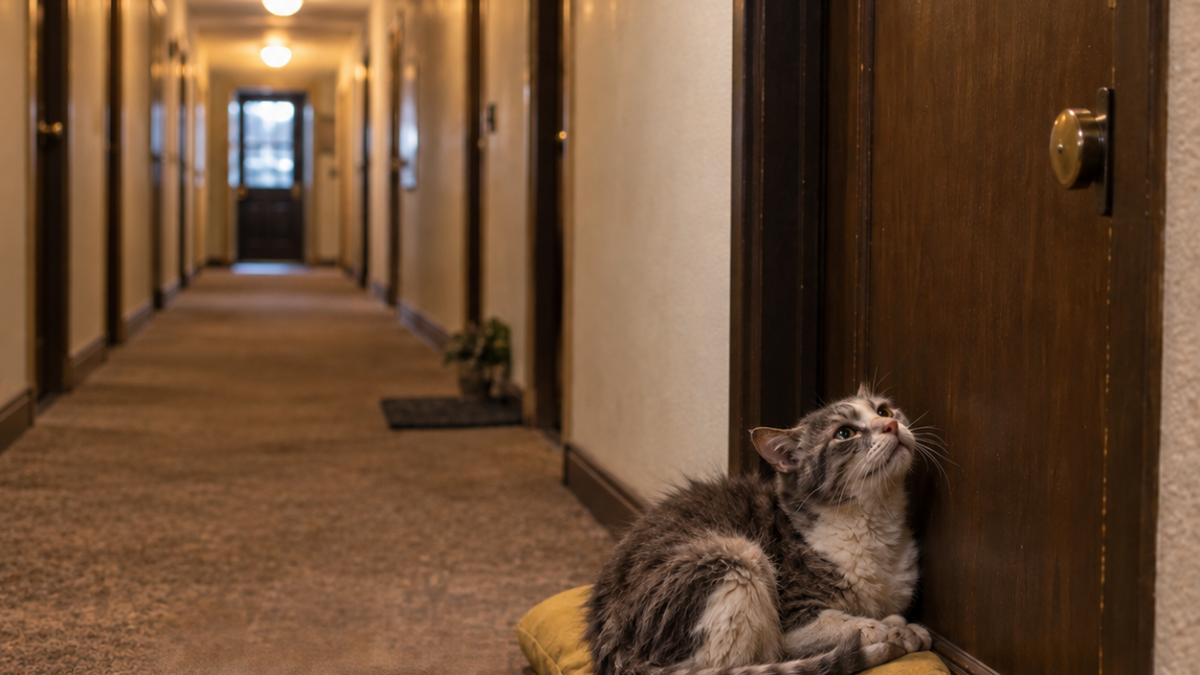
He sat directly in front of 4B.
His body faced the door.
His head was tilted slightly upward.
And when he cried again, something tightened in my chest.
It wasn’t loud.
That would have been easier.
Loud can make you angry.
Loud gives you permission to complain.
This sound was just sad.
Small enough to ignore if you wanted to.
Sad enough that ignoring it required effort.
“Hey,” I said softly.
The cat looked at me.
For one second.
Then he turned back toward the door.
I knocked.
“Mary?”
Nothing.
I knocked harder.
“Mary, it’s your neighbor from downstairs.”
Silence.
I tried the handle.
Locked.
There was a shallow dish near the wall.
Empty.
I crouched.
The cat didn’t come to me.
“Where is she, buddy?”
He stared at the door.
I wish I could tell you that was the moment I became the kind of person I later wanted to believe I was.
It wasn’t.
I went downstairs.
I told myself management probably knew.
I told myself maybe Mary had been taken to the hospital and someone was coming for the cat.
I told myself cats wandered into halls all the time.
I told myself it was not my place to interfere.
Mostly, I told myself whatever allowed me to go back inside my apartment and avoid becoming responsible for something I didn’t understand.
That night I barely slept.
Every so often I heard the cry travel faintly through the building.
By morning, I was angry.
Not at anybody specific.
At the sound.
At myself.
At the uncertainty.
At the fact that caring about something immediately creates work.
I left early and stopped by the management office before my shift.
A woman named Denise sat behind the desk.
I knew her by sight.
Professional smile.
Neat hair.
The kind of calm voice people in property management must practice until it becomes a second language.
“There’s a cat outside 4B,” I said. “Mary’s cat.”
Denise looked at her computer.
“Four-B?”
“Mary Sullivan.”
Her fingers stopped.
“Oh.”
That one word did not help.
“What?”
“I can’t discuss another resident’s private information.”
“I’m not asking for private information. I’m asking why her cat is outside her apartment.”
Denise’s expression softened.
“There was a medical emergency.”
My stomach dropped.
“When?”
“A couple of days ago.”
“Is she okay?”
“I really can’t—”
“Fine. Is someone coming for the cat?”
“We were informed family would handle personal effects.”
“The cat isn’t a personal effect.”
She gave me a tired look.
“I understand.”
“Do you?”
“I do.”
“Because he’s been in the hallway all night.”
That got her attention.
“All night?”
“At least.”
She typed something.
“I’ll notify maintenance.”
“What will maintenance do?”
“Check the situation.”
That phrase should have bothered me more.
Check the situation.
Not feed him.
Not call someone.
Not make sure a living animal wasn’t starving outside a locked apartment.
Just check.
I left for work angry enough to believe I had done something useful.
When I came home, the cat was still there.
Same spot.
Same door.
The food dish had been moved closer to the wall.
Still empty.
And beside the door was Mary’s yellow window cushion.
I don’t know who put it there.
Maybe maintenance.
Maybe someone entered the apartment and moved it out.
Maybe the cat dragged at it.
I never found out.
But he was curled around that cushion like it was the last piece of Mary left in the world.
When I approached, he raised his head.
He looked thinner than I remembered.
That was probably impossible after one day.
Maybe grief makes you notice bones that were already there.
I crouched again.
“Come on.”
Nothing.
I went downstairs, opened a can of tuna, and brought it up.
He sniffed once.
Turned away.
I brought water.
He drank two small laps.
Then he pressed his face against the yellow cushion.
That was the moment.
Not the crying.
Not the empty dish.
The cushion.
I looked at that little gray-and-white body curled around a faded piece of fabric and suddenly understood something I should have understood the first night.
He was waiting.
Not wandering.
Not lost.
Waiting.
Whatever had happened to Mary, nobody had explained it to him.
The last truth he knew was that she lived behind that door.
So he had decided to stay until the world became normal again.
I sat beside him for almost twenty minutes.
People passed.
A man from 4D stepped over us.
A teenager wearing headphones glanced down and kept going.
Nobody said anything.
Finally, I slid my hands under the cat.
He tensed.
I expected claws.
He didn’t fight.
That scared me more than fighting would have.
He barely weighed anything.
“Okay,” I whispered. “You’re coming with me.”
I carried the cat downstairs.
He twisted once to look back at Mary’s door.
Then he went limp against my chest.
Inside my apartment, I put food and water near the couch.
I set him down.
He immediately disappeared underneath it.
For the next hour, I lay on my stomach and checked every few minutes to make sure he was breathing.
“Great,” I muttered. “I kidnapped my dead—or hospitalized—neighbor’s cat and now I’m talking to furniture.”
His eyes reflected from the darkness.
I pushed the tuna closer.
Nothing.
That night he didn’t eat.
The next morning he didn’t eat.
I tried wet food after work.
Nothing.
Chicken.
Nothing.
I bought expensive food I absolutely could not afford because the label said “highly palatable.”
Apparently nobody had consulted him.
Nothing.
I moved Mary’s yellow cushion beside the couch.
He came out at two in the morning.
I know because I was awake.
He walked to the cushion, circled it twice, then lay down with his nose pressed into the fabric.
He stayed there until sunrise.
The next day I called a veterinarian.
They told me to bring him in.
The vet was a woman named Dr. Patel.
She looked to be around forty, with tired eyes and a calm voice.
She examined him while I stood near the table feeling like an impostor.
“I’m not technically his owner,” I explained.
“Who is?”
“My neighbor. Maybe. I mean, she was. I don’t know if she…”
I couldn’t finish it.
Dr. Patel glanced at me.
“You haven’t been told?”
“No.”
She nodded once and went back to listening to his heart.
He was dehydrated.
Underweight.
Weak.
But there was no obvious disease causing him to refuse food.
When she finished, she rested both hands on the table.
“He may be grieving.”
I looked at the cat.
“Cats do that?”
“Of course.”
“I mean, I know they miss people. I just didn’t know they could stop eating.”
“Some do. Cats are very sensitive to disruption, loss, scent, routine. When their person disappears, especially suddenly, they can become severely stressed.”
She looked down at him.
“Sometimes grief is quiet enough that people underestimate it.”
That sentence stayed with me.
Because people do the same thing.
We answer emails.
Go to work.
Buy groceries.
Pay rent.
Stand in line at pharmacies.
Say “I’m fine” because the real answer would make somebody late.
We can be collapsing inside while appearing functional enough that nobody feels required to intervene.
Dr. Patel gave me medication to stimulate his appetite.
Fluids.
Instructions.
Warnings.
“If he still refuses food, call me.”
I paid the bill with a credit card I had promised myself I would stop using.
When we got home, I sat on the floor.
The cat stayed near Mary’s cushion.
“I don’t know your name,” I said.
One ear moved.
“Which feels rude at this point.”
Nothing.
“I’m not replacing her.”
His eyes opened.
Maybe coincidence.
Maybe not.
“I don’t even know what happened to her.”
I swallowed.
“But until I do, you’re not sitting in that hallway.”
He stared at me.
“I’m here.”
That became the sentence I repeated most.
I’m here.
Not everything is okay.
Not you’re safe forever.
Not I know what I’m doing.
Just that.
I’m here.
For three days, almost nothing changed.
I called out of work once and used vacation time I had been saving.
I sat on the floor and read.
I watched bad television with the volume low.
I talked to him.
Not about Mary.
Not always.
I told him my coffee maker was a piece of junk.
I complained about Reggie downstairs slamming his truck door every morning.
I told him the teenager with the headphones almost hit me with the stairwell door.
I described a customer at work who had spent twenty minutes yelling because we didn’t control the weather.
Ordinary things.
Safe things.
He never came closer.
Then one afternoon, I crossed the room and realized his eyes were following me.
I stopped.
He looked away.
I walked back.
His eyes followed again.
“That counts,” I said.
He blinked.
The next morning, I put a little wet food on my finger and sat near him.
He stared.
I stayed still.
My shoulder started hurting.
My leg fell asleep.
I didn’t move.
Finally, he leaned forward.
One lick.
Tiny.
Quick.
He immediately pulled back.
I started crying.
Not graceful movie tears.
I laughed and cried at the same time.
“You ate,” I whispered.
He looked deeply unimpressed.
“You actually ate.”
One lick became three.
That night he ate from a dish.
Not much.
Enough.
Over the next week, he began coming back.
Slowly.
He slept on the cushion instead of under the couch.
Then beside the couch.
Then one night, during a thunderstorm, he climbed onto the far end.
I didn’t touch him.
He stayed.
A few minutes later, his paw stretched across the cushion between us.
I put my hand near it.
He rested his paw on my finger.
I don’t know why I named him Phoenix.
Maybe because I needed a name.
Maybe because watching him choose food again felt like watching something return from ashes.
“Phoenix,” I said.
His ear twitched.
“Terrible?”
No reaction.
“Good. Phoenix it is.”
Ten days after I brought him downstairs, somebody started pounding on Mary’s door.
Phoenix was asleep on the couch.
At the first bang, his head snapped up.
At the second, he jumped down and ran to my front door.
His whole body changed.
Ears forward.
Tail lifted.
Hope.
That is the only word for it.
I hated hope in that moment.
Because I knew what he thought.
He thought Mary had come home.
A man’s voice echoed from upstairs.
“Unit 4B? Maintenance.”
Phoenix made a sound I had never heard before.
Small.
Broken.
He scratched once at my door.
I opened it.
He darted into the hall.
“Phoenix.”
He ran upstairs.
I followed.
By the time I reached the fourth floor, he was sitting in front of Mary’s apartment again.
There were two people there.
One was a maintenance worker named Carlos.
The other was a woman in her fifties.
Jeans.
Black sweater.
Dark hair threaded with gray.
She held a cheap bouquet wrapped in clear plastic.
Her eyes were swollen.
Not crying in that moment.
Beyond crying.
Carlos looked at me.
“You with the cat?”
“I guess.”
The woman’s eyes dropped.
Her face changed.
“Oh.”
Phoenix stood.
He approached her.
One slow step.
Then another.
He sniffed the air.
The woman covered her mouth.
“That’s Jasper.”
I froze.
“Jasper?”
She looked at me.
“Mary’s cat.”
For some reason, learning his real name felt like being caught doing something wrong.
“I didn’t know,” I said. “I’ve been calling him Phoenix.”
The woman let out a strange, wet laugh.
“Of course you have.”
“Are you family?”
Her face closed slightly.
“I’m Elaine. Mary was my mother.”
Was.
There it was.
The word.
My stomach turned.
“I’m sorry.”
Elaine nodded.
Phoenix sat between us.
He looked from her to the door.
Back to Elaine.
Then to the door again.
“When?” I asked quietly.
“Four days ago.”
The hallway seemed to lose air.
Elaine stared at Mary’s door.
“She had a stroke. A neighbor—or maybe management—called emergency services after she didn’t respond. They said she was conscious for a while at the hospital.”
She swallowed.
“Then she wasn’t.”
I looked at Phoenix.
He stared at the door.
“Was he outside when they took her?”
Carlos shifted uncomfortably.
“There was some confusion.”
I looked at him.
“What does that mean?”
“The office believed family was coming.”
“That doesn’t answer my question.”
Carlos sighed.
“When the paramedics came, the cat apparently hid. Afterward he got into the hall somehow.”
“And nobody checked on him?”
“I wasn’t the one on call.”
It wasn’t cruel.
It was worse in a quieter way.
Responsibility had become a baton everyone could pass.
Elaine looked at me.
“He was outside?”
“For two nights.”
Her face went pale.
“Two?”
“He wouldn’t leave the door.”
She looked at Phoenix.
“I didn’t know.”
A hard thought rose immediately.
Where were you?
I hated myself for it and still felt it.
Where was the daughter?
Where was the family?
Where was everybody while an old woman died and her cat waited until hunger weakened him?
Elaine seemed to read some of it in my face.
Her jaw tightened.
“I live three hours away.”
I said nothing.
“I know how this looks.”
I still said nothing.
Carlos cleared his throat.
“We need to access the apartment. The lease has to be processed, contents documented, that sort of thing.”
Processed.
Contents.
Documented.
There are words that become obscene depending on the room.
Elaine set the flowers down.
She had her own key.
Her hand shook so badly she missed the lock twice.
When the door opened, Phoenix lunged forward.
I caught him automatically.
He twisted in my arms.
“Should I let him?”
Elaine stared inside.
The apartment smelled like dust, tea, and absence.
Mary’s shoes sat beside the chair.
A blanket was folded over the recliner.
A mug was still beside the sink.
Reading glasses rested on a crossword puzzle.
It looked like she had stepped out for five minutes.
Elaine did not move.
Phoenix strained again.
I looked at her.
“Maybe he needs to see.”
She wiped her face.
“Do cats understand?”
“I don’t know.”
Neither of us did.
But I knew what waiting had done to him.
I set him down.
He entered slowly.
No excitement.
No running.
He sniffed the rug.
The chair.
The kitchen.
He went to where his bowls had been.
Then he jumped onto the window ledge.
The yellow cushion was gone because it was downstairs with me, but the indentation remained in the fabric beneath where it had sat.
Phoenix pressed his face against the window frame.
Elaine broke.
She bent forward with both hands over her mouth, and a sound came out of her that I hope I never hear another person make.
Carlos stepped back.
“I’ll give you some time.”
He left.
I stayed because I didn’t know whether leaving would be kinder or crueler.
Phoenix jumped down.
He disappeared into the bedroom.
Elaine wiped her eyes.
“I hadn’t seen her in eight months.”
There it was.
The confession I had expected.
I leaned against the wall.
“She wouldn’t speak to me.”
I looked at her.
Elaine laughed bitterly.
“That sounds like the line every neglectful daughter uses, doesn’t it?”
“I didn’t say that.”
“You thought it.”
I couldn’t deny it.
She looked around the apartment.
“My mother could be the kindest woman in the world to strangers.”
That surprised me.
Elaine saw it.
“Yes. I know. Everybody always says that.”
“She was kind to me.”
“I’m sure she was.”
The anger in her voice wasn’t aimed at me.
Not really.
“She loved me too,” Elaine said. “But love and ease are not the same thing.”
Phoenix reappeared.
He had a gray sock in his mouth.
He carried it into the living room and lay down around it.
Elaine stared.
“She used to wear those at night.”
She crouched.
Phoenix didn’t approach her.
Elaine lowered herself onto the rug anyway.
“I begged her to move closer to us,” she said. “There was a senior community ten minutes from my house. Nice place. Private apartment. Meals if she wanted them. Transportation.”
“She said no?”
Elaine laughed.
“She said if I tried to put her in ‘one of those places,’ she would die hating me.”
“That sounds like Mary?”
“You didn’t know her.”
The words were sharp.
I flinched.
Elaine immediately looked ashamed.
“Sorry.”
“No. You’re right.”
She stared at the floor.
“She fell last winter. Didn’t tell me for a week. Then she fell again in May. I drove here and found bruises all over her hip. I told her we needed help. She told me to stop treating her like a child.”
Phoenix put his chin on the sock.
“We screamed at each other,” Elaine continued. “I said something awful.”
“What?”
“I told her if she wanted to die alone in this apartment, maybe I should stop trying to stop her.”
Silence.
Elaine’s face collapsed.
“Those are probably the last words she remembers me saying in person.”
I sat across from her.
For a while, neither of us spoke.
Then Phoenix stood.
He walked toward Elaine.
She held her breath.
He stopped three feet away.
Sniffed.
Then returned to the sock.
Elaine looked almost relieved he hadn’t forgiven her too quickly.
“I can’t take him,” she whispered.
That was when my sympathy hit a wall.
“What?”
“I can’t take Jasper.”
“You’re telling me that after all this?”
Her eyes flashed.
“My husband has a severe cat allergy.”
“People manage allergies.”
“My grandson has asthma.”
I stopped.
“We rent,” she continued. “We already have a dog. And I travel twice a week to take my sister for dialysis.”
She stood.
“You think I haven’t been standing here asking myself what kind of monster can’t take her dead mother’s cat?”
I looked away.
“I’m not saying you’re a monster.”
“You were about to.”
Maybe I was.
That bothered me.
Elaine folded her arms.
“I spent ten years being the person everyone expected to solve my mother. The falls. The bills she forgot. The driving she shouldn’t have been doing. The medications. The doctor appointments she canceled. Every time I stepped in, she fought me. Every time I backed off, I felt guilty.”
Her voice shook.
“I cannot take one more living thing home and promise I won’t fail it.”
Phoenix looked at her.
That sentence silenced both of us.
Because it was ugly.
And honest.
Real life has a way of ruining clean moral judgments.
Carlos returned with boxes.
And somehow I spent the rest of that Saturday helping a grieving daughter pack the apartment of a woman I had known only through hallway conversations and ceiling sounds.
Every drawer opened another piece of Mary.
Tea bags saved in rubber-banded bundles.
Birthday candles reused so many times the bottoms were black.
Old greeting cards.
Medical bills.
Three pairs of reading glasses.
Photographs.
Mary young.
Mary holding a little girl.
Elaine.
Mary beside a man with a fishing hat.
Mary at a beach.
Mary laughing so hard in one picture her head was thrown back.
I stared at that photograph longer than I should have.
Elaine noticed.
“That was my father,” she said.
“Where is he?”
“Died fourteen years ago.”
“I’m sorry.”
“She changed after that.”
Elaine put the photo into a box.
“She was always stubborn. But after Dad died, accepting help became impossible. Like needing somebody meant she had betrayed him somehow.”
Phoenix followed us.
Room to room.
Quiet.
Watching.
In the bedroom closet, I found a plastic file box.
Each folder had a label.
UTILITIES.
MEDICAL.
TAXES.
INSURANCE.
Then one folder simply said CAT.
I opened it.
Vaccination records.
A receipt from an adoption center eleven years earlier.
A photograph of a much younger Jasper.
And a folded piece of paper.
I opened it.
Mary’s handwriting was careful and slightly shaky.
If something happens to me, his name is Jasper.
He is afraid of loud voices and hates being carried unless he is sick.
He likes the window when it rains.
Please make sure he eats.
And please do not let him think I left him on purpose.
I read the last line twice.
Then a third time.
Elaine came over.
“What?”
I handed her the paper.
She read it.
Her knees seemed to weaken.
She sat on the bed.
“He waited outside the door?”
“Yes.”
“For two nights?”
I nodded.
Elaine pressed the note to her mouth.
“Oh, Mom.”
Phoenix sat in the closet doorway.
Elaine looked at him.
“Jasper.”
His ears moved.
“Jasper, she didn’t leave you.”
He stared.
Elaine started crying again.
This time I sat beside her.
Not touching.
Just there.
After a minute, I said, “I called him Phoenix because I didn’t know.”
She laughed through the tears.
“Phoenix.”
“He was barely eating. Then he started coming back.”
Elaine looked at him.
“Maybe he needs both names.”
I never forgot that.
Jasper for who he had been.
Phoenix for what he survived.
Late that afternoon, Carlos came back with a clipboard.
He stood in the doorway.
“I need to document what remains.”
Elaine nodded.
Phoenix hissed.
Carlos blinked.
“That’s new.”
“He knows what you represent,” I said.
“What do I represent?”
“The end of his lease.”
Carlos looked offended for half a second, then almost smiled.
“Fair.”
He made notes.
Furniture.
Appliances.
Damage.
Keys.
Everything became categories.
As he finished, his expression changed.
“The office is going to ask about the cat.”
“He’s with me.”
“Temporarily?”
I looked at Phoenix.
“I don’t know.”
Carlos lowered his voice.
“You have a pet on your lease?”
“No.”
He grimaced.
“That could be an issue.”
Of course it could.
Because grief wasn’t expensive enough yet.
Elaine helped me carry Mary’s yellow cushion downstairs.
Phoenix climbed onto it the second we set it by my window.
He curled up.
Elaine stood behind him.
“I can help with food,” she said.
“That’s okay.”
“The vet.”
“I said it’s okay.”
She turned toward me.
“Please don’t make this into pride.”
The word irritated me because she was right.
“I’m not.”
“You are.”
I folded my arms.
Elaine pulled a small envelope from her purse.
“I found something else.”
Inside was another handwritten note.
This one looked older.
It said:
I know people are busy.
If I am ever the old woman nobody notices for a while, please check on Jasper before the paperwork.
I sat down.
Please check on Jasper before the paperwork.
That line hurt worse than the others.
Because it meant Mary had imagined this.
Not necessarily dying.
Being unnoticed.
Being turned into procedure before somebody remembered the living thing still waiting for her.
Elaine sat across from me.
“She knew.”
“Apparently.”
“I hated when she talked like this.”
“Why?”
“Because it made me feel guilty.”
I looked at her.
She gave a small, exhausted shrug.
“She would say things like, ‘Old people become invisible before they die.’ Or, ‘Nobody notices quiet people until they stop making noise.’”
Elaine’s eyes filled again.
“And I’d tell her she wasn’t invisible. I called. I visited. I sent groceries. I arranged appointments. But it never felt like enough to her.”
“Maybe it wasn’t about you.”
Elaine looked at me.
“Maybe she was scared.”
That seemed to land somewhere deeper.
Three days later, management slid an envelope under my door.
UNAUTHORIZED ANIMAL.
I read the notice twice.
Then laughed.
Phoenix looked up from his cushion.
“Of course.”
Five business days to correct the violation.
Correct.
Like he was a leak.
Or an illegal shelf.
The notice listed the pet deposit.
The monthly pet fee.
Administrative charges.
I sat at my kitchen table with a calculator.
Then I checked my bank balance.
Then I laughed again, because apparently despair and comedy share a wall.
The vet visit had already hurt.
The medication had hurt.
The special food had hurt.
Now the building wanted hundreds of dollars before compassion could be made legally compliant.
I called the office.
Denise answered.
“I received a pet notice.”
“Yes.”
“You know where the cat came from.”
“I do.”
“You know why he’s here.”
“Yes.”
“Then waive it.”
Silence.
“I don’t have authority to do that.”
“Who does?”
“Our regional manager.”
“Then I want to talk to him.”
“That may not be possible directly.”
“Why?”
“He oversees several properties.”
“So?”
Denise sighed.
“I can submit a request.”
“Do it.”
I called Elaine next.
She offered money.
I refused.
She got angry.
“You paid a veterinarian for my mother’s cat.”
“I chose to.”
“You chose because nobody else did.”
“I don’t want your money.”
“Well, maybe this isn’t about what you want.”
That stopped me.
Elaine’s voice softened.
“You are doing the exact thing my mother used to do.”
“What?”
“Turning help into humiliation.”
“I’m not humiliated.”
“Then take the help.”
I almost argued.
Instead I looked at Phoenix.
He was watching rain collect on the window.
“I’ll think about it.”
“That’s progress.”
The next morning, Mrs. Alvarez from 2A stopped me by the mailboxes.
She was seventy-something, five feet tall on a generous day, and wore lipstick even to take out the trash.
“I heard you have Mary’s cat.”
“I do.”
“Management bothering you?”
News moved faster than plumbing problems in that building.
“Yes.”
She opened her purse.
“No.”
“I didn’t ask you anything.”
“You’re reaching for money.”
“I am reaching for my glasses.”
She pulled out her glasses.
Then a twenty-dollar bill.
I laughed.
“No.”
She shoved it toward me.
“Take it.”
“Mrs. Alvarez.”
“That cat cried for two nights.”
I stared at her.
“You heard him?”
Her expression changed.
“Yes.”
The word was quiet.
“Why didn’t you—”
“I asked myself that all week.”
She looked down.
“I heard him. I thought somebody else would handle it.”
There it was.
The sentence.
Somebody else.
Mrs. Alvarez pushed the twenty into my hand.
“You handled it. So now I help.”
“I can’t take your money.”
“Then use it for food.”
“I’m serious.”
“So am I.”
She narrowed her eyes.
“Do not insult an old woman by refusing the one useful thing she decided to do after already failing once.”
I took the twenty.
That evening there was an envelope under my door.
Fifteen dollars.
A note.
For the yellow-cushion cat.
—Nia, 1C.
The girl with the headphones.
The next day Reggie knocked.
I opened the door.
He held a half-used bag of premium cat food.
“My sister’s cat died last month.”
“I’m sorry.”
He shrugged, uncomfortable.
“She gave me this stuff. I forgot it was in my truck.”
He looked past me.
Phoenix sat by the couch.
“That him?”
“Yes.”
Reggie nodded.
“Mary gave my son peppermints when he was little.”
“I didn’t know you had a son.”
“College now.”
Reggie looked almost embarrassed.
“Crazy.”
He handed me the food.
“No point wasting it.”
People will invent whole speeches to avoid saying, I care.
By Friday, I had a pile on my counter.
Cash.
Food.
A grocery-store gift card.
Cat toys.
A blanket.
A handwritten note that said Mary always said Jasper liked watching rain.
I stared at everything.
For years, we had lived ten feet from each other.
We knew vehicles.
Footsteps.
Music choices.
Laundry schedules.
But not names.
It took Mary dying and her cat almost starving for us to behave like neighbors.
That truth embarrassed me.
Monday morning, Denise called.
“The regional manager will be here this afternoon.”
“I’ll come down.”
When I arrived, Denise wasn’t alone.
A man in a gray suit sat beside her.
Mid-fifties.
Expensive watch.
Expression designed to suggest he had already heard every version of every complaint and survived them all.
“Mr. Caldwell,” Denise said. “This is the resident from 3B.”
“My name is Daniel,” I said.
Caldwell shook my hand.
“Denise tells me you have concerns about the pet policy.”
“Not the pet policy.”
He waited.
“The way it’s being applied.”
He folded his hands.
“The policy applies equally to all residents.”
“That’s usually what people say right before explaining why context doesn’t matter.”
Denise looked down.
Caldwell’s eyes cooled.
“I understand the animal belonged to the deceased resident.”
“His name is Jasper.”
Caldwell paused.
“Excuse me?”
“Jasper. Phoenix now, sometimes. But if we’re talking about him, he has a name.”
“All right. Jasper.”
“Thank you.”
Caldwell leaned back.
“You chose to bring him into your unit.”
“Yes.”
“Without authorization.”
“Yes.”
“The lease is clear.”
“So was the hallway.”
His jaw tightened.
“I’m not sure what that means.”
“It means he spent two nights outside Mary Sullivan’s door after she was taken away.”
“We were informed family would retrieve personal property.”
“He wasn’t property.”
“Legally—”
“I don’t care what category your software uses.”
Denise’s eyes flicked toward Caldwell.
He gave a small sigh.
“I appreciate that you acted compassionately.”
“No, you appreciate it right up until compassion costs your company two hundred dollars.”
“That’s unfair.”
“Is it?”
“We operate hundreds of units.”
“And Mary lived in one of them.”
Caldwell’s patience thinned.
“You seem to believe management was responsible for this animal.”
“I believe somebody should have checked.”
“We had no obligation—”
Denise interrupted quietly.
“Actually, maintenance was notified.”
Caldwell turned.
“What?”
Denise looked uncomfortable.
“The initial incident report says the responding technician noted a cat in the unit after EMS removed Ms. Sullivan.”
I stared at her.
“You knew?”
“I personally did not see the report until after Daniel spoke to me.”
Caldwell’s voice became controlled.
“This isn’t relevant to the current lease violation.”
That was the moment I understood him.
Not evil.
Not cartoonishly cruel.
Worse for a story like ours.
He had trained himself to convert every human problem into a category small enough to manage.
“Can I see the report?”
“No,” Caldwell said.
“Why?”
“Internal document.”
“Does it say someone would check the cat?”
Denise hesitated.
Caldwell looked at her.
“Denise.”
That answered me.
“There was a note,” she said.
“What note?”
She swallowed.
“Family expected. Follow-up if animal remained.”
“And did anybody follow up?”
Silence.
Caldwell stood.
“I think this conversation is becoming unproductive.”
“No. It just became productive.”
He looked at me.
“The fee remains.”
I laughed once.
“You’re serious.”
“The lease remains enforceable regardless of the surrounding circumstances.”
I stood too.
“Fine.”
I picked up my folder.
Caldwell looked satisfied.
Then I added, “I want a copy of every policy governing abandoned animals, deceased residents, emergency entry, and welfare checks.”
His satisfaction disappeared.
“For what purpose?”
“I’m curious.”
“About?”
“How many procedures were followed before you decided the only rule that mattered was the one that charged me money.”
Denise looked at me.
Something almost like approval passed through her expression.
Caldwell said, “You are free to submit a formal request.”
“I will.”
I went upstairs furious.
Mrs. Alvarez was waiting by the mailboxes.
“Well?”
“They want the money.”
Her mouth tightened.
“I knew I didn’t like his tie.”
“How do you know what tie he had?”
“I saw him come in.”
Of course she did.
By that night, Nia had posted on the private building forum.
I didn’t know we had a private building forum.
Apparently everybody except me did.
The post was simple.
Management says we are a “community.” Mary died. Her cat waited outside her door. Daniel took him in. Now management wants to charge Daniel for rescuing him.
Thoughts?
There were fifty-three comments by midnight.
Some supported management.
“Rules are rules.”
“If they waive one fee, everyone will ask.”
“Pets cost the property money.”
Then came others.
“Didn’t the cat belong to Mary already?”
“Why wasn’t he checked after EMS came?”
“I heard him crying.”
“So did I.”
“Me too.”
That was the comment that hit me.
Me too.
Then another.
Me too.
And another.
Apparently half the building had heard Phoenix.
We had all made versions of the same choice.
Not yet.
Somebody else.
Not my business.
By morning, the post had become something larger than the fee.
People started talking about Mary.
Mrs. Alvarez wrote that Mary had brought her soup after knee surgery.
Reggie wrote about the peppermints.
Nia wrote that Mary once waited with her at the bus stop because a man in the parking lot had made her uncomfortable.
A woman in 5C said Mary watered her plants during a funeral trip.
Carlos from maintenance, against what I assume were several company policies, wrote only:
She always thanked us by name.
Then Elaine joined the forum.
I didn’t even know how she got access.
Her post was long.
She wrote:
My name is Elaine Parker. Mary Sullivan was my mother.
Some of you probably knew her as the sweet older woman in 4B. Some of you may be angry that her daughter was not here sooner.
You are allowed to be.
I am angry too.
But my mother was complicated, as most people are when you know them beyond hallway conversations.
She could be kind and difficult in the same hour.
She could love deeply and push help away until helping her felt impossible.
We had not spoken properly in months when she died.
I will live with that.
But one thing was never complicated.
She loved Jasper.
She left written instructions asking that, if something happened to her, somebody check on him before handling paperwork.
He waited outside her door for two nights after she was taken away.
A neighbor named Daniel brought him inside, paid for veterinary care, sat with him while he refused food, and helped him begin eating again.
Management is now charging that neighbor because he did not get advance permission to rescue the cat.
I cannot take Jasper into my home because of serious family health issues.
That does not mean I intend to stand by while the person who saved him is punished for doing what my family, this building, and I failed to do quickly enough.
My mother was afraid of becoming invisible.
Please do not make her last fear look reasonable.
I read it three times.
Then I called Elaine.
“You didn’t need to write that.”
“Yes, I did.”
“It’s private.”
“So was my shame. Keeping it private didn’t make it useful.”
I sat down.
“Are you okay?”
“No.”
Her answer was immediate.
Then she laughed.
“But I think that’s probably the correct answer for a while.”
Two days later, Caldwell scheduled what he called a resident information meeting.
I suspect he thought he could calm everyone down.
That was his first mistake.
The lobby was packed.
Mrs. Alvarez sat in the front row like she had bought tickets to an execution.
Nia stood against the wall.
Reggie crossed his arms near the back.
Denise sat beside Caldwell.
Carlos hovered near the door.
Elaine drove three hours to attend.
Phoenix stayed upstairs.
I refused to make him a mascot for our anger.
Caldwell began with phrases like misinformation, policy consistency, resident safety, and operational standards.
Nobody cared.
Mrs. Alvarez raised her hand.
Caldwell made the mistake of calling on her.
“How long did Mary live here?”
He checked a paper.
“Twelve years.”
“And how much rent did she pay in twelve years?”
“I don’t have that number.”
“I can estimate.”
A few people laughed.
Caldwell forced a smile.
Mrs. Alvarez continued.
“Twelve years she paid you. Then she dies, and the first thing you find energy for is charging the man who saved her cat?”
“That is not an accurate characterization.”
“Sounds accurate to me.”
Nia spoke next.
“If your company had followed the animal note in the maintenance report, would Daniel even have the cat?”
Caldwell looked at Denise.
“We are reviewing internal procedures.”
“That means no,” Nia said.
Applause.
Caldwell’s face tightened.
He turned to me.
“Daniel, perhaps you could clarify that our discussion in the office was respectful.”
I almost admired the move.
Use me to soften them.
“It was professional,” I said.
He nodded.
“Thank you.”
“It was also ridiculous.”
The room went silent.
I stood.
“I don’t think Mr. Caldwell hates cats.”
He looked relieved for half a second.
“I don’t think Denise is cruel. Carlos isn’t cruel. I’m not standing here because I think this building is run by monsters.”
I looked around.
“That would be easier.”
People listened.
“The problem is that everybody had a reasonable excuse.”
I pointed toward myself.
“Me too.”
Mrs. Alvarez looked at me.
“I heard Jasper crying the first night and went back downstairs.”
The room shifted.
“I want that included in this story, because I’m tired of stories where everybody divides neatly into heroes and villains.”
I looked at Elaine.
“She wasn’t here because she and her mother had a painful relationship and because real families are complicated.”
Elaine’s eyes filled.
“Management assumed family would handle the cat.”
I looked at Carlos.
“Maintenance assumed the office had a process.”
I looked at Denise.
“The office assumed maintenance or family followed through.”
Then Caldwell.
“And the regional office assumed the lease mattered more than the circumstances.”
Caldwell said, “That’s not—”
I raised a hand.
“And all of us heard something wrong and thought somebody else had more responsibility than we did.”
Nobody interrupted.
“That is how Mary became invisible.”
I swallowed.
“Not because nobody cared.”
I looked around the lobby.
“Because everybody cared a little and acted too late.”
Silence.
Then Elaine stood.
She held one of Mary’s notes.
“My mother wrote this.”
She read aloud.
“If I am ever the old woman nobody notices for a while, please check on Jasper before the paperwork.”
The lobby went completely still.
Elaine lowered the page.
“She could be difficult.”
Her voice shook.
“She could make help feel like an insult. She could make me furious enough to avoid calling her for days because I knew every conversation would become another fight.”
Tears ran down her face.
“But she should not have been right about this.”
Nobody moved.
Caldwell looked at the floor.
For the first time, he didn’t have a policy answer.
Denise whispered something to him.
He shook his head.
She whispered again.
Then, surprisingly, Denise turned toward the residents.
“I saw the report after Daniel came into the office.”
Caldwell’s head snapped toward her.
She continued anyway.
“There should have been a follow-up.”
Nobody spoke.
“I didn’t create the initial error, but I also treated the cat notice like a normal lease issue after I knew what had happened.”
She took a breath.
“That was wrong.”
It was not a dramatic apology.
That made it stronger.
Caldwell looked furious.
But not at us.
At the loss of control.
Mrs. Alvarez leaned toward me and whispered, “His tie looks worse now.”
I almost laughed.
Caldwell finally stood.
“The pet deposit will be waived.”
Nobody reacted.
He continued.
“The monthly pet fee will be waived for the remainder of Daniel’s current lease.”
Still nobody reacted.
Caldwell looked annoyed by the lack of applause.
“And we will review our emergency animal procedures.”
Mrs. Alvarez raised her hand again.
He stared at her.
“Yes?”
“You’re forgetting the warning.”
“What warning?”
“The unauthorized pet warning.”
He sighed.
“It will be withdrawn.”
“Good.”
This time people applauded.
Caldwell gathered his papers.
I almost felt sorry for him.
Almost.
Then Reggie spoke from the back.
“One more thing.”
Caldwell stopped.
“You keep those signs in the lobby about community.”
Everybody looked toward the wall.
COMMUNITY BEGINS AT HOME.
LIVE CONNECTED.
NEIGHBORS. COMFORT. BELONGING.
Reggie nodded toward them.
“Maybe now they mean something.”
Caldwell left without answering.
When I got upstairs, Phoenix was sitting in Mary’s yellow cushion by the window.
Rain had started.
Of course it had.
I sat on the floor.
“You get to stay.”
Phoenix looked at me.
“That whole meeting was about you.”
He blinked.
“You could at least pretend to care.”
He stood.
Walked toward me.
And climbed directly into my lap.
Not half.
Not one paw.
All of him.
He circled twice.
Curled up.
Put his head against my stomach.
I froze.
Then slowly rested my hand on his back.
I felt his breathing.
Steady.
Warm.
Alive.
I cried.
Quietly this time.
A few days later, Elaine came over with a cardboard box.
Inside was Mary’s robe.
Her blue-flowered ceramic dish.
A framed photograph of Mary with Jasper on her lap.
And several notebooks.
“Journals?” I asked.
“Sort of.”
Elaine sat on my couch.
“She wrote thoughts. Lists. Recipes. Things she noticed.”
“Should I read them?”
Elaine gave me a tired smile.
“She would hate that.”
I laughed.
“Then no.”
“She’d also secretly love it.”
“That sounds difficult.”
“Welcome to my childhood.”
Phoenix climbed onto the couch between us.
Elaine touched his back.
He allowed it.
She opened one notebook.
Mary’s handwriting wandered across the page.
Elaine read:
People think loneliness means having nobody.
Sometimes the worse loneliness is having people close enough to hear you drop something, but not close enough to notice when the sounds stop.
I closed my eyes.
“That woman really knew how to ruin an afternoon.”
Elaine laughed.
A real laugh.
Probably the first I had heard.
“She did.”
We read more.
Some entries were ordinary.
Buy milk.
Call pharmacy.
Jasper hates new litter.
Elaine’s birthday Tuesday—call even if she is still angry.
That line stopped both of us.
Elaine took the notebook.
“She was going to call?”
“Looks like it.”
“What date?”
We checked.
The entry had been written six days before Mary’s stroke.
Elaine pressed her fingers to her lips.
“She never called.”
“Maybe she planned to.”
“Maybe.”
For once, maybe was enough.
Elaine stayed for three hours.
She told me stories.
Mary singing badly while washing dishes.
Mary teaching Elaine to drive and yelling so loudly at a stop sign that Elaine got out of the car and walked home.
Mary making chicken soup whenever anybody was sick and pretending the recipe was secret even though it came from the back of a grocery-store package.
Mary being impossible after her husband died.
Mary refusing hearing aids for two years.
Mary secretly sending Elaine fifty dollars every Christmas even after Elaine turned fifty herself.
People become flatter when they die if we aren’t careful.
Saint.
Victim.
Difficult mother.
Lonely old woman.
Mary had been all of those and none of them.
She had been a person.
That mattered.
Over the next several weeks, something strange happened to the building.
People started knocking.
Mrs. Alvarez came upstairs with soup.
Then stayed to talk about her husband, who had died nine years earlier.
Nia came by without headphones.
She sat on my floor and let Phoenix sniff her hand.
“My mom lives in Ohio,” she said.
“Are you two close?”
Nia shrugged.
“She always says she’s fine.”
“You don’t believe her?”
“I didn’t think about whether I believed her before.”
She looked at Phoenix.
“I called her last night.”
“How was she?”
“She cried.”
Nia’s eyes watered.
“She said she was lonely.”
I didn’t know what to say.
So I didn’t.
Reggie fixed my kitchen faucet.
He refused money.
“You already gave me cat food.”
“That was not payment.”
“Then consider this none of your business.”
I laughed.
Carlos started checking on elderly residents whenever maintenance hadn’t seen them in a while.
Not officially.
Just small things.
A knock.
A question.
“You doing okay?”
Denise created a voluntary emergency contact form.
Caldwell, to his credit or exhaustion, approved it.
Elaine visited once a month.
At first Phoenix stayed across the room.
Then closer.
One afternoon, Elaine sat on my floor and told him about Mary singing an old Motown song while washing dishes.
Phoenix walked over.
He sniffed her hand.
Then climbed into her lap.
Elaine froze.
“Oh.”
He curled against her.
Elaine covered her face.
She cried into his fur for ten straight minutes.
Phoenix stayed.
He didn’t erase anything.
He didn’t absolve her.
Animals don’t do morality the way we do.
They know safe.
Familiar.
Warm.
Here.
Maybe that was enough.
Three months after Mary died, Reggie found an old wooden shelf.
He sanded it and mounted it beside the mailboxes.
Management did not authorize it.
Management also wisely chose not to remove it.
We put things on the shelf.
Soup.
Batteries.
A flashlight.
Stamps.
An extra phone charger.
Pet food.
A grocery gift card.
Mrs. Alvarez contributed Band-Aids.
Nia put up a small jar.
On the front she wrote:
IF YOU HEAR SOMEBODY CRYING, KNOCK.
Mrs. Alvarez called it dramatic.
Nia said, “Good.”
Elaine brought a framed copy of one of Mary’s handwritten lines.
Not the saddest one.
A different one.
People do not always need rescuing.
Sometimes they only need proof someone noticed.
We hung it above the shelf.
Nobody argued.
Life didn’t turn magical after that.
People still fought over parking.
Someone still left laundry in the dryer for six hours.
Reggie still slammed his truck door.
Nia still wore headphones.
Mrs. Alvarez still complained about the thermostat in the lobby as if she personally owned the climate.
Denise still sent notices.
Rules still existed.
People still failed each other.
But now we knew names.
That sounds small until you have lived somewhere without them.
I knew the woman in 5C was Teresa.
I knew Carlos had twins.
I knew Reggie’s son was studying engineering.
I knew Nia’s mother’s name was Carol.
People started noticing absences.
Nothing invasive.
Nothing dramatic.
Just enough.
“Haven’t seen Mrs. Alvarez today.”
“She went to her sister’s.”
“Reggie’s truck hasn’t moved.”
“He’s on vacation.”
“Nia missed two days.”
“She has the flu. Somebody left soup.”
It became normal.
Not perfect.
Normal.
That was the miracle.
Phoenix got stronger too.
He started eating like grief had personally offended him.
He yelled if dinner was late.
He followed me to the bathroom.
He attacked a shoelace one evening and then acted embarrassed about losing his dignity.
Sometimes he slept beside Mary’s photograph.
Sometimes he ignored it.
Sometimes he sat by my front door.
At first, that scared me.
The old waiting.
The old hope.
But gradually I understood.
He wasn’t always waiting for her.
Sometimes he was remembering.
There is a difference.
I stopped trying to distract him.
If he sat there for five minutes, I let him.
If he went to the window when it rained, I left the curtain open.
Mary belonged to him too.
I had no right to make healing depend on forgetting her.
About six months after Mary died, Elaine invited me to the cemetery.
I almost said no.
It felt too intimate.
Then I thought about all the lines we had crossed already.
So I went.
Phoenix stayed home.
Mary’s marker was simple.
Mary Elizabeth Sullivan.
Beloved Wife and Mother.
Elaine stood beside it with flowers.
For a while she said nothing.
Then she laughed.
“She would hate ‘Beloved Wife and Mother.’”
“Why?”
“She’d say it left out the interesting parts.”
“What would she prefer?”
Elaine thought.
“Terrible Driver. Excellent Soup. Difficult Woman. Loved One Cat Excessively.”
I laughed.
Elaine wiped her eyes.
“I spent months thinking grief meant deciding what kind of mother she was.”
I looked at her.
“Good or bad?”
“Exactly.”
She touched the top of the stone.
“I don’t think I need to decide anymore.”
That stayed with me.
We want verdicts.
Especially after death.
Good parent.
Bad daughter.
Kind neighbor.
Negligent management.
Hero.
Villain.
But most human beings resist clean sentences.
Mary loved Elaine.
Mary hurt Elaine.
Elaine loved Mary.
Elaine stayed away.
I cared about Phoenix.
I ignored his first night.
Denise made a bureaucratic mistake.
Then she admitted it publicly.
Carlos missed a follow-up.
Then he changed how he worked.
Even Caldwell eventually sent a revised emergency protocol to every property in the region.
I know because Denise printed it and handed it to me.
“Thought you’d enjoy this.”
I read the title.
ANIMAL WELFARE PROCEDURES FOLLOWING RESIDENT MEDICAL EMERGENCY OR DEATH.
I looked at her.
“This exists because of Phoenix?”
“Officially? Because of a procedural review.”
“Of course.”
Denise smiled.
“Unofficially, yes.”
The new rule required staff to verify whether animals were present, contact emergency caregivers, provide water if safe, and document who had assumed responsibility.
I ran my thumb over the paper.
It wasn’t justice in the movie sense.
Nobody got arrested.
Caldwell didn’t lose his job.
There was no dramatic lawsuit.
No television cameras.
Just a rule that might prevent another animal from spending two nights crying outside a door.
Sometimes that is justice.
Not punishment.
Prevention.
I took the policy upstairs and placed it beside Mary’s note.
Please check on Jasper before the paperwork.
For once, the paperwork had caught up.
A year has passed now.
Phoenix is asleep beside me as I write this.
I still call him Phoenix most of the time.
Elaine calls him Jasper.
He responds to both names when food is involved and neither name when I need him to stop scratching the couch.
Mary’s yellow cushion is still in my window.
Faded.
Lumpy.
Impossible to wash properly because I’m afraid changing the smell too much will take something from him.
When it rains, he sits there.
I sometimes wonder what he remembers.
Her voice?
Her hands?
The way she moved around the kitchen?
The sound of the can opening?
The little songs Elaine says she sang?
Or maybe memory is simpler for him.
Warm lap.
Window.
Rain.
Safe.
Gone.
New safe.
Elaine still visits.
We are not family.
I don’t use words like that casually anymore.
But we matter to each other.
That is enough.
Mrs. Alvarez still keeps emergency cash hidden in places she tells everyone about, which defeats the purpose.
Nia visits her mother more often.
Reggie’s son graduated.
Carlos’s twins turned ten.
Denise transferred to another property and sent us a Christmas card.
Caldwell never sent one.
I’m okay with that.
The shelf by the mailboxes is still there.
People use it.
People refill it.
Sometimes I see something disappear and something else show up.
That is community, I think.
Not slogans.
Circulation.
One person has extra.
Another person needs it.
Then someday the direction reverses.
A few weeks ago, I came home late.
There was a grocery bag outside Mrs. Alvarez’s door.
Milk.
Bread.
Soup.
I knocked.
No answer.
A year earlier, I might have assumed she was asleep.
Or out.
Or busy.
Instead, I knocked again.
“Mrs. Alvarez?”
Nothing.
I called her.
Her phone rang inside.
My heart started pounding.
I called Reggie.
He came upstairs.
We contacted management.
Carlos was on duty.
They opened the door.
Mrs. Alvarez was in her bedroom.
She had fallen.
She was conscious but couldn’t get up.
She had been there almost three hours.
The ambulance came.
She broke her wrist.
Nothing worse.
When I visited her at the hospital, she raised her cast.
“You see?”
“What?”
“That ridiculous cat saved me too.”
I laughed.
“No. Your habit of leaving groceries in hallways saved you.”
She pointed her good hand at me.
“Do not ruin my version.”
So I didn’t.
Phoenix never met Mary’s husband.
Never knew the younger Elaine.
Never understood management policy.
Never knew there was a meeting held because of him.
He did not know why Mrs. Alvarez was found sooner than Mary.
He simply cried in a hallway because the person he loved disappeared.
That cry changed us.
I used to believe being a good neighbor meant not causing trouble.
Keep your music down.
Move your laundry.
Don’t block parking spaces.
Smile.
Hold the door.
Mind your own business.
Now I think maybe being a good neighbor sometimes means refusing to mind your own business.
Not always.
Privacy matters.
Boundaries matter.
People deserve space.
But there is a difference between respecting privacy and using it as an excuse not to notice.
We had confused those things.
I had confused them.
The night I first heard Phoenix crying, I knew something felt wrong.
I went upstairs.
I saw him.
I saw the empty dish.
I saw the locked door.
And I went back downstairs.
I can explain why.
It was late.
I was tired.
I didn’t know Mary well.
I didn’t want to overreact.
I assumed someone else had more information.
All reasonable explanations.
And still, I left him there.
That belongs to me.
I don’t tell this story because I was the hero.
I wasn’t.
I was simply the person who finally acted on the second night.
There is a difference.
The line between somebody who helps and somebody who looks away is often not character.
Sometimes it is timing.
One more minute.
One more knock.
One more decision not to go home yet.
That realization made me less interested in judging people and more interested in what they do next.
Elaine came too late to save her relationship with Mary.
But she did not come too late to love Jasper.
Denise came too late to prevent the mistake.
But not too late to admit it.
Management came too late for Mary.
But maybe the next resident will be treated differently.
I came too late to spare Phoenix those two nights.
But not too late to help him survive the third.
Maybe that is what we owe each other.
Not perfection.
Not constant access.
Not the impossible promise that nobody around us will ever be lonely.
Just the willingness to notice when the ordinary pattern breaks.
A television that always plays suddenly silent.
Groceries sitting too long outside a door.
A mailbox filling up.
A pet crying.
A neighbor who says “I’m fine” differently than usual.
Small things.
Until they aren’t.
Sometimes I still hear Mary upstairs.
Not literally.
The new tenant in 4B is a teacher named Samantha.
She walks faster.
Drops things constantly.
Owns a blender powerful enough to threaten the building’s foundation.
But every so often, late at night, the pipes shift or someone moves softly overhead, and for half a second my brain gives me Mary’s old footsteps.
Then I remember.
Gone.
That truth doesn’t soften.
You just learn how to hold it.
Phoenix will sometimes lift his head at the same sound.
His ears turn toward the ceiling.
He listens.
Then he looks at me.
The first time it happened, I cried.
Now I usually say, “I know.”
He settles again.
That feels like grief to me now.
Not getting over.
Not moving on.
Not erasing.
Learning there can be more than one place your heart recognizes as home.
Mary was home.
Now I am home too.
One doesn’t cancel the other.
A few days ago, Elaine brought one final thing she had found in storage.
A sealed envelope.
On the front, Mary had written:
For Elaine, eventually.
Elaine sat at my kitchen table staring at it.
“You haven’t opened it?”
“No.”
“How long have you had it?”
“Two days.”
“Why bring it here?”
She looked toward Phoenix.
“Because if I hate what’s inside, I want him nearby.”
I sat across from her.
She opened it.
The letter was short.
Elaine read silently.
Then handed it to me.
I hesitated.
“She wrote it to you.”
“She’s dead, Daniel.”
“That doesn’t answer the moral issue.”
“Read it.”
So I did.
Elaine,
You think I do not know I am difficult.
I know.
Your father used to say stubbornness kept me standing and would one day knock me down.
He was probably right about both.
I know you want me closer because you are afraid.
I know I refuse because I am afraid too.
You are afraid I will fall.
I am afraid I will become somebody people manage instead of somebody who lives.
We are both making each other pay for being scared.
I am sorry for my share of it.
If I do not say that out loud, believe I at least managed to write it down.
You were a good daughter even when I made you feel like a bad one.
Love,
Mom
Elaine didn’t make a sound while I read.
I put the letter down.
“Oh.”
“That’s what I said.”
She laughed and wiped her face.
“I spent a year wishing she had called.”
“She tried.”
“On paper.”
“Sometimes paper is what stubborn people can manage.”
Elaine looked toward Phoenix.
He was asleep on the yellow cushion.
“I’m still angry.”
“You’re allowed.”
“I miss her.”
“You’re allowed that too.”
“I’m relieved she isn’t struggling anymore.”
“That too.”
Elaine looked at me.
“You always say that.”
“What?”
“That everything gets to exist at the same time.”
“I learned it from your mother’s cat.”
She smiled.
Phoenix opened one eye.
Then closed it.
Outside, rain began tapping against the window.
Phoenix stood.
Stretched.
Jumped onto the yellow cushion.
He watched drops race down the glass.
I thought about Mary looking at that same window.
About Elaine three hours away, furious and worried.
About a maintenance report nobody followed.
About an empty hallway.
About the first night I walked away.
About the second night I didn’t.
People want life-changing moments to feel dramatic while they happen.
Usually they don’t.
Usually they look like carrying a cat downstairs.
Taking twenty dollars you don’t want.
Knocking twice instead of once.
Making a phone call.
Reading a note.
Admitting you were wrong.
Staying when leaving would be easier.
The world rarely changes all at once.
A hallway changes.
A building changes.
A policy changes.
A daughter’s memory changes.
A cat eats one bite.
Then another.
Then one day, without anybody announcing it, something that was surviving is living again.
Phoenix turned from the rain and looked at me.
A year ago, he stared at a locked door and believed his whole world existed on the other side.
Now he jumped down from the window and walked toward me.
He climbed into my lap.
I put my hand on his back.
Steady rise.
Steady fall.
Elaine smiled.
“He chose you.”
I shook my head.
“No.”
“What do you mean?”
“I think he chose to keep going.”
She looked at him.
Then nodded.
Maybe that is the better ending.
Not that I saved him.
Not that he saved me.
Not even that Mary’s death taught an apartment building how to care.
Those things are partly true.
But the fuller truth is less clean.
We all failed.
Then we all got another chance to do one thing better.
That is most of life.
Another chance.
Not with the same person.
Not always with the same problem.
Mary did not get to benefit from the shelf in the lobby.
She did not get the new welfare-check procedure.
She did not get to read Elaine’s reply.
She did not get another afternoon with Jasper at the window.
That is the part that hurts.
Some lessons arrive carrying a cost that cannot be refunded.
So the only honest way to pay for them is forward.
The next cat.
The next elderly neighbor.
The next tired daughter.
The next person standing behind a professional desk saying, “I don’t make the rules.”
The next man who hears crying and wants to believe somebody else will handle it.
That man is still in me.
I know him.
He wants to go downstairs.
He wants dinner.
He wants television.
He wants somebody with more authority to make the difficult thing disappear.
I don’t hate him.
I just don’t let him make every decision anymore.
Now, when something feels wrong, I stay one minute longer.
I ask one more question.
I knock again.
Sometimes the answer is nothing.
Sometimes somebody says, “I’m fine,” and they really are.
Sometimes I feel foolish.
Good.
I can survive foolish.
Regret is heavier.
Phoenix shifted in my lap.
Elaine reached over and scratched behind his ear.
“Jasper,” she whispered.
His tail moved.
I smiled.
“Phoenix.”
His other ear twitched.
Elaine laughed.
“He has two lives now.”
“No.”
I looked at the yellow cushion.
“At least two names.”
Outside, the rain kept falling.
Inside, the apartment felt warm.
Above us, Samantha dropped something heavy and shouted a word I will not repeat.
Phoenix looked at the ceiling.
Elaine and I laughed.
Then he settled again.
Mary was gone.
That remained true.
But Jasper was here.
Phoenix was here.
Elaine was here.
I was here.
And downstairs, near the mailboxes, sat a crooked wooden shelf built by neighbors who had once passed one another without knowing names.
There were cans of soup on it.
Batteries.
Pet food.
A phone charger.
A folded twenty-dollar grocery card.
And Nia’s jar:
IF YOU HEAR SOMEBODY CRYING, KNOCK.
I used to think that message was too dramatic.
Now I think it may be the closest thing our building has to a constitution.
Because caring is easy when it stays theoretical.
Everybody loves kindness as an idea.
Kindness in real life is inconvenient.
It costs money.
It interrupts dinner.
It creates awkward conversations.
It makes you responsible for facts you might rather not know.
It puts a grieving cat in your apartment when your lease says no.
It puts a difficult mother back inside a daughter’s heart after death has made anger safer.
It forces a manager to admit procedure failed.
It makes neighbors reveal that they all heard the same cry and hoped somebody else would answer.
Real compassion is rarely clean.
It comes with fur on the couch.
Vet bills.
Paperwork.
Old resentment.
Unanswered questions.
And sometimes that is exactly why it matters.
Phoenix lifted his head.
For a moment, he looked toward the front door.
He still does that.
Less now.
But he does.
I never stop him.
After a few seconds, he looked back at me.
Then at Elaine.
Then he lowered his head again.
That is grief too, I think.
Not forgetting the door that never opened.
Just learning there are other directions worth facing.
And if Mary could see him now, I think she would understand.
A full bowl.
A warm window.
Her yellow cushion.
Her daughter’s hand resting gently on his back.
A home where he no longer has to cry in a hallway to prove he has not been forgotten.
Maybe that was all she ever wanted for him.
Maybe, in a strange way, it was all she wanted for herself too.
And maybe that is what I will remember longest.
Not the death.
Not the meeting.
Not the fees.
Not even the notes.
I will remember a little gray-and-white cat outside a locked door, waiting with absolute faith for a person who could never return.
I will remember how close I came to walking past him twice.
And I will remember what happened when I finally didn’t.
One door opened.
Then another.
Then another.
Until an apartment building full of people who used to hear everything and know almost nothing finally learned the difference between living near someone and being their neighbor.
All because one grieving cat refused to stop crying until somebody listened.








