My Neighbor Called the Police on the Bikers Outside—She Didn’t Know My Son Had Invited Them
PART3:
He explained that his mom cried at night when she thought the door was closed all the way, but usually it wasn’t.
He signed it:
Hudson Lawson, age nine.
Then he mailed it to the address on the flyer using three stamps from my desk drawer because he did not know how many a letter needed, and he did not want to risk it.
Then he waited.
And told no one.
He went back to being a boy who did homework, shot baskets at the crooked hoop, and ate store-brand granola bars without complaint.
I did not know any of this on the second Saturday of September.
All I knew was that the laundry basket was on my hip, the mortgage reminder was sitting in my email like a threat, and a low rolling thunder had begun somewhere beyond the end of our cul-de-sac.
At first, I thought it was weather.
Then the sound grew louder.
Deeper.
Closer.
It moved through the floorboards before I understood it.
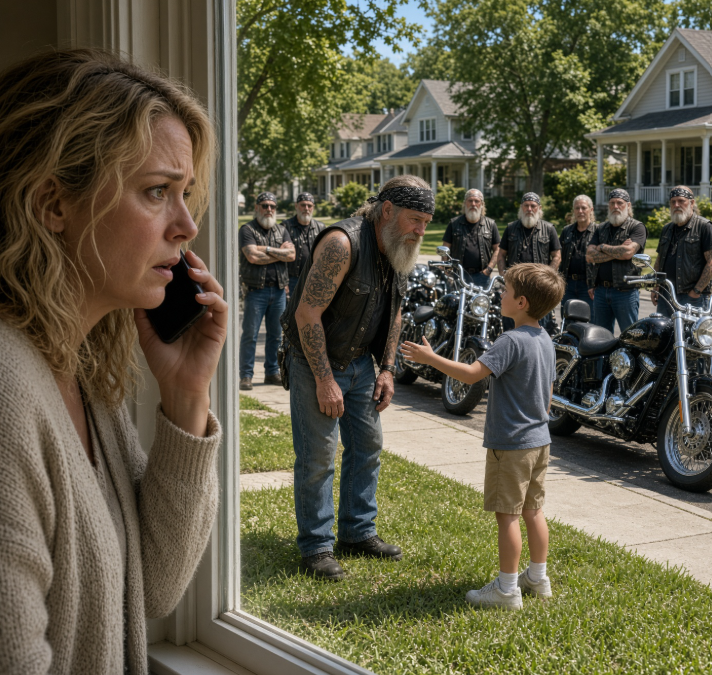
I set the laundry basket down and went to the front window.
What I saw first was chrome.
A whole line of it catching the sun as eight motorcycles turned off North Locust Grove Road and rolled slowly toward my house.
Not past it.
Not around the cul-de-sac.
Toward my house.
Engines dropped from a roar to a heavy idle that seemed to vibrate through the windows. One by one, the bikes lined up along my curb.
What I saw second was the men climbing off them.
Big men.
Bearded men.
Men in black leather vests covered with patches I did not recognize and did not want to. Tattoos ran down forearms thick as fence posts. One of them, the tallest, had a skull inked into the crook of his elbow. Another wore a bandana knotted at the back of his head like something out of a movie I would have changed the channel on.
My first thought was: wrong house.
My second thought was: Kyle.
Kyle had been my sister-in-law’s ex-husband years earlier, a man who ran with a rough club out of Nampa back when we were all younger and stupider and too willing to call danger “complicated.” He had put two men in the hospital before anyone in the family stopped making excuses for him. He had once punched a hole through a kitchen wall because someone told him no.
I had not thought of Kyle in years.
I thought of him then.
My third thought was the one that made me reach for the phone.
Hudson was outside.
I had seen him a half second before I truly registered it—small, blue-shirted, already off the porch and running down the front walk toward the bikers like he had been waiting his whole life.
I grabbed the cordless phone.
Then I heard Mrs. Henderson screaming from her porch two houses down.
“I called the police!”
My stomach dropped.
She had beaten me to it.
Curtains twitched all over the street. Mr. Corbett came out onto his porch in socks, holding his phone up to film. The Henderson sprinkler ticked back and forth across the lawn, ridiculous and indifferent.
I dropped the phone and ran outside.
“Hudson!”
He did not stop.
He skidded to a halt in front of the biggest man, the one with the long gray beard, ponytail, skull tattoo, and pale blue eyes.
“You got my letter?” Hudson asked, breathless.
The old man crouched slightly, hands on his knees. Leather creaked.
“We got your letter, son,” he said.
His voice was rough as gravel.
But not unkind.
“Took us a bit to track down which house was yours. You didn’t put your address on it. Smart, actually. Made this part harder, though.”
“I didn’t want the wrong guy opening it,” Hudson said, as if this explained everything.
To him, I suppose it did.
I reached them half-running, half-stumbling.
“Hudson, get behind me.”
“Mom, it’s okay. They’re—”
“Get behind me.”
One of the other men, heavyset with a shaved head and reading glasses pushed up on his forehead, raised both hands, palms out.
“We’re not here to cause trouble, ma’am. Your boy wrote us a letter a few weeks back. We should’ve called ahead. I’ll own that.”
“A letter?” I looked down at Hudson. “What letter?”
His face changed from triumph to uncertainty in one breath.
“The flyer,” he said. “From the assembly. About helping veterans’ families. About the paper the VA got wrong about Dad.”
Something in my chest folded in on itself.
Grief.
Fury.
Confusion.
Fear.
All of it came at once, too fast to sort.
Before I could answer, a Meridian police cruiser turned onto the cul-de-sac, lights on, rolling to a stop behind the last parked motorcycle.
Mrs. Henderson stood on her porch with one hand pressed dramatically to her chest.
Mr. Corbett kept filming.
Hudson moved closer to my side.
The officer who climbed out was broad-shouldered, in his forties, with a calm face and one hand resting near his belt as a matter of habit rather than threat. His name tag read Leadbetter.
He took in the scene.
Eight bikers.
A shaking widow.
A boy who looked like he might cry.
Neighbors watching like the whole street had bought tickets.
“Everybody just hold where you are for a second,” Officer Leadbetter said.
The whole cul-de-sac seemed to obey.
The old rider straightened slowly. He kept his hands visible without being asked.
“Officer,” he said, “nobody here’s armed. Nobody’s raised a voice at this family, and I’ve got paperwork in my jacket. I’d be happy to show you slow if you’ll let me reach for it.”
Paperwork.
Of all the words I expected from a man who looked like he could bend a tire iron, paperwork was not among them.
Officer Leadbetter blinked once.
Then said, “Slow.”
The old man reached into his jacket the way a man reaches for something he knows will be misread if he moves too fast. From inside, he drew out a folded manila envelope soft at the corners from being carried for days.
“My name is Everett Blevins,” he said. “Most of the boys call me Deacon. This is Bruce Sorenson.”
He nodded toward the heavyset man.
“Your son wrote to our chapter.”
“Chapter of what?” Officer Leadbetter asked.
Bruce answered evenly.
“Motorcycle club. And before anybody asks, yes, we know what people think when they see the vests. We’re not here for a fight.”
Mrs. Henderson called from her porch, “Then why are there eight of you?”
Bruce turned his head.
“Because two of us ride bad in the wind, one won’t admit he needs help reading small print, and the kid deserved to know somebody came.”
Mrs. Henderson closed her mouth.
I almost laughed.
Almost.
Everett looked at me.
“Ma’am, you want us gone, we go. Your porch. Your kid. Your call.”
Officer Leadbetter looked at me too.
“He’s right. As long as nobody’s breaking a law, if you want them to leave, they leave.”
I looked at Hudson.
His eyes were raw.
Not quite hope.
Not quite fear.
Something between, open enough to hurt.
Then I looked at Everett, who stood with that folded envelope in his hand, waiting on my word like it mattered.
“Show me,” I said. “Whatever is in your pocket. Show me first.”
Everett nodded.
Inside the envelope was a photocopy of my denial letter.
My denial letter.
I felt the ground tilt slightly.
Beneath it was a single typed page in Everett’s own careful hand. The heading held a case number that was not mine but might as well have been, because the mistake described was identical. Same kind of status code. Same transposed line. Same bureaucratic trapdoor.
“I spent thirty-four years rating claims for the Department of Veterans Affairs,” Everett said. “Boise regional office mostly. Salt Lake before that. Retired six years ago.”
I stared at him.
“You worked for the VA?”
“For longer than was probably healthy.”
He held the pages out so I could read them without having to take them from his hand.
“I’ve seen this exact clerical error maybe forty times. Somebody transcribes a line-of-duty finding from an informal report instead of the final one. Pending investigation gets typed where in line of duty, no misconduct should be. The system reads the wrong box, spits out a denial, and nobody downstream goes back because everybody assumes somebody upstream already did.”
I took the pages.
My hands were not steady.
I read the top line twice.
It matched almost word for word the language that had sent me to the kitchen floor three weeks earlier.
“You did this for a living?” I asked.
“Thirty-four years.”
“And now you…”
I looked at the motorcycles.
The leather.
The tattoos.
The skull inked into his arm.
Everett’s beard shifted with a faint, dry smile.
“Ride with these knuckleheads.”
Bruce said, “We prefer respected community nuisance.”
Everett ignored him.
“Folks don’t usually picture a man on a Harley behind a government desk with a green visor, correcting typos that keep widows from paying the light bill.”
Officer Leadbetter had lowered his hand from his belt without seeming to notice.
He looked over my shoulder at the page.
“You have documentation you worked there?”
Everett nodded.
“Retirement letter. Employee ID. Commendations gathering dust in a drawer. I can bring them by. I understand what I’m asking you to take on faith, officer. I spent three decades asking grieving families to trust a process that gave them every reason not to.”
Then he turned those pale blue eyes back to me.
“I don’t take it personal when somebody’s slow to trust me back.”
That sentence did something to me.
Because trust did not arrive all at once just because a piece of paper matched another piece of paper.
Fear has roots deeper than logic.
I thought again of Kyle.
Of my sister-in-law afraid to answer her own door.
Of every headline I had half-read about outlaw clubs and violence and men in leather bringing trouble behind them.
The fact that I could almost laugh now at the idea of Everett correcting federal paperwork instead of breaking kneecaps did not erase the fear.
It sat beside it.
“Even if you’re right,” I said slowly, “what am I supposed to do with it? I already appealed once. It took eleven weeks just to get the denial. I don’t have eleven more weeks.”
My voice cracked.
“I’ve got a mortgage payment due on the first and thirty-four dollars to my name.”
“That’s where you let us be useful,” Bruce said.
I looked at him.
“Everett still knows people inside that building,” Bruce continued. “Half of them trained under him. We can’t promise a miracle by Monday morning, but we can promise your file won’t sit in a stack for eleven weeks with nobody’s eyes on it.”
“Monday?” I repeated. “Today is Saturday. The regional office is closed.”
“That’s the honest truth,” Everett said. “I won’t pretty it up for you. What we can do between now and nine Monday morning is make sure the right amended line-of-duty finding is sitting on the right desk before the doors open instead of buried in a queue behind four hundred other files.”
He tapped the envelope once.
“I need your husband’s DD-214, the original line-of-duty investigation report if you have it, every letter they sent you, and about two hours at your kitchen table if you’ll have me.”
I looked toward the house.
The house where Derek’s boots still sat in the hall closet because I had never found the strength to move them.
The house I was afraid of losing.
The house my son had tried to save with notebook paper and three stamps.
Hudson whispered, “I’m sorry I didn’t tell you.”
I looked down at him.
His chin trembled.
“I just didn’t want you to be sad on the phone anymore.”
That broke me in a place paperwork had not reached.
I crouched, pulled him into my arms, and held him right there in front of eight bikers, one police officer, three watching neighbors, and a sprinkler still ticking across Henderson grass.
“You are not responsible for fixing grown-up problems,” I whispered.
“I know.”
But he did not.
Not really.
Children say they know things because they want us to stop hurting.
I looked back at Everett.
“Two hours,” I said. “At my kitchen table. And somebody explains every single line to me before I sign anything.”
For the first time since he had climbed off his motorcycle, relief crossed his face.
“Yes, ma’am,” Everett said. “That’s exactly how I always did it.”
Mrs. Henderson remained on her porch.
Officer Leadbetter turned toward her.
“Ma’am, you can go back inside.”
She looked offended.
“I was concerned.”
“I understand.”
Her eyes moved from the bikers to me to Hudson.
“Well,” she said.
That was all.
No apology.
Not yet.
Fear, like trust, changes slowly.
Mr. Corbett lowered his phone but did not go inside.
Everett looked at him.
“You filming the paperwork part too?”
Mr. Corbett’s face reddened.
He lowered the phone completely.
Good.
They worked at my kitchen table until almost nine that night, and again most of Sunday.
By Saturday afternoon, the surface had disappeared beneath manila folders, Derek’s service records, a borrowed laptop, a legal pad, highlighters, my denial letters, and coffee mugs nobody had time to wash.
Everett wrote in block capitals so precise they looked typed.
Bruce stayed the first few hours, making calls and speaking quietly on the porch. Jesse, one of the other riders, turned out to have been a paralegal before he ever owned a motorcycle. He sat at my table reading forms with such focus that Hudson whispered, “He looks like my math teacher but with cooler arms.”
Jesse heard him.
“Best compliment I’ve had all year.”
A younger rider named Mason mostly fetched coffee, carried printer paper, and kept Hudson occupied by explaining motorcycle parts in a way that made my son’s eyes light up for the first time in weeks.
Officer Leadbetter came by Sunday afternoon.
Off duty.
Out of uniform.
Holding a six-pack of root beer for Hudson.
“I couldn’t stop thinking about the case,” he said, standing awkwardly at my back door like a man unsure whether he had the right to enter a story after misreading the first scene.
I let him in.
He stayed two hours, reading over Everett’s shoulder and asking sharper questions than I expected from a man I had watched arrive with his hand near his holster less than forty-eight hours earlier.
Everett moved through Derek’s file the way I imagined a surgeon might move through a chart.
Unhurried.
Methodical.
He cross-referenced the informal accident report against the final line-of-duty investigation. He circled the exact line where a records clerk eighteen months earlier had copied the wrong status into the wrong field. He explained every step out loud, translating acronyms into plain English without once making me feel foolish for not knowing them.
Twice he stopped to make phone calls to people he still called sir out of old habit.
Former colleagues.
Supervisors.
People two levels up from the man whose name sat on my denial.
Perry Duval.
Everett’s mouth tightened every time he said it.
By Sunday evening, I finally asked.
“You know him?”
“Duval?”
“Yes.”
Everett leaned back.
“He was a green adjudicator fifteen years ago when I was already senior. Smart enough. Didn’t like being corrected.”
“That matters?”
“It may.”
Bruce, who had come back with sandwiches, said quietly, “You thinking about the widow with the European date?”
Everett sighed.
“Man once denied a widow’s claim because she wrote a date European style and called it fraud. Took me six weeks to undo.”
I stared.
“That can happen?”
Everett looked at me kindly.
“Mrs. Lawson, paperwork is just people wearing file numbers. People can be tired, proud, careless, frightened, stubborn, lazy, decent, brilliant, cruel, or wrong. The form doesn’t remove the human problem. It hides it better.”
That sentence stayed with me.
Maybe because it explained more than the VA.
It explained the cul-de-sac.
The neighbors.
The police call.
Me at the window, counting tattoos before I counted reasons.
Sunday evening, while Everett waited for a fax confirmation from an old machine at the clubhouse, Hudson finally asked the question he had been circling all weekend.
“Were you ever in trouble like this when you were a Marine?”
Everett went quiet long enough that I thought he might not answer.
Then he said, “May of 1975, I was twenty-one years old off the coast of Cambodia, on a ship waiting to go ashore at a place called Koh Tang to pull our own people off a beach where things had gone about as sideways as they can go.”
Hudson sat very still.
“We lost good men that day,” Everett continued. “I came home with all my limbs and most of my nerve, which is more than plenty of the fellas on that beach got to say.”
He rubbed his thumb along the edge of a paper.
“I spent a long time after that not knowing what to do with myself. Ended up at a government desk almost by accident. Found out I was good at something nobody else wanted to do.”
“What?”
“Reading a stack of paper closely enough to find the one line that was wrong when it was the difference between a family eating that month or not.”
Hudson did not fully understand Cambodia or line-of-duty findings or survivor benefits.
But he understood the shape of what Everett was saying.
So did I.
Everett had spent a lifetime looking like one kind of man while carrying another kind of work inside him.
On Monday morning, September fourteenth, Everett Blevins was in the lobby of the VA regional office on Overland Road in Boise when the doors unlocked at eight.
I stood beside him with my hands laced together so tightly my knuckles had gone pale.
Hudson was at school because I refused to let him miss math for federal bureaucracy, though he had argued strongly that Dad would approve of “mission support.”
Bruce waited outside with the bikes.
Jesse sat in his truck with backup copies of everything.
Officer Leadbetter had given me his direct number “in case anyone decides paperwork needs a witness.”
At 8:50, Perry Duval emerged from a back office.
He recognized Everett before Everett spoke.
Something crossed his face.
Not pleasure.
“Blevins,” he said. “Heard you retired.”
“Heard you got promoted,” Everett replied. “Congratulations.”
Duval’s mouth tightened.
Everett gestured toward me.
“This is Andrea Lawson. Her husband was Staff Sergeant Derek Lawson, Idaho Army National Guard. Fatal training accident at Orchard in June of last year. Her claim was denied twice on a line-of-duty finding transcribed wrong from the informal report instead of pulled from the final investigation.”
He held out the folder.
“I’ve got both documents here side by side, and I think if you look at them the way you’d have wanted someone to look at them for you fifteen years ago, you’ll see exactly what I’m seeing.”
Duval did not open it immediately.
“You always did like showing your work.”
“Learned it from a supervisor who chewed me out in front of the whole floor for guessing instead of verifying.”
Everett’s tone stayed even.
“I’m not here to make you look bad, Perry. I’m here because a nine-year-old boy wrote a letter asking somebody to fix a mistake before his mother lost her house. I’d consider it a personal favor if you’d actually read it before you decide what kind of morning this is going to be.”
That was the closest Everett came to pressure.
It worked.
At 9:03 a.m., standing at a shared desk with my folder open between them, Perry Duval found the transposed code exactly where Everett said it would be.
He exhaled through his nose in the particular way of a man who had recognized an old, familiar shape of error and hated that someone else found it first.
“I can push an expedited amended finding through today,” he said. “It’ll take a payment cycle or two to land, but the denial is getting reversed this morning. That much I can promise.”
For a moment, I had no ready response.
I had spent all weekend bracing for another closed door.
I did not know what to do with an open one.
Everett looked at me with the same unhurried patience he had shown from the moment he climbed off his motorcycle.
And for the first time since the denial letter arrived, I let myself believe the ground under my family might actually hold.
The amended finding cleared in nine days.
Faster than Everett promised.
Faster than Duval admitted he expected.
The first payment landed in my account on a Thursday afternoon while I was at work at the dental office, covering a second front-desk shift because the gap had not yet closed.
I opened my banking app in the break room.
Then stared.
A coworker asked if I was all right.
I sat down in a plastic chair and cried for the second time in a month.
But this was different crying.
The kind that empties something out instead of filling it up.
I called Everett before I called anyone else.
When he answered on the second ring, I had no words ready.
Only thank you, repeated three or four times until he gently told me that was more than enough and Hudson deserved at least as much credit as he did.
“None of this happens without a nine-year-old and three stamps,” he said.
That Saturday, exactly one week after eight motorcycles first turned onto our street, I invited the whole chapter over for dinner.
I made brisket.
The kind I had been too proud and too tired to attempt in over a year.
The kind of meal that takes all afternoon and makes the house smell like the family it used to hold.
The men who had frightened half my cul-de-sac ate off mismatched plates at a folding table in my backyard, complimenting cornbread and letting Hudson show off a scraped knee from riding his bike too fast down the driveway.
Officer Leadbetter came by too, off duty again, carrying root beer that had already become a joke.
Word had gotten around the neighborhood, as it does on streets where everyone’s front windows face the same drama.
Mr. Corbett came by with his wife’s peach cobbler and stood sheepishly near the gate until Bruce waved him in like he had been invited all along.
Mrs. Henderson did not come at first.
I saw her watching from her porch.
Then Everett saw her too.
He picked up a paper plate, put two slices of brisket on it, added cornbread, and handed it to Hudson.
“Think your neighbor eats?”
Hudson looked at her house.
“She called the police.”
“Did she shoot at us?”
“No.”
“Then she’s learning.”
Hudson carried the plate over.
I watched him knock.
Mrs. Henderson opened the door cautiously. Hudson said something. She looked past him toward the yard, then down at the plate.
Five minutes later, she came across the lawn holding a bowl of potato salad like a peace offering with mayonnaise.
She stopped in front of me.
“I’m sorry,” she said.
The words seemed to cost her more than the salad.
“I saw the motorcycles and thought—”
“I know.”
“I should have asked.”
“Yes.”
She swallowed.
“I was afraid.”
“So was I.”
She looked at Everett.
He lifted his root beer in greeting.
Mrs. Henderson looked embarrassed.
Then said, “I make good potato salad.”
Bruce called from the table, “Ma’am, we are prepared to verify that claim.”
She almost smiled.
That was how she entered the yard.
Not forgiven grandly.
Not shamed forever.
Just allowed to bring potato salad into a story she had first tried to end with police lights.
Mrs. Whitam, Hudson’s school counselor, called me that evening after hearing what happened from another parent. She was half in disbelief, half in tears.
“In eleven years of setting up those cafeteria tables,” she said, “I never imagined one flyer taped beside a coffee can would matter this much.”
She asked gently if Hudson might be willing to speak at the November assembly about why he wrote his letter.
I told her I would ask.
I already knew what he would say.
Hudson had spent the whole week telling anyone who listened that he always knew the flyer was telling the truth.
He just had to wait for the right moment to use it.
After the plates were cleared and the evening went soft and gold the way September evenings do in the valley, I finally asked Everett the question that had been sitting in me since Saturday morning.
“Why do you do it?”
He looked at me.
“The paperwork. All of it. You’re retired. Nobody would blame you for just riding on weekends and letting someone else fight these battles.”
Everett turned a bottle of root beer slowly between his palms.
“My wife, Karen, passed six years back. Cancer took its time with her. Near the end, the two of us spent more hours arguing with an insurance company about hospice coverage than we spent just sitting together.”
His voice remained steady.
That made the pain in it sharper.
“That’s about the cruelest thing bureaucracy ever did to me personally. I promised myself after that I wasn’t going to let another family lose time they didn’t have to a mistake some tired clerk made on a Tuesday afternoon.”
He looked around my yard.
Bruce refilling his plate.
Officer Leadbetter laughing at something Jesse said.
Mrs. Henderson listening quietly.
Hudson sprawled in the grass, showing his scraped knee to anyone willing to admire it.
“Folks see leather and ink and bikes lined up on a street, and they make their minds up quick,” Everett said. “Your boy’s the only one who looked past all that before he met me, based on nothing but a laminated card on a cafeteria table.”
He set the bottle down.
“Most people need proof first. He just needed a reason to hope, and he went looking for it himself.”
I had no response beyond reaching over and squeezing his forearm right over the fading edge of a tattoo he had carried for fifty years.
Everett let me.
Three weeks later, on an ordinary Tuesday, Officer Todd Leadbetter was three hours into a routine patrol shift along North Locust Grove Road when he passed our house and slowed without meaning to.
Eight motorcycles were parked along the curb again.
The same row of chrome.
Everett, Bruce, Jesse, Mason, and the others were out front helping repaint the crooked basketball hoop over the garage. Hudson supervised from the porch steps with a juice box and the solemn authority of a contractor who paid nobody.
Nobody called the police.
Nobody filmed from behind a curtain.
Mrs. Henderson brought lemonade.
Mr. Corbett asked Everett if he knew anything about a veterans’ appeal for his cousin in Oregon.
Everett said, “Bring me the paperwork.”
That became the sentence people on our street learned to trust.
Bring me the paperwork.
Not everything could be fixed.
Everett never promised that.
Some forms were correct and heartbreaking.
Some claims took time no matter whose name sat on the cover sheet.
Some families needed attorneys, not bikers.
Some needed food, rides, witnesses, explanations, copies, calls, patience.
But people began coming anyway.
A widow from Nampa.
A reservist’s father from Kuna.
A Marine’s daughter with a folder full of medical bills.
A retired mechanic who had given up after three denials.
Everett sat at my kitchen table more Saturdays than not that fall, reading closely, writing neatly, refusing coffee after four and accepting pie before anyone asked twice.
Hudson started calling him Mr. Deacon.
Everett told him that was unnecessary.
Hudson kept doing it.
I did not stop him.
At the November assembly, Hudson stood in the school cafeteria holding his paper with both hands. He was nervous enough that his cowlick seemed to stand taller from pure electricity. I sat in the front row beside Mrs. Whitam. Everett sat in the back with Bruce and Jesse, all three in clean leather vests, hands folded like men trying very hard not to scare elementary school chairs.
Hudson looked once at me.
Then at Everett.
Then down at his paper.
“My dad was Staff Sergeant Derek Lawson,” he began. “He died last year during training. My mom tried to get the VA to fix a mistake, but it was hard. I heard about a group that helps veteran families, so I wrote them a letter with three stamps because I didn’t know how many stamps it needed.”
A few adults laughed softly.
Hudson did not.
“They came to my house on motorcycles. My neighbor got scared and called the police. My mom got scared too. I wasn’t scared because I invited them.”
He paused.
“They helped us because the flyer was true.”
Then he looked up.
“My dad always said you check the whole thing before you decide it’s broken. I think people are like that too.”
The room went silent.
Behind me, I heard Everett clear his throat.
Mrs. Whitam cried openly.
I did too.
After the assembly, children swarmed the bikers with questions about motorcycles, tattoos, helmets, and whether Everett had ever punched a bad guy.
He said, “Mostly I punched keyboards.”
One little girl asked if tattoos hurt.
Bruce said, “Less than taxes.”
The principal looked like she regretted allowing questions.
Hudson stood beside Everett, proud and shy and younger than he had seemed in months.
That was the greatest gift those men gave me.
Not the corrected file.
Not the payment.
Not the mortgage breathing room.
They gave me back pieces of my son.
His grin.
His curiosity.
His belief that grown-ups could be surprising in good ways.
His permission to hope without apologizing for it.
The following spring, we planted a small tree in the front yard for Derek.
Not a formal memorial.
Just a young maple Everett and Bruce hauled over in a pickup because motorcycles, as Everett explained, are “poorly designed for landscaping.”
Officer Leadbetter came by with gloves.
Mrs. Henderson brought cookies.
Mr. Corbett brought a shovel and did most of the talking.
Hudson placed Derek’s old dog tags in a small waterproof box beneath the soil. He had asked me first. I had said yes, though it hurt.
Everett stood beside him.
“You sure?” he asked.
Hudson nodded.
“Dad liked things organized.”
“Then this is a good place.”
We covered the roots.
Watered the tree.
Stood back.
It looked too small to carry so much meaning.
Most living things do at first.
That evening, after everyone left, Hudson and I sat on the porch steps beneath the crooked basketball hoop, now painted bright and straight enough to look almost professional.
“Mom?”
“Yeah?”
“Were you mad I wrote the letter?”
I thought carefully.
“I was scared because I didn’t know. But no, baby. I’m not mad.”
“I used your stamps.”
“I forgive the stamp theft.”
He smiled.
Then grew serious.
“I just wanted someone to help you.”
I put my arm around him.
“I know.”
“Dad would’ve liked Mr. Deacon.”
I looked at the young maple moving slightly in the breeze.
“Yes,” I said. “He would have.”
Hudson leaned against me.
“I still miss him.”
“Me too.”
“Even when good stuff happens.”
“Especially then sometimes.”
He nodded, understanding more than I wanted him to, but less alone than before.
That is what changed after the motorcycles came.
Not grief.
Grief stayed.
The difference was that it no longer had the whole house to itself.
Hope moved in carefully.
So did help.
So did a strange new family of leather vests, root beer, corrected forms, neighborly apologies, and men who looked nothing like what I expected mercy to look like.
I still do grocery math in my head sometimes.
Habit does not vanish just because one payment lands.
But I put the good granola bars in the cart now when Hudson looks at them.
The first time I did, he said, “Mom, those cost more.”
“I know.”
“We’re okay?”
I swallowed hard.
“We’re getting there.”
He picked up the box and held it like proof.
A year after Derek’s death benefits were corrected, the cul-de-sac held a block party. Not one of those perfect neighborhood events with matching banners and organized games. Just folding tables, lawn chairs, children running through sprinklers, too much food, and eight motorcycles parked openly along the curb.
Mrs. Henderson made potato salad.
Bruce verified its quality again.
Officer Leadbetter brought root beer without explanation.
Everett sat beneath the maple tree in a lawn chair Hudson dragged there personally.
At some point, I stood in the driveway and looked at the street.
The same street where curtains had twitched.
The same street where fear had decided quickly.
The same street where a police cruiser had rolled in behind motorcycles everyone thought meant danger.
Now Mr. Corbett was asking Jesse about paralegal school.
Mrs. Henderson was telling Mason he was too thin and needed more brisket.
Hudson was showing Everett how much better he had gotten at free throws.
The bikes shone in the afternoon sun like they had that first day.
Only the story around them had changed.
Everett came to stand beside me.
“You okay, Mom?”
He called me that sometimes, not because I was his mother, obviously, but because old veterans and old bikers have their own language for women holding families together with tape and prayer.
“I was thinking about the day you all showed up.”
“Understandable. We made a poor first impression.”
“You arrived like thunder.”
“Bruce likes drama.”
Bruce, from across the yard, yelled, “I heard that.”
Everett ignored him.
“I almost called the police too,” I admitted.
“I know.”
“You don’t mind?”
He looked at me.
“I told you. Fear earned honestly doesn’t offend me. It’s what people do after facts arrive that tells the story.”
I let that sit.
“What did I do?”
He glanced around the yard.
“You opened the door.”
It sounded simple.
It had not been.
But he was right.
I opened the door.
Hudson wrote the letter.
Everett brought the paperwork.
Officer Leadbetter changed his mind.
Mrs. Henderson crossed the lawn with potato salad.
A whole street learned, slowly and imperfectly, that people are not always what fear names them first.
That is the story I tell now.
Not because it makes me look better.
It does not.
I was afraid.
I judged.
I stood between my son and the men he had invited because all I could see at first was leather, tattoos, skulls, engines, and every old memory of violence that had taught me to be careful.
But I also listened.
Not immediately.
Not perfectly.
Enough.
Sometimes enough is where grace enters.
The world is in an awful hurry to sort people by what they wear, where they live, what they ride, what uniform they have on, what forms they carry, what mistakes were typed beside their names. Widow. Biker. Cop. Neighbor. Veteran. Problem. Threat. Burden. Case number.
But a person is not a single entry.
Break the name, and the trail breaks with it.
Derek was not a code in a wrong box.
Hudson was not a child too small to help.
Everett was not a skull tattoo on a motorcycle.
Officer Leadbetter was not only his first cautious read of the scene.
Mrs. Henderson was not only the woman who called the police.
And I was not only the scared widow at the window with thirty-four dollars left and no idea how much longer she could hold the house together.
We were all carrying more than anyone saw at first.
That was what Hudson understood before the rest of us.
A flyer on a cafeteria table told him help might exist.
So he believed it long enough to write.
Three stamps.
Wide-ruled paper.
Best cursive.
A child’s hope folded into an envelope and sent to strangers everyone else would have been afraid to invite.
On the day those strangers came, my neighbor called the police because she thought danger had parked at my curb.
She did not know my son had invited them.
She did not know the oldest rider had spent thirty-four years correcting the kinds of mistakes that keep families hungry.
She did not know the envelope in his jacket carried the line that would save our home.
Neither did I.
Now, when motorcycles turn onto our street, nobody runs for the phone.
Hudson runs for the porch.
Everett lifts two fingers from the handlebar.
Officer Leadbetter waves if he happens to pass.
And I stand in the doorway of the house I almost lost, watching the people I once feared pull up like family.
Not because fear was foolish.
Because facts finally got a chance to speak.
And because one nine-year-old boy, tired of hearing his mother cry through thin walls, believed a laminated card that said there was help somewhere in the world.
He was right.








