My Neighbor Called the Black Stray Cat a Curse—Then He Came Through My Door the Night My Marriage Finally Broke Me, and I Learned Who Had Been Trying to Make Him Disappear
My Neighbor Called the Black Stray Cat a Curse—Then He Came Through My Door the Night My Marriage Finally Broke Me, and I Learned Who Had Been Trying to Make Him Disappear
My neighbor told me the black stray cat outside my kitchen was bad luck, and for one ashamed morning I believed her enough to leave him sitting hungry in the rain.
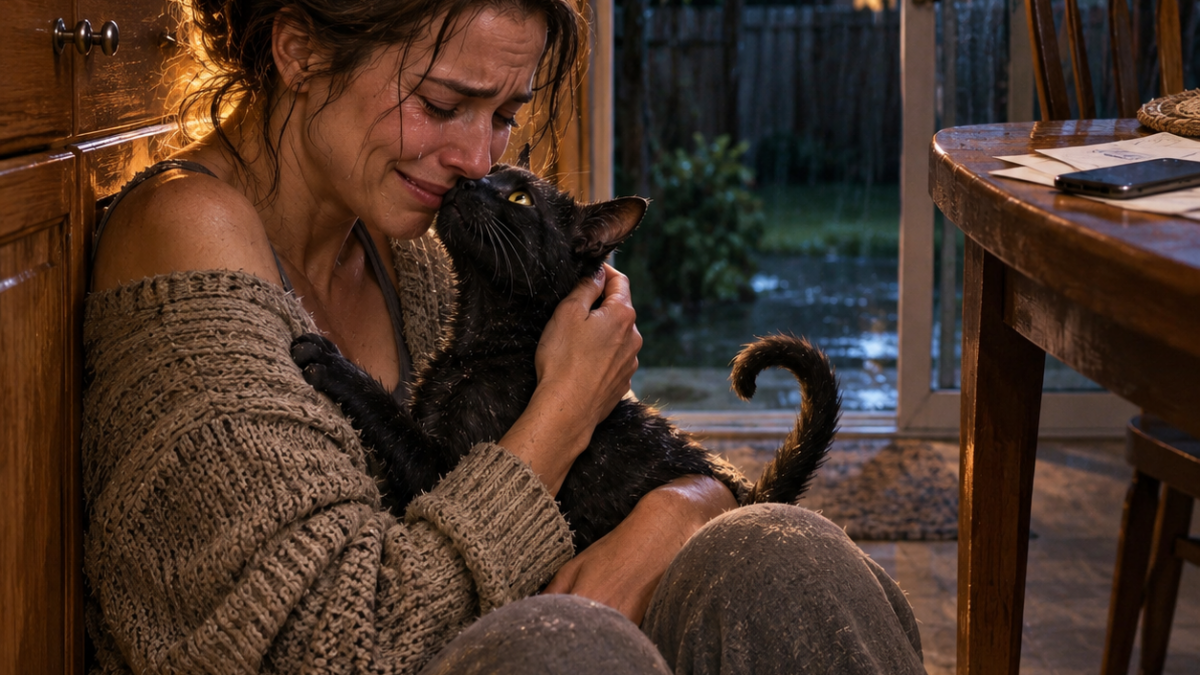
That same night, after a phone call about my divorce left me crying on the kitchen floor, he scratched at my glass door until I let him in—and then refused to leave my side.
But weeks later, when I finally discovered where he had come from and why someone on our street desperately wanted him gone, I realized the little animal everyone called a curse had walked into my life carrying the truth about two broken homes.
The first time I saw the black cat, I was deciding which bill I could afford not to pay.
It was a rainy Tuesday in October, the kind of gray Indiana afternoon when the sky seems to lower itself over the rooftops.
I was sitting alone at my kitchen table with three envelopes spread in front of me.
Electricity.
Car insurance.
A bill from the attorney handling my divorce.
My checking account had $642.18 in it.
My electric bill was already twelve days overdue.
My employer had reduced my hours three weeks earlier.
And the lawyer’s bill had a yellow box near the bottom reminding me that another payment was required before she could continue preparing documents.
For nearly eleven years, I had shared financial decisions with another person.
Now every envelope had my name alone on it.
That was one of the smaller humiliations of divorce nobody had warned me about.
People talked about heartbreak.
Sleeping alone.
Removing wedding photographs.
Splitting holidays.
They did not tell you about standing in a grocery aisle calculating whether the name-brand detergent mattered.
They did not tell you what it felt like when your insurance changed from “family” to “individual.”
They did not tell you that every ordinary object in your house suddenly became evidence.
The blue coffee mug from our honeymoon.
The dent in the refrigerator door from when Mark carried it inside and slipped.
The kitchen table we bought after signing our mortgage.
Even silence seemed to belong partly to him.
I was staring at the electric bill when something moved beyond the sliding glass door.
At first I thought it was a leaf.
Then two yellow eyes appeared beneath the hydrangea.
A cat stepped into the yard.
He was small.
Not kitten-small, but thin enough that the word fragile came to mind.
His coat was almost completely black except for six or seven white hairs beneath his chin.
Rain flattened his fur.
His tail curved upward at the end like a question mark.
He stopped about eight feet from the house.
And stared directly at me.
I stared back.
“You’re having a better day than I am?”
PART2:
His ears twitched.
I had never owned a cat.
My younger sister, Megan, had a gray tabby named Winston who treated me as though I were temporary staff.
That was the extent of my feline experience.
Still, something about this animal bothered me.
Not his color.
His ribs.
Even through wet fur, I could see them.
I stood and opened the sliding door.
Cold rain blew inside.
The cat did not run.
“That’s strange.”
He walked toward me.
Not quickly.
Not cautiously either.
Just directly.
As if he had been waiting for permission.
When he reached the threshold, he sniffed my slipper.
Then rubbed his cheek against my ankle.
A tiny sound came from him.
“Meow.”
I laughed.
It surprised me.
I had not laughed all day.
PART3:
“Well, hello there, little stranger.”
He looked up.
His eyes were a brilliant yellow-gold.
Not frightened.
Not wild.
Tired, maybe.
I crouched.
He leaned into my hand before I even touched him.
Someone had loved this cat.
That was my first thought.
A truly feral animal would not behave like that.
“You belong to somebody.”
He responded by rubbing against me again.
I found an old ceramic bowl, filled it with water, then remembered the half bag of cat food Megan had left months earlier when Winston stayed with me during a vacation.
I poured some onto a paper plate.
The cat ate so quickly that I moved the plate farther inside so the rain would not soak it.
He followed.
When he finished, he sat beside my feet.
No pacing.
No inspecting the house.
No panic.
He simply sat.
As though we had been doing this for years.
“You can’t stay,” I told him.
He blinked.
“I mean it.”
Blink.
“I can barely afford me.”
He raised one paw and began washing his face.
“You’re not listening.”
That should have been the end of it.
Instead, I found myself sitting on the kitchen floor fifteen minutes later while a wet black cat leaned against my thigh.
When the rain weakened, I carried the plate outside.
He followed.
I closed the door.
He sat on the patio and stared through the glass.
I lasted four minutes.
Then I opened it again.
“You are manipulative.”
He walked inside.
Around seven that evening, he finally disappeared.
I assumed he had gone home.
The next morning, he was waiting outside at 7:06.
Same place.
Same yellow eyes.
Same question-mark tail.
I opened the door.
“You again?”
Meow.
I fed him.
The next morning he returned.
Then Thursday.
Friday.
Saturday.
Within a week, he had established a schedule more reliable than most adults I knew.
Around seven every morning, he appeared outside the kitchen.
Sometimes he meowed.
Sometimes he sat silently until I noticed.
Occasionally he came back near sunset.
I began calling him my morning visitor.
Then, without deciding to, I started calling him Midnight.
It was not creative.
He was black.
I was emotionally exhausted.
Creativity had limits.
“Morning, Midnight.”
He came inside to eat.
“Still freeloading?”
Tail up.
“Thought so.”
I told myself I was not adopting him.
Feeding a hungry animal was not adoption.
Buying a small bag of cat food specifically for him was still not adoption.
Placing an old bath towel inside a cardboard box on my covered patio because nights were getting colder was definitely not adoption.
My sister disagreed.
Megan came over one Sunday and found Midnight asleep on my kitchen rug.
She looked at me.
I looked at her.
Then at the cat.
“He’s visiting.”
“Inside your house?”
“He got cold.”
“You bought a scratching pad.”
“That protects furniture.”
“You don’t have a cat.”
“Exactly. So I need to protect the furniture from the cat I don’t have.”
Megan smiled.
I pointed at her.
“Don’t.”
“I didn’t say anything.”
“Your face did.”
Midnight opened one eye.
Megan crouched.
He immediately walked toward her.
“Oh my God.”
“Don’t encourage him.”
“He’s adorable.”
“He’s expensive.”
“He weighs nine pounds.”
“Those pounds eat.”
Megan scratched his chin.
Midnight purred.
“You named him?”
I hesitated too long.
Her smile widened.
“No.”
“You did.”
“It’s temporary.”
“What’s his name?”
“Midnight.”
She laughed.
“What?”
“That’s the most divorced-woman cat name possible.”
I threw a dish towel at her.
Midnight chased it.
For ten minutes, my kitchen sounded like somewhere people still lived.
That mattered more than I wanted to admit.
My neighbor Denise noticed him the following afternoon.
Denise Halpern lived in the pale yellow house next door.
She was sixty-two, recently retired from a dental office, and seemed to know everything that occurred within three streets of ours.
She knew when garbage collection changed before the city website did.
She knew which teenager backed into the Petersons’ mailbox.
She knew who was selling, who was refinancing, who had termites, whose daughter had dropped out of Purdue, and who had put their recycling out one day early.
Before my divorce, I found her mildly entertaining.
After Mark left, she became exhausting.
She would stop me at the mailbox and ask whether I had “heard from him lately.”
As though my husband had gone on a fishing trip instead of moving into a downtown apartment with a woman named Ashley from his office.
One afternoon, Denise saw me placing food beside Midnight’s box.
Her expression changed immediately.
“Oh, Sarah.”
My name is Sarah Whitmore.
I was thirty-seven years old.
And at that moment I knew from Denise’s tone that I was about to receive advice I had not requested.
“What?”
“You’re feeding that thing?”
Midnight was rubbing against my boot.
“He’s a cat, Denise.”
“A stray.”
“Probably.”
“A black stray.”
I looked down.
“He hasn’t changed colors since yesterday.”
She did not laugh.
“You need to stop encouraging him.”
“Why?”
“Black cats are bad luck.”
I thought she was joking.
She wasn’t.
“Seriously?”
“My grandmother always said you never let one settle around your house.”
I smiled.
“Your grandmother also probably said not to open umbrellas indoors.”
“And she lived to ninety-four.”
“Strong evidence.”
Denise frowned.
“I’m trying to help you.”
Midnight sat on my boot.
“I appreciate it.”
“No, you don’t.”
“Not particularly.”
Her eyes moved toward the cat.
“Once you start feeding strays, they don’t leave.”
Something in her voice was different then.
Sharper.
I noticed it.
But I did not understand it.
“You say that like he’s collecting property taxes.”
“I just think with everything you already have going on…”
She let the sentence hang.
Everything.
Divorce.
Reduced hours.
Mark’s affair becoming neighborhood knowledge faster than I would have believed possible.
My finances.
My empty driveway.
The fact that I had stopped mowing as often.
People can fit a remarkable amount of judgment inside the phrase everything you have going on.
Denise continued.
“You don’t need another problem.”
Midnight looked up at me.
I scratched behind his ear.
“He hasn’t caused one.”
“Yet.”
I laughed it off.
But her words followed me inside.
That embarrassed me.
I considered myself rational.
I had spent twelve years working in billing administration for a regional medical supply company.
I believed in spreadsheets.
Due dates.
Documented evidence.
I did not believe the color of an animal’s fur altered financial outcomes.
But superstition rarely gets you through logic.
It gets you through vulnerability.
And I was vulnerable.
My marriage of eleven years had ended four months earlier.
Mark had not disappeared overnight.
That almost would have been easier.
He had withdrawn slowly.
Working late.
Phone turned facedown.
Trips that did not quite make sense.
A new password.
A new gym membership.
New clothes.
Then one Thursday evening, he sat across from me at the same kitchen table where I now paid bills and said he was unhappy.
People always remember dramatic lines in stories.
Mine was ordinary.
“I don’t think we’re good together anymore.”
That was it.
Eleven years reduced to one sentence.
I asked whether there was someone else.
He said no.
Three days later, I found a hotel receipt in the center console of his car.
When I asked again, he admitted there was someone.
Ashley.
Thirty-one.
Marketing coordinator.
“Nothing happened until recently.”
That phrase offended me more than the confession.
As though betrayal had a waiting period that made it respectable.
Mark moved out.
Then, bizarrely, became efficient.
He wanted everything “amicable.”
He created spreadsheets for property division.
Suggested mediators.
Forwarded articles about collaborative divorce.
He spoke to me as though we were dissolving a business partnership.
I hated him for making calmness look reasonable.
I hated myself more for crying after every conversation.
Then my employer cut overtime.
Two weeks later our department lost a hospital contract and management reduced hours across the team.
Suddenly my paycheck dropped nearly twenty percent.
Mark knew.
Still, his attorney challenged several expenses during settlement discussions.
Every conversation became about numbers.
Mortgage.
Equity.
Retirement accounts.
Vehicles.
Furniture.
Somewhere in the middle of legal language, I began to feel as though I had been audited out of my own life.
So when Denise said Midnight might be another problem, I heard more than superstition.
I heard cost.
Responsibility.
Vet bills.
Food.
Maybe disease.
Maybe somebody angry that I had fed their pet.
Maybe one more thing I could fail.
That night Midnight arrived around six.
I gave him dinner.
He slept near the sliding door for an hour.
When he left, I washed the bowl.
Then put it in the cupboard.
The following morning, he appeared at 7:03.
I saw him through the blinds.
He sat exactly where he always sat.
I did not open the door.
Instead I made coffee.
He waited.
I kept my back toward him.
After five minutes, I looked.
Still there.
Ten minutes.
Still there.
At seventeen minutes, he stood.
He walked to the corner of the patio.
Looked back once.
Then disappeared through the hedge.
The guilt was immediate.
Ridiculous.
Sharp.
I almost opened the door and called after him.
Instead I whispered, “This is sensible.”
The empty kitchen did not agree.
That afternoon, my lawyer called.
Her name was Patricia.
She was good at her job.
Patient.
Professional.
Exactly the kind of person you want during a divorce and exactly the kind of voice capable of making the end of a marriage feel legally permanent.
“Sarah, I received Mark’s revised proposal.”
I closed my eyes.
“Okay.”
“He’s willing to withdraw the request for reimbursement on the kitchen renovation.”
“How generous.”
Patricia paused.
“You want the legal answer or the human answer?”
“Human.”
“He’s being an ass.”
I laughed once.
“Thank you.”
“But there are issues with the house.”
I sat at the kitchen table.
“What issues?”
“His attorney is arguing that continued mortgage costs are creating an unfair burden if the property remains unsold.”
“My name is on the mortgage too.”
“I know.”
“I’m paying it.”
“I know.”
“What does he want?”
Patricia hesitated.
That was enough.
“He wants me to sell.”
“He is proposing that either you refinance into your name within ninety days or list the property.”
My throat tightened.
“Patricia, I can’t qualify for refinancing right now. My hours were cut.”
“I know.”
“Mark knows.”
“Yes.”
I stared at the cabinets we had painted together.
The refrigerator he had dented.
The backyard where he built a raised garden bed and then abandoned gardening after three weeks.
“I thought we agreed I’d stay until the divorce was final.”
“That was informal.”
“So he changed his mind.”
“Apparently.”
I heard myself laugh.
It did not sound like laughter.
“Of course.”
“Sarah.”
“I’m okay.”
“No, you’re not.”
That nearly broke me by itself.
People had accepted I’m okay for months.
Patricia was the first person who refused.
“We have options,” she said.
“What options?”
“We can challenge the timeline. We can negotiate. We can review whether you qualify for temporary support based on the income change.”
“I don’t want his money.”
“This isn’t about pride.”
“It feels like it.”
“It’s about protecting your legal position.”
I covered my eyes.
The conversation continued for fifteen more minutes.
I remember almost none of it.
When we hung up, the house became unbearably quiet.
I remained at the table.
Then I looked at Mark’s empty chair.
The strangest thing happened.
I remembered a Tuesday night eight years earlier when our furnace broke during a snowstorm.
We had no money for the repair.
We spent the evening under blankets eating peanut butter sandwiches while Mark tried to fix it using a YouTube video.
He failed spectacularly.
At midnight we were laughing so hard I could barely breathe.
Nothing about that memory matched the man now trying to force a sale because carrying costs were inconvenient.
I began crying.
Quietly at first.
Then not quietly.
I slid from the chair onto the kitchen floor.
My back rested against the cabinets.
I cried for my marriage.
For the house.
For the future I had assumed was settled.
For the humiliating fact that Ashley had posted a photograph from a restaurant Mark and I used to visit.
For the $642.18.
For the electric bill.
For every time somebody had told me I was strong when what I actually wanted was permission to collapse for one afternoon.
I covered my face.
“I can’t do this.”
Saying it aloud made it worse.
“I can’t.”
Then I heard something.
Scratch.
Scratch.
Scratch.
I did not move.
The sound came again.
Scratch.
Scratch.
I wiped my face.
A branch, I thought.
Then came a small meow.
I turned.
Two yellow eyes looked through the sliding glass door.
Midnight.
He stood outside in light rain.
Waiting.
My chest hurt.
“You came back.”
He scratched again.
I almost laughed.
“You’re persistent.”
Meow.
I crawled across the floor and opened the door.
He walked inside immediately.
No hesitation.
No wandering.
He came directly toward me.
Pressed his head against my knee.
Then, to my astonishment, climbed into my lap.
I sat with my back against the cabinet.
Midnight turned twice.
Curled into a small black circle.
Then began purring.
The vibration traveled through both of us.
I stared at him.
“You don’t know me.”
He pushed his head beneath my hand.
“I ignored you this morning.”
Purr.
“I’m not doing very well.”
Purr.
“I may lose this house.”
He reached one paw across my wrist.
That did it.
I started crying again.
Only this time I wrapped my arms around him.
He stayed.
No restlessness.
No attempt to leave.
For almost an hour, that little animal remained in my lap while I cried into his fur.
Whenever my hand stopped moving, he nudged it.
At one point I laughed through tears.
“You are extremely demanding for someone who doesn’t pay utilities.”
His eyes closed.
Eventually my legs went numb.
I stood carefully.
Midnight followed me into the living room.
I sat on the couch.
He jumped beside me.
Then climbed onto my legs again.
Around ten, I got ready for bed.
I left the bedroom door open.
Not intentionally.
At least that was what I told myself.
Midnight slept at the foot of the bed.
When I woke the next morning, he was sitting beside my pillow.
Staring at me.
“Were you watching me sleep?”
Meow.
“That’s unsettling.”
He stepped onto my chest.
“Ow.”
Purr.
I smiled.
A real smile.
The first in days.
“Well.”
I scratched his chin.
“I suppose you live here now.”
The decision felt absurdly large.
It was also the easiest decision I had made in months.
But before I could make it official, I needed to know whether somebody else already loved him.
That afternoon I took Midnight to Cedar Grove Veterinary Clinic.
He hated the carrier.
He informed the entire waiting room.
A golden retriever across from us looked personally offended.
Dr. Elise Morgan scanned Midnight for a microchip.
Nothing.
She examined him.
Young adult.
Probably two or three.
Underweight.
Ear mites.
Minor dental issues.
A healing scar beneath his left shoulder.
No collar mark.
No obvious major illness.
“He’s definitely been outside a while,” she said.
“Can you tell how long?”
“No.”
“Could he belong to someone?”
“Absolutely.”
I nodded.
That disappointed me more than it should have.
Dr. Morgan noticed.
“The right thing is still to try.”
“I know.”
“We can photograph him. Shelters can cross-check reports.”
“I’ll post online.”
“Good.”
She gave me information about local found-animal procedures.
Then looked at Midnight, who was currently trying to push his face beneath my elbow.
“He likes you.”
“He likes food.”
“No.”
She smiled.
“He likes you.”
I paid the examination fee using my credit card.
When the receipt printed, I winced.
Midnight meowed.
“Do not judge my finances.”
Dr. Morgan laughed.
Over the next week, I did everything correctly.
Photographs in neighborhood groups.
Found-cat posts.
Shelter notifications.
Local lost-pet pages.
Flyers at two grocery stores, the vet clinic, and the library.
I avoided publishing every identifying detail so a claimant would have to prove ownership.
Nobody called.
Almost nobody.
On the sixth day, I got a message from a woman named Karen.
Is this cat from Maplewood Drive?
Yes.
Please be careful.
I stared at the screen.
Why?
Three dots appeared.
Then disappeared.
Returned.
Ask your neighbor Denise.
A cold feeling moved through me.
I typed:
What about Denise?
No response.
I checked Karen’s profile.
Local.
Older woman.
Photographs of flowers, grandchildren, and a white dog.
I sent another message.
Did this cat belong to someone?
Still nothing.
The next afternoon, Denise saw Midnight sitting in my front window.
She stopped on the sidewalk.
“You still have him?”
“Yes.”
She frowned.
“I thought you were going to stop feeding him.”
“I changed my mind.”
“You took him inside?”
“He came inside.”
“That’s worse.”
I stared at her.
“Why does this bother you so much?”
“It doesn’t.”
“It seems to.”
She folded her arms.
“I just think stray animals cause problems.”
“Problems like what?”
“Fleas. Disease. Damage.”
“He saw a veterinarian.”
“You paid for that?”
There was something about the way she said it.
Not concern.
Judgment.
“I did.”
“Sarah, you told me money was tight.”
I felt my face heat.
I had mentioned reduced hours once.
Apparently that had become communal information.
“I can decide where my money goes.”
“Of course.”
Her eyes shifted toward Midnight.
He stared at her through the glass.
His back rose slightly.
That surprised me.
Midnight loved people.
The delivery driver.
Megan.
Dr. Morgan.
My mail carrier.
He approached everyone.
But when Denise stepped closer to the window, he backed away.
Tail lowered.
I noticed.
So did Denise.
She looked uncomfortable.
“You see?”
“What?”
“He’s strange.”
“No.”
I watched him.
“He’s scared of you.”
Denise’s expression changed.
“Don’t be ridiculous.”
She walked away.
That night I messaged Karen again.
This time she responded.
I probably shouldn’t have said anything.
Please tell me.
It took five minutes.
Then:
I think that cat belonged to Mr. Alvarez.
I sat upright.
Mr. Alvarez.
The name was familiar.
An older man who had lived three houses behind Denise.
White bungalow.
Vegetable garden.
Always wore a red Cardinals cap despite living nowhere near St. Louis.
I had spoken to him maybe five times.
His first name was Ernesto.
I had not seen him in months.
Where is Mr. Alvarez?
Karen responded:
He died in June.
I looked toward Midnight.
He was asleep on the arm of the couch.
Something inside me tightened.
Did he have a black cat?
Yes. At least I think it was this one.
What was its name?
I don’t know.
Why did you tell me to ask Denise?
Long pause.
Then:
Because she complained about the cat after he died.
The story emerged slowly.
After Ernesto Alvarez died unexpectedly from a stroke, his adult son flew in from Arizona to settle the estate.
Karen had helped with meals.
Denise had helped “organize things.”
Ernesto owned a black cat.
Young.
Friendly.
Often sat with him on the porch.
His son believed a rescue had taken the animal.
At least, that was what Karen had heard.
But two weeks after the funeral, she saw the black cat behind her garage.
When she mentioned it to Denise, Denise said it was just a stray and should not be encouraged.
Same words she used with me.
I called Megan.
“Do you remember Mr. Alvarez?”
“The tomato guy?”
“Yes.”
“Sure.”
“I think Midnight was his.”
Megan became quiet.
“What happened?”
I explained.
When I finished, she said, “Call his son.”
“I don’t have his number.”
“Find him.”
That sounded intrusive.
It also sounded necessary.
The next morning, I called Karen.
Hearing her voice made everything more real.
“Yes,” she said. “Ernesto had a black cat.”
“Do you remember his name?”
“I think… Shadow?”
I looked toward Midnight.
“Shadow.”
His head snapped up.
My entire body went cold.
“Midnight?”
Nothing.
“Shadow?”
He jumped from the couch.
Walked toward me.
Meowed.
Karen heard it.
“Oh my.”
I sat down.
“You’re sure?”
“I’m almost certain.”
“Do you know his son?”
“Gabriel.”
“Can you contact him?”
“I have an old number.”
An hour later, my phone rang.
Arizona area code.
“Sarah?”
“Yes.”
“This is Gabriel Alvarez.”
His voice already sounded emotional.
“Karen sent me your photograph.”
I looked at Shadow.
I could not call him Midnight anymore.
Not entirely.
“He responds to Shadow.”
Gabriel inhaled sharply.
“That’s him.”
My heart sank and lifted at the same time.
“Then he’s yours.”
“No.”
The answer came quickly.
I frowned.
“What?”
“He was my dad’s.”
Gabriel went silent.
Then said, “And I thought I failed him.”
Over the next forty minutes, he told me what happened.
Ernesto had adored Shadow.
Found him as a kitten behind a grocery store.
Bottle-fed him.
Took photographs.
Sent them constantly.
After Ernesto died, Gabriel came to Indiana overwhelmed.
He had three days of bereavement leave.
A funeral to organize.
A house to secure.
Medical bills.
Legal documents.
His father’s belongings.
Shadow disappeared the day after Gabriel arrived.
Gabriel searched.
Posted online.
Asked neighbors.
He specifically asked Denise because she had been helping coordinate estate-sale preparations.
“She told me animal control probably picked him up.”
“Did you check?”
“Every shelter within thirty miles.”
Nothing.
Denise later said somebody had seen a black cat hit near the county highway.
Gabriel believed Shadow was dead.
“I felt horrible,” he said. “Dad loved that cat.”
I looked at Shadow.
He was sitting beside my feet.
“Why would Denise lie?”
Silence.
“I don’t know.”
But his voice told me he did.
“Gabriel.”
“There was an argument.”
“What about?”
“My dad’s house.”
I waited.
“Denise wanted to buy it.”
That surprised me.
“For herself?”
“For her daughter.”
According to Gabriel, Denise approached him less than twenty-four hours after Ernesto’s funeral.
She said her daughter Emily had always admired the property.
She offered a private sale.
Cash.
No agent.
Quick closing.
Gabriel declined because he needed an appraisal.
Denise pressed.
Said the house needed major work.
Said the neighborhood was changing.
Said carrying costs would drain the estate.
When the appraisal came back nearly $70,000 above Denise’s offer, Gabriel listed publicly.
The house sold within nine days.
Denise barely spoke to him afterward.
“What does that have to do with Shadow?”
“I don’t know.”
Then Gabriel remembered something.
“My dad’s will.”
“What?”
“He left instructions about the cat.”
I felt my chest tighten.
“What instructions?”
“Five thousand dollars in a pet-care trust.”
I looked down at Shadow.
Gabriel continued.
“Whoever took him permanently was supposed to receive the funds for veterinary care and expenses.”
“Who was named?”
“That’s the weird part.”
“Who?”
“Dad’s neighbor.”
My stomach dropped.
“Denise?”
“Yes.”
I stood.
Shadow looked up.
Gabriel said, “Dad trusted her.”
“Did she receive the money?”
“No.”
“Why?”
“Because she said Shadow disappeared before the estate was settled. The trust money reverted into the residual estate.”
Something did not fit.
“If she wanted money, wouldn’t she keep him?”
“That’s what I thought.”
“Unless…”
I stopped.
Gabriel waited.
Unless the cat was a problem for another reason.
“Was anything else left to Denise?”
“No.”
“What about her daughter?”
“No.”
I paced the kitchen.
Shadow followed.
“Did your father keep documents at home?”
Gabriel gave a sad laugh.
“My father kept everything.”
“What kind of everything?”
“Receipts from 1989. Warranties for appliances he no longer owned. Property records.”
Property records.
“Did he ever have a dispute with Denise?”
Silence.
Then Gabriel said, “Actually…”
There it was.
Six months before Ernesto died, Denise had built a new privacy fence.
Ernesto complained that part of it crossed his property line.
A survey showed he was right.
By nearly four feet along twenty yards.
Denise argued.
Ernesto refused to sign an easement.
The issue remained unresolved when he died.
After his death, Denise told Gabriel it had been a misunderstanding.
Gabriel, overwhelmed, did not pursue it.
The buyer later accepted the existing fence after Denise claimed Ernesto had verbally agreed to the placement.
“Did your father document disputes?”
“Everything.”
“What if he had photographs?”
Gabriel became quiet.
“He did.”
“Where?”
“I don’t know.”
Then Shadow jumped onto the kitchen table.
I started to push him down.
He stepped onto an envelope.
The old electric bill.
Then sat.
Something almost funny crossed my mind.
“You’re not going to solve property law, buddy.”
But Shadow stared toward the sliding door.
Toward my backyard.
Toward Denise’s house beyond the fence.
I remembered what Karen said.
She complained about the cat after he died.
Not after he appeared.
After Ernesto died.
I asked Gabriel, “Where did Shadow spend most of his time?”
“Dad’s backyard.”
“Did he wear a collar?”
“Yes.”
“What kind?”
“Blue. With an AirTag holder.”
I froze.
“What?”
“Dad was paranoid he’d disappear.”
“Was the tracker active?”
“I checked it after Shadow vanished.”
“And?”
“Last location was near Dad’s property.”
“Then?”
“It stopped updating.”
“Did you find the collar?”
“No.”
My heart began pounding.
The next day, Megan came over.
I showed her everything.
Messages.
Timeline.
Gabriel’s information.
She listened.
Then said, “Do not accuse Denise.”
“I wasn’t planning to.”
“You have the face.”
“What face?”
“The one you had when you caught Mark lying about Ashley.”
“I did not have a face.”
“You drove to his office.”
“I brought him his laptop.”
“You brought him his laptop after checking whether Ashley’s car was there.”
“That was unrelated.”
Megan stared.
“Do not confront Denise.”
“I won’t.”
That promise lasted eighteen hours.
The next afternoon, Denise knocked on my door.
Not rang.
Knocked.
Hard.
Shadow ran beneath the table.
That alone made me angry.
I opened the door but kept the storm door closed.
“What?”
Denise looked past me.
“You’ve been asking questions.”
My pulse jumped.
“About?”
“Ernesto.”
I said nothing.
“Karen called me.”
Of course she did.
Neighborhood information moved faster than weather.
Denise continued.
“Whatever she told you, she likes drama.”
“You told Gabriel that Shadow was probably dead.”
Her face changed.
So little.
But enough.
“So that is Ernesto’s cat.”
“You knew.”
“I suspected.”
“You told me he was a stray.”
“He was wandering loose.”
“After his owner died.”
“That makes him stray.”
“No, it makes him displaced.”
Denise crossed her arms.
“What exactly are you accusing me of?”
“I didn’t accuse you of anything.”
“Good.”
“Did you remove his collar?”
Her face went still.
There.
The answer.
Not proof.
But answer.
“I have no idea what you’re talking about.”
“He wore a tracking collar.”
“Lots of cats wear collars.”
“Gabriel never found it.”
“That’s unfortunate.”
“Why were you so determined that I stop feeding him?”
“I wasn’t.”
“You warned me twice.”
“Because I don’t want stray animals around my yard.”
“He barely goes near your yard.”
“You don’t know where he goes.”
“I know he’s afraid of you.”
Denise’s face hardened.
“He’s an animal.”
“So?”
“Don’t turn this into some ridiculous detective story because your husband left you and you need something to focus on.”
The sentence struck with surgical accuracy.
For a second I could not breathe.
Denise saw it.
And, worse, looked satisfied.
Then something inside me changed.
Months earlier, I would have backed down.
Embarrassed.
Ashamed of being emotional.
I opened the storm door.
Not to let her in.
To step onto the porch.
“Do not use my divorce to make me doubt what I saw.”
Denise blinked.
“Excuse me?”
“You heard me.”
“I was trying to—”
“You were trying to humiliate me because you don’t want questions.”
“Sarah, you’re being unstable.”
I laughed.
Actually laughed.
“That word doesn’t work as well as you think it does.”
Her expression tightened.
“You need to leave this alone.”
“Why?”
“Because Ernesto is dead. Gabriel sold the house. Whatever neighborhood disagreement existed is over.”
“Then why are you standing on my porch?”
No answer.
I continued.
“If this is over, go home.”
She stared at me.
Then toward the window.
Shadow had emerged.
He stood behind the glass.
Watching her.
Denise stepped backward.
“You’ll regret keeping him.”
I thought of the first warning.
Bad luck.
You’ll regret it.
Now it sounded different.
Not superstition.
Threat.
I pulled out my phone.
Denise saw.
“What are you doing?”
“Making a note of exactly what you just said.”
Her face flushed.
“You’re unbelievable.”
“Goodbye, Denise.”
I closed the door.
Then locked it.
My hands shook afterward.
Shadow walked over.
Rubbed against my ankle.
“Your former neighbor is exhausting.”
He purred.
The investigation, if you could call it that, began with a blue collar.
Gabriel flew to Indiana two weeks later.
Not because of the fence.
Because of Shadow.
He arrived at my house carrying an old leather bag and looking more like Ernesto than I expected.
Same eyebrows.
Same careful way of smiling.
Shadow was asleep on my couch.
Gabriel stepped inside.
The cat opened his eyes.
For half a second nothing happened.
Then Shadow stood.
His body went rigid.
Gabriel whispered, “Hey, buddy.”
Shadow jumped down.
Walked toward him.
Stopped three feet away.
Sniffed.
Then made a sound I had never heard.
Not a normal meow.
Longer.
Broken.
Gabriel covered his mouth.
“Oh God.”
Shadow rushed forward.
Rubbed against his legs.
Gabriel dropped to his knees.
He buried both hands in the cat’s fur.
“I’m sorry.”
Shadow climbed against his chest.
Gabriel cried.
I turned toward the kitchen.
Some reunions deserve privacy even when they happen in your living room.
Afterward Gabriel sat at my table.
Shadow occupied his lap.
“He remembered.”
“Of course.”
“I only saw him maybe twice a year.”
“You smelled like Ernesto.”
Gabriel looked at me.
“You think?”
“I think memory works in ways we underestimate.”
He nodded.
Then looked around my house.
“He’s happy here.”
My chest tightened.
“I’ll understand if you want to take him.”
Gabriel immediately shook his head.
“No.”
“He belonged to your dad.”
“That’s exactly why.”
I frowned.
“My father would care about where Shadow wants to be.”
He looked down.
The cat was already asleep against him.
“Dad always said cats are roommates, not property.”
I smiled.
“That sounds like him.”
“He’d like you.”
“Based on what?”
“You’re letting a black cat bankrupt you during a divorce.”
“That information traveled?”
“Megan told Karen, apparently.”
I closed my eyes.
“I hate this neighborhood.”
Gabriel laughed.
Later that afternoon, we walked to Ernesto’s old house.
The new owners, the Parkers, agreed to let Gabriel inspect the garage and shed for anything potentially belonging to the estate.
Mrs. Parker had heard part of the story.
Everyone had.
She opened the garage.
“Anything you find that’s your dad’s, take it.”
Most of Ernesto’s belongings had been cleared months earlier.
But old shelves remained.
A workbench.
Pegboard.
A broken cabinet.
Gabriel searched quietly.
I stayed near the door.
Shadow remained at my house because bringing him seemed like asking for trouble.
After forty minutes, Gabriel found a metal box behind a loose wall panel.
Empty.
Then an envelope taped beneath the workbench.
Inside were photographs.
Fence posts.
Survey stakes.
Measurements.
Dates.
Ernesto standing beside the property line holding a tape measure.
And several photographs of Denise’s contractor moving stakes.
One image showed something else.
A black cat.
Shadow.
He was sitting beside a blue plastic storage tote.
Nothing important.
Except Gabriel stared at it.
“What?”
He pointed.
“That tote.”
“What about it?”
“My dad kept documents in those.”
We searched the shed.
No tote.
Mrs. Parker joined us.
“I think Denise took some containers.”
Gabriel turned.
“When?”
“Before we moved in.”
The garage became silent.
“She told us they were hers,” Mrs. Parker continued. “Gardening supplies Ernesto had borrowed.”
“How many?”
“Maybe three?”
“Blue?”
“Yes.”
Gabriel looked at me.
There are moments when suspicion changes into shape.
Not proof yet.
But structure.
We thanked Mrs. Parker.
Then walked toward my house.
Halfway there, Denise stepped outside.
She saw Gabriel.
Stopped.
He stopped too.
“Hello, Denise.”
Her expression changed.
“Gabriel.”
“I heard you took several storage containers from Dad’s garage after the sale.”
“I took my property.”
“What property?”
“Garden supplies.”
“Do you still have them?”
She folded her arms.
“I don’t know. Probably.”
“I’d like to see them.”
“No.”
Gabriel’s voice remained calm.
“Why?”
“Because I don’t owe you an inspection of my belongings.”
“You told the Parkers those containers were yours.”
“They were.”
“My father photographed one holding his property records.”
“Then maybe he reused my container.”
Gabriel nodded slowly.
“Okay.”
That surprised her.
He pulled out his phone.
“I’ll let the estate attorney handle it.”
Her face changed.
“Don’t be ridiculous.”
“Then show me the totes.”
“You people are harassing me.”
You people.
Me.
Gabriel.
A dead man’s cat.
Apparently a criminal organization.
I almost laughed.
Gabriel said, “I’m not arguing with you.”
He turned.
Denise called after him.
“Your father was confused near the end.”
Gabriel stopped.
His shoulders stiffened.
Denise continued.
“He accused people of things. He forgot conversations.”
I saw Gabriel’s face.
That hurt.
He looked back.
“My father had no dementia diagnosis.”
“I’m just telling you what I observed.”
“No.”
His voice changed.
“You’re telling me what you need me to believe.”
Denise went silent.
Gabriel walked away.
Three days later, the estate attorney sent a formal request for property believed removed after the sale.
Denise hired a lawyer.
That made everyone take it more seriously.
The blue totes were eventually produced.
Two contained gardening supplies.
The third was empty.
Except forensic dust from paper.
And a label beneath old adhesive.
E.A. PROPERTY.
That alone proved little.
Then the missing AirTag collar appeared.
Not in the tote.
In Denise’s trash.
Technically, in a bag she placed at the curb during the week the dispute became public.
I did not find it.
I want that clear.
Karen did.
Of course Karen did.
She was walking her dog on trash morning when something blue protruding from a torn bag caught her attention.
She pulled it free.
A collar.
Blue.
Small tracker holder attached.
She took a photograph and called Gabriel.
The AirTag itself was gone.
But Shadow’s old identification plate remained beneath layers of dirt.
His name.
Ernesto’s phone number.
Denise claimed she had found the collar in her yard months earlier and thrown it away recently by coincidence.
Nobody believed that coincidence.
Still, removing a cat’s collar was not a major crime.
What mattered was why.
The answer was in Ernesto’s photographs.
One image showed Denise’s contractor moving a boundary stake.
Another showed a second man filling the original survey marker hole with soil.
Ernesto had photographed the work from his kitchen window.
Shadow appeared in three pictures.
In one, the cat stood beside Denise while she pointed toward the fence.
In another, the blue collar’s AirTag was visible.
Gabriel suddenly remembered that Ernesto had shared location access.
Apple retained limited historical account information.
His attorney obtained records through the estate.
The final ping before Shadow’s tracker went offline had not occurred at Ernesto’s house.
It happened nearly eight miles away.
Beside an abandoned county maintenance lot.
The same place local animal control officers sometimes found dumped pets.
I felt sick.
Denise had not merely removed his collar.
Someone had transported him.
We could not prove who.
Not immediately.
Then Karen remembered Denise’s red SUV.
She had seen it parked near Ernesto’s back gate the afternoon Shadow disappeared.
Another neighbor had a doorbell camera.
The footage still existed in cloud storage.
There was Denise.
Walking through Ernesto’s side gate carrying a pet carrier.
Forty minutes later, she returned without it.
That changed everything.
When confronted by Gabriel’s attorney, Denise finally admitted taking Shadow.
Her explanation was almost worse than denial.
“He kept going into my yard.”
Gabriel stared at her across a mediator’s conference table.
“So you drove him eight miles away?”
“I thought someone would adopt him.”
“You removed his tracker.”
“He was scratching at it.”
“You lied to me.”
“You were leaving.”
“You told me he was probably dead.”
“I didn’t want to upset you.”
Gabriel laughed in disbelief.
“You dumped my father’s cat beside an abandoned maintenance yard and told me he was dead because you didn’t want to upset me?”
Denise’s lawyer touched her arm.
She pulled away.
“I was under pressure.”
“From what?”
“The fence issue.”
There it was.
She had feared Shadow’s tracker history might complicate her story.
Ernesto had apparently walked the property line frequently with the cat following him.
His phone location data, Shadow’s tracker data, and dated photographs supported his claim about the original boundary.
After Ernesto died, Denise wanted the dispute to disappear before Gabriel understood its significance.
The cat was part of the digital record.
Not intentionally.
Just incidentally.
That was enough.
So she removed him.
Then removed the collar.
Then lied.
When Shadow somehow traveled eight miles back toward the neighborhood over the following weeks, Denise saw him.
She tried to scare him away.
Karen saw that too.
Then Shadow found my backyard.
The woman who warned me he brought bad luck was not afraid of superstition.
She was afraid the cat would bring questions.
The property issue escalated.
The Parkers had purchased Ernesto’s house based partly on representations about the fence.
Their title insurer became involved.
A new survey confirmed the encroachment.
Denise had to move the fence.
She paid legal expenses under a settlement.
She compensated the Parkers for landscaping damage and corrected boundary improvements.
Gabriel did not pursue a dramatic criminal case over Shadow.
Animal abandonment statutes were discussed with local authorities, and Denise received a citation connected to the incident.
But the larger consequences were social.
For years Denise had built her identity around being the woman who knew everyone’s business.
Now everyone knew hers.
I expected to enjoy that.
I didn’t.
Watching somebody become isolated is less satisfying in real life than in stories.
Denise stopped walking in the neighborhood for months.
People who had once lingered at her driveway kept conversations brief.
Her daughter visited one weekend and left crying.
I saw them arguing.
I felt something close to pity.
Not forgiveness.
Those are different things.
Pity simply meant I no longer needed her to suffer for me to feel whole.
Meanwhile, my own life remained complicated.
That surprised me too.
Discovering a neighborhood scandal did not pay my electric bill.
It did not restore my hours.
It did not erase Mark’s affair.
Justice in one corner of your life does not magically clean the others.
Patricia challenged Mark’s demand to force the house sale.
His income had increased substantially during the marriage.
Mine had recently decreased for reasons outside my control.
Temporary support became part of negotiations.
Mark hated that.
At mediation he said, “I don’t understand why Sarah suddenly can’t support herself.”
Suddenly.
I stared at him across the conference table.
For months I had avoided confrontation because I feared looking bitter.
That day I stopped caring.
“My hours were cut.”
“You could find another job.”
“I am looking.”
“You always said you wanted independence.”
There it was.
The weaponized version of something I once believed about myself.
I looked at him.
“I wanted a partner, Mark.”
His face shifted.
“You had one.”
“No.”
The mediator became very interested in her notes.
I continued.
“I had a husband until being married became inconvenient for him.”
His attorney leaned forward.
“Let’s keep this productive.”
I laughed softly.
“For eleven years, I kept things productive.”
Mark looked away.
I had never said those words to him.
Not like that.
“I managed the house. I moved twice for your promotions. I turned down a supervisory position because it required travel while your mother was sick and you said somebody needed to stay nearby.”
“That was a joint decision.”
“No. It was a decision I agreed to because I thought that was what marriage meant.”
His jaw tightened.
“Sarah—”
“And now you’re using my lower income as proof that I should leave the house?”
Nobody spoke.
I felt strangely calm.
Not victorious.
Just present.
“I’m not asking you to rescue me.”
I looked at Patricia.
“Ask for what the law says is fair.”
Mark stared.
Something in our marriage finally ended in that room.
Not love.
That had ended earlier.
The expectation that I would protect his version of events.
The divorce settled six weeks later.
I kept the house.
Not forever by guarantee.
But long enough to refinance after securing a new position.
My employer restored some hours temporarily, and then, unexpectedly, I was offered a billing supervisor job at another medical company.
Better salary.
Better benefits.
Longer commute.
I accepted.
The day I received the offer, Midnight—Shadow—was sitting on the kitchen counter.
I held the phone in one hand.
“Guess what?”
He knocked a pen onto the floor.
“I got the job.”
Another pen.
“You could show enthusiasm.”
He looked at me.
Then head-butted my arm.
“Thank you.”
By then I had stopped deciding whether his name was Midnight or Shadow.
Gabriel solved it.
“Keep both.”
“What?”
“My dad called him Shadow. You called him Midnight.”
“That sounds confusing.”
“He’s a cat. He ignores you regardless.”
So officially, according to veterinary records, he became Shadow Midnight Whitmore.
Megan laughed for ten straight minutes.
“Why did you include my last name?”
“Because you’re his mother.”
“I am not saying that sentence.”
“You spent three hundred dollars on a cat tree.”
“He needs enrichment.”
“You are his mother.”
Shadow ignored the expensive cat bed I bought him.
Naturally.
He slept on the kitchen floor.
The exact place where he had sat beside me the night I let him stay.
Sometimes I woke during the night and found him there.
Black shape against pale tile.
Perfectly content.
As months passed, the house changed.
Not physically.
Emotionally.
I started opening curtains again.
That sounds small.
It wasn’t.
After Mark left, I had kept the living room blinds closed because I hated feeling visible.
Shadow loved windows.
He would sit beside the blinds until I opened them.
Then spend hours watching birds.
So I opened them.
Sunlight returned.
I began waking earlier because he demanded breakfast at 6:47 regardless of weekends, holidays, illness, or constitutional protections.
I began cooking again.
Mostly because he sat on a stool and watched me as though hosting a television program.
“Tonight we are making pasta,” I would announce.
Meow.
“No, you cannot eat garlic.”
Meow.
“Your feedback is noted.”
I talked to him constantly.
About work.
Money.
Mark.
My mother.
Megan.
Things I would never say aloud to another person because they sounded too petty or too sad.
Shadow listened equally to all of it.
That is one of the great gifts of animals.
They do not require your pain to be impressive before they sit beside it.
The first anniversary of my separation arrived quietly.
I expected to feel devastated.
Instead I woke at 6:42 because Shadow was standing on my chest.
“Get off.”
Meow.
“It’s Saturday.”
Meow.
“Capitalism has not begun yet.”
He stepped closer to my face.
I laughed.
“Fine.”
I fed him.
Made coffee.
Opened the curtains.
And realized I had forgotten the date until halfway through breakfast.
That made me cry.
Not from sadness.
From relief.
Healing had occurred without asking permission.
Denise eventually spoke to me again.
Nearly a year after the confrontation.
I was pulling weeds near the mailbox.
Shadow sat in the front window.
Denise approached slowly.
She looked older.
Maybe I did too.
“Sarah.”
“Denise.”
She stopped several feet away.
“I owe you an apology.”
I stood.
She looked toward the house.
“I treated you badly.”
“Yes.”
She flinched slightly.
Perhaps she expected me to rescue her from the discomfort.
Old Sarah might have.
I did not.
She continued.
“I was scared.”
“Of losing four feet of yard?”
Her face reddened.
“It sounds ridiculous.”
“It was.”
“I’d spent years on that landscaping. My daughter wanted the house next door eventually. Ernesto and I had argued. Then he died before we resolved it.”
“So you dumped his cat.”
“I told myself someone would find him.”
“You drove him to an abandoned lot.”
“I know.”
“You took off his collar.”
“I know.”
“You told his son he was probably dead.”
She began crying.
That complicated my anger.
“I know.”
For a moment neither spoke.
Then Denise said, “I don’t expect you to forgive me.”
“Good.”
She nodded.
I looked at her.
“But I appreciate the apology.”
She wiped her face.
“That cat hates me.”
“He has reasons.”
A tiny smile crossed her face.
“Yes.”
She turned to leave.
Then stopped.
“I never actually believed black cats were bad luck.”
“I figured that out.”
“My grandmother did.”
“Did she also steal survey markers?”
Denise laughed despite herself.
“No.”
“Then let’s leave her out of this.”
She nodded.
We never became friends.
I think some relationships are repaired by becoming civil, not close.
She moved eighteen months later.
Her daughter did not buy Ernesto’s house.
A young couple with two children lived there instead.
They planted sunflowers along the corrected property line.
Gabriel visited occasionally.
Whenever he came to Indiana, he stopped by to see Shadow.
The first few times, Shadow became wildly excited.
Later it became calmer.
Familiar.
Gabriel would sit on my couch.
Shadow climbed beside him.
We talked about Ernesto.
Through those conversations, I learned the man whose cat had chosen me.
Ernesto immigrated from New Mexico as a young adult, though his family had lived in the Southwest for generations.
He worked thirty-four years repairing industrial equipment.
He hated mayonnaise.
Loved baseball.
Could grow tomatoes the size of softballs.
He called Shadow “mi sombra,” my shadow.
That was how the name began.
Gabriel once brought me a photograph.
Ernesto sat on his porch.
Shadow in his lap.
Both looking directly at the camera.
“He’d want you to have this.”
I touched the edge.
“I can’t.”
“You can.”
“This is your father.”
“And your cat.”
I laughed softly.
“Our cat.”
Gabriel smiled.
“Fair.”
I framed it.
It still sits beside my kitchen window.
Two years after Shadow arrived, I received another photograph.
This one came from Mark.
Not directly.
Social media.
He and Ashley were engaged.
For a moment the old pain returned.
Not because I wanted him.
Because some endings remain capable of touching bruises you thought had disappeared.
I stared at the picture too long.
Ashley’s ring.
Mark’s smile.
A restaurant.
Then Shadow jumped onto the desk and sat directly on my keyboard.
“You have terrible timing.”
He stared.
“I’m processing something.”
He lay down.
“Move.”
Purr.
I laughed.
Then closed the page.
That was it.
No dramatic breakdown.
No angry message.
No glass of wine at noon.
I made lunch.
Mark remarried the following year.
I sent a polite congratulations after he emailed about a remaining tax document.
He responded:
Thank you. I hope you’re doing well too.
I looked around the kitchen.
Shadow asleep in sunlight.
My electric bill paid.
A new job badge hanging near the door.
A mortgage I could finally afford alone.
Megan coming over for dinner that evening.
Was I doing well?
Not perfectly.
But yes.
I replied:
I am.
For once, it was true.
Shadow became known in the neighborhood.
Not as a bad omen.
As the black cat who came home.
Children stopped outside the window to wave at him.
The mail carrier carried treats.
Mrs. Parker once brought him a Christmas stocking.
Dr. Morgan used his photograph in a shelter campaign encouraging black-cat adoption.
Apparently black cats can remain longer in shelters because of old superstitions and because their features sometimes photograph less distinctly.
That broke my heart in a way I had not expected.
I volunteered at an adoption event the following October.
Megan came too.
Three black cats were waiting.
One older female named Wednesday.
Two kittens.
People walked past them.
Not everyone.
But enough that I noticed.
I sat beside Wednesday’s cage.
An elderly man approached.
“She friendly?”
“Very.”
“Black cats unlucky?”
I looked at him.
He smiled.
Testing me.
I smiled back.
“The one at my house saved my life.”
That was an exaggeration.
Maybe.
He opened Wednesday’s cage.
She climbed into his lap.
He adopted her forty minutes later.
On the drive home Megan said, “You know you’re becoming a cat person.”
“No.”
“You volunteered at an adoption event.”
“Community service.”
“You own cat-print socks.”
“They were a gift.”
“You have three cat beds.”
“Shadow ignores all of them.”
“That makes it worse.”
I smiled out the window.
Maybe I was becoming a cat person.
Or maybe I had simply learned what it means to be chosen by a creature with no interest in your résumé, relationship status, bank balance, or neighborhood reputation.
On the third anniversary of the rainy Tuesday when Shadow first appeared, I sat at the same kitchen table.
I remembered the overdue electricity bill.
The attorney invoice.
$642.18.
I remembered watching him through the glass.
Thin.
Wet.
Yellow eyes.
I remembered Denise telling me I would regret letting him become comfortable.
She was wrong.
But not entirely.
I did regret something.
I regretted the one morning I left him outside because somebody else’s fear became louder than my own judgment.
Sometimes I wondered what Shadow thought during those twenty minutes.
Probably nothing nearly as dramatic as I imagined.
Cats are merciful that way.
Maybe he was simply waiting for breakfast.
Maybe he already knew something I had not learned yet.
Doors can close without meaning they stay closed.
That evening, rain started.
Soft.
October rain.
Shadow appeared from the hallway and sat near the sliding glass door.
He no longer went outside unsupervised.
After everything I learned about his history, I had no interest in losing him again.
He watched drops move down the glass.
I sat beside him.
“You remember?”
His ears moved.
“Probably not.”
He looked up.
I touched his head.
“I do.”
The kitchen lights reflected against the dark window.
For a moment I could see us both.
A black cat.
A woman who looked different than she had three years earlier.
Not younger.
Not untouched.
Just steadier.
I once believed rebuilding meant getting back what you lost.
My marriage.
Financial security.
The version of my home that existed before Mark left.
I eventually learned rebuilding is rarely restoration.
It is construction.
Different materials.
Different shape.
Sometimes smaller.
Sometimes stronger.
I never got my old life back.
Thank God.
I got a new job.
A sister I stopped pretending to be fine around.
A friendship with Gabriel.
A photograph of a man I barely knew holding the cat I loved.
A neighborhood whose secrets turned out to be stranger than anything I could have invented.
And Shadow.
Especially Shadow.
He grew older.
His black coat developed faint brown highlights in sunlight.
The scar beneath his shoulder became almost impossible to find.
He gained weight.
Then too much weight.
Dr. Morgan informed me this was my fault.
“He was starving when I found him.”
“That was four years ago.”
“He has emotional needs.”
“He has a food problem.”
Shadow objected loudly from the exam table.
I defended him badly.
Eventually I bought lower-calorie food.
He considered it a betrayal equal to abandonment.
By age eight, he had arthritis in one hip.
At ten, he started missing jumps.
I bought pet stairs.
He ignored them for six months.
Then one morning I saw him using them when he thought I wasn’t looking.
I pretended not to notice.
That dignity mattered.
Gabriel flew in for Shadow’s twelfth estimated birthday.
We had no real date, so we used the day Ernesto supposedly found him.
Gabriel brought tuna.
Megan brought a ridiculous black-cat cake for the humans.
My mother came.
Yes, we had become those people.
Shadow slept through most of it.
At one point Gabriel sat beside me.
“My dad would think this is insane.”
“He created a pet trust.”
“True.”
“He started it.”
Gabriel laughed.
Then looked at Shadow.
“I’m glad he found you.”
I shook my head.
“I think I found him.”
“No.”
Gabriel smiled.
“Dad would say the cat decided.”
Maybe.
Years after everything began, I sometimes thought about luck.
Not superstition.
Luck as probability.
What if I had been at work that rainy Tuesday?
What if my blinds were closed?
What if Megan had taken the leftover cat food home?
What if Shadow had walked one yard farther before stopping?
What if I listened to Denise permanently?
What if he never scratched the door that night?
The chain of tiny accidents frightened me.
Then I realized every life is built from them.
The people we meet.
The roads we choose.
The phone calls we answer.
The doors we open.
We like to believe important moments announce themselves.
They rarely do.
Sometimes they look like a wet animal staring through glass while you are deciding whether to pay the electric bill.
Shadow did not fix me.
I want that clear.
Animals are not magic.
He did not cure grief.
He did not get me a job.
He did not negotiate my divorce.
He did not repair my finances.
He did not erase betrayal.
What he did was much smaller.
And somehow bigger.
He made me get up.
He gave mornings structure.
He interrupted evenings that could have become too quiet.
He made me laugh when I was determined to remain miserable.
He required care at a time when I had become obsessed with everything I had lost.
He offered affection without asking whether I deserved it.
He made the house feel inhabited again.
And because of him, I eventually understood something about loneliness.
Loneliness is not always the absence of people.
I had coworkers.
A sister.
A mother.
Neighbors.
An attorney who occasionally swore about my ex-husband.
I was not socially abandoned.
I was emotionally unmoored.
Shadow became one tiny point of connection.
Enough to begin.
One winter evening, years later, the power went out during a storm.
I laughed when it happened.
Full-circle irony.
I lit candles.
Started the gas fireplace.
Shadow curled beside me.
I remembered the overdue bill.
The fear that the electricity might be shut off.
The woman on the kitchen floor.
I wished I could speak to her.
Not to tell her everything would be fine.
It wasn’t.
Some things hurt.
Some relationships ended badly.
Money stayed difficult for a while.
People disappointed her.
She disappointed herself.
That would have been an unfair promise.
I would tell her something else.
Open the door.
Not every door.
Not for everyone.
But when something gentle keeps showing up and asking nothing except a little kindness, do not let fear make the decision for you.
The power returned forty minutes later.
Shadow did not move.
I stroked his back.
His purr filled the dark room.
The last time Denise visited the neighborhood was years after she moved.
She came to see Karen.
I was outside watering flowers.
Shadow sat behind the screen door.
Denise stopped.
“He’s still alive?”
I smiled.
“Very much.”
She looked at him.
Then at me.
“I guess he wasn’t bad luck.”
“No.”
Her mouth twisted into something almost like a smile.
“I suppose not.”
Shadow stared at her.
She did not approach.
Smart woman.
Before leaving, Denise said, “I’m sorry again.”
I nodded.
“I know.”
This time that was enough.
After she walked away, I opened the door.
Shadow came outside onto the screened porch.
He rubbed against my leg.
I picked him up.
He was heavier now.
Warm.
Familiar.
Home.
“You heard her?”
Purr.
“Apparently you’re officially not cursed.”
He looked unimpressed.
“I know. Big day.”
He pushed his forehead beneath my chin.
I closed my eyes.
Years earlier, a woman standing in that same yard had warned me that if I fed him, he would never leave.
That was the only part she got right.
He didn’t.
And I stopped wishing he would.
Because the little black cat people called unlucky arrived when my marriage was collapsing, my money was disappearing, my confidence had been stripped down to almost nothing, and the home I loved felt more like evidence of failure than a place to live.
He arrived carrying his own abandonment.
His own lost person.
His own story of being removed, discarded, and somehow finding the road back.
Maybe that was why we understood each other.
Neither of us needed rescue in the dramatic way stories usually mean it.
We needed somewhere safe enough to stop wandering.
He found that in my kitchen.
I found it beside him.
Even now, when rain touches the sliding glass door, I sometimes see the first evening again.
A thin black cat.
A paper plate of food.
A woman who had no idea how much her life was about to change.
I had opened the door because I thought he might be hungry.
I did not understand that I was hungry too.
Not for food.
For companionship.
For uncomplicated affection.
For proof that being left did not mean being unwanted.
Shadow gave me that before I had language for it.
Years later, his favorite place remained the kitchen floor.
Not the expensive bed.
Not the heated mat Megan bought.
Not the cat tower overlooking the yard.
The tile beside the cabinets.
The place where I had sat crying on the night he scratched at the glass.
Sometimes I wondered if he remembered.
I liked to think he did.
Maybe that was sentimentality.
I had earned a little.
One morning I came downstairs and found him there in a patch of sunlight.
His tail curled upward at the end.
Still a question mark.
His yellow eyes followed me across the room.
I poured coffee.
Filled his bowl.
Opened the curtains.
Outside, the neighborhood was waking.
Cars.
School buses.
People carrying garbage cans.
Ordinary life.
Shadow walked toward me.
Pressed his head against my ankle.
I bent down.
“Morning, little stranger.”
He purred.
He was not a stranger anymore.
Neither was the woman I had become.
For years I thought the worst thing that could happen to a life was for the plan to fail.
I know better now.
Sometimes the plan fails because another life is waiting behind it.
Not necessarily better.
Not easier.
Just yours.
Mine happened to begin with a divorce, an overdue electricity bill, a lying neighbor, and a skinny black cat standing in the rain.
People still say black cats bring bad luck.
Maybe some always will.
I cannot prove luck exists one way or another.
I only know what happened at my house.
A black cat arrived when everything I thought made me safe was disappearing.
He kept coming back even after I shut the door once.
He sat with me when I finally stopped pretending I was fine.
He led me toward the truth about what had happened to him.
And somewhere along the way, while I was giving him food, shelter, and a name, he quietly gave me something I had almost stopped believing I could have again.
A home.
So if Shadow brought bad luck with him, it must have gotten lost somewhere on the way.
Because the only thing he ever left at my door was love.








