My Mother-in-Law Hadn’t Spoken in 9 Days—Then a Hospice Cat Climbed Beside Her and She Said One Word
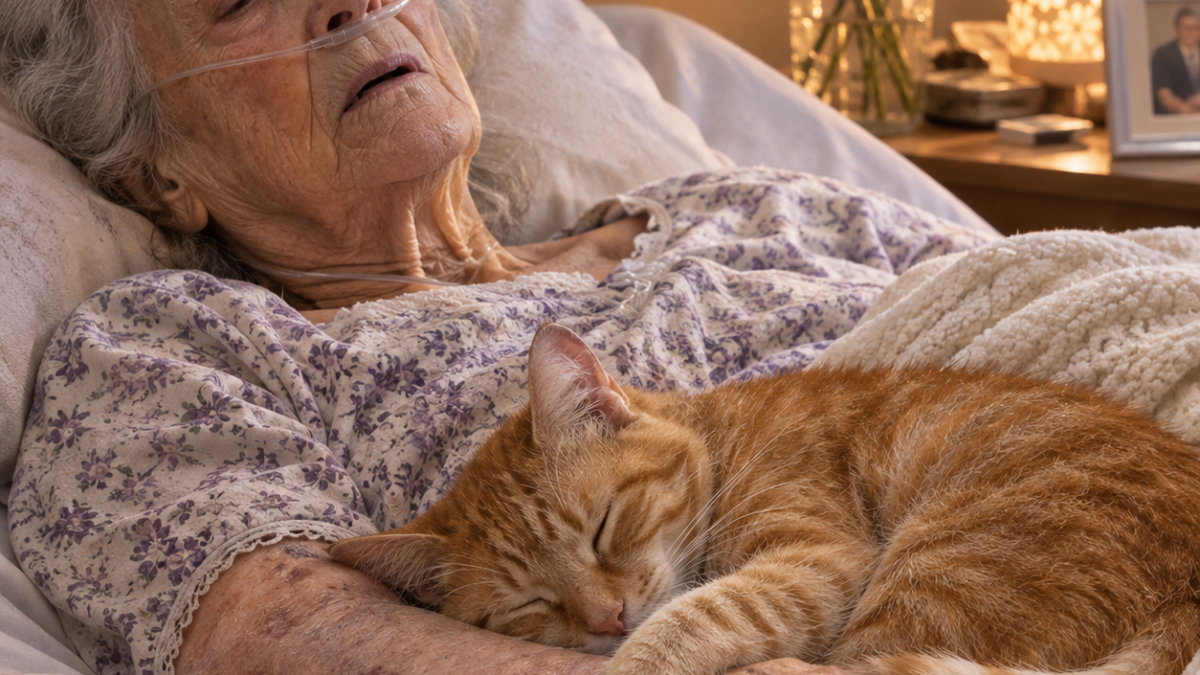
My Mother-in-Law Hadn’t Spoken in 9 Days—Then a Hospice Cat Climbed Beside Her and She Said One Word
For nine days, my eighty-four-year-old mother-in-law had not spoken, opened her eyes, squeezed a hand, or reacted to the voices of the children she had spent a lifetime raising—then a hospice nurse placed an orange therapy cat beside her arm, and Helen slowly turned her head and whispered, “Kitty.”
My wife spent the next hour crying because after days of telling her mother everything she still needed her to hear, the only word that seemed able to cross whatever distance now separated us was not a name, not “I love you,” and not “goodbye,” but the simplest word a child might use when seeing a cat for the first time.
Then, while searching through an old box of photographs that evening, Laura found a picture of her mother at three years old holding an orange kitten against her chest—and on the back, in Helen’s own handwriting from decades later, were six words that changed the way we understood what may have been the final word of her life.
The first thing hospice taught me was that dying has far less respect for schedules than the living do.
We wanted dates.
How long?
Days?
Weeks?
Could she make it to Sunday when our son came home from college?
Would she still know him?
Should Laura’s sister fly in now or wait until the weekend?
Would Helen be awake tomorrow morning?
Would she eat again?
Would she speak?
Every question we asked seemed to receive a version of the same answer.
Maybe.
Possibly.
We’ll watch.
Everyone is different.
The nurse, Rachel Bennett, never sounded evasive when she said those things.
She sounded experienced.
There was a difference.
Rachel was probably in her late forties, though exhaustion and kindness can both make age difficult to judge. She had dark hair she usually tied behind her head, comfortable shoes, and a habit of sitting down whenever she spoke to us about something important.
She never stood over Helen’s bed and discussed her as if she weren’t there.
Even after Helen stopped responding.
Especially then.
“Talk to her normally,” Rachel told us.
“We don’t know exactly what she can process. You don’t need to fill every second with words, but don’t assume silence means absence.”
That sentence became something I held onto.
Silence does not necessarily mean absence.
Helen Callahan had been receiving hospice care in our home for three weeks.
Technically, it was Laura’s home too.
We had been married twenty-six years.
But when Helen moved in, the guest bedroom stopped being a guest room and somehow became the center of the entire house.
Everything rotated around it.
Medication schedules.
Nurse visits.
Family calls.
Meals nobody finished.
Whispered conversations in the hallway.
The gentle machine sounds of oxygen at night.
PART2:
The front door opening for aides, social workers, clergy, relatives, neighbors, and people who said they only wanted to stay five minutes and then sat beside Helen for an hour because leaving felt too final.
Helen had been diagnosed with advanced heart failure complicated by kidney disease two years earlier.
She had managed longer than doctors initially expected.
That was typical Helen.
She considered medical predictions a personal challenge.
At eighty-three, she had told a cardiologist:
“If you’re going to tell me what month I’m dying, at least buy me dinner first.”
The cardiologist had laughed.
Laura had not.
Helen had looked at her daughter and said:
“Oh, stop making that face. I’m sick, not humorless.”
That was Helen.
Sharp.
Stubborn.
Particular.
She liked toast darker than most people considered edible.
She hated scented candles.
She believed every restaurant used too much salt except the ones that objectively used too much salt, which she loved.
She corrected grammar in television commercials.
She watched baseball but claimed she disliked sports.
PART3:
She kept twenty-seven reusable grocery bags and forgot every one of them whenever she went shopping.
If you asked whether she needed help, she would say no while actively requiring help.
A month before hospice, she had still been living in an assisted-living apartment twenty minutes away.
She complained about it constantly.
Not because it was bad.
Because it was not her house.
The carpet was “hotel carpet.”
The dining room coffee was “dishwater.”
The thermostat was controlled by “fascists.”
The activities director, whom Helen actually adored, was “that cheerful woman.”
Every time Laura visited, Helen asked:
“When am I going home?”
Laura would answer:
“Mom, this is home for now.”
Helen would say:
“No. This is where my furniture came to die.”
Then she would ask for chocolate pudding.
When her condition worsened, the hospital recommended hospice.
Helen refused the word the first time.
Not the service.
The word.
“Hospice sounds like everybody has given up.”
Rachel explained later that this fear was common.
Hospice did not mean abandoning care.
It meant changing the goal.
Comfort instead of cure.
Time at home instead of time spent chasing interventions that might no longer help.
Helen listened.
Then asked:
“Can I go to Laura’s?”
That was how she came to us.
The first week was difficult but still recognizably life.
Helen talked.
Complained.
Asked questions.
Demanded updates on everyone.
She knew exactly who came through the bedroom door.
Our daughter Emily sat beside her and painted her nails pale pink.
Helen inspected them and said:
“I look like a teenager.”
Emily asked:
“Is that bad?”
“At my age, no.”
Our son Jake drove in from Purdue for a Saturday.
Helen made him bend down so she could inspect his hair.
“You’re losing it.”
Jake laughed.
“I’m twenty-two.”
“Your grandfather started at nineteen.”
“Good genes.”
“Terrible genes.”
She held his face.
Then whispered:
“You look like him.”
My wife turned away.
Helen saw.
“Laura.”
“I’m fine.”
“You always say that before crying.”
“I’m not crying.”
“You married Daniel, so we know your judgment isn’t perfect.”
I raised my hand.
“Still in the room.”
Helen smiled.
That smile stayed with me because it was one of the last.
The decline came quickly after that.
First food.
A few bites.
Then only liquids.
Then less.
She slept more.
She stopped asking what day it was.
Stopped asking when she could go somewhere else.
Stopped complaining about the temperature.
That frightened Laura more than anything.
“Mom hasn’t complained in twelve hours.”
She tried to make it a joke.
It did not work.
Rachel adjusted medications.
Explained what we might see.
Changes in breathing.
Cooler hands and feet.
Longer sleep.
Less interest in food and water.
Periods of confusion.
Withdrawal.
“All normal?” I asked.
“Common,” she corrected.
“Normal is a dangerous word around death.”
I respected that answer.
Nine days before the cat came, Helen spoke for the last time—or what we assumed was the last time.
Laura was helping moisten her lips with a small sponge.
Helen’s eyes opened.
She looked irritated.
That was encouraging.
“What?”
Laura leaned close.
“What, Mom?”
Helen whispered:
“Too much.”
“Water?”
Tiny nod.
Laura laughed.
“Of course I’m doing hydration wrong.”
Helen’s mouth moved.
Laura leaned closer.
“What?”
Helen whispered:
“Bossy.”
Then she closed her eyes.
That was it.
At first we did not understand that it was it.
We assumed she was tired.
The next morning, she did not speak.
That afternoon, nothing.
The following day, nothing.
By day three, Laura was afraid to say the word unconscious because Helen did not seem fully unconscious.
Her eyes sometimes moved beneath the lids.
Her breathing changed occasionally when we repositioned her.
But she no longer responded to questions.
No hand squeeze.
No eye opening.
No turning toward voices.
Nothing.
We played Frank Sinatra.
Helen loved Sinatra.
Nothing.
Emily played the recording of Jake badly singing “Happy Birthday” at age six.
Nothing.
Laura told stories.
Nothing.
I tried baseball.
“Cubs won.”
No reaction.
“They beat the Cardinals.”
Nothing.
“By ten runs.”
I looked at Laura.
“If that doesn’t do it, we may be in trouble.”
She almost smiled.
Then cried.
The hardest thing was not knowing whether Helen heard us.
People said:
“Keep talking.”
So we did.
But talking to someone who does not answer creates a strange pressure.
You begin searching for important things to say.
As if ordinary conversation has become wasteful because time is short.
Laura sat beside her mother for hours.
She told her things I had never heard her say.
Some beautiful.
Some painful.
“I’m sorry I moved to Chicago after college.”
“I know you hated that.”
“You were right about Eric. He was terrible.”
“I’m sorry I blamed you when Dad died.”
“I know you were grieving too.”
“You were a good mom.”
“I know I didn’t always tell you.”
“You were difficult.”
“I think you knew that.”
“You made me crazy.”
“I’m going to miss you.”
“I don’t know how to do this without calling you.”
That last one destroyed me.
Because Laura was sixty-one.
A grandmother herself.
Competent in every imaginable way.
She had managed a medical practice for thirty years.
Raised two children.
Survived breast cancer.
Buried her father.
Helped me through my own mother’s stroke.
Yet sitting beside that bed, she looked twelve years old.
“I don’t know how to do this without calling you.”
Helen did not respond.
Laura squeezed her hand.
Nothing.
She pressed her forehead against her mother’s knuckles and cried silently.
I stood at the bedroom door because some grief belongs to a marriage and some belongs to a daughter.
I knew when I was invited into one and when I should remain outside the other.
By day six of silence, Laura began interpreting everything.
Her mother’s eyebrow moved.
Was that recognition?
Her breathing changed when Emily spoke.
Did she hear?
A finger twitched.
Was it intentional?
Rachel was careful.
“Maybe.”
Laura hated maybe.
“I just want to know if she knows we’re here.”
Rachel sat beside her.
“You’re here.”
“I know.”
“That part is certain.”
“But does she know?”
Rachel looked at Helen.
“I don’t know.”
Laura wiped her face angrily.
“That feels useless.”
“I know.”
Rachel paused.
“But presence does not become useless because we cannot prove it was received.”
That was another sentence I kept.
Presence does not become useless because we cannot prove it was received.
On day eight, a hospice chaplain came.
Helen had never been especially religious.
She described herself as “Catholic when convenient.”
But she liked Father Michael.
He had known her from the parish years earlier.
He stood beside the bed.
Prayed.
Then whispered something I did not hear.
No response.
When he left, he hugged Laura.
“She knows she is loved.”
Laura asked:
“How can you know?”
Father Michael smiled sadly.
“I can’t.”
Then:
“But you do.”
That night Laura barely slept.
At 2:13 a.m., I found her sitting on the kitchen floor.
Not chair.
Floor.
Back against the cabinets.
I sat beside her.
No questions.
After a while she said:
“What if the last thing she heard me say was something stupid?”
“You have said approximately thirty thousand words to her this week.”
“That’s not helpful.”
“Statistically, some were stupid.”
She laughed.
Then covered her face.
“I keep waiting for something.”
“What?”
“I don’t know.”
“One more look.”
“One more word.”
“One squeeze.”
“Anything.”
I took her hand.
“What if it doesn’t happen?”
She looked at me.
“That’s what I’m afraid of.”
I wanted to say:
Then it’s still okay.
But I could not.
Because it was easy for me to accept what was not my mother.
Instead:
“Then you were still here.”
She nodded.
We sat on the kitchen floor until four.
The next afternoon, Rachel arrived carrying her usual nursing bag and something unusual.
A small fabric carrier.
Laura noticed immediately.
“What’s that?”
Rachel smiled.
“I wanted to ask first.”
“Ask what?”
“We have an animal-assisted visitation program.”
I raised an eyebrow.
“Dogs?”
“Dogs mostly.”
She placed the carrier on a chair.
“And Oliver.”
Something moved inside.
Laura looked at her mother.
Then at the carrier.
“A cat?”
“Orange tabby.”
“Certified therapy animal.”
“He belongs to one of our hospice volunteers.”
“He’s been doing visits for four years.”
I smiled.
“Certified cat sounds contradictory.”
Rachel laughed softly.
“Oliver would agree.”
Laura looked uncertain.
“Mom never had a cat.”
At least that was what she believed then.
Rachel nodded.
“We don’t have to.”
“What’s the point?”
“Comfort, maybe.”
“Warmth.”
“Touch.”
“A different kind of stimulation.”
She chose her words carefully.
“Sometimes patients who don’t seem to respond to us react to animals.”
“Sometimes they don’t.”
“I cannot promise anything.”
Laura looked at Helen.
“Would it bother her?”
“I wouldn’t place him there if I thought it would.”
“Does he just sit?”
“Mostly.”
I said:
“He has mastered hospice care.”
Rachel smiled.
“Honestly? Better than many humans.”
Laura was quiet for a long time.
Then:
“Okay.”
Rachel opened the carrier.
Oliver emerged.
Large orange tabby.
White chin.
Broad face.
Thick tail.
He wore a simple blue therapy vest.
No tricks.
No dramatic entrance.
He stepped onto the floor.
Looked around.
Sniffed Rachel’s pant leg.
Then jumped onto the chair.
Laura whispered:
“He’s huge.”
“Seventeen pounds.”
“He’s not fat.”
Rachel said this defensively.
“He’s structurally generous.”
I laughed.
It felt good.
The first real laugh in the room in days.
Rachel removed Oliver’s vest.
Lifted him carefully.
Placed him on the bed beside Helen’s left arm.
Oliver stood for a moment.
Sniffed the blanket.
Sniffed Helen’s hand.
Then turned twice and settled against the outside of her forearm.
Warm orange body against thin human arm.
He began purring.
Loud.
Ridiculously loud.
The sound filled the room.
Laura sat on the opposite side of the bed.
Held Helen’s other hand.
I stood near the dresser.
Rachel remained by the door.
For the first minute, nothing happened.
Of course.
Why would it?
Oliver purred.
Helen breathed.
Second minute.
Nothing.
Third.
Oliver shifted.
Pressed closer.
His side rose and fell.
Helen remained still.
At some point I stopped expecting anything.
That mattered.
We were no longer waiting for proof.
The room became simply:
Old woman.
Cat.
Daughter.
Son-in-law.
Nurse.
Afternoon light.
Purring.
Five minutes passed.
Maybe more.
Then Helen’s eyes opened.
I saw it first.
Not fully.
Halfway.
Cloudy blue-gray eyes.
I stopped breathing.
“Laura.”
My wife looked up.
Her mother’s head moved.
Slowly.
It was the first voluntary movement we had seen in days.
Not random muscle twitching.
A turn.
Toward Oliver.
Laura gripped my arm.
Hard.
Hard enough that later I had four small crescent-shaped marks where her fingernails pressed through my sleeve.
Helen looked at the cat.
Oliver kept purring.
He did not lift his head.
He did not perform.
He simply existed beside her.
Helen’s lips moved.
Laura leaned closer.
“Mom?”
Nothing.
Then again.
A sound.
So faint I thought I imagined it.
Laura whispered:
“What did she say?”
Helen’s lips moved.
This time all of us heard.
“Kitty.”
Clear.
Soft.
One word.
Kitty.
Laura’s hand flew to her mouth.
Rachel became completely still.
I felt something inside my chest drop.
Not break.
Drop.
Like gravity changed.
Helen continued looking at Oliver.
Five seconds.
Maybe ten.
Her face softened.
I do not know if that is objective memory or something I have added after the fact.
Her eyes simply seemed less tense.
Then they closed.
Her head settled back.
Oliver purred.
Helen did not speak again.
Laura whispered:
“Mom?”
Nothing.
“Mom?”
Rachel touched Laura’s shoulder.
Not stopping her.
Grounding her.
Laura began crying.
Not loud.
At first.
Then she folded over her mother’s hand.
“Kitty?”
She laughed through sobs.
“Seriously, Mom?”
I sat beside her.
She looked at me.
“Kitty.”
“I heard.”
“Nine days.”
“I know.”
“I’ve told her I love her a hundred times.”
“I know.”
“I told her everything.”
“I know.”
“And she says kitty.”
That was when we both started laughing.
Not because it was funny.
Because grief does strange things to the body.
Laura pressed her forehead against Helen’s hand.
“Oh, Mom.”
Oliver lifted his head.
Looked at us.
Then lowered it again.
Rachel remained near the doorway.
Later, Laura asked:
“Why didn’t you say anything?”
Rachel answered:
“I didn’t want my voice to become part of the moment.”
That was exactly right.
Oliver stayed twenty more minutes.
Helen did not open her eyes again.
No more words.
No hand movement.
Nothing.
But her left hand had relaxed.
The fingers, usually curled tightly inward, were slightly open beside Oliver’s fur.
I took a photograph.
I hesitated before doing it.
The entire culture of photographing everything sometimes feels obscene around death.
But Laura nodded.
So I took one.
No faces.
Helen’s hand.
Oliver.
Blanket.
That was all.
Rachel eventually lifted him.
Oliver stretched.
Then, before leaving, he leaned toward Helen and sniffed her fingers.
Rachel placed him back in the carrier.
Laura touched the top of it.
“Thank you, Oliver.”
He meowed.
That almost broke her again.
After Rachel left, the house became quiet.
Laura kept repeating the word.
“Kitty.”
Not obsessively.
Like testing it.
Trying to understand its weight.
At dinner she barely ate.
Then suddenly said:
“Mom didn’t even like cats.”
I looked up.
“Are you sure?”
“She always said she was a dog person.”
“People lie.”
“She never had one.”
“You sure?”
“Yes.”
Then:
“I think.”
Grief had turned the word into a mystery.
Why that?
Why now?
Was it because the word was simple?
Was the cat warm?
Did the vibration of purring reach her differently?
Did she smell him?
Did she see orange?
Did some childhood memory surface?
Did she merely recognize an animal and name it?
Was it random?
The human brain hates randomness when time is short.
We want last words to contain a code.
A final lesson.
A secret.
I told Laura:
“We may never know.”
She glared.
“I hate you.”
“Fair.”
She stood.
“I’m going through Mom’s things.”
“Tonight?”
“Yes.”
“Why?”
“I don’t know.”
That answer was enough.
Helen had arrived with surprisingly little.
Clothes.
Toiletries.
Medical paperwork.
One jewelry case.
Two photo boxes Laura brought from the assisted-living apartment because Helen had insisted important photographs were inside.
They had remained in our hall closet.
Laura carried both to the dining table.
I made coffee.
She opened the first box.
Old photographs have a smell.
Dust.
Paper.
Closets.
A little sweetness.
Laura sorted.
Her parents’ wedding.
Helen holding newborn Laura.
Christmas 1972.
Beach trip.
School pictures.
Laura’s sister Susan in braces.
Helen’s husband George standing beside a Pontiac.
Nothing.
Second box.
Older photographs.
Black-and-white.
Helen as a child.
Her parents.
People Laura could not identify.
Then she stopped.
“Daniel.”
I looked over.
She held a small black-and-white photograph.
A little girl sitting on wooden porch steps.
Curly hair.
Maybe three.
Maybe four.
Dress with puffed sleeves.
In her arms:
A kitten.
Not just any kitten.
Even in black-and-white, you could tell it was light-colored with faint tabby stripes.
Laura turned it over.
Handwriting.
Faded blue ink.
Not written when the photograph was taken.
Helen’s adult handwriting.
Laura read aloud:
“Me and Marmalade. 1945.”
She stared at me.
“Marmalade.”
“Orange?”
“Obviously.”
There was another line below.
Smaller.
Almost missed.
Laura moved closer to the light.
“What?”
I asked.
She read:
“My first friend after we moved.”
Silence.
Then she found the six words.
Written beneath that.
“He always slept when I cried.”
Laura sat down.
Hard.
“Oh.”
I took the photograph.
Tiny Helen.
Orange kitten.
The image looked ordinary.
That made it stronger.
No one knew while taking it that eighty years later an orange cat would lie beside her hospice bed and pull one word across nine days of silence.
Laura pressed both hands over her face.
“She had a cat.”
“Yes.”
“She had a cat.”
“Apparently.”
“She never told me.”
“Maybe she did.”
“What?”
“You know your mother.”
“She told stories fifteen times.”
“She also forgot which ones she told.”
Laura laughed.
Then started crying again.
“She was three.”
“Maybe four.”
“The same word.”
“What?”
“Kitty.”
She looked at me.
“That’s what a little kid would say.”
I understood.
First words.
Final words.
Same simple vocabulary.
Eighty years apart.
I wanted to be careful.
I said:
“That doesn’t prove she was remembering Marmalade.”
Laura nodded.
“I know.”
“The brain—”
“Don’t explain my mother to me.”
“I wasn’t.”
“You were about to.”
“Yes.”
“Don’t.”
“Okay.”
She held the photograph.
“I don’t need it to be scientific.”
That sentence mattered too.
She was not claiming Oliver unlocked a hidden eighty-year-old memory.
She was not claiming her mother traveled backward in time.
She simply found comfort in the possibility that the sight of an orange cat touched something familiar and old.
That was enough.
Later that evening, Rachel called to check on Helen.
Laura told her about the photograph.
Rachel listened.
Then said:
“That’s beautiful.”
Laura asked:
“Do you think she remembered?”
Rachel paused.
“I think we should be careful about pretending we know.”
Exactly the answer I expected.
Laura sighed.
“I know.”
Rachel continued:
“But simple words and deeply familiar associations can sometimes surface when more complex communication is no longer possible.”
“So maybe?”
“Maybe.”
Laura laughed.
“You people love that word.”
“We have to.”
Then Rachel softened.
“Whatever happened in her brain, she looked at Oliver.”
“She opened her eyes.”
“She used a word correctly.”
“You heard it.”
“That moment belongs to you even if we never explain it.”
Laura looked at the photograph again.
“Thank you.”
That night, she placed the photograph beside Helen’s bed.
Not because she thought Helen could see it.
Because Laura needed it there.
She sat beside her mother.
“Mom.”
No response.
“I found Marmalade.”
Nothing.
“You never told me about him.”
Nothing.
“Or maybe you did and I wasn’t listening.”
Laura smiled.
“You’d like that possibility.”
Still nothing.
“He was cute.”
Helen breathed slowly.
“Oliver was orange too.”
Laura touched her mother’s hand.
“You said kitty.”
No response.
“I heard you.”
That was when Laura changed.
Before Oliver, she had been begging for response.
One more word.
One more look.
One more squeeze.
After Oliver, she stopped asking.
Not because one word satisfied everything.
Nothing could.
But because she no longer felt the last nine days were a wall she had to break through.
Something had crossed once.
That made silence less cruel.
The next morning, Helen’s breathing changed.
Rachel came early.
She listened.
Checked pulse.
Looked at us.
“Call anyone who needs to come.”
The sentence landed like a physical object.
Laura called Susan.
She was already driving from Cincinnati.
Jake left Purdue.
Emily came from across town.
Father Michael stopped by.
The room filled.
Not crowded.
Held.
Helen did not wake.
Susan arrived at 11:30.
She leaned over her mother.
“Seriously?”
Everyone looked.
Susan laughed through tears.
“You said kitty?”
Laura nodded.
Susan looked at the photograph on the nightstand.
“Marmalade.”
Laura turned.
“You knew?”
“Of course.”
“What?”
“Mom talked about that cat all the time.”
Laura stared.
“She never told me.”
“Yes, she did.”
“No.”
“She did.”
“When?”
“Every time we drove past Grandma’s old street.”
Laura looked offended.
“You knew this all night and never told me?”
“I got your text at six this morning.”
“What text?”
Laura checked her phone.
She had sent Susan only:
Mom spoke yesterday. One word. Call me when awake.
Susan sat.
“You said one word.”
“You didn’t say cat.”
Laura handed her the photo.
Susan smiled.
“Oh my God.”
“What do you remember?”
Susan looked at Helen.
Then back at us.
“Mom was four when Grandpa moved the family from West Virginia to Pennsylvania.”
“She hated it.”
“Wouldn’t talk to anybody.”
“Sound familiar?”
Laura almost smiled.
“She found a kitten under the porch.”
“Marmalade.”
“Yes.”
“Grandma hated animals in the house.”
“She let Mom keep him because Mom wouldn’t eat.”
Laura stared.
“Seriously?”
“That’s how Mom told it.”
“She said Marmalade slept on her bed.”
“When she had nightmares, he climbed onto her chest.”
“He died when she was twelve.”
Susan touched the picture.
“Mom said it was the first time she understood something could disappear even if you loved it.”
That sentence silenced the room.
Laura whispered:
“She told you that?”
“Many times.”
“I don’t remember.”
Susan shrugged.
“You remembered everything about Dad.”
“I remembered everything about Mom before Dad.”
Sisters.
Different mothers from the same woman.
Different stories.
Different archives.
That happens in families.
One person remembers the recipes.
Another remembers the arguments.
One remembers the cat.
Another remembers the funeral.
No one possesses the complete version of somebody else.
Even children.
Especially children.
Jake arrived at two.
He leaned over Helen.
“Hi, Grandma.”
No response.
“I heard you saved all your energy for a cat.”
Laura laughed.
Helen remained still.
Jake touched her forehead.
“I love you.”
He sat.
Emily arrived twenty minutes later.
She brought another photograph she had printed from Laura’s phone.
Oliver beside Helen’s hand.
She placed it next to Marmalade.
Orange cat in 1945.
Orange cat in 2026.
Helen between them in time.
It could have become sentimental enough to feel false.
Somehow it did not.
Maybe because nobody claimed magic.
Oliver had not cured her.
He had not reversed dying.
Helen did not become alert.
She did not say everyone’s names.
She did not deliver final wisdom.
She said one word.
Then continued dying.
That limitation made the moment more sacred, not less.
At 3:00, Rachel returned.
Susan asked if Oliver could come again.
Rachel hesitated.
“Maybe.”
“Would that be okay?”
“Yes.”
“Does he have other visits?”
Rachel almost smiled.
“He’s a working professional.”
Susan laughed.
“I like him already.”
Rachel made a call.
Oliver arrived an hour later with his volunteer handler, a retired teacher named Carol Ames.
Carol apologized.
“He was sleeping.”
“That feels on brand.”
Oliver looked less impressed than the day before.
He wore his blue vest.
Carol removed it.
Placed him on the bed.
This time Helen did not open her eyes.
No word.
No movement.
Oliver settled against her legs.
Purr.
Laura watched.
For ten minutes.
Twenty.
Nothing.
Susan whispered:
“Come on, Mom.”
Laura touched her arm.
“No.”
Susan looked at her.
Laura shook her head.
“She doesn’t owe us another one.”
That was the sentence I remember most from that afternoon.
She doesn’t owe us another one.
Helen had already spent eighty-four years talking.
Answering.
Explaining.
Arguing.
Apologizing.
Correcting.
Comforting.
Calling.
Mothering.
She did not owe anyone a final performance.
Not a meaningful phrase.
Not “I love you.”
Not goodbye.
Not even another kitty.
She could be silent.
We could still stay.
Oliver remained for thirty minutes.
Then left.
Helen’s breathing changed again after sunset.
Longer pauses.
Rachel explained what we were hearing.
Laura sat on one side.
Susan the other.
I stood near the foot.
Emily and Jake took turns.
Father Michael returned.
At 9:40, everyone except immediate family left.
At 10:15, Helen’s hands became cooler.
At 11:02, Laura began telling childhood stories.
Not because she expected a response.
Because they had stopped needing response.
“Remember when you made me wear that green dress to Susan’s wedding?”
Susan laughed.
“You looked like a curtain.”
“I know.”
“You chose it.”
“Mom chose it.”
“I thought it was beautiful.”
“Because you were nine.”
They laughed.
Helen breathed.
Jake told the story about Helen insulting his first girlfriend accidentally.
“It wasn’t accidental.”
Laura said.
“Grandma said she had ‘a loud personality.’”
Susan laughed.
“That was deliberate.”
Helen breathed.
Emily played Sinatra quietly.
Not as a test.
Just music.
At 12:21, Laura picked up the Marmalade photograph.
“Do you think this is stupid?”
“No.”
I answered.
“What?”
“Whatever you’re about to do.”
She placed the photograph beside Helen’s hand.
Then whispered:
“Mom, if you see a cat wherever you’re going, I hope he’s nicer than the ones you pretended not to like.”
Susan said:
“She loved cats.”
Laura smiled.
“She lied for sixty years.”
Susan corrected:
“She loved individual cats and disliked the species.”
“That sounds like her.”
At 1:08 a.m., Helen took a breath.
Then another.
Then a long pause.
We all looked at Rachel, who had returned around midnight.
She did not move.
Helen breathed again.
At 1:12, another pause.
Longer.
Laura held her hand.
“Mom.”
No begging.
Just the word.
Mom.
Helen’s final breath came at 1:14.
Quiet.
No dramatic struggle.
No open eyes.
No final words.
The last word had come the day before.
Kitty.
Rachel checked gently.
Waited.
Then looked at Laura.
“I’m sorry.”
Laura closed her eyes.
Susan cried first.
Then everyone.
There is no graceful way for a family to become one person smaller.
We stayed in the room.
That surprised me.
I had imagined death would create an urge to leave.
Instead nobody wanted Helen alone.
Not even after she was no longer, medically speaking, there.
Emily brushed her hair.
Susan folded the blanket.
Jake stood at the window.
Laura kept holding Helen’s hand.
At some point she looked at me.
“Kitty.”
I laughed through tears.
“Kitty.”
“Of course.”
“Of course.”
That was not mockery.
It was recognition.
Helen had spent her entire life refusing the ending other people would have written for her.
A conventional final word?
Absolutely not.
A beautiful goodbye?
Too obvious.
Her daughter’s name?
Expected.
Helen apparently preferred:
Kitty.
When the funeral home came, Laura slipped the Marmalade photograph into her mother’s hand.
Then stopped.
“Wait.”
She took it back.
I looked at her.
“I want this.”
“Good.”
She kissed Helen’s forehead.
“I’m keeping your cat.”
The funeral was three days later.
The priest mentioned Helen’s years as a school secretary.
Her marriage to George.
Her daughters.
Grandchildren.
Great-grandson.
Volunteer work.
He did not mention Oliver.
Laura did.
During the family remembrance.
She stood at the lectern holding the old photograph.
Her hands shook.
“My mother’s last word was not profound.”
People smiled.
“She did not tell us the secret of life.”
“She did not say goodbye.”
“She did not call any of us by name.”
“She looked at a seventeen-pound orange hospice cat and said, ‘Kitty.’”
Laughter.
Gentle.
Grateful.
Laura continued.
“And for about an hour, I was offended.”
More laughter.
“I had spent nine days saying everything.”
“I love you.”
“Thank you.”
“I’m sorry.”
“I’m going to miss you.”
“I thought perhaps, if she came back to us for one second, she might give us something equally important.”
Laura looked at the photograph.
“Then my sister reminded me that when Mom was four years old and frightened in a new town, she had an orange kitten named Marmalade.”
“She said Mom used to tell her that he slept beside her whenever she cried.”
Her voice broke.
“So maybe Mom remembered him.”
“Maybe she didn’t.”
“We’ll never know.”
“But when another orange cat lay beside her eighty years later, something reached her.”
“She opened her eyes.”
“She looked.”
“She said one word.”
Laura paused.
“I spent most of my life believing communication had to be complicated to be meaningful.”
“My mother spent her last days teaching me the opposite.”
Nobody moved.
Laura continued:
“Sometimes love is a sentence.”
“Sometimes it’s a hand squeeze.”
“Sometimes it’s staying beside somebody who can no longer answer.”
“And sometimes, apparently, it’s just kitty.”
That was Helen’s funeral.
Afterward, people told their own animal stories.
An aunt remembered Helen feeding a stray behind the office where she worked.
A cousin said Helen once drove twenty miles because she saw a dog running beside a highway.
A former neighbor said she had fed their cat every afternoon for six years and complained every single time.
“Your mother said she didn’t like cats.”
Laura laughed.
“She was committed to the lie.”
The contradiction pleased her.
Grief needs new information sometimes.
It gives you somewhere to go besides the empty place.
The hospice program sent a sympathy card.
Rachel signed.
Carol signed.
There was even an ink paw print from Oliver.
Probably arranged by humans.
Still effective.
Laura framed it.
Beside the photo of Marmalade.
Beside the photograph I took of Oliver next to Helen’s hand.
Three images.
Childhood.
Dying.
And the strange bridge between them.
For weeks afterward, Laura woke at the hours she used to check on Helen.
2:00.
4:30.
6:00.
Her body had learned vigilance.
The guest room remained mostly untouched.
Hospice equipment disappeared quickly.
That was shocking.
Within hours of Helen’s death, a company came for the oxygen equipment.
The bed remained a few days.
Then it too was gone.
Suddenly the room looked like a guest room again.
Laura stood in the doorway.
“I hate that.”
“What?”
“It looks normal.”
I understood.
When suffering ends, the room sometimes looks innocent.
As if nothing happened.
We kept Helen’s chair.
Not the medical things.
The old upholstered chair from her assisted-living apartment.
It sat near the window.
For two months, nobody used it.
Then our granddaughter climbed into it during a visit and ate crackers.
Laura watched.
I thought she might stop her.
Instead she smiled.
Life returning to furniture.
That is what grief eventually asks.
Not forgetting.
Reuse.
Months later, Rachel called.
Not as a nurse.
She had a question.
“Our hospice foundation is expanding animal-assisted visits.”
“Okay.”
“Laura mentioned she might want to do something in Helen’s memory.”
I looked at my wife.
She was across the room.
“What kind of something?”
“We’re raising money for training, transport, veterinary screening, insurance.”
“Oliver has administrative overhead?”
“Oliver is a professional.”
I laughed.
Laura took the phone.
“What do you need?”
That became the Helen Callahan Comfort Animal Fund.
Laura hated the name at first.
“Too grand.”
Rachel said:
“It bought gas cards for volunteers.”
“Fine.”
“It paid for one dog’s updated certification.”
“Fine.”
“It helped cover veterinary costs for a therapy rabbit.”
Laura paused.
“A rabbit?”
“Yes.”
“What does a hospice rabbit do?”
“Mostly sits.”
“So same as Oliver.”
“Exactly.”
The fund stayed small.
That mattered to Laura.
She did not want a foundation with galas and brochures bearing Helen’s face.
Just practical support.
Animals reaching rooms where perhaps words no longer could.
The first year raised a little over six thousand dollars.
Enough.
One evening, nearly a year after Helen died, Laura and I attended the hospice volunteer appreciation dinner.
Oliver was there.
Older.
Still enormous.
Still orange.
He sat in a padded carrier beside Carol.
Laura crouched.
“Do you remember us?”
I said:
“He’s a cat.”
“Let me have this.”
Oliver stepped out.
Sniffed Laura’s hand.
Then pressed his forehead into her fingers.
Laura froze.
Not because she believed he remembered Helen.
Because the sensation itself was familiar.
She sat on the floor.
Oliver climbed partly into her lap.
Carol laughed.
“He usually doesn’t do that.”
I gave her a look.
“Don’t say things like that to grieving people.”
She smiled.
“Fair.”
Laura scratched beneath Oliver’s chin.
“You got one word.”
Oliver purred.
“That’s all she gave you.”
Purr.
“I talked to her for sixty-one years.”
Purr.
“She was impossible.”
Oliver closed his eyes.
Laura laughed.
Then cried.
Not the old way.
Grief had changed shape by then.
Less like drowning.
More like weather.
Still capable of arriving suddenly.
But no longer the only climate.
On the drive home, Laura said:
“I used to hate that she didn’t say my name.”
I looked over.
“When?”
“After.”
“I didn’t tell you.”
“I figured.”
“I know it’s ridiculous.”
“No.”
“I wanted one last thing that was mine.”
That sentence was honest enough to hurt.
“I wanted her to say Laura.”
“Or ‘love you.’”
“Something.”
“I kept thinking a cat got her last word.”
I waited.
“What changed?”
Laura looked out the window.
“She didn’t owe me her last word.”
I remembered the bedside.
She doesn’t owe us another one.
Laura continued:
“I got sixty-one years.”
“Marmalade got one word.”
I smiled.
“Oliver.”
“Whatever.”
We laughed.
Then she said:
“And maybe it wasn’t for the cat.”
“What do you mean?”
“Maybe it was just what she could reach.”
One word.
A shape.
A category.
Something simple.
“I spent months trying to make it mean something bigger.”
“And?”
“It was already big.”
That was the final lesson.
Not everything requires hidden symbolism.
A dying woman opened her eyes.
Saw an animal.
Named it.
That was extraordinary enough.
We did eventually learn more about Marmalade.
Susan found an old journal after sorting boxes from Helen’s storage unit.
Not a diary exactly.
School notebooks Helen had kept as a teenager.
One page mentioned the cat.
April 1954.
Marmalade died today. Dad buried him behind the lilacs. I cried so hard Mother let me stay home. I told him all my secrets because he never corrected me.
Laura read that line three times.
“I told him all my secrets because he never corrected me.”
She smiled.
“Mom needed that.”
“Everyone does.”
“She corrected everybody.”
“Exactly why she needed a cat.”
The journal also proved something useful.
Marmalade had not been some perfect mythical companion.
He scratched furniture.
Killed a bird.
Vomited on Helen’s bed.
Stole bacon.
A cat.
Real.
That made the story better.
Helen’s childhood comfort had not been symbolic either.
It had fur.
Bad behavior.
A name.
A warm body beside a crying child.
Eighty years later, Oliver had done almost exactly the same thing without knowing anything about her.
Warm body.
Purr.
Presence.
No correction.
No demand.
No questions.
Maybe that was why animals sometimes reach people differently near the end.
Not because they possess supernatural access.
Because they ask almost nothing.
Humans enter a hospice room carrying history.
Fear.
Need.
Language.
Unfinished conversations.
We lean over the bed wanting something.
Recognition.
Forgiveness.
A sign.
A cat lies down.
That is all.
No question.
No expectation.
Just warmth.
I began volunteering with hospice two years after Helen died.
Not as a nurse.
I am not qualified.
I drive equipment occasionally.
Sit with patients whose families need a break.
Deliver supplies.
Once, Rachel asked me to accompany Carol and Oliver to a visit because she needed help transporting things.
The patient was a seventy-nine-year-old man named Walter.
Advanced dementia.
He shouted when strangers approached.
Oliver entered.
Walter stared.
Then said:
“Fat.”
Carol burst out laughing.
The man smiled.
His daughter cried.
One word again.
Not profound.
Perfect.
I thought of Helen.
After the visit, I told Carol:
“Maybe Oliver’s real certification is making dying people insult him.”
She said:
“He has range.”
Oliver looked unconcerned.
I learned not every animal visit produced something dramatic.
Most didn’t.
Sometimes the cat slept.
Sometimes the patient ignored him.
Sometimes family members got more comfort than the patient.
That was fine.
The program never promised miracles.
That mattered to me.
I hated when people retold Helen’s story online and changed it.
“The cat woke a dying woman.”
No.
Helen did not wake.
Not really.
“A therapy cat restored her speech.”
No.
One word.
“Cat brings woman back from coma.”
Absolutely not.
That language cheapened both hospice and the moment.
Helen was dying.
Oliver did not reverse that.
He sat beside her.
She responded briefly.
Then she continued dying.
The beauty was not that death had been defeated.
The beauty was that connection appeared inside it.
Those are different stories.
One is fantasy.
The other is enough.
On the second anniversary of Helen’s death, our granddaughter Sophie was two.
Laura showed her the old Marmalade photograph.
“Who’s that?”
Sophie pointed.
“Kitty.”
Laura froze.
I saw it happen.
Same word.
Two-year-old.
Eighty-four-year-old.
Same simple sound.
Laura laughed.
Then kissed Sophie’s hair.
“Yes.”
“Kitty.”
Sophie pointed again.
“Kitty.”
Laura looked at me over her head.
“The same word.”
I nodded.
The same word, separated by more than eighty years.
Maybe that had been what hurt and healed Laura most.
At the beginning of life, language narrows toward simplicity because complexity has not arrived yet.
At the end, sometimes complexity falls away.
Names.
Stories.
Dates.
Explanations.
The sophisticated architecture of a lifetime may become inaccessible.
What remains can be small.
Light.
Warmth.
A familiar face.
A cat.
Kitty.
There was humility in that.
Helen had spent eighty-four years accumulating language.
Arguments.
Opinions.
Recipes.
Phone numbers.
Stories.
Sarcasm.
Advice nobody requested.
Entire decades of words.
Then one of the final things she offered the world was a word learned near the beginning.
We used to think that made it sad.
Now I think it made it complete.
Not in a mystical sense.
Life rarely ties itself into a neat bow.
But emotionally?
Yes.
There was something complete about it.
A little girl once held an orange kitten after moving to a place that did not feel like home.
The kitten slept beside her when she cried.
Eighty years passed.
The little girl became a woman.
Wife.
Mother.
Widow.
Grandmother.
Great-grandmother.
She lost parents.
A husband.
Friends.
Mobility.
Independence.
Speech.
Then another orange cat rested beside her.
For five seconds, perhaps, she noticed.
“Kitty.”
That was enough.
Not because it told us everything.
Because it told us she was still somewhere inside that body at that exact moment.
We were there.
We heard her.
Laura heard her.
That became a gift no one had promised.
Today, the photograph of Helen and Marmalade hangs in our hallway.
Beside it is the photograph of Oliver next to Helen’s hand.
People sometimes ask why we framed a picture that does not show Helen’s face.
Laura answers:
“Because her hand was relaxed.”
That is what she remembers.
Not the word first.
The hand.
For days, Helen’s fingers had been curled.
Tense.
After Oliver settled beside her, the hand opened slightly.
Maybe medication.
Maybe relaxation.
Maybe coincidence.
Maybe warmth.
We do not know.
We stopped needing to.
The photograph is enough.
The word is enough.
Her sixty-one years of motherhood are enough.
Her eighty-four years are enough.
Some evenings, Laura still talks to her.
Not literally expecting answers.
She’ll burn toast and say:
“Mom would approve.”
Or see a badly parked car and say:
“Mom would have written a note.”
Once we passed an orange cat sitting in a window.
Laura pointed.
“Look.”
I said:
“Kitty.”
She shoved my arm.
Then laughed until she cried.
That is grief now.
Love with interruptions.
Laughter with memory inside.
The silence Helen left behind is still real.
There are moments Laura reaches for her phone because something happens and instinct says:
Call Mom.
Then remembers.
But she no longer thinks of Helen’s last nine silent days as empty.
That changed because of one afternoon.
One cat.
One word.
Before Oliver, we thought nothing was reaching Helen.
Afterward, we understood that we could never have known that for certain.
Maybe our voices reached her.
Maybe Sinatra did.
Maybe the handholding did.
Maybe none of it did.
But we had stayed.
That mattered whether she could prove it or not.
And when something finally did produce a visible response, it was not because our love had failed and the cat succeeded.
That distinction took Laura months to accept.
Oliver was not more important than us.
He was simply different.
Different texture.
Different warmth.
Different movement.
No family history attached.
No grief in his voice.
No need from Helen.
He arrived without asking her to recognize anyone.
He lay down.
Purrrred.
And for one tiny moment, Helen found a word.
My mother-in-law’s final word was not goodbye.
It was not Laura.
Not Susan.
Not Daniel.
Not Jesus.
Not home.
It was not profound enough for a movie script.
It was better than that.
It was true.
A cat was beside her.
She saw him.
She said:
“Kitty.”
Then she closed her eyes.
Twenty-two hours later, she died surrounded by the family she had spent a lifetime loving.
And when people ask Laura whether she wishes her mother had said something else at the end, she no longer hesitates.
“No.”
Then she smiles.
“Mom gave us eighty-four years of words.”
“She was allowed to spend the last one on a cat.”








