My Mom Makes $14 an Hour Cleaning Offices at Night—Then She Spent $400 on a Stray Cat Because “He Looked at Me.”
PART3:
Mostly empty at night except for a handful of cars belonging to people working late.
Mom had gone downstairs to take trash to a service area when she noticed movement beneath a parked SUV.
At first, she thought it was a plastic bag.
Then she saw eyes.
Young cat.
Orange and white.
Very thin.
Crouched beneath the vehicle.
One rear leg stretched strangely behind him.
She said:
“He keeps trying to stand up, but he can’t.”
I asked:
“Is he bleeding?”
“No.”
“Can you get close?”
“I already did.”
Of course she had.
“What did you do?”
“I gave him my sandwich.”
I closed my eyes.
“Your dinner?”
“I have the apple.”
“Mom.”
“What?”
“You’ve got six hours left.”
“I’m not going to starve.”
She had torn pieces from the sandwich and placed them near the car.
Turkey.
Cheese.
Bread.
The cat hesitated at first.
Then crawled forward.
Not walked.
Crawled.
Dragging his left back leg.
He ate every piece.
Then looked at her.
That was the moment.
Mom sent me a photograph.
I still have it.
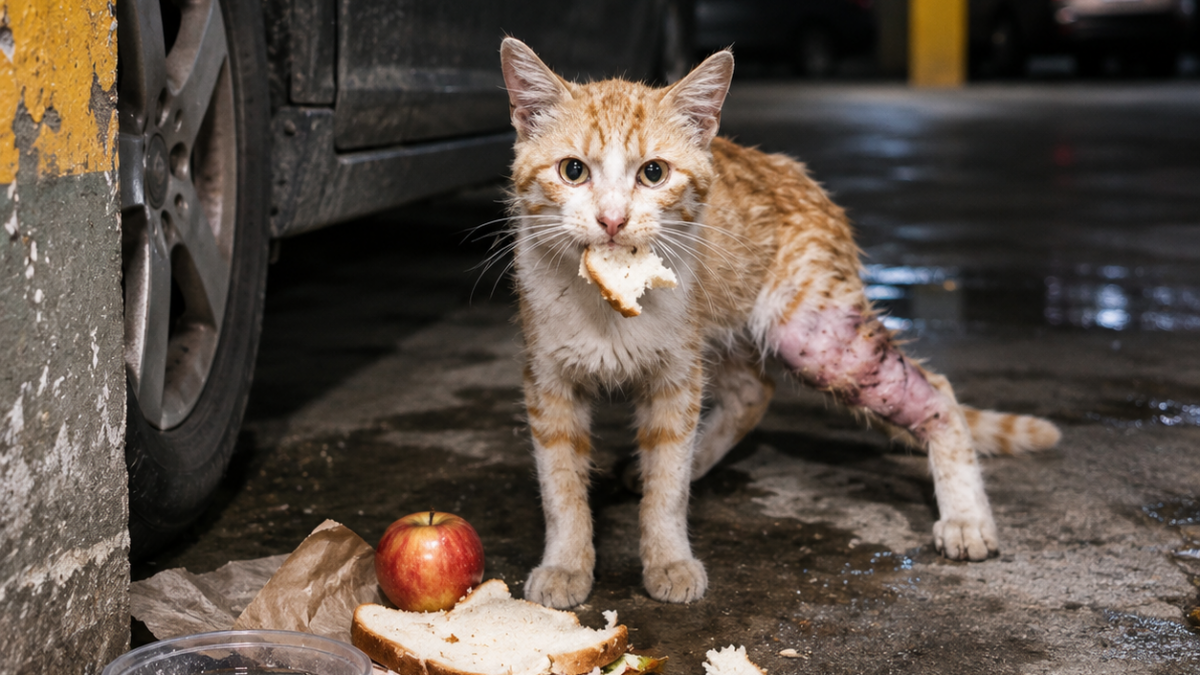
The garage floor is gray concrete.
The only light comes from her phone and the overhead fluorescents.
You can see the underside of a parked car.
Then the cat.
Orange-and-white fur.
Skinny shoulders.
One rear leg visibly swollen and angled wrong.
Half of my mother’s sandwich on the ground in front of him.
And those eyes.
Wide.
Fixed directly on the camera.
Or more accurately, on the person holding it.
My mother.
He didn’t look wild.
He didn’t look aggressive.
He looked tired.
Hungry.
And completely focused on the first person who had stopped.
I called her.
“Mom, don’t do anything expensive.”
She was silent.
I knew that silence.
“Mom.”
“What?”
“You can’t afford an emergency vet bill right now.”
“I know.”
“You just paid the car insurance.”
“I know.”
“And rent went up.”
“I know.”
She sounded annoyed now.
Then:
“But look at his leg.”
“I am.”
“He can’t walk.”
“I know.”
“What am I supposed to do?”
That question.
At the time, I thought it was rhetorical.
It wasn’t.
She genuinely wanted to know what alternative I thought existed.
Leave him?
Walk away?
Finish mopping floors while an injured animal crawled beneath cars outside?
To Mom, those weren’t realistic choices.
She went back to work.
That part surprised me.
I asked later how she managed to keep cleaning.
She shrugged.
“I had a shift.”
So she finished.
Vacuumed two floors.
Cleaned six bathrooms.
Took out trash.
Mopped a lobby.
Every time she passed the garage entrance, she checked.
The cat remained beneath the same car.
At four in the morning, when her shift ended, she returned carrying a cardboard box and an old towel from her trunk.
She knelt on the concrete.
Reached beneath the vehicle.
The cat didn’t run.
He couldn’t.
But he didn’t scratch either.
Didn’t bite.
Didn’t hiss.
Mom wrapped him gently in the towel.
Lifted him.
Placed him inside the box.
Then drove twenty minutes to a twenty-four-hour emergency veterinary clinic.
It was just after 4:30 a.m.
She was still wearing her work clothes.
Black pants.
Gray polo shirt.
Cleaning-company logo.
Hands dry and cracked from chemicals.
She smelled like disinfectant.
The cat still smelled like parking garage dust.
The vet examined him.
X-rays.
Bad fracture.
Left rear leg.
Likely hit by a car.
Not that night.
Earlier.
Maybe days earlier.
The bone had already started healing incorrectly.
The veterinarian explained there were basically two choices.
Surgery to realign and stabilize the fracture.
Or, if that wasn’t possible or affordable, amputation.
Mom asked:
“Will he walk normally after surgery?”
“Probably.”
“Will he be in pain if you don’t?”
“Yes.”
“How much?”
Four hundred dollars.
That may not sound enormous to everyone.
For my mother, it was enormous.
Mom brings home around four hundred fifty dollars in a decent week after taxes.
Sometimes less.
Four hundred dollars is groceries.
Utilities.
Gas.
Medication.
Part of rent.
It’s not spare money.
She did not have an emergency pet fund.
She didn’t even have a pet.
The receptionist asked whether she wanted time to think about it.
Mom said:
“No.”
She put two hundred dollars on her debit card.
Then asked whether she could make payments on the rest.
They agreed.
She signed the paperwork at five in the morning.
Then she drove home.
Slept about four hours.
Woke up.
Did laundry.
Picked up groceries.
And later went back to work.
Like nothing had happened.
That’s the part that sounds most like my mother.
I didn’t know she’d actually paid for surgery.
Not at first.
A week later, I called.
“How’s the parking-garage cat?”
She said:
“Oh, he’s fine.”
“What does that mean?”
“I got him fixed.”
I thought she meant treated.
Medication.
Bandage.
Something smaller.
“What did they do?”
“Surgery.”
I sat up.
“Mom.”
“What?”
“You paid for the surgery?”
“Yes.”
“How much?”
She paused.
“You know how much.”
“Four hundred dollars?”
“Yes.”
“Mom.”
“What?”
“That’s almost a week of your paycheck.”
“I know.”
I got frustrated.
Not because I didn’t care about the cat.
Because I cared about her.
My mother’s finances have always existed close to the edge.
A car repair matters.
A medical copay matters.
Twenty dollars matters.
She does not have the luxury of making four-hundred-dollar decisions emotionally.
At least that’s what I believed.
I said:
“You can’t keep spending money like that on animals you find.”
She became quiet.
Then:
“I don’t.”
“This one you did.”
“Yes.”
“Why?”
Another pause.
Then the sentence I haven’t been able to forget.
“I know it was a lot.”
“Then why?”
“Because he was looking at me.”
That was it.
Her entire defense.
A cat looked at her.
Not:
Because I’m an animal lover.
Not:
Because it was the morally correct thing.
Not:
Because someone needed to teach the world kindness.
None of that.
“He was looking at me.”
I said:
“That’s your reason?”
“Yes.”
“What does that even mean?”
Mom sighed, as if I was the one being difficult.
“He ate my sandwich.”
“Okay.”
“Then he looked at me.”
“Okay.”
“And he couldn’t walk.”
“I know.”
“So what was I supposed to do?”
There it was again.
What was I supposed to do?
I realized later that my mother and I had been asking completely different questions.
I was asking:
What can you afford?
She was asking:
What can you live with?
Those answers weren’t the same.
The vet kept the cat through surgery and initial recovery.
Mom visited.
Of course she did.
She brought food.
Talked to him.
Asked questions about his medication.
The staff asked whether she wanted them to contact a rescue once he was ready to leave.
She said yes.
At first.
That lasted about two days.
Then she started asking what would happen if no foster was available.
Then how long he’d stay at the clinic.
Then whether he’d need a quiet room.
Then what kind of litter was easiest after leg surgery.
I knew where this was going before she did.
One Saturday, I called.
“Are you keeping him?”
“No.”
Pause.
“Maybe temporarily.”
“Mom.”
“He needs somewhere to recover.”
“Mom.”
“What?”
“You’re keeping him.”
Long silence.
Then:
“He already knows me.”
Case closed.
She named him Garage.
I wish I could tell you she chose something beautiful.
She didn’t.
She named the cat after the parking garage.
“Garage?”
“Yes.”
“That’s terrible.”
“He doesn’t care.”
“You could call him Oliver.”
“He’s Garage.”
“Milo?”
“Garage.”
“Charlie?”
“Garage.”
My mother does not overcomplicate naming conventions.
If she found a horse beside a refrigerator, it would probably be called Refrigerator.
Garage came home wearing a small shaved patch on his leg.
Metal hardware stabilizing the fracture.
Medication schedule taped to Mom’s refrigerator.
No jumping.
Limited movement.
Follow-up appointments.
Mom set up a recovery area in her bedroom.
Blanket.
Litter box.
Food.
Water.
She slept on the edge of the mattress because Garage somehow occupied most of the middle.
Within days, he started waiting for her.
At first, from his bed.
Then from the hallway.
Eventually, once he could move more comfortably, from beside the apartment door.
Mom works until around four in the morning.
Garage learned the sound of her car.
Then her footsteps on the stairs.
Then the key.
When she comes home, he’s waiting.
Every morning.
Four o’clock.
Sometimes 4:15.
Sometimes later.
Orange-and-white cat sitting by the door for the woman who once sat on a parking-garage floor and gave him half a turkey sandwich.
His leg healed.
Not perfectly.
He still has a slight limp when he first gets up after sleeping.
The veterinarian says he’ll probably always have it.
But he runs.
Jumps.
Climbs.
He has absolutely no respect for the fact that several hundred dollars of orthopedic work live inside that leg.
Mom once called me because he’d climbed onto the refrigerator.
I said:
“Sounds like four hundred dollars well spent.”
She hung up on me.
The sandwich became a ritual.
Mom still takes the same kind to work most nights.
Turkey.
Cheese.
Mustard.
Whole wheat bread.
But before leaving, she tears off a little piece of turkey.
Garage gets it.
Sometimes she gives him more than she should.
I tell her to stop.
She ignores me.
When she comes home, she eats breakfast.
Garage sits beside her.
Then they sleep.
He sleeps on her bed during the day.
Usually against her legs.
The first time I visited after he recovered, I barely recognized him.
The parking-garage cat had been thin enough that his hips showed.
Now his coat was clean.
Orange fur bright.
White chest.
Healthy face.
He walked toward me with that slight hitch in his left leg.
Sniffed my shoe.
Then went back to Mom.
She sat on the couch.
Garage jumped beside her.
Leaned into her hip.
She scratched beneath his chin.
I said:
“You realize this cat cost you four hundred dollars before you even knew whether he liked you.”
Mom shrugged.
“He likes me.”
“That isn’t the point.”
She smiled.
“What is?”
I didn’t know anymore.
Because watching them made my original argument feel incomplete.
The money still mattered.
Of course it did.
Kindness does not make bills disappear.
Mom had to pay the remaining two hundred dollars over several installments.
She skipped takeout she rarely bought anyway.
Delayed replacing a pair of work shoes.
Cut a few things from the grocery list.
I hated that.
I offered to pay the balance.
She refused at first.
Eventually I started slipping grocery gift cards into her purse.
She knew.
We pretended she didn’t.
But here’s what bothered me most about the whole story.
My mother didn’t have money to waste.
Yet the people in the office building where she found Garage probably spent more than four hundred dollars every day without noticing.
Not one specific person.
I don’t blame strangers who never saw him.
That’s not the point.
The contrast just stayed in my head.
Mom cleaned conference rooms where people discussed deals involving millions of dollars.
She emptied trash cans containing half-finished coffees that cost almost as much as one hour of her work.
She scrubbed toilets after everyone else went home.
Then one night, an injured cat appeared beneath a car.
The person who stopped wasn’t a veterinarian.
Wasn’t a rescue worker.
Wasn’t someone wealthy.
It was the woman carrying a mop.
The woman who packed her own sandwich because buying dinner out five nights a week cost too much.
And when the bill came?
She paid.
Four hundred dollars.
Hours of labor.
Not abstract dollars.
That’s how I think about money now.
My mother’s four hundred dollars wasn’t just four hundred dollars.
It was toilets cleaned.
Trash bags carried.
Vacuum cords pulled down empty hallways.
Bathroom mirrors polished at one in the morning.
Coffee drunk in a parked Honda.
Sore feet.
Seven-hour shifts.
Nearly one whole week of her life.
She handed that week across a veterinary counter for a cat that didn’t belong to anyone.
At least, not yet.
When I told Mom I wanted to write about her, she was annoyed.
“Why?”
“Because people should hear this.”
“Hear what?”
“What you did.”
“I took a cat to the vet.”
“You spent a week of pay.”
“He had a broken leg.”
“Exactly.”
She shrugged.
“What else would I do?”
I said:
“Most people would call a rescue.”
“I did.”
“Eventually.”
“Yes.”
“Most people wouldn’t pay four hundred dollars.”
“Then I guess it’s good I was there.”
She said it without pride.
That’s the strange part.
Mom does not think this story makes her special.
To her, Garage was not a test of character.
He was a cat with a broken leg.
Problem.
Solution.
That’s all.
But I started thinking about the words she used.
“He was looking at me.”
Why did that matter so much?
I asked her months later.
We were sitting in her kitchen.
Garage asleep beneath the table.
“What did you mean when you said he was looking at you?”
Mom frowned.
“When?”
“When you found him.”
“Oh.”
She looked down at Garage.
“He just was.”
“That doesn’t answer anything.”
She sighed.
“He’d finished the sandwich.”
“Okay.”
“And I was getting ready to go back upstairs.”
“Okay.”
“He looked at me.”
She paused.
“Like he thought I knew what happened next.”
That stopped me.
Mom continued.
“I don’t know.”
“Maybe I’m making that up.”
“But that’s what it felt like.”
“He couldn’t follow me.”
“He couldn’t walk.”
“So he just watched.”
I looked under the table.
Garage was asleep.
Bad leg stretched sideways.
Mom said:
“I couldn’t leave after that.”
There it was.
Not because he asked.
Animals don’t ask in words.
But dependence has its own language.
Sometimes it is a cry.
Sometimes a limp.
Sometimes just eyes following the only person who stopped.
My mother understood that language immediately.
I think part of the reason the story affects me is because people like Mom are usually described through what they don’t have.
She doesn’t make much money.
Doesn’t have benefits.
Doesn’t own a big house.
Doesn’t have savings large enough to absorb surprises comfortably.
But those descriptions miss what she did have.
Enough attention to notice a shape beneath a car.
Enough food to share half a sandwich.
Enough patience to return after her shift.
Enough courage to ask what treatment would cost.
Enough conviction to sign the papers anyway.
Maybe generosity isn’t measured by how much you give.
Maybe it matters how much remains afterward.
For some people, four hundred dollars is an inconvenience.
For Mom, it changed an entire month’s budget.
Garage doesn’t know that.
He doesn’t know money exists.
He doesn’t know Mom cleans buildings all night.
He doesn’t know his surgery represented dozens of bathrooms or hundreds of trash cans.
He only knows she comes home.
That’s enough for him.
About three months after surgery, Mom sent me another photograph.
Not the parking garage.
Her apartment.
Four in the morning.
The photograph shows her front door halfway open.
Garage is sitting inside.
Waiting.
His head tilted slightly.
In the second photo, he’s standing against her shin.
I called the next day.
“He does that every night?”
“Pretty much.”
“What if you’re late?”
“He gets mad.”
“How do you know?”
“He tells me.”
“Cats don’t tell time.”
“This one does.”
She sounded proud.
I saved that photograph beside the first one.
The two pictures feel like the entire story.
First:
Concrete garage.
Half a sandwich.
Broken leg.
Eyes looking up.
Second:
Warm apartment.
Healed leg.
Front door.
Eyes waiting for her to return.
Same cat.
Same woman.
Different kind of looking.
The first time, he didn’t know whether she’d come back.
Now he does.
A year ago, if you’d asked me what kindness looked like, I probably would have imagined something dramatic.
A huge donation.
Someone rescuing a person from danger.
A public act.
Now I think of my mother sitting on dirty concrete at eleven-thirty at night.
Her work cart somewhere behind her.
A sandwich torn in half.
An injured stray beneath somebody else’s car.
No audience.
No photograph except the one she sent because she didn’t know what else to do.
No expectation anyone would ever hear about it.
That’s important.
Nobody was watching Mom.
Except Garage.
Maybe that was enough.
One night I decided to ride with her.
I wanted to understand what one of her shifts actually looked like.
She thought I was ridiculous.
“You’ll be bored.”
“Probably.”
“Then don’t come.”
“I want to.”
So I did.
At 9:00 p.m., we entered the first office.
Lights mostly off.
She worked quickly.
Efficiently.
Trash.
Vacuum.
Bathrooms.
Break room.
Conference room.
Then second building.
Then third.
By midnight, my back hurt.
Mom laughed.
“Office boy.”
“I work harder than this.”
“No.”
At 1:15, we sat in her car.
She opened the sandwich.
Broke off a piece of turkey.
Then stopped.
Garage wasn’t there.
Of course.
He was home.
Still, she smiled.
“Habit.”
That tiny moment almost got me.
I watched her eat.
Thermos between the seats.
Cleaning gloves on the dashboard.
Fourteen dollars an hour.
I mentally calculated how long she’d worked to earn Garage’s surgery.
It felt obscene reducing it to hours.
Then I thought:
She knew.
She knew exactly what it cost.
And did it anyway.
At 3:58, we reached her apartment.
Before she even opened the door, I heard him.
One short meow.
Mom smiled.
“Told you.”
Door opened.
Garage sat there.
He looked at her.
Then at me.
Then immediately rubbed against her leg.
Mom bent down.
“Hey, buddy.”
He followed her into the kitchen.
She took out turkey.
Tiny piece.
Placed it in his bowl.
He ate.
Then limped after her toward the bedroom.
I stood in the doorway.
Mom looked back.
“What?”
“Nothing.”
She rolled her eyes.
“Go home.”
I did.
But I understood something on that drive that I hadn’t before.
Garage had changed the meaning of her workday.
Before, she came home because the shift was over.
Now somebody was waiting.
Maybe that sounds small.
It isn’t.
My father left when I was young.
Mom raised us mostly by herself.
For years, almost everything she did was for somebody else.
Kids.
Bills.
School.
Work.
Then we grew up.
Moved out.
Built our own lives.
Mom never said she was lonely.
She wouldn’t.
But her apartment had become quiet.
Garage changed that.
He needed breakfast.
Medication.
Checkups.
Attention.
He climbed into her bed.
Waited at her door.
Followed her into the kitchen.
When she leaves for work, he watches.
When she returns, he’s there.
Maybe she repaired his leg.
But he filled something in her life too.
I asked once:
“Do you think you rescued him?”
Mom laughed.
“No.”
“Why?”
“I just took him home.”
“What would you call that?”
“Taking him home.”
There’s no winning with her.
Garage still limps slightly.
You notice it more when he first wakes.
Three or four uneven steps.
Then he loosens up.
The vet says he’s fine.
The leg healed well considering how long the fracture had been untreated.
Mom worries anyway.
Every time he jumps from something high, she says:
“Garage.”
He ignores her.
Then jumps again.
I’ve suggested pet stairs.
Mom bought them.
Garage sleeps on them.
Doesn’t use them as stairs.
Typical.
The final two hundred dollars from the payment plan were paid off recently.
I asked:
“How does it feel to officially own the most expensive free cat you’ve ever found?”
She said:
“He wasn’t free.”
I thought she meant the vet bill.
Then she added:
“He cost me a sandwich too.”
That’s Mom.
But later, after she thought the conversation was over, she sent me a picture.
Garage asleep beside her work shoes.
Caption:
Worth it.
Two words.
That’s probably the closest she’ll ever come to admitting the whole thing mattered.
I don’t want this story to become one of those messages where poor people are praised for sacrificing things they shouldn’t have to sacrifice.
My mother should make more than fourteen dollars an hour.
She should have health benefits.
She should not have to think about whether a surprise four-hundred-dollar expense means delaying new work shoes.
There should be better systems for injured stray animals too.
Kindness shouldn’t depend on whether the person who happens to notice can afford it.
All of that is true.
But something else is true too.
When the system wasn’t there at 4:30 in the morning, Mom was.
Garage’s leg didn’t care about policy.
He needed help then.
She gave it.
Not because it made financial sense.
Not because anyone promised repayment.
Not because she’d receive praise.
She did it because he’d eaten half her sandwich and looked at her as if she were the only person in the world who knew he was there.
Sometimes I think that’s all compassion really is.
Noticing that somebody is there.
Most suffering doesn’t arrive with music.
No spotlight.
No announcement.
Sometimes it’s under a parked car at 11:30 at night.
Sometimes the person who notices is exhausted.
Underpaid.
Holding a mop.
Carrying dinner in foil.
Sometimes that person doesn’t have enough.
And still decides that what little they do have can be divided once more.
Half a sandwich.
Two hundred dollars now.
Two hundred later.
One cardboard box.
One towel.
One place on the bed.
Mom still says:
“I just took a cat.”
She’s wrong.
She gave him the one thing an injured stray didn’t have.
A future that belonged to someone.
Garage went from a nameless cat dragging a broken leg across concrete to a cat who knows exactly what time my mother gets home.
He has a bowl.
A bed.
A veterinarian.
A microchip.
A ridiculous name.
And a woman who saves the best piece of turkey from her sandwich for him every night.
Sometimes I look again at that first picture.
Orange-and-white cat beneath a car.
Half a sandwich.
Broken leg.
Eyes wide.
I understand now why Mom couldn’t walk away.
Those eyes weren’t asking whether she could afford him.
They weren’t asking how much she made.
They didn’t know surgery cost almost a week’s wages.
They simply found the one human who had stopped.
And looked at her.
Mom looked back.
For her, apparently, that was enough.
If she ever reads this, she’ll probably call me and tell me I’ve exaggerated everything.
She’ll say:
“He was hurt.”
“I took him to the vet.”
“That’s it.”
Then she’ll complain that I told strangers how much she earns.
After that, she’ll probably leave for work.
Sandwich.
Apple.
Coffee.
Same old Honda.
Garage will watch from the apartment.
And sometime around four in the morning, he’ll hear her key in the door.
He’ll get up.
Walk toward the sound with that slight little limp.
And wait for the woman who once gave almost an entire week of her life to a cat nobody was looking for.
Not because she had money to spare.
Not because she wanted anyone to know.
Not even because she believed she was doing something extraordinary.
Because he was looking at her.
And sometimes, for the kindest people among us, being seen is already reason enough not to walk away.








