My Lab Pulled a Stray Kitten From the Water—Then I Learned We Had 24 Hours Before Someone Else Could Take Him
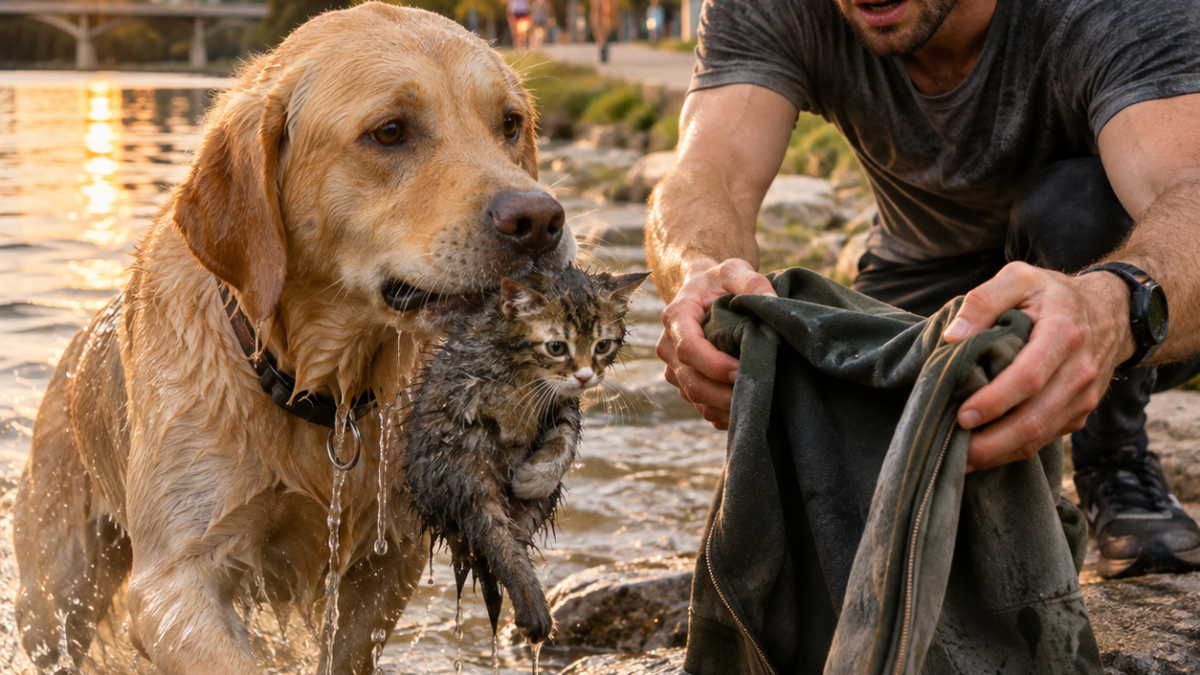
My Lab Pulled a Stray Kitten From the Water—Then I Learned We Had 24 Hours Before Someone Else Could Take Him.
My Labrador dragged a half-drowned kitten out of Lady Bird Lake, but less than twenty-four hours later, I was told saving his life did not mean I had any right to keep him.
Then a stranger claimed the kitten was hers, the rescue prepared to hand him over, and one photograph on my phone exposed a secret that turned a simple adoption dispute into something much darker.
By the time I understood why that tiny tabby had been abandoned beside the water, my dog was standing between him and the woman who had come to take him back—and the clock on his file had less than an hour left.
My name is Ethan Cole.
I was thirty-four years old when my yellow Labrador jumped into Lady Bird Lake and changed the shape of my life before I even understood what he had seen.
His name is Murphy.
He was six then.
Seventy-eight pounds of yellow fur, bad timing, unconditional optimism, and the deeply held belief that every human being on earth existed primarily to throw tennis balls.
Murphy had never been trained for rescue work.
He had never been a service dog.
He had no heroic résumé.
He stole bread from countertops.
He slept on his back with all four paws in the air.
He once barked for twenty minutes at a plastic grocery bag trapped in a bush.
So when people later called him a hero, I always smiled.
Because Murphy did not know he was doing anything heroic.
He simply saw something small in trouble and acted before the rest of us had finished thinking.
It happened on a Thursday evening in Austin.
Late September.
One of those Texas evenings when the worst heat had finally broken and the entire city seemed to remember it was possible to exist outdoors without resenting the sun.
The light over Lady Bird Lake had turned gold.
Runners moved along the trail.
Cyclists rang bells behind slower walkers.
Paddleboards cut dark lines through the water.
Somewhere across the lake, music drifted faintly from a patio.
I had finished a ten-hour sound installation at a hotel ballroom downtown and taken Murphy out because I needed air more than he did.
That was my life then.
I worked freelance audio.
Concerts.
Corporate events.
Hotel installs.
Festivals.
Anything that involved cables, speakers, microphones, mixing consoles, and somebody yelling, “Why is there no sound?” thirty seconds before doors opened.
When work was heavy, I complained I never had time to breathe.
When work slowed down, I worried about money.
PART2:
Freelance life has a way of making you miss the problem you had last week.
Murphy never cared.
Busy week?
Walk.
Slow week?
Walk.
Bad client?
Ball.
Good client?
Ball.
Existential crisis?
Ball.
That evening I had my phone in one hand and Murphy’s leash in the other.
My coordinator, Rachel, had texted about a Dallas job.
Possible three-day run.
Good money.
Bad timing.
I was reading the message when Murphy stopped so suddenly that the leash snapped tight across my fingers.
“Hey.”
His whole body had changed.
Ears forward.
Head low.
Tail still.
Not squirrel posture.
Not duck posture.
Something else.
“What is it?”
He pulled.
Hard.
I looked toward the water.
At first I saw nothing.
Rocks.
Mud.
A piece of driftwood.
PART3:
Then the driftwood moved.
It was a kitten.
Tiny.
Brown-gray tabby.
Maybe ten or twelve weeks old.
White patch beneath his chin.
He was pressed against a flat rock inches above the waterline, soaked almost black from his shoulders down.
His front paws spread wide against the stone.
His entire body trembled.
People passed twenty feet behind us without noticing him.
That bothered me later.
Not because those people were cruel.
Because danger can be astonishingly quiet.
You imagine emergencies announce themselves.
Sirens.
Screaming.
Something obvious.
Sometimes an emergency is four pounds of wet fur pressed against a rock while a hundred people walk by.
I shortened Murphy’s leash.
“Easy.”
He whined.
The kitten turned his head.
His eyes were huge.
Not pleading.
That is what I remember.
He did not cry.
He looked furious.
Terrified, exhausted, freezing—and somehow offended that the universe had placed him there.
I took one slow step.
A cyclist passed behind me.
His bell rang.
Sharp.
Metallic.
The kitten startled.
His rear paw slipped.
For half a second, he recovered.
Then the wet rock gave way beneath him.
He slid into the lake.
I dropped my phone.
Murphy launched.
The leash ripped through my hand.
“Murphy!”
He hit the water hard enough to splash my jeans.
The kitten disappeared.
I saw one tiny paw once.
Then nothing.
Murphy dove.
I do not know whether it was instinct or luck.
Probably both.
The next four seconds felt longer than most years.
Then Murphy’s head broke the surface.
Something small hung from his mouth.
I ran into the shallows.
“Good boy. Easy. Easy.”
Murphy swam toward me.
He had the kitten by the loose skin and fur across his shoulder and upper back, holding him with a gentleness I had never seen from a dog who routinely crushed tennis balls into wet green pancakes.
I grabbed Murphy’s collar.
He climbed onto the rocks.
Then he lowered his head.
Placed the kitten on the trail.
And stepped back.
The kitten did not move.
My stomach dropped.
“No.”
I crouched.
His chest moved.
Barely.
One breath.
Then another.
“Okay.”
My voice shook.
“Okay, little guy.”
I stripped off my light jacket and wrapped him in it.
He weighed almost nothing.
That scared me more than the water.
His body was ice cold.
His front right leg stayed tucked strangely against his chest.
When I touched near it, he flinched but made no sound.
Murphy pushed his nose into the jacket.
“Back up.”
Murphy ignored me.
He sniffed frantically.
Then looked directly at my face.
If you have lived with a Labrador long enough, you learn they can ask questions without subtlety.
Murphy’s question was obvious.
Why are we still standing here?
“Yeah.”
I picked up my phone.
The screen had cracked.
Still worked.
I searched emergency vet.
Closest open clinic.
Nine minutes.
I ran.
Not sprinting.
The kitten felt too fragile for that.
I moved as fast as I could without jarring him.
Murphy stayed glued to my left leg.
At the car, I opened the back door.
Murphy jumped in.
I placed the kitten, still wrapped in my jacket, on the passenger seat.
Then changed my mind.
Too exposed.
I held him against my stomach with one arm while trying to fasten the seat belt around the bundle.
It was ridiculous.
Finally I wedged the jacket securely inside an open gym bag so he could not roll.
“Stay.”
Murphy leaned between the seats.
“Murphy, back.”
He did not move.
I started driving.
The clinic was seven minutes away if every light cooperated.
None did.
At the first red light, I reached into the jacket.
Still breathing.
Second light.
Still breathing.
Third light.
I could not tell.
My heart jumped into my throat.
Then the kitten twitched.
“Come on.”
Murphy’s nose touched my elbow.
“Come on, buddy.”
The light turned green.
I drove.
The emergency clinic looked almost painfully bright after the lake.
White tile.
Glass.
Stainless steel.
Fluorescent lights.
Two people sat in the lobby with dogs.
A woman held a carrier.
The receptionist looked up as I came through the door.
Her expression changed immediately.
“What happened?”
“Kitten. In the lake.”
She stood.
“Found?”
“Yes.”
“Breathing?”
“Yes. I think.”
A technician appeared through swinging doors.
“Come with me.”
Murphy tried to follow.
“No dogs in treatment unless they’re patients.”
“He pulled him out.”
The tech looked at Murphy.
Then at the bundle.
Her face softened.
“I understand. But he has to wait.”
Murphy did not understand.
He planted himself.
I handed his leash to the receptionist.
“Can you—”
“I’ve got him.”
I followed the technician.
She opened my jacket.
The kitten’s eyes were half closed.
“Hypothermic.”
She placed a stethoscope against his chest.
“Heart rate’s low but present.”
Another tech appeared.
Warm towels.
Heating pad.
Oxygen.
Everything began moving quickly.
“What’s his name?”
“I don’t know.”
“Yours?”
“Ethan Cole.”
“Phone number?”
I answered automatically.
The veterinarian came in.
Dr. Mara Patel.
I remember her because she was the first person who spoke to me as though panic could be organized into useful information.
“He’s very cold. We’re going to warm him slowly.”
“Is he going to live?”
“I can’t promise that yet.”
That honesty frightened me, but I trusted it.
“He aspirated water?”
“Possibly. We’ll monitor his lungs. There’s some tenderness in the right front leg. Could be soft tissue, could be more. First priority is temperature and breathing.”
I nodded.
“Do it.”
“There is one other issue.”
I thought she meant money.
She partly did.
“Because he’s a found animal, we have to treat this as a stray intake. You can authorize emergency stabilization, but legal ownership doesn’t automatically transfer to the finder.”
I barely heard her.
“Fine.”
“There’ll also be a deposit.”
“How much?”
She told me.
I swallowed.
It was more than I wanted to spend.
Not more than he was worth.
Those are different things.
My checking account did not care about philosophy.
A hotel still owed me for a job three weeks earlier.
My truck needed brakes.
Rent was due in nine days.
The Dallas run suddenly mattered a lot more.
I looked at the kitten.
His eyes opened.
Barely.
One pale green eye first.
Then the other.
He looked at me.
I thought about saying I could only cover stabilization.
I thought about asking whether a rescue could take over immediately.
Then his front paw moved.
A tiny attempt to pull away from the thermometer.
The technician smiled.
“That’s actually good.”
I took out my card.
“Do whatever he needs.”
At the desk, the receptionist asked whether I wanted to list a temporary name.
I looked through the glass doors.
Murphy stood exactly where I had left him.
Nose pressed against the treatment-room door.
“Not yet.”
She waited.
“Put ‘lake kitten.’”
She typed.
LAKE KITTEN.
It looked absurd on the form.
Clinical.
Temporary.
Like a placeholder for a life.
I signed.
When they took the kitten farther into treatment, Murphy made a sound.
Not a bark.
Not a whine I had heard before.
Small.
Almost swallowed.
He pressed his nose against the crack beneath the door.
I crouched beside him.
“He’s staying tonight.”
Murphy looked at the door.
“Yeah.”
I rubbed behind his ears.
“I know.”
The clinic gave me my wet jacket in a clear plastic bag.
Without the kitten inside it, it felt strangely empty.
I drove home with Murphy in the passenger seat.
He normally stuck his head near the window.
That night he sat facing me.
Watching the jacket.
At home, I hung it over a kitchen chair.
Murphy lay beneath it.
I showered.
Tried to eat.
Couldn’t.
At 12:20 a.m., I checked my phone.
No call.
At 1:03, no call.
At 2:17, I woke from a dream where I was standing beside the lake watching something disappear beneath black water.
Murphy was still beneath the jacket.
At 3:40, I got up for water.
He lifted his head.
At 5:15, I gave up pretending I was sleeping.
The clinic called at 9:08.
“Mr. Cole?”
“Yes.”
“This is Austin Emergency Animal Care.”
I stood so quickly I spilled coffee.
“How is he?”
“He made it through the night.”
I closed my eyes.
Murphy jumped up because my voice had changed.
“He’s warmer. More alert. He ate a very small amount. Lungs sound better than we expected.”
I laughed once.
Pure relief.
“What about his leg?”
“Likely sprain. No obvious fracture on preliminary imaging.”
“Good.”
“However, we do need to talk about next steps.”
There it was.
The phrase adults use before ruining relief.
“Okay.”
“Because he’s a stray, we’ve notified the municipal intake network and partner rescue.”
“I posted online last night.”
“That’s good. There’s a statutory stray-hold process depending on how the intake is processed. Our rescue partner may take custody once he’s medically cleared.”
“How long?”
“That depends.”
“Can I adopt him?”
“You can apply.”
Apply.
The word annoyed me.
I had pulled him from the lake.
Technically Murphy had.
I had authorized the bill.
I had spent the night staring at my phone.
And I still had to apply to become relevant.
I understood why.
That did not mean I liked it.
“What do I need to do?”
She gave me the rescue coordinator’s number.
I wrote it on the back of an electric bill.
Then she added, “Also, if an owner comes forward with proof, they have priority during the legal hold.”
My stomach tightened.
“Right.”
“Do you want to visit today?”
“Yes.”
I did not even check my schedule.
“Absolutely.”
Before leaving, I created a found-animal post.
SMALL TABBY KITTEN FOUND NEAR LADY BIRD LAKE.
I deliberately left out the exact markings.
No close-up photo.
No sex.
No detail about the injured leg.
If someone claimed him, they would need to know something.
Within fifteen minutes, comments appeared.
Poor baby.
Thank you for helping.
Shared.
Someone asked for a photo.
Someone else said they had seen a woman searching for a kitten two neighborhoods away.
I messaged her.
Wrong color.
Another person wrote:
Was this the kitten in the trail video?
I stared.
What video?
They sent a link.
A cyclist’s action camera had captured part of the rescue.
The footage was shaky.
Six seconds.
The kitten falling.
Murphy jumping.
Me running toward the water.
The cyclist had posted it with the caption:
This dog just saved a kitten at Lady Bird.
Thirty thousand views overnight.
My first reaction was pride.
My second was dread.
Now thousands of people knew there was a kitten.
Which meant anyone could claim him.
I called the rescue coordinator.
Her name was Valerie Kim.
Efficient voice.
No nonsense.
She asked about Murphy first.
Vaccinations.
Temperament.
Cats?
“Never lived with one.”
“Prey drive?”
“He chases squirrels but mostly because he believes they’re withholding friendship.”
Silence.
Then Valerie laughed.
“Okay.”
“I’m serious.”
“I believe you.”
She explained foster-to-adopt.
Home check.
Veterinary reference.
Separation plan.
Financial responsibility.
Follow-up.
I answered everything.
Then I asked, “If I complete all this, he comes to me?”
“Not automatically.”
“Why not?”
“Because an owner could still come forward.”
“And if nobody does?”
“We assess applications.”
“Applications?”
“There’s already another inquiry.”
I looked at Murphy.
He was sitting beside the front door.
“Another person wants him?”
“The video circulated.”
Of course.
“You need to understand kittens move quickly.”
“How quickly?”
“If he’s medically cleared tomorrow, potentially within twenty-four hours.”
Twenty-four hours.
That was when the clock started.
Not officially.
Not with a red digital countdown.
But in my head, it became exact.
Twenty-four hours to prove I was suitable.
Twenty-four hours before a transfer.
Twenty-four hours before somebody with a cleaner schedule, larger house, or earlier application could become the person who took him home.
I hung up.
Rachel called thirty seconds later.
“Dallas moved up.”
I closed my eyes.
“When?”
“Crew rolls tomorrow afternoon.”
“Of course it does.”
“Problem?”
I looked at Murphy.
“Yes.”
“What kind?”
I told her.
There was silence.
Then she said, “You’re skipping a three-day job for a cat you don’t own?”
“When you say it like that, it sounds financially irresponsible.”
“It is financially irresponsible.”
“I know.”
“How much is the Dallas run worth?”
I told her.
Another silence.
“That’s rent.”
“I know.”
“Ethan.”
“I know.”
The word came out sharper.
Rachel backed off.
“You want me to find somebody?”
“Please.”
“No guarantee.”
“I know.”
After the call, I sat on my kitchen floor.
Murphy came over.
Pressed his head into my chest.
“You caused this.”
His tail moved.
“You could’ve minded your own business.”
Tail.
“You see how other dogs behave?”
Tail.
“They sniff things.”
Tail.
“They don’t start families without consulting anyone.”
He licked my chin.
“That is not an apology.”
At the clinic that afternoon, the kitten looked different.
Still fragile.
Still small.
But alive in a way he had not looked beside the lake.
His coat had dried into soft brown stripes.
The white under his chin was brighter.
One ear had a tiny nick.
When I entered, his head lifted.
I stepped closer.
His eyes locked on me.
“Hey.”
He blinked.
I put one finger against the kennel door.
The kitten shifted.
Carefully.
His sore leg touched down.
He moved forward two inches.
Then stretched one paw toward the clear plastic.
His toes touched the other side of my finger.
That was it.
A piece of plastic between us.
Still, my throat tightened.
“You’re making this difficult.”
The veterinarian entered.
“He’s doing surprisingly well.”
“Can he leave tomorrow?”
“Possibly.”
“To me?”
She gave me a sympathetic look.
“That’s a rescue question.”
“I know.”
“You’re attached.”
“No.”
The kitten’s paw was still against my finger.
She looked at it.
Then at me.
“Clearly.”
In the lobby, Murphy waited with a technician.
The second I emerged, he stood.
I opened the exam-room door just enough that scent could travel.
Murphy inhaled.
His whole body softened.
“He’s okay,” I told him.
Murphy wagged once.
Slow.
I had never seen a dog worry before.
Not in the way humans describe worry.
But I knew what I was looking at.
He had carried something fragile out of danger.
Now he expected us to finish the job.
That evening, the first strange message arrived.
It came through my found-kitten post.
A profile named Kelsey Warren.
THAT IS MY KITTEN.
My heart jumped.
I clicked her profile.
Young woman.
Austin.
Photos with dogs.
Normal-looking.
I messaged:
Can you describe him?
She responded instantly.
Brown tabby.
That was public.
Anything unique?
White paws.
Wrong.
The lake kitten had dark paws.
I asked sex.
Female, she wrote.
Wrong again.
I told her the markings did not match.
She became angry.
YOU STOLE SOMEONE’S PET AND NOW YOU’RE GATEKEEPING.
I blocked her.
Ten minutes later, another message.
Different person.
Same claim.
This one said the kitten had blue eyes.
Wrong.
Then another.
The viral video had done exactly what I feared.
People wanted to be part of the story.
Some probably meant well.
Some wanted a free kitten.
Some wanted attention.
At 8:17 p.m., Valerie called.
“We received an ownership claim.”
My stomach dropped.
“A real one?”
“Potentially.”
“Who?”
“I can’t give you the claimant’s information yet.”
“What did they know?”
“Sex. Approximate age. White chin. Small nick on the left ear.”
I stood.
Those details had not been public.
“Did they have photos?”
“Yes.”
My chest tightened.
“So he has an owner.”
“Maybe.”
I stared at Murphy.
The correct thing should have been relief.
A lost kitten going home.
That should have been good.
Instead, I felt sick.
“What happens now?”
“We verify.”
“How long?”
“Could be tomorrow.”
The twenty-four-hour clock changed meaning.
Now I was not racing another adopter.
I was racing ownership.
And ownership beats emotion.
As it should.
Unless the owner is the reason the animal needed rescue.
I slept even less that night.
At 7:05 the next morning, Valerie sent me one photo.
She was allowed to ask whether it matched the kitten I had found.
The image showed a tiny tabby sitting on a blue blanket.
White chin.
Ear nick.
Same narrow dark stripe from forehead to nose.
It was him.
There was no doubt.
I stared at the screen.
Murphy rested his head on my knee.
“He belongs to somebody.”
My voice sounded hollow.
Murphy looked up.
“This is good.”
He did not wag.
“It’s supposed to be good.”
At 8:20, Rachel texted.
CHRIS CAN COVER DALLAS IF YOU TAKE HIS SAN ANTONIO LOAD-IN NEXT WEEK.
I answered YES immediately.
Then the clinic called.
The kitten was medically cleared.
The owner claim was being reviewed.
Please do not come until contacted.
That felt worse than anything.
Waiting from home while decisions happened elsewhere.
At 10:06, a woman called me.
“Is this Ethan?”
“Yes.”
“My name is Lauren Reeves.”
Her voice trembled.
“I think you found my kitten.”
I sat down.
“How did you get my number?”
“The rescue gave me permission to contact you after I asked.”
“Okay.”
“His name is Milo.”
The name landed.
Milo.
Not lake kitten.
Not a placeholder.
Milo.
“How old?”
“Twelve weeks.”
“What happened?”
Silence.
Then: “He got out.”
“From where?”
“My apartment.”
“How far are you from Lady Bird?”
She named a neighborhood nearly three miles away.
A twelve-week-old kitten had not casually traveled three miles through Austin traffic.
“How long was he missing?”
“Two days.”
“Do you have other pets?”
“No.”
“Was he wearing a collar?”
“He hates collars.”
Something in her answers sounded rehearsed.
Not necessarily dishonest.
Just careful.
I asked, “How did he get out?”
“The door.”
“What door?”
“My front door.”
“Someone left it open?”
“I don’t know.”
My discomfort grew.
“Lauren, I’m not trying to keep your cat if he’s yours.”
“Then don’t.”
Her voice sharpened instantly.
I stopped.
She breathed.
“I’m sorry.”
There was something underneath her apology.
Fear.
Not sadness.
Fear.
“I’ve been looking everywhere.”
“I believe you.”
“Please don’t make this harder.”
“I’m not.”
“You posted him online.”
“To find an owner.”
“You paid the clinic.”
“He was dying.”
“I know.”
Her voice broke.
“I know, okay?”
I softened.
“Then help me understand.”
Silence.
Finally she whispered, “I can’t.”
Then she hung up.
I stared at the phone.
Murphy nudged my hand.
Something was wrong.
I called Valerie.
“Do not transfer him yet.”
“We don’t plan to until verification is complete.”
“She said he escaped three miles away.”
“We noticed.”
“What did the photos prove?”
“That she had possession of him previously.”
“Previously?”
Valerie emphasized the word.
“Possession is not always the same as lawful ownership.”
My pulse quickened.
“What does that mean?”
“We’re checking his microchip status.”
“He has a chip?”
“The clinic found one this morning.”
Nobody had told me.
“Who’s registered?”
“That’s what we’re investigating.”
At 11:12, Valerie called again.
“Ethan, I need you to answer something carefully.”
“Okay.”
“When you found the kitten, did you see a carrier?”
“No.”
“Blanket?”
“No.”
“Food?”
“No.”
“Vehicle stopped nearby?”
“No.”
“Any person walking away?”
I thought back.
Runners.
Cyclists.
A man with a stroller.
A couple taking photos.
Then something surfaced.
A white SUV.
Parked illegally on the gravel service shoulder near the bridge.
Rear hatch open.
I had noticed it because Murphy pulled toward the kitten seconds after it drove away.
“I saw a white SUV.”
“What kind?”
“I don’t know.”
“Could you identify it?”
“Maybe.”
She exhaled.
“Okay.”
“What is happening?”
“The microchip is registered to an organization.”
“What organization?”
“Central Texas Paws Network.”
“That’s a rescue.”
“Yes.”
“Lauren works there?”
“No.”
I stood.
“What?”
“She fostered for them.”
The room seemed to tilt slightly.
“So Milo isn’t hers.”
“Not legally.”
“Why does she have photos?”
“Because he was in her foster care.”
My stomach tightened.
“Was.”
“Yes.”
“What happened?”
“We’re working on that.”
“How long do you need?”
“Give us a few hours.”
That was not possible.
Not emotionally.
But there was nothing else to do.
At noon, Murphy began pacing.
I told myself he needed exercise.
We went back to Lady Bird Lake.
Not because I thought I would find answers.
Because I could not sit still.
Murphy led.
The moment we reached the section of trail, his behavior changed.
He sniffed the rocks.
Then pulled past them.
Toward brush beneath the pedestrian bridge.
“Murphy.”
He pulled harder.
I followed.
Twenty feet into the brush, I heard something.
A tiny sound.
I froze.
“Mew.”
Murphy’s ears snapped forward.
“No way.”
He pushed under the branches.
I crouched.
There, beneath a pile of dry leaves and plastic trash, were two kittens.
One black.
One tabby.
Both alive.
Both terrified.
My blood went cold.
The rescue email from the previous day came back to me.
Two other kittens had recently been found nearby.
Possible dumped litter.
“Milo wasn’t alone.”
Murphy whined.
I called Valerie with shaking hands.
“Send somebody to the lake.”
“What happened?”
“There are more.”
Within thirty minutes, two rescue volunteers arrived with carriers.
The kittens were thin.
Dehydrated.
But not critical.
We searched the brush.
Found an overturned cardboard box farther uphill.
Inside were old towels.
A disposable food tray.
And a piece of blue fleece.
I photographed everything before touching it.
One volunteer, a woman named Denise, stared at the box.
“This wasn’t a litter born out here.”
“No.”
“Somebody dumped them.”
Murphy sniffed the blue fleece.
Then whined.
I looked at Denise.
“That smell means something to him.”
She nodded.
“If Milo was inside this box, absolutely.”
We called animal services.
An officer came.
Photographs.
Statements.
Evidence bag.
The box had a shipping label partly torn away.
Most of the address was gone.
One name remained.
LAUREN R.
My skin went cold.
Valerie called while the officer was looking at it.
I answered.
“We found the foster record,” she said.
“So did we.”
“What?”
I told her about the box.
Silence.
Then Valerie said, “Do not contact Lauren.”
“What did the record say?”
“She was assigned four kittens from the same litter six days ago.”
I looked at the two kittens in carriers.
“Milo plus these two is three.”
“Yes.”
“Where’s the fourth?”
“We don’t know.”
That became the new emergency.
Not adoption.
Not ownership.
A missing kitten.
Animal services went to Lauren’s apartment.
Nobody home.
Her phone went straight to voicemail.
The rescue had records.
Four kittens.
Milo.
Juniper.
Bean.
Poppy.
Milo had been found in the water.
Two others were now beside me.
Poppy was missing.
The officer asked me to describe exactly where Murphy first alerted.
We walked the trail again.
Murphy’s nose stayed low.
He was no tracking dog.
I knew that.
But scent is scent.
He pulled toward the bridge.
Then stopped near a storm drainage opening.
My stomach dropped.
“No.”
The grate was large enough for a kitten.
A volunteer shone a flashlight.
Nothing.
We called.
No sound.
Murphy sniffed.
Then moved away.
I did not know whether that was good.
We searched until nearly sunset.
Nothing.
At 6:40, the animal-services officer received a call.
Lauren had returned to her apartment.
She agreed to speak.
I was not there for that conversation.
I learned what happened later through Valerie and the formal case record.
Lauren Reeves was twenty-seven.
She had started fostering six months earlier.
At first, she had apparently done well.
Then her life began collapsing.
She lost her job at a marketing agency.
Her boyfriend left.
She fell behind on rent.
She began drinking heavily.
The rescue did not know.
Lauren continued accepting foster animals because she was ashamed to admit she was struggling.
Four kittens arrived.
They developed diarrhea.
One scratched her couch.
Milo urinated on a rug.
Lauren panicked.
Not one dramatic violent act.
Something more ordinary and ugly.
She put all four kittens into a cardboard box.
Drove to the lake.
And abandoned them near the trail.
She told investigators she believed people would find them.
That sentence stayed with me.
People would find them.
It is one of the easiest lies human beings tell themselves when they want to walk away from responsibility.
Someone else will handle it.
Someone else will notice.
Someone else will fix what I am choosing not to.
She had driven away.
Milo escaped the box first.
A bicycle frightened him.
He slid into the lake.
Murphy saw him.
Juniper and Bean crawled deeper into the brush.
And Poppy disappeared.
When Lauren saw the viral video, she panicked again.
She knew the kitten could be traced back through his chip.
So she claimed he had escaped from her apartment.
She wanted him returned quickly enough that nobody would examine the foster records closely.
That was the betrayal.
Not that she had once cared and suddenly become a monster.
Reality was more uncomfortable.
She was a damaged person who made a cruel decision and then tried to hide it.
I could understand her fear.
I could not excuse what she did.
At 7:15 that evening, Murphy and I were still near the trail.
Valerie arrived.
She looked exhausted.
“They suspended Lauren from fostering.”
“Good.”
“Animal services is taking the case.”
“What about Poppy?”
“No sign.”
I looked toward the lake.
The sun was dropping.
“Then we keep looking.”
“Ethan.”
“What?”
“You’ve been out here seven hours.”
“So?”
“You cannot search every inch of Austin.”
“Then tell me what inch we haven’t searched.”
She studied me.
Then smiled tiredly.
“Okay.”
We kept searching.
At 8:03, a runner stopped.
“You guys looking for a kitten?”
Every head turned.
“Yes.”
“Orange-ish?”
My heart jumped.
“Tabby?”
“Maybe. Small. I saw something yesterday behind the kayak rental storage.”
We ran.
The storage building stood half a mile east.
Behind it were stacked plastic boats, old pallets, and fencing.
Murphy reached the fence first.
His tail stopped.
He whined.
Then we heard it.
Tiny.
Hoarse.
Mew.
Valerie covered her mouth.
A rescue volunteer crawled beneath the lowest rack.
“Got her.”
When she backed out, a small brown-orange kitten was pressed against her chest.
Poppy.
Alive.
Dehydrated.
Hungry.
But alive.
Everybody started talking at once.
I crouched beside Murphy.
He wagged so hard his whole body moved.
“You ridiculous animal.”
He licked my face.
“You started all of this.”
He licked me again.
“That is still not an apology.”
At 9:18, all four kittens were accounted for.
And suddenly the twenty-four-hour clock that had been terrifying me became irrelevant.
There was no legitimate owner coming for Milo.
No transfer back to Lauren.
No reason to rush him into the first available home.
I thought that meant everything was solved.
It did not.
At 9:47, Valerie called me aside.
“There’s a problem.”
I laughed.
Not because it was funny.
Because by then the universe had become predictable.
“Of course there is.”
“The rescue board is uncomfortable placing Milo with you.”
I stared.
“What?”
“They know you’re sincere.”
“That sentence never ends well.”
“Your work travel is a concern.”
“I canceled Dallas.”
“For one week.”
“I have Murphy.”
“That’s also a concern.”
I genuinely thought I had misheard.
“The dog who saved him?”
“Some board members think a home without a dog may be lower risk.”
I looked toward Murphy.
He was asleep beside the volunteer’s truck.
“You watched them together.”
“I did.”
“Has Murphy shown aggression?”
“No.”
“Did he chase him?”
“No.”
“Did he injure him?”
“No.”
“He carried him out of the lake.”
“I know.”
“Then what exactly are we doing?”
Valerie rubbed her eyes.
“Policy.”
I felt something inside me harden.
Not anger at her.
At the word.
Policy.
Procedure.
Rules.
All necessary.
All capable of becoming excuses when human beings stopped thinking.
“What does policy require?”
“Formal home assessment. Foster period. Controlled dog-cat introduction.”
“Fine.”
“Reference check.”
“Fine.”
“Financial review.”
“What does that mean?”
“Proof you can handle ongoing veterinary care.”
I almost laughed.
“You cashed my emergency deposit.”
“I know.”
“I’m paying part of the current bill.”
“I know.”
“So what is this really about?”
Valerie hesitated.
There it was.
Something else.
“Another applicant.”
I went still.
“Who?”
“I can’t tell you.”
“Was there another applicant before the owner claim?”
“Yes.”
“And they’re still interested.”
“Yes.”
“Donor?”
She said nothing.
I understood.
“Donor.”
“Ethan.”
“How much?”
“That is not relevant.”
“Then why are you uncomfortable answering?”
Her face tightened.
“They’ve supported the rescue for years.”
“And that makes them a better home?”
“No.”
“Does the kitten know their donation history?”
“Stop.”
Her voice was sharper than before.
I did.
She lowered it.
“I’m on your side.”
“Then act like it.”
The words landed harder than I intended.
Valerie looked hurt.
I immediately regretted the tone.
“Sorry.”
“No.”
She shook her head.
“You’re right.”
She looked toward the rescue vehicle.
Then at Milo’s siblings.
“This organization almost sent one of these kittens back to the person who abandoned him because our records weren’t reviewed quickly enough.”
“That’s not your fault.”
“It’s still our failure.”
She crossed her arms.
“The donor is William and Marcia Keene.”
I waited.
“They’ve donated around sixty thousand over four years.”
“Okay.”
“They lost an older cat recently. No dogs. Large home. Excellent veterinary history.”
“That sounds like a good home.”
“It probably is.”
That was the problem.
I could not hate them.
They were not villains.
They had money.
Stability.
Experience.
No large dog.
On paper, they might actually look safer than me.
Freelance sound technician.
Rental house.
Travel.
Labrador.
Suddenly I saw myself through an application form.
Messy.
Less predictable.
Good intentions were not enough.
“What do I do?”
Valerie looked surprised.
“You’re not going to argue?”
“I am arguing.”
“No. I mean…you’re asking.”
I looked at Murphy.
“I don’t want Milo because I think I’m owed him.”
That was the moment I finally understood something.
Saving a life does not make you owner of it.
Love is not possession.
“I want him if we’re actually right for him.”
Valerie’s expression softened.
“Then prove it.”
So I did.
The next morning, while Milo remained at the clinic, Valerie came to my house.
She inspected everything.
Doors.
Windows.
Where I would put the litter box.
Where Milo could isolate for his first week.
Where Murphy would sleep.
My work calendar.
My backup caretaker.
My finances.
My veterinarian.
She called Murphy’s vet.
She called Rachel.
That part I had not expected.
Rachel called me afterward.
“You listed me as a work reference for a cat adoption?”
“You know my schedule.”
“You owe me forever.”
“I already took Chris’s San Antonio load-in.”
“That covers maybe one third of this.”
“What did you tell her?”
“That you are irresponsible about your own sleep but annoyingly responsible when anyone else depends on you.”
“Thank you?”
“I also told her you once drove back forty miles because you realized you had somebody’s microphone in your truck.”
“That microphone cost four thousand dollars.”
“Exactly.”
The controlled introduction happened that afternoon.
Clinic room.
Milo behind a baby gate.
Murphy on leash.
Valerie watched.
A behavior volunteer watched.
I felt like Murphy was being interviewed for national security clearance.
“Leave it.”
Murphy lay down.
Milo stared at him.
Murphy’s tail tapped once.
Milo approached.
Stopped.
Murphy did not move.
Milo came closer.
His nose reached the gate.
Murphy shifted forward.
“Stay.”
He stayed.
Milo extended one paw.
Touched Murphy’s nose.
Murphy closed his eyes.
The behavior volunteer smiled.
“That’s promising.”
I nearly said, Promising? He saved him from a lake.
I kept my mouth shut.
Then Milo did something none of us expected.
He squeezed one front leg through the gate and rested his paw directly on Murphy’s muzzle.
Murphy remained perfectly still.
Milo held it there.
Three seconds.
Four.
Then pulled it back.
Valerie whispered, “Well.”
The behavior volunteer smiled wider.
“Sometimes the animal gets a vote.”
The Keenes arrived before we left.
I knew who they were immediately.
Late sixties.
Kind-looking.
Marcia carried a cat carrier.
William held a folder.
They were not arrogant.
That almost made it harder.
Marcia looked through the window into Milo’s room.
“Oh, he’s beautiful.”
I felt defensive.
Then ashamed of feeling defensive.
She noticed Murphy.
“Is that the dog from the video?”
“Yes.”
Her face lit up.
“Oh my goodness.”
She crouched.
Murphy walked over.
She scratched his chest.
“You brave boy.”
Murphy adored her immediately.
Traitor.
William introduced himself.
“I think we’re competing.”
He smiled.
I did not know what to say.
“Apparently.”
He looked through the glass.
“We lost our Henry in July.”
“I’m sorry.”
“Eighteen years.”
“That’s a long time.”
“Not long enough.”
No.
Never long enough.
Marcia stood beside us.
“We saw Milo’s story.”
I braced.
Then she said, “But I think we’re withdrawing.”
I stared.
“What?”
She nodded toward Murphy.
“That kitten already has a dog.”
My throat tightened.
“You don’t have to do that.”
“We know.”
William smiled.
“We’ve had cats our whole lives. There will be another animal who needs us.”
Marcia looked at Murphy.
“This one already started the adoption paperwork in the lake.”
I laughed.
I could not help it.
“You’re sure?”
She squeezed my arm.
“Take your kitten home.”
No dramatic rivalry.
No evil wealthy couple.
Just two decent people making room.
I learned something from that too.
When you are frightened of losing something, every person near it can begin to look like an enemy.
Sometimes they are not.
Sometimes the right person walks away because they understand what belongs together.
At 4:32 p.m., Valerie called.
“Your foster-to-adopt is approved.”
I closed my eyes.
“For Milo?”
“For Milo.”
Murphy stood because my voice changed.
“How long?”
“Initial fourteen-day foster. Then finalization if everyone adjusts.”
“So he comes home?”
“Yes.”
“When?”
“Today.”
Murphy began wagging before I said anything.
I pointed at him.
“You have no idea what she said.”
He sneezed.
“You are guessing.”
Tail.
I laughed.
“Fine.”
I crouched.
“We’re getting him.”
Murphy jumped onto me.
Seventy-eight pounds.
Nearly knocked me over.
At the pet store, I bought too much.
I had planned basics.
Then panic took over.
Small litter box.
Large litter box.
Two types of litter because apparently opinions about litter can start wars.
Kitten food.
Bowls.
Blanket.
Carrier.
Tiny mouse.
Wand toy.
Scratching board.
Bed.
Another bed because the first seemed insufficiently emotional.
The cashier looked at everything.
“First cat?”
“Is it obvious?”
“You bought two beds.”
“I have a Labrador. He owns six.”
She nodded.
“Fair.”
At the clinic, the paperwork was anticlimactic.
Sign.
Initial.
Medication.
Follow-up.
Keep Milo separated initially.
Monitor breathing.
Limit jumping until the leg improved.
Return immediately if appetite dropped.
Valerie brought the carrier.
Milo sat inside.
Small.
Quiet.
Watching.
I crouched.
“Hey.”
His ears moved.
Murphy pressed his nose against the carrier grate.
Milo moved toward him.
Nose to nose through plastic.
Murphy made that same soft sound from the first night.
The technician wiped her eyes.
“I’m fine.”
Nobody had asked.
We laughed.
At home, I prepared the spare room.
I lived alone in a small two-bedroom rental in South Austin.
The second room mostly contained road cases, microphone stands, cables, and equipment I promised myself I would organize.
Within an hour it became a kitten suite.
I moved everything dangerous.
Placed a blanket.
Food.
Water.
Litter.
Small cardboard box for hiding.
Milo’s carrier went on the floor.
Murphy lay outside the baby gate.
I opened the carrier.
Milo did not move.
“That’s okay.”
I sat on the floor.
“No deadline.”
That felt significant after the previous two days.
No clock.
No application.
No transfer.
No one waiting to claim him.
Just time.
Milo emerged eighteen minutes later.
He moved directly beneath a small desk.
Murphy’s nose appeared between the bars.
I snapped my fingers.
“Back.”
Murphy backed away.
Milo watched.
Ten minutes later, he came out again.
He ate.
Only a little.
Then hid.
That night I slept on the couch.
Murphy slept outside Milo’s room.
At 12:41 a.m., I heard tiny footsteps.
I opened my eyes.
Milo stood in the hallway.
He had somehow pushed through a slightly loose gap beside the baby gate.
He looked at me.
Then at Murphy.
Murphy lifted his head.
Did not move.
Milo walked toward him.
One careful step at a time.
His injured leg still slightly stiff.
I did not breathe.
They stopped six inches apart.
Milo leaned forward.
Touched his nose to Murphy’s.
Murphy closed his eyes.
Soft breath out.
Milo stood there.
Then rubbed one side of his face against Murphy’s muzzle.
I covered my mouth.
Murphy’s tail moved once against the floor.
Milo turned.
Walked under the couch.
And disappeared.
That was all.
No swelling music.
No magical transformation.
But I sat awake for another hour.
Because something had happened.
Trust had moved six inches.
Sometimes that is enough.
The fourteen-day foster became my entire life.
Milo began exploring.
First the room.
Then hallway.
Then kitchen.
He discovered Murphy’s water bowl and preferred it to his own, despite the fact that his entire body could nearly fit inside it.
He discovered my shoelaces.
He discovered speaker cables.
That nearly ended our relationship.
“No.”
Milo chewed.
“No.”
Chew.
“That cable is worth more than your adoption fee.”
Chew.
I bought protective covers.
Murphy developed rules.
Rule one: Milo could eat from Murphy’s bowl.
Rule two: Milo could sleep on Murphy’s bed.
Rule three: Milo could attack Murphy’s tail.
Rule four: Murphy could never retaliate in any meaningful way.
I watched a twelve-week-old kitten launch himself from the couch onto Murphy’s back.
Murphy looked at me with the expression of a middle-aged father who had made irreversible life choices.
“You wanted him.”
Murphy sighed.
“You literally jumped in a lake.”
Another sigh.
“No refunds.”
By day five, Milo slept beside Murphy.
By day seven, he followed him.
By day nine, Murphy stopped checking every time Milo left the room.
That was how I knew Murphy finally believed the kitten was staying.
Then, on day ten, everything changed again.
Milo stopped eating.
Morning food untouched.
At noon, untouched.
By three, he was hiding.
My chest went cold.
I called the vet.
They told me to bring him immediately.
Murphy tried to climb into the car.
“Not this time.”
He whined.
“I know.”
At the clinic, X-rays showed inflammation in Milo’s lungs.
Likely delayed complication from aspiration.
Dr. Patel explained it calmly.
I heard one phrase.
“Can become serious quickly.”
They wanted him hospitalized.
I signed.
Another deposit.
More money.
I did not even look at the total until afterward.
Then I sat in my truck.
Banking app open.
The number frightened me.
I had lost Dallas.
My hotel client still had not paid.
Now another emergency bill.
Love does not make arithmetic disappear.
I called Rachel.
“Tell me there’s work.”
She laughed.
“There is always work.”
“I need all of it.”
“You sound serious.”
“I am.”
She found me a weekend event.
Two overnight load-outs.
Terrible hours.
Good money.
I accepted.
For three days, I worked and visited Milo between shifts.
Murphy waited at home.
Every time I returned without the kitten, he searched behind me.
The second night, I sat beside Milo’s oxygen kennel at 3:30 in the morning still wearing black work clothes.
He looked impossibly small.
“You are expensive.”
Milo blinked.
“You need a job.”
Blink.
“I’m serious.”
His paw moved toward the door.
I touched the glass.
“I’m not leaving because this got inconvenient.”
That sentence came from somewhere deeper than the situation.
Maybe because inconvenience is where commitments prove themselves.
Anybody can love something when love fits the calendar.
It is when the work comes.
The money.
The exhaustion.
The fear.
That is where the word means something.
Milo recovered.
Slowly.
By day thirteen, he ate.
By day fourteen, he came home.
Valerie called the next morning.
“Foster period is technically complete.”
I looked at Milo sleeping with his head on Murphy’s paw.
“Okay.”
“Do you want to finalize?”
I laughed.
“What do you think?”
“I’m required to ask.”
“Yes.”
She became quiet.
“Full name?”
“What?”
“You never changed it in our system. Do you want Milo?”
I looked at the kitten.
Milo.
Lauren had called him Milo.
For a while, I had considered changing it because of everything attached to the name.
But names do not cause abandonment.
People do.
“Milo stays.”
“Okay.”
She typed.
“Milo Cole.”
Something about hearing it hit me unexpectedly.
Not ownership.
Family.
“Yeah.”
I swallowed.
“Milo Cole.”
The rescue later pursued formal charges related to abandonment.
Lauren accepted a plea agreement involving fines, probation, mandatory counseling, and a prohibition on fostering or possessing animals for a period determined by the court.
People online wanted harsher punishment when the story became public.
Some wanted her jailed for years.
Some called her a monster.
I did not.
That surprised people.
What she did was cruel.
It deserved consequences.
But I had spoken to her.
I had heard the fear in her voice.
Calling her a monster would have made the story easier.
Monsters are different from us.
They belong in another category.
The harder truth is that ordinary people can make horrible decisions when shame, fear, exhaustion, and selfishness combine.
That does not excuse them.
It makes accountability more important.
Lauren sent me one letter.
It arrived through Valerie three months later.
I almost threw it away.
Then I opened it.
Ethan,
I don’t expect forgiveness.
I have replayed leaving that box every day.
I kept telling myself someone would find them because there were people on the trail.
The truth is I wanted that to make what I did feel less like abandonment.
It was abandonment.
I saw the video of Murphy going into the water.
I realized Milo could have died because I wanted to escape one night of feeling overwhelmed.
I lied because I was scared of everyone knowing what kind of person I had become.
I’m getting help now.
I am sorry.
Please don’t answer.
I only wanted you to know I stopped lying to myself.
Lauren
I sat with the letter for a long time.
Then I put it away.
I never answered.
Forgiveness is personal.
Accountability is public.
The two do not have to happen on the same schedule.
Juniper and Bean were adopted together by a retired teacher.
Poppy went to a family with two teenage daughters.
The Keenes adopted a six-year-old black cat named Franklin who had been sitting at the rescue for eight months.
Marcia sent Valerie a photograph.
Franklin occupied an entire velvet chair like he had inherited an estate.
Murphy and Milo became locally famous for about two weeks after a news station covered the rescue.
They invited us to the studio.
I declined.
Murphy would have eaten something expensive.
Instead, the rescue used the attention to raise money for emergency foster support.
That part mattered.
Lauren’s situation revealed a gap.
Fosters were being asked whether they could handle animals before placement.
Nobody was checking whether they were still okay afterward.
Valerie created a weekly support system.
Food assistance.
Temporary relief fosters.
Emergency veterinary guidance.
A no-judgment surrender process for overwhelmed volunteers.
“Why?” I asked.
She looked at me as though the answer were obvious.
“Because punishment doesn’t rescue the next litter.”
That sentence stayed with me.
Real justice cannot only look backward.
It should make the next bad thing less likely.
My own life changed quietly.
I took fewer out-of-town jobs.
Not none.
I still had bills.
When I traveled, Jenna stayed at my place.
She claimed Murphy loved her more.
That was false.
Milo probably did.
I became more organized.
Not because cats teach discipline.
Because Milo believed 4:57 a.m. was breakfast.
The first time he slept on my pillow happened six weeks after the lake.
I woke because something tickled my nose.
Whiskers.
Milo was curled above my head.
One paw resting in my hair.
Murphy slept beside the bed.
I stared at the ceiling.
Then laughed quietly.
That first night after bringing Milo home, I had wondered whether I would ever find him on my pillow instead of beneath the couch.
Apparently yes.
I lifted one hand.
Milo opened his eyes.
He did not run.
I scratched beneath his chin.
His eyes closed.
That was the whole moment.
But moments do not have to be dramatic to divide your life into before and after.
Months later, I walked Murphy beside Lady Bird Lake again.
Milo stayed home.
Cats have boundaries.
Murphy reached the section of trail where it happened.
He slowed.
Sniffed the rocks.
Looked toward the water.
I wondered if he remembered.
Probably.
Dogs remember more than we understand.
I sat on a bench.
Murphy leaned against my knee.
People passed.
Runners.
Bikes.
Families.
Life moving normally through the exact place where ours had changed.
I looked at the water.
I thought about that first instant.
A kitten slipping.
Murphy jumping.
Me standing half a second behind both of them.
The difference between the life I had and the one I ended up with came down to one animal refusing to hesitate.
Murphy did not ask whether the kitten belonged to us.
He did not ask whether the veterinary bill would be expensive.
He did not ask whether I had Dallas scheduled.
He did not ask whether the rescue application would be complicated.
He saw something drowning.
So he went in.
Humans cannot live entirely that way.
We have mortgages.
Rules.
Schedules.
Consequences.
We have to think.
But I sometimes wonder whether we think ourselves out of compassion because compassion is inconvenient.
We tell ourselves somebody else will help.
Somebody more qualified.
Somebody with more money.
More time.
A bigger house.
A better plan.
I was never the obvious person to adopt Milo.
The Keenes had more space.
Other adopters had predictable schedules.
Rescue staff had more animal experience.
Even Lauren, before everything fell apart, probably looked more qualified on paper than I did.
But life is rarely lived on paper.
Milo did not need perfection.
He needed somebody who would come back.
Somebody who would pay attention when he stopped eating.
Someone willing to rearrange a schedule.
Someone who would make mistakes and keep showing up.
And Murphy?
Murphy never needed convincing.
To him, Milo belonged with us before I even pulled my wet jacket around that shaking little body.
Two years later, Milo still has the white chin.
The ear nick.
And a slight stiffness in his right front leg when he wakes from a long nap.
The veterinarian says it causes him no real trouble.
He compensates mostly by expecting everyone else to accommodate him.
He steals Murphy’s bed.
Murphy sleeps on the floor beside it.
He steals Murphy’s water.
Murphy waits.
He bites Murphy’s ears.
Murphy sighs.
Sometimes Milo gets the midnight zoomies and launches across the living room while Murphy watches with the exhausted dignity of an old man whose irresponsible roommate has discovered caffeine.
And every morning, they touch noses.
Every single morning.
Not because I trained them.
Not because anyone taught them.
It became theirs.
One quiet check.
You here?
I’m here.
That is what I imagine it means.
The original twenty-four-hour clock terrified me.
I thought I had one day to stop Milo from becoming someone else’s kitten.
I thought the story was about racing paperwork.
Beating another adopter.
Proving I deserved him.
I was wrong.
The real clock had started much earlier.
It started when four kittens were placed inside a cardboard box beside a lake.
Every passing hour reduced their odds.
Every runner who missed them.
Every bicycle that passed.
Every night getting colder.
Every predator.
Every car.
Every inch of water.
Milo’s clock nearly ran out on a wet rock.
Murphy stopped it.
Not permanently.
Nobody gets to do that.
He simply bought Milo another hour.
The veterinarian bought him another.
The rescue volunteers bought Poppy another.
The clinic bought all of us time.
That may be the closest thing any of us ever gets to saving another life.
Not guaranteeing forever.
Just giving someone enough time to reach the next safe place.
One evening not long ago, a thunderstorm rolled over Austin.
Milo hates thunder.
At the first crack, he disappeared.
I searched the bedroom.
Under the couch.
Closet.
Nothing.
Then I found him.
He was curled beneath Murphy’s front legs.
Murphy had lowered his chest over him without actually touching his weight to the kitten.
Milo’s face was buried against the yellow fur.
Murphy looked at me.
Calm.
Patient.
Exactly the same expression he had worn outside the clinic door years earlier.
I sat on the floor.
“Still doing your job?”
Murphy’s tail tapped.
Milo opened one eye.
Thunder rolled again.
He pressed closer.
Murphy did not move.
I remembered Murphy emerging from that dark water with an impossibly small body in his mouth.
I remembered thinking he was carrying a kitten.
Now I understood he had been carrying the beginning of something none of us could see yet.
A responsibility.
A friendship.
A family.
A reason for a rescue organization to change how it supported overwhelmed fosters.
A reason three other kittens were found before it was too late.
A lesson I never knew I needed about the difference between saving something once and choosing it every day afterward.
People still sometimes ask which one rescued which.
They expect me to say Murphy rescued Milo.
That is the obvious answer.
It is also incomplete.
Murphy rescued Milo from the water.
Milo gave Murphy something I had never realized he was missing—a creature to protect who trusted him completely.
And both of them changed me.
Before that night, I was good at keeping my life flexible.
No commitments I could not rearrange.
No responsibility beyond myself and a dog easy enough to take almost anywhere.
Work first.
Then whatever fit around it.
I thought freedom meant leaving enough empty space that nothing could trap me.
Milo taught me the opposite.
Some responsibilities do not shrink your life.
They give its empty spaces names.
Home.
Dinner.
Medicine.
Morning.
Waiting.
Return.
Family.
The scarier thing was never that Milo might complicate my life.
The scarier thing was how close I came to believing complication meant I should not choose him.
I still work sound.
I still travel occasionally.
I still count money during slow months.
Nothing became magically easy.
That is another lie rescue stories sometimes tell.
Animal comes home.
Music rises.
Everyone lives happily ever after.
Real life continues.
Vet bills happen.
Work changes.
Animals get sick.
Dogs age.
People worry.
Love does not remove those things.
It gives you reasons to face them.
Murphy is older now.
Gray has started spreading around his muzzle.
He takes longer getting up after naps.
The veterinarian says he is doing well.
I know what that means.
It means enjoy the days.
Milo seems to know too.
He sleeps beside Murphy more often than he used to.
Sometimes directly against his chest.
If Murphy changes rooms, Milo eventually follows.
Whenever I see it, I think about the first decision Murphy made for all of us.
He did not wait for certainty.
He did not wait for someone to tell him that kitten was his responsibility.
He simply refused to watch something small disappear.
That is the part of the story I want to remember.
Not Lauren’s lie.
Not the rescue paperwork.
Not the bill.
Not the argument about who had a better application.
Not even the twenty-four-hour clock.
I want to remember the instant before all of that existed.
A wet rock.
A frightened kitten.
A dog going completely still because he saw what I had not yet seen.
Then one small body slipping.
And Murphy jumping.
Because almost everything good that happened afterward began with that.
Milo is asleep beside him as I tell this.
Murphy’s front paw is stretched across the rug.
Milo has one tiny paw resting on top of it.
He is much bigger than the kitten from the lake now.
Healthy.
Loud when food is late.
Obnoxiously confident.
Nothing about him looks temporary anymore.
And whenever I look at the two of them, I remember how frightened I was that first night that someone would tell me I could not take him home.
I thought home was the thing I had to win.
It wasn’t.
Home was already forming in a clinic hallway where a yellow Labrador pressed his nose beneath a door and refused to leave.
All I had to do was recognize it in time.








