My Husband Swore Our Orange Cat Was Ruining Everything—Then One Night Cheddar Went Quiet, and I Found Mark Sitting on the Floor Holding Him Like He Couldn’t Let Go
PART3:
We were just worn thin.
Then I saw Cheddar.
He was curled in the corner of a metal cage, wet from the rain because apparently even on his rescue day he had found a way to be dramatic. He looked like a damp cheese puff with abandonment issues. His ears were too big for his head. His fur stuck up in uneven little spikes. A card clipped to the cage said:
CHEDDAR
Male, 2 years
Playful, affectionate, “spirited”
Needs patient home
The quotation marks around spirited should have warned us.
Mark crossed his arms.
“We are just looking.”
“Of course.”
“I mean it.”
“I heard you.”
“No commitments.”
“None.”
“No emotional decisions.”
“Absolutely not.”
Cheddar opened one eye, reached one paw through the bars, hooked Mark’s shoelace, and refused to let go.
Mark looked down.
The cat looked up.
I swear something passed between them.
Not love.
More like a legal dispute.
“Laura,” Mark said slowly.
“Yes?”
“The cat has detained me.”
“He likes you.”
“He has taken a hostage.”
The volunteer smiled.
“That’s the first time he’s done that today.”
Mark looked suspicious. “How many times has he done it this week?”
She did not answer quickly enough.
We adopted him forty minutes later.
In the car, Cheddar screamed the entire way home.
Not meowed.
Screamed.
Like a Victorian widow discovering bad news in a letter.
Mark drove with both hands tight on the steering wheel.
“This is not a normal cat sound,” he said.
“He’s scared.”
“He sounds like he owes money.”
“Give him time.”
“I am giving him a ride.”
At home, Cheddar emerged from the carrier, sniffed the living room, knocked one coaster off the coffee table, and climbed behind the couch.
“There,” Mark said. “He hates us. We tried. Back to the rescue.”
But that night, while we watched TV, one orange paw appeared from under the couch. Then another. Then a nose. Then the rest of him.
He walked straight to Mark.
Jumped onto his lap.
Turned in three circles.
Sat down.
Mark stiffened.
“No,” he said.
Cheddar closed his eyes.
“Absolutely not.”
Cheddar began to purr.
It sounded like a broken refrigerator.
Mark looked at me.
“Do not make that face.”
“What face?”
“The face that says this is cute.”
“It is cute.”
“It is manipulation.”
Cheddar stretched one paw across Mark’s stomach and sighed.
Mark looked down at him with deep resentment.
Then, very slowly, he rested one hand on the cat’s back.
Only one hand.
Only barely.
Like he was not petting the cat but checking whether the cat had structural integrity.
That became their routine.
Every night, Mark sat in his chair.
Every night, Cheddar launched himself into Mark’s lap like a man arriving late to a meeting he owned.
Every night, Mark said some version of no.
“No.”
“Absolutely not.”
“Find another victim.”
“You have your own bed.”
“This is harassment.”
“Laura, tell your cat about boundaries.”
And every night, ten minutes later, Mark would be watching television with one hand resting on Cheddar’s back, fingers moving slowly through orange fur like his body knew something his pride refused to admit.
I noticed.
Of course I noticed.
Wives notice everything.
We notice when the trash bag is replaced but the new bag is not opened properly.
We notice when our husbands pretend not to like a song but tap their fingers to it in traffic.
We notice when a man who claims to hate a cat learns exactly where that cat likes to be scratched behind the ears.
But I did not tease him too much.
Not then.
Because I noticed something else too.
Mark was laughing again.
Not big laughs.
Not at first.
But little ones.
A snort when Cheddar fell off the arm of the couch after trying to lick his own tail.
A muttered “idiot” that somehow sounded affectionate when the cat got his head stuck in a grocery bag and walked backward for five full seconds.
A helpless chuckle when Cheddar dragged one of Mark’s socks into the hallway and yowled at it like it had insulted his bloodline.
That was Cheddar’s real gift.
He interrupted the quiet.
Not in a graceful way.
Grace was not in his skill set.
He interrupted it with chaos.
He knocked a spoon off the counter during a tense conversation about our mortgage and made both of us stop mid-sentence.
He leapt into a laundry basket while I was folding clothes, emerged with Mark’s underwear on his head, and ran through the living room like a criminal escaping a scene.
He once got inside a cereal box, panicked, and sprinted blind through the house, taking out a lamp, two magazines, and what remained of Mark’s dignity.
Mark stood in the wreckage and said, “This animal is lowering our property value.”
Then he laughed so hard he had to sit down.
I had missed that sound.
I had missed the man inside that sound.
Sometimes you do not realize how much tenderness has gone missing until something ridiculous brings it back.
Still, Mark maintained his official position.
“The cat is a menace.”
He said it while buying Cheddar a new toy shaped like a taco.
“He is ruining this house.”
He said it while cutting a piece of plain chicken into a Cheddar-sized bite and pretending it had fallen by accident.
“He has no respect for me.”
He said it while moving his laptop because Cheddar wanted the warm spot on his desk.
“He is not my cat.”
He said it every morning while Cheddar sat on his foot.
I let him have the lie.
Marriage is knowing which lies are load-bearing.
Then came the night Cheddar went quiet.
It was a Tuesday in January, cold enough outside that the windows showed their age and the heat ran almost constantly. Mark had gone to bed earlier than usual because he had a 6 a.m. job site meeting across town. I stayed up reading, though reading is generous. Mostly I held a book and thought about whether we had paid the water bill.
Cheddar spent the evening being Cheddar.
He attacked a twist tie.
He tried to climb into the dishwasher.
He sat on Mark’s chest during the weather forecast and blocked the five-day outlook with his orange body, which Mark said was “probably an improvement.”
Then we went to bed.
Around two in the morning, I woke up.
At first, I did not know why.
The house was dark. The heat clicked softly through the vents. Mark’s side of the bed was empty, but that did not register right away. What registered was the silence.
Not normal silence.
Cheddar silence.
By then, our nights had a soundtrack.
Paws thudding down the hallway.
A weird scratching at the bedroom door.
The soft crash of something small being pushed from somewhere high.
Cheddar chirping at shadows.
Cheddar digging enthusiastically in the litter box like he was searching for buried treasure.
Cheddar throwing himself against the linen closet because sometimes doors personally offended him.
But that night, nothing.
I sat up.
“Mark?”
No answer.
I got out of bed, pulled on my robe, and walked toward the living room.
The hallway floor was cold.
The house felt wrong.
Then I saw them.
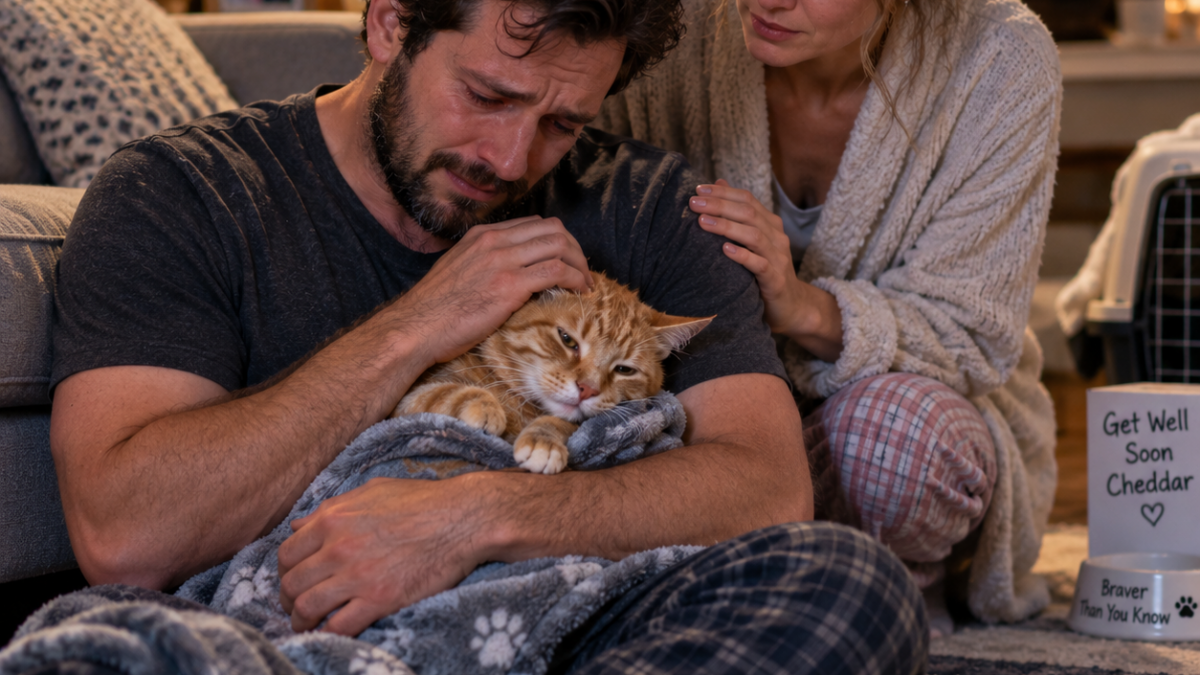
Mark was sitting on the living room floor in his old gray T-shirt and sweatpants, back against the couch, knees bent. The lamp beside him was on low. His glasses were crooked. His hair stuck up on one side.
Cheddar was in his lap.
Limp enough that my heart stopped.
“What happened?” I whispered.
Mark looked up.
His face was one I had not seen in years.
Not grumpy.
Not tired.
Scared.
“He threw up,” he said. His voice was rough. “A lot. Then he kind of stumbled, and he wouldn’t move much. I didn’t want him alone.”
I crossed the room and dropped to the floor so fast my knees cracked.
Cheddar lifted his head slightly and made a small, weak sound.
Not the loud complaint of a cat who believed the universe had wronged him.
A tiny meow.
Almost a question.
“Oh, baby,” I whispered.
I touched his side.
He was warm. Breathing. His eyes followed my fingers. His gums looked okay, though I was not a vet and every Google search I had ever made at night had convinced me everyone was dying.
“We should call the emergency clinic,” I said.
“I did.”
Of course he had.
“What did they say?”
“To monitor him unless he gets worse. They said it could be something he ate. If he’s lethargic or vomiting again, we bring him in.”
“What did he eat?”
Mark’s jaw tightened.
“I found part of that fake plant from the bathroom.”
“The one I told you to move because he kept chewing it?”
“I moved it.”
“To where?”
“The laundry shelf.”
“And?”
He looked away.
“He can jump higher than expected.”
Any other night, I might have laughed.
Not that night.
Cheddar tucked his head deeper into Mark’s arm.
And that was when I saw Mark’s hand.
It was shaking.
Not a little.
Enough for me to notice.
He kept stroking Cheddar’s back slowly, carefully, like the cat was made of glass.
I had not seen that kind of tenderness in him for a while.
Not because it had disappeared.
Because life had covered it.
Work. Bills. Exhaustion. That American habit of acting like being constantly worn down is just adulthood. The daily grind had layered itself over him until all his softness had gone underground.
But there it was.
In his shaking hand.
In the way he held the cat against his chest.
In the way his thumb moved over Cheddar’s tiny orange head.
“I think he’s okay right now,” I whispered.
Mark swallowed hard.
“Don’t do that again, buddy,” he said.
So softly.
Buddy.
Not menace.
Not that cat.
Not your cat.
Buddy.
That one word nearly broke me.
Because suddenly I understood that Cheddar had not just been interrupting our quiet.
He had been reaching Mark.
In all the ridiculous ways Mark would allow.
Jumping on his lap.
Stealing his food.
Sleeping on his coat.
Knocking over his coffee.
Forcing himself into the path of a man who had forgotten how to ask for comfort and would never admit he needed it.
I rested my head against Mark’s shoulder.
He did not move away.
For a long time, the three of us sat on the living room floor under the low lamp.
Cheddar breathing.
Mark stroking him.
Me watching the man I loved remember how to be openly gentle.
Eventually, Cheddar lifted his head, blinked, and gave a slightly stronger meow.
Mark exhaled like he had been holding his breath for an hour.
“You scared me,” he muttered.
Cheddar closed his eyes.
“He scared both of us,” I said.
Mark looked down at him.
“He’s such an idiot.”
“I know.”
“The plant was fake.”
“I know.”
“It didn’t even taste good.”
“How would you know?”
He gave me a look.
I smiled, and for the first time that night, his mouth curved too.
Cheddar was fine.
By morning, of course, he was deeply fine.
Offensively fine.
The kind of fine that made the entire night feel like a prank.
At 6:30 a.m., I walked into the kitchen and found him on the counter trying to lick butter off a knife wrapper.
“Absolutely not,” I said, lifting him down.
He yelled at me.
Loudly.
Full volume.
Mark appeared in the doorway, exhausted, wearing jeans and one sock, holding his work boots.
He saw Cheddar.
Cheddar saw him.
For one second, they stared at each other.
Then Mark said, “Unbelievable.”
Cheddar trotted to his feet and rubbed against his leg.
Mark looked at me.
“He almost dies from eating a plastic plant, and now he wants butter.”
“He contains multitudes.”
“He contains stupidity.”
Then he opened the fridge, took out leftover chicken, tore off the tiniest piece, and bent down.
“I’m watching,” I said.
Mark froze.
“I dropped it.”
“You tore it off with your fingers.”
“It slipped.”
“Into his mouth?”
“Gravity is complicated.”
Cheddar swallowed the chicken and looked up like a man ready for the next installment.
Mark pointed at him.
“This changes nothing. You are still a problem.”
Cheddar purred.
I leaned against the counter and laughed.
Not because the night had been funny.
Because morning had come.
Because the cat was alive.
Because my husband, who claimed Cheddar would destroy our marriage, was standing in our kitchen feeding him chicken and pretending not to love him.
That was the beginning of Mark losing the war.
He never admitted it.
Not directly.
But after that night, things changed in small ways.
Cheddar got a new bed.
Mark said it was because he was tired of “the creature shedding on every civilized surface.”
The bed went beside Mark’s chair.
Cheddar ignored it for three days, then slept in it once, and Mark walked by like a proud father pretending not to look.
A toy basket appeared near the fireplace.
Mark said he was tired of stepping on cat springs.
Then I saw him at the store comparing feather wands like a man selecting medical equipment.
He installed a small shelf under the living room window.
“For plants,” he said.
We owned no plants in that window because Cheddar was a salad criminal.
The shelf was exactly Cheddar-sized.
When I pointed this out, Mark said, “A cat can sit near plants in theory.”
“What plants?”
“Future plants.”
Cheddar claimed the shelf within four minutes.
Mark pretended to be annoyed, then adjusted the angle so the afternoon sun hit it better.
The strangest change was not what he did for Cheddar.
It was what Cheddar did for us.
He made the house less careful.
That is the best way I can explain it.
Before him, Mark and I had become careful with each other in the way tired people do. Not cruel. Not cold. Just efficient.
What time will you be home?
Did you call the insurance company?
We need milk.
Your mother left a voicemail.
The dryer is making that sound again.
Did you pay the electric bill?
Functional sentences.
Necessary sentences.
But Cheddar created useless sentences, and useless sentences saved us.
“Your cat is licking the wall again.”
“Why is there a toy mouse in my boot?”
“Did Cheddar turn on the printer?”
“Why is he wet?”
“Why is he in the bathtub if he hates water?”
“Did you teach him to open drawers?”
“No, Mark, I did not train the cat in burglary.”
“He has learned.”
We talked more because Cheddar gave us something to talk about that was not money, work, health insurance, groceries, or the slow exhaustion of being adults in a world that always wanted a little more from us.
We laughed more.
We touched more too.
Not dramatically.
A hand on the shoulder while passing in the kitchen.
Leaning against each other on the couch while Cheddar sprawled between us like a smug orange marriage counselor.
Mark started telling me about his day again, usually while pretending to tell Cheddar.
“You wouldn’t believe what Dave did on the job site today,” he would say, scratching under Cheddar’s chin.
“I wouldn’t?” I’d ask.
“I’m talking to the cat.”
“Oh, sorry.”
“The cat understands workplace incompetence.”
Cheddar, who once fell off a windowsill while asleep, blinked wisely.
One Saturday, I came home from grocery shopping and found Mark asleep in his chair.
Cheddar was on his chest.
One orange paw rested against Mark’s beard.
Mark’s hand covered Cheddar’s back.
The television was playing a fishing show neither of them was watching.
I stood there with grocery bags cutting into my fingers and felt something warm spread through me.
It was such an ordinary picture.
A man.
A cat.
A living room.
A half-empty coffee mug on the side table.
No grand declaration.
No dramatic reconciliation.
No movie-moment speech about how we had been drifting and needed to find our way back.
Just my husband sleeping with a ridiculous orange cat pressed against his heart.
Sometimes love returns quietly.
Sometimes it returns wearing fur and shedding on your black pants.
That spring, Mark built Cheddar a catio.
He claimed it was because Cheddar kept yelling at birds through the screen door and it was “bad for neighborhood morale.”
The catio attached to the kitchen window and extended along the back patio. It had shelves, ramps, a shaded corner, and a little covered box Mark called “a weather-resistant relaxation unit.”
“You mean a cat house?”
“It is not a cat house.”
“It is a house for a cat.”
“It is a structural enrichment enclosure.”
“Of course.”
He spent two weekends building it.
Measured everything twice.
Sanded the edges.
Painted the frame.
Installed wire mesh with the seriousness of a man building a submarine.
Cheddar watched from inside the window, occasionally screaming encouragement or criticism.
When it was finished, Mark opened the window.
Cheddar stepped into the catio, sniffed the ramp, climbed to the highest shelf, and sat there in the sun.
Mark folded his arms.
“Well?”
Cheddar closed his eyes.
“He likes it,” I said.
Mark’s face softened before he could stop it.
“Good,” he said.
Just one word.
But it held so much.
A few months later, Cheddar had another scare.
Nothing dramatic, thankfully. A routine vet visit found early signs of dental trouble, and we had to schedule a cleaning and extraction. Mark acted casual all week. Too casual.
“He’ll be fine,” he said.
“Yes.”
“Cats have teeth pulled all the time.”
“I know.”
“He probably doesn’t even use all of them.”
“I don’t think that’s how teeth work.”
The morning of the appointment, Mark insisted on driving.
At the clinic, Cheddar yelled from the carrier like he was being delivered to prison.
Mark leaned close.
“Stop telling everyone our business.”
Cheddar screamed louder.
When the vet tech took him back, Mark sat in the waiting room with one knee bouncing so hard the chair shook.
“He’ll be fine,” I said.
“I know.”
“You don’t look like you know.”
“I know intellectually.”
“What’s the other way?”
“Stomach.”
I took his hand.
He held mine tightly.
There it was again.
That tenderness.
That fear.
That proof that love had gotten under his skin and built a home there without permission.
Cheddar came through fine.
He returned home slightly loopy, missing one small tooth, and filled with the righteous anger of a man betrayed by modern medicine.
Mark carried him inside like royalty.
“Careful,” he said when I tried to help.
“I am being careful.”
“He’s medicated.”
“He’s also biting your sleeve.”
“He’s confused.”
“He knows exactly what he’s doing.”
Cheddar recovered by evening and tried to steal Mark’s soup.
“Absolutely not,” Mark said, moving the bowl.
Then he added, very softly, “You little moron.”
I heard the love in it.
So did Cheddar.
Years passed.
Not many, but enough for life to shift around the shape of our little family.
Cheddar got rounder.
Mark got softer, though he would deny it under oath.
I got better at recognizing that our marriage had not been saved by a cat exactly. That would be too simple. Too cute.
Cheddar did not pay the bills.
Cheddar did not fix our communication.
Cheddar did not erase the stress, the long workdays, the rising costs, the aging parents, the sore backs, the thousand little weights that make middle life feel heavier than anyone warned you it would.
What he did was interrupt the numbness.
He made it impossible for the house to stay too quiet.
He gave us something small and ridiculous to protect together.
He reminded Mark that tenderness did not have to be efficient to matter.
He reminded me that laughter counts as care.
He reminded both of us that sometimes a home needs a little chaos to let the love breathe again.
One evening, years after we adopted him, Cheddar climbed into Mark’s lap the same way he always had.
Except slower.
Older.
Less like an orange missile and more like a man arriving at his favorite chair.
Mark lowered the newspaper.
“You need help, buddy?”
Cheddar paused, considered his dignity, then let Mark lift him the rest of the way.
I looked over from the couch.
Mark caught me watching.
“What?”
“Nothing.”
“You’re making the face.”
“What face?”
“The sentimental one.”
“I’m allowed.”
He looked down at Cheddar, who was already turning in circles on his lap.
“He’s still a problem.”
“I know.”
Cheddar settled, rested his chin on Mark’s stomach, and began to purr.
Mark’s hand moved automatically to his back.
Slow.
Gentle.
The same way it had moved that night on the living room floor when Cheddar scared ten years off our lives.
After a while, Mark said, “He did help, didn’t he?”
I stayed very still.
“With what?”
Mark did not look at me.
“Us.”
Cheddar purred louder, as if taking credit.
I smiled.
“Yeah,” I said. “I think he did.”
Mark cleared his throat.
“Don’t tell anyone I said that.”
“I would never.”
“I mean it.”
“I’ll only tell the cat.”
“The cat already knows too much.”
We sat there together in the quiet that no longer felt empty.
That was the difference.
The house could be quiet again now, but it was not the old quiet. Not the heavy kind. Not the quiet of two tired people disappearing into separate corners of the same life.
This quiet had warmth in it.
A cat purring.
A man’s hand moving through orange fur.
My feet tucked under a blanket.
A marriage that had not been destroyed by the cat my husband swore would ruin everything.
Maybe some homes are saved by big speeches.
Ours was not.
Ours was saved in smaller, stranger ways.
By stolen chicken.
By a cat sitting in mashed potatoes.
By laughter in the middle of arguments.
By one terrifying night on the living room floor.
By Mark saying buddy when he thought only the cat could hear him.
By the ridiculous orange fool who kept jumping into the middle of our tired life until we remembered how to be soft with each other again.
And if you ask Mark today whether he loves Cheddar, he will roll his eyes and say, “That cat is a menace.”
Then he will reach down, scratch the orange head pressed against his leg, and add, under his breath:
“But he’s our menace.”








