My Husband Found a Half-Frozen Gray Kitten Behind a Dumpster—Days Later, I Watched the Tiny Cat Crawl Onto His Arm and Reach the Part of Him I Thought I’d Lost
PART3:
I stood in the hallway watching him, and for reasons I could not explain, the sight nearly broke me.
This man had been so hard to reach for so many months. He had been sealed behind exhaustion, pride, fear, bills, overtime, and the kind of silence working men are taught to call discipline. Yet here he was, barefoot on the cold floor in the middle of the night, whispering encouragement to a half-dead kitten.
“Still breathing?” I asked.
He nodded.
“Still fighting.”
His voice changed on the last word.
Fighting.
I wondered how long it had been since he felt like he was doing that for himself.
The next few days were touch and go.
The kitten got a little stronger, then weaker.
He drank a little, then refused.
One minute he seemed to perk up, and the next he would go limp again and scare me half to death.
We took him to the vet the next morning. The doctor said he was underweight, dehydrated, likely chilled too long, with an upper respiratory infection beginning in his tiny chest. She gave us medicine, special food, a feeding schedule, and a look that tried to be hopeful without lying.
“He has fight,” she said. “That matters.”
My husband nodded like she had given him an order.
After that, he became a soldier in a war measured by teaspoons and blankets.
Before work, after work, in the middle of the night, he showed up for that kitten. He set alarms. He warmed towels. He learned how to give medicine. He cleaned crust from the kitten’s eyes with a cotton pad and a tenderness that made my throat ache.
He talked to that kitten more than he had talked to me in weeks.
Not big speeches.
Just little things.
“You’re stubborn.”
“You’ve got fight in you.”
“Don’t you quit on me.”
“Come on, little man.”
Sometimes, when he thought I was not listening, his voice changed.
It got lower.
Rougher.
“Stay,” he would whisper. “Just stay.”
I knew he was talking to the kitten.
I also knew he was not only talking to the kitten.
One evening, about four days in, the kitten stopped eating altogether.
He lay in the towel nest so still that my stomach dropped.
My husband had just come home from a twelve-hour shift. He still had dust on his pants, grease on one sleeve, and that gray exhaustion on his face. But when he saw the kitten, panic broke across him before he could hide it.
He picked him up with both hands like he was afraid even love might be too heavy.
“Please,” he said softly. “Don’t give up now.”
It was the first honest thing I had heard come out of him in a long time.
And I knew it cost him.
Because honesty, when a man has been pretending for months, can feel like tearing stitches open.
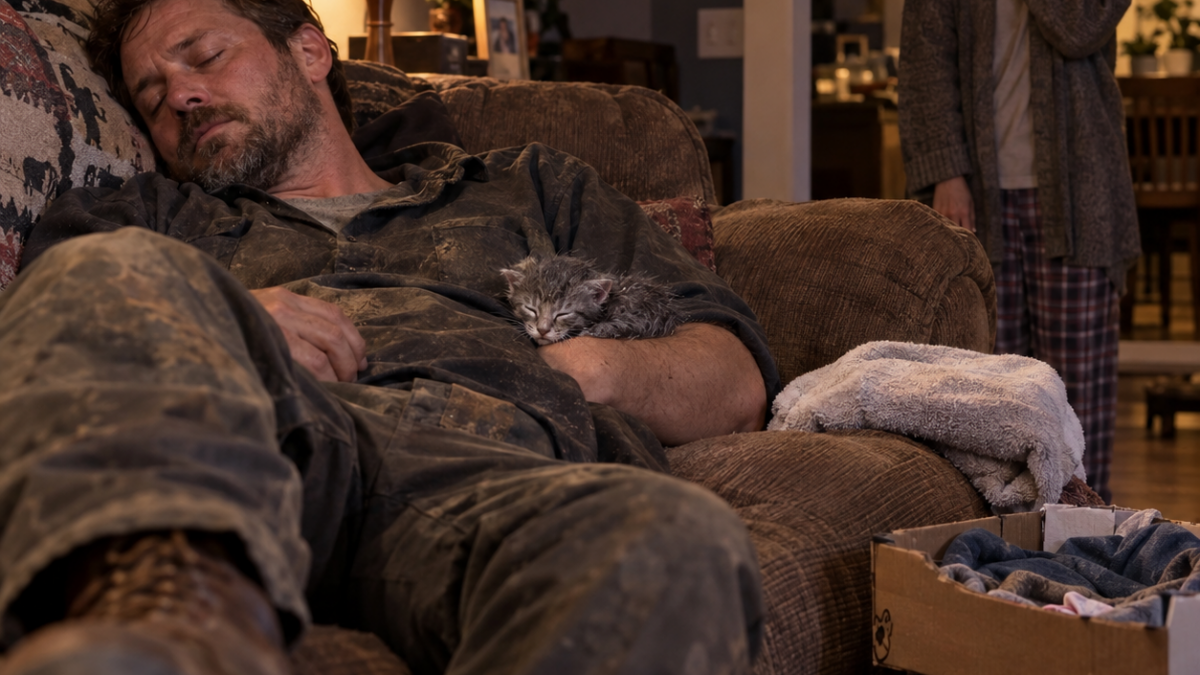
That night, after hours of trying to keep the little thing warm and calm, my husband finally fell asleep on the couch.
Still in his work clothes.
One arm hanging at his side.
Head tilted back.
Mouth slightly open.
He looked older like that. Worn down. Defenseless. The lines around his eyes seemed deeper in the lamplight, and I could see the man beneath all the providing, all the enduring, all the silence he had mistaken for strength.
I stood in the hallway holding a mug of tea I had forgotten to drink.
That was when the kitten moved.
Slowly.
Painfully.
He pushed himself out of the blanket basket we had made for him.
Then he took one shaky step.
Then another.
I held my breath.
He crossed the couch cushion like it was a mile. His tiny paws slipped twice. His head dipped. For a second, I thought he would collapse.
But he kept going.
And then, with the very last bit of strength in his tiny body, he climbed onto my husband’s arm, turned once, and tucked himself against him.
Just like that.
Like he had found the place he had been looking for all along.
Then he fell asleep.
No shaking.
No crying.
No fear.
I stood there with my hand over my mouth, trying not to sob and wake them both.
Because in that moment, something in the room changed.
The kitten had found safety.
And my husband had too.
After that night, he got better.
The kitten, I mean.
But so did my husband.
He smiled more.
He came home and looked present again.
He laughed one afternoon when the kitten followed him into the laundry room and screamed at the closed door like abandonment had legal consequences.
He started eating dinner at the table instead of in front of the television.
He started asking me things again.
Not deep questions at first.
Just ordinary ones.
“How was your day?”
“Did the grocery store have those apples you like?”
“Did the mail come?”
Normal things.
But when you have been starving, even crumbs feel like a feast.
The kitten gained strength by ounces.
My husband gained himself back the same way.
A little more every day.
A little more eye contact.
A little more laughter.
A little more staying in the room instead of vanishing while sitting right beside me.
We named the kitten after a week.
Not because we planned to.
Because by then, he had made it impossible not to.
I wanted something sweet.
My husband wanted something ridiculous.
We landed on Smoke because he was gray, thin, and hard to hold onto at first.
“Fits him,” my husband said.
Smoke blinked at us from the blanket basket like he had bigger plans than either of us understood.
He was still tiny then.
Still fragile.
But he had developed this stubborn habit of dragging himself toward my husband every time he heard the front door open. It did not matter if he had been sleeping. It did not matter if he had just eaten. He would wobble forward on those shaky legs like he was answering a call only he could hear.
And my husband, who had spent months moving through this world like nothing could reach him anymore, would drop his keys, kneel down, and scoop him up with both hands.
Every single time.
It should have been a simple, beautiful thing.
Inside our house, it was.
Outside our house, people had opinions.
The first person to say something was my sister.
She came by one Saturday with a casserole and one of those faces people make when they already think you are making a mistake but want credit for pretending to be concerned.
She stood in our kitchen while Smoke climbed clumsily up the leg of my husband’s sweatpants.
Her mouth tightened.
“Oh,” she said. “So you’re keeping it.”
Not him.
It.
I felt my shoulders stiffen.
My husband did not say anything.
He bent down, lifted Smoke gently, and settled him against his chest.
My sister watched him like she was seeing a grown man do something faintly embarrassing in public.
“I just mean,” she said, “with everything already going on, I don’t know if taking on an animal right now is the smartest choice.”
There are words that sound practical on the surface and cruel underneath.
Smartest was one of those words.
My husband gave a small shrug.
“He was dying.”
She laughed.
Not a mean laugh, exactly.
The worse kind.
The dismissive kind.
“Everything is dying,” she said. “That doesn’t mean you can drag it all home.”
The room went quiet so fast it almost rang.
I looked at her.
Then at my husband.
He kept his eyes on Smoke, rubbing one finger over the kitten’s tiny back.
And I knew that if I did not say something right then, the wrong thing would settle in the room and stay there.
“Actually,” I said, “sometimes that’s exactly what people need to do.”
My sister looked at me like I was being dramatic.
Maybe I was.
But I was tired too.
Tired of how quickly people called tenderness irresponsible.
Tired of how this country worshiped productivity and treated compassion like a hobby for people with spare time.
Tired of how men were expected to carry the world on their backs but got mocked the second they loved something out loud.
My sister set the casserole on the counter a little harder than necessary.
“I’m just being realistic.”
“No,” I said. “You’re being efficient. That’s not the same thing.”
My husband looked up then.
Just for a second.
Our eyes met.
And I saw something flicker there.
Not gratitude exactly.
More like surprise.
Like he was still getting used to the idea that someone might stand between him and the cold.
My sister left twenty minutes later.
The casserole stayed.
So did the silence after the door shut.
I started to apologize, but my husband shook his head.
“You didn’t say anything wrong.”
Then he paused.
“She’s not the only one who thinks it.”
I leaned against the counter.
“What do you mean?”
He let out a breath and scratched under Smoke’s chin.
“A couple guys at work saw the kitten picture on my phone,” he said. “They’ve been joking about it.”
Anger rose through me so fast it made me hot.
“What kind of joking?”
He gave me that look men give when they are trying to protect you from the details of what already hurt them.
The look said enough.
Still, I waited.
He swallowed.
“You know. That I’ve turned soft. That I’m running some kind of cat hospice. One of them asked if I needed a little pink stroller next.”
I closed my eyes for a second.
Not because I was shocked.
Because I was not.
That was the part that made me sick.
We talk a lot about men being lonely. About men shutting down. About men not opening up, not reaching out, not asking for help until everything has already gone dark.
Then the second a man shows gentleness, someone makes a joke.
The second he cares for something small, helpless, inconvenient, somebody acts like he dropped his manhood at the door.
Then people wonder why so many men decide silence is safer.
I looked at my husband.
Really looked at him.
At the lines under his eyes.
At the careful way he held Smoke, as if he had finally learned that being needed was not the same thing as being used up.
“What did you say?” I asked.
A tiny smile pulled at one corner of his mouth.
“I said if they ever end up freezing and starving behind a dumpster, I’ll bring them home too.”
I stared.
Then I laughed so hard I had to grab the counter.
It startled Smoke, who lifted his head and blinked at both of us like we were the ridiculous ones.
My husband laughed too.
A real laugh.
Deep enough to shake his shoulders.
Not the polite little exhale he had been giving the world for the last year.
I cannot explain to someone who has never missed a person while they were still alive what that sound did to me.
It felt like finding a pulse.
That night we sat on the couch with Smoke sprawled across my husband’s chest like a tiny gray king.
The lamp was low.
The dishes were done.
Everything looked ordinary.
But I had lived inside enough hard years to know ordinary is one of the most beautiful things you can be trusted with.
My husband stroked the kitten absently.
After a while he said, “I didn’t realize how bad it got.”
I turned to look at him.
His eyes stayed on the ceiling.
“I knew I was tired,” he said. “I knew work was a mess. I knew I was snapping at nothing and sleeping all the time and feeling like everything took twice as much effort as it should.”
He paused.
“But I didn’t realize I had gotten to the point where I almost walked past something crying.”
The words landed heavy.
Because that was it.
That was the line.
Not that he had stopped loving.
Not that he had stopped caring.
That he had grown so numb he nearly mistook surrender for survival.
I reached over and laced my fingers through his free hand.
“You didn’t walk past,” I said.
He nodded slowly.
“No,” he said. “I didn’t.”
Then, after a long silence, he whispered, “I think that scared me more than anything.”
I knew what he meant.
It is terrifying to realize how close you came to becoming somebody you do not recognize.
A lot of people think the biggest danger in life is breaking apart all at once.
Sometimes it is not.
Sometimes the real danger is erosion.
Slow.
Quiet.
Respectable.
You keep showing up to work.
Paying bills.
Answering texts with all good.
Smiling at neighbors.
Taking out trash.
Renewing car insurance.
Meanwhile, something vital keeps leaking out of you until one day a sound from behind a dumpster is almost not enough to make you turn your head.
That was what scared him.
And me too.
Smoke became impossible to separate from our days after that.
He followed my husband everywhere.
The bathroom door became a personal offense.
Laundry was betrayal.
The garage was a war crime.
If my husband disappeared from the room for longer than thirty seconds, Smoke would let out this scrappy, outraged little cry and go searching.
He was still tiny, but he acted like he had personally been assigned to monitor one middle-aged man’s emotional stability.
Honestly, he was not wrong.
One Sunday afternoon, I found the two of them in the backyard.
My husband was sitting on the back step in an old T-shirt, elbows on his knees. Smoke was batting at a dandelion near his boot. The light was warm. The air smelled like cut grass and dirt.
I had not seen my husband sit still outside in over a year unless it was because he was too exhausted to move.
That day, he was just there.
Present.
Watching a half-grown kitten fail to understand how flowers worked.
I stood behind the screen door and listened.
“Life’s rough, buddy,” my husband told him as Smoke attacked the dandelion again. “You’re not gonna win every fight.”
Smoke pounced harder.
My husband snorted.
“Okay,” he said. “That’s fair.”
I started laughing before I could stop myself.
He looked up and smiled.
“Didn’t see you there.”
“I can tell,” I said. “You’re busy mentoring.”
He glanced at the kitten.
“Somebody has to.”
The thing nobody tells you about healing is that it does not always arrive wearing solemn clothes.
Sometimes it looks like a man talking to a cat in the backyard.
Sometimes it sounds like laughter where silence used to live.
Sometimes it is so ordinary you nearly miss the holiness of it.
About three weeks later, the first real fight happened.
Not between me and my husband.
Between my husband and his brother.
His brother Nate had always been one of those men who treated every conversation like a chance to establish dominance over furniture.
Loud.
Confident.
Convinced volume and certainty were the same thing.
He came over to borrow a tool and found Smoke asleep in the crook of my husband’s arm while a baseball game muttered from the television.
Nate stared.
Then he made the mistake of smirking.
“You serious with this?” he asked.
My husband looked down at Smoke.
Then back at his brother.
“Yeah.”
Nate laughed and shook his head.
“Man, you used to hunt with Dad. Now you’re over here babying a rescue cat like a retiree named Linda.”
I saw my husband go still.
That stillness scared me more than yelling.
Because for most of the last year, stillness had meant retreat. It had meant he was stepping backward inside himself, leaving me to talk to the shell.
But this was different.
This was not retreat.
This was decision.
He set Smoke carefully on the blanket beside him and stood.
Not aggressive.
Not loud.
Just fully upright.
I had almost forgotten how much presence he had when he allowed himself to take up space.
“You done?” he asked.
Nate blinked.
“What?”
“You got anything else?” my husband said. “Any other jokes you want to get out while you’re here?”
The room changed.
Nate gave a half-laugh, already sensing the ground shift beneath him.
“Come on. I’m just messing with you.”
My husband nodded once.
“Yeah,” he said. “That’s the problem.”
Nate rolled his eyes.
“Don’t be dramatic.”
And there it was.
The national anthem of people who say hurtful things and want to stay the hero anyway.
Don’t be dramatic.
As if pain only counts when it is convenient for the person causing it.
My husband looked at his brother for a long moment.
Then he said something I do not think Nate had ever heard from him before.
“Do you know how close I was,” he said quietly, “to not hearing him at all?”
Nate’s smirk faded.
I do not know if he understood.
Maybe not fully.
But my husband kept going.
“I was so tired I almost walked past something dying,” he said. “And bringing him home was the first thing that made me feel like myself in a long time. So if you need to laugh at that to feel like a man, you can do it somewhere else.”
Silence.
Big silence.
The kind that strips a room down to truth.
Nate shifted his weight.
His face changed a little.
Not enough for an apology.
Enough for discomfort.
“I didn’t mean it like that,” he muttered.
My husband held his gaze.
“I know,” he said. “Most people don’t.”
Nate took the tool and left five minutes later.
The front door shut.
I stood in the kitchen pretending not to cry.
My husband sat back down on the couch.
Smoke, who had slept through the emotional breakthrough like a union worker on break, climbed right back into his lap.
I walked over and kissed the top of my husband’s head.
He leaned into it for half a second.
That was all.
But after a year of distance, half a second felt like a vow.
Later that night, I asked him if he was okay.
He looked out the window for a long time before answering.
“I’m tired of pretending the things that hurt me don’t hurt me,” he said.
It was such a simple sentence.
It nearly broke me open.
Because that was the whole sickness, wasn’t it?
Not just exhaustion.
Not just stress.
But the performance.
The constant, grinding performance.
Men are told to provide.
Protect.
Endure.
Push through.
And for some reason, even now, in a country full of burnout and loneliness and funerals people could have avoided, tenderness still gets treated like weakness.
Especially in men.
Especially in working men.
Especially in men who already feel one missed paycheck away from being judged, replaced, or forgotten.
So they go quiet.
They call it being responsible.
They call it handling things.
They call it not wanting to burden anyone.
And sometimes what they really mean is this:
I do not think the world will let me stay lovable if I stop being useful.
That was the sentence underneath our hardest months.
Smoke did not care how much money came in.
He did not care whether the lawn got mowed on Saturday.
He did not care whether my husband was impressive.
He wanted warmth.
A steady hand.
A body that stayed.
He wanted presence.
It turns out presence can save a life.
Sometimes more than one.
A month after Smoke came home, the bills started pressing harder.
Not catastrophic.
Just enough to tighten the air in the house.
A car repair.
A medical bill from an old follow-up appointment.
Groceries rising again for no good reason except that breathing seemed to cost more every season.
I saw the tension return to my husband’s shoulders.
The old silence started hovering near him like it remembered the address.
One evening I found him in the kitchen staring at a notepad where he had written and rewritten a list of numbers.
Smoke sat by his elbow, flicking his tail across the paper like an unhelpful accountant.
I poured us both coffee and sat down.
“We’ll figure it out,” I said.
He nodded, but his jaw stayed tight.
After a minute he said, “Maybe we should find somebody to take him.”
I thought I had misheard.
I looked at Smoke.
Then at my husband.
He could not meet my eyes.
“It’s just for now,” he said quickly. “Until things level out. Somebody with more room. More money. Somebody who can—”
“No,” I said.
He flinched like I had raised my voice, though I had not.
I reached across the table and put my hand over his.
“This is fear talking,” I said. “Not logic.”
His face crumpled in a way I had not seen before.
Not dramatic.
Just tired enough to be honest.
“I know,” he said.
Then, so quietly I almost missed it:
“I’m scared of loving something and failing it.”
That was it.
The hidden engine under all of it.
Not money.
Not cat litter.
Not vet food.
Not even the bills.
Fear.
Fear that love creates responsibility, and responsibility creates the chance to come up short.
There is a particular kind of exhaustion that does not come from effort.
It comes from feeling like every living thing around you depends on a version of you that you are no longer sure you can maintain.
No wonder men go numb.
No wonder women go hard.
No wonder marriages start to feel like two exhausted coworkers sharing a mortgage.
I tightened my hand around his.
“Listen to me,” I said. “This house is not better because everything in it is efficient. It’s better because something alive gets loved here.”
He looked at me then.
Really looked.
Tired.
Scared.
Trying.
I nodded toward Smoke, who had now sat directly on top of the notepad like a furry declaration of bankruptcy.
“He’s not the burden,” I said. “He’s the evidence.”
“Evidence of what?”
“That your heart is still working.”
His eyes filled so fast it startled us both.
My husband has never been a crier.
Not because he is cold.
Because somewhere along the way he learned that leaking was dangerous.
Still, he turned his face and wiped at one eye with the heel of his hand.
Then he laughed, embarrassed.
“Great,” he said. “Now I’m crying over a cat.”
“No,” I said. “You’re crying because you’ve been carrying too much for too long and the cat happened to get there first.”
That became one of the truest things I have ever said.
Not just about him.
About so many people I know.
The mother who keeps snapping at everyone because she has not sat down in years.
The teenage boy who calls everything dumb because caring would expose him.
The old man at the hardware store who talks to strangers because he goes home to an empty house.
The nurse who jokes through burnout.
The teacher who buys supplies with her own money and says she is fine.
The father who keeps working overtime because he thinks collapse is a privilege other people can afford.
We keep mocking the visible signs of tenderness.
Then we act shocked when people break in private.
A few days after that conversation, Smoke got sick again.
Nothing dramatic at first.
He was eating less.
Sleeping more.
His ears felt hot.
He curled up in places he normally did not.
By evening, he would not touch food at all.
My stomach dropped back to that first-week feeling.
My husband did not even take his boots off.
We bundled Smoke into a carrier and drove to an emergency animal clinic across town.
The waiting room was packed.
Dogs whining.
A child crying.
Phones glowing in tired hands.
My husband sat hunched forward, one hand pushed through the carrier grate so Smoke could lean against his fingers.
There was an older woman across from us with a little white dog wrapped in a blanket.
She looked at my husband, then at the kitten.
“You love him a lot,” she said.
My husband gave a tired half-smile.
“Yeah.”
She nodded like she recognized something.
“That’s good,” she said. “A lot of men don’t let themselves anymore.”
My husband looked startled.
Maybe because she said it so plainly.
Maybe because a stranger had just named something people in his own life preferred to joke about.
He glanced at me.
Then back at her.
“I’m trying,” he said.
The woman smiled.
“That counts.”
I have thought about that sentence a lot since then.
That counts.
Not perfection.
Not mastery.
Not always knowing what to say.
Trying.
Trying counts.
Staying counts.
Turning around when you hear something crying counts.
At the clinic, they told us Smoke had an infection but he was going to be okay.
Medication.
Rest.
A few rough days.
Nothing we could not handle.
On the drive home, my husband kept one hand on the carrier.
Streetlights flashed over his face.
After a while he said, “I think I’ve been waiting to deserve care.”
I turned toward him.
He kept his eyes on the road.
“Like if I worked hard enough or kept my mouth shut long enough or got strong enough, then maybe I’d earn the right to not feel awful all the time.”
He let out a small breath.
“But the cat didn’t do anything to earn it. He was just cold and hurting.”
I waited.
“And we still helped him.”
There it was.
The doorway.
The thing grief and exhaustion and love had been trying to teach him all along.
Worth is not something you invoice.
Care is not a prize for the least inconvenient person.
And if that sounds obvious to some people, good for them.
For others, it is a revelation big enough to rearrange a life.
When we got home, I made tea neither of us really wanted.
Smoke curled up in a blanket nest on my husband’s lap while we sat at the kitchen table in the quiet.
“I don’t know how to fix all of it,” my husband said.
“You don’t have to fix all of it tonight.”
He nodded.
Then, very carefully, as if the words might spook and run if he moved too fast, he said, “I think I need help.”
The room went still.
Not bad still.
Sacred still.
I reached for his hand.
“What kind of help?”
He stared down at Smoke.
“I don’t know yet,” he admitted. “Maybe somebody to talk to. Maybe I need to cut back overtime. Maybe both.”
Then he looked up at me, ashamed and hopeful at the same time.
“I just know I can’t keep disappearing and calling it being tired.”
I do not think I will ever forget that sentence.
Because that was what was happening.
He was disappearing.
And the cruelest part was how socially acceptable it looked from the outside.
He was working.
Providing.
Coming home.
Not drinking too much.
Not screaming.
Not smashing things.
Just fading in a respectable, tax-paying way that nobody would have called an emergency until it swallowed him whole.
That is why I get angry when people talk about pain as if it only matters once it becomes cinematic.
A lot of lives are lost quietly.
A lot of marriages go cold quietly.
A lot of children grow up with physically present parents who were emotionally stranded five feet away.
Quiet suffering still counts.
Maybe especially then.
The next week, my husband called a counselor.
A real one.
Not a buddy at work.
Not a stranger on the internet.
Not me playing interpreter for a silence I did not cause and could not cure by myself.
A counselor.
He made the call in the driveway after work.
He sat in the truck for fifteen minutes before coming inside.
When he walked through the door, he looked rattled.
But lighter.
Like he had set down a box he had been carrying so long he forgot it had handles.
“How’d it go?” I asked.
He exhaled.
“I made an appointment.”
I smiled so hard my face hurt.
Smoke, sensing emotion but misunderstanding everything as usual, attacked my shoelace.
My husband bent down, scooped him up, and kissed the top of his little gray head.
I watched that and thought, there it is.
That’s courage.
Not the performance.
Not the posture.
Not the old script.
This.
A tired man making one honest phone call and then kissing a cat in his own kitchen without apologizing for either.
Some people will roll their eyes at that.
They will say it is just a cat.
They will say adults should not need a half-dead kitten to teach them how to feel.
They will say bills are real and sentiment does not pay them.
They will say men have always had it hard and still managed to carry on.
They will say people are too soft now.
Here is my answer.
Maybe softness is not the disease.
Maybe pretending not to need tenderness is.
Maybe what is bankrupting us is not compassion, but the lack of it.
Maybe the reason so many people are angry, lonely, brittle, and unreachable is that we keep treating gentleness like some embarrassing side effect instead of a survival skill.
And maybe a culture that laughs at care should not act confused when so many people stop believing they are worth saving.
I think a lot of what we call strength is just untreated pain with good branding.
I think we praise people for enduring things they should never have had to endure alone.
I think we romanticize burnout because admitting its cost would force too many systems, families, and habits to change.
I think women are expected to absorb everybody’s feelings without complaint.
I think men are expected to bury theirs until they cannot feel anything at all.
Then we place both inside marriages and call it normal when they stop recognizing each other.
This is not men versus women.
Not old values versus new ones.
Just this:
Is a person more respectable when they are numb?
Or more human when they let themselves care?
Because I know my answer.
I saw what numbness did to my husband.
I saw what care brought back.
His first counseling appointment was on a Thursday.
He almost canceled twice.
Once that morning.
Once in the parking lot.
He told me this afterward while standing at the stove stirring soup with Smoke weaving around his ankles like a tiny gray hazard.
“I felt stupid,” he admitted.
“For going?”
“For needing it.”
I set bowls on the table.
“Do you still feel stupid?”
He thought about it.
Then he shook his head.
“No,” he said. “Mostly I feel mad.”
“At what?”
“At how long I thought I had to be miserable before I qualified.”
That right there.
That is the sentence I wish could be mailed to every front door.
How long I thought I had to be miserable before I qualified.
How many people are living like that?
How many are postponing rest, help, honesty, softness, treatment, grief, joy, because they do not yet think they have suffered enough to deserve relief?
How many are one crying thing behind a dumpster away from realizing they are almost gone?
My husband started talking more after that.
Not in a flood.
Not all the time.
But enough.
He told me work had been worse than he let on. Layoffs had hit people around him, and every day felt like a test nobody would explain. He felt replaceable. He felt old some mornings and invisible others. He had started waking up already tired, which made him ashamed, which made him withdraw, which made him lonelier, which made him more tired.
The ugliest spirals are not always dramatic.
Sometimes they are logical.
That is what makes them dangerous.
He also told me something that sat in my chest for days.
“When I picked him up,” he said one night, nodding toward Smoke asleep between us, “I realized I still had a reflex to protect something.”
I looked at him.
He kept speaking softly, like he was translating from a language he had not used in years.
“And if that was still in me, then maybe not everything was gone.”
I leaned my head on his shoulder.
“Not everything was gone,” I said.
He covered my hand with his.
“I know that now.”
Smoke recovered fully over the next couple of weeks.
Then he became unbearable in the healthiest possible way.
He stole socks.
Scaled curtains.
Ambushed ankles.
Knocked a pen into my coffee.
Stole chicken off my plate with the shameless confidence of a tiny felon.
My husband adored him.
I adored my husband for adoring him.
One night Smoke launched himself onto the bed at three in the morning, missed entirely, scrambled up the comforter in a panic, and landed squarely on my husband’s face.
I woke up to a full-grown man yelling, “Jesus, Smoke!”
Then coughing fur out of his mouth.
Then laughing so hard he could barely breathe.
I laughed too.
Not graceful laughter.
Bent-over, helpless, tears-on-the-pillow laughter.
Smoke stood on the blanket, offended and magnificent.
In the dark, with my husband laughing beside me, I had this sharp, sudden thought:
There are people who would look at this and see chaos.
Expense.
Inconvenience.
One more needy thing in an already hard world.
I looked at it and saw resurrection.
Months passed.
Not perfect months.
Real ones.
There were still bills.
Still bad days.
Still stretches when work got heavy and his eyes went far away.
Healing did not make him someone else.
It brought him back to who he had always been before life convinced him tenderness was a liability.
The counselor helped.
Time helped.
Truth helped.
But if I am being honest, Smoke helped too.
Because healing sometimes needs a shape.
Something warm and alive to answer to.
Something small enough to hold when the world feels too large.
Something that does not care about your resume or your stamina or whether you have been strong in an approved way.
Something that just crawls into your lap and says, here.
Stay.
Months later, my sister came back over.
Smoke was no longer a trembling scrap in a shoebox.
He was sleek, healthy, shameless, and convinced all countertops belonged to him by divine right.
He leaped into my husband’s lap while we sat in the living room.
My sister watched them for a minute.
Then she said, quieter than before, “He really loves you.”
My husband scratched under Smoke’s chin.
“Guess so.”
She looked down.
Then up again.
“My son’s been having a hard time,” she said. “Shutting down a lot.”
The room softened instantly.
Because pain, when people finally admit to it, can make enemies out of nobody.
She worried the hem of her sleeve.
“I think maybe I was wrong,” she said. “About some things.”
My husband could have made her work for it.
He did not.
“That happens,” he said gently.
She smiled in this sad, relieved way.
And I thought, there it is again.
Mercy.
The thing people call weak right up until they need it desperately.
A person does not become foolish because they care for something fragile.
A man does not become less of a man because he cries over a cat, or goes to counseling, or admits he is not okay, or chooses gentleness over performance.
A marriage does not get stronger because two people learn to suffer independently in the same house.
A life is not more valuable because it is efficient.
If this story bothers somebody because it sounds too emotional, I would ask why emotion scares them more than numbness.
If this story seems small compared to all the bigger tragedies in the world, maybe that is part of the point.
Most lives are made of small things.
Small turnings.
Small mercies.
Small creatures someone almost did not notice.
And sometimes the smallest thing in the room is the one that reveals who is starving.
A few weeks ago, I woke before dawn and found my husband in the recliner by the window.
Smoke was asleep on his chest, one paw hooked into the collar of his T-shirt.
The whole house was blue with early morning.
Neither of them moved when I stepped into the room.
My husband looked up at me and smiled.
That quiet smile.
The one that does not perform.
The one that simply says, I am here.
“You okay?” I whispered.
He nodded.
Then he looked down at Smoke and rubbed that little gray head with one finger.
“Better than I was,” he said.
I stood there for a long moment.
Watching the rise and fall of his chest under that cat.
Watching the stillness.
The real kind.
Not emptiness.
Peace.
And I thought about that first night.
The wet fur.
The shaking body.
The way my husband said almost.
I almost walked past.
Maybe that is why this story stays with me.
Because almost is where so many of us live.
Almost asking for help.
Almost telling the truth.
Almost admitting we are lonely.
Almost turning around.
Almost staying numb because it seems easier.
Almost becoming strangers to ourselves.
But almost is not the same as gone.
That is the whole point.
As long as something in you still turns toward the cry, it is not too late.
As long as you can still feel tenderness, even in one small corner of your life, it is not too late.
As long as you can still pick up something shaking and say stay with me, it is not too late.
Not for the kitten.
Not for the marriage.
Not for the man on the couch.
Not for the woman watching from the hallway.
Not for the version of you that got buried under bills and grief and pride and years of pretending.
It is not too late.
That little gray kitten is asleep on my husband right now as I write this.
Same place he chose that night.
Chest rising.
Tiny paws tucked in.
Keeping watch over the heart that once saved him.
Some people will keep saying it was just a cat.
They can say that if they want.
But I was there.
I saw a dying creature crawl toward the safest thing in the room.
And I saw my husband realize he still knew how to be that thing.
That is not small to me.
That is not silly.
That is not weakness.
That is the kind of salvation most people miss because they are too busy looking for something louder.
So no.
I do not think my husband brought Smoke home only to save a kitten.
I think he brought home proof.
Proof that gentleness is not weakness.
Proof that care can revive what exhaustion nearly kills.
Proof that some people do not need to be mocked into toughness.
They need to be loved back into aliveness.
And if that sounds too soft for the world we live in, maybe the world we live in is exactly the problem.








